Aluminum Electrical Wiring Hazard Summary
Aluminum Wiring in Residential Properties: Hazards & Remedies
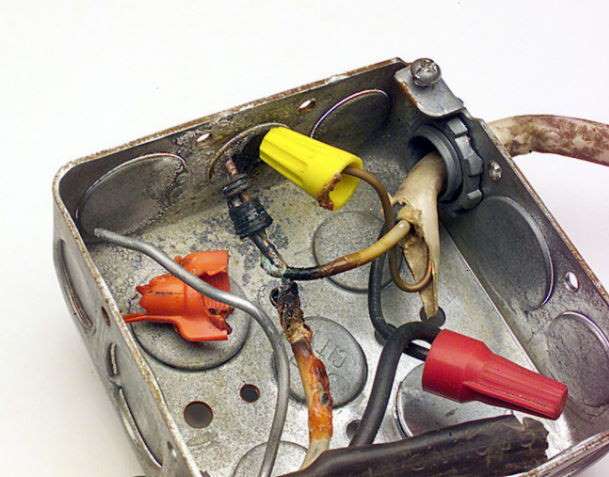
Solid conductor aluminum branch circuit wiring in Residential Properties: Hazards & Remedies
Printer Friendly PDF Version of this document
Also see Reducing the Fire Hazards in Aluminum-Wired Homes
This page summarizes information provided at the Aluminum Electrical Wiring Hazards Website - at the online encyclopedia InspectAPedia.com®.
https://InspectAPedia.com/aluminum/Aluminum_Wiring_Hazards.php
This page may be freely distributed in print or electronic form and may be copied to other websites. Do not alter the content of this page without first contacting us for permission. InspectAPedia.com privacy and content use policies can be viewed at Accuracy & Privacy Policies.
InspectAPedia.com is an independent publisher of building, environmental, and forensic inspection, diagnosis, and repair information for the public - we have no business nor financial connection with any manufacturer or service provider discussed at our website.
What is the Aluminum Wiring Hazard?
Aluminum electrical wiring, used in some homes from the mid 1960's to the early 1970's, is a potential fire hazard. According to the U.S. Consumer Product Safety Commission, fires and even deaths have been reported to have been caused by this hazard. Problems due to expansion can cause overheating at connections between the wire and devices (switches and outlets) or at splices.
CPSC research shows that "homes wired with aluminum wire manufactured before 1972 are 55 times more likely to have one or more connections reach "Fire Hazard Conditions" than are homes wired with copper.
"Post 1972" aluminum wire is also a concern. Introduction of the aluminum wire "alloys" in 1972 time frame did not solve most of the connection failure problems. Aluminum wiring is still permitted and used for certain applications, including residential service entrance wiring and single-purpose higher amperage circuits such as 240V air conditioning or electric range circuits.
How do I Reduce the Risk of Aluminum Electrical Wiring?
As of the current date of this page, only two remedies (1 - Discontinued Use and 2.1.- COPALUM, below) have been recommended by the CPSC.
- Discontinued use of the aluminum circuit - or:
- Pigtailing: less costly, the addition of copper connecting "pigtail" wires between the aluminum wire and the wired device (receptacle, switch, or other device).
The pigtail connection must be made using
- The COPALUM connector, a special connector and special crimping tool licensed by the AMP Corporation.
- The AlumiConn TM aluminum to copper lug connectors [New in 2006, U.L. Listed, 2007 completed independent testing] available from King Innovation. Results of independent testing indicate that this product "... is predicted to have a high probability of failure-free long-term safe performance, PROVIDED THAT THE SETSCREWS ARE CAREFULLY TIGHTENED TO THE MANUFACTURER'S RECOMMENDATION".The AlumiConn™ connector is now recommended by the US CPSC as an alternative to the COPALUM.
- Emergency temporary repairs necessary to keep an essential circuit in service might be possible following other procedures described by the CPSC.
7 Key Points About Un-Repaired or Improperly-Repaired Aluminum Wiring in Homes
- Watch out: Aluminum Electrical Wiring is a Fire Hazard in Homes - see ALUMINUM WIRING SAFETY RISKS - CPSC. For help in recognizing aluminum electrical wiring in homes see ALUMINUM WIRING IDENTIFICATION.
- Aluminum Electrical Wiring repairs in a home where that work has not been performed will be a significant expense
- Aluminum wiring repairs should not be deferred, as the risk increases with age and use of the electrical system; meanwhile be sure that the home has working smoke detectors, and turn off any circuits behaving oddly.
- Aluminum wiring repairs should be performed only by a licensed electrician who is well informed about the correct repair methods. Using an improper repair method may actually increase the risk of a fire. See ALUMINUM WIRING REPAIR ELECTRICIANS
- Do use one of the following aluminum wiring repair methods:
- Do not use any of these aluminum wiring repair methods
- COALR or CU-AL devices - see ALUMINUM WIRING REPAIR COALR & CU-AL
- Twist-on connectors such as the Ideal-65 purple "twister" - see ALUMINUM WIRING REPAIRS NOT-RECOMMENDED
COPY PERMISSION: Readers are welcome to copy and place this ALUMINUM WIRIING SUMMARY free to copy page at their website or to make printed copies to give to others at no charge as long as this document is not modified in any form.
More Information about Aluminum Wiring Hazards
- ALUMINUM WIRING INFORMATION WEBSITE - https://InspectAPedia.com/aluminum/Aluminum_Wiring_Hazards.php - the aluminum wiring home page
- RECOGNIZING ALUMINUM WIRING - https://InspectAPedia.com/aluminum/recogniz.htm - how to recognize aluminum electrical wiring in buildings
- REDUCING THE FIRE HAZARDS in Aluminum-Wired Homes - https://InspectAPedia.com/aluminum/Aluminum_Wiring_Risk_Reduction.php - methods, research, experience, expert sources. This document answers most technical questions about the hazards and remedies of aluminum electrical wiring. UPDATED 3/5/2003
- "IS YOUR ALUMINUM WIRING SAFE?" - https://InspectAPedia.com/aluminum/Aluminum_Wiring_Safety_Assessment.php - article discussing safety claims made without looking at the wiring, J. Aronstein, 11/21/95
- ALUMINUM WIRING REPAIR ELECTRICIANS - https://InspectAPedia.com/electric/Electrical_Definitions.php - Certified, Experienced Electricians Offering Aluminum Wire Repair Services
- ALUMINUM WIRING RISK Reduction - https://InspectAPedia.com/aluminum/Aluminum_Wiring_Repair_Methods.php" - details of how to repair aluminum wiring
- "REPAIRING ALUMINUM WIRING" - https://InspectAPedia.com/aluminum/Aluminum-Wiring-Repair-US-CPSC-Pub-516.php - Consumer Product Safety Commission Booklet CPSC#516
- AMP COPALUM™ CONNECTOR - this connector works, is rated for aluminum conductors of all types, and has performed spotlessly for more than 25 years
- 1 May 2003 - U.S. CPSC announced that Tyco Electronics Corp. will continue offering the COPALUM connector repair system until at least 2005 - for details see the Tyco Press Release - http://www.cpsc.gov/cpscpub/prerel/prhtml03/03120.html
- AMP Corporation - http://www.amp.com/ Harrisburg PA 17105 800-522-6752 - CPSC's recommended COPALUM aluminum-copper retrofit - US Customer Support 800-522-6752 [See the TYCO announcement above]
- AMP Canada Product Information Department, 905-470-4425 the COPALUM connector line is available in Canada; they do not appear to have a contractor training/certification program such as is (at least in a few places) available in the USA.
- AMP COPALUM Connectors & Equipment - http://connect.amp.com/AMP/bin/AMP.Connect?M=CINF&C=10914&N=3&RQS=C~10914^M~FEAT - available from Tyco Electronics - http://www.tycoelectronics.com/
- AlumiConn ALUMINUM WIRE CONNECTORS - & see http://www.AlCopStore.com - for information on obtaining the AlumiConn™ aluminum wiring connector.
- ALUMINUM WIRING REPAIR NOT-Recommended - https://InspectAPedia.com/aluminum/Aluminum_Wire_Repairs_Not_Recommended.php - here are products and methods sold but not recommended for repair of aluminum electrical wiring:
 Ideal-65™ Twister - https://InspectAPedia.com/aluminum/Ideal_65_Twister_Aluminum_Wire_Connector.php - field failures & lab studies show that this connector does not perform adequately - purple twist-on connector sold for aluminum wire repair
- "Analysis of field failures of aluminum-copper pigtail splices made with twist-on connectors", Aronstein, J., Poughkeepsie, NY, USA; Electrical Contacts, 1999, Proceedings of the Forty-Fifth IEEE Holm Conference: 1999, page(s): 87-93 reports a study of failures among 4,531 connectors used in 102 apartments within one year of installation using normal, proper workmanship and typical aluminum branch circuit wiring.
Abstract: ... On the basis of the field failures in combination with previously reported laboratory studies it is concluded that the connector is not suitable for permanent use with aluminum wire residential wiring systems - CPSC reiterates unsuitability of twist-on connectors (Including the Ideal No. 65) - https://InspectAPedia.com/aluminum/Twist_On_Connecrtors_Aluminum_Wire.php - for aluminum wiring in residences.
- "Analysis of field failures of aluminum-copper pigtail splices made with twist-on connectors", Aronstein, J., Poughkeepsie, NY, USA; Electrical Contacts, 1999, Proceedings of the Forty-Fifth IEEE Holm Conference: 1999, page(s): 87-93 reports a study of failures among 4,531 connectors used in 102 apartments within one year of installation using normal, proper workmanship and typical aluminum branch circuit wiring.
- A special installation method for aluminum wire pigtail splicing repairs (special procedures using the 3-M Scotchlok™ connector) was previously described using special procedures but this method is now considered obsolete given the options and products listed above

Hosted & provided by InspectApedia.com - InspectAPedia tolerates no conflicts of interest. We have no relationship with advertisers, products, or services discussed at this website.
2023/11/09 - 04/01/1988 - https://InspectAPedia.com/aluminum/Aluminum_Wiring_Summary.html - © 2023 - 1988 Copyright Daniel Friedman All Rights Reserved - InspectAPedia® is a Registered U.S. Trademark - This page may be copied to other websites as long as it is not modified. This page may be freely printed and distributed as long as it is done so without charge and as long as it is not used to endorse or sell a particular product or service.