
InspectAPedia® FREE Encyclopedia of Building & Environmental Construction, Diagnosis, Maintenance & Repair |
Question? Just ask us! InspectAPedia
|
 Aluminum Wiring Ideal #65 purple Twist-on Connector Debate History
- POST a QUESTION or COMMENT about using twist on connectors for aluminum wiring repair
History of the Ideal No. 65 twist-on connector usage debate regarding aluminum wiring:
This document provides opinions, conclusions, and links to public documents outlining the history of debate and research concerning use of the Ideal #65 Twister™, a twist-on connector listed by UL and marketed by Ideal Corporation as a retrofit product for aluminum wiring.
InspectAPedia tolerates no conflicts of interest. We have no relationship with advertisers, products, or services discussed at this website.
Independent Research Evaluates Performance of the Ideal-65 Twist On Connector
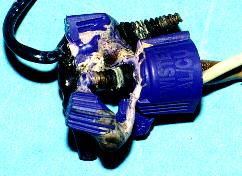
10/04/1999Independent Research report to IEEE Holm Conference of a study of more than 4,531 of these connectors used in 102 apartments indicates that significant field failures occurred and were attributable to the connector itself, not to installation practices nor to any unusual condition of the aluminum branch circuit wiring.
07/10/1998 CPSC Against Twist-On Aluminum Wire Connectors documents the US CPSC position on the use of twist-on connectors for aluminum wiring repairs
10/20/1997 Independent Research report to IEEE Holm Conference indicates splices using this connector are not capable of long term safe performance as part of the permanent wiring of existing aluminum-wired homes.
9/10/1997 Field failures of this device in actual service have now been reported.
3/29/1996 Independent Tests indicate Ideal-65 purple Twist-on retrofit connector fails UL 486C Safety Standard despite its UL-listing
1/31/1996 Ideal Corporation has indicated they're sending us additional information. 5/96 note: received, not posted. Reply contained no information except asserts no reported problems.
1/31/996 Fire Hazards With Aluminum to Copper Twist-on Connectors & Acceptable Repair Practices Color Photos, Alternative Retrofit/Repair Procedures, Current Issues. From the 9/28/95 CPSC Meeting Minutes.
9/28/1995: AL-Rated Twist-On Connector Debate Continues: At a second meeting at CPSC HQ on 9/28/95, attended by the manufacturer, CPSC, UL, the author, and other professionals we learned that the manufacturer has responded to some of the CPSC concerns. That information, along with information from UL is forthcoming in the meeting log.
Ideal's marketing literature which we received and which opens with "Retrofitting Aluminum Wire Used To Be A Can of Worms"..."Not Any More!" should not be taken literally to mean that this is a general retrofit product.
At the 9/2819/95 meeting at the US CPSC in Washington, D.C., the manufacturer clarified that while their new twist-on connector has been listed under UL486C, this device is not intended for general aluminum wiring retrofit. The new connector is intended for limited special applications involving (only) certain aluminum-to-copper splices such as the addition of a new device (e.g. ceiling fan) to a house wired with aluminum. The manufacturer is reviewing its marketing and instructional literature in order to clarify the intended use.
6/1/1995: Twist-on connectors (wire nuts) have not been recommended
(by the CPSC) for permanent repair of aluminum wire electrical circuits. To date, this includes recently-released twist-on connectors manufactured by Ideal Industries and available in some markets. While Underwriters Laboratories has listed these new twist-on's, at a meeting with the CPSC on 1 June,1995, a number of CPSC CONCERNS RE: ALUMINUM WIRING CONNECTORS were reviewed with UL and with the device manufacturer. As a result, additional research was being performed.
6/1/1995 CPSC, UL, Ideal Corp, Meeting Log 6/1/95 documenting UL-CPSC agreements for report exchange and additional testing of twist-on connectors for aluminum retrofit
5/1/1995 CPSC CONCERNS RE: ALUMINUM WIRING CONNECTORS letter to UL documents concerns with twist-on connectors for aluminum wire retrofit
Conclusions & Opinions
08/03/2010: The results of independent testing and studies of both field use and laboratory testing of aluminum electrical wiring repairs using this twist-on connector and using materials and connections such as found in homes wired with aluminum wiring indicate that the Ideal #65™ does not meet the UL Standard UL486C even though the connector is UL listed for those wire combinations.
Our interpretation of this result is that there are possible fire hazards using this connector for general retrofit of aluminum wiring, and we advise against its recommendation or use in this manner. Consumers and building professionals should watch for any CPSC update of their current position:
The US Consumer Product Safety Commission (CPSC) does not recommend use of this connector for retrofit of aluminum-wired homes.
1/31/1996: Previous position: We view the CPSC and independent consultant's concerns as serious, and have some additional opinions based on field experience.
The CPSC is waiting for additional information before deciding on any recommendations or actions.
We advise consumers, electricians, and building inspectors to wait for follow up information from the CPSC or other authorities before recommending this new product to their clients. Any new information we receive will be posted here promptly.
Despite some recent misunderstandings to the contrary, ASHI, the American Society of Home Inspectors does not approve nor recommend products, including this one, but does provide information for building professionals and consumers on this and other topics.
More Information - Detection, Repair, Advice for Aluminum Wiring in buildings
"Analysis of field failures of aluminum-copper pigtail splices made with twist-on connectors",
Aronstein, J.
Poughkeepsie, NY, USA; Electrical Contacts, 1999, Proceedings of the Forty-Fifth IEEE Holm Conference on
Publication Date: 1999, page(s): 87-93,
Meeting Date: 10/04/1999 - 10/06/1999,
Location: Pittsburgh, PA, USA
ISBN: 0-7803-5549-0,
References Cited: 15,
INSPEC Accession Number: 6520589
Digital Object Identifier: 10.1109/HOLM.1999.795931
Current Version Published: 2002-08-06
Available from IEEE
Abstract: A new type of twist-on splicing connector for use with aluminum and copper wire combinations was utilized to reconnect wire terminations in a group of residential apartment units. The connector differs from conventional twist-on connectors in that it is pre-filled with a corrosion inhibitor compound containing suspended particulates. Burnout occurring among these splices led to removal and replacement of all of the new connectors.
In this study, the connectors removed from 102 apartments were inspected for signs of overheating and for indications of abnormal conditions that might cause the failed connectors included samples that were applied to rated wire combinations and showed no sign of abnormal installation or application conditions.
Tests of the aluminum conductors from the apartments reveal no abnormalities that could account for the poor performance of the new connector. The inhibitor compound inside the connector was determined to be of limited effectiveness in improving the wire-to-wire contact through the high resistance film on the aluminum wire surface. On the basis of the field failures in combination with previously reported laboratory studies it is concluded that the connector is not suitable for permanent use with aluminum wire residential wiring systems
Comments: In 1997 a licensed electrician was contracted to replace all aluminum branch wiring in a 1968 residential apartment building used CO/ALR type devices to replace existing devices; the electrician "pigtailed" (aluminum spliced to copper conductor pigtails) heavily loaded branch circuits using a recently-introduced twist-on connector rated for that purpose. Independent testing (see Evaluation of a Twist-on Connector for Aluminum Wire", J. Aronstein, below) had previously demonstrated significant weaknesses of this connector. Other aluminum to copper splices using this connector involved connections to copper wire leads of lighting fixtures, HVAC equipment, and appliances.
Electrical failures were noted within the first year after these repairs had been made, detected by smell or device malfunction. Infra-red temperature measurements showed abnormal heating of other splices. By the end of 1998 these conditions had led to replacement of all of the newly-made twist-on splices, this time using the COPALUM connector recommended by the US CPSC for this application. During replacement, additional examples of overheating were discovered.
All of the 4,531 removed connectors that had been installed in 102 apartments were retained and provided to Dr. Aronstein for further study. The results were published in the 1999 IEEE paper cited above. Aronstein did not find evidence of improper installation of the devices, and study of the aluminum wire itself for abnormalities (such as abnormal levels of oxide film on wire surfaces leading to higher wire-to-wire resistance in the splices) did not find that abnormal wire conditions were a factor in the failures.
These studies left the failures to be attributed to the devices themselves, by components and mechanisms within the device as Aronstein explains in detail in the paper. This article describes the field results and testing of a twist on connector produced by Ideal Industries, Ideal#65 purple "Twister"™ twist-on connector listed and sold as a repair/retrofit for residential aluminum wiring.
"Evaluation of a twist-on connector for aluminum wire",
Aronstein, J.,
Poughkeepsie, NY, USA;
Electrical Contacts, 1997., Proceedings of the Forty-Third IEEE Holm Conference on
Publication Date: 20-22 Oct 1997
On page(s): 46-56,
Meeting Date: 10/20/1997 - 10/22/1997,
Location: Philadelphia, PA, USA
ISBN: 0-7803-3968-1,
References Cited: 21,
INSPEC Accession Number: 5795024
Digital Object Identifier: 10.1109/HOLM.1997.637874
Current Version Published: 2002-08-06,
Available from IEEE
Abstract: A new type of twist-on splicing connector for use with aluminum and copper wire combinations is tested to determine initial resistance, performance in a zero-current environmental test, performance in a heat-cycle test, and portion of current carried by the connector's steel spring. The splices tested consist of two aluminum wires and one copper wire.
The aluminum wire samples used for the test are of the types actually installed in aluminum-wired homes. Initial resistance is found to be relatively high, and there is a significant sample-to-sample variation.
This reflects failure to consistently establish low-resistance wire-to-wire contact through the insulating oxide film on the wire. Results of the environmental and heat-cycle tests show deterioration of a significant portion of the samples.
The splices made with this connector are also found to be sensitive to mechanical disturbance, such as applied in normal installation when the completed splice is pushed back into the junction box.
Based on the test
results, it is concluded that this connector has not overcome the fundamental deficiency of twist-on connectors for use with aluminum wire, and is not considered to be suitable for permanent splices in residential aluminum wire applications
This article describes the field results and testing of a twist on connector produced by Ideal Industries, Ideal#65 purple "Twister" twist-on
connector listed and sold as a repair/retrofit for residential aluminum wiring.
...
Continue reading at ALUMINUM WIRING REPAIRS NOT-RECOMMENDED or select a topic from the closely-related articles below, or see the complete ARTICLE INDEX.
Or see these
Recommended Articles
- ALUMINUM WIRING HAZARDS & REPAIRS - home
- ALUMINUM WIRING IDENTIFICATION
- ALUMINUM WIRING REPAIR METHODS
- ALUMINUM WIRING REPAIR ELECTRICIANS
- ALUMINUM WIRING REPAIR METHODS - CPSC Meeting 9/28/95
- ALUMINUM WIRING REPAIRS NOT-RECOMMENDED
- CPSC CONCERNS RE: ALUMINUM WIRING CONNECTORS
- CPSC, UL, Ideal Corp, Meeting Log 6/1/95
- REDUCE THE AL WIRE RISK: DETAILS
Suggested citation for this web page
IDEAL 65 TWISTER HISTORY at InspectApedia.com - online encyclopedia of building & environmental inspection, testing, diagnosis, repair, & problem prevention advice.
Or see this
INDEX to RELATED ARTICLES: ARTICLE INDEX to ELECTRICAL INSPECTION & TESTING
Or use the SEARCH BOX found below to Ask a Question or Search InspectApedia
Ask a Question or Search InspectApedia
Try the search box just below, or if you prefer, post a question or comment in the Comments box below and we will respond promptly.
Search the InspectApedia website
Note: appearance of your Comment below may be delayed: if your comment contains an image, photograph, web link, or text that looks to the software as if it might be a web link, your posting will appear after it has been approved by a moderator. Apologies for the delay.
Only one image can be added per comment but you can post as many comments, and therefore images, as you like.
You will not receive a notification when a response to your question has been posted.
Please bookmark this page to make it easy for you to check back for our response.
Our Comment Box is provided by Countable Web Productions countable.ca
Citations & References
In addition to any citations in the article above, a full list is available on request.
- ALUMINUM WIRE REPAIR METHODS to reduce risk in buildings with Aluminum Electrical Wiring - Overview of Acceptable Repair Practices (in the document you are presently viewing)
- Reducing the Fire Hazards in Aluminum-Wired Homes, Jess Aronstein, Ph.D., This document answers most technical questions about the hazards and remedies of aluminum electrical wiring. Some of the sections of this very thorough document are listed below:
- Fire Hazards With Aluminum to Copper Twist-on Connectors & Acceptable Aluminum Wiring Repair Practices Color Photos, Current Issues. 9/28/95 CPSC Meeting Minutes
- REPAIRING ALUMINUM WIRING, US CPSC Pub. No. 516 U.S. Consumer Product Safety Commission Publication available online
- Directory of Home Inspectors accessible via Internet
- In addition to citations & references found in this article, see the research citations given at the end of the related articles found at our suggested
CONTINUE READING or RECOMMENDED ARTICLES.
- Carson, Dunlop & Associates Ltd., 120 Carlton Street Suite 407, Toronto ON M5A 4K2. Tel: (416) 964-9415 1-800-268-7070 Email: info@carsondunlop.com. Alan Carson is a past president of ASHI, the American Society of Home Inspectors.
Thanks to Alan Carson and Bob Dunlop, for permission for InspectAPedia to use text excerpts from The HOME REFERENCE BOOK - the Encyclopedia of Homes and to use illustrations from The ILLUSTRATED HOME .
Carson Dunlop Associates provides extensive home inspection education and report writing material. In gratitude we provide links to tsome Carson Dunlop Associates products and services.
 | HOME | ABOUT | ASK a QUESTION | CONTACT | CONTENT USE POLICY | DESCRIPTION | POLICIES | PRIVACY | |
| © 2024 - 1985 Publisher InspectApedia.com - Daniel Friedman | |||||||||