
InspectAPedia® FREE Encyclopedia of Building & Environmental Construction, Diagnosis, Maintenance & Repair |
Question? Just ask us! InspectAPedia
|
 Aluminum Wire: Copper Pigtailing Failures on CPSC Test, Examples
- POST a QUESTION or COMMENT about copper pigtailing for aluminum wiring repairs: which connectors fail and why
Aluminum wiring repair failures at copper pigtail connections:
Aluminum Wiring Repair Failures at Copper Pigtail Connections. Color photos and descriptive captions from CPSC Meeting 9/28/95..
Illustrations, photos, and explanation of overheating and failures at copper pigtail connections used to repair aluminum wire. In this article series aluminum electrical wire twist-on connector failures and repair procedures are described, including aluminum wire repair methods which work and methods which do not work and are unsafe.
InspectAPedia tolerates no conflicts of interest. We have no relationship with advertisers, products, or services discussed at this website.
Aluminum Wiring Repair Failures due to overheating at copper pigtails using twist on connectors
Color photos of aluminum wire repair procedures, and photos of failed connectors are included. This document series describes hazards with existing aluminum wiring repair products, explains the aluminum wiring failure mechanism, and reviews recommended retrofit procedures including use of readily-available materials.
This information was presented to the US Consumer Product Safety Commission by Dr. J. Aronstein, 9/28/95. The minutes of that meeting were obtained under the Freedom of Information Act and posted by Daniel Friedman January 1996.
Click any image to see an enlarged version.
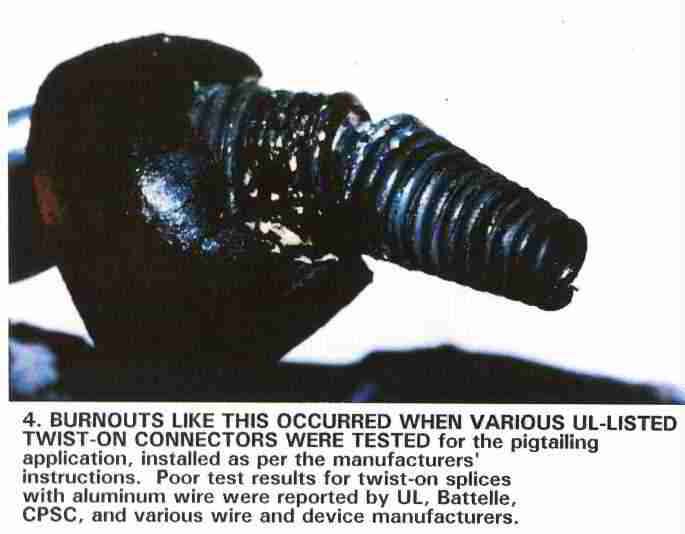
4. Burnouts like this occurred when various UL-listed twist-on connectors were tested for the pigtailing application, installed as per the manufacturers' instructions. Poor test results for twist-on
splices with aluminum wire were reported by UL, Battelle, CPSC, and various wire and device manufacturers.
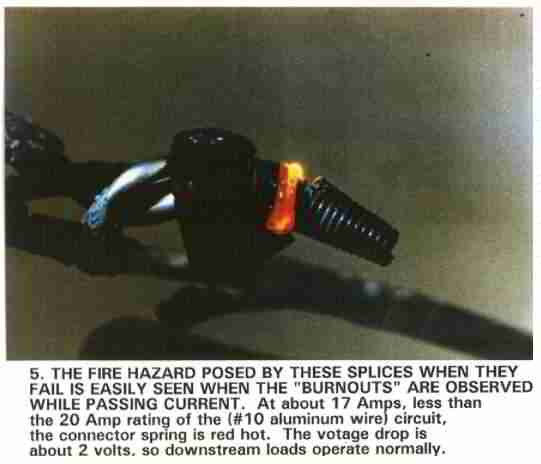
5. The fire hazard posed by these splices when they fail is easily seen when the "burnouts" are observed while passing current. At about 17 amps, less than the 20 Amp rating of the (#10 aluminum wire)
circuit, the connector spring is red hot. The voltage drop is about 2 volts, so downstream loads operate normally.
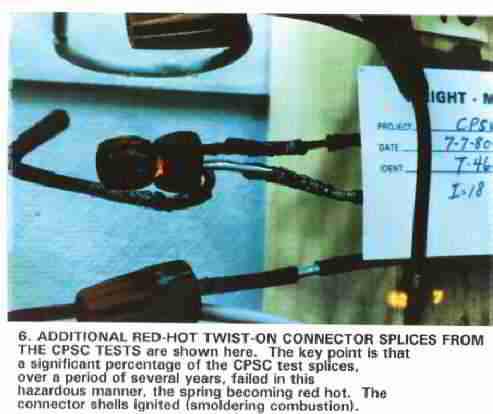
6. Additional red-hot twist-on connector splices fr6m the CPSC tests are shown here. The key point is that a significant percentage of the CPSC test splices over a period of several years failed in
this hazardous manner, the spring becoming red hot. The connector shells ignited (smoldering combustion).
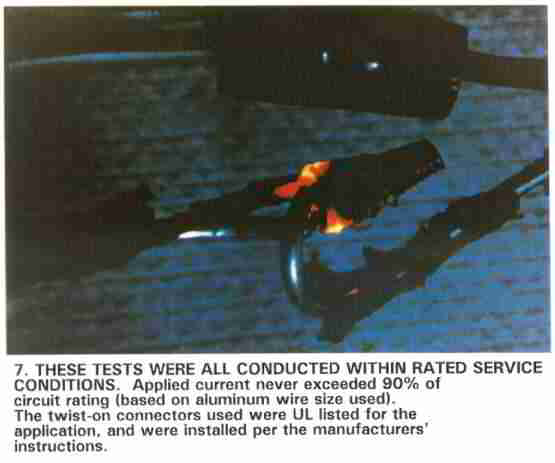
7. These tests were all conducted within rated service conditions. Applied current never exceeded 90% of the circuit rating (based on aluminum wire size used). The twist-on connectors used were UL listed for the application, and were installed as per the manufacturers instructions.
Aluminum Wiring Repair Failure Photos & Causes: overheating at copper pigtails using twist on connectors
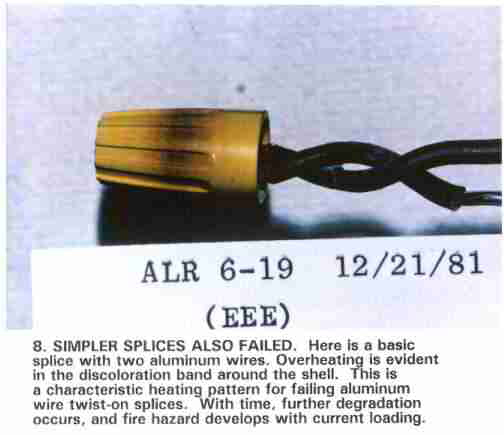
8. Simpler splices also failed. Here is a basic splice with two aluminum wires. Overheating is evident in the discoloration band around the shell. This is a characteristic heating pattern for failing
aluminum wire twist-on splices. With time, further degradation occurs, and fire hazard develops with current loading.
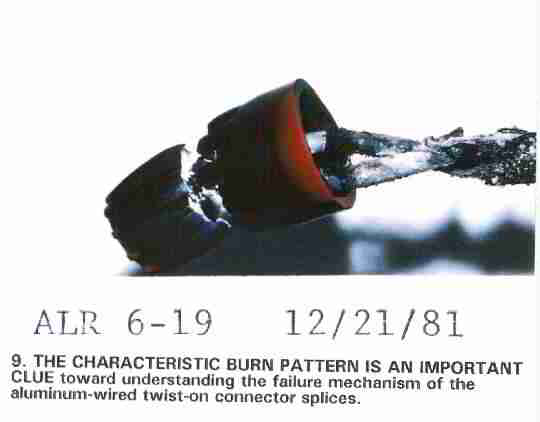
9. The characteristic burn pattern is an important clue toward understanding the failure mechanism of the aluminum-wired twist-on connector splices.
...
Continue reading at ALUMINUM WIRING FIELD FAILURES or select a topic from the closely-related articles below, or see the complete ARTICLE INDEX.
Or see these
Recommended Articles
- ALUMINUM WIRING REPAIR METHODS
- ALUMINUM WIRING REPAIR ELECTRICIANS
- ALUMINUM WIRING REPAIR METHODS - CPSC Meeting 9/28/95
- COPPER PIGTAILING for ALUMINUM WIRE
- COPPER PIGTAILING FAILURES in ALUMINUM WIRING
- ALUMINUM WIRING FIELD FAILURES
- ALUMINUM WIRE to WIRE CONTACT
- ALUMINUM WIRING EQUIVALENT CIRCUITS
- ALUMINUM WIRING CONNECTOR CURRENT FLOW
- ALUMINUM WIRING CONNECTOR DETERIORATION
- ALUMINUM WIRING CONNECTOR UL TEST INADEQUATE
- ALUMINUM WIRING SPECIAL CONNECTOR FAILURES
- AMP TYCO COPALUM CONECTORS
- SCOTCHLOK 3M REPAIR CONNECTORS
- ALUMINUM WIRING REPAIR SPECIAL CONCERNS
- ALUMINUM WIRING REPAIRS NOT-RECOMMENDED
- REDUCE THE AL WIRE RISK: DETAILS
Suggested citation for this web page
COPPER PIGTAILING FAILURES in ALUMINUM WIRING at InspectApedia.com - online encyclopedia of building & environmental inspection, testing, diagnosis, repair, & problem prevention advice.
Or see this
INDEX to RELATED ARTICLES: ARTICLE INDEX to ELECTRICAL INSPECTION & TESTING
Or use the SEARCH BOX found below to Ask a Question or Search InspectApedia
Ask a Question or Search InspectApedia
Questions & answers or comments about copper pigtailing for aluminum wiring repairs: which connectors fail and why.
Try the search box just below, or if you prefer, post a question or comment in the Comments box below and we will respond promptly.
Search the InspectApedia website
Note: appearance of your Comment below may be delayed: if your comment contains an image, photograph, web link, or text that looks to the software as if it might be a web link, your posting will appear after it has been approved by a moderator. Apologies for the delay.
Only one image can be added per comment but you can post as many comments, and therefore images, as you like.
You will not receive a notification when a response to your question has been posted.
Please bookmark this page to make it easy for you to check back for our response.
Our Comment Box is provided by Countable Web Productions countable.ca
Citations & References
In addition to any citations in the article above, a full list is available on request.
- Fire Hazards With Aluminum to Copper Twist-on Connectors & Acceptable Aluminum Wiring Repair Practices Color Photos, Current Issues. 9/28/95 CPSC Meeting Minutes
- "Is YOUR Aluminum Wiring Safe?" article discussing safety claims made by some people without looking at the wiring, J. Aronstein, 11/21/95
- "Repairing Aluminum Wiring", US CPSC Publication 516, U.S. Consumer Product Safety Commission, Bethe3sda MD, website: www.cpsc.gov / www.SaferProducts.gov, updated June 2011, original source: .cpsc.gov/cpscpub/pubs/516.pdf, Quoting:
The U.S. Consumer Product Safety Commission (CPSC) staff and other government officials have investigated numerous hazardous incidents and fires throughout the nation involving aluminum branch circuit wiring. A national survey conducted by Franklin Research Institute for CPSC showed that homes built before 1972, and wired with aluminum, are 55 times more likely to have one or more wire connections at outlets reach “Fire Hazard Conditions”1 than homes wired with copper. That survey encompassed only the wire connections at outlets. It did not address other types of aluminum wire connections and splices in homes that are also prone to fail. No information was developed for aluminum-wired homes built after 1972.
The fire hazard investigated by CPSC occurs at connections with aluminum wire, including receptacles or switches and junction boxes; or the hazards occur with major appliances, including dishwashers or furnaces, for example. There are several deterioration processes in aluminum wire connections that cause increased resistance to the flow of electric current, resulting in damage that is cumulative in effect. That increased resistance causes overheating, sometimes at hazardous levels, when current is flowing in the circuit. - AlumiConn website - www.kinginnovation.com/products/alumiconn/ has installation videos, Wire combinations, specification sheets, and other information and assistance in purchasing or using this product.
- AlumiConn™ AlCopStore.com
223 Salt Lick Road, #279,
St. Peters, MO 63376
Tel: 866-826-2256, Fax: 636-754-0500, Email Sales: pking@AlCopStore.com, Email General Inquiry: info@AlCopStore.com - "Repairing Aluminum Wiring," [As updated 2011] U.S. Consumer Product Safety Commission Publication available online
- "Repairing Aluminum Wiring," [Original, now obsolete] U.S. Consumer Product Safety Commission Publication REPAIRING ALUMINUM WIRING, US CPSC Pub. No. 516available online
- "Record of Commission Action, Commissioners Voting by Ballot", CPSC Publication No. 516, Repairing Aluminum Wiring (original version op.cit.), (Briefing package dated March 15, 2011), Quoting:
The Commission voted unanimously (5-0)·to approve republication of CPSC Publication No. 516, Repairing Aluminum Wiring, with the explicit recognition that the COPALUM and AlumiConn connectors currently are the only products that meet the agency's standards to prevent aluminum wire fire hazards
Copy on file as /aluminum/Pub516_Alumi_Conn.pdf - Southwire Corporation, manufacturer of aluminum (and other) wire products
- What Owners Need to Know About [Aluminum] Wiring Dangers, Sandra Fleishman, Washington Post, 3 July 2004 pF01

Carson Dunlop's Home Inspector's Home Study Course (DJF is a contributor and participant in this education project).- Dr. Jess Aronstein, protune@aol.com is a research consultant and an electrical engineer in Schenectady, NY. Dr. Aronstein provides forensic engineering services and independent laboratory testing for various agencies. Dr. Aronstein has published widely on and has designed and conducted tests on aluminum wiring failures, Federal Pacific Stab-Lok electrical equipment, and numerous electrical products and hazards. See ALUMINUM WIRING BIBLIOGRAPHY and see FPE HAZARD ARTICLES, STUDIES for examples.
- "The Influence of Corrosion Inhibitor and Surface Abrasion on the Failure of Aluminum-Wired Twist-on Connections", Aronstein, J.; Campbell, W., Components, Hybrids, and Manufacturing Technology, IEEE Transactions on Volume 7, Issue 1, Mar 1984 Page(s): 20 - 24
- "Overheating Failures of Aluminum-Wired Special Service Connectors", J.Aronstein and W.E.Campbell,
IEEE Transactions, Vol. CHMT-6, No. 1, March 1983.
This paper appears in: Components, Hybrids, and Manufacturing Technology, IEEE Transactions on Publication Date: Mar 1983 Volume: 6, Issue: 1 On page(s): 8 - 15 ISSN: 0148-6411 Current Version Published: 2003-01-06. This paper is available to IEEE members and subscribers and can be obtained through public or academic libraries.
Abstract: Special service" twist-on connectors are tested with aluminum and copper wire combinations. The special service connectors are qualified by a Canadian standard which applies to connectors for use with aluminum branch circuit conductors. Two brands of special service connectors are presently qualified by this standard and marketed. Both are rated for various combinations of aluminum and copper conductors. Samples of both brands are tested in this investigation. The tests are conducted within rated electrical and environmental conditions, with connections made according to the connector manufacturers' instructions. Overheating failures have occurred among the aluminum-wired special service connector combinations. The failures are accelerated by humid environment to a greater extent than by the application of electrical current. In contrast, connections which are copper-wired, using either standard or special service connectors, are stable and failure-free. The difference between the standard twist-on connectors and the special service connectors is in the material used for the connector spring. Improved compatibility between the spring material and the aluminum conductor, compared to the plated steel springs of the conventional twist on connectors, has not dealt with several important failure mechanisms. The test results indicate that the new standard, as presently defined, cannot be relied on to screen out aluminum-wired connector combinations which will not survive long-term operation within rated conditions. Thus the objective of accelerated qualification testing-- the prediction and assurance of safe and reliable operation in actual service---is not achieved in this case. The reasons are discussed, along with possible improvements. - "Evaluation of a Twist-on Connector for Aluminum Wire", Dr. Jesse Aronstein, Forty-Third IEEE Holm Conference on Electrical Contacts, Jan 1997, 0-7803-3968-1/97.
[This article describes the Ideal Industries Ideal#65 purple "Twister" twist-on connector marketed as a repair/retrofit for residential aluminum wiring.--DJF]
Abstract: A new type of twist-on splicing component for use with aluminum and copper wire combinations is tested to determine initial resistance, performance in a zero-current environment test, performance in a heat-cycle test, and portion of current carried by the connector's steel spring. The splices tested consist of two aluminum wires and one copper wire.
The aluminum wire samples used for the test are of the types actually installed in aluminum-wired homes. Initial resistance is found to be relatively high, and there is a significant sample-to-sample variation. This reflects failure to consistently establish low-resistance wire-to-wire contact through the insulating oxide film on the wire. Results of the environmental and heat-cycle tests show deterioration of a significant portion of the samples.
The splices made with this connector are also found to be sensitive to mechanical disturbance, such as applied in normal installation when the completed splice is pushed back in to the junction box. Based on the test results, it is concluded that this connector has not overcome the fundamental deficiency of twist-on connectors for use with aluminum wire applications. Keywords: aluminum wire, connectors, twist-on connectors, environmental test, heat-cycle test. - Harbor Freight Hydraulic Wire Crimping Tool Model 66150 instruction manual
- Marrette® (Brown)Company, (Canadian Thomas & Betts) ACS™ Aluminum Wiring connector product brochure indicates that this connector is "approved for circuits up to 600V and lighting fixtures and signs up to 1000V, not UL Listed (therefore not approved for use in the United States).
- Thomas & Betts, 8155 T&B Boulevard Memphis, TN 38125 USA, is a producer of more than 30,000 electrical components. 888-862-3289. Quoting the company:
Thomas & Betts offers more than 30,000 high-quality products marketed under a variety of market-leading brand names. Designed to help passively conduct electricity, Thomas & Betts products are found everywhere electricity is used -- inside commercial and industrial buildings, in homes and schools, inside complex machinery and original equipment, in the power generating plant and distribution network, outside your home and underground. - Using COALR or CU-AL Electrical Outlets and Switches with Aluminum Wire for the details of these COALR or CU-AL (or AL-CU) products and why they should not be used with aluminum wiring.
- FAQs on author/website credibility
- Our recommended books about building & mechanical systems design, inspection, problem diagnosis, and repair, and about indoor environment and IAQ testing, diagnosis, and cleanup are at the InspectAPedia Bookstore. Also see our Book Reviews - InspectAPedia.
 The Aluminum Wiring Information Website Aluminum Wiring Hazards and Repairs: in-depth info, photos, documents. Main Page.
- The Aluminum Electrical Wiring Hazard Explained (in the document you are presently viewing)
- ALUMINUM WIRE REPAIR METHODS to reduce risk in buildings with Aluminum Electrical Wiring - Overview of Acceptable Repair Practices (in the document you are presently viewing)
- Aluminum Wire Repair Method Details - "How to" details, how to identify, COPALUM repair, alternative repairs, history, products, research, source of special AMP TYCO COPALUM connectors & COPALUM Electricians (in the document you are presently viewing)
- COPALUM Electricians: Sources of TYCO COPALUM -Certified/Trained Aluminum Wire Repair Services (in the document you are presently viewing)
- Other Products, Ideal 65 Purple Twister (not recommended), & other Aluminum Wire Products/Articles (in the document you are presently viewing)
- In addition to citations & references found in this article, see the research citations given at the end of the related articles found at our suggested
CONTINUE READING or RECOMMENDED ARTICLES. - Directory of Home Inspectors accessible via Internet
- In addition to citations & references found in this article, see the research citations given at the end of the related articles found at our suggested
CONTINUE READING or RECOMMENDED ARTICLES.
- Carson, Dunlop & Associates Ltd., 120 Carlton Street Suite 407, Toronto ON M5A 4K2. Tel: (416) 964-9415 1-800-268-7070 Email: info@carsondunlop.com. Alan Carson is a past president of ASHI, the American Society of Home Inspectors.
Thanks to Alan Carson and Bob Dunlop, for permission for InspectAPedia to use text excerpts from The HOME REFERENCE BOOK - the Encyclopedia of Homes and to use illustrations from The ILLUSTRATED HOME .
Carson Dunlop Associates provides extensive home inspection education and report writing material. In gratitude we provide links to tsome Carson Dunlop Associates products and services.
 | HOME | ABOUT | ASK a QUESTION | CONTACT | CONTENT USE POLICY | DESCRIPTION | POLICIES | PRIVACY | |
| © 2024 - 1985 Publisher InspectApedia.com - Daniel Friedman | |||||||||