
InspectAPedia® FREE Encyclopedia of Building & Environmental Construction, Diagnosis, Maintenance & Repair |
Question? Just ask us! InspectAPedia
|
 Home Inspection Methods
Home Page & Article Index
- POST a QUESTION or COMMENT about home inspection certification, licensing, professional associations, procedures, reports, ethics, classes & education
This page provides our index to articles about home inspection methods, procedures, reporting, standards, ethics, as well as home inspection education , training, classes, references.
This article series explains how to inspect and diagnose all types of defects found at residential and light commercial buildings, how to perform home inspections, home how to find a qualified home inspector, home inspection standards and ethics, and detailed home inspection methodology.
Advice for home buyers includes how to choose a home inspector and how to get the most from a home inspection.
Advanced home inspection methods are presented, stressing methods for increasing the detection of significant or safety defects at properties, technical expertise, and ethical conduct.
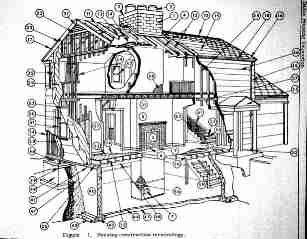
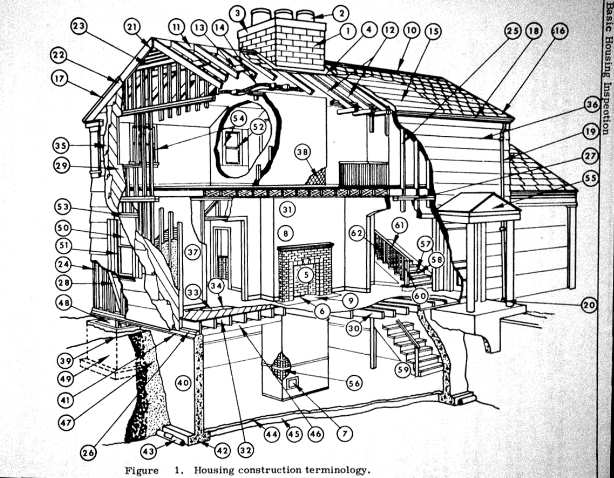
Advice is provided for people interested in becoming a home inspector as well as for home buyers or owners who need to hire a home inspector. Our page top sketch was published by US DHEW and by New York State in 1955 or earlier. [1] A glossary key to the numbered items is found at Home Inspection Definitions & Terms.
InspectAPedia tolerates no conflicts of interest. We have no relationship with advertisers, products, or services discussed at this website.
How to Find a Home Inspector

(Inception - 2008) |
|
How to Become a Home Inspector: certification, costs, education & Training
To find what you need quickly, if you don't want to scroll through this index you are welcome to use the page top or bottom SEARCH BOX to search InspectApedia for specific articles and information.
Reader Question on how to get into the home inspection "business" or "profession"
 I've been looking around for good advice about home inspection. I'm in the 'brainstorming stage', of starting a new venture.
My interest is multi-purposed. I want to become a certified home inspector in Pennsylvania, as the first stage. I've found it difficult to get good advice about which 'on line' course to purchase. Hidden fees, and marginal disclosure are my hurdles.
Your site is the first I've seen that seems without bias. Is it possible to see a comparison of on line courses for certification in Pennsylvania? I am willing to pay for the best, but it seems impossible to compare.
The purpose of my schooling is to facilitate a dream my son and I share. My son is in college for another two years, and wants to become a real estate 'mogul'. He is actually taking the right classes. As most his age, his imagination/dreams fall short of reality. I'm a home owner. No mortgage, and willing to sell if it could provide start up cash for our goal.
Why does it require $25K to get this home inspection business off the ground, when the course costs only a thousand dollars? I've got other financial backing, but prefer to go forward on my own. I will appreciate your reply.
Your site has been what I was looking for, unless you are in the business of promoting a vested interest. There are recognized associations other than ASHI. I am eager to learn more. - D.R.
Reply: costs & how to figure out where to concentrate your home inspection education
 I'm sorry to have to reply that I don't have specific enough information about home inspection courses in PA to have an opinion about which is best.
Some national education projects with which we've been connected are listed below as well as at BOOKS & ARTICLES.
I'm not sure why you have found it costs $25,000. to enter the home inspection "business", unless you are considering buying a franchise.
See HOME INSPECTION COMPANY FRANCHISES.
But the cost of home inspection education is certainly going to be more than the $1000. you quote, as to succeed and to practice at a level of competence that minimizes the chance that you'll harm your clients, continuing education and professional involvement will be needed.
Some very good technical education is free if you are someone who can enjoy reading in-depth technical material, including the several thousand building inspection, diagnosis, and repair articles found for free here at InspectAPedia
Watch out: the advantage of taking some formal home inspection education courses and classes is that presumably the teacher takes an organized approach to presenting material to assure that you are not omitting critical basic skills and knowledge - a risk if you simply wander through publications on your own.
HOME INSPECTOR EDUCATION lists home inspection training, courses, home study programs, texts, and references for home inspectors and other building inspectors and building diagnosticians as well as for building, structural, and indoor environment forensic investigators
Watch out: in my experience, some self-appointed home inspection educators and course providers simply teach their "opinion" as if it were fact, and may fail even to have read basic authoritative sources on the very subject they present. Look for authoritative citations to expert sources in all of your course and reading material on home inspection methods, building practices, etc.
The three Carson Dunlop home inspector education and report writing courses here start at much lower out of pocket costs than you cite. [Disclosure: Carson Dunlop Associates have contributed illustrations and technical content to InspectApedia.com and I have contributed content to their training material. - Ed.]
 As I have experience in the home inspection education field, naturally I have opinions about that education process in general, as well as about some of the courses offered in classrooms and by distant education.
Some more general advice about both choosing a home inspection course and home inspection education might include
- Take a look at the education and experience of the instructors themselves. Some instructors may actually have had little or no field experience, or may come from an industry that gives them depth in a particular topic but who have little idea about what's needed during a home inspection.
During an home inspection seminar in St. Louis, a highly competent expert from the gas company was invited to tell us what problems to look for during a home inspection. He brought a gas meter onto the dais and proceeded to show how a gas meter is disassembled and tested for accuracy - interesting as background but completely off track. - Watch out: home inspection educators and classes, like construction in general, is often plagued by arm-waving "experts" who, in fact, have strong opinions but who have never even read the instructions on the box. Look for authoritative citations to expert sources when standards, procedures, and requirements are being discussed.
- Getting licensed vs. staying in business: Most important: front-end or beginning home inspector education is aimed at meeting the requirements for licensing or "certification" in various states and provinces.
But having worked on home inspection course curriculum development, standards, and exam or test questions, I can assure you that it is impossible to include in any single series of classes or tests all of what a home inspector really needs to know to avoid a catastrophe such as missing a costly or even fatal defect at a property. - Continuing professional education: Getting into the "business" (it's less of a profession and more of a business these days) is easier than staying in the business.
Therefore my OPINION is that anyone serious about developing professional-level expertise as a home inspector needs to plan for continuing education, participation in classes, seminars, professional meetings, etc. You are quite correct that there are "recognized" home inspection associations besides the original - ASHI, the American Society of Home Inspectors. - Professional home inspection associations, ASHI and others, include among their members people who are highly ethical, professional, serious, and competent, and almost always such people are happy to assist newcomers to the field. As in any association, you'll also come across some people who are perhaps more lax about ethics, professionalism, and competence.
The benefits from working together in education, professional development, and even marketing far exceed the personal gain that might be obtained by being individually greedy or exclusive. Your task will include sorting out the people with whom you want to associate from those you will want to avoid.
Your recognition of the ethical and practical issues around hidden fees and marginal disclosure make clear that you already have a criteria for making that distinction. - Focus first on what you know least: In beginning one's home inspection education, and considering the vast breadth and depth of knowledge that is required to approach all of the many systems, materials, and components of even a simple residential structure, there is one trick that can help: admit to yourself, honestly, which topics you know the least about, and concentrate on becoming educated on those areas first.
- Eschew overconfidence: Last among this sermon, is the need for humility. As soon as one of us becomes overconfident that we know it all, we're going to make serious mistakes, errors, or omissions that put both our clients and ourselves at risk.
Even after thousands of diligent home inspections, the best inspectors approach every building with a genuinely curious mind, asking "what crazy weird new problem am I going to find here?" And never, ever try to buffalo or bluff your clients. I found that the more honest I was about admitting what I did not know, the more my clients trusted me.
Particularly because you are planning to work in the field, I invite you to take a look at any of our articles that you find of interest, and to comment, critique, ask for more information, or contribute information. Doing so improves the quality of our information and it gives another opportunity for a credit-link to refer readers to you for your own professional services.
We would much appreciate hearing any comments, critique, suggestions, or further questions that you may have after you've taken a look at any of our online articles (see CONTACT).
We are dedicated to making our information as accurate, complete, useful, and unbiased as possible: we very much welcome critique, questions, or content suggestions for our web articles. Working together and exchanging information makes us better informed than any individual can be working alone.
Please keep me posted on how things progress, and send along photos of interesting or curious things you come across at home inspections or in classes if you can. Such added details can help us understand what's happening and often permit some useful further comment. What we both learn may help me help someone else.
More detailed advice about becoming a home inspector is found
at HOME INSPECTOR, HOW TO BECOME
Basic & Advanced Home & Building Inspection Methods Courses & Papers
Also see the home inspection topics listed at page top or at the MORE READING links at the bottom of this article .
- HOME INSPECTOR EDUCATION - home inspection training, courses, home study programs, texts, and references
- ADVICE ON BECOMING A HOME INSPECTOR - opinions and tips from experienced home inspection professionals
- AFCIs ARC FAULT CIRCUIT INTERRUPTERS - 2008 National Electrical Code Update on AFCIs and GFCIs in homes
- ALUMINUM WIRING HAZARDS - how to identify and repair the fire hazard of aluminum electrical wiring in homes
- AMPS & VOLTS DETERMINATION - how to figure out amps and volts at a property
- BUILDING DEFECTS LISTS - curriculum recommendations for home inspector education, includes recommended knowledge base, inspection skills, and typical defects for each major area of residential and light commercial building inspections. Focus is on the identification and reporting of building and building mechanical system defects and hazards, rather than (the more narrow and new-construction-focused building code compliance).
- BUILDING INSPECTION SURPRISE PROVES NEED for SCOPE
- ASHI@HOME HOME INSPECTION TRAINING PROGRAM - an ASHI version of the Carson Dunlop Home Study Course. Contact the company at 800-268-7070.
- Basic Housing Inspection, US DHEW, S 352.75 U48, p.144, out of print, but is available in most state libraries; New York State version, ca 1955, source of our page top sketch of house parts.
However even this illustration appears to have been copied from a still earlier source and we have seen this identical drawing with different numbers and often published without a consistent key that defines the numbered items. - BUILDING DEFECTS LISTS - curriculum recommendations for home inspector education, includes recommended knowledge base, inspection skills, and typical defects for each major area of residential and light commercial building inspections.
Focus is on the identification and reporting of building and building mechanical system defects and hazards, rather than (the more narrow and new-construction-focused building code compliance). - CAN X-RAY VISION WARN OF SINK HOLES? - in Florida or elsewhere
- CERTIFICATIONS FOR HOME INSPECTORS - professional associations, licensing
- CHECKLIST vs NARRATIVE INSPECTION REPORTS - advice for home inspectors & home buyers
- CHINESE DRYWALL HAZARDS - discusses Chinese drywall odors, sulphur smells, and corrosive outgassing hazards in buildings. Major costs to remove this product, repair or replace electrical wiring, plumbing, and HVAC components may be involved, and there may be immediate safety hazards due to damaged smoke detectors or carbon monoxide detectors in buildings where Chinese drywall outgassing has caused damage.
- CRAWL SPACE ACCESS - what are the accessibility requirements & codes for entering crawl spaces: how can we inspect a crawl area and building conditions when safe, ready access are not already provided
- CRAWL SPACE SAFETY ADVICE - when should you stay out of a crawl space; how do you enter one safely
- DECK & PORCH CONSTRUCTION - deck & porch construction details for safe, durable structures.
Also see DECK COLLAPSE Case Study - DEVELOPING YOUR X-RAY VISION - 6TH ED. The Science of Building Inspections - advanced home inspection techniques including "The Limits of Vision," "Inattentional Blindness," "Invasive Inspection Methods," "Missed Defects," & "Contextual Inspection," "Termite Inspections," "Moisture & Building Water Entry," © Daniel Friedman 2006-1987
- DEVELOPING YOUR X-RAY VISION - 5TH ED.- PPT SLIDES - presentation slides © 2005 Daniel Friedman
- Electrical Education Classes - the following are works in process Power Point Presentations, very large files, for Milestone Electric, Dallas, TX - due - 3/25/2010
- ALUMINUM WIRING CLASS FOR ELECTRICIANS - summary for licensed electricians, of the history, issues, current status of aluminum wiring hazards in residential homes
- FPE_STAB-LOK_CLASS FOR ELECTRICIANS - summary for licensed electricians
- ZINSCO_CLASS FOR ELECTRICIANS - summary for licensed electricians
- ELECTRICAL SAFETY CLASS FOR ELECTRICIANS - summary for licensed electricians
- ELECTRICAL GROUND SYSTEM INSPECTION
- ELECTRICAL INSPECTION, DIAGNOSIS, REPAIR
- ELECTRIC METERS & METER BASES
- ELECTRIC METER & METER BASE FAQs
- ELECTRIC PANEL INSPECTION
- ELECTRICAL SYSTEM INSPECTION SAFETY PROCEDURES for home inspectors & electrical inspectors
- ELECTRICAL SYSTEM TERMS & DEFINITIONS
- FEDERAL PACIFIC FPE HAZARDS
- THE NATURE OF VISION, Inspecting Complex Systems - why inspectors don't see certain defects and miss important omissions
- HEALTHY HOUSING INSPECTION MANUAL [PDF], Centers for Disease Control and Prevention and U.S. Department of Housing
and Urban Development. Healthy housing inspection manual. Atlanta: US Department of Health and
Human Services; 2008. from US HUD and HHS, retrieved 2018/11/10, original source: https://www.cdc.gov/nceh/publications/books/inspectionmanual/healthy_housing_inspection_manual.pdf
Excerpt: The Healthy Housing Inspection Manual is a model reference tool that local jurisdictions or others may use as is or modify based on local needs. Use of the manual is expected to improve the effectiveness and efficiency of the public health, housing management, and workforces that identify, prevent, and control health problems associated with housing.
The manual does not introduce any inspection requirements, nor does it modify any existing inspection requirements for housing agencies, residents, HUD, or CDC. The manual is not a substitute for the Federal Housing Administration (FHA) Minimum Property Standards.
Finally, the manual does not propose to establish any regulatory authority for HUD or CDC with regard to residential inspection requirements.
The Healthy Housing Inspection Manual takes environmental health professionals and housing managers, specialists, and inspectors through the elements of a holistic home inspection. It is also a useful reference tool for nurses, outreach workers, and others who are interested in preventing illness and injury due to residential health and safety hazards.
The Healthy Housing Inspection Manual addresses the broad range of housing deficiencies and hazards that can affect residents’ health and safety. - HISTORIC HOMES, HOME IMPROVEMENT COSTS, RESEARCH
- HOME INSPECTION DEFINITIONS & TERMS - collected from various professional associations & home inspection standards
- HOME INSPECTORS DIRECTORY - online directory of home inspectors by state, no-fee listings from InspectAPedia.com
- HOUSE DOCTOR, how-to be - education, training, tools, publications for house doctors: air leaks, heat loss, building energy loss diagnosis and cure
- HOME INSPECTOR EDUCATION - lists of courses, home study programs, resources for home inspectors
- HOME INSPECTION COMPANY FRANCHISES - advice and warnings for new home inspectors
- HOME INSPECTION ETHICS - examples of ethical standards for home & building inspectors. Also see examples at CONFLICTS OF INTEREST.
- HOME INSPECTION REPORT WRITING - & suggestions from Carson Dunlop
- HOME INSPECTION REPORT LANGUAGE LIBRARY: GAS FUEL PIPING OR TANK FAULTS - basic advice - home inspection report language suggestions
- HOME INSPECTION REPORT LANGUAGE LIBRARY: BURIED OIL TANKS - basic home buyer advice - home inspection report language suggestions
- HOME INSPECTION REPORT LANGUAGE LIBRARY: DEFECTS IN OIL TANK INSTALLATIONS - tanks, and heating oil piping
- HOME INSPECTION REPORT LANGUAGE LIBRARY: OIL TANKS - text file list © oil and other storage tank leaks, testing, abandonment, inspection - UST home inspection report language files - Reference List
- HOME INSPECTION STANDARDS - historical documents give home inspection standards for earlier years - 1995 - 2002
- HOW TO IDENTIFY A SEARS CATALOG KIT HOUSE
- HOW MUCH SHOULD YOU PAY for PROFESSIONAL SERVICES? - don't pay too much for a home inspection, and don't pay too little either
- INACCESSIBLE / SHUT_DOWN AREAS / EQUIPMENT - how should a building inspector or buyer handle the problem of abnormal limitations on the inspection
because some building areas may not be accessible or some building equipment or systems are off, shut down, or cannot be operated at the time of the inspection? - LIGHT, GUIDE to FORENSIC USE - a guide to effective use of light levels, direction, color, frequency & methods for forensic investigation
- LOG HOME INSPECTION & REPAIR GUIDE - how to inspect, diagnose, and repair problems on log houses;
how to identify and determine the age of different types of log homes: traditional log homes, manufactured log homes, slab-sided log homes, and alternative log homes using concrete logs and fiberglass logs - MOBILE HOME INSPECTION GUIDE - a mobile home, manufactured home, and trailer inspection guide
Safety & Environmental Articles for Building Owners and Inspectors
- ASBESTOS IDENTIFICATION IN BUILDINGS - provides a detailed guide to recognizing asbestos-containing materials in buildings and links to in depth articles about individual asbestos-containing building materials
- BACKDRAFTING HEATING EQUIPMENT
- BUILDING FIRE SAFETY, ARTICLE INDEX - home
- BUILDING SAFETY HAZARDS GUIDE - advice for home inspectors, contractors, and homeowners who need to inspect and examine a building
- CARBON MONOXIDE - CO
- CHIMNEY INSPECTION DIAGNOSIS REPAIR
- BRICK CHIMNEY CRACKS & COLLAPSE
- DECK COLLAPSE Case Study
- ELDER-PERSON SAFETY: Elderly & Veterans Home Safety
- ELECTROMAGNETIC FIELDS, CANCER, AND ENVIRO-SCARE: the relation of cycles of public fear and property values for Asbestos, UFFI, Radon, EMF, Lead hazards - "Enviro-Scare" - The Normal Curve Cycle of Public Fear of Environmental Issues
- ENVIRONMENTAL HAZARDS - INSPECT, TEST, REMEDY - extensive information on indoor environmental concerns for just about all residential indoor environmental issues such as asbestos, chemical, or mold contamination, indoor air quality, allergens, lead exposure, etc.
- ENVIRONMENTAL REGULATIONS, New Jersey - Update on New Jersey Environmental Regulations that impact real estate transactions, courtesy of Gregory Brown, P.E.
- FIBERGLASS HAZARDS & INSULATION - building insulation and HVAC duct work insulation hazards
- FOUNDATION CRACKS & DAMAGE GUIDE & FOUNDATION DAMAGE SEVERITY
- FPE Stab-Lok HAZARDS & REPAIRS WEBSITE - some circuit breakers may not only fail to protect the building from fire or its occupants from shock, they may also cause arcing, arc over, fire, or even explosion accidents and injuries to building inspectors, electrical workers, building owners, and home inspectors
- HEATING OIL EXPOSURE HAZARDS, LIMITS - exposure risks, hazards, allowable exposure limits for home heating oil
- ROOF INSPECTION SAFETY & LIMITS - don't fall off the roof
- SAFETY PROCEDURES FOR BUILDING INSPECTORS & HOME INSPECTORS - class on inspection safety, multiple safety hazards discussed
- SAFETY PROCEDURES FOR ELECTRICAL SYSTEM INSPECTORS - how to inspect and test electrical panels and wiring in buildings safely, how to use digital multimeters or VOMs safely, how to avoid a potentially fatal shock
- SAFETY, HEATING INSPECTION - don't blow up the boiler, get burned, or cause carbon monoxide poisoning
- SAFETY PROCEDURES FOR SEPTIC SYSTEM INSPECTORS - don't fall into the septic tank
- STAIRS, RAILINGS, LANDINGS, RAMPS - INSPECTIONS, CODES - safety hazards at steps and railings, checklist
- THERMAL EXPANSION of MATERIALS - how temperature changes affect building materials and cause building leaks or other failures
- VOLTS / AMPS MEASUREMENT EQUIP
- WEB-BASED INSPECTION REPORTING - Horizon: web-based home inspection & commercial inspection writing & business management software from Carson Dunlop
- HORIZON LAPTOP Web-Based Reporting System - demonstration video from Carson Dunlop. Work in the field with no internet connection. 800-268-7070. (Carson Dunlop assists with technical review and content at this website, InspectAPedia.com)
- ZINSCO / SYLVANIA HAZARDS - some circuit breakers may not only fail to protect the building from fire or its occupants from shock, they may also cause arcing, arc over, fire, or even explosion accidents and injuries to building inspectors, electrical workers, building owners, and home inspectors.
- See also WEBSITE CONTENTS for topical research papers - on defect recognition, reporting, repair on individual Building topics or components
- See also DANIEL FRIEDMAN'S CV-LIST of technical papers and presentations - © cc's available
Historic Homes, Home Improvement Costs, Home Research
- Amazon BOOKS ON SEARS AND OTHER KIT OR CATALOG HOUSES - you can buy these great reference books on Kit Homes online
- HISTORIC HOMES, HOME IMPROVEMENT COSTS, RESEARCH
- FIND THE AGE OF A HOUSE - how to determine the age of a building from visual clues, architectural style, building materials, construction details, or documentary clues
- BRICK LINED WALL CAVITIES - determining the age of older homes by bricks in wall cavities
- SEARS HOUSES: HOW TO IDENTIFY SEARS CATALOG KIT HOUSES - photos and tips for identifying these interesting homes
Home Inspection Business Offerings, Franchises, Start-ups, or Inspection Companies for Sale
- INSPECTION COMPANY FRANCHISES - fraud warning in Massachusetts
Home Inspection Standards, Ethics, American Society of Home Inspectors-ASHI and Other Home Inspection Standards, Ethics, and Home Inspector Certification Procedures
- CANADIAN HOME INSPECTOR CERTIFICATIONS - RHI - the Registered Home Inspector designation in Canada
- CANADIAN HOME INSPECTION ASSOCIATION - Quebec - aibq.qc.ca - certification and professional education for Canadian Home Inspectors
- CANADIAN ASSOCIATION OF HOME INSPECTORS CAHPI - includes the National Certification Program for Home Inspectors, and CAHPI, the professional association and provider of education for Canadian Home Inspectors - in English ou en Francais
- WHAT A HOME INSPECTION INCLUDES - list of house parts and components - also see ASHI Standards of Practice
- HOW TO GET THE MOST BENEFIT FROM A HOME INSPECTION - who attends, who gets the report, ethical issues and tricks, respecting the seller, digesting the volume of information
- HOW MUCH SHOULD YOU PAY FOR A HOME INSPECTION? - getting the right value for your money - you can spend too much, or too little. This is what Ruskin had to say.
- HOME INSPECTION TERMS & DEFINITIONS
- HOW TO ENTER THE HOME INSPECTION PROFESSION - how to become a home inspector, background, training, business opportunities, how to survive first and succeed second, how to qualify, obtain experience, develop competence, & reduce risk for the inspector and the client
- ASHI CERTIFICATION LINKS
- HOME INSPECTION REPORTS - a Critique narrative vs. checklist type home inspection reports
- ASHI STANDARDS OF PRACTICE FOR HOME INSPECTIONS - Jan 2002 and ASHI Standards History - links to older and alternative versions of Home Inspection Standards
- ASHI STANDARDS OF PRACTICE FOR HOME INSPECTIONS - Jan 2001 and ASHI Standards History - links to older and alternative versions of Home Inspection Standards
- ASHI STANDARDS OF PRACTICE FOR HOME INSPECTIONS - 1997 and ASHI Standards History - links to older and alternative versions of Home Inspection Standards
- ASHI STANDARDS OF PRACTICE FOR HOME INSPECTIONS - 1996 and ASHI Home Inspection Standards History
- ASHI STANDARDS OF PRACTICE FOR HOME INSPECTIONS - 1995 and ASHI Home Inspection Standards History
- ASHI CODE OF ETHICS FOR HOME INSPECTORS 1993, and ASHI Ethics History - links to older versions; Note: newer may be found at ASHI
- ASHI in 1996 ASHI History - association description from 1996
- ASHI HOME INSPECTOR'S CERTIFICATION EXAM GUIDE
Reader Comments, Questions & Answers About The Article Above
Below you will find questions and answers previously posted on this page at its page bottom reader comment box.
Reader Q&A - also see RECOMMENDED ARTICLES & FAQs
On 2022-09-18 by InspectApedia-911 (mod) - many home defects require on site professional inspection
@Michael H.,
These photos are a potpourri of a wide range of defects, some significant, some blemishes, over many different building topics. Taken as a whole you are right to be alert for the level of care, maintenance, and repair - or lack thereof in the property's history.
Watch out: if you truly have structural walls that are "teetering" that means they're moving visibly and that there could be risk of a catastrophic building collapse that can injure or kill someone.
Your photos are a catalog of a collection of defects ranging from probably trivial to possibly significant and dangerous.
It is a serious error in such a case to try to diagnose these by posting photos and brief comments.
For us, it's like trying to inspect a whole building, structural, mechanical, site factors etc. through the eye of a needle.
ALL we an see is the needle's eye view -
In contrast, a professional home inspector will make an orderly and thorough inspection of the whole property.
The inspector will report to you, at the very least,
1. Conditions that are DANGEROUS -
2. Conditions that are causing rapid, costly DAMAGE to the building
3. Things that are needed and simply DON'T WORK - or don't work at an acceptable level of reliability: electric, heat, plumbing, etc.
That report will guide you in setting priorities of repair.
On 2022-09-18 by InspectApedia-911 (mod)
@Michael H.,
This photo shows a window top gasket or trim sag - that's not building movement
On 2022-09-18 by Michael H.
Other signs of movement

On 2022-09-18 by InspectApedia-911 (mod)
@Michael H.,
Can't say that that bent SEC conduit is building movement versus bending of the SEC due to pulling on the overhead power line.
That pull might explain why someone added brackets.
On 2022-09-18 by Michael H.
Multiple pipe brackets, damaged siding, and signs of movement.

Back stoop with ledger(?) board. Shimmed.

Front trouble garage wall teetering on footing with daylight showing through.

Garage house connection via breezeway with checked/cracked beams.

Some stucco cracking

Siding damage

Cracked valley rafter with makeshift repair

Problem Joist 1 & 2
 ...
... 
On 2022-09-18 by Michael H.
 I don’t know where to start.
Two months ago we bought a 1923 built Tudor which was moved to it’s current location in 1981 where the basement foundation was poured. The man who previously owned it oversaw the move and lived in the home for the last 50 years.
Upon inspection and later taking ownership of the property, I began to see potential issues with the property particularly with movement.
All the p traps in each bathroom had been replaced with the exception of the one located in the finished attic which is clear with a clean out. The stucco siding on the exterior is cracked. And on one side has been replaced with a product that looks like stucco. A double-paned basement window is broken and has since cracked more. However only on pane shattered where the pane closest to the interior remains intact. Another is cracked. Again only one exterior facing pane.
After discovering dry rot under a leaky toilet, the toilet was replaced. After cutting out the dry rotted hardwood and diagonal plank subfloor the entire house changed-felt far less stable. After blocking between joists seemed to make matter worse, a handyman finished the repair which made the floor bouncy.
After tightening the toilet down further a few hours later, the building tightened and a crack and some bulges formed in the vinyl siding installed in 1981.
After taking some drywall out of a closet below the toilet in the basement, rot was discovered and the joist itself was twisted at the end and severely checked/cracked originating from where the cleats were attached for the patch to the hardwood and to support the toilet. This joist appears only partially attached the the back wall of the building. Possibly a ledger seeming I believe the home may be balloon-framed.
A look in the attic revealed a severely cracked valley rafter with a makeshift support holding up the gable which the inspector did not catch. There are four studs which I believe span the vertical height of the building which have been tied together with a 2x4.
In the basement, there is a large crack in one of the rooms and the corner sinks where I believe an underground spring flows spastically through the property. I can offer feel the basement slab bulge up and down which I think might be the plumbing.
Outside on the exterior, there are signs of building movement including extra brackets holding the electrical mast to the building.
The garage is a old pole framed barn like structure that is covered by a shed-style roof and is attached to the home via breezeway. The front wall of the garage which is parallel to the back wall of the home is not fully on the footing and appears to rock slightly. The side walls are secured to the footing with bolts set into the footing when it was poured. The structure was raised and set onto the footing. 2x4 on either side of the old timber post were employed to make the building level.
The back stoop is set against a board (possibly a ledger board or related board) which is rotted and cracked and seems to serve as a support for the threshold itself; but also has some influence on the flooring inside and the vinyl siding. It to appears to have the ability to pull the wall in either direction depending on the height of the of the adjustable threshold.
Wind is caught between the back of the home and the troubled garage wall under the roof of the breezeway. I fear that this has been happening for quite some time. A large load of lumber was creating a sagging rafter ties/joists and I was advised to take it down which I have down, however I worry that it was a dead load stabilizing the troubled walls of each structure.
I feel the main floor of the home dip in the corner underneath the finished attic directly below the gable with the cracked valley rafter.
The trouble joist can be observed where the drywall was removed under the leaky toilet.
My question is this: is this home in danger of immediate collapse or otherwise. I have been assured by a structural engineer, foundation contractor, home inspector, and various other contractors that the home is safe and seeming the basement was poured as recently as 1981, there is little to no concern of foundation issues as no actually cracks in the foundation are observed.
I am awaiting the engineers report. The number of drywall and plaster cracked have been dismissed as from minor building settlement and being moved. Even the ones which have appeared since taking up residence. We are in the process of having the property sold to the organization which the inspector is a member.
But in the meantime: are we safe? Is there reasonable suspicion that the back wall of the building has become detached from the ribbon/ledger if the building is indeed balloon-framed?
Again I have been told there is no concern by people afraid of being involved in any potential lawsuit and those quick to sell me products and services.
Thank you for looking.
 ...
... 
On 2020-09-10 - by (mod) -
Rocky
We saw this question posted and answered at https://inspectapedia.com/aircond/Condensate_Drains.php please see your question and my reply at the bottom of that page. Help me out by posting in just one place, as we have hundreds of reader questions per day. Thanks.
On 2020-09-09 by Rocky
I live in an Apartment community here in Temecula, CA. I was having A/C issues which are being addressed by management. When I was inspecting the system, I discovered that the condensate primary drain line had been capped off depriving it of an outlet.
The secondary outlet drain port had a safe-t-switch SS2 overflow preventor installed. This device shuts the unit OFF when water level in condensate drain pan reaches the level of the secondary drain port. As a result, the unit cycles on and off excessively. My question is: Is this an acceptable solution to the condensation water build up in the pan?
I would think that some sort of drain would be necessary. If if you could, would you please help me out with this. It would be greatly appreciated. Thank You.
On 2020-03-29 - by (mod) -
Re-posting from private email:
2020/03/28 Anonymous said: multiple severe plumbing problems.
First, I appreciate InspectAPedia and thank you for all you do.
I have spent countless hours educating myself on many topics. Your comprehensive articles are priceless when I need to understand or learn how to address issues.
However, I have a problem that is bigger than me. It has run my pregnant wife and I out of our home. It has caused health problems, is costing us tens of thousands, insurance claims and legal intervention.
The issue is, simply, multiple severe plumbing problems.
I believe they are combining to create so many different types of symptoms that diagnosis is past my abilities.
I believe I am dealing with molds/bio films/bacterial problems/backflow issues/siphonage/connection to old well and old grease trap/etc
A basic rundown of the home and the problems:
A 1920's era brick veneer 1.5 story bungalow located in Kansas City. Stone foundation, with retrofitted concrete slabs. Mostly original, down to the hardwood, mortise locks, masonry, fireplace, HVAC grates, etc.
The plumbing system, like all others, has been upgraded or added to so many times over the years that it has lost all sense of engineering design and functional ability.
A) Clay pipes existing for guttering, clay pipe system beneath the basement slab, until recently, two fixtures drained into this old system. The clay pipes are collapsed and no longer connected to a functional city sewer
The waste water was simply seeping into the ground. Furthermore, the only 'vent' for the entire home is an old galvanized pipe which runs vertically from the clay system, upwards all the way through the roof. It is located in the middle of the main drain and I believe still connected to the collapsed clay system underground. It's a wet vent at best, likely biohazard from my understanding.
B) Every type of pipe material ever invented is present to some extent. Ito mostly copper, PVC or PEX. However, galvanized and vast iron are still in use. Often the piping is in close proximity to electrical work (I measured 197 volts when looking into elyctrolsis).
C) The main drain is not sloped well. It ends with a rough in that carries waste water from a poorly designed attic bath. It begins with a rough in that carries waste water from the kitchen sink and the dish washer. Essentially, the far end of the system is very poorly vented and waste settles there, and the front end is often used, creating hot water and waste water to pull water from traps and allow the gasses to rise to the end of the line; a stagnant waste rough in.
I am begging for any type of help that you are able to provide.
I begin to talk about my concerns of iron reducing bacteria combined with an alkaline phosphate bacteria in a closed system, or the effects of existing molds and dialectic issues and these local guys, they don't even have an answer.
I can provide detailed diagrams of the system. I can provide photos. I can describe in great detail the ways in which this contaminated water behaves. Whatever you need.
I need someone or someone(s) who can explain, exactly, what is happening at this property.
Why my shoes cracked apart like uncooked pasta after working in this water, why this gel will rapidly grow as I watch, why my hands and feet are numb from exposure to the water.
Please, helps us if you can. I hope to hear from you soon. All the best. - Anon
Moderator reply:
I'm sorry to read of the troubles you report.
I can help with answers to specific questions, but frankly I cannot make a useful site assessment, diagnosis, and remedy-recommendation by remote text, email, etc.
In my experience there are always important on-site observations that will be made by an experienced inspector but that are not obvious to a normal homeowner, and these make a material difference in the diagnosis and remedy for building, health, and safety problems.
In short, you need an onsite expert.
Take a look at CONSULTANTS & EXPERTS DIRECTORIES
at the top of any InspectApedia.com page
or call some local plumbers to discuss your concerns. Convince yourself that the person is experienced, thoughtful, patient, and that they will do more than a superficial walk-through or an arbitrary "test" of your home.
Then ask for their help.
Don't hesitate to let me know what is found, what you're told, and don't hesitate to ask specific follow-up questions and I'll do my best to offer further information.
On 2020-02-24 - by (mod) -
Al
A quick search of this website for "electrical panel in closet" finds ELECTRICAL DISTRIBUTION PANELS https://inspectapedia.com/electric/Electrical_Distribution_Panel_Inspect.php
where we read:
Electrical Panel Location Defects
Mains: Not in: bathroom, clothes closet, kitchen cabinets, stairwells (same as service disconnect)
Also if an electrical panel or "fuse box" is in a closet there would be an electrical panel working-distance issue:
A quick search of InspectApedia.com using the search box just above, to look for "Electrical panel clearance distances" finds
ELECTRIC PANEL WORKING SPACE https://inspectapedia.com/electric/Electrical-Panel-Clearance-Distances.php
On 2020-02-24 by al harden
can the fuse box be located in closet
Reader Question: Please help me, my home has many problems
2016/04/01 Hi, I hope you can help me as I am at the end of my tether and I have tried everything I can think of. I live in Scotland and my home is around 46 years old and I have lived here all my life.
In the past three years I have noticed small changes in and around my home, garage and garden, I have also had a catalogue of disasters such as decaying joist caused by seal round the bath, kitchen ceiling flooded caused by pressure valve coming off from toilet cistern also I had to be rewired because the sockets were tripping even when nothing plugged in.
The list seems endless.
I had the old aspestos heating system removed after 10 years unused but the old plastic tank is still in the loft.
I was wondering if I sent some pictures if you would let me know your professional opinion or suggest someone who could help me as I have had pest control in and a structural survey done but I just cannot seem to get to the bottom of this problem. - K.E. by private email
Reply: how to find a building inspector for your home in Scotland
K.E.,
you're welcome to send me some photos and I may be able to comment. But to help me help you, please give me a specific problem statement or question. Reading your note I found several topics and found myself getting confused: asbestos for example, vs a plastic tank, vs. pesticide, vs. rot vs flooding and leak damage, vs. electrical wiring.
If you have trouble with many different types of systems and components in your home you may be best served by hiring a chartered surveyor.
Contact RICS in Scotland
To find a chartered surveyor in Scotland, contact RICS the Royal Institute of Chartered Surveyors. In Scotland that's at http://www.rics.org/us/about-rics/where-we-are/uk/scotland/
- RICS 3rd Floor 125 Princes Street Edinburgh EH2 4AD t +44 (0)131 225 7078 email: scotland@rics.org Website: http://www.rics.org/us/about-rics/where-we-are/uk/scotland/
RICS surveyor members cover a wide range of building specialties, so you'll need to make clear that you are looking for a RICS building surveyor who can examine a private home and its mechanical system, with the objective of telling you (in writing) the dangerous or costly defects that need to be addressed and who can help you set priorities of repair.
Basically you want to address first things at your home that
1. are dangerous: an immediate threat to life and safety
2. causing rapid, costly damage
3. just plain don't work, or don't work reliably enough, and that are needed, such as flushing toilets and a working heating and electrical system
Keep me posted.
Question: is it ethical for a home inspector to pay agents or realtors for referrals?
(Aug 26, 2014) john said:
I would like to know ASHI's rules on home inspectors paying agents or even REALTORs for referrals I couldn't find it on here could you please send me in the right direction or just a strait answer thank you
surfbum22@hotmail.com
Reply: No.
John
When I served on the Ethics Committee for ASHI we found that paying real estate agents for referrals was certainly unethical because of an innate conflict of interest that pertains. That was the view of the unanimous committee as well as a consultant we'd hired who was an expert on business ethics. However I cannot comment on ASHI's current position nor on whether or not the association enforced such ethical rules.
Inspectors are not prohibited from advertising.
Where the topic becomes sticky, even a slippery slope, was payments for referrals that are operating under the guise of an advertisement in a real estate company's magazine. The pressures and implications should be obvious.
Question: are there lists of things that home inspectors are NOT allowed to do?
(Feb 12, 2015) NHFireBear said:
Is there a page that lists things a Home Inspector is NOT allowed to do? For instance, a home inspector is not necessarily a licensed professional engineer, licensed electrician, license plumber, nor a certified fire inspector, so should NOT be offering advice in those areas, right? I believe ASHI has guidelines, but I wondered if Inspectapedia has addressed this. Thanks for the greatest inspection website EVER!
Now I see the page on Home Inspection Standards, showing the 2002 ASHI Guidelines, but they only say "an inspector is not required to ...." do those things, not that they may also be legally prohibited from doing or saying certain things.
Reply: building inspectors must stay within their area of expertise but are not prohibited from offering in-depth expert services beyond the scope of a home inspection
NH
OPINION: You're right that the prohibited list for home inspectors is short and sweet. And home inspection standards have focused more on excluding items from inspection because of safety, accessibility, or site conditions rather than to tell home inspectors not to inspect something.
The states or provinces that license home inspectors, or in the U.K., chartered surveyors, and the home inspection associations (such as ASHI or CREIA) or chartered surveyor associations (such as RICS) don't want to prohibit an expert from doing more than the standards require.
In part that's because of the variation in training and skill level that some inspectors have that places them (by ability or expertise) above the minimum level required for state licensing or inspector association certification.
Home inspection standards are a minimum standard of compliance intended to protect the public from inspectors who might otherwise, for speed, greed, or stupidity, would simply skip some major topics that belong in the scope of a home inspection. (Such as "I don't do roofs").
Home inspectors, like any profession (or more accurately for some inspectors, "any business") are expected to stay within the limits of their individual expertise, just as we do not expect structural analysis or beam design from a licensed professional engineer whose expertise is in circuit design.
For example, one home inspector may be a licensed electrician or may be expert in electrical testing and might offer in-depth electrical analysis services. The various home inspection standards will not prohibit the performing of that service. But those same standards of practice should make clear that such in-depth expert services are not considered part of a standard or normal home inspection for a home buyer or home seller.
Where matters get sticky is when a licensed professional engineer or architect chooses to perform home inspections.
When the licensed professional performs a service whose scope is defined by law or by codes of professional practice (such as a home inspection) she or he is not or at least should not be expected to have been functioning in their licensed professional engineering or architecture capacity - which might present a higher duty of care.
Where the stickiness can get tacky is where a few licensed professionals have tried to have their cake and eat it too: using the credential of their license to market home inspection services but still wanting to be held to the lower or more general standard of home inspections should a dispute later arise about their inspection.
On 2015-12-07 - by (mod) - The Affordable Care Act of 2010, Section 2703
Yes Michael,
Check with your local medicaid office. Here is an excerpt from Medicaid's information
The Affordable Care Act of 2010, Section 2703, created an optional Medicaid State Plan benefit for states to establish Health Homes to coordinate care for people with Medicaid who have chronic conditions by adding Section 1945 of the Social Security Act. CMS expects states health home providers to operate under a "whole-person" philosophy.
Health Homes providers will integrate and coordinate all primary, acute, behavioral health, and long-term services and supports to treat the whole person.
Who Is Eligible for a Health Home?
Health Homes are for people with Medicaid who:
Have 2 or more chronic conditions
Have one chronic condition and are at risk for a second
Have one serious and persistent mental health condition
Chronic conditions listed in the statute include mental health, substance abuse, asthma, diabetes, heart disease and being overweight. Additional chronic conditions, such as HIV/AIDS, may be considered by CMS for approval.
States can target health home services geographically
States can not exclude people with both Medicaid and Medicare from health home services
Continuing:
The act does not name a narrow category of inspectors or providers. Instead it says
Health Home Services
Comprehensive care management
Care coordination
Health promotion
Comprehensive transitional care/follow-up
Patient & family support
Referral to community & social support services
Health Home Providers
States have flexibility to determine eligible health home providers. Health home providers can be:
A designated provider: May be a physician, clinical/group practice, rural health clinic, community health center, community mental health center, home health agency, pediatrician, OB/GYN, or other provider.
A team of health professionals: May include physicians, nurse care coordinators, nutritionists, social workers, behavioral health professionals, and can be free-standing, virtual, hospital-based, or a community mental health center.
A health team: Must include medical specialists, nurses, pharmacists, nutritionists, dieticians, social workers, behavioral health providers, chiropractics, licensed complementary and alternative practitioners.
Reporting Requirements
Health Home service providers must report quality measures to the state. States are also required to report utilization, expenditure and quality data for an interim survey and an independent evaluation.
On 2015-12-07 by Michael Polidori michael0156@hotmail.com
I have heard that the Affordable Care Act has a provision called The Healthy Homes Initiative which authorizes government agencies to inspect homes for "health hazards" and require repairs by contractors or face fines or even eviction.
Does anyone know about this section of the ACA, who can do the inspecting and what the inspection criteria are?
On 2015-12-07 by Michael Polidori michael0156@hotmail.com
I have heard that the Affordable Care Act has a provision called The Healthy Homes Initiative which authorizes government agencies to inspect homes for "health hazards" and require repairs by contractors or face fines or even eviction.
Does anyone know about this section of the ACA, who can do the inspecting and what the inspection criteria are?
On 2015-12-07 by Anonymous
I have heard that the Affordable Care Act has a provision called The Healthy Homes Initiative which authorizes government agencies to inspect homes for "health hazards" and require repairs by contractors or face fines or even eviction.
Does anyone know about this section of the ACA, who can do the inspecting and what the inspection criteria are?
On 2015-09-26 - by (mod) -
Miguelina
Use our email found at the page bottom CONTACTS link to send me some sharp photos of the insulation kraft facing, brands, labels, markings, and of the insulating material itself and I can comment most reliably. It sounds as if you're describing cellulose insulation. If so, the mold risk from having been wet is much less (in my OPINION) than in fiberglass insulation; cellulose insulation is treated with a fire retardant that also seems to improve its mold resistance. I'll say more after seeing your photos. Insulation marked with the Indian Head was used as early as the 1940's and continued.
Could you also tell me why the exact wording of your question was posted by Eugene on This Old House Web on 29 August 2011?
On 2015-09-26 by Miguelina
The insulation in the attic was exposed because of leaking during the winter rains. The date of construction was about 1970 and the brand of the insulation is PREMIUM BRAND High Density BUILDING INSULATION. It is in large batts (cut to 3 or 4 feet in length and 3" thick) with an Indian Head Symbol on them.
The actual material inside is dark grey or black in color and looks like cotton in consistency and texture. Do you or anyone reading this article know if this insulation is dangerous in anyway as it has been exposed by the rains.
On 2013-02-12 - by (mod) -
Fred and Pat,
Thanks for the comment; indeed we have written and griped quite a bit about conflicts of interest among some home inspectors & contractors. From the original ASHI professional association many years ago there has now exploded a forest of home inspector clubs, classes, cliques, and certifiers. Some do a credible job at educating and testing while others - .... well my dog got certified by one outfit.
In my OPINION and that of ethicists whom we (the old ASHI ethics committed) consulted, it is unethical for a home inspector to try to serve two masters.
S/he cannot have a business relationship with realtors (such as paying for inspection referrals or serving as a "preferred inspector") and s/he certainly should bid to perform work on the building that s/he is inspecting. But state laws as well as association codes vary widely in what they permit.
On 2013-02-12 - by (mod) -
(Feb 3, 2013) Fred and Pat Biggs said:
Everyone needs to beware in NYS ...it really is a trap if you do not have proper oversight/inspection before you buy
verify your contractors credentials (even worth making a trip to the County Courthouse to search your contractors history) and have proper in progress inspections to prevent this:
also check our web site for details, take advantage of our mistakes! Hopefully it will help save someone, we are too late to save ourselves
Hi, my wife came across your site last night .....and said wow, maybe this is where we can warn people of the problems facing home buyers if they "trust" without verification (by proper inspection)...our builder was a licensed home inspector in NYS, that we trusted
On 2012-11-09 - by (mod) -
Mary,
What you describe is a job that needs cause diagnosis and probably structural repairs specified by a civil or structural engineer who has specific experience and expertise with residential building foundations.
The first priority is an assessment of whether the building is even safe to occupy. If in doubt and in emergency call your local emergency services Dept. For help.
On 2012-11-09 by mary
what can be done about a home that is rapidly settling and crawlspace has broken floor joyce, cracked beams, sagging in 3 different directions. there are diagonal cracks in bearing wall. and not to mention the list of other things happening. moved in in apr. and the inspector passed house. nothing mentioned about the failed attempt someone else had trying to lift house already. not sure where to start
On 2012-02-05 - by (mod) -
Griselda
Any forensic Microscopist should be able to ID particles for you, but often a simple visual look around can also identify a probable particle source.
On 2011-12-27 by Griselda West
HI
Is there a way to know what the glittery particles are? Can you do dust-tests? And what are the procedures and rates? Thanks!
...
Continue reading at HOME INSPECTOR EDUCATION or select a topic from the closely-related articles below, or see the complete ARTICLE INDEX.
Or see HOME & BUILDING INSPECTION FAQs - Questions & answers posted originally at the end of this page
Or see these
Recommended Articles
- BUILDING DEFECTS LISTS
- BUILDING INSPECTION SURPRISE PROVES NEED for SCOPE
- CONSULTANTS & EXPERTS DIRECTORIES
- HOME & BUILDING INSPECTION - home
- HOME INSPECTION BUSINESSES & FRANCHISES
- HOME INSPECTION COMPONENTS MASTER LIST
- HOME INSPECTION ETHICAL CODES
- HOME INSPECTION, GET THE MOST FROM
- HOME INSPECTION PUBLICATIONS
- HOME INSPECTION REPORT CHOICES
- HOME INSPECTION REPORT WRITING
- HOME INSPECTION SAFETY HAZARDS
- HOME INSPECTION STANDARDS & ETHICAL CODES
- HOME INSPECTOR CERTIFICATION
- HOME INSPECTOR EDUCATION
- HOUSE DOCTOR, HOW TO BE A
- OLD HOUSE MYSTERIES & SOLUTIONS
Suggested citation for this web page
HOME & BUILDING INSPECTION at InspectApedia.com - online encyclopedia of building & environmental inspection, testing, diagnosis, repair, & problem prevention advice.
Or see this
INDEX to RELATED ARTICLES: ARTICLE INDEX to BUILDING & HOME INSPECTION
Or use the SEARCH BOX found below to Ask a Question or Search InspectApedia
Ask a Question or Search InspectApedia
Try the search box just below, or if you prefer, post a question or comment in the Comments box below and we will respond promptly.
Search the InspectApedia website
Note: appearance of your Comment below may be delayed: if your comment contains an image, photograph, web link, or text that looks to the software as if it might be a web link, your posting will appear after it has been approved by a moderator. Apologies for the delay.
Only one image can be added per comment but you can post as many comments, and therefore images, as you like.
You will not receive a notification when a response to your question has been posted.
Please bookmark this page to make it easy for you to check back for our response.
Our Comment Box is provided by Countable Web Productions countable.ca
Citations & References
In addition to any citations in the article above, a full list is available on request.
- [3] Building Pathology, Deterioration, Diagnostics, and Intervention, Samuel Y. Harris, P.E., AIA, Esq., ISBN 0-471-33172-4, John Wiley & Sons, 2001 [General building science-DF] ISBN-10: 0471331724 ISBN-13: 978-0471331728
- Our recommended books about building & mechanical systems design, inspection, problem diagnosis, and repair, and about indoor environment and IAQ testing, diagnosis, and cleanup are at the InspectAPedia Bookstore. Also see our Book Reviews - InspectAPedia.
- In addition to citations & references found in this article, see the research citations given at the end of the related articles found at our suggested
CONTINUE READING or RECOMMENDED ARTICLES.
- Carson, Dunlop & Associates Ltd., 120 Carlton Street Suite 407, Toronto ON M5A 4K2. Tel: (416) 964-9415 1-800-268-7070 Email: info@carsondunlop.com. Alan Carson is a past president of ASHI, the American Society of Home Inspectors.
Thanks to Alan Carson and Bob Dunlop, for permission for InspectAPedia to use text excerpts from The HOME REFERENCE BOOK - the Encyclopedia of Homes and to use illustrations from The ILLUSTRATED HOME .
Carson Dunlop Associates provides extensive home inspection education and report writing material. In gratitude we provide links to tsome Carson Dunlop Associates products and services.
 | HOME | ABOUT | ASK a QUESTION | CONTACT | CONTENT USE POLICY | DESCRIPTION | POLICIES | PRIVACY | |
| © 2024 - 1985 Publisher InspectApedia.com - Daniel Friedman | |||||||||