
InspectAPedia® FREE Encyclopedia of Building & Environmental Construction, Diagnosis, Maintenance & Repair |
Question? Just ask us! InspectAPedia
|
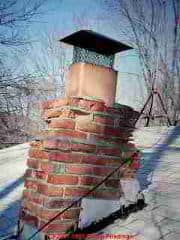 Chimney Inspection Checklist
15
Most Frequently Found Chimney Defects
- POST a QUESTION or COMMENT about chimney inspection procedures
Chimney inspection checklists:
This article provides a checklist of the most common chimney defects found during a home inspection. We include links to two additional detailed chimney inspection checklists for outdoors and indoors.
Three other detailed chimney inspection checklists for outside inspection, inside inspection & flue interior inspections are listed at the top of this article.
These articles on chimneys and chimney safety provide detailed suggestions describing how to perform a thorough visual inspection of chimneys for safety and other defects. Chimney inspection methods and chimney repair methods are also discussed.
InspectAPedia tolerates no conflicts of interest. We have no relationship with advertisers, products, or services discussed at this website.
Chimney Inspection Checklist of 15 Most Common Chimney Defects
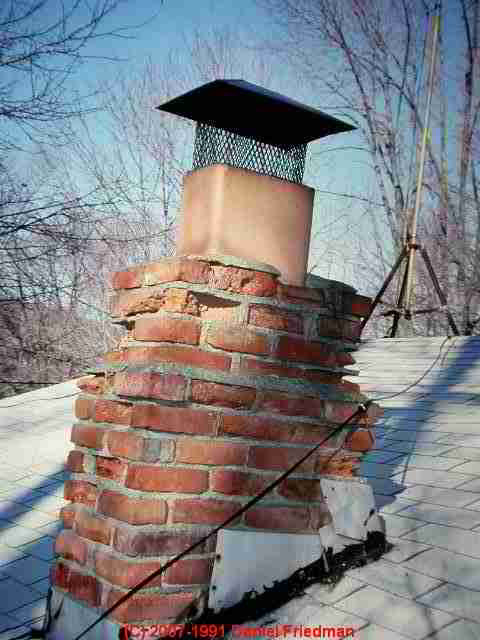
This chimney inspection checklist is a companion to our detailed photo guide to chimney inspections & problem diagnosis found at CHIMNEY INSPECTION GUIDE.
Watch out: no checklist is ever a complete guide to building inspection or diagnosis since no checklist can contain every possible hazard or every clue that suggests a problem.
Therefore do not rely on this or any checklist to assure that your inspection of a chimney is complete.
Instead, use this list to suggest additional topics that you otherwise may have omitted from your inspection.
The more detailed chimney inspection and repair articles at the links at page-left and below suggest further, more-detailed chimney inspection points and procedures.
Contact Us by email to suggest changes, corrections, or additions to this material.
16 Frequent Chimney Defects, Problems, Unsafe Conditions© Copyright 2017 InspectApedia.com, All Rights Reserved. Author Daniel Friedman. |
||
|---|---|---|
| Item # | Chimney Defect, Concern, Hazard | Comment / More Detail |
Building ID & Location: __________________________________________ Date & Time: _________________________________________________ Inspector: ____________________________________________________ |
||
| 1 | Chimney cap and crown defects: missing chimney cap, damaged chimney crown or top seal, leaks into the chimney leading to rust damage on metal flues or frost and water damage to masonry flues, leading to an unsafe chimney. | CHIMNEY CAP & CROWN DEFINITIONS CHIMNEY SHROUD, Decorative CHIMNEY CHASE CONSTRUCTION |
| 2 | Creosote or heavy soot in chimneys: a possible chimney fire hazard, especially at wood-burning fireplaces or woodstove flues | CHIMNEY FLUE INSPECTION CAMERA |
| 3 | Chimney thimble ports abandoned or hidden, covered-over by drywall, wallpaper, or a simple metal "pie-plate" enclosure - a fire and flue gas leakage hazard. | |
| 4 | Cleaning: chimney has not been cleaned for a protracted time; risks are greater for oil-fired equipment and for fireplaces & woodstoves. | CHIMNEY CLEANING PROCEDURE CHIMNEY CLEANING FRAUD |
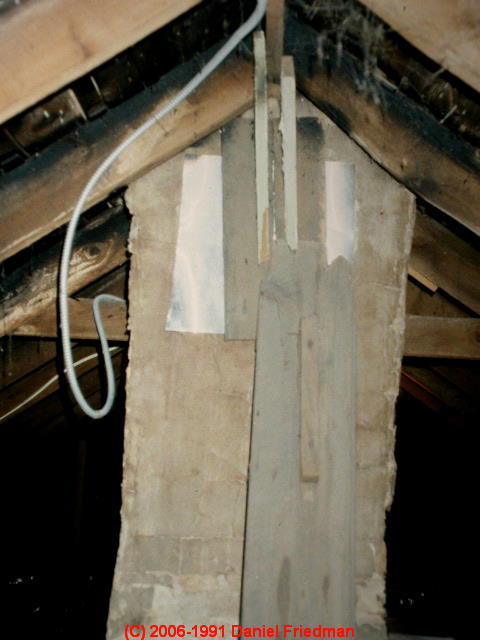
| 5 | Damaged, blocked, or unsafe chimney flues: a damaged chimney flue risks leaking dangerous combustion gases into the building or risks sparks which could start a building fire. Movement and cracks in a masonry chimney, rusted metal flues, unlined single-brick wythe flues, water leaks through chimneys, frost damaged chimney clay flue tiles, missing or open chimney cleanouts, dead-end flues, are examples. Look for conditions likely to rust a metal flue; look for conditions likely to cause cracking, breaking, or spalling of clay flue liners. Look for improperly constructed clay-tile lined masonry chimneys leaving concrete between joints that prevents thorough chimney clearing, or causing leaks and frost damage to the chimney flue or chimney structure. |
CHIMNEY INSPECTION, FLUE INTERIOR |
| 6 | Dead end flues - a chimney that is entered by a flue vent from a heating appliance, woodstove, or similar device right into the very bottom of the chimney flue. Common in older homes, such flues are easily blocked by falling debris - an unsafe condition. | DEAD END CHIMNEY FLUE HAZARDS |
| 7 | Fireplace inserts for wood or coal installed into an existing masonry flue without chimney inspection and if needed, re-lining. | FIREPLACE INSERTS INSTALL, INSPECT, REPAIR |
| 8 | Inspection: chimney has not been inspected for safety or cleanliness for some protracted interval | |
| 9 | Missing chimney cleanout doors, open cleanout doors: a fire hazard as well as a cause of improper, unsafe heating appliance operation | CHIMNEY CLEANOUT DOOR |
| 10 | Movement in chimneys, especially masonry chimneys: a dangerous condition, movement can cause hidden cracks and breaks that make a chimney unsafe, risking flue gas leakage into the interior or causing a building fire. |
CHIMNEY LEANING, SEPARATION, MOVEMENT
|
| 11 | Orphaned gas-fired water heaters not venting into any chimney, or a gas-fired water heater venting alone into a large masonry flue. The water heater may never develop sufficient heat in the old masonry flue to establish a working draft - flue gases spill backwards into the building, an unsafe condition. |
COMBUSTION GASES & PARTICLE HAZARDS |
| 12 | Rusted or damaged chimney or fireplace components: rusted, damaged, inoperative or missing fireplace dampers. Examples include a damper that has rusted through, a metal damper enclosure in the chimney throat rusted through, a metal fireplace insert rusted out at the chimney base. | FIREPLACE INSERTS INSTALL, INSPECT, REPAIR FIREPLACE INSPECTIONS FLUE TILE DAMAGE in CHIMNEY |
| 13 | Support defects: metal chimneys not adequately supported along building walls or above the roof. Example: an un-supported metal chimney extending more than five feet above the roof surface. | BRACING for METAL CHIMNEYS |
| 14 | Unlined chimney flues in single-brick wythe chimneys of older homes - a fire and flue gas leakage hazard | |
| 15 | Un-sealed flue-vent connectors at chimney thimbles: metal flues not sealed in the thimble, missing thimble, risking flue gas leaks or sparks; common at woodstove and heating system metal flue connections into a masonry chimney. |
FLUE VENT CONNECTORS - Boilers, Furnaces |
| 16 | Unsafe fire clearances between metal flues or other types of chimneys and nearby combustibles. | CHIMNEY HEIGHT & CLEARANCE CODE FLUE SEPARATION REQUIREMENTS PYROLYSIS EXPLAINED |
Notes to the table above
Inspection checklist warning: This chimney inspection checklist is a companion to our detailed photo guide to chimney inspections found at CHIMNEY INSPECTION GUIDE.
No checklist is ever a complete guide to building inspection or diagnosis since no checklist can contain every possible hazard or every clue that suggests a problem. Therefore do not rely on this or any checklist to assure that your inspection of a chimney is complete. Instead, use this list to suggest additional topics that you otherwise may have omitted from your inspection. The more detailed chimney inspection and repair articles at the links at Related Links and the citations below below suggest further, more-detailed chimney inspection points and procedures.
Adapted from chimney inspection safety sources including these documents cited atReferences or Citations
- [3] Wood Heating Alliance, "BUILDING INSPECTOR'S CHECKLIST FOR FACTORY BUILT FIREPLACES [PDF] " [PDF]
- [4] Baird, David J., C.B.O., "Factory-built Chimney Chase Fires: A case for More Detailed Inspection", Building Standards, March-April 1991, pp. 14-17.
- [5] Purdie, Roger K., "CHIMNEY FIRE SAFETY BULLETIN", Vista Fire Protection District, 2001, report of house fire related to the home's metal chimney. Contains advice for chimney * fire safety & sketches of approved and not-code-approved metal chimney tops, caps & crowns. [PDF]
- [12] Fire Inspector Guidebook, [BOOK] A Correlation of Fire Safety Requirements Contained in the 1987 BOCA National Codes, (newer edition available), Building Officials and Code Administrators International, Inc. (BOCA), Country Club HIlls, IL 60478 312-799-2300 4th ed. Note: this document is reissued every four years. Be sure to obtain the latest edition.
- [15] "Top Ten Chimney (and related) Problems Encountered by One Chimney Sweep," Hudson Valley ASHI education seminar, 3 January 2000, contributed by Bob Hansen, ASHI
- [16] Chimney Inspection Checklist, Carson Dunlop, Associates, Toronto, Ontario
- [18] "Chimneys and Vents," Mark J. Reinmiller, P.E., ASHI Technical Journal, Vol. 1 No. 2 July 1991 p. 34-38.
- [19] "Chimney Inspection Procedures & Codes," Donald V. Cohen was to be published in the first volume of the 1994 ASHI Technical Journal by D. Friedman, then editor/publisher of that publication. The production of the ASHI Technical Journal and future editions was cancelled by ASHI President Patrick Porzio. Some of the content of Mr. Cohen's original submission has been included in this more complete chimney inspection article: CHIMNEY INSPECTION DIAGNOSIS REPAIR . Copies of earlier editions of the ASHI Technical Journal are available from ASHI, the American Society of Home Inspectors.
- [20] "Chimney Inspection Procedures & Codes," Donald V. Cohen, draft, was to be published in the first volume of the 1994 ASHI Technical Journal by D. Friedman
- [25] Chimney Inspection Checklist, Carson Dunlop, Associates, Toronto, Ontario
- [26] Chimney & Stack Inspection Guidelines, American Society of Civil Engineers, 2003
Reader Comments, Questions & Answers About The Article Above
Below you will find questions and answers previously posted on this page at its page bottom reader comment box.
Reader Q&A - also see RECOMMENDED ARTICLES & FAQs
Question: Are HVAC contractors who install a replacement gas heating system also responsible for inspecting/assessing the (interior) chimney for safety/efficiency/proper draft/draw prior to installation?
Thank you so much for offering to answer questions. I am a basically clueless woman who gets shafted constantly when it comes to contractors and repairs because they know I have no clue about such things.
My question is this: Are HVAC contractors who install a replacement gas heating system also responsible for inspecting/assessing the (interior) chimney for safety/efficiency/proper draft/draw prior to installation?
A plumber just happened to notice that I have considerable heat coming off the large pipes and the tank etc in the closet which houses the heating system. He informed me that it is most likely due to a bad chimney which is not drafting or drawing correctly, and that the HVAC installer should have done a chimney assessment prior to installation. Is this correct?
I need to know if the HVAC man is the one I need to contact to correct the situation, before spending hundreds on paying someone different. I really and truly appreciate your help answering my question. - K.M. 7/19/2013
Reply:
We cannot know from just the information in your email whether the heating installation you describe is properly installed and safe or not. I also worry that while you may have heard of a concern, an expert, looking over the system might see something else of far greater concern.
These are my off-the-cuff first prioirty conerns when looking at a newly installed replacement gas heating system for the most fundamental questions of safety and proper installation:
1. Is the heating system safe: does it have adequate combustion air, is the chimney venting properlty, were proper fire clearances respected, are there working CO and smoke detectors installed in the home at proper locations and working properly.
2. Is the heating system functional: does it respond properly to a call for heat?
3. Is the heating system installed in all respects in keeping with the manufacturere's installation instructions (and local codes) - this last item can only be determined by a more detailed examination of the system along with the heater's installation guide.
A heating system installer who was in a rush might assume that a chimney is working properly, but he or she would be foolish to do so. Certainly a confirmation of proper draft and a visual inspection for obvious defects (blockage, leaks, damage, fire clearances), as well as a confirmation that the heater was operating properly (combustion air, temperature, etc) would be basic steps to perform before leaving the job.
I suggest calling the service manager of the company who installed your heater. Don't be confrontational and don't assume the installer fouled up, but do let the manager know you are concerned and that a plumber raised some safety questions. Ask that an experienced, trained expert be sent to check out your system.
...
Continue reading at CHIMNEY INSPECTION, FLUE INTERIOR or select a topic from the closely-related articles below, or see the complete ARTICLE INDEX.
Or see these
Recommended Articles
- CHIMNEY INSPECTION DIAGNOSIS REPAIR - home
- CHIMNEY FLUE INSPECTION CAMERA
- CHIMNEY INSPECTION CHECKLIST
- CHIMNEY INSPECTION, FLUE INTERIOR
- CHIMNEY INSPECTION from GROUND
- CHIMNEY INSPECTION INDOORS
- CHIMNEY INSPECTION OUTDOORS
- CHIMNEY INSPECTION at ROOFTOP
- CHIMNEY TOP MASONRY DAMAGE
- INACCESSIBLE CONNECTIONS FIREPLACE, WOODSTOVE
- UNLINED FLUE INSPECTIONS
Suggested citation for this web page
CHIMNEY INSPECTION CHECKLIST at InspectApedia.com - online encyclopedia of building & environmental inspection, testing, diagnosis, repair, & problem prevention advice.
Or see this
INDEX to RELATED ARTICLES: ARTICLE INDEX to CHIMNEYS & FLUES
Or use the SEARCH BOX found below to Ask a Question or Search InspectApedia
Ask a Question or Search InspectApedia
Try the search box just below, or if you prefer, post a question or comment in the Comments box below and we will respond promptly.
Search the InspectApedia website
Note: appearance of your Comment below may be delayed: if your comment contains an image, photograph, web link, or text that looks to the software as if it might be a web link, your posting will appear after it has been approved by a moderator. Apologies for the delay.
Only one image can be added per comment but you can post as many comments, and therefore images, as you like.
You will not receive a notification when a response to your question has been posted.
Please bookmark this page to make it easy for you to check back for our response.
Our Comment Box is provided by Countable Web Productions countable.ca
Citations & References
In addition to any citations in the article above, a full list is available on request.
- [1] ...
- [2] ...
- [3] Wood Heating Alliance, "BUILDING INSPECTOR'S CHECKLIST FOR FACTORY BUILT FIREPLACES [PDF] ", appearing in Baird, David J., C.B.O., "Factory-built Chimney Chase Fires: A case for More Detailed Inspection", Building Standards, March-April 1991, pp. 14-17. Note: The Fireplace Institute (FI) and the Wood Energy Institute (WEI) united to form the Wood Heating Alliance in 1980. The name was then changed again in 1983 to the Hearth Products Association (HPA) a non-profit organization, in order to better reflect the diversity and range of products and services within the industry. The name was changed once more to, Hearth Patio and Barbecue Association (HPBA) in 2001. Pacific HPBA, 2304 Huntington Dr., Suite 218, San Marino, CA 91108
(626) 237-1200 or (888) 332-2472
Fax: (626) 237-0721- info@hpbapacific.org, Website: http://hpbapacific.org/
Fireplace Safety Tips - Barbecue Safety Tips from the HPBA - see http://hpbapacific.org/pdfs/safetytips.pdf - [4] Baird, David J., C.B.O., "Factory-built Chimney Chase Fires: A case for More Detailed Inspection", Building Standards, March-April 1991, pp. 14-17.
- [5]
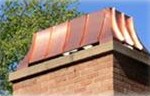 Stephen Werner, General Manager, Chimney King LLC., P.O. Box 8, Gurnee, IL 60031, Tel: (847) 244-8860, Email: steve@chimneyking.com, Website: www.chimneyking.com . Mr. Werner is also a licensed home inspector serving clients in Wisconsin. Chimney King sells their products through a network of fireplace dealers, chimney sweeps, roofers and builders. Each decorative shroud is custom built because no two chimney/chase are alike.
 - Stephen Werner General Manager
Chimney King, op cit, personal communication 3/26/2013 w/attachments:
- CHIMNEY KING INSTALLATION INSTRUCTIONS FOR CHIMNEY CROWN, [PDF]
- Purdie, Roger K., "CHIMNEY FIRE SAFETY BULLETIN", Vista Fire Protection District, 2001, report of house fire related to the home's metal chimney. Contains advice for chimney * fire safety & sketches of approved and not-code-approved metal chimney tops, caps & crowns. [PDF]
- See also CHIMNEY SHROUD FIRE - technical article contribution by Mr. Werner
- [6] Residential Masonry Fireplace and Chimney Handbook, James E. Amrhein, S.E., MIA, Masonry Institute of America, 2d. Ed., 1995, ISBN 0-940116-29-4. The MIA is in Los Angeles, CA 213-388-0472. This manual reflects the 1994 Uniform Building Code, Energy Conservation Requirements of California, and the U.S. Department of Housing and Urban Development - HUD. The complete UBC is available from the International Conference of Building Officials (ICBO), Whittier CA 310-699-0541.
- [7] NFPA 211 - Standards for Chimneys & Fireplaces, NFPA 211: Standard for Chimneys, Fireplaces, Vents, and Solid Fuel-Burning Appliances, 2006 Edition (older editions and standards are found at the same bookstore)
- [8] NFPA 211 - Standards for Chimneys & Fireplaces, NFPA 211: Standard for Chimneys, Fireplaces, Vents, and Solid Fuel-Burning Appliances, 2006 Edition (older editions and standards are found at the same bookstore), NFPA #211-3.1 1988 -
Specific to chimneys, fireplaces, vents and solid fuel burning appliances.
- NFPA 211 - 3-1.10 - Relining guide for chimneys
- NFPA 211 - 3-2 - Construction of Masonry Chimneys
- NFPA 211 - 3-3 - Termination Height for chimneys
- NFPA 211 - 3-4 - Clearance from Combustible Material
- NFPA 54 - 7-1 - Venting of Equipment into chimneys
- [9] NFPA # 54-7.1 1992 - Specific to venting of equipment with fan-assisted combustion systems.
- [10] GAMA - Gas Appliance Manufacturers' Association has prepared venting tables for Category I draft hood equipped central furnaces as well as fan-assisted combustion system central furnaces.
- [11] National Fuel Gas Code, an American National Standard, 4th ed. 1988 (newer edition is available) Secretariats, American Gas Association (AGA), 1515 Wilson Blvd., Arlington VA22209, and National Fire Protection Association (NFPA), Batterymarch Park, Quincy MA 02269. ANSI Z223.1-1988 - NFPA 54-1988. WARNING: be sure to check clearances and other safety guidelines in the latest edition of these standards.
- [12] Fire Inspector Guidebook, A Correlation of Fire Safety Requirements Contained in the 1987 BOCA National Codes, (newer edition available), Building Officials and Code Administrators International, Inc. (BOCA), Country Club HIlls, IL 60478 312-799-2300 4th ed. Note: this document is reissued every four years. Be sure to obtain the latest edition.
- [13] Uniform Mechanical Code - UMC 1991, Sec 913 (a.) Masonry Chimneys, refers to Chapters 23, 29, and 37 of the Building Code.
- [14] New York 1984 Uniform Fire Prevention and Building Code, Article 10, Heating, Ventilating, and Air Conditioning Requirements
- New York 1979 Uniform Fire Prevention & Building Code, The "requirement" for 8" of solid masonry OR for use of a flue liner was listed in the One and Two Family Dwelling Code for New York, in 1979, in Chapter 9, Chimneys and Fireplaces, New York 1979 Building and Fire Prevention Code:
- [15] "Top Ten Chimney (and related) Problems Encountered by One Chimney Sweep," Hudson Valley ASHI education seminar, 3 January 2000, contributed by Bob Hansen, ASHI
- [16] Chimney Inspection Checklist, Carson Dunlop, Associates, Toronto, Ontario
- [17] "Rooftop View Turns to Darkness," Martine Costello, Josh Kovner, New Haven Register, 12 May 1992 p. 11: Catherine Murphy was sunning on a building roof when a chimney collapsed; she fell into and was trapped inside the chimney until rescued by emergency workers.
- [18] "Chimneys and Vents," Mark J. Reinmiller, P.E., ASHI Technical Journal, Vol. 1 No. 2 July 1991 p. 34-38.
- [25] Chimney Inspection Checklist, Carson Dunlop, Associates, Toronto, Ontario
- [26] Chimney & Stack Inspection Guidelines, American Society of Civil Engineers, 2003 - These guidelines address the inspection of chimneys and stacks. Each guideline assists owners in determining what level of inspection is appropriate to a particular chimney and provides common criteria so that all parties involved have a clear understanding of the scope of the inspection and the end product required. Each chimney or stack is a unique structure, subject to both aggressive operating and natural environments, and degradation over time. Such degradation may be managed via a prudent inspection program followed by maintenance work on any equipment or structure determined to be in need of attention. Sample inspection report specifications, sample field inspection data forms, and an example of a developed plan of a concrete chimney are included in the guidelines. This book provides a valuable guidance tool for chimney and stack inspections and also offers a set of references for these particular inspections.
- [31] Brick Institute of America - Flashing Chimneys
Brick Institute of America - Proper Chimney Crowns
Brick Institute of America - Moisture Resistance of Brick - [32] American Gas Association - New Vent Sizing Tables
- [33] Chimney Safety Institute of America - Chimney Fires: Causes, Effects, Evaluation
- [34] National Chimney Sweep Guild - Yellow Pages of Suppliers
- [35] "Building Codes that Regulate Decorative Chimney Shrouds", provided by Stephen Werner [5], [copy on file as Chimney_Decorative_Shroud_Regs.pdf] cites:
- International Mechanical Code IMC (2000), M74-98 806.6, ratified 9.98, model building code for the United States,
806.6 Decorative Shrouds. Decorative shrouds shall not be installed at the termination of factory-built chimneys, except where such shrouds are listed and labeled for use with the specific factory-built chimney system and are installed in accordance with section 304.1. Reason: Decorative shrouds have been the cause of roof and chase fires - International Residential Code (IRC) (2000), R1002.2 ratified 9/99, 1000.2 Decorative Shrouds. Decorative shrouds shall not be installed at the termination of factory-built chimneys, except where such shrouds are listed and labeled for use with the specific factory-built chimney system and are installed in accordance with the manufacturers installation instructions. Reason: Decorative shrouds often allow for the creation of temperatures in excess of those permitted in UL 103 and UL 127. Decorative shrouds have been the cause of chase top fires ...
- International Fire Code (IFC) (2000), IFC 603.6.3, 603.6.3 Decorative Shrouds. Decorative shrouds installed at the termination of factory-built chimneys shall be removed, except where such shrouds are listed and labeled for use with the specific factory-built chimney system and are installed in accordance with the manufacturers installation instructions. Reason: Decorative shrouds have been the cause of dozens of chase fires. As a non-listed part to a listed assembly, their use should not have been allowed in the first place.
- International Mechanical Code IMC (2000), M74-98 806.6, ratified 9.98, model building code for the United States,
- [36] International Residential Code IRC R100.11 - Fireplace Clearance:
International Residential Code was recently amended:-
R1001.11 Fireplace clearance. Combustible material shall have a clearance of not less than 2 inches (51 mm) from the front faces and sides of masonry fireplaces and not less than 4 inches (102 mm) from the back faces of masonry fireplaces. The air space shall not be filled, except to provide fire blocking in accordance with Section R1003.12.
Exceptions:1. Masonry fireplaces listed and labeled for use in contact with combustibles in accordance with UL 127, and installed in accordance with the manufacturer's installation instructions, are permitted to have combustible material in contact with their exterior surfaces.
2. Combustible materials, including framing, wood siding, flooring and trim, shall be permitted to abut the sides and hearth extensions, but not the backs, of masonry fireplaces, in accordance with FIGURE R1003.12, provided such combustible materials are a minimum of 12 inches (306 mm) from the inside surface of the nearest firebox lining.
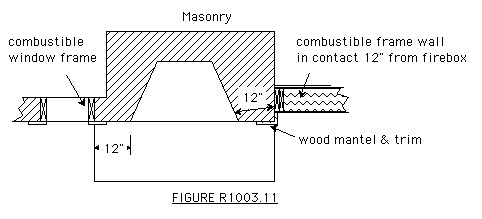
3. Exposed combustible mantels or trim may be placed directly on the masonry fireplace front surrounding the fireplace opening provided such combustible materials shall not be placed within 6 inches (153 mm) of a fireplace opening. Combustible material within 12 inches (305 mm) of the fireplace opening shall not project more than 1/8 inch (3.2 mm) for each 1-inch (25 mm) distance from such opening.
- Our recommended books about building & mechanical systems design, inspection, problem diagnosis, and repair, and about indoor environment and IAQ testing, diagnosis, and cleanup are at the InspectAPedia Bookstore. Also see our Book Reviews - InspectAPedia.
- Chimney & Stack Inspection Guidelines, American Society of Civil Engineers, 2003 - These guidelines address the inspection of chimneys and stacks. Each guideline assists owners in determining what level of inspection is appropriate to a particular chimney and provides common criteria so that all parties involved have a clear understanding of the scope of the inspection and the end product required. Each chimney or stack is a unique structure, subject to both aggressive operating and natural environments, and degradation over time. Such degradation may be managed via a prudent inspection program followed by maintenance work on any equipment or structure determined to be in need of attention. Sample inspection report specifications, sample field inspection data forms, and an example of a developed plan of a concrete chimney are included in the guidelines. This book provides a valuable guidance tool for chimney and stack inspections and also offers a set of references for these particular inspections.
- NFPA 211 - Standards for Chimneys & Fireplaces, NFPA 211: Standard for Chimneys, Fireplaces, Vents, and Solid Fuel-Burning Appliances, 2006 Edition (older editions and standards are found at the same bookstore)
- Principles of Home Inspection: Chimneys & Wood Heating, in (Principles of Home Inspection), Carson Dunlop, Associates, Toronto, Ontario
- NFPA 211 - 3-1.10 - Relining guide for chimneys
- NFPA 211 - 3-2 - Construction of Masonry Chimneys
- NFPA 211 - 3-3 - Termination Height for chimneys
- NFPA 211 - 3-4 - Clearance from Combustible Material
- NFPA 54 - 7-1 - Venting of Equipment into chimneys
- Brick Institute of America - Flashing Chimneys
Brick Institute of America - Proper Chimney Crowns
Brick Institute of America - Moisture Resistance of Brick - American Gas Association - New Vent Sizing Tables
- Chimney Safety Institute of America - Chimney Fires: Causes, Effects, Evaluation
- National Chimney Sweep Guild - Yellow Pages of Suppliers
- In addition to citations & references found in this article, see the research citations given at the end of the related articles found at our suggested
CONTINUE READING or RECOMMENDED ARTICLES.
- Carson, Dunlop & Associates Ltd., 120 Carlton Street Suite 407, Toronto ON M5A 4K2. Tel: (416) 964-9415 1-800-268-7070 Email: info@carsondunlop.com. Alan Carson is a past president of ASHI, the American Society of Home Inspectors.
Thanks to Alan Carson and Bob Dunlop, for permission for InspectAPedia to use text excerpts from The HOME REFERENCE BOOK - the Encyclopedia of Homes and to use illustrations from The ILLUSTRATED HOME .
Carson Dunlop Associates provides extensive home inspection education and report writing material. In gratitude we provide links to tsome Carson Dunlop Associates products and services.
 | HOME | ABOUT | ASK a QUESTION | CONTACT | CONTENT USE POLICY | DESCRIPTION | POLICIES | PRIVACY | |
| © 2024 - 1985 Publisher InspectApedia.com - Daniel Friedman | |||||||||