
InspectAPedia® FREE Encyclopedia of Building & Environmental Construction, Diagnosis, Maintenance & Repair |
Question? Just ask us! InspectAPedia
|
 Chimney & Flue Cleaning Advice
- POST a QUESTION or COMMENT about chimney & flue cleaning: how to clean a chimney, who should clean & inspect a chimney, certified chimney sweeps, when or how often should the chimney be cleaned, chimney maintenance & repairs done at cleaning time
Chimney cleaning:
This article describes the basic requirement for periodic inspection and professional cleaning of chimneys.
We answer: How often should you clean the chimney? and Who should you use to clean or repair a chimney to be sure that the result is a safe, properly working flue and vent system? We include referral links to professional chimney sweep and chimney sweep certification organizations.
InspectAPedia tolerates no conflicts of interest. We have no relationship with advertisers, products, or services discussed at this website.
Chimney Cleaning Advice
These articles on chimneys and chimney safety provide detailed suggestions describing how to perform a thorough visual inspection of chimneys for safety and other defects.
Chimney inspection methods and chimney repair methods are also discussed.
Cleaning wood-burning appliance chimneys by arbitrary rule of thumb
such as "once every 50 fires in the fireplace" is better than never cleaning your chimney, but in fact what actually determines the need for cleaning is how clean or dirty the chimney flue is.
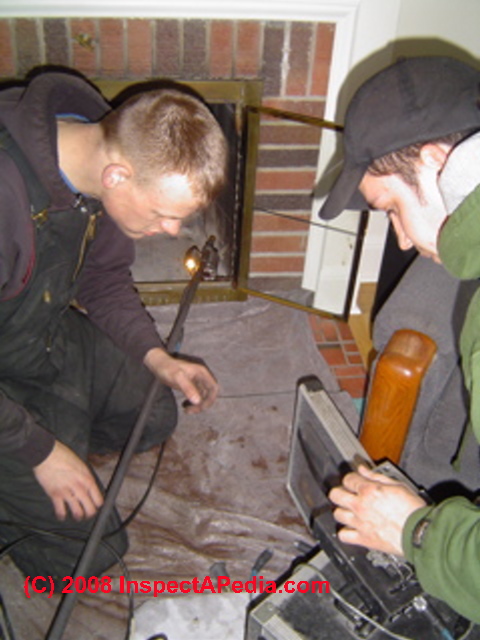
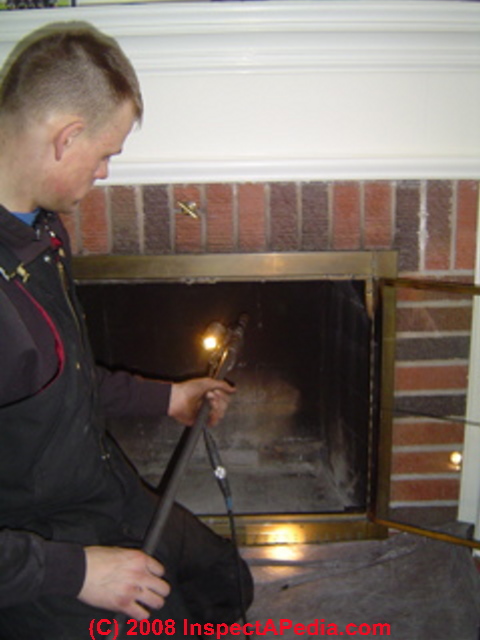
Our photo shows a Duluth MN team of chimney sweeps preparing to inspect a chimney interior using a camera and lighting.
Cleaning chimneys based on actual usage:
If your building includes a wood burning fireplace or woodstove, especially if you burn a lot of fires, but in particular, if you are burning fires using green wood, or slow cool fires, or worst, slow cool small fires with green wood, you can clog up the chimney with creosote which, later when it catches on fire, can burn the whole house down.
Even a chimney that has not been used for a wood burning appliance can become blocked by rodents or insects such as our hornets nest shown above.
I tried inspecting small openings like this using a Nest Cam but it's not a practical approach.
See NEST CAM INSTALLATION & USE.

Instead you'd want to use a camera designed for inspecting close spaces.
See CHIMNEY FLUE INSPECTION CAMERA
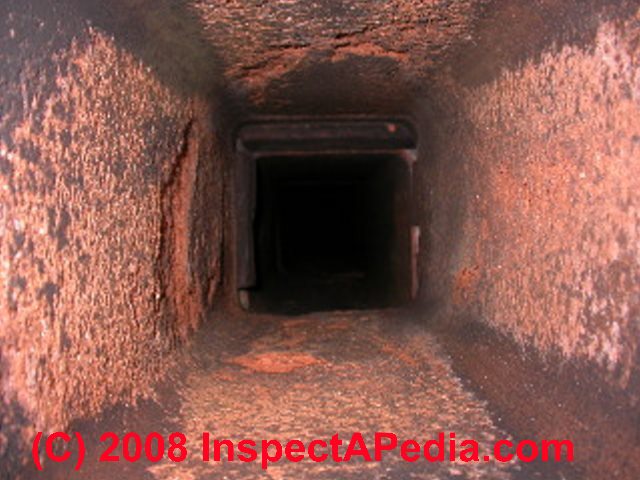
And a chimney inspection may reveal that the flue has been damaged not by creosote blockage but by spalling and water (above).
If you don't already know the condition of your chimney, you should certainly take the following steps:
- Pay for a thorough chimney cleaning,
I would ask the cleaner how clean or dirty the flue actually was (they may fib about it), especially in a building whose chimney conditions and safety are unknown - Pay for a thorough chimney safety and condition inspection
using a chimney scanning camera such as the Chimscan® or similar device which is basically a fisheye camera on a string.
Using the chimscan can tell you more than just how clean the flue is, it'll tell you if it has been damaged in some way that could make it unsafe, such as cracked or missing flue tile liners or leaks into the interior of the building. - Use a professional chimney sweep
such as someone who is a member of and certified by the National Chimney Sweeps Guild (NCSG) or the Chimney Safety Institute of America (CSIA).
The National Chimney Sweep Guild's certification requires training including in chimney and fire safety. The Chimney Safety Institute of America also certifies chimney sweeps. - Also see CHIMNEY CLEANING FRAUD WARNING
Oil & Gas fired heating appliance chimneys also need to be inspected and cleaned.
Part of normal oil fired appliance heating service includes disassembly and cleaning of the flue vent connector. Ask your heating service tech to check the chimney itself and order a cleaning if needed.
Gas fired heating appliance chimneys should be inspected regularly: a blocked gas fired appliance chimney creates a serious risk of improper gas appliance operation which in turn is likely to produce dangerous, potentially fatal carbon monoxide.
Once you've done this thorough job, future cleanings can be scheduled based on how many fires you've had, more often if your 're burning green wood, and before use at all if you see clogging in the chimney or thick creosote therein on your own inspection.
Also don't forget to inspect the flue before lighting the first fire of the season- since an animal or insects could have obstructed the flue over the summer. If you have a properly screened cap on your chimney top you'll keep out the animals but not the insects.
Chimney Cleaning Costs
Reader Question
I have a fireplace which is blocked from the chimney (top). Could you give me a general idea of how much it will cost to re-open it please? - G.B. 11/6/2013
Reply:
Sorry, but I don't know. Costs for chimney cleaning typically range widely between $100 and $1300. And I am skeptical about the low-end of that range.
The variables that affect the cost of chimney cleaning include at least these:
- Location of the property - including the country, city, state, etc.
- Height of the chimney and ease of access from outside and from inside (some chimney cleaning is done from inside but depending on the nature of blockage that may not be appropriate).
For example, a masonry chimney in good shape on a two story house blocked by a birds nest is at the low-end of cost, probably a few hundred for most chimney sweeps, while a discovery that the chimney is high, hard to access, or damaged and unsafe completely change the picture. - Nature of the chimney construction which in turn may affect its condition and ease of cleaning
- The fuel that has been burned in the appliance vented into the chimney.
- For example, glazed-on creosote in a chimney can be quite difficult to remove.
- Why the chimney is blocked.
For example if the chimney is blocked because of an internal collapse or damage the repair is not going to be done with just a brush and vacuum cleaner.
Watch out: if it's too good to be true, it's in fact not true. The chimney cleaning industry suffers from scammers in some areas. See CHIMNEY CLEANING FRAUD - live link given just below.
More information is in the links just below
Where to locate a certified chimney installation, repair, or cleaning professional
Be sure that Your Chimney Company is Qualified
Watch out: at UNLINED FLUE INSPECTIONS we describe a scary story that happened when we identified an unsafe chimney and advised our client to have a chimney expert inspect and repair the condition.
She called a chimney company listed in her local telephone book. But the "expert" was so poorly informed about chimney safety that his "repairs" came close to killing the occupants of the house.
Watch out: also for a common chimney repair fraud that takes your money but does nothing to make your chimney safe.
See CHIMNEY REPAIR FRAUD WARNING for details.
Be sure that your chimney expert really is one. And if you are in the slightest doubt, in addition to contacting the associations listed below, you should ask your local fire inspector or building inspector for help.
Directory of Chimney Sweep & Chimney Cleaning & Repair Associations
- Austria chimney sweeps: Austria Bundesinnung der Rauchfangkehrer. Website http://www.rauchfang.at/
- European Federation of Chimney Sweeps (ESCHFOE) Association of Chimney Sweep Guilds. Avemie des Mervoems 117, bte 48 bis-B-1040 Bruxelles, Belgium, Website: http://www.eschfoe.com/
Note: useless website, no content. - Finland Chimney Sweeps: Nuohousalan Keskusliitto Ry. Website: http://www.nuohoojat.fi/
- Germany Chimney Sweeps: ZDS Bundesverband. Website http://www.zds-schornsteinfeger.de/
- International Union of European Chimney Sweep Workers (ICU) Representing worker sweeps and apprentices. Website: http://www.icu.li/
- Ireland chimney sweeps: Chimney Sweeps Association of Ireland. Patrick Cowan, 14 Derreen Dr. Harbour View Wicklow Town Co. Wicklow Tel: 087-25 74 267 Email: patrick@chimneysolutions.ie Website: http://csai.ie/
- International Association of Fireplace and Chimney Inspectors, Inc., IAFCI, 5325 N Commerce Ave Ste 5
Moorpark, CA 93021, Website: http://www.membersiafci.org/ Quoting from the association's website:
The International Association of Fireplace & Chimney Inspectors (IAFCI) is a Non-Profit Association formed to facilitate education and promote professionalism within the Hearth, Fireplace, Vent and Chimney Inspection Industry.
...
IAFCI, its Members, and Educational Providers will conform, utilize and assist in the application of recognized standards, listings, and codes for all hearth products intended for service, repair, replacement, or new construction. - Luxemburg chimnbey sweeps: Fédération des Patrons http://federation-des-artisans.lu/
- Netherland chimney sweeps: ASPB, Algemene Schoorsteenvegers http://www.aspb.nl/
- Northern Ireland chimney sweeps: Northern Ireland Association of Chimney Sweeps NIACS, Website: http://www.niacs.co.uk/
- Norway chimney sweeps: Feiermesternes Landsforening (Norway) http://www.feiermester.org/
Vocational Education and Training (VET) in Norway [PDF] describes training for chimney sweeps in Norway - Poland chimney sweeps: Korporacja Kominiarzy Polskich http://www.kominiarz.org.pl/
- Slovenia chimney sweeps: OZS, Craft of Slovenia http://www.ozs.si/
- Sweden chimney sweeps: Sveriges Skorstenfejaremästares http://www.skorstensfejare.se/
- Switzerland chimney sweeps: Schweizerischer Kaminfegermeister-Verband http://www.kaminfeger.ch/
- UK United Kingdom chimney sweeps: Guild of Master Sweeps (UK) Email: info@guildofmasterchimneysweeps.co.uk Website: https://www.guildofmasterchimneysweeps.co.uk/
- UK United Kingdom chimney sweeps: National Association of Chimney Sweeps NACS (UK) - Emerald Way, Stone Business Park, Stone, Staffordshire, ST15 0SR UK Tel: 01785 336555 Website: https://nacs.org.uk/
- USA: United States chimney sweeps: NATIONAL CHIMNEY SWEEPS GUILD, 2155 Commercial Drive, Plainfield, IN 46168 USA Tel: (317) 837-1500 Email: office@ncsg.org Website: http://www.ncsg.org/
- USA: Chimney Safety Institute of America, CSIA, CSIA Technology Center, 2155 Commercial Drive, Plainfield, IN 46168. CSIA directory of CISA certified chimney professionals: Website: http://www.csia.org/ Email: mmcsweeney@ncsg.org
- USA: National Fireplace Institute - NFI, Website: http://nficertified.org/ Quoting from the associations website:
The National Fireplace Institute® is the professional certification division of the Hearth, Patio & Barbecue Education Foundation (HPBEF), a 501(c)3 non-profit educational organization for the hearth industry. - NFPA #211-3.1 1988 - Specific to chimneys, fireplaces, vents and solid fuel burning appliances.
- NFPA # 54-7.1 1992 - Specific to venting of equipment with fan-assisted combustion systems.
- WETT (Canadian Chimney & Wood-Burning Appliance Fire Safety Inspections) - see details at CHIMNEY WETT INSPECTION
What's the difference between the Chimney Safety Institute of America, CSIA, and the National Chimney Sweeps Guild, NCSG?
According to Robert Husted, owner of Dave's Chimney Service in Port Orchard WA:
NCSG vs. CSIA: the big difference is that the NCSG is a guild that promotes proper chimney service through education and training as well as a voice when it comes to NFPA211,54,74, and IRC codes reviews and changes.
The CSIA is a nationally recognized chimney service certification group that works with Realtors, home owners and home inspectors to insure competent chimney sweeps that know the codes and standards of the hearth trade to insure safe and clean burning solid fuel appliances.
The CSIA requires CEU's just like a electrician or plumber. However this is just my opinion as a certified chimney sweep. I DO NOT speak for the CSIA or NCSG.
Other Chimney Sweep Sources, Research
- Chrisite, William Wallace. Chimney design and theory: a book for engineers and architects. D. Van Nostrand, 1902.
Excerpt:
Preface: Up to the present time, there has been but one book on the subject of “Chimneys” printed in the United States, that of Armstrong's, revised by FE Idell, and published in the “ Van Nostrand Science Series.” It is a treatment of chimney-draft only. - Cullingford, Benita. British Chimney Sweeps: Five Centuries of Chimney Sweeping. Rowman & Littlefield, 2001.
...
Continue reading at CHIMNEY CLEANING FRAUD or select a topic from the closely-related articles below, or see the complete ARTICLE INDEX.
Or see these
Recommended Articles
- CHIMNEY CLEANOUT DOORS
- CHIMNEY INSPECTION CAMERA - ChimScan
- CHIMNEY INSPECTION DIAGNOSIS REPAIR - home
- CHIMNEY INSPECTION PROCEDURE SUMMARY
Suggested citation for this web page
CHIMNEY CLEANING PROCEDURE at InspectApedia.com - online encyclopedia of building & environmental inspection, testing, diagnosis, repair, & problem prevention advice.
Or see this
INDEX to RELATED ARTICLES: ARTICLE INDEX to CHIMNEYS & FLUES
Or use the SEARCH BOX found below to Ask a Question or Search InspectApedia
Ask a Question or Search InspectApedia
Questions & answers or comments about chimney & flue cleaning: how to clean a chimney, who should clean & inspect a chimney, certified chimney sweeps, when or how often should the chimney be cleaned, chimney maintenance & repairs done at cleaning time.
Try the search box just below, or if you prefer, post a question or comment in the Comments box below and we will respond promptly.
Search the InspectApedia website
Note: appearance of your Comment below may be delayed: if your comment contains an image, photograph, web link, or text that looks to the software as if it might be a web link, your posting will appear after it has been approved by a moderator. Apologies for the delay.
Only one image can be added per comment but you can post as many comments, and therefore images, as you like.
You will not receive a notification when a response to your question has been posted.
Please bookmark this page to make it easy for you to check back for our response.
Our Comment Box is provided by Countable Web Productions countable.ca
Citations & References
In addition to any citations in the article above, a full list is available on request.
- Chimney Safety Institute of American, CSIA, CSIA Technology Center, 2155 Commercial Drive, Plainfield, IN 46168. CSIA directory of CISA certified chimney professionals: Website: http://www.csia.org/ Email: mmcsweeney@ncsg.org
- National Chimney Sweeps Guild, NCSG, 2155 Commercial Drive, Plainfield, IN 46168, Tel: 317) 837-1500, Website: http://www.ncsg.org/ , Email: mmcsweeney@ncsg.org
- National Fuel Gas Code, an American National Standard, 4th ed. 1988 (newer edition is available) Secretariats, American Gas Association (AGA), 1515 Wilson Blvd., Arlington VA22209, and National Fire Protection Association (NFPA), Batterymarch Park, Quincy MA 02269. ANSI Z223.1-1988 - NFPA 54-1988. WARNING: be sure to check clearances and other safety guidelines in the latest edition of these standards.
- Fire Inspector Guidebook, A Correlation of Fire Safety Requirements Contained in the 1987 BOCA National Codes, (newer edition available), Building Officials and Code Administrators International, Inc. (BOCA), Country Club HIlls, IL 60478 312-799-2300 4th ed. Note: this document is reissued every four years. Be sure to obtain the latest edition.
- Uniform Mechanical Code - UMC 1991, Sec 913 (a.) Masonry Chimneys, refers to Chapters 23, 29, and 37 of the Building Code.
- New York 1984 Uniform Fire Prevention and Building Code, Article 10, Heating, Ventilating, and Air Conditioning Requirements
- New York 1979 Uniform Fire Prevention & Building Code, The "requirement" for 8" of solid masonry OR for use of a flue liner was listed in the One and Two Family Dwelling Code for New York, in 1979, in Chapter 9, Chimneys and Fireplaces, New York 1979 Building and Fire Prevention Code:
- "Top Ten Chimney (and related) Problems Encountered by One Chimney Sweep," Hudson Valley ASHI education seminar, 3 January 2000, contributed by Bob Hansen, ASHI
- Chimney Inspection Checklist, Carson Dunlop, Associates, Toronto, Ontario
- "Rooftop View Turns to Darkness," Martine Costello, Josh Kovner, New Haven Register, 12 May 1992 p. 11: Catherine Murphy was sunning on a building roof when a chimney collapsed; she fell into and was trapped inside the chimney until rescued by emergency workers.
- "Chimneys and Vents," Mark J. Reinmiller, P.E., ASHI Technical Journal, Vol. 1 No. 2 July 1991 p. 34-38.
- "Chimney Inspection Procedures & Codes," Donald V. Cohen was to be published in the first volume of the 1994 ASHI Technical Journal by D. Friedman, then editor/publisher of that publication. The production of the ASHI Technical Journal and future editions was cancelled by ASHI President Patrick Porzio. Some of the content of Mr. Cohen's original submission has been included in this more complete chimney inspection article: CHIMNEY INSPECTION DIAGNOSIS REPAIR . Copies of earlier editions of the ASHI Technical Journal are available from ASHI, the American Society of Home Inspectors.
- Natural Gas Weekly Update: http://tonto.eia.doe.gov/oog/info/ngw/ngupdate.asp Official Energy Statistics from the U.S. Government
- US Energy Administration: Electrical Energy Costs http://www.eia.doe.gov/fuelelectric.html
- Our recommended books about building & mechanical systems design, inspection, problem diagnosis, and repair, and about indoor environment and IAQ testing, diagnosis, and cleanup are at the InspectAPedia Bookstore. Also see our Book Reviews - InspectAPedia.
- Chimney & Stack Inspection Guidelines, American Society of Civil Engineers, 2003 - These guidelines address the inspection of chimneys and stacks. Each guideline assists owners in determining what level of inspection is appropriate to a particular chimney and provides common criteria so that all parties involved have a clear understanding of the scope of the inspection and the end product required. Each chimney or stack is a unique structure, subject to both aggressive operating and natural environments, and degradation over time. Such degradation may be managed via a prudent inspection program followed by maintenance work on any equipment or structure determined to be in need of attention. Sample inspection report specifications, sample field inspection data forms, and an example of a developed plan of a concrete chimney are included in the guidelines. This book provides a valuable guidance tool for chimney and stack inspections and also offers a set of references for these particular inspections.
- Fireplaces, a Practical Design Guide, Jane Gitlin
- Fireplaces, Friend or Foe, Robert D. Mayo
- NFPA 211 - Standards for Chimneys & Fireplaces, NFPA 211: Standard for Chimneys, Fireplaces, Vents, and Solid Fuel-Burning Appliances, 2006 Edition (older editions and standards are found at the same bookstore)
- NFPA 211 - 3-1.10 - Relining guide for chimneys
- NFPA 211 - 3-2 - Construction of Masonry Chimneys
- NFPA 211 - 3-3 - Termination Height for chimneys
- NFPA 211 - 3-4 - Clearance from Combustible Material
- NFPA 54 - 7-1 - Venting of Equipment into chimneys
- Brick Institute of America - Flashing Chimneys
Brick Institute of America - Proper Chimney Crowns
Brick Institute of America - Moisture Resistance of Brick - American Gas Association - New Vent Sizing Tables
- Chimney Safety Institute of America - Chimney Fires: Causes, Effects, Evaluation
- National Chimney Sweep Guild - Yellow Pages of Suppliers
- In addition to citations & references found in this article, see the research citations given at the end of the related articles found at our suggested
CONTINUE READING or RECOMMENDED ARTICLES.
- Carson, Dunlop & Associates Ltd., 120 Carlton Street Suite 407, Toronto ON M5A 4K2. Tel: (416) 964-9415 1-800-268-7070 Email: info@carsondunlop.com. Alan Carson is a past president of ASHI, the American Society of Home Inspectors.
Thanks to Alan Carson and Bob Dunlop, for permission for InspectAPedia to use text excerpts from The HOME REFERENCE BOOK - the Encyclopedia of Homes and to use illustrations from The ILLUSTRATED HOME .
Carson Dunlop Associates provides extensive home inspection education and report writing material. In gratitude we provide links to tsome Carson Dunlop Associates products and services.
 | HOME | ABOUT | ASK a QUESTION | CONTACT | CONTENT USE POLICY | DESCRIPTION | POLICIES | PRIVACY | |
| © 2024 - 1985 Publisher InspectApedia.com - Daniel Friedman | |||||||||