
InspectAPedia® FREE Encyclopedia of Building & Environmental Construction, Diagnosis, Maintenance & Repair |
Question? Just ask us! InspectAPedia
|
 Chimney Cleanout Door Inspect & Fix
How to install a cleanout door or repair a damaged, leaky chimney cleanout
- POST a QUESTION or COMMENT about chimney cleanout doors
Chimney cleanout doors & openings:
This article describes chimney cleanout access doors or ports.
We explain that in addition to using the chimney cleanout as a service port to remove debris that has fallen to the bottom of a masonry chimney, the cleanout door and the type of debris found inside can tell us something about the condition of the chimney flue even though we cannot see most of it.
These articles on chimneys and chimney safety provide detailed suggestions describing how to perform a thorough visual inspection of chimneys for safety and other defects. Chimney inspection methods and chimney repair methods are also discussed.
InspectAPedia tolerates no conflicts of interest. We have no relationship with advertisers, products, or services discussed at this website.
Chimney Flue View by Cleanout Door
Where you can find a chimney cleanout or can remove a flue vent connector to look into a flue, use of a mirror inside the flue to view the flue from below.
[Click to enlarge any image]
This is by no means a thorough and accurate view of all of the chimney flue interior. But if the chimney was constructed as a straight flue up through the building roof, you should see daylight - otherwise the flue has become blocked, perhaps with nesting animals or collapsing debris.
Our photo (left) will provide an easy view into this section of the chimney flue. But even before opening the chimney cleanout door we can see that there has been a history of leaks inside of the chimney flue.
Article Contents
- CHIMNEY CLEANOUT DOORS
- CHIMNEY CLEANOUT DOOR ACCESS
- CHIMNEY CLEANOUT CLEARANCE to COMBUSTIBLES - separate article
- CHIMNEY CLEANOUT REQUIREMENTS
- CHIMNEY CLEANOUT INTERIOR INSPECTION
- MASONRY FRAGMENTS & DEBRIS at the CLEANOUT
- METAL CHIMNEY CLEANOUT TEES
- MISSING CHIMNEY CLEANOUT DOOR
- CHIMNEY CLEANOUT DOOR INSTALL or REPLACE
- SEALING a CHIMNEY CLEANOUT DOOR
- WHERE TO BUY A CHIMNEY CLEANOUT DOOR - size, proportions, material & price
Chimney Cleanout Door Inspection & Hazards
Chimney Cleanouts Are Required
All chimneys must have a cleanout at least 12" below the lowest appliance inlet opening. A fireplace is considered as access for cleaning. Cleanouts must have metal or pre cast concrete doors that can be secured tightly
 ...
...
In the photo at above left, the chimney cleanout is easy to find and the door is in place and closed; look inside for clues of flue damage and also for the presence of a flue liner if this is a single-brick wythe flue.
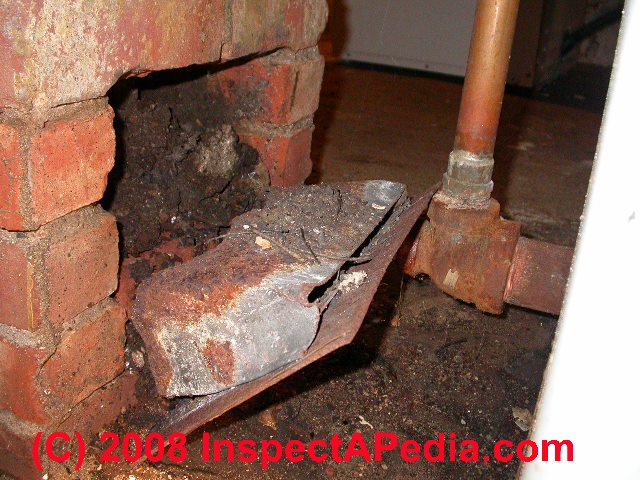
In the photo at above right the home made cleanout door was a metal scrap propped against the chimney. It has fallen open, and we see some masonry debris that has fallen down the flue.
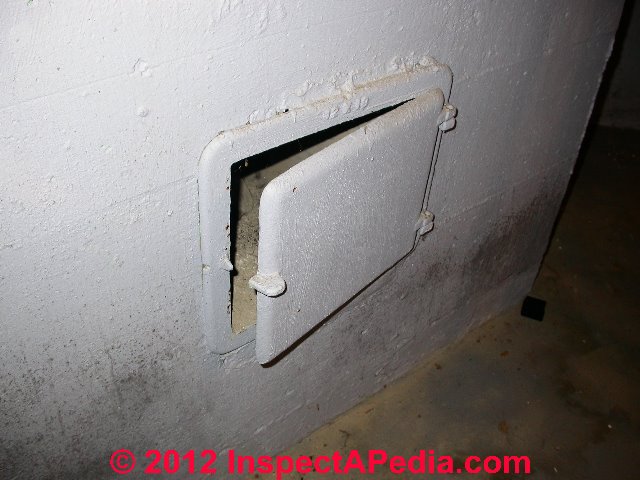
Chimney cleanout door left open
We found this chimney cleanout door (shown above) ajar.
This chimney cleanout access port served a common ash dump below both a fireplace flue and a separate heating appliance chimney flue.
Watch out: Failure to close the chimney cleanout door can result in a fire and will certainly interfere with good draft in the flue. A rusted-out chimney cleanout door and its role in producing potentially dangerous carbon monoxide at the heating equipment is discussed later in this article.
Water leaks through the chimney cleanout port
We found this chimney cleanout pouring water into the building basement during a heavy rainstorm.
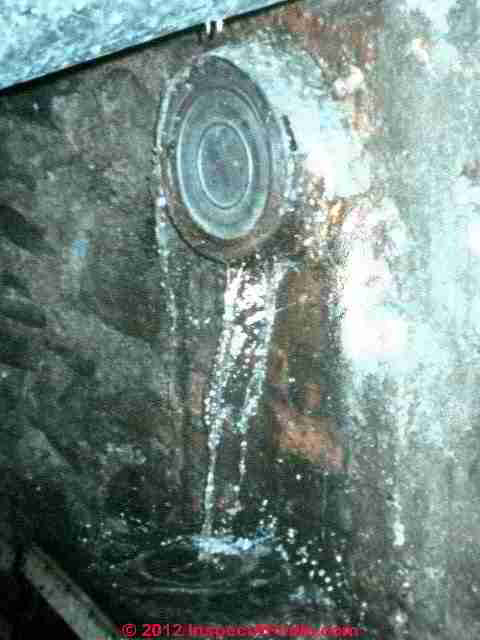
See CHIMNEY CAP & CROWN DEFINITIONS for chimney top sources of water leakage.
But in the case of the water leak shown our photo most likely the water source is from roof spillage onto the ground or surface runoff on the ground around the chimney base.
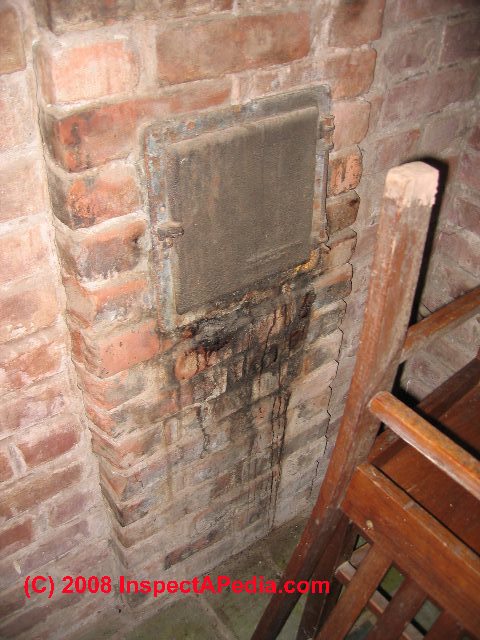
A combination of in-slope grade around the chimney base and leaks into the chimney can be detected by noticing water or creosote leak stains around the chimney cleanout opening even if you don't have the good luck to catch water in the act of entering the building.
Our photo above illustrates this condition - brown rust and creosote stains below the cleanout access opening. This chimney and its rain cap and cap seal need further inspection as may the flue itself.
Watch out: water damage to a chimney flue may leave the chimney unsafe.
Combustibles Stuffed in Chimney Opening
Using a one-gallon plastic bottle (photo below) as a means of sealing off a chimney cleanout opening (photo at left, Poughkeepsie, NY) is nothing less than stupid.
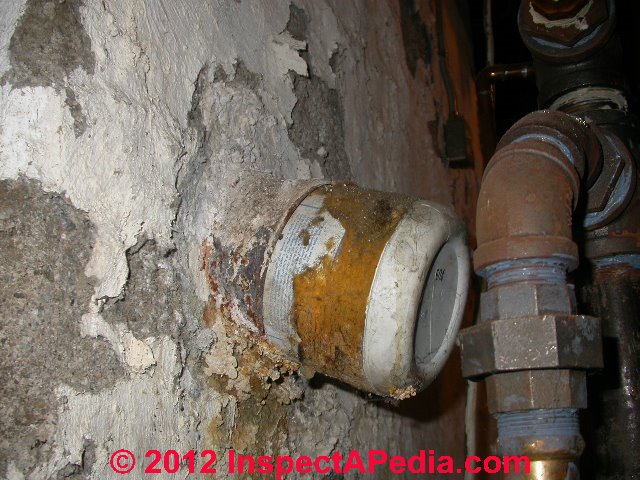
The fire hazard is greater below a fireplace where burning embers may fall into the cleanout pit, but this expedient is not recommended in any case.
Do not use a combustible material in the construction of chimneys or flues.
Open the Chimney Cleanout Door & Inspect the Chimney Base
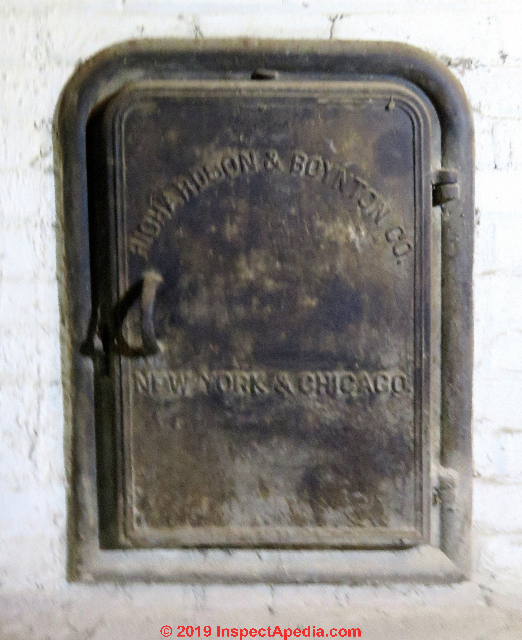
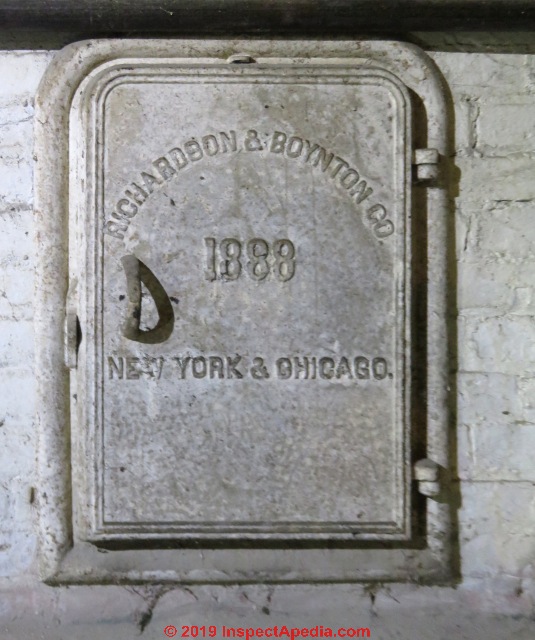 Having already noted obvious chimney defects and hazards one can determine simply by observing whether or not there even is a chimney cleanout and then noting the condition of the cleanout access opening, we can proceed to inspecting the interior of the chimney cleanout base.
The two chimney cleanout openings shown here were observed in a Vassar College property, 79 Raymond Avenue, in 2018. The date cast into the first chimney cleanout gives a clue about the building age.
See that discussion
at CHIMNEYS & FIREPLACES, Age, Types
First: exercise some common sense about whether or not you can and should open the cleanout door.
If the door is in good condition and can be opened it is important to inspect therein as you may find conditions that affect the safety of building occupants, such as evidence of a damaged, unsafe chimney that might show up as (this is not a complete list)
- Masonry chimney fragments falling from above -
see MASONRY FRAGMENTS & DEBRIS at the CLEANOUT - Signs of heavy creosote deposits
- A completely blocked cleanout by decades of fallen debris: soot, creosote, chimney fragments can accumulate so high inside the chimney base that they block the flue-vent opening of appliances venting into the chimney, making it unsafe.
- Signs of leaks around the chimney cleanout opening door interfering with safe heating appliance draft -
see SEALING a CHIMNEY CLEANOUT DOOR
Watch out: do not even touch the chimney cleanout door if it is obviously badly rusted or damaged since doing so may mean that it falls apart in your hands, leaving a gaping hole at the chimney base, destroying the chimney draft, and making operation of the heating system difficult, improper, or even unsafe.
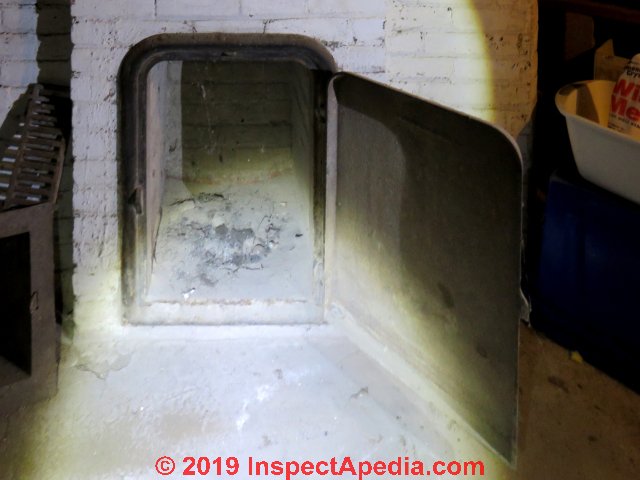
Above: good news for this building and its chimney: we found just a small amount of fireplace debris at this chimney cleanout; I didn't see any red flags.
But at other chimney cleanouts in other buildings shown below the news was not so good. ,
Masonry Fragments and Debris at the Chimney Cleanout May Indicate an Unsafe Chimney
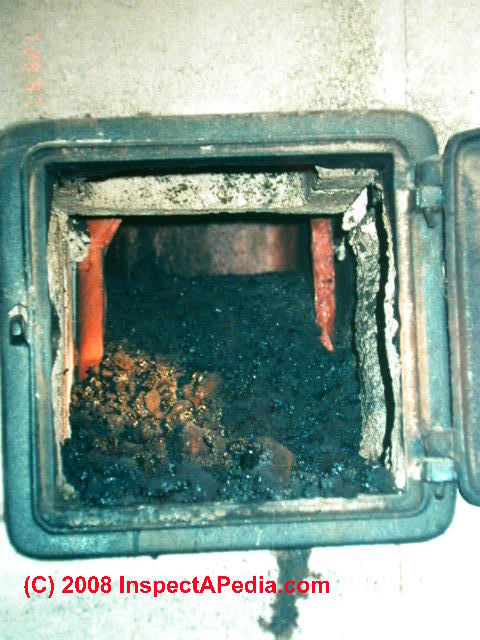
Masonry Flues & Clay Tile Lined Flues: If you open a chimney cleanout-door or pull the flue vent connector from a dead end chimney flue, in either case you are looking at the very bottom of the chimney flue.
If you are inspecting a masonry chimney, be alert for discovery of masonry fragments when inspecting or cleaning the bottom of the flue.
If a piece of brick, masonry block, concrete, or clay flue tile liner is pulled out of your chimney, ask "where do you suppose this came from?" If the masonry scrap fell during construction of the chimney it may mean nothing.
But if it fell because the chimney has been damaged, perhaps by water, frost, or during cleaning, then you probably have an unsafe chimney flue - more investigation is in order, promptly.
Certainly if you believe that the masonry scrap found at the bottom of a flue fell during original construction, and if you remove it during cleaning, you should never find another piece in the flue bottom.
If you do, the flue has been damaged anew and it is unsafe
Our photo shows normal chimney creosote and debris at the bottom of a flue.
When removing this material be alert for surprises such as fragments of clay flue tile liner.
Chimney Cleanout Door Must be Accessible
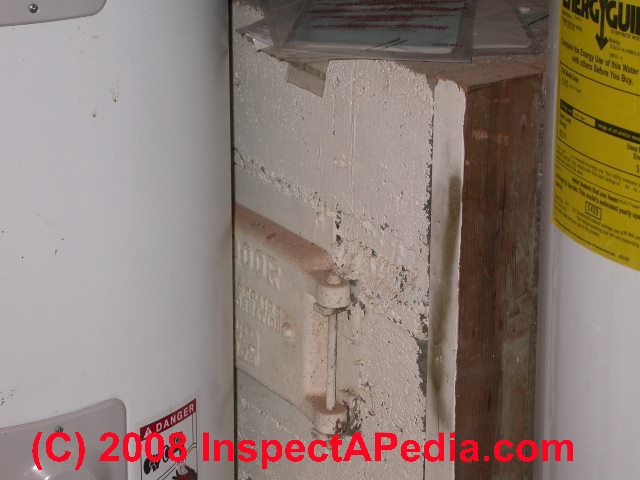
If the chimney cleanout access door is blocked such as by an installed appliance (a water heater in our photo at left) how is someone going to access the flue for inspection or cleanout?
Wait a minute? What's that sitting on the horizontal surface at the top of our photo?
Has an abandoned chimney been partly removed?
It is possible that this is an offset access into a common ash pit.
In some constructions multiple chimney flues may terminate in a single large ash pit with one or more individual cleanout doors.
We suspect that this is an improper design, making regulation of draft among the chimneys difficult, since any individual flue that begins to draw may pull air down and into itself from a neighbor,
Unsafe DIY home made chimney cleanout door closures
If the chimney cleanout door is closed using a permanently-mounted component such as shown in our photo you've got a clue that work was not done by a professional.
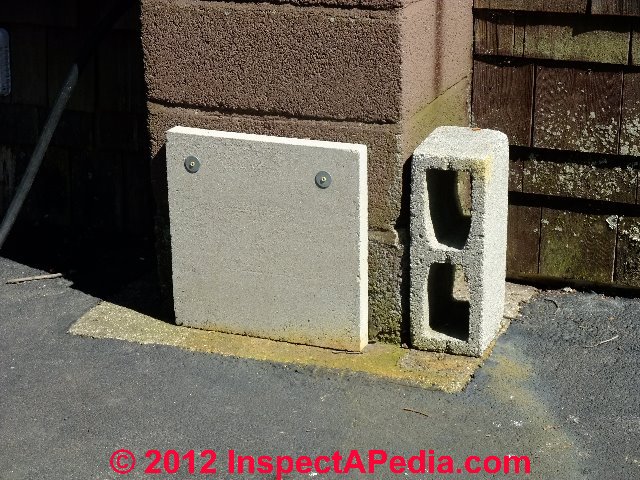
This chimney cleanout closure may be fireproof (really?) and it may stop a draft problem, but it violates the readily-accessible and operable chimney cleanout door requirement.
Chimney Cleanouts on Metal Flues
 Cleanout opening on a metal chimney for an oil fired boiler
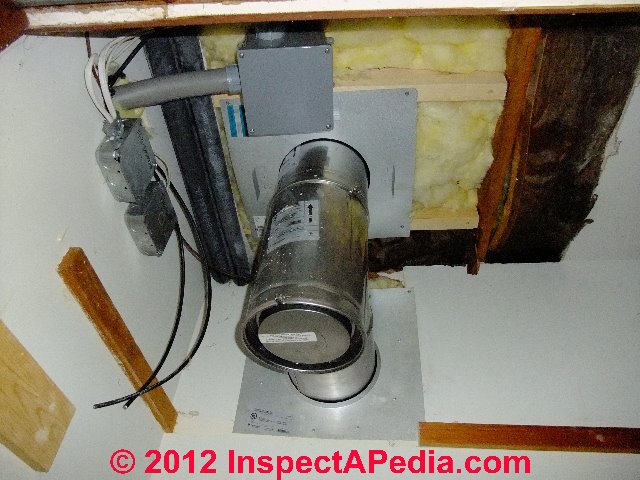
Even a factory-built insulated metal chimney needs to include a cleanout access port.
Here, shown during installation, you can see that this metal chimney includes a removable cleanout door at the bottom of the tee used to turn from horizontal to vertical in the chimney run. This metal chimney vents an oil fired heating boiler. The horizontal tee connects through the wall to a boiler on the other side.
The bottom cap on this chimney could be removed to give a straight-line vertical access into the metal chimney for cleaning or inspection.
This photo of a metal chimney cleanout port was taken during construction - the required drywall (and an access cover through the drywall if the chimney is enclosed) were not yet installed.
Watch out: opening a cleanout at the bottom of a vertical chimney run like this can spill a horrible mess of ash and debris - be prepared, or better, if the horizontal run to the tee is short, vacuum and clean the chimney first through the horizontal chimney run.
In practice this particular tee-bottom cleanout is never used.
The horizontal run through the wall is less than two feet. During oil burner cleaning and service the oil heat technician removes the boiler's flue-vent connector and vacuums out this chimney base through the wall. That avoids spilling soot all over the clothes in the closet.
Cleanout access on a metal chimney for a wood stove
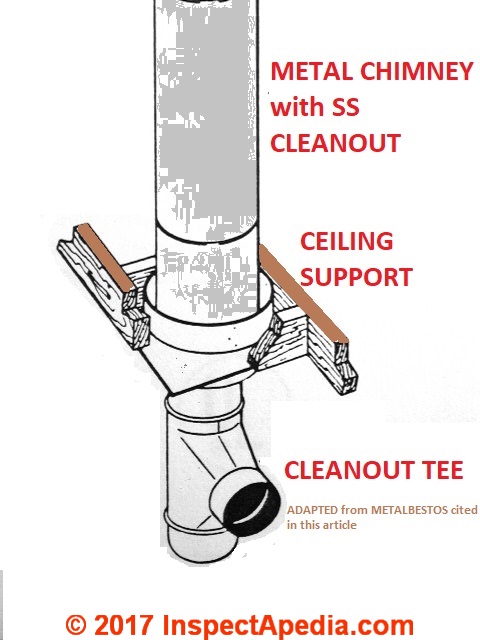
Above in an illustration of a cleanout tee installed in a metal chimney, adapted from information from Metalbestos, the cleanout tee sketch can be confusing so let's elaborate for a wood stove installation.
First you would not install an uninsulated metal chimney or flue vent connector within 36" of a wood frame ceiling (as might be implied in the sketch) though you might be ok with a class A chimney.
Second, which opening is the "cleanout" ?
The black opening gives access to the chimney but I'd prefer to see this tee much lower in the indoor space, right at the woodstove.
Provided there is enough clearance above the floor to access the chimney base, I'd tee the wood stove into the black opening - the horizontal connection, and I'd prefer to use the bottom opening as the cleanout.
Watch out: as I warned above, don't open the bottom cleanout opening on a metal flue without first taking care to control where the falling ash and soot will go.
Also see CLASS A CHIMNEYS, MetalBestos™
Missing Chimney Cleanout Door & Other Chimney Cleanout Opening Hazards
What if there is no cleanout on the woodstove flue?
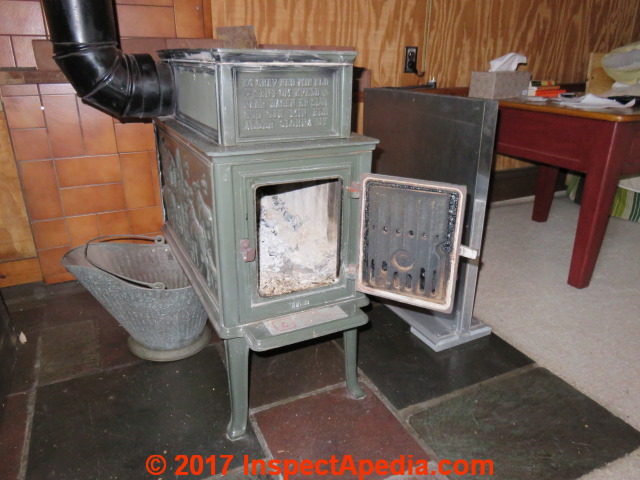
Above, my friend Paul Galow installed this Jotul woodstove - I traded it to him for a Seiko wristwatch - in his New York home.
The black metal flue uses a 90 degree elbow to connect to the vertical riser that's going to pass into an insulated flue that goes through the roof structure.
There is no cleanout door at all. To clean this flue Mr. Galow simply disconnects the elbow from both the wood stove and from the vertical flue section.
Watch out: be sure that the metal chimney is easily accessible for regular inspection and cleaning, either by simple disassembly or through a cleanout opening. Making it inconvenient to inspect and clean a chimney means that this important safety task won't get done. The risk is a fatal building fire.
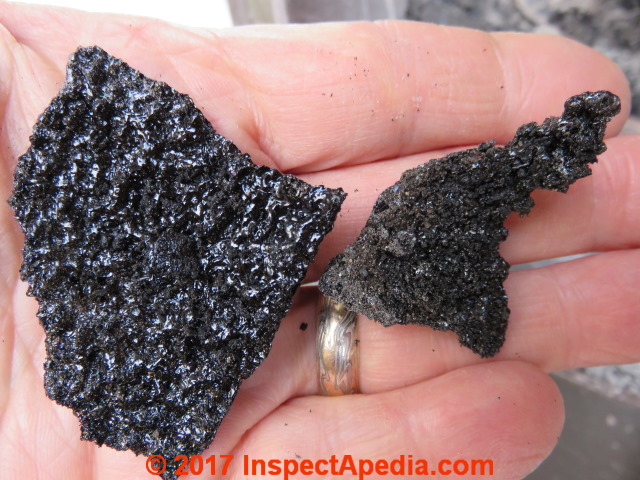
That cleaning this metal flue is a critical safety step is pretty obvious when you see the clots of creosote that we retrieved from the flue. Setting accumulated creosote on fire in a chimney results in a very hot chimney fire that is likely to take down the structure.
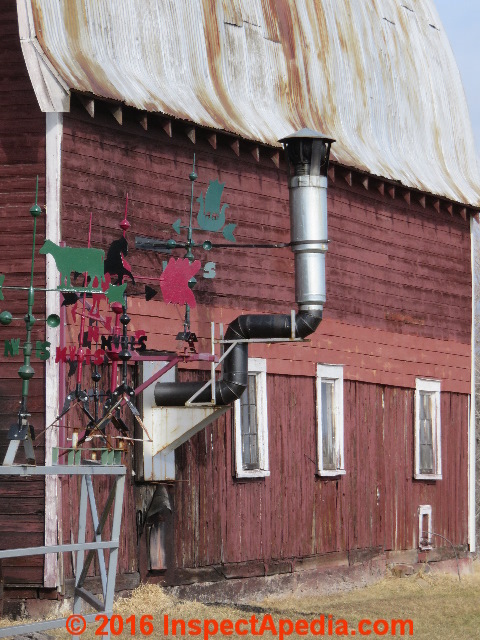
Above: a metal chimney serving a woodstove in an antiques barn along Highway 61, south of Two Harbors, Minnesota. We see three 90's, a rather short flue close top the roof edge, and no cleanout opening.
Paraphrasing Bob Dylan,
Where in hell was that chimney done? God said, "Out on Highway 61"
Air & Ember Leak Openings at the Chimney Cleanout Door
 In this photo the chimney cleanout is easy to find but isn't that door
missing? No not in the first photo at left of this pair of photographs of chimney cleanout doors.
In this photo the chimney cleanout is easy to find but isn't that door
missing? No not in the first photo at left of this pair of photographs of chimney cleanout doors.
But look carefully at the next photo given below.
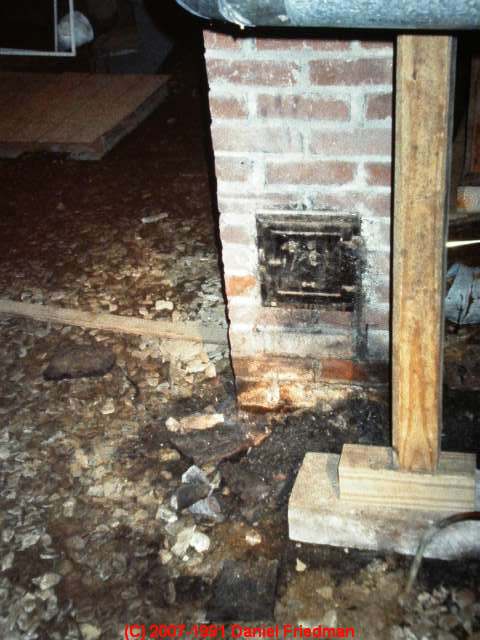
Even though a cleanout door is installed, masonry has fallen out above the door, giving an opening right into the flue.
A missing chimney cleanout door or any other hole in the flue means that there is a fire safety hazard (sparks or ashes falling out onto the basement floor) and also that it is impossible to control the draft in the flue.
Watch out: Where the hole in a chimney is lower than or below the flue vent connector joining the heating appliance to the flue, there is also a serious problem with draft control as well as the risk of sparks or embers falling out of the flue into the interior of the building where they may cause a fire.
Where you can find a chimney cleanout or can remove a flue vent connector to look into a flue, use of a mirror inside the flue to view the flue from below.
This is by no means a thorough and accurate view of all of the chimney flue interior.
But if the chimney was constructed as a straight flue up through the building roof, you should see daylight - otherwise the flue has become blocked, perhaps with nesting animals or collapsing debris.
We have found heating boilers with draft problems and "repair attempts" like removing the boiler's barometric damper, when all the while the root problem of bad chimney draft was that the cleanout door was open or missing.
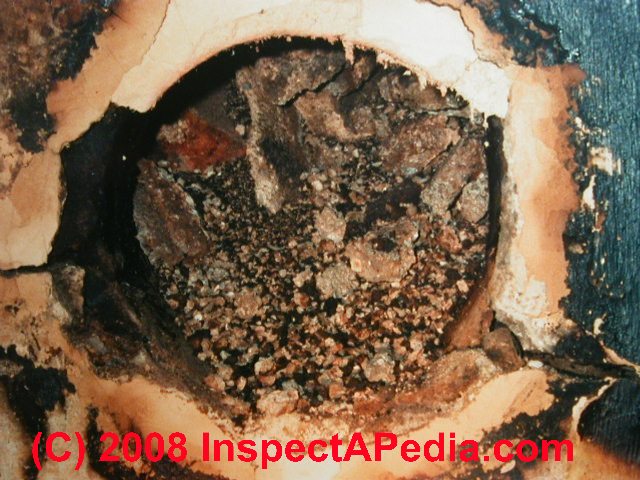
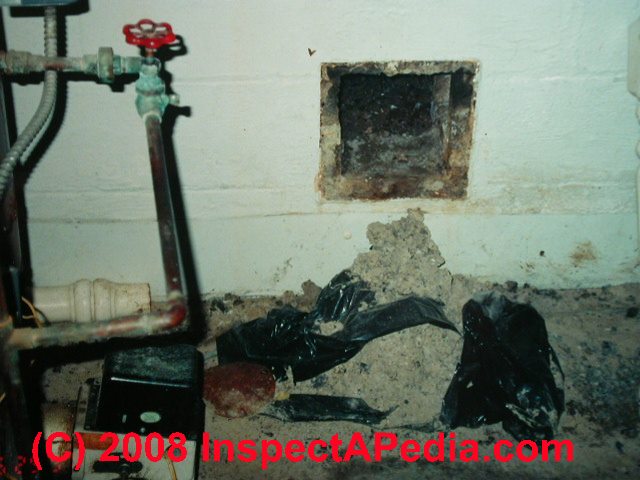
Watch out: Our photo shows a chimney thimble completely blocked by falling debris. If you find this much trash at the bottom of your chimney or at any other chimney opening, you need an expert to evaluate the chimney condition and safety as soon as possible.
The chunks of masonry debris make it likely that the chimney in our photo at left is in very poor condition and is unsafe.
How to Install or Replace a Chimney Cleanout Door
 Question: what kind of cement is used to keep the cleanout door in place on my chimney?
2020/04/13 Peter said:
The Clean-out Door has fallen off my chimney in the basement. I'm going to clean and paint it and put it back in. What do I use as the cement to hold it to the block chimney ?
Reply: steps in installing a new or re-installing a fallen-out chimney cleanout door
Thanks for asking, Peter as that shows me where we need to add information.
Photo: a cast iron chimney cleanout opening door from U.S. Stove Co.
How to Install a Chimney Cleanout Door or Ash Cleanout Door in a Masonry Chimney
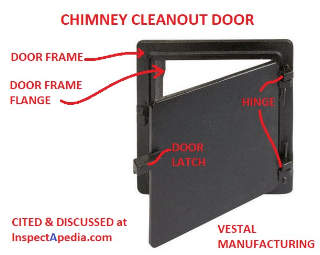
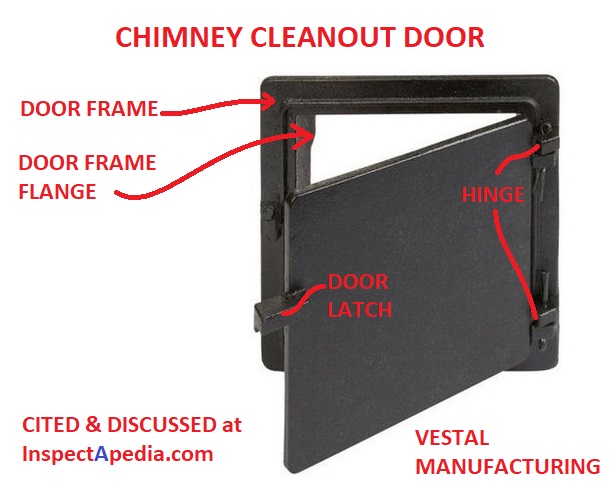
1. Prepare the opening in the chimney base; it should be about 1/2" larger than the inserted-flange portion of the new or replacement cast-iron or steel chimney cleanout door frame - the hinged frame that carries the actual cleanout door.
Measure the outer dimensions of the door flange that will insert into an opening in the chimney, or simpler-still, simply hold the cleanout door against the chimney at the proper location (keep it level) and use a pencil or coarse magic marker to mark the chimney opening.
Your actual opening will be about 1/2" larger in height and width than the outer dimension of the cleanout door insert-flange.
Watch out: by "larger than the insert flange" I'm referring to a protruding flange on the back of the cleanout door frame. Do NOT make the chimney opening larger than the actual door frame width or height. See "DOOR FRAME FLANGE" marked on the illustration above.
Watch out: do not attempt to make an opening or work on a chimney if the chimney is in use nor if it is hot. Doing so is unsafe.
It's best to locate the cleanout opening such as to give easy access to the entire chimney base, close to the bottom of the chimney base and centrally located.
When installing a chimney cleanout door in the chimney base, normally you should not encounter hard-fired clay chimney liner as that material does not normally extend to the the chimney base.
Watch out: But if your cleanout door must be installed in a location where you need to cut through a clay liner, do not pound and hammer on the liner or you'll break it into a mess; instead use a masonry drill and drill 1/2" diameter holes first at the four corners of the opening, then at 1-inch intervals around the opening so that you can gently tap with a cold chisel to break away the clay liner to give the necessary rectangular opening.
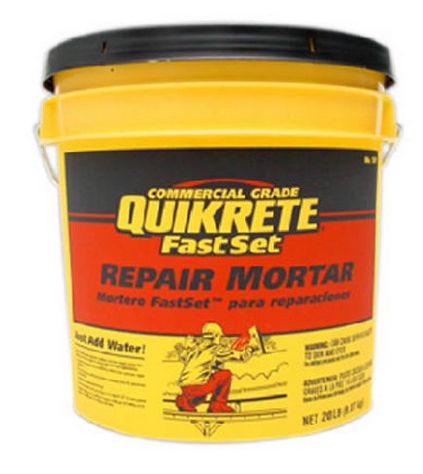
2. To secure the cleanout door in place use a mortar mix, prepared to the consistency of thick mud. Don't add more water than necessary or you'll weaken the mortar unnecessarily.
For a small job like this it's best to simply buy a prepared mortar mix or even a small tub of mortar such as the Quikrete FastSet repair mortar illustrated here.
3. Trowel mortar onto the bottom and sides of the cleanout door opening, at a thickness of about 1/4". You can be a bit generous;
4. Trowel additional mortar mix onto the upper surface of the upper chimney cleanout door frame flange that will be inserted into the chimney opening. Optionally trowel a bit more mortar onto the side flanges.
5. Press the cleanout door frame into the mortared opening (the door itself should be closed and latched into its frame at this point) and
prop a 2x4 or similar object against the door to hold it securely in place for 24 hours or longer to allow the mortar to set solid.
Watch out: before inserting the chimney or ash pit cleanout door into the rough opening in the chimney base, be sure that you have it in the desired position - it may be more convenient to have the door open to your left or right, depending on whether or not there are nearby obstructions. Also I like the writing on the door to be upright.
You should see some mortar ooze out around all four sides of the cleanout door as you press it into place. It's fine to use your trowel to remove this excess mortar as well as any that spilled onto the floor.
6. Seal the door frame against the chimney when the chimney cleanout door and its frame have set soundly for 24 hours or more, remove the prop and seal the door frame to the chimney surface..
Use a masonry sealing caulk or sealant (about 1/2" thick) around the chimney cleanout door frame at the juncture of frame to face of the chimney base.
This additional seal improves the air-tightness of the cleanout door and thus reduces the chance that a leaky chimney cleanout opening causes inadequate chimney draft.
7. Clean up debris: When the mortar is hard and dry, if needed, working carefully so as not to disturb the door, open it on its hinges, keeping the frame in place - so that you can clean up debris that fell into the chimney base.
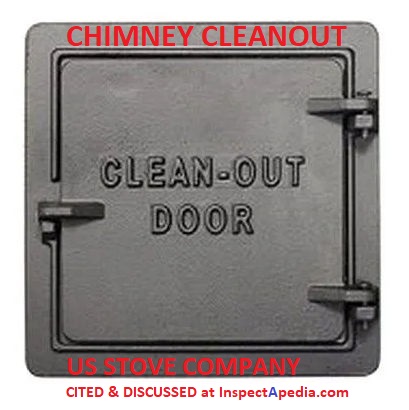
Above: a cast-iron ash cleanout door as sold by Menards (Vozelzang 8" x 8" Cleanout Door), and by U.S. Stove and many other vendors.
How to Seal a Leaky Chimney Cleanout Door
 Reader Question: can I fill in the old chimney to stop drafts?
11/29/2014 Dazy said:
I have a gas insert now in my old fireplace. May I , and how can I fill the old chimney cleanout because I get a lot of cold draft from it?
Reply: Sealing the Cleanout Door on an Abandoned Chimney
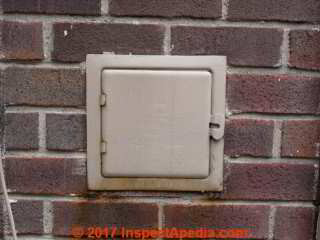
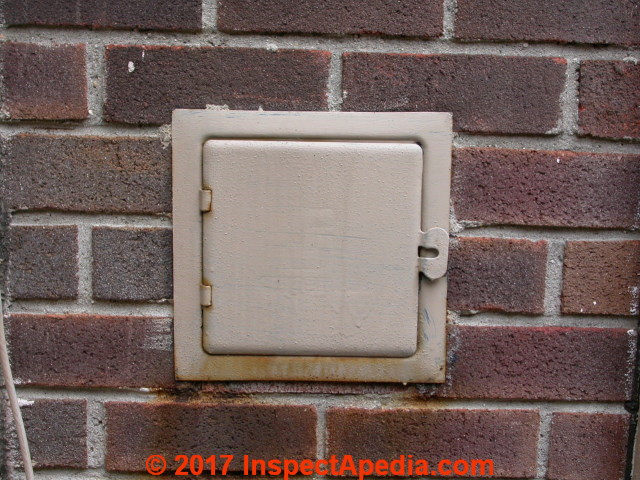
Above: an outdoor chimney cleanout door in good condition but sporting a clue (stains at the door bottom) that water has been running down this chimney interior: there is a risk of hidden damage and of an unsafe flue.
Dazy
If there is not already a screened chimney cap over the flue serving the abandoned fireplace, and if there is safe easy access to the rooftop or if you can arrange for service by a chimney sweep, placing a solid cover over the chimney top has the advantage of keeping animals from nesting in the chimney and also protecting it from future rain and water damage.
From inside the fireplace be sure that the fireplace damper is un-damaged (not broken, missing, perforated by rust) and place it in the closed position.
At the chimney cleanout door some readers describe using a high temperature silicone sealant (caulk) or high temperature refractory cement to seal off the door.
I appreciate the inclination for that simple approach but worry that some work would be needed in the future should it be necessary to return the old flue to service or to access and clean out the chimney base.
If you do decide to seal around the door, clean the surfaces of loose rust and dirt. Then wipe the surfaces clean of remaining dust before applying your bead of high temperature silicone exterior grade sealant around the edges of the cleanout door. That way the sealant can be easily cut away if future access is needed.
Watch out: be sure that your new gas-fueled fireplace insert is installed according to the manufacturer's specifications, all of them, including provision of combustion air and as required, exhaust.
A gas fireplace that is not properly installed can produce dangerous, even fatal carbon monoxide gas. Be sure that you have working CO detectors properly installed.
Seal a Leaky Chimney Cleanout Door where the Flues are In Use
 Watch out: before sealing a chimney cleanout door shut, be sure that the door serves only the chimney or flue that is being abandoned. Do not use sealant to caulk-shut the cleanout door of a chimney that is in active use, as you'll need to be able to open the door later to inspect or clean the chimney base.
Some chimneys use a common cleanout area in the base of a chimney that contains multiple flues.
In that case that's another reason that you can't seal the door as it is still needed.
But you can improve the cleanout-door's sealing closure by making sure it fits tightly and if necessary adding a thin coating of silicone on the door face and its meeting surface on the door frame. Let the silicone sealant dry on those surfaces before closing the door and returning the chimney to service.
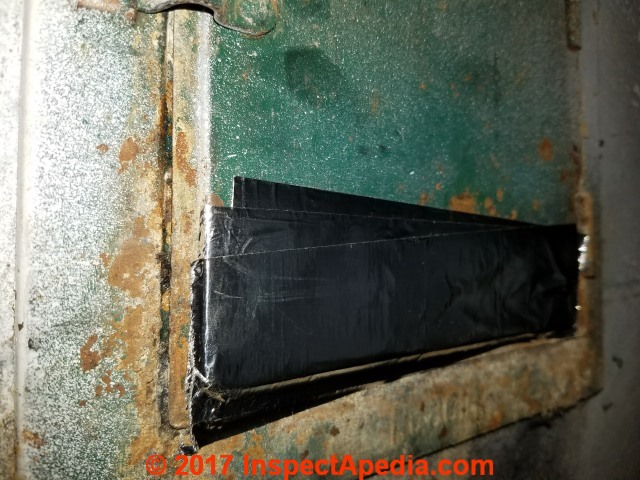
Above: we used multiple layers of metal adhesive-backed tape to seal the bottom of this rust-damaged chimney cleanout door on a home in Two Harbors Minnesota.
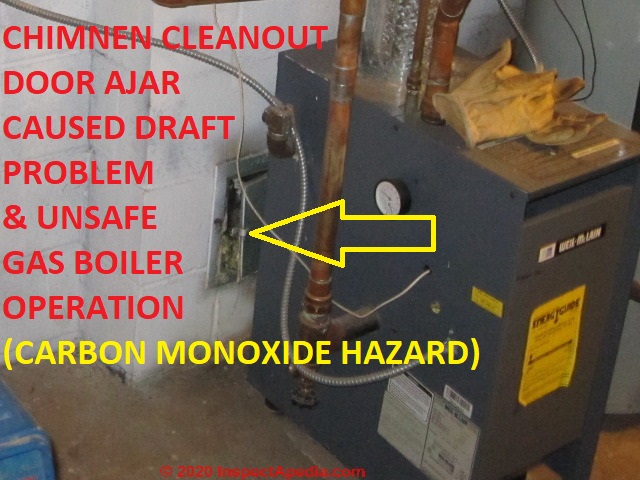
Watch out: a previous heating system inspection by a heating service company had condemned the home's cast-iron gas fired heating boiler because the inspector detected a trace of carbon monoxide (CO) gas spillage at the boiler flue draft-hood.
More-happily, working together with another service technician from the same company we found that behind the boiler the cleanout door for the boiler's chimney flue was ajar and that the chimney cleanout door itself was rust-perforated.
Combined with servicing and cleaning the boiler we cleaned out years of soot and crud from the bottom of this flue, repaired the door with multiple layers of metal tape, and closed the cleanout. The carbon monoxide gas hazard completely disappeared and the boiler was saved to heat another day.
Chimney Ash Cleanout Door Sources & Resources - Where to Buy
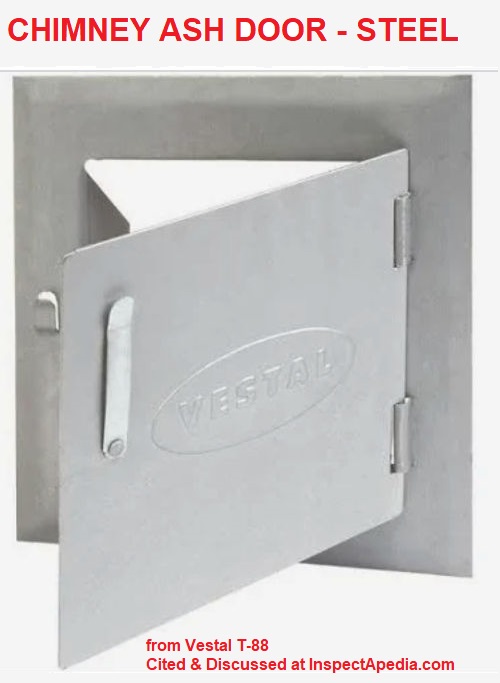
Above: the Vestal steel chimney cleanout door sold by various vendors & cited in more-detail below. Black Galvanized Cast Iron Cleanout Door like one shown earlier on this page and in other models and sizes shown below, are sold by a variety of building suppliers, fireplace and woodstove suppliers, and hardware stores as well as by online vendors that we will list here.
The cost of a typical chimney cleanout opening cover is in the $25 - $45. range depending on material and quality. Cleanout doors for chimneys are sold made of cast-iron, concrete, or steel. The door must be non-combustible and must be sealed well into the chimney opening so as not to leak air that can reduce chimney draft.
Chimney cleanout door rough opening dimensions and actual door opening dimensions vary depending on the door and door frame or mount materials, model, and manufacturer.
Typical cleanout doors fit into a chimney rough opening of these dimensions:
- 8" x 8"
- 8" x 12"
- 10" x 10"
- 12" x 16"
- 14" x 18"
The larger dimension for these clean-out doors can be in the vertical or horizontal position but take care to note the door model and its hinge location. A non-square chimney cleanout door with hinges on one side can not be simply flipped from horizontal to vertical.
For some doors that do not mount using a flange onto the chimney face, the door is sealed into the chimney opening using a 3/8" wide mortar bed.
- Chimney cleanout doors are sold by building supply stores (Ace hardware stores, Lowes, Home Depot, Menards, Walmart, Zoro), by fireplace and woodstove suppliers and stores, by masonry suppliers, and also by online vendors like Amazon and eBay.
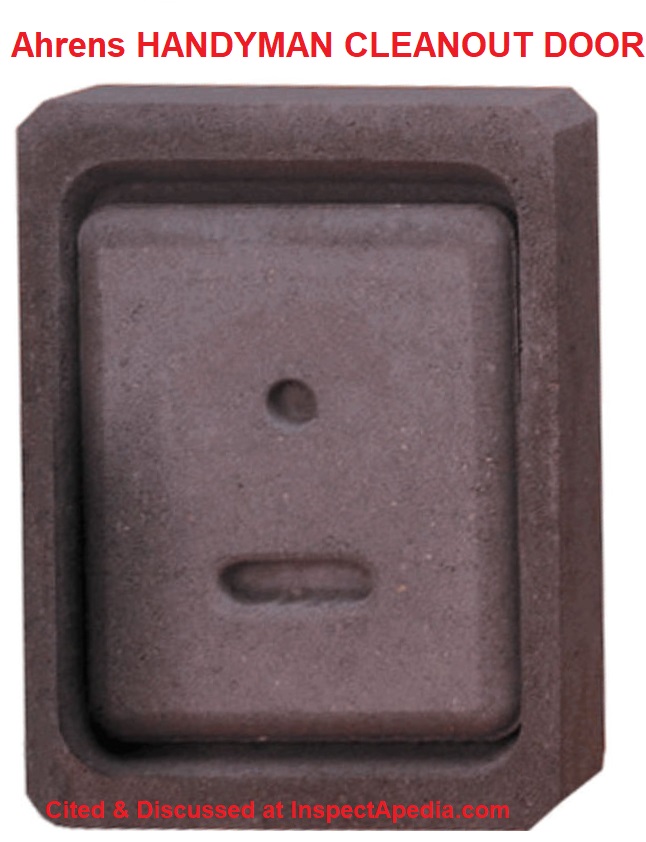
Above: the Ahrens "Large" masonry clean-out door for chimneys (Ahrens #30108), is set into a chimney opening sized to 11 5/8" x 15 5/8" and provides an accessible cleanout opening of 6 3/4" x 10 1/4" when the access door is lifted out.
A smaller version of this masonry clean-out door is sold in a model (Ahrens #30106) that fits into a chimney opening sized to 7 1/2" x 10 1/2" and provides an accessible cleanout opening of 5 1/8" x 7" when the access door is lifted out.
- Ahrens Masonry Cleanout Doors (just above) are sold by masonry suppliers and fireplace/ woodstove suppliers and by Walmart, in the $110 - $140. price range. These chimney cleanouts include a concrete surround intended to be set into a chimney opening using Type N mortar along with a bonding agent such as Mor-Bond. Using the proper type of mortar reduces the risk of cracking and of a loose, leaky chimney cleanout access door.
Contact Ahrens:
Ahrens Chimney Technique Inc. 2000 Industrial Avenue, Sioux Falls, SD 57104 USA, Tel: Sales & Technical 1-800-843-4417 - Email: ahrenschimney@qwestoffice.net Web :https://www.ahrenfire.com
See this Handyman CLEANOUT DOOR INSTALLATION INSTRUCTIONS [PDF]
 ...
... 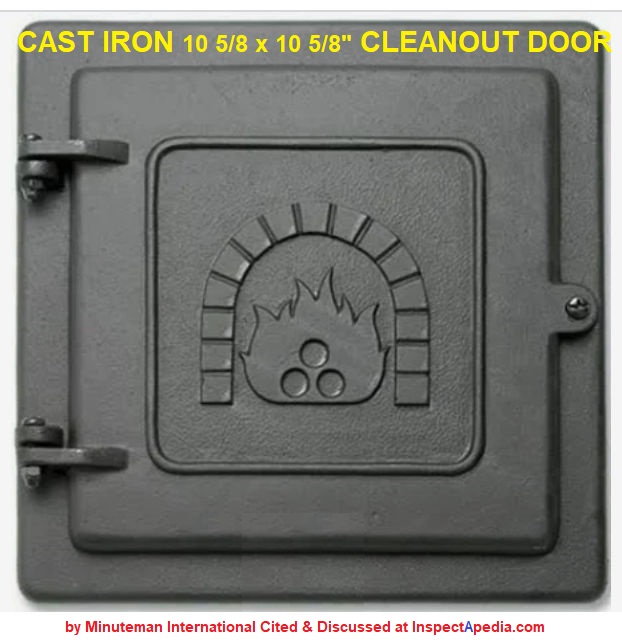
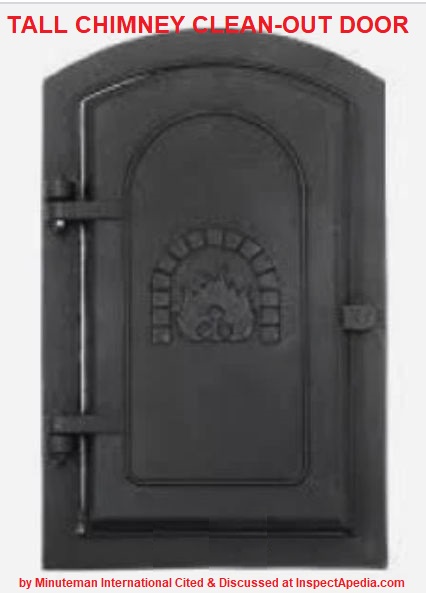
- The Minuteman International cast-iron chimney clean-out doors shown immediately above are sold by Woodland Direct, Wayfair, and Walmart, and are sold in both the usual square model (10 5/8" x 10 5/8") and also in a tall model (8" x 12") giving a larger access opening that may be useful in some more-narrow chimney cleanout locations.
Minuteman International Company is a supplier to suppliers of fireplace items & wood stoves.
Watch out: the identical chimney cleanout door among these vendors varies significantly in price by model, by vendor, and also in shipping cost.
In April 2022 we saw this door listed at prices from about $65. to $165. U.S. - U.S. Stove Co., Tel: 1-423-837-2100 Website: www.usstove.com
- Vestal Manufacturing, P.O. Box 420, Sweetwater, TN 37874
USA, Tel: 1-800-456-9562 Email: vestal@vestalmfg.com Website: https://www.vestalmfg.com - shown just above, Vestal steel chimney ash door model ST-88.
Chimney cleanout doors by Vestal Manufacturing include the company's cast iron ash door Vestal #4507497 and also a steel cleanout door shown above, Vestal #ST-88.
Reader Comments, Questions & Answers About The Article Above
Below you will find questions and answers previously posted on this page at its page bottom reader comment box.
Reader Q&A - also see RECOMMENDED ARTICLES & FAQs
On 2020-10-20 by (mod) - open chimney cleanout door leads to dangerous gas fired boiler operation
 Nancy
Nancy
The proper and safe repair is to replace the cleanout door entirely; that's the most fire-safe step to take and it's not technically difficult, though a bit of minor masonry may be involved.
As we illustrate just above, or minor damage to a steel chimney cleanout door, I have made emergency repairs by cleaning a rust hole in the door and covering that with several layers of metal foil tape.
That stops openings that can cause insufficient draft that in turn can make the heating system dangerous - unsafe.
Watch out: To underscore just how serious an open or rust-holed chimney cleanout door or opening cover can be, take a look at the two photographs I provide below. These are of the same cleanout door as is shown above repaired with foil tape and latched shut.
This cleanout door had been left ajar for months or longer.
A heating service company observed flue gas spillage at the gas fired boiler that vents into this chimney - a condition that can dump fatal carbon monoxide gas into the building interior.
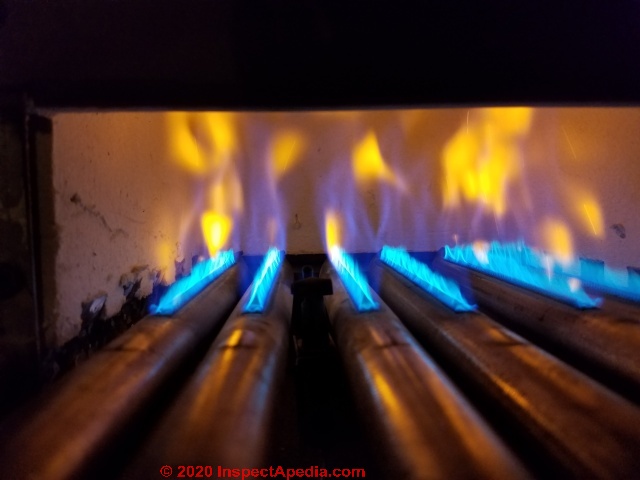
We also saw that the gas burner flame contained a lot of yellow, suggesting a dirty burner, adjustment error, or combustion air or draft problem.
We repaired this unsafe gas boiler by cleaning the burner and closing the chimney cleanout-door, a step that corrected an inadequate chimney draft.
The heating service technician, before we found the open chimney cleanout, had been of the opinion that the boiler would have to be replaced. But it made sense to first diagnose the cause of flue gas spillage to be sure the issue was the boiler and not an external problem (like inadequate draft).
Review the condition of your heating equipment, the cleanout door and the condition and safety of the chimney itself with your heating service company - you may also need to hire a professional chimney sweep; she can both inspect the flue and replace the door if needed.
On 2020-10-20 by Nancy
My clean out door has some rust and holes. Is there a way to repair it, or can I put something on it outside, to cover the holes? Thank you so much.
On 2020-09-18 - by (mod) -
Try Making the chimney opening size smaller using a bit of mortar mix
On 2020-09-18 by Bruce
Hi -- I need to replace two clean out doors, but I can't find them in a 9" wide by 7" high size (the insert). Any idea where I could find replacements. Following on that, what do you recommend I do — adapt a different size door? And what would I need to do to adapt it? I can get 8" x 8" doors at my local True Value.
On 2020-08-06 - by (mod) -
Have you checked outside for a surface drainage that is running towards the chimney?
On 2020-08-06 by Becky
Having water coming in the around the chimmy clean out. Also water is coming in through the cemter blocks
On 2020-04-14 - by (mod) -
Thank you for asking a very helpful question, Peter.
Please see your question repeated and my detailed reply now found in the article above
at INSTALL or REPLACE CHIMNEY CLEANOUT DOOR
https://inspectapedia.com/chimneys/Chimney_Cleanout_Opening.php#InstallDoor
You may need to clear or refresh your browser cache to see the updated page.
Don't hesitate to offer criticism or ask questions.
On 2020-04-14 by Peter
The Clean-out Door has fallen off my chimney in the basement. I'm going to clean and paint it and put it back in. What do I use as the cement to hold it to the block chimney ??
Thanks
On 2020-03-01 - by (mod) -
Brooks
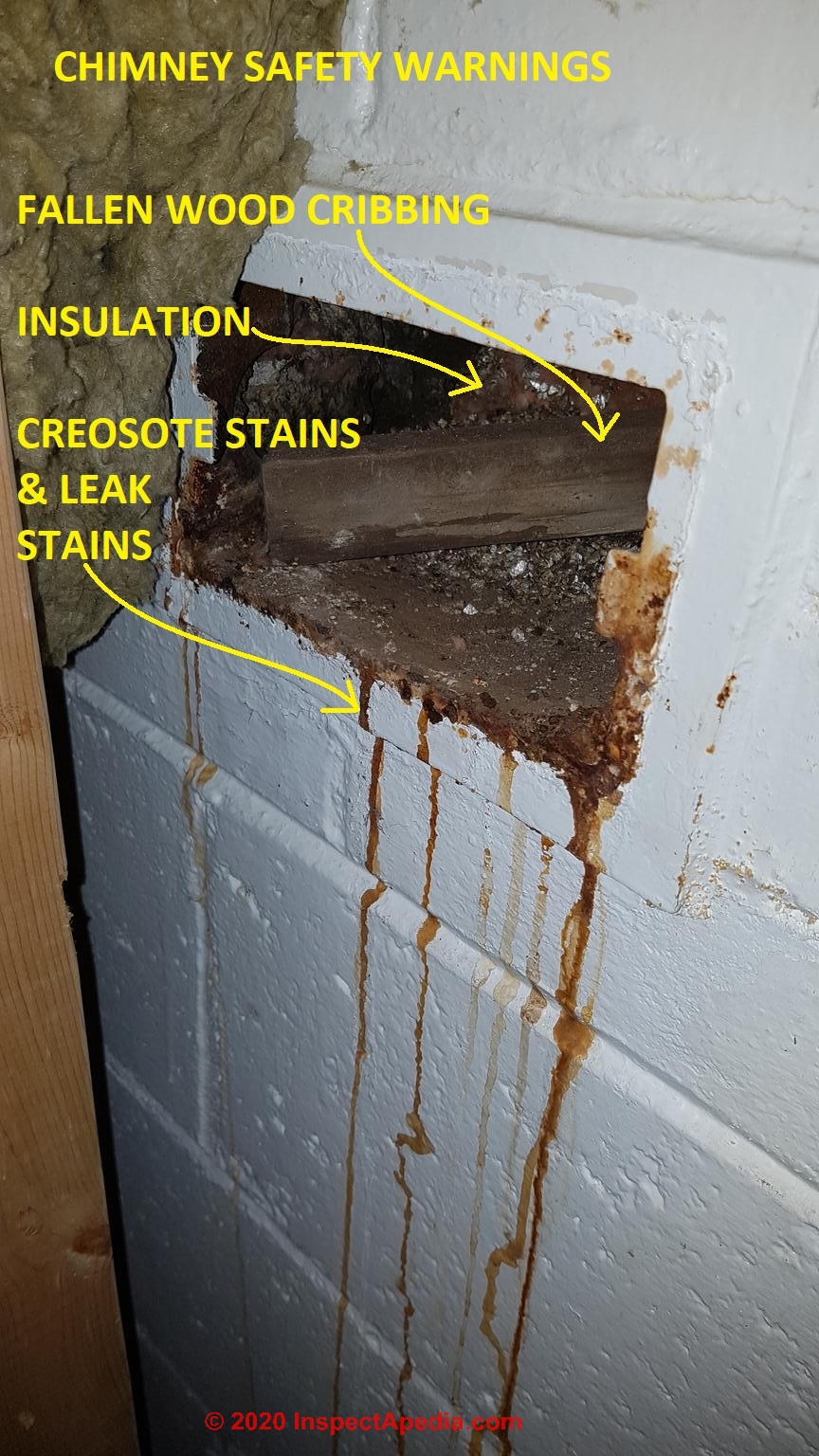 In your photo I see
- water leaking out of what appears to be a chimney cleanout opening, probably near the chimney base - water would enter the chimney at a bad or missing cap or at other points of damage anywhere on the chimney exterior, even below ground at the building foundation;
Further inspection to find and fix the leak makes sense not just because you don't want a chimney collapse but also to be sure we're not sending water into the building elsewhere risking other water or moisture or mold damage
- a scrap of wood that raises a concern that a fireplace or other chimney component was not properly constructed and has collapsed - meaning that if there's a fireplace it may be unsafe to use;
- what looks like fiberglass insulation to one side of the cleanout opening
- no closure door on the cleanout opening - the chimney would not work properly nor safely for any purpose
If there is anything else using this chimney - such as a fireplace - stop using it and have the chimney interior and exterior inspected by a professional such as a certified chimney sweep.
Let me know what you're told and we can comment further.
On 2020-02-29 by Brooks
What is this debris? My brick chimney is no longer used as my HVAC system is vented directly through the wall. There's a cap on the top of the chimney that was placed when the new furnace was installed in 2014
On 2019-12-26 - by (mod) -
Building a fire in the clean-out opening of a chimney is unsafe in several regards. It's also of course illegal. Don't do it.
On 2019-12-25 by Joe
My clean out is in my garage. Can I have a small 🔥 in there, to heat my garage when I'm in there working?
...
Continue reading at CHIMNEY CLEANOUT CLEARANCE to COMBUSTIBLES or select a topic from the closely-related articles below, or see the complete ARTICLE INDEX.
Or see CHIMNEY CLEANOUT DOOR FAQs - questions & answers posted originally at this article
Or see these
Recommended Articles
- DRAFT REGULATOR SOOT INSPECTION for another spot where it may be possible to inspect for clues about the condition of a chimney and its safety.
- CHIMNEY CLEANOUT CLEARANCE to COMBUSTIBLES
- CHIMNEY CLEANOUT DOOR
- CHIMNEY DRAFT & PERFORMANCE
- CHIMNEY INSPECTION DIAGNOSIS REPAIR - home
- CHIMNEY STAINS & LEAKS
- CREOSOTE HAZARDS
- CREOSOTE ODOR CURE / REMOVAL
- DRAFT MEASUREMENT, CHIMNEYS & FLUES
Suggested citation for this web page
CHIMNEY CLEANOUT DOOR at InspectApedia.com - online encyclopedia of building & environmental inspection, testing, diagnosis, repair, & problem prevention advice.
Or see this
INDEX to RELATED ARTICLES: ARTICLE INDEX to CHIMNEYS & FLUES
Or use the SEARCH BOX found below to Ask a Question or Search InspectApedia
Ask a Question or Search InspectApedia
Try the search box just below, or if you prefer, post a question or comment in the Comments box below and we will respond promptly.
Search the InspectApedia website
Note: appearance of your Comment below may be delayed: if your comment contains an image, photograph, web link, or text that looks to the software as if it might be a web link, your posting will appear after it has been approved by a moderator. Apologies for the delay.
Only one image can be added per comment but you can post as many comments, and therefore images, as you like.
You will not receive a notification when a response to your question has been posted.
Please bookmark this page to make it easy for you to check back for our response.
Our Comment Box is provided by Countable Web Productions countable.ca
Citations & References
In addition to any citations in the article above, a full list is available on request.
- NFPA 211 - Standards for Chimneys & Fireplaces, NFPA 211: Standard for Chimneys, Fireplaces, Vents, and Solid Fuel-Burning Appliances, 2006 Edition (older editions and standards are found at the same bookstore)
- NFPA #211-3.1 1988 - Specific to chimneys, fireplaces, vents and solid fuel burning appliances.
- NFPA # 54-7.1 1992 - Specific to venting of equipment with fan-assisted combustion systems.
- GAMA - Gas Appliance Manufacturers' Association has prepared venting tables for Category I draft hood equipped central furnaces as well as fan-assisted combustion system central furnaces.
- National Fuel Gas Code, an American National Standard, 4th ed. 1988 (newer edition is available) Secretariats, American Gas Association (AGA), 1515 Wilson Blvd., Arlington VA22209, and National Fire Protection Association (NFPA), Batterymarch Park, Quincy MA 02269. ANSI Z223.1-1988 - NFPA 54-1988. WARNING: be sure to check clearances and other safety guidelines in the latest edition of these standards.
- Fire Inspector Guidebook, A Correlation of Fire Safety Requirements Contained in the 1987 BOCA National Codes, (newer edition available), Building Officials and Code Administrators International, Inc. (BOCA), Country Club HIlls, IL 60478 312-799-2300 4th ed. Note: this document is reissued every four years. Be sure to obtain the latest edition.
- Uniform Mechanical Code - UMC 1991, Sec 913 (a.) Masonry Chimneys, refers to Chapters 23, 29, and 37 of the Building Code.
- New York 1984 Uniform Fire Prevention and Building Code, Article 10, Heating, Ventilating, and Air Conditioning Requirements
- New York 1979 Uniform Fire Prevention & Building Code, The "requirement" for 8" of solid masonry OR for use of a flue liner was listed in the One and Two Family Dwelling Code for New York, in 1979, in Chapter 9, Chimneys and Fireplaces, New York 1979 Building and Fire Prevention Code:
- "Top Ten Chimney (and related) Problems Encountered by One Chimney Sweep," Hudson Valley ASHI education seminar, 3 January 2000, contributed by Bob Hansen, ASHI
- Chimney Inspection Checklist, Carson Dunlop, Associates, Toronto, Ontario
- "Rooftop View Turns to Darkness," Martine Costello, Josh Kovner, New Haven Register, 12 May 1992 p. 11: Catherine Murphy was sunning on a building roof when a chimney collapsed; she fell into and was trapped inside the chimney until rescued by emergency workers.
- "Chimneys and Vents," Mark J. Reinmiller, P.E., ASHI Technical Journal, Vol. 1 No. 2 July 1991 p. 34-38.
- Natural Gas Weekly Update: http://tonto.eia.doe.gov/oog/info/ngw/ngupdate.asp Official Energy Statistics from the U.S. Government
- US Energy Administration: Electrical Energy Costs http://www.eia.doe.gov/fuelelectric.html
- Chimney & Stack Inspection Guidelines, American Society of Civil Engineers, 2003 - These guidelines address the inspection of chimneys and stacks. Each guideline assists owners in determining what level of inspection is appropriate to a particular chimney and provides common criteria so that all parties involved have a clear understanding of the scope of the inspection and the end product required. Each chimney or stack is a unique structure, subject to both aggressive operating and natural environments, and degradation over time. Such degradation may be managed via a prudent inspection program followed by maintenance work on any equipment or structure determined to be in need of attention. Sample inspection report specifications, sample field inspection data forms, and an example of a developed plan of a concrete chimney are included in the guidelines. This book provides a valuable guidance tool for chimney and stack inspections and also offers a set of references for these particular inspections.
- Fireplaces, a Practical Design Guide, Jane Gitlin
- Fireplaces, Friend or Foe, Robert D. Mayo
- NFPA 211 - Standards for Chimneys & Fireplaces, NFPA 211: Standard for Chimneys, Fireplaces, Vents, and Solid Fuel-Burning Appliances, 2006 Edition (older editions and standards are found at the same bookstore)
- NFPA 211 - Standards for Chimneys & Fireplaces, NFPA 211: Standard for Chimneys, Fireplaces, Vents, and Solid Fuel-Burning Appliances, 2006 Edition (older editions and standards are found at the same bookstore)
- Principles of Home Inspection: Chimneys & Wood Heating, in (Principles of Home Inspection), Carson Dunlop, Associates, Toronto, Ontario
- NFPA 211 - 3-1.10 - Relining guide for chimneys
- NFPA 211 - 3-2 - Construction of Masonry Chimneys
- NFPA 211 - 3-3 - Termination Height for chimneys
- NFPA 211 - 3-4 - Clearance from Combustible Material
- NFPA 54 - 7-1 - Venting of Equipment into chimneys
- Brick Institute of America - Flashing Chimneys
Brick Institute of America - Proper Chimney Crowns
Brick Institute of America - Moisture Resistance of Brick - American Gas Association - New Vent Sizing Tables
- Chimney Safety Institute of America - Chimney Fires: Causes, Effects, Evaluation
- National Chimney Sweep Guild - Yellow Pages of Suppliers
- In addition to citations & references found in this article, see the research citations given at the end of the related articles found at our suggested
CONTINUE READING or RECOMMENDED ARTICLES.
- Carson, Dunlop & Associates Ltd., 120 Carlton Street Suite 407, Toronto ON M5A 4K2. Tel: (416) 964-9415 1-800-268-7070 Email: info@carsondunlop.com. Alan Carson is a past president of ASHI, the American Society of Home Inspectors.
Thanks to Alan Carson and Bob Dunlop, for permission for InspectAPedia to use text excerpts from The HOME REFERENCE BOOK - the Encyclopedia of Homes and to use illustrations from The ILLUSTRATED HOME .
Carson Dunlop Associates provides extensive home inspection education and report writing material. In gratitude we provide links to tsome Carson Dunlop Associates products and services.
 | HOME | ABOUT | ASK a QUESTION | CONTACT | CONTENT USE POLICY | DESCRIPTION | POLICIES | PRIVACY | |
| © 2024 - 1985 Publisher InspectApedia.com - Daniel Friedman | |||||||||