
InspectAPedia® FREE Encyclopedia of Building & Environmental Construction, Diagnosis, Maintenance & Repair |
Question? Just ask us! InspectAPedia
|
 Chimney Top Extensions to Improve Draft & Chimney Performance
- POST a QUESTION or COMMENT about extensions to chimney height at the rooftop: how do we correct a chimney that is too short? What sorts of chimney top extensions are proper and what others are improper or even unsafe?
When, why & how to extend the height of a chimney:
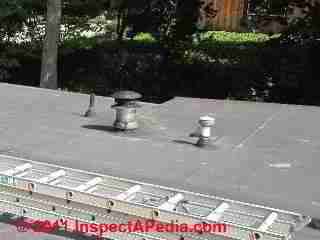
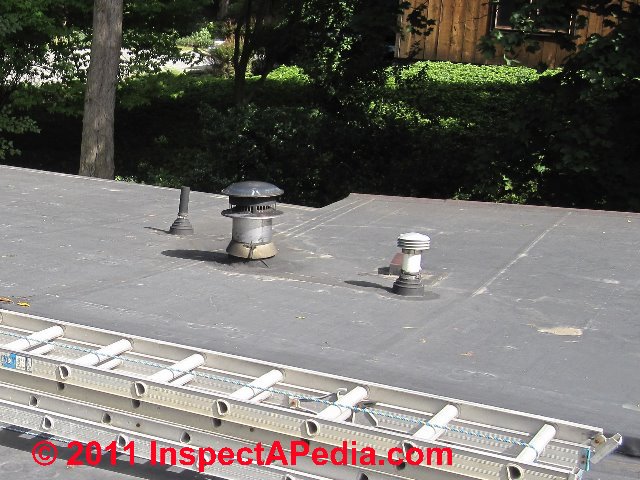
This article describes methods of extending the height of a chimney above a rooftop to improve chimney draft and performance and also to improve fire safety. Our page top photo shows a too-short metal chimney serving an oil fired heating boiler.
This website provides detailed suggestions describing how to perform a thorough visual inspection of chimneys for safety and other defects. Chimney inspection methods and chimney repair methods are also discussed.
InspectAPedia tolerates no conflicts of interest. We have no relationship with advertisers, products, or services discussed at this website.
Chimney Extensions for Improving Chimney Draft
 A chimney that is too short is unsafe, risking a building fire from sparks or heat, and it often is also a source of poor venting, resulting in bad draft, heating equipment malfunction and even unreliable or unsafe building heating.
[Click to enlarge any image]
Often the repair for a too-short chimney or flue, whether masonry or metal, is simply to extend the chimney to the proper height above the building rooftop.
But chimney height extensions must be properly designed, connected, or installed, or the result can be leaks into the structure or an ineffective chimney height extension that doesn't work or worse, is unsafe. Here we illustrate improper and unsafe chimney height extensions.
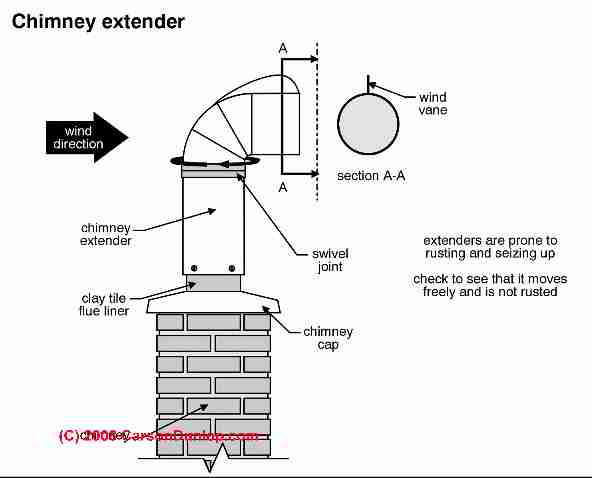
A chimney extension may be added, often combined with a rain cap that makes sure the chimney faces away from the direction of incoming wind, in order to improve chimney performance.
Sketch courtesy of Carson Dunlop.
Here is an odd case of a chimney rain capOn a metal flue sent through a single-brick wythe old unlined chimney which has no crown at its top. This is not a properly installed chimney extension nor a reliable chimney relining job.
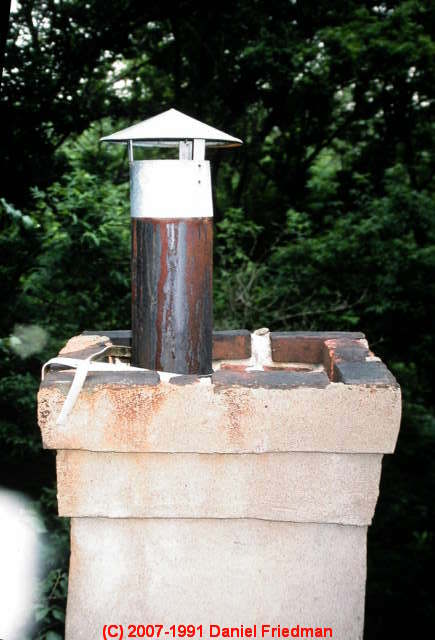 Water continues to run down this flue in wet weather, and we're not going to have a very confident opinion about the safety of that old metal flue either as it's not stainless steel and is likely to be rust-damaged.
Also, unless we can see into this chimney, we don't know if the rusty, questionable metal flue extends fully down through the building.
Watch out.
Sometimes the metal "flue liner" you see projecting up out of a masonry chimney is a little shortcut: a metal flue extender may have been installed just at the chimney top.
Is this a safe "chimney extension or chimney relining job"?
When a masonry flue has been damaged and is unsafe, a chimney sweep or repair company may propose chimney re-lining to improve the chimney's safety and performance.
Actually from outside we're not sure what we're going to find at this property. Is this an attempt to "re-line" a bad chimney flue or was it an attempt to vent some other heating appliance up and out through an existing chimney?
Is the chimney in use by two different heating systems or just one?
A professional chimney re-lining operation would have not left a chimney like the one shown here using easily rusted steel, no protection from weather or animals at the top, flimsy mounting of the metal flue, possibly an under-sized flue, possibly an unsafe sharing of a chimney between two different heating systems or sources.
The owner or inspector should be very nervous about this installation and should investigate it further.
Chimney Height Extensions to Clear Neighbouring Buildings
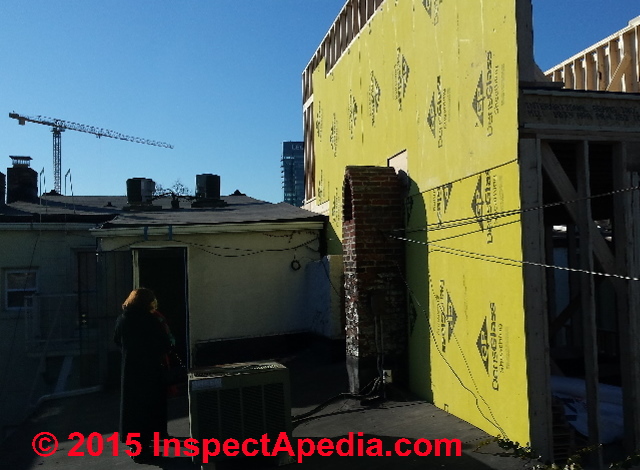 Reader Question:
My mother's neighbor built a building that is one story taller than hers with no separation between the buildings - the taller building is dwarfing her chimney (which vent the heating system and hot water tank) - is there anything she can do to prevent the lack of air flow?
I have an attached a picture. [Click to enlarge any image]
Despite a number of initial responses substantiating the problem, the city has decided to ignore the potential dangers and my mother is very concerned for the people who live in the apartments as well future sanctions by the city if at some point they decided that her chimney doesn’t meet code.
If you could advise us as to how to remedy the situation – specifically is there some way or system that can be implemented to make sure that the air flow and venting is adequate? Thanks so much for your assistance. - N N-F., 06/05/2015
The building is located in Baltimore, MD in the Fells Point area – we have also been told that we should increase the height of the chimney, however, the concern is whether or not the building can structurally support it – so additional information on how to add the support and whether or not we would be able to find someone to clean it given its height would be helpful too
Reply:
I suspect that the best if not only option is going to be to extend the height of the low chimneys to about two feet or 60 cm above the upper roof line. That will probably also require adding support for the taller chimney. Can you tell me where this building is located - country, province, city? There may be help from your local building officials as well - depending on where you live.
The red arrow marks the chimney under discussion. Not only is one side of this chimmey's exit vent opening apparently-blocked by the new building, one wonders how the builders are going to meet fire safety requirements when the chimney's vent openings are practically touching their structure. To me this smells like the absence of building code compliance inspections for the new structure as well.
I see what looks like another chimney (orange oval) and as you noted, rootop AC units on the building at left of the new one. That second chimnney on the far left in the photo might also be affected by the new structure, though less directly, as the new building may affect wind direction.
Reader follow-up:
The chimney in question is the old and tall one on roof of 2 stories building located at the property line to the south side of the yellow new 4 stories construction. The chimney's opening is north – South side direction and the north side now is completely blocked.The arrows are pointing to the A/C units one the roof of 3 stories building need your export opinion on the following
1 - This chimneys is about 8 ft.. high have to be extended at list 24ft, from the roof 2 story building
a - Can its base stand this height.
b - Is there a limitation for the high and
c - what is the effect of this height on the force of ventilation and discharging of CO
2 - if nothing by be done and let it be the way it is now.
a - Is there going to be health hazards by carbon-monoxide back up to the building
b - Does it pass inspection for sale
3 -Some suggested to change the direction of the chimney,s opening to East - west with out any extension? is that true
4 -What is the IB. code in this situation?responsibility of the new building to the old one ?
- N.N. F. 9 June 2015
Reply:
1. Chimney footing adequacy: If the masonry chimney was properly constructed on an adequate footing then the footing may have been designed to support the added weight of a height extension but you must understand that one cannot possibly know that by a simple e-text. If necessary we'd excavate a small spot at a corner of the chimney footing to detrermine its depth and thickness.
But there are certainly other options including extending the chimney height using a more light-weight metal chimney. The type depends on the application - what fuel is being vented.
See METAL CHIMNEYS & FLUES - home and as the height will be considerable also see BRACING for METAL CHIMNEYS.
If a chimney is properly constructed the height generally improves draft rather than harming it, though in cold weather it may take longer to establish the chimney draft.
These are design questions that need your on-site chimney expert installer who will examine the heating appliance fuel, total input BTUH, and the site for fire clearances, safety, and effects on chimney draft caused by neighbouring buildings.
2. If a chimney has inadequate draft it is unsafe. Depending on the fuel being burned the hazard of fatal carbon monoxide backdrafting could be significant. Ultimately it would be more effective to use help from an onsite expert who might also actually measure the chimney draft, extrapolate to varying weather conditions, and thus have a more fact-based opinion on the draft performance of the chimney.
3. Changing the facing directions of side opening vents at a chimney top may impact its performance depending on the prevailing wind direction, but I suspect that if draft is inadequate or wind direction change due to the new structre impacts chimney draft, then just that change may be inadequate and unsafe.
4. Final chimney construction code approval authority rests with your local building department. But we do summarize common building code specifications for chimney height in these articles that may help you out a bit:
- CHIMNEY CODES & STANDARDS
- CHIMNEY HEIGHT & CLEARANCE CODE
- CHIMNEY CLEARANCE to NEIGHBORS
- CHIMNEY CLEARANCE to WINDOWS
- CHIMNEY HEIGHT for Types L & Type B Vents
- CHIMNEY HEIGHT EXTENSIONS
The legal question of the obligations of the neighbouring building owner whose construction affects the safety or costs of operating heating systems in your building is a legal question, one to bring to a local attorney who knows local real estate law.
My lay opinion is that as long as the neighbour's building is code compliant new costs that affect your mom's building are likely to be hers to bear, though your attorney may feel she can negotiate in your mom's behalf.
Reader Comments, Questions & Answers About The Article Above
Below you will find questions and answers previously posted on this page at its page bottom reader comment box.
Reader Q&A - also see RECOMMENDED ARTICLES & FAQs
Question:
(Jan 15, 2013) designer@myoldekentuckyhome said:
I was hopeing to see discussion on this topic as I am planning to extend my brick flue 8' to proper code height for the Security Chimneys high temp pipe for our wood stove.
Question: I would rather frame with steel angle and appropriate sheathing for man. rock veener than add weight of more brick. Concerns about four pieces of 10' angle being a lightning attractor. Considered making a transitional bracket to fasten to the brick so height could be achieved with metal wall studs (concerned about light weight and not standing up to winds.)
Instead of brick or wood?
Oct 12, 2014) jet said:
I would like to install a wood burning epa approved wood burning stove in a room that is 10' by 20'
how do I meet the required 10' roof line requirememt .?
(Oct 14, 2014) a.j. avants said:
hey guys. i am looking at extending my sisters chimney.she has a wood burning brick chimney and the extended part would be attached to the side of the second story we are adding. i have only extended double wall pipe and never terra cotta lined. first . i want to stay in code. second i did not know if it was possible to attach the double wall pipe atop the chimney by encasing it with the proper mortar. i will build the chase out of metal or wood and we will also have the entire chimney mortared and stuccoed to match the new addition. thank you for any help.
Question:
(May 17, 2015) Derek said:
I have a roof top deck that had a chimney top located next to it. the brink and mortar stop at about 4' heigh from deck surface and then a arrestor is about 18" tall.
What height does that exhaust have to be away from the deck surface, and do I need to turn vent at a 90 deg away from deck. I have read a lot of things and the answer is varying. So I'm now asking it directly thank you
Reply:
Derek we discussed this question from you on another page. Briefly you need to meet normal rooftop or combustible surface and nearby window or door clearances specified in this article series. On a flat roof that is also an occupied space you may need to add height for personal safety and aesthetics, in which case you'll need bracing too.
See CHIMNEY HEIGHT & CLEARANCE CODE
...
Continue reading at BRACING for METAL CHIMNEYS or select a topic from the closely-related articles below, or see the complete ARTICLE INDEX.
Or see these
Recommended Articles
- BRACING for MASONRY CHIMNEYS
- CHIMNEY DRAFT & PERFORMANCE
- CHIMNEY HEIGHT & CLEARANCE CODE required height of a chimney above the building roof.
- CHIMNEY HEIGHT EXTENSIONS
- CHIMNEY INSPECTION DIAGNOSIS REPAIR - home
- DRAFT MEASUREMENT, CHIMNEYS & FLUES
- GAS PRESSURE vs BUILDING HEIGHT
- WATER PRESSURE MEASUREMENT and in that article DEFINE WATER PRESSURE per FOOT of HEIGHT
Suggested citation for this web page
CHIMNEY HEIGHT EXTENSIONS at InspectApedia.com - online encyclopedia of building & environmental inspection, testing, diagnosis, repair, & problem prevention advice.
Or see this
INDEX to RELATED ARTICLES: ARTICLE INDEX to CHIMNEYS & FLUES
Or use the SEARCH BOX found below to Ask a Question or Search InspectApedia
Ask a Question or Search InspectApedia
Try the search box just below, or if you prefer, post a question or comment in the Comments box below and we will respond promptly.
Search the InspectApedia website
Note: appearance of your Comment below may be delayed: if your comment contains an image, photograph, web link, or text that looks to the software as if it might be a web link, your posting will appear after it has been approved by a moderator. Apologies for the delay.
Only one image can be added per comment but you can post as many comments, and therefore images, as you like.
You will not receive a notification when a response to your question has been posted.
Please bookmark this page to make it easy for you to check back for our response.
Our Comment Box is provided by Countable Web Productions countable.ca
Citations & References
In addition to any citations in the article above, a full list is available on request.
- Mark Cramer Inspection Services Mark Cramer, Tampa Florida, Mr. Cramer is a past president of ASHI, the American Society of Home Inspectors and is a Florida home inspector and home inspection educator. Mr. Cramer serves on the ASHI Home Inspection Standards. Contact Mark Cramer at: 727-595-4211 mark@BestTampaInspector.com
- John Cranor [Website: /www.house-whisperer.com ] is an ASHI member and a home inspector (The House Whisperer) is located in Glen Allen, VA 23060. He is also a contributor to InspectApedia.com in several technical areas such as plumbing and appliances (dryer vents). Contact Mr. Cranor at 804-873-8534 or by Email: johncranor@verizon.net
- Thanks to Luke Barnes for suggesting that we add text regarding the hazards of shared chimney flues. USMA - Sept. 2008.
- New York 1984 Uniform Fire Prevention and Building Code, Article 10, Heating, Ventilating, and Air Conditioning Requirements
- New York 1979 Uniform Fire Prevention & Building Code, The "requirement" for 8" of solid masonry OR for use of a flue liner was listed in the One and Two Family Dwelling Code for New York, in 1979, in Chapter 9, Chimneys and Fireplaces, New York 1979 Building and Fire Prevention Code:
- "Top Ten Chimney (and related) Problems Encountered by One Chimney Sweep," Hudson Valley ASHI education seminar, 3 January 2000, contributed by Bob Hansen, ASHI
- Chimney Inspection Checklist, Carson Dunlop, Associates, Toronto, Ontario
- "Rooftop View Turns to Darkness," Martine Costello, Josh Kovner, New Haven Register, 12 May 1992 p. 11: Catherine Murphy was sunning on a building roof when a chimney collapsed; she fell into and was trapped inside the chimney until rescued by emergency workers.
- "Chimneys and Vents," Mark J. Reinmiller, P.E., ASHI Technical Journal, Vol. 1 No. 2 July 1991 p. 34-38.
- "Chimney Inspection Procedures & Codes," Donald V. Cohen was to be published in the first volume of the 1994 ASHI Technical Journal by D. Friedman, then editor/publisher of that publication. The production of the ASHI Technical Journal and future editions was cancelled by ASHI President Patrick Porzio. Some of the content of Mr. Cohen's original submission has been included in this more complete chimney inspection article: CHIMNEY INSPECTION DIAGNOSIS REPAIR . Copies of earlier editions of the ASHI Technical Journal are available from ASHI, the American Society of Home Inspectors.
- Natural Gas Weekly Update: http://tonto.eia.doe.gov/oog/info/ngw/ngupdate.asp Official Energy Statistics from the U.S. Government
- US Energy Administration: Electrical Energy Costs http://www.eia.doe.gov/fuelelectric.html
- Our recommended books about building & mechanical systems design, inspection, problem diagnosis, and repair, and about indoor environment and IAQ testing, diagnosis, and cleanup are at the InspectAPedia Bookstore. Also see our Book Reviews - InspectAPedia.
- Principles of Home Inspection: Chimneys & Wood Heating, in (Principles of Home Inspection), Carson Dunlop, Associates, Toronto, Ontario
- NFPA 211 - 3-1.10 - Relining guide for chimneys
- NFPA 211 - 3-2 - Construction of Masonry Chimneys
- NFPA 211 - 3-3 - Termination Height for chimneys
- NFPA 211 - 3-4 - Clearance from Combustible Material
- NFPA 54 - 7-1 - Venting of Equipment into chimneys
- Brick Institute of America - Flashing Chimneys
Brick Institute of America - Proper Chimney Crowns
Brick Institute of America - Moisture Resistance of Brick - American Gas Association - New Vent Sizing Tables
- Chimney Safety Institute of America - Chimney Fires: Causes, Effects, Evaluation
- National Chimney Sweep Guild - Yellow Pages of Suppliers
- In addition to citations & references found in this article, see the research citations given at the end of the related articles found at our suggested
CONTINUE READING or RECOMMENDED ARTICLES.
- Carson, Dunlop & Associates Ltd., 120 Carlton Street Suite 407, Toronto ON M5A 4K2. Tel: (416) 964-9415 1-800-268-7070 Email: info@carsondunlop.com. Alan Carson is a past president of ASHI, the American Society of Home Inspectors.
Thanks to Alan Carson and Bob Dunlop, for permission for InspectAPedia to use text excerpts from The HOME REFERENCE BOOK - the Encyclopedia of Homes and to use illustrations from The ILLUSTRATED HOME .
Carson Dunlop Associates provides extensive home inspection education and report writing material. In gratitude we provide links to tsome Carson Dunlop Associates products and services.
 | HOME | ABOUT | ASK a QUESTION | CONTACT | CONTENT USE POLICY | DESCRIPTION | POLICIES | PRIVACY | |
| © 2024 - 1985 Publisher InspectApedia.com - Daniel Friedman | |||||||||