
InspectAPedia® FREE Encyclopedia of Building & Environmental Construction, Diagnosis, Maintenance & Repair |
Question? Just ask us! InspectAPedia
|
 A Catalog of Methods to Inspect the Interior of Chimneys & Flues
- POST a QUESTION or COMMENT about choices among procedures for inspecting the condition of chimney flues
Catalog of chimney interior flue inspection methods & techniques:
This article describes various methods that can be used to make a visual inspection of the interior of a chimney flue. Inspection methods taking advantage of existing openings such as at barometric dampers or chimney thimbles and cleanout doors can tell a lot about the condition of a chimney interior even though a complete view of the entire flue is not available.
InspectAPedia tolerates no conflicts of interest. We have no relationship with advertisers, products, or services discussed at this website.
Methods Used to Inspect the Chimney or Chimney Flue Interior

Described in this article are more readily-accessible ways to inspect portions of the chimney flue interior by eye.
Also see CHIMNEY FLUE INSPECTION CAMERA for a discussion of chimney inspection camera systems.
While none of these methods is comprehensive, valuable information can be easily obtained by putting two and two together combining visual clues about a chimney.
We recommend that you have any questionable chimney inspected by a professional and if necessary, make use of a remote camera and lighting to complete a detailed examination. But you can also make use of the methods we describe in this article.
First, Some Simple Indoor Clues Can Suggest Very Serious Chimney Hazards
Odors
from a chimney or from heating equipment, high levels of indoor moisture, trouble keeping a gas burner going, rust on top of a heating appliance are examples of indoor observations that could indicate a very dangerous blocked chimney even before the homeowner or home inspector has approached the chimney itself.
Evidence of flue gas spillage
may be easy to spot, especially with gas-fired equipment.
For example, the rust on the top of this gas-fired heating boiler was from a long history of spillage
from the boiler's draft hood.
The flue gases were spilling out of the draft hood because the chimney was
blocked by fallen bricks which had jammed up in the flue right above the thimble for the boiler.
The bricks had fallen from loose masonry up in the attic - as we showed by photos just above.
The homeowner contacted us to ask for a diagnosis of the high level of water found on basement walls, not because she suspected an unsafe chimney and indoor carbon monoxide hazards.
Chimney Flue View by Barometric Damper or Flue Vent Connector and Thimble
 Masonry flue interiors:
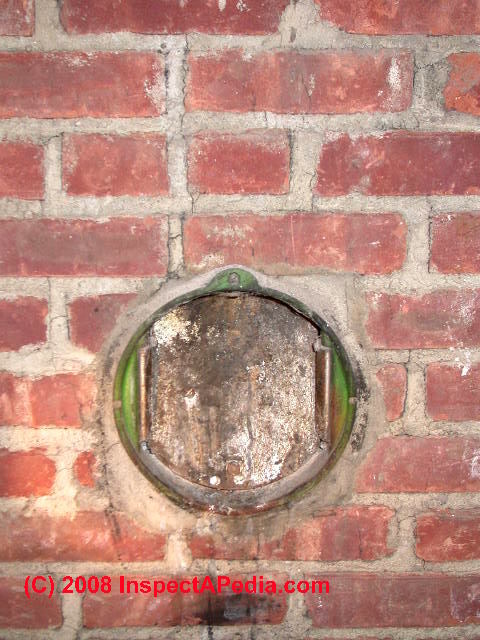
It may be possible to obtain a limited view of the chimney interior by looking through the hinged door of a barometric damper, flue vent connector (disassembly required) or thimble (disassembly required), or where no flue vent connector is installed, if you find a cover closing off a previously-used chimney thimble, such as the old spring-loaded metal "pie plate" chimney thimble covers, it may be possible to inspect the chimney interior through those openings.
You may not be so lucky as to find a barometric damper giving view directly into the chimney flue (photo at left) but check to see if the draft regulator on a heater or water heater gives view into the chimney.
This damper location, built right into a chimney works properly only if just a single appliance is vented into this flue.
Also see DRAFT REGULATOR, DAMPER, BOOSTER.
Metal chimney flue liners
have to be inspected by removing the vent connector from the chimney breach to check for corrosion. Sight up the liner with a mirror to check straightness, rust, holes, heavy creosote, leak evidence, and for metal flue blockage.
Metal chimney flue interiors & metal chimney liners
have to be inspected from the chimney top and inside by removing the vent connector from the chimney breach to check for corrosion. Sight up the liner with a mirror to check straightness and for blockage.
Even when a home inspector cannot see much of the chimney flue through such a limited access opening, certain observations can be critical, such as:
- The chimney is constructed of a single-wythe brick thickness - and is a gas leak and fire hazard
- The chimney is unlined
- The chimney has thick creosote or soot inside
- There are indications of broken, falling masonry or flue tile components
- There is evidence of water leaks or frost damage inside the flue
- The inspector might simply hear the noise from another appliance, perhaps on another floor, indicating a surprise shared-flue
Chimney Thimble Requirements
A chimney thimble is a sleeve embedded in the chimney wall designed to accept the flue connector from an appliance. They must be placed with the chimney end flush with the inside wall of the flue lining and cemented in place with the refractory mortar used in the flue tiles.
Chimney Thimble Damage and Safety Concerns
The thimble is the masonry or clay or insulated metal sleeve that provides an entry passage for a metal flue vent connector to enter a masonry chimney.
The most common defect we see at the chimney thimble is failure to seal the metal flue at the entry to the chimney flue.
A broken or short thimble can allow combustion gases to rise in the air space between the flue liner and the masonry surround. Condensation stains will often appear in the mortar joints and as streaks running down the exterior face of the chimney. Wood or oil burners leave soot that leaches out as black streaks.
Readers of this article should be sure to
review FIREPLACE DAMAGE & UNSAFE HEARTHS, and also
see FIREPLACE INSPECTIONS for a professional chimney sweep's fireplace and chimney hazard checklist.
at FIREPLACE INSERTS INSTALL, INSPECT, REPAIR we discuss fireplace inserts and zero-clearance fireplaces, both antique and modern, and their hazards and inspection limitations.
Readers should also
see INACCESSIBLE CONNECTIONS FIREPLACE, WOODSTOVE. The inspection of chimney interiors is discussed
at CHIMNEY INSPECTION, FLUE INTERIOR.
Reader Comments, Questions & Answers About The Article Above
Below you will find questions and answers previously posted on this page at its page bottom reader comment box.
Reader Q&A - also see RECOMMENDED ARTICLES & FAQs
Reader Question: (Aug 12, 2012) John said: I am getting a pale, sand colored, crystalline buidlup around the joints of my less than one year old I metal flue liner and the stuff has even dripped onto the top of the oil burner box which is also less than a year old. Looking through the flue damper, which is right next to the base of the chimney, I see only rust, which I am also not happy about. What is this stuff and how is it getting into my flue? Thanks
Reply: John, it sounds as if there is a condensation or leak problem in that chimney or the flue vent connector as well as deterioration. If the metal "flue" you describe is the actual chimney I'd ask a certified chimney sweep to inspect, clean, repair the system. Else it may be unsafe. If the metal flue you describe is actually the connector betweeen the heating appliance and the chimney, that's a job for your heating service technician.
Question:
(Oct 28, 2011) mark daniels said:
my 8"round chimney thimble is broken off flush with the concrete block and im trying to install a pellet burning stove how can i fix the thimble? cani add to the thimble?
Reply:
(Nov 2, 2012) rodney calhoun said:
im replacing a mortat cap on a large hollow with only 2 clay flue liners should their be bore brick around liner
...
Continue reading at CHIMNEY FLUE INSPECTION CAMERA or select a topic from the closely-related articles below, or see the complete ARTICLE INDEX.
Or see CHIMNEY INSPECTION DIAGNOSIS FAQs - questions and answers posted originally here on this page.
Or see these
Recommended Articles
- CHIMNEY INSPECTION DIAGNOSIS REPAIR - home
- CHIMNEY FLUE INSPECTION CAMERA
- CHIMNEY INSPECTION CHECKLIST
- CHIMNEY INSPECTION, FLUE INTERIOR
- CHIMNEY INSPECTION from GROUND
- CHIMNEY INSPECTION INDOORS
- CHIMNEY INSPECTION OUTDOORS
- CHIMNEY INSPECTION at ROOFTOP
- CHIMNEY TOP MASONRY DAMAGE
- INACCESSIBLE CONNECTIONS FIREPLACE, WOODSTOVE
- UNLINED FLUE INSPECTIONS
Suggested citation for this web page
CHIMNEY INSPECTION, FLUE INTERIOR at InspectApedia.com - online encyclopedia of building & environmental inspection, testing, diagnosis, repair, & problem prevention advice.
Or see this
INDEX to RELATED ARTICLES: ARTICLE INDEX to CHIMNEYS & FLUES
Or use the SEARCH BOX found below to Ask a Question or Search InspectApedia
Ask a Question or Search InspectApedia
Try the search box just below, or if you prefer, post a question or comment in the Comments box below and we will respond promptly.
Search the InspectApedia website
Note: appearance of your Comment below may be delayed: if your comment contains an image, photograph, web link, or text that looks to the software as if it might be a web link, your posting will appear after it has been approved by a moderator. Apologies for the delay.
Only one image can be added per comment but you can post as many comments, and therefore images, as you like.
You will not receive a notification when a response to your question has been posted.
Please bookmark this page to make it easy for you to check back for our response.
Our Comment Box is provided by Countable Web Productions countable.ca
Citations & References
In addition to any citations in the article above, a full list is available on request.
- Chimney & Stack Inspection Guidelines, American Society of Civil Engineers, 2003 - These guidelines address the inspection of chimneys and stacks. Each guideline assists owners in determining what level of inspection is appropriate to a particular chimney and provides common criteria so that all parties involved have a clear understanding of the scope of the inspection and the end product required. Each chimney or stack is a unique structure, subject to both aggressive operating and natural environments, and degradation over time. Such degradation may be managed via a prudent inspection program followed by maintenance work on any equipment or structure determined to be in need of attention. Sample inspection report specifications, sample field inspection data forms, and an example of a developed plan of a concrete chimney are included in the guidelines. This book provides a valuable guidance tool for chimney and stack inspections and also offers a set of references for these particular inspections.
- NFPA 211 - Standards for Chimneys & Fireplaces, NFPA 211: Standard for Chimneys, Fireplaces, Vents, and Solid Fuel-Burning Appliances, 2006 Edition (older editions and standards are found at the same bookstore)
- NFPA #211-3.1 1988 - Specific to chimneys, fireplaces, vents and solid fuel burning appliances.
- NFPA # 54-7.1 1992 - Specific to venting of equipment with fan-assisted combustion systems
- Principles of Home Inspection: Chimneys & Wood Heating, in (Principles of Home Inspection), Carson Dunlop, Associates, Toronto, Ontario
- U.S. vs. Canadian Unlined Masonry Chimney Flue Requirements & Case Study
- GAMA - Gas Appliance Manufacturers' Association has prepared venting tables for Category I draft hood equipped central furnaces as well as fan-assisted combustion system central furnaces.
- National Fuel Gas Code, an American National Standard, 4th ed. 1988 (newer edition is available) Secretariats, American Gas Association (AGA), 1515 Wilson Blvd., Arlington VA22209, and National Fire Protection Association (NFPA), Batterymarch Park, Quincy MA 02269. ANSI Z223.1-1988 - NFPA 54-1988. WARNING: be sure to check clearances and other safety guidelines in the latest edition of these standards.
- Fire Inspector Guidebook, A Correlation of Fire Safety Requirements Contained in the 1987 BOCA National Codes, (newer edition available), Building Officials and Code Administrators International, Inc. (BOCA), Country Club HIlls, IL 60478 312-799-2300 4th ed. Note: this document is reissued every four years. Be sure to obtain the latest edition.
- Uniform Mechanical Code - UMC 1991, Sec 913 (a.) Masonry Chimneys, refers to Chapters 23, 29, and 37 of the Building Code.
- New York 1984 Uniform Fire Prevention and Building Code, Article 10, Heating, Ventilating, and Air Conditioning Requirements
- New York 1979 Uniform Fire Prevention & Building Code, The "requirement" for 8" of solid masonry OR for use of a flue liner was listed in the One and Two Family Dwelling Code for New York, in 1979, in Chapter 9, Chimneys and Fireplaces, New York 1979 Building and Fire Prevention Code:
- "Top Ten Chimney (and related) Problems Encountered by One Chimney Sweep," Hudson Valley ASHI education seminar, 3 January 2000, contributed by Bob Hansen, ASHI
- Chimney Inspection Checklist, Carson Dunlop, Associates, Toronto, Ontario
- "Rooftop View Turns to Darkness," Martine Costello, Josh Kovner, New Haven Register, 12 May 1992 p. 11: Catherine Murphy was sunning on a building roof when a chimney collapsed; she fell into and was trapped inside the chimney until rescued by emergency workers.
- "Chimneys and Vents," Mark J. Reinmiller, P.E., ASHI Technical Journal, Vol. 1 No. 2 July 1991 p. 34-38.
- "Chimney Inspection Procedures & Codes," Donald V. Cohen was to be published in the first volume of the 1994 ASHI Technical Journal by D. Friedman, then editor/publisher of that publication. The production of the ASHI Technical Journal and future editions was cancelled by ASHI President Patrick Porzio. Some of the content of Mr. Cohen's original submission has been included in this more complete chimney inspection article: InspectAPedia.com/chimneys/Chimney_Inspection_Repair.php . Copies of earlier editions of the ASHI Technical Journal are available from ASHI, the American Society of Home Inspectors.
- Natural Gas Weekly Update: http://tonto.eia.doe.gov/oog/info/ngw/ngupdate.asp Official Energy Statistics from the U.S. Government
- US Energy Administration: Electrical Energy Costs http://www.eia.doe.gov/fuelelectric.html
- NFPA 211 - 3-1.10 - Relining guide for chimneys
- NFPA 211 - 3-2 - Construction of Masonry Chimneys
- NFPA 211 - 3-3 - Termination Height for chimneys
- NFPA 211 - 3-4 - Clearance from Combustible Material
- NFPA 54 - 7-1 - Venting of Equipment into chimneys
- Brick Institute of America - Flashing Chimneys
Brick Institute of America - Proper Chimney Crowns
Brick Institute of America - Moisture Resistance of Brick - American Gas Association - New Vent Sizing Tables
- Chimney Safety Institute of America - Chimney Fires: Causes, Effects, Evaluation
- National Chimney Sweep Guild - Yellow Pages of Suppliers
- In addition to citations & references found in this article, see the research citations given at the end of the related articles found at our suggested
CONTINUE READING or RECOMMENDED ARTICLES.
- Carson, Dunlop & Associates Ltd., 120 Carlton Street Suite 407, Toronto ON M5A 4K2. Tel: (416) 964-9415 1-800-268-7070 Email: info@carsondunlop.com. Alan Carson is a past president of ASHI, the American Society of Home Inspectors.
Thanks to Alan Carson and Bob Dunlop, for permission for InspectAPedia to use text excerpts from The HOME REFERENCE BOOK - the Encyclopedia of Homes and to use illustrations from The ILLUSTRATED HOME .
Carson Dunlop Associates provides extensive home inspection education and report writing material. In gratitude we provide links to tsome Carson Dunlop Associates products and services.
 | HOME | ABOUT | ASK a QUESTION | CONTACT | CONTENT USE POLICY | DESCRIPTION | POLICIES | PRIVACY | |
| © 2024 - 1985 Publisher InspectApedia.com - Daniel Friedman | |||||||||