
InspectAPedia® FREE Encyclopedia of Building & Environmental Construction, Diagnosis, Maintenance & Repair |
Question? Just ask us! InspectAPedia
|
 Masonry Chimney Flue Tile Damage
- POST a QUESTION or COMMENT about chimney flue tile liner inspection, diagnosis, repair
Chimney clay tile flue liner damage inspection, diagnosis, repair:
This article describes how to detect and assess chimney flue tile or flue line damage and how that damage is repaired.
These articles on chimneys and chimney safety provide detailed suggestions describing how to perform a thorough visual inspection of chimneys for safety and other defects. Chimney inspection methods and chimney repair methods are also discussed.
InspectAPedia tolerates no conflicts of interest. We have no relationship with advertisers, products, or services discussed at this website.
Damaged Chimney Flue Tiles: cause,
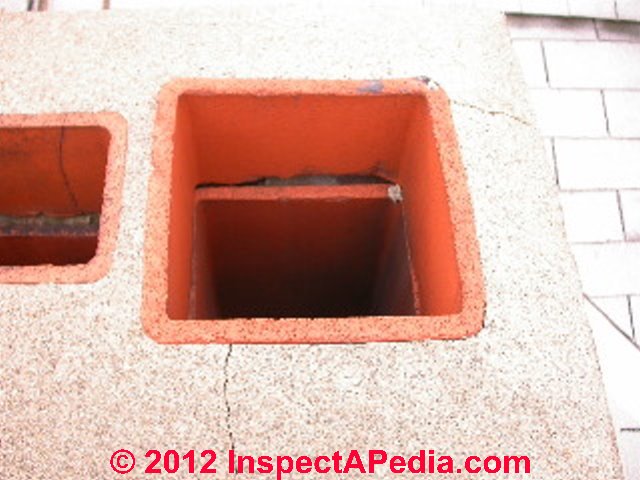 Flue liners can be made of clay, ceramic or metal and must contain the
products of combustion and protect the shell from heat and corrosion.
Flue liners can be made of clay, ceramic or metal and must contain the
products of combustion and protect the shell from heat and corrosion.
Clay linings are usually square, round or rectangular sections two feet in length.
[Click to enlarge any image]
They are stacked upon each other with refractory cement in the joints to form a continuous smooth walled vent from below the appliance inlet to the top.
A space of one half inch to one inch must be maintained between the flue and masonry surround. Alignment of the flue tiles is secured with one walnut sized mortar deposit between the masonry surround and each of the faces of the tile.
As the flue is heated the warm liner will expand outward and lengthwise. Thus it is important that the liner not be secured to the surrounding masonry.
The air space effects a reduction of temperature at the exterior of the masonry surround and helps to maintain the elevated temperature of the flue for proper draft.
Above left is an example: an improperly-constructed chimney flue and top crown combined with absence of any chimney cap at all - all conditions that risk leaks and hidden damage to the chimney flue.
[Also see: U.S. vs. Canadian Unlined Masonry Chimney Flue Requirements & Case Study -- -Editor]
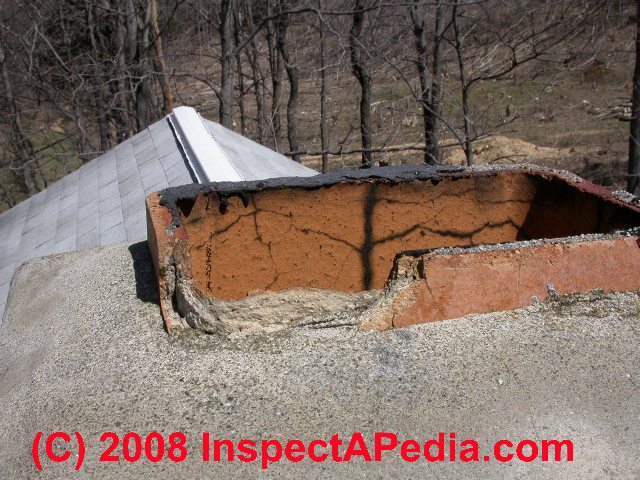
Damaged clay flue tiles lining a chimney are often obvious only from a rooftop inspection such as we show in these photos.
Above we see that frost has broken off a portion of the clay liner for this chimney and that fine cracks in the clay flue tiles tell us that additional damage may have occurred below.
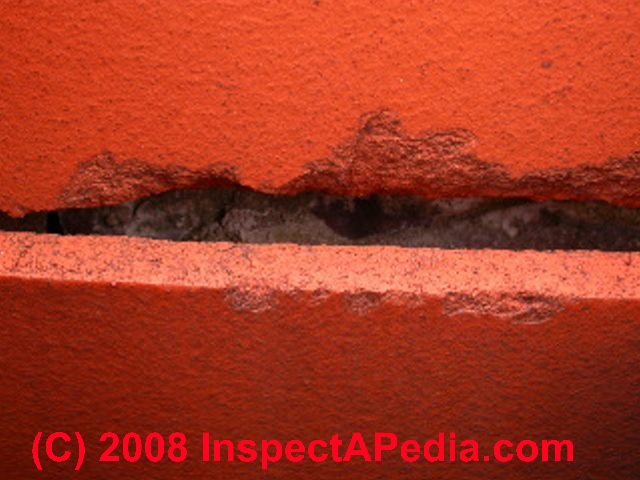
Above we see poor chimney construction that left misaligned chimney tiles, inviting water to leak into the chimney structure, adding to the risk of frost damage and possibly causing an unsafe flue.
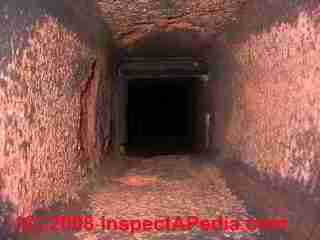
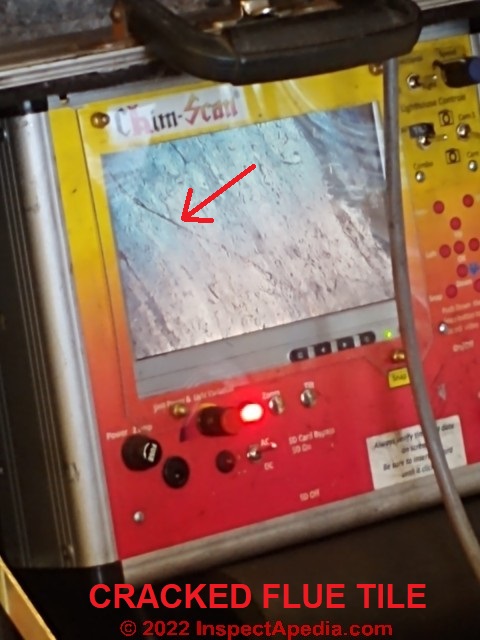
Below: using a chimney inspection camera to inspect the entire flue can show potentially-serious fire hazards as well as risks of leakage of fatal flue gases into the building interior: cracked chimney flue tiles or gaps between flue tiles where mortar was either lost or was insufficient during original construction.
Photos courtesy of InspectApedia.com editor A. Church.
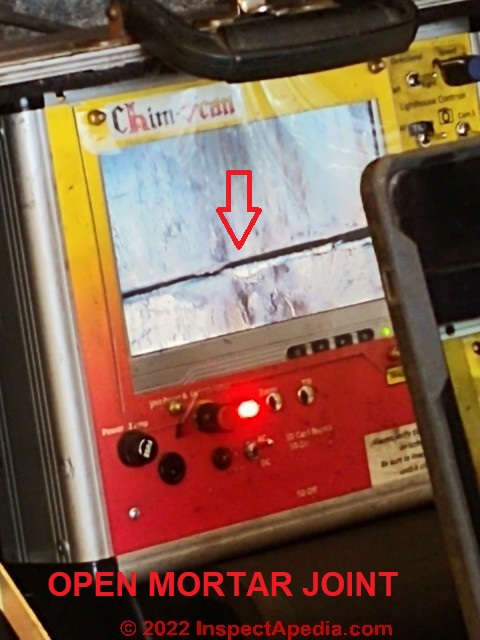 ...
... 
The camera used to make these observations is discussed
at CHIMNEY FLUE INSPECTION CAMERA
Below: an interesting cross-sectional view of a clay chimney flue tile liner during chimney relining at a home in Two Harbors, MN.
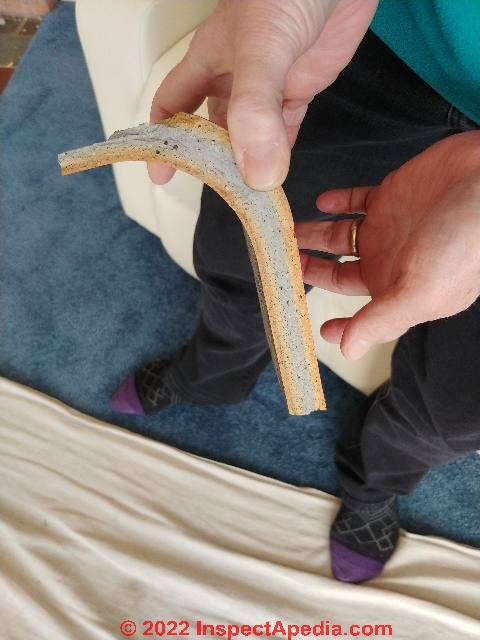
See more about this chimney repair
at CHIMNEY RE-LINING CHOICES - chimney lining alternatives when a flue liner is missing or damaged.
Examples of Chimney Flue Tile Liner Internal Damage, Leaks, Hazards
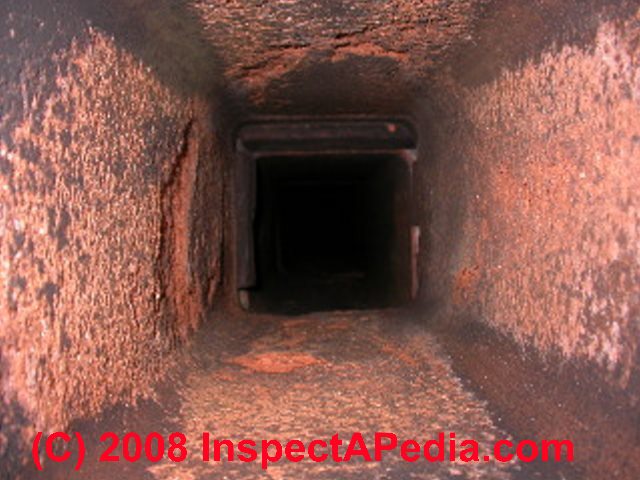
 \
\
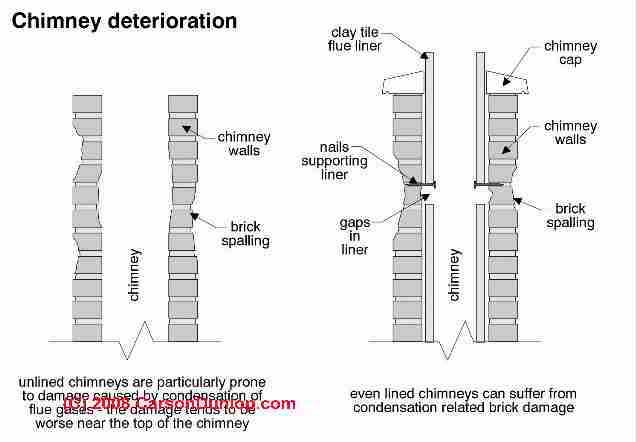
Damage to clay chimney flue tile liners can also appear as spalling shown in our photo (above left) or as shown in Carson Dunlop Associates [at REVIEWERS] sketch (above right).
Notice that the chimney wall is getting thin at the left side of the flue. It is time to have this chimney lined for safety.
Many water damaged chimney flues could have been prevented by installation of a good chimney rain cap and crown or top seal at the time of construction.
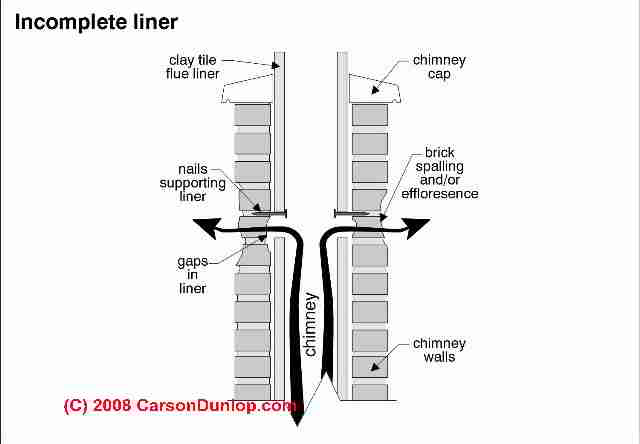
The sketch at left shows the effects of gaps in a chimney liner.
While the drawing depicts a regular gap as if magically the upper clay flue tile was suspended curing chimney construction, this is not as impossible as it may seem.
Details in the drawing show the upper liner was suspended by nails, leaving a mortar gap between the clay flue tiles.
This flue tile liner gap can also occur if sections of the flue tiles are broken and lost after chimney construction, later in its life.
These flue liner gaps may explain why white efflorescence appears mysteriously somewhere below the top of the exterior of a masonry chimney.
Gaps in the chimney liner can be found by a camera inspection of the flue interior; they might be suspected based on damage or stains on the chimney exterior.
Significance of Finding Soot at the Chimney Top
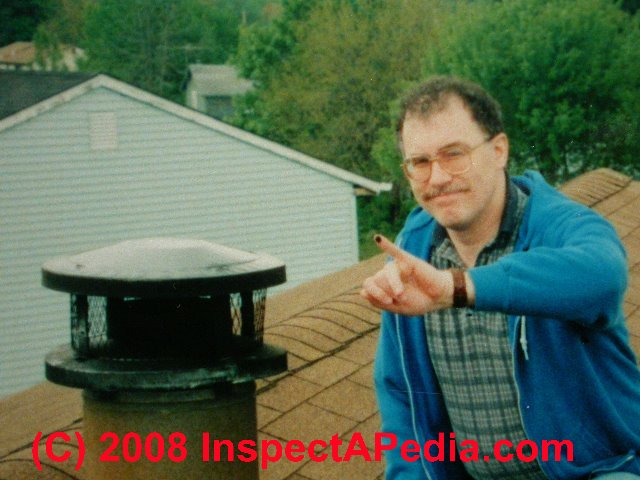
Watch out: If you see soot forming at a chimney which is venting gas-fired appliances you should shut the equipment down immediately and call for an expert to inspect and correct the chimney or equipment problem. Gas fired equipment can suddenly malfunction, producing soot, and blocking a chimney.
The result is the production of dangerous, possibly fatal carbon monoxide gas. Be sure that your building has working carbon monoxide detectors (CO Gas Detectors) as well as working smoke detectors that are properly located and installed.
Soot at the top of a chimney, regardless of whether the chimney is metal or masonry, can be a clue about improper and inefficient heating system operation where oil-fired heating boilers, furnaces, or water heaters are installed.
Photo of a sooty metal chimney cap venting an oil-fired heater was provided courtesy of Roger Hankey.
is there anything wrong with the chimney shown in these two photos?
 On 2020-10-27 by debharve@yahoo.com - This is a 1929 Chicago brick bungalow.
Are there any visible issues in this photo? 1929 Brick bungalow.
Are there any visible issues in these photos?I am confused. when I first moved into the house 22 years ago, I had a chimney sweep inspect it and was told it hadn't been used in years and was clean and safe.
Then about five years ago, I had another company come and they tried to upsell me in such a huge way with alleged safety violations.
I told them to send the photos and they never did even after several reminders. Then I had it inspected with someone who had great reviews and lots of experience and he told me it was fine. He inspected it again in February and said it was fine.
[Click to enlarge any image]
So, I updated my yelp review about the upsell place and they contacted me and sent me photos and said the fireplace was unusable and dangerous. I'd like to use the fireplace this year but am now nervous and am trying to figure out the photos. I assume the caged one is the fireplace chimney and does that look okay?
I'm embarrassed to admit I have no idea what the other one with the hand it, but whatever that rusty thing is does not look good. I'd like to get an independent safety inspection and have been looking at reviews but it seems that upselling is a huge issue.
Any assistance in figuring this out is appreciated.
Moderator reply: On 2020-10-27 by (mod) - At least 15 chimney safety & other defects are visible in your photos
Thanks for clarifying DH.
Don't be embarrassed at all; you are not expected to be a chimney expert; in my OPINION the chimney company was right to flag your chimney as unsafe but were derelict in failing to be specific in both language - listing what they saw wrong and why those defects are a concern, and also in failing to provide photos to help you understand what they are talking about.
This is particularly egregious where there are fire and life-safety issues at stake. I can only defend the company by pointing out that very often skilled technical people know their job but area either poor communicators or simply become impatient with consumers who don't take them a their word.
Not everyone uses the same terms to describe various chimney parts. For widely-accepted definitions of parts around the chimney top,
see CHIMNEY CAP & CROWN DEFINITIONS
In you rtwo photos, here is what I can see, with the strong caveat that complete inspection by a chimney expert will absolutely see additional and important safety or structural or functional features that one cannot possibly infer from two or three photos of a chimney.
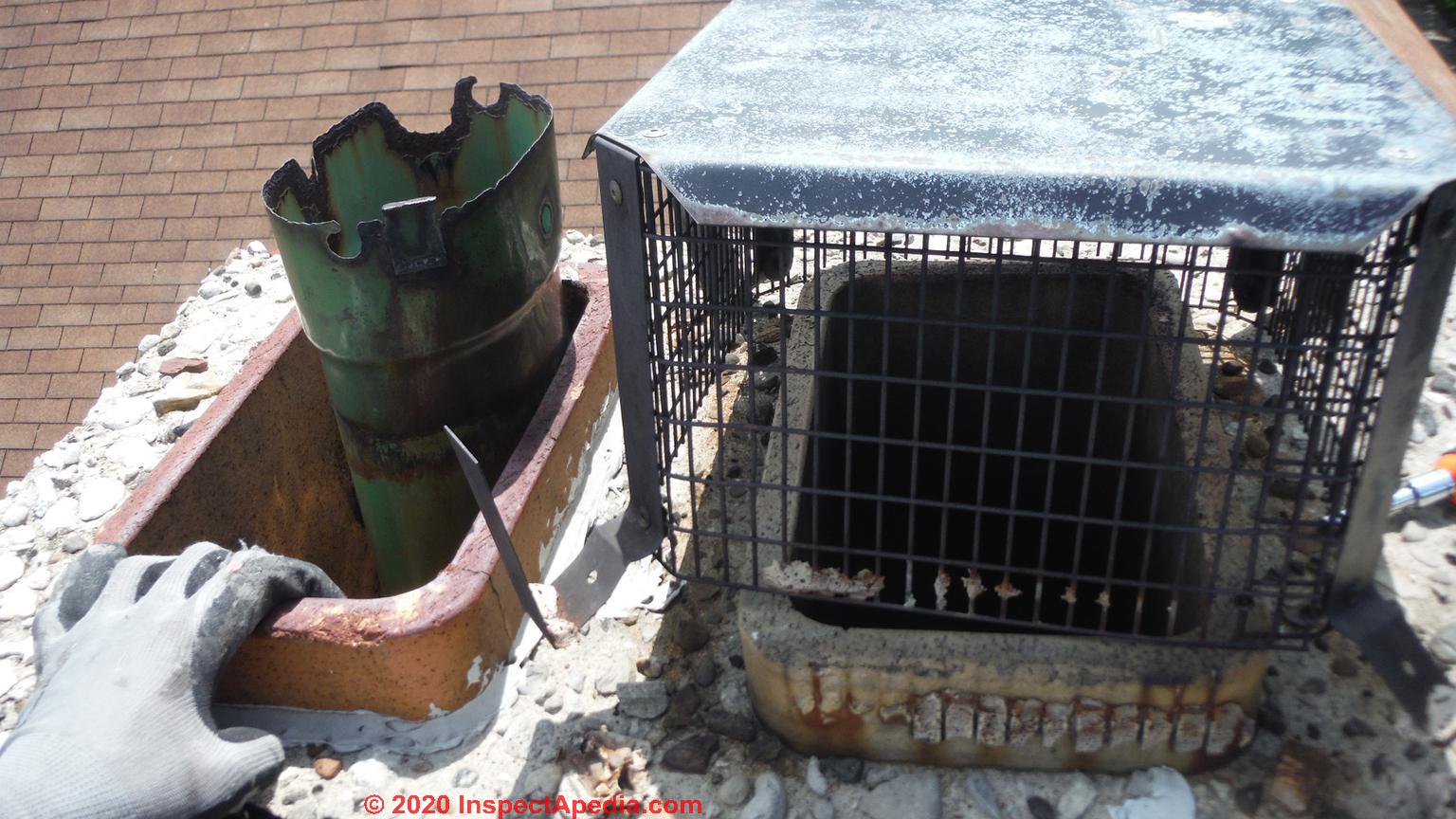
Chimney defects in your first photo include at least these
1. Improper flue top heights: two flues ending at same height interfere with one another's draft
2. Improper chimney top crown: the concrete seal around the flues and forming the top of the chimney is weathered, in poor condition, risking leaks into the flue (where water or frost can damage a flue and make it unsafe risking fire or fatal carbon monoxide poisoning
; the concrete is so weathered and worn that it will absorb water and deteriorate at an accelerating rate; It may also have never been adequately sloped to drain properly - we can't know for sure as material has been lost, suggesting also that the concrete was poorly mixed.
3. No crown drip edge: It appears that the crown does not extend over the edges of the chimney sides so water will run down the chimney surfaces - no drip cap - increasing the risk of water damage to the chimney structure
4. Cap not secured: The metal "cage" or screen around the larger (perhaps fireplace) flue is not secured in place
5. Cap not listed? The metal cap or chimney cap over the larger flue is most-likely not UL listed, not approved, looks "home made", does not extend out over the flue to protect against rain - again risking water damage that can make a chimney unsafe
6. Cap wrong dimensions? The metal cap or top of this "cap" over the flue may be too low - insufficient space over the flue exit opening, interfering with draft - another feature likley to be the case if the cap is not a listed, approved device
7. The metal cap does not actually fit the flue liner and so does not protect the chimney- it's too small
The following pertain to the second or left-hand open flue in your first photo
- shown below
8. The second open clay flue has no cap at all - no protection from rain and frost, again risking damaging the chimney to create a fire or fatal carbon monoxide poisoning hazard
9. Improper metal flue liner, This flue has been "re-lined" (maybe, we don't know how far down the flue the metal vent projects) with a green, rusted metal flue vent or pipe that is rust-damaged and has lost its cap
- again risking water damage, CO poisoning, improper heater operation for whatever appliance (probably gas) being vented by this metal "chimney"
These additional observations pertain to your second photo of a clay chimney interior
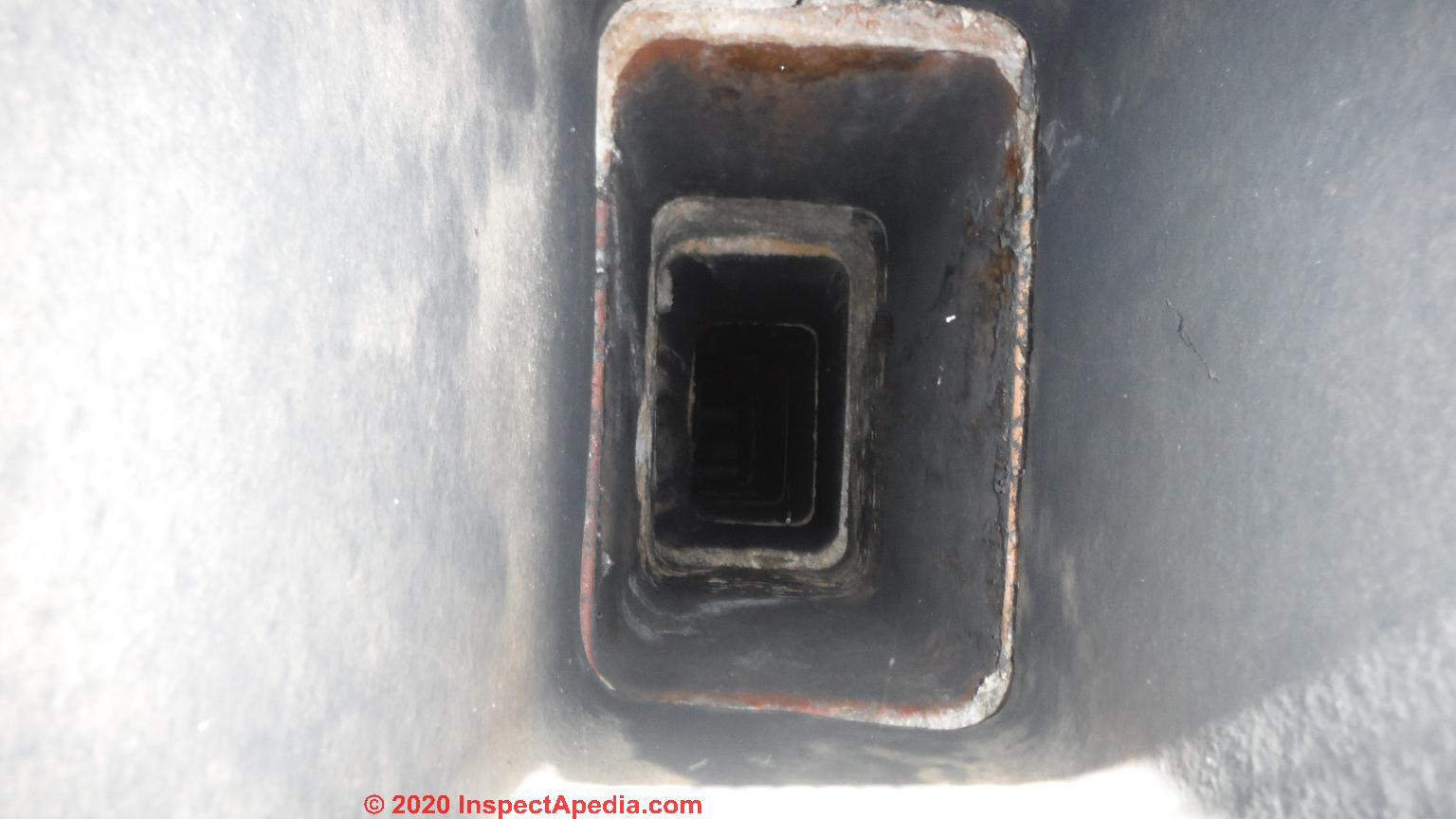
11. The mortar joints between the clay chimney liner tiles are open, have lost mortar and so there is risk of fire and carbon monoxide (CO) poisoning
12. The clay chimney tiles or liners appear to be mis-aligned as we look down the flue, a poorly-built chimney prone to water and if in a freezing climate frost damage, and also making the flue difficult to clean properly; if a flue cannot be properly cleaned there is risk of a chimney fire that can become a house fire
13. There appears to be at least one damaged clay tile in the third position down in the photo, possibly from spalling or loss of material from the clay flue tile liner, again ascribed to water damage in turn ascribed to absence of a proper chimney cap
14. There is a crack in the top of the left hand clay chimney tile - possibly indicating other damage that we can't see in the photo. The crack may be trivial and confined to the top inch or so of the flue or it may be a telltale of other such damage that may be more serious, such as broken clay flue tiles that again would be a fire or CO hazard.
So from even a casual inspection from a distance and only seeing two photos there are at least 13 dangerous conditions, possibly 14, at these two chimneys that can risk fire, injury or even a fatality for building occupants.
Not visible in your photos but implied hazards include
15. Questionable chimney draft adequacy and building safety: If a chimney is not properly constructed, maintained, safe, sound, and weather protected it may also fail to provide safe draft for the appliances it is venting.
In turn, inadequate draft can mean at the very least, increased operating costs for the appliances (heater, water heater, for example) and particularly for gas-vented heating equipment, inadequate draft significantly increases the probability of dangerous, even fatal production of and release of carbon monoxide into the building interior.
So, DH, maybe all of your chimney companies and people on site were experienced, knowledgable, and well-meaning, but not everybody is a clear communicator.
Some of the items in my list are opinions based on such limited data as to possibly be mistaken; for example maybe the screened cap was listed, even if it does not fit and is not secured and is wrong size. But in my view it is far better, where human life is at risk, to err on the side of caution.
Watch out: In my OPINION and based on this limited and incomplete data from just two photos, your chimneys are improper and unsafe.
A thorough inspection of the full height of your chimney flues can be done using a camera.
Reader Comments, Questions & Answers About The Article Above
Below you will find questions and answers previously posted on this page at its page bottom reader comment box.
Reader Q&A - also see RECOMMENDED ARTICLES & FAQs
Question:
(Jan 3, 2013) David, Thunder Bay, Ontario said:
Recently purchased a 40yr old home with beautiful fireplace. Previous owners used it until they sold the house. I noticed many cracks in outer chimney brickwork so have been wondering about the clay tiles integrity. With the information in this article,
I will now lower a video camera down the chimney, with a small flashlight, so I can inspect the tiles afterwards. I was all ready assuming that I'd have to install a liner, but my video will verify if I need it for sure. Thanks for the information.
(Mar 19, 2015) Lee said:
Crumbling chimney liner from top looking down. How serious? Owner wants to cap over top of chimney without repairing liner first. Carbon Monoxide potential? Thanks for any help.
Reply:
Lee
I can't assess risk from an e-text but certainly a damaged flue risks CO as well as a building fire. If you are the contractor and you feel the situation is unsafe, I would be reluctant to take the job, and I'd leave with a written safety warning in the hands of the customer.
S/he can always find some fool who'll do just what's wanted, and on-the-cheap, but in my opinion no amount you might be paid is worth the risk of a later fire or death and your role in it.
If needed, ask for a certified chimney sweep to make a thorough inspection of the flue.
...
Continue reading at CHIMNEY INSPECTION at ROOFTOP or select a topic from the closely-related articles below, or see the complete ARTICLE INDEX.
Or see these
Recommended Articles
- CHIMNEY DEFINITIONS
- CHIMNEY CAP & CROWN DEFINITIONS
- CHIMNEY COMPONENT DEFINITIONS
- CHIMNEY DRAFT & PERFORMANCE
- CHIMNEY INSPECTION DIAGNOSIS REPAIR - home
- ATTIC CHIMNEY INSPECTION
- CHIMNEY CLEANOUT DOOR INSPECTION
- CHIMNEY FLASHING MISTAKES & LEAKS
- CHIMNEY FLUE INSPECTION CAMERA
- CHIMNEY INSPECTION CHECKLIST
- CHIMNEY INSPECTION, FLUE INTERIOR
- CHIMNEY INSPECTION from GROUND
- CHIMNEY INSPECTION INDOORS
- CHIMNEY INSPECTION OUTDOORS
- CHIMNEY INSPECTION at ROOFTOP
- CHIMNEY TOP MASONRY DAMAGE
- FLUE TILE DAMAGE in CHIMNEY
- CHIMNEY FLUE RE-LINING
- CHIMNEY RE-LINING CHOICES
- CHIMNEY RE-LINING CHOICES - choices among chimney lining alternatives when a flue liner is missing or damaged
- CHIMNEY REPAIR: REPLACE ENTIRE CHIMNEY
- CHIMNEY REPAIR: ABANDON & USE DIRECT VENT
- CHIMNEY REPAIRS, TOP & CLAY FLUE TILE
Suggested citation for this web page
FLUE TILE DAMAGE in CHIMNEY at InspectApedia.com - online encyclopedia of building & environmental inspection, testing, diagnosis, repair, & problem prevention advice.
Or see this
INDEX to RELATED ARTICLES: ARTICLE INDEX to CHIMNEYS & FLUES
Or use the SEARCH BOX found below to Ask a Question or Search InspectApedia
Ask a Question or Search InspectApedia
Try the search box just below, or if you prefer, post a question or comment in the Comments box below and we will respond promptly.
Search the InspectApedia website
Note: appearance of your Comment below may be delayed: if your comment contains an image, photograph, web link, or text that looks to the software as if it might be a web link, your posting will appear after it has been approved by a moderator. Apologies for the delay.
Only one image can be added per comment but you can post as many comments, and therefore images, as you like.
You will not receive a notification when a response to your question has been posted.
Please bookmark this page to make it easy for you to check back for our response.
Our Comment Box is provided by Countable Web Productions countable.ca
Citations & References
In addition to any citations in the article above, a full list is available on request.
- Mark Cramer Inspection Services Mark Cramer, Tampa Florida, Mr. Cramer is a past president of ASHI, the American Society of Home Inspectors and is a Florida home inspector and home inspection educator. Mr. Cramer serves on the ASHI Home Inspection Standards. Contact Mark Cramer at: 727-595-4211 mark@BestTampaInspector.com
- John Cranor [Website: /www.house-whisperer.com ] is an ASHI member and a home inspector (The House Whisperer) is located in Glen Allen, VA 23060. He is also a contributor to InspectApedia.com in several technical areas such as plumbing and appliances (dryer vents). Contact Mr. Cranor at 804-873-8534 or by Email: johncranor@verizon.net
- Thanks to Luke Barnes for suggesting that we add text regarding the hazards of shared chimney flues. USMA - Sept. 2008.
- NFPA #211-3.1 1988 - Specific to chimneys, fireplaces, vents and solid fuel burning appliances.
- NFPA # 54-7.1 1992 - Specific to venting of equipment with fan-assisted combustion systems.
- GAMA - Gas Appliance Manufacturers' Association has prepared venting tables for Category I draft hood equipped central furnaces as well as fan-assisted combustion system central furnaces.
- National Fuel Gas Code, an American National Standard, 4th ed. 1988 (newer edition is available) Secretariats, American Gas Association (AGA), 1515 Wilson Blvd., Arlington VA22209, and National Fire Protection Association (NFPA), Batterymarch Park, Quincy MA 02269. ANSI Z223.1-1988 - NFPA 54-1988. WARNING: be sure to check clearances and other safety guidelines in the latest edition of these standards.
- Fire Inspector Guidebook, A Correlation of Fire Safety Requirements Contained in the 1987 BOCA National Codes, (newer edition available), Building Officials and Code Administrators International, Inc. (BOCA), Country Club HIlls, IL 60478 312-799-2300 4th ed. Note: this document is reissued every four years. Be sure to obtain the latest edition.
- Uniform Mechanical Code - UMC 1991, Sec 913 (a.) Masonry Chimneys, refers to Chapters 23, 29, and 37 of the Building Code.
- New York 1984 Uniform Fire Prevention and Building Code, Article 10, Heating, Ventilating, and Air Conditioning Requirements
- New York 1979 Uniform Fire Prevention & Building Code, The "requirement" for 8" of solid masonry OR for use of a flue liner was listed in the One and Two Family Dwelling Code for New York, in 1979, in Chapter 9, Chimneys and Fireplaces, New York 1979 Building and Fire Prevention Code:
- Natural Gas Weekly Update: http://tonto.eia.doe.gov/oog/info/ngw/ngupdate.asp Official Energy Statistics from the U.S. Government
- US Energy Administration: Electrical Energy Costs http://www.eia.doe.gov/fuelelectric.html
- Our recommended books about building & mechanical systems design, inspection, problem diagnosis, and repair, and about indoor environment and IAQ testing, diagnosis, and cleanup are at the InspectAPedia Bookstore. Also see our Book Reviews - InspectAPedia.
- Principles of Home Inspection: Chimneys & Wood Heating, in (Principles of Home Inspection), Carson Dunlop, Associates, Toronto, Ontario
- NFPA 211 - 3-1.10 - Relining guide for chimneys
- NFPA 211 - 3-2 - Construction of Masonry Chimneys
- NFPA 211 - 3-3 - Termination Height for chimneys
- NFPA 211 - 3-4 - Clearance from Combustible Material
- NFPA 54 - 7-1 - Venting of Equipment into chimneys
- Brick Institute of America - Flashing Chimneys
Brick Institute of America - Proper Chimney Crowns
Brick Institute of America - Moisture Resistance of Brick - American Gas Association - New Vent Sizing Tables
- Chimney Safety Institute of America - Chimney Fires: Causes, Effects, Evaluation
- In addition to citations & references found in this article, see the research citations given at the end of the related articles found at our suggested
CONTINUE READING or RECOMMENDED ARTICLES.
- Carson, Dunlop & Associates Ltd., 120 Carlton Street Suite 407, Toronto ON M5A 4K2. Tel: (416) 964-9415 1-800-268-7070 Email: info@carsondunlop.com. Alan Carson is a past president of ASHI, the American Society of Home Inspectors.
Thanks to Alan Carson and Bob Dunlop, for permission for InspectAPedia to use text excerpts from The HOME REFERENCE BOOK - the Encyclopedia of Homes and to use illustrations from The ILLUSTRATED HOME .
Carson Dunlop Associates provides extensive home inspection education and report writing material. In gratitude we provide links to tsome Carson Dunlop Associates products and services.
 | HOME | ABOUT | ASK a QUESTION | CONTACT | CONTENT USE POLICY | DESCRIPTION | POLICIES | PRIVACY | |
| © 2024 - 1985 Publisher InspectApedia.com - Daniel Friedman | |||||||||