
InspectAPedia® FREE Encyclopedia of Building & Environmental Construction, Diagnosis, Maintenance & Repair |
Question? Just ask us! InspectAPedia
|
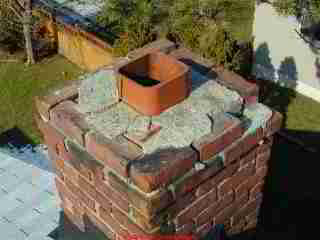 Repair of Chimney Top & Flue Liner Damage
- POST a QUESTION or COMMENT about repairs made at the portion of chimneys that extends above the building roof
Repairs for cracked chimney top crown or damaged top clay flue tiles:
This article describes chimney top repairs for masonry chimneys and clay flue tiles, work performed at or from the rooftop. This website provides detailed suggestions describing how to perform a thorough visual inspection of chimneys for safety and other defects. Chimney inspection methods and chimney repair methods are also discussed.
InspectAPedia tolerates no conflicts of interest. We have no relationship with advertisers, products, or services discussed at this website.
Repair of Damaged Clay Chimney Flue Liners at the Rooftop
Determine the Extent of Chimney Damage and the Safety of the Entire Chimney Flue
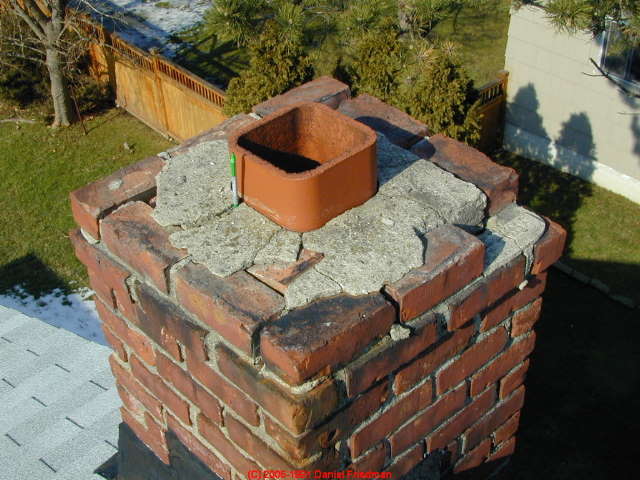
Our photo above shows an unsafe chimney that was still in active use. Notice those missing bricks and lost mortar? Damaged chimney top masonry such as missing bricks and a missing chimney cap were easily spotted from ground level, raising a critical concern for the fire and gas-leak safety of the clay flue tiles lining this chimney.
[Click to enlarge any image]
At the front left corner of the clay chimney flue tile you can see our pen inserted into an opening between the chimney flue tile and the (damaged) surrounding brick and concrete chimney structure - water entering the chimney structure at this location risks freeze damage to the chimney flue itself, resulting in potentially very dangerous conditions.
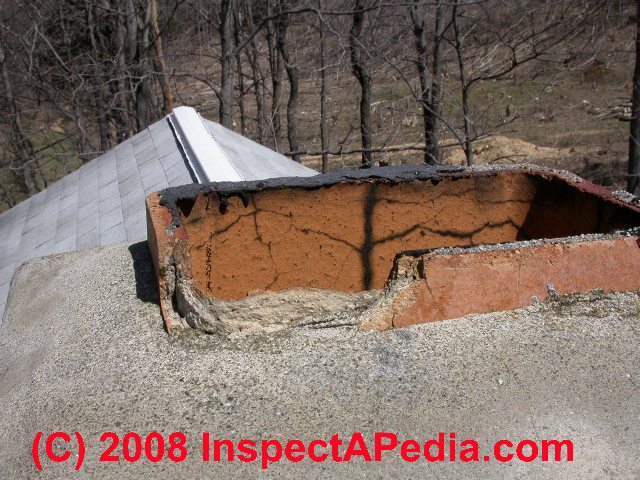
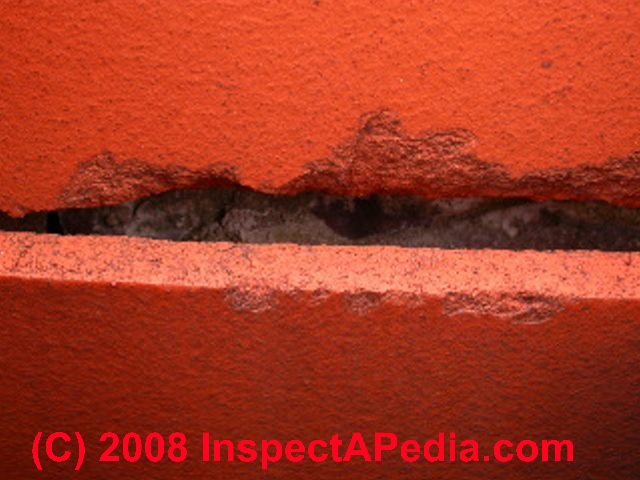
First, you will want to be absolutely sure that the chimney damage, whether to the ceramic clay flue liner or to the surrounding masonry or both, is limited to the upper, visible, accessible part of the chimney. Our chimney clay flue tile liner damage photos above show enough wear and cracking (above left) and opening between clay flue tile liner sections (above right) that further inspection and repair by a chimney professional is warranted.
Other chimney damage lower in the chimney itself as it passes through or alongside the building could be very dangerous, even fatal if carbon monoxide or other flue gases leak into the building or if sparks cause a fire.
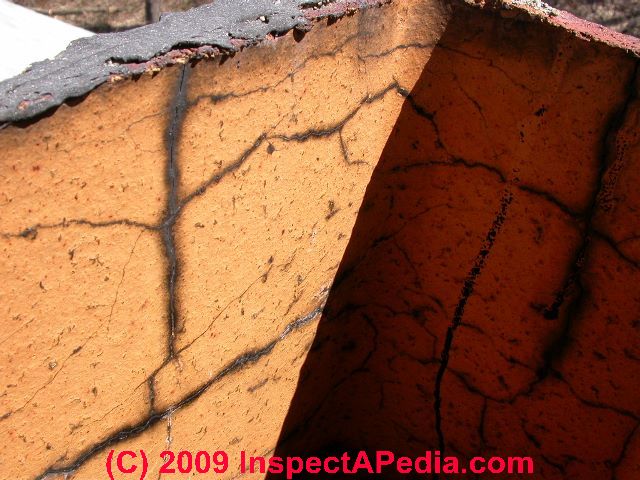
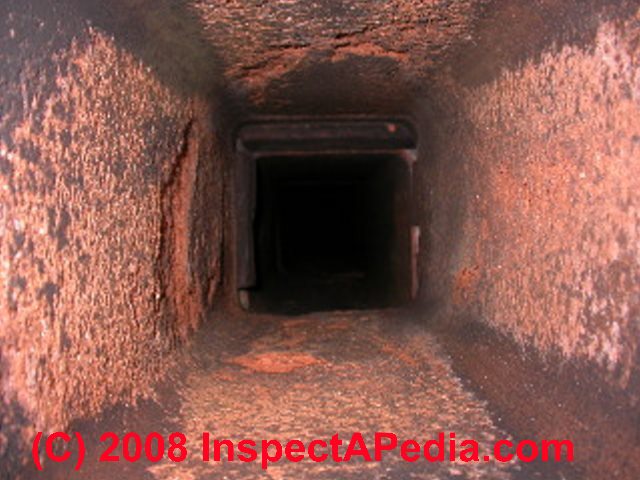
Our photos above show damage to the chimney clay flue tiles near the chimney top, with multiple cracks in the clay flue liner (above left), and severe spalling in the clay flue tile liner (above right) -these are two different chimneys.
Both need repair. The right hand chimney (above right) may need a complete re-lining while the chimney at above left might be damaged only above the roof line, making roof top repair a reasonable approach.
We suggest that you hire a professional chimney sweep who can examine the entire chimney flue. Most chimney sweeps also offer repair services, and can suggest what repairs are needed and give alternatives for the particular chimney and flue on your building.
Reline the Chimney versus Repairs Just at the Chimney Top
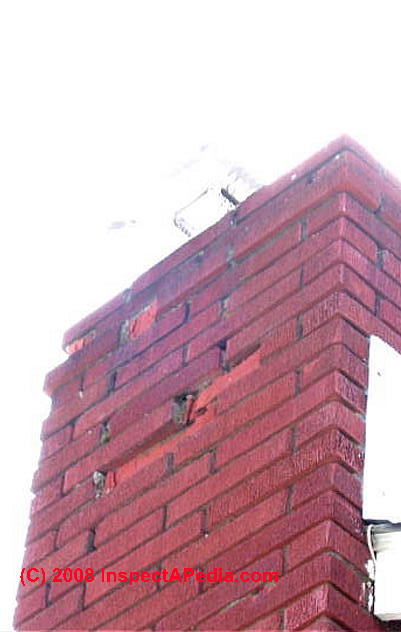 Our photo of spalling brick near the top of this masonry chimney (left) shows damage almost certainly caused by frost. Without a view of the chimney top, however, we don't know exactly where water was leaking into the structure, nor the condition of the flue liner itself. It is the condition of the fire clay (or as some call it "ceramic") flue liner that is of course critical to safe venting of flue gases outside.
Some chimney repair contractors will want to reline the whole chimney flue - an approach that is often safe, quick, easy, and profitable. But this approach may be inappropriate if the damage is just due to weather at the chimney top and the rest of the flue is intact and safe.
Water leaking between the flue liner and the masonry surround is also a very common cause of water and frost damage at the chimney top.
Most often we see spalling flue liners and loose or damaged bricks or concrete block around a chimney top caused in large part by failure to protect the chimney to from the weather; lack of an allowance for thermal movement among chimney parts, especially the liner and the surrounding masonry,can also crack and break the flue liner, especially on the above-roof portion where the chimney is in northern climates exposed to coldest temperatures.
Potentially, damage to the masonry chimney structure as well as to its clay flue tile liner can occur also inside a freezing attic space.
If the damage is just at the top of the chimney and its masonry flue liner, repairs can usually be completed entirely from outside, working from the rooftop. (Be sure the mason performing the repairs protects the surrounding roof surface from damage lest your chimney repair be followed by roof leaks.)
Other Chimney Top Repairs for Damaged Flue Liners or Surrounding Masonry
Some people try patching the damaged areas of the chimney top or chimney flue with refractory cement but we don't recommend applying "patches" to the interior of a chimney flue: there is a risk that the "patch" might later fall into and block the flue - a very dangerous condition.
A better approach and the one used by most chimney repair masons who are not going to simply reline the flue, is to remove all of the damaged materials down to sound chimney flue liner and brick or block, then rebuild with new clay flue liner and brick (or block), adding an appropriate chimney cap and top seal.
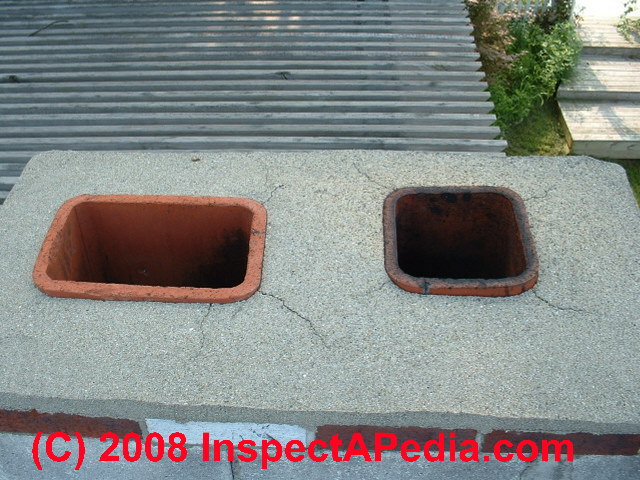
 Using solid masonry between the clay liner and the surrounding masonry at the chimney top is a common practice (photo at left), and having inspected quite a few chimney tops, we can't say that every chimney built this way fails, but it is not the best practice and is not recommended by experts.
Our chimney top photo (at above left) shows that this roof top chimney seal is already cracking, threatening future damage to the chimney flue liner as well as the chimney structure at roof top.
Other problems at this chimney top include the termination of both flues at the same height, and the absence of any rain cap.
Using a fire-safe flexible caulk at that joint will reduce the chances of cracking due to temperature differences.
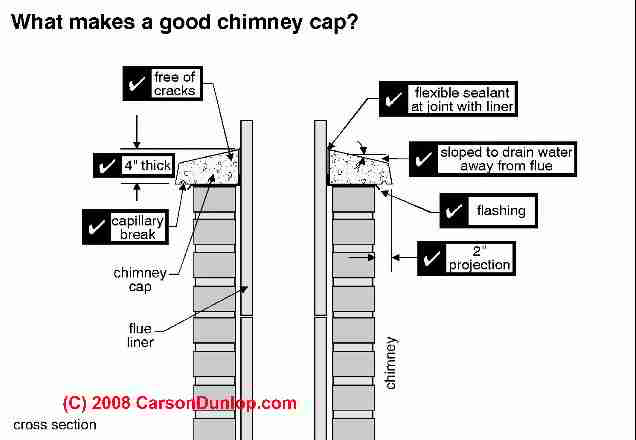
Carson Dunlop Associates [at REVIEWERS] sketch ( above-left) show some details of good chimney cap construction. The object of these details is to avoid water and frost damage to the flue or to the chimney itself.
See CHIMNEY INSPECTION ROOFTOP for these chimney top inspection and final repair and sealing details.
Reader Comments, Questions & Answers About The Article Above
Below you will find questions and answers previously posted on this page at its page bottom reader comment box.
Reader Q&A - also see RECOMMENDED ARTICLES & FAQs
On 2021-12-13 by Inspectapedia Com Moderator
@Anonymous,
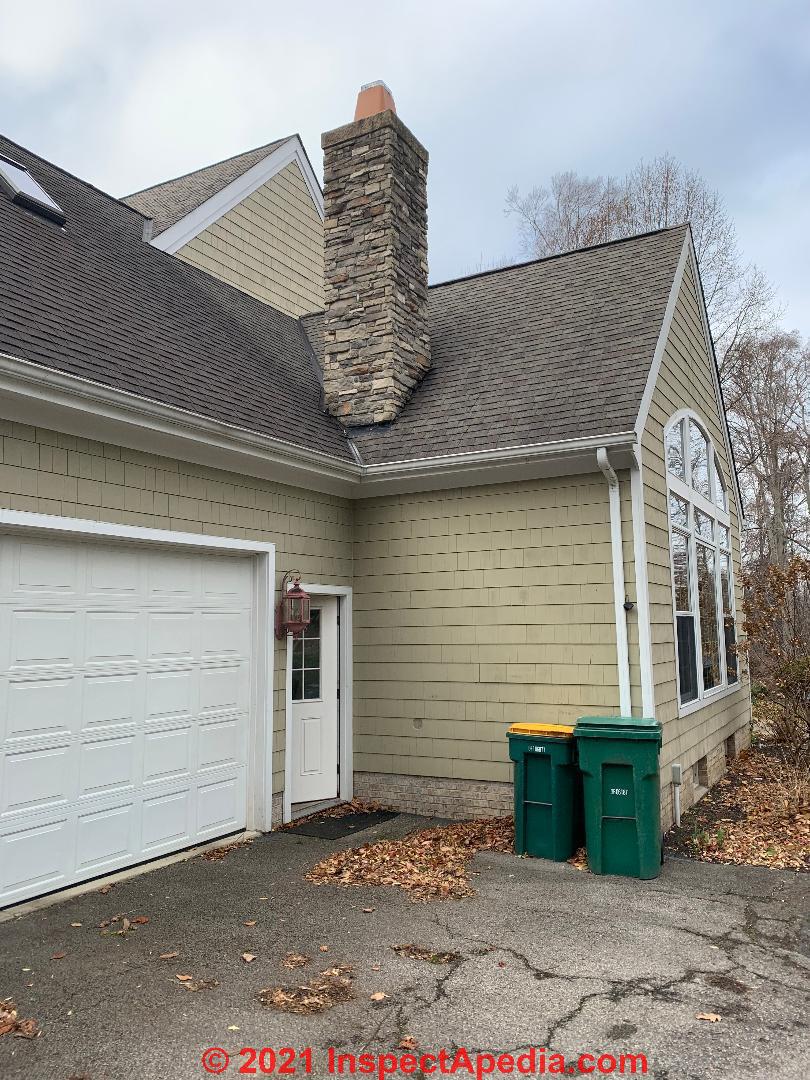
Thanks for the helpful photo of a bad chimney design: putting a chimney smack in a roof valley blocks valley drainage and invites leaks.
I can't see enough to be sure but this looks like someone added a stone veneer (with no bottom flashing) onto some other type of chimney.
See solutions to this bad chimney location found at
CHIMNEY SADDLE / CRICKET FLASHING
that is found in our article
FLASHING, CHIMNEY MISTAKES & LEAKS
On 2021-12-11 by Anonymous
On 2021-12-11 by Inspectapedia Com Moderator
@Paul,
Darn. I'm over-challenged by your perfectly-fair question: is it safe to continue using our fireplace?
Your description of the apparent risk: a crack in a (solid masonry with clay flue tile liners, right?) chimney that is found 10 feet above the roof line and nowhere near any combustible material
as being low-risk,
sounds reasonable on the face of it.
Picture me, an experienced and really old building and environmental guy, sitting at my nice wood desk in Poughkeepsie, trying to be useful to a reader whose expertise and experience I don't know, at a building I've never seen, located I don't know where, in an unknown condition, of an unknown age, construction, climate, and a host of other risk-relevant factors.
Isn't it all clay, brick and mortar above the roof?
Yes, that's what we'd expect, but a long experience says to expect the unexpected.
So before we bet your life and that of your family or other home occupants on a remote consult, with apology, I have to say that before using the fireplace (wood-burning we are guessing) it would make everybody safer if you could have (or have already had) a complete chimney flue inspection by a qualified expert (such as an inspector certified by the Chimney Sweeps Guild if you're in the U.S.).
- Is that the only chimney damage?
- Is there already a creosote problem and risk of a chimney fire?
- Is the crack a fine and low-worry one in an intact solid masonry (with normal air gaps) chimney, or is the crack we've seen the tip of an iceberg of trouble - that is, what's the risk that the chimney masonry is damaged enough that you build a fire and pieces of the liner fall out and the chimney becomes immediately dangerous both above the roof and lower in its run up through the building.
The photo I show below is discussed above on this page and is, of course not YOUR chimney. Have you got a photo of your chimney crack and a copy of a chimney inspection report?

On 2021-12-11 by Paul
Our chimney extends about 12 feet above the roof line. We just discovered a crack in the interior clay flue near the top. It extends about 2-3 feet down from the top. Where the crack ends is still 8-10 feet above the roofline.
Are we at risk using the fireplace for the few weeks left before we can get the chimney flue relined?
Does it even need relined if the crack is that far above the roof line? If the crack is that far above the roof line, if an ember did get lodged in the crack, what is there to catch fire? Isn't it all clay, brick and mortar above the roof?
On 2020-09-17 by danjoefriedman (mod)
Remove the loose concrete and seal anew; Use flexible sealant at the intersection of the top seal or crown and the clay flue tile liner (where you see a gap in your photo) for a more-durable seal.
Usually the smaller flue is for a heating appliance and the larger flue is for a fireplace.
More about chimney flues, flue sharing, inspection, safety, etc. are in the ARTICLE INDEX to CHIMNEYS & FLUES
given above
On 2020-09-17 by Dave
@danjoefriedman,
Thank you for the response. I know nothing about this stuff or what the difference is between the flues but only cap the large one? Think I can get away with resealing around the edges or just chop away all the old mortar and start fresh?
On 2020-09-15 by danjoefriedman (mod)
Dave:
That chimney could be or become unsafe from water damage; the top seal or crown around the flues is cracked and leaking; there are no chimney caps.
At the very least I'd make those repairs.
If the larger flue - presumably an unused fireplace - is not in use and is not connected to any fireplace nor other heating equipment at all, then you could cover it with slate or stone;
On 2020-09-15 by Dave
Hi - my house was built in 1952, so I’m sure this hasn’t been touched since. I know I have to do some flashing repair but this is not working chimney like we have a fireplace or anything.
Forgive my ignorance, but should I be concerned that water is doing damage in between the clay pipe and broken mortar?
On 2020-05-18 by danjoefriedman (mod)
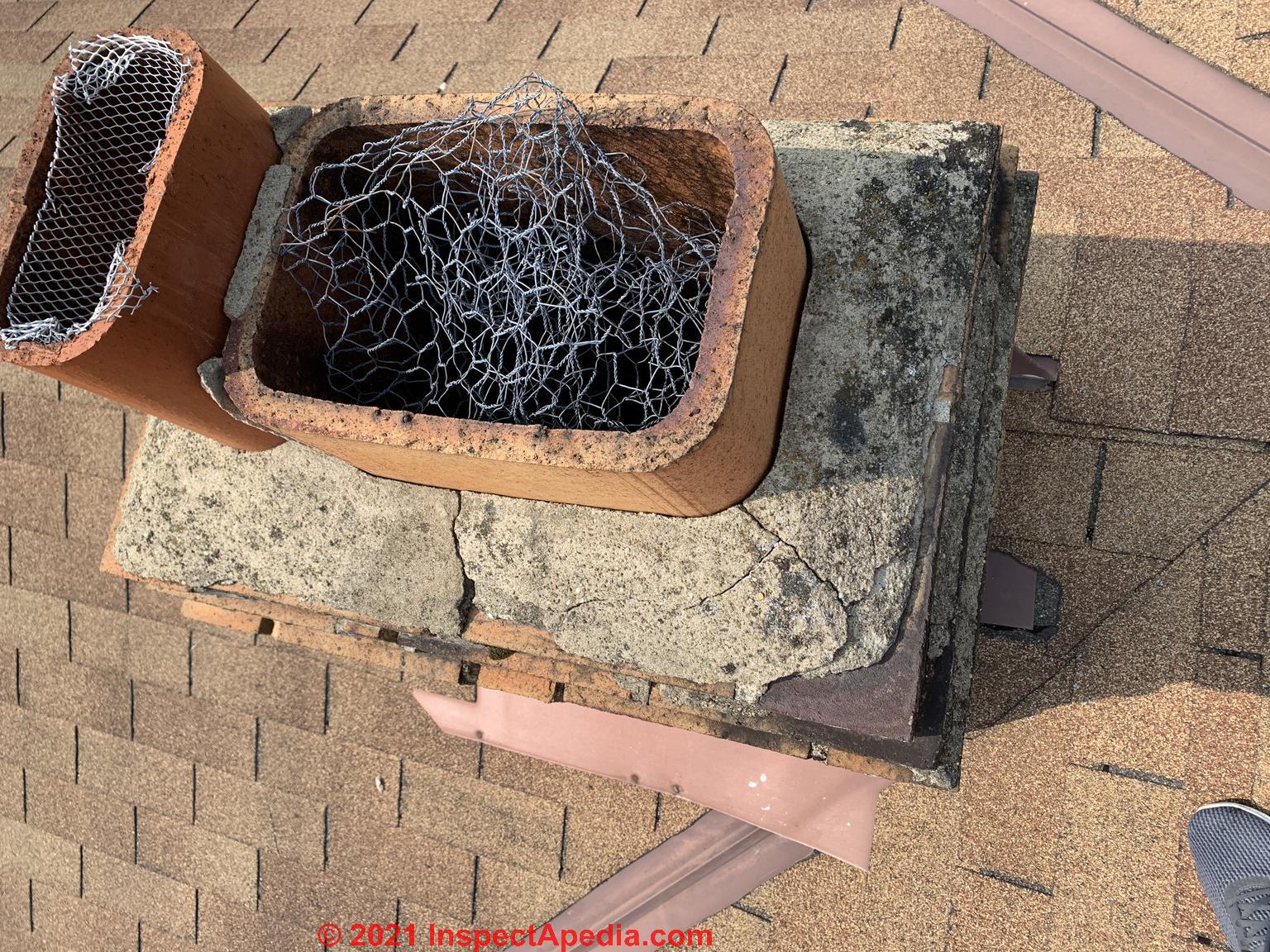
Certainly, Brenda, it's possible to repair or replace the topmost chimney tile(s) as long as there's access.
Broken tiles further down in the flue can sometimes be repaired too
On 2020-05-18 by Brenda
Hi: The terracotta that extends outside of the chimney has some minor damage. Is it possible to repair that part of the terracotta/clay flue without having to put in a stainless steel flue?
On 2017-09-30 by Steve
You will cap the entire top of the chimney. Attaching to the side of the chimney.
On 2017-02-03 by Valerie
How do you cap the flues that are level with the cement? In the following example: "...the termination of both flues at the same height, and the absence of any rain cap."
Since the cap goes on the outside of the flue and is not inserted inside -- unless there's a cap that's inserted inside?
My flue is even with the concrete with nothing to grab onto, like the example above. I don't use the fireplace and just want to cap it to keep nesting birds out. Thanks
Question: chimney sweep opinion on chimney safety
(Sept 24, 2011) Sarah L said:
Hi,
I have been told by a chimney sweep that i have a liner that is suitable for an open fire. Would this be adequate for multi fuel stove (wood and coal) and if so would i need any lining further down the chimney to connect a stove to the chimney. When talking to or reading up on manufacturer websites it seems that they advise a lining which can cost almost as much as the stove.
Is this necessary? When I have peered into the chimney myself I cannot see any liner only bricks but there is a bend in the chimney and i cant see all the way up to the top; do you think there still is one there or should i get a second opinion? If so how can I get an independent one from someone who is not trying to sell me something? Thanks.
Reply:
Sarah if you see only bricks, at least part of the chimney is unlined. Still we don't know it's safety - for example we don't know if the chimney is built with a single brick (wythe) thickness or more bricks were used. A single-brick wythe chimney would be unsafe for most applications.
I'd call a different chimney sweep and get more explicit details on the chimney construction, materials, condition, and safety before I'd consider using it. Chimney fires are really dangerous and not something on which to risk a short cut. Perhaps a sweep certified by one of the certifying agencies would be more reliable.
see
Chimneys Cleaning Advice, Procedures
Question: Blocked flue at Parkray Fire with Back Boiler
(Apr 17, 2012) russell s said:
hi we had a parkray fire with back boiler in our current propperty when we moved in 5 years ago and 2 years ago this was removed by housing association and exchanged with oil central heating,
however last year we decided to fit a woodburning stove with no back boiler and have this as a cheaper alternative to using the oil for the heating, however we had it swept in july last year and used it regularly until
about 2 weeks ago when we noticed it wasnt drawing properly and assumed it just needed sweeping however when we were letting it go out by itself
we noticed smoke coming from a crack in the plaster above our brick fireplace from the wall does this mean the clay liner originally fitted must be damaged or could just be blocked as i noticed last week sea gulls are dropping twigs and building a nest on top of it, please help thanks
Reply: we noticed smoke coming from a crack in the plaster above our brick fireplace
Russell
I do not understand all of our question, not knowing what a "back boiler" is - perhaps you mean a backup heating system ? In any case,
Watch out: I would IMMEDIATELY STOP USING THAT SYSTEM AND CHIMNEY - you are describing what sounds to me to be a very serious building fire and flue gas leakage hazard. Indeed, on 12/31/1969 I was in a house that caught fire afber being preceded by just about the same symptom.
You need the chimney inspected by a professional chimney sweep who can examine the entire flue interior and tell you what work is needed. Probably reconstruction or relining.
Birds might block the top of the chimney - that's bad enough, but smoke coming out of the wall above the fireplace means you are about to burn your house down.
...
Continue reading at CHIMNEY REPAIR METHODS or select a topic from the closely-related articles below, or see the complete ARTICLE INDEX.
Or see these
Recommended Articles
- CHIMNEY DEFINITIONS
- CHIMNEY CAP & CROWN DEFINITIONS
- CHIMNEY COMPONENT DEFINITIONS
- CHIMNEY DRAFT & PERFORMANCE
- CHIMNEY INSPECTION DIAGNOSIS REPAIR - home
- ATTIC CHIMNEY INSPECTION
- CHIMNEY CLEANOUT DOOR INSPECTION
- CHIMNEY FLASHING MISTAKES & LEAKS
- CHIMNEY FLUE INSPECTION CAMERA
- CHIMNEY INSPECTION CHECKLIST
- CHIMNEY INSPECTION, FLUE INTERIOR
- CHIMNEY INSPECTION from GROUND
- CHIMNEY INSPECTION INDOORS
- CHIMNEY INSPECTION OUTDOORS
- CHIMNEY INSPECTION PROCEDURE SUMMARY
- CHIMNEY INSPECTION at ROOFTOP
- CHIMNEY TOP MASONRY DAMAGE
- FLUE TILE DAMAGE in CHIMNEY
- CHIMNEY RE-LINING CHOICES
- CHIMNEY REPAIR METHODS
Suggested citation for this web page
CHIMNEY REPAIRS, TOP & CLAY FLUE TILE at InspectApedia.com - online encyclopedia of building & environmental inspection, testing, diagnosis, repair, & problem prevention advice.
Or see this
INDEX to RELATED ARTICLES: ARTICLE INDEX to CHIMNEYS & FLUES
Or use the SEARCH BOX found below to Ask a Question or Search InspectApedia
Ask a Question or Search InspectApedia
Try the search box just below, or if you prefer, post a question or comment in the Comments box below and we will respond promptly.
Search the InspectApedia website
Note: appearance of your Comment below may be delayed: if your comment contains an image, photograph, web link, or text that looks to the software as if it might be a web link, your posting will appear after it has been approved by a moderator. Apologies for the delay.
Only one image can be added per comment but you can post as many comments, and therefore images, as you like.
You will not receive a notification when a response to your question has been posted.
Please bookmark this page to make it easy for you to check back for our response.
Our Comment Box is provided by Countable Web Productions countable.ca
Citations & References
In addition to any citations in the article above, a full list is available on request.
- Thanks to Alan Carson and Bob Dunlop, Carson Dunlop, Associates, Toronto, for permission to use illustrations from their publication, The Illustrated Home which illustrates construction details and building components. Carson Dunlop provides home inspection education, publications, report writing materials, and home inspection services. Alan Carson is a past president of ASHI, the American Society of Home Inspectors.
- "Top Ten Chimney (and related) Problems Encountered by One Chimney Sweep," Hudson Valley ASHI education seminar, 3 January 2000, contributed by Bob Hansen, ASHI
- "Rooftop View Turns to Darkness," Martine Costello, Josh Kovner, New Haven Register, 12 May 1992 p. 11: Catherine Murphy was sunning on a building roof when a chimney collapsed; she fell into and was trapped inside the chimney until rescued by emergency workers.
- "Chimneys and Vents," Mark J. Reinmiller, P.E., ASHI Technical Journal, Vol. 1 No. 2 July 1991 p. 34-38.
- "Chimney Inspection Procedures & Codes," Donald V. Cohen was to be published in the first volume of the 1994 ASHI Technical Journal by D. Friedman, then editor/publisher of that publication. The production of the ASHI Technical Journal and future editions was cancelled by ASHI President Patrick Porzio. Some of the content of Mr. Cohen's original submission has been included in this more complete chimney inspection article: CHIMNEY INSPECTION DIAGNOSIS REPAIR . Copies of earlier editions of the ASHI Technical Journal are available from ASHI, the American Society of Home Inspectors.
- Natural Gas Weekly Update: http://tonto.eia.doe.gov/oog/info/ngw/ngupdate.asp Official Energy Statistics from the U.S. Government
- US Energy Administration: Electrical Energy Costs http://www.eia.doe.gov/fuelelectric.html
- Our recommended books about building & mechanical systems design, inspection, problem diagnosis, and repair, and about indoor environment and IAQ testing, diagnosis, and cleanup are at the InspectAPedia Bookstore. Also see our Book Reviews - InspectAPedia.
- Chimney Inspection Checklist, Carson Dunlop, Associates, Toronto, Ontario
- Chimney & Stack Inspection Guidelines, American Society of Civil Engineers, 2003 - These guidelines address the inspection of chimneys and stacks. Each guideline assists owners in determining what level of inspection is appropriate to a particular chimney and provides common criteria so that all parties involved have a clear understanding of the scope of the inspection and the end product required. Each chimney or stack is a unique structure, subject to both aggressive operating and natural environments, and degradation over time. Such degradation may be managed via a prudent inspection program followed by maintenance work on any equipment or structure determined to be in need of attention. Sample inspection report specifications, sample field inspection data forms, and an example of a developed plan of a concrete chimney are included in the guidelines. This book provides a valuable guidance tool for chimney and stack inspections and also offers a set of references for these particular inspections.
- NFPA #211-3.1 1988 - Specific to chimneys, fireplaces, vents and solid fuel burning appliances.
- NFPA # 54-7.1 1992 - Specific to venting of equipment with fan-assisted combustion systems.
- GAMA - Gas Appliance Manufacturers' Association has prepared venting tables for Category I draft hood equipped central furnaces as well as fan-assisted combustion system central furnaces.
- National Fuel Gas Code, an American National Standard, 4th ed. 1988 (newer edition is available) Secretariats, American Gas Association (AGA), 1515 Wilson Blvd., Arlington VA22209, and National Fire Protection Association (NFPA), Batterymarch Park, Quincy MA 02269. ANSI Z223.1-1988 - NFPA 54-1988. WARNING: be sure to check clearances and other safety guidelines in the latest edition of these standards.
- Fire Inspector Guidebook, A Correlation of Fire Safety Requirements Contained in the 1987 BOCA National Codes, (newer edition available), Building Officials and Code Administrators International, Inc. (BOCA), Country Club HIlls, IL 60478 312-799-2300 4th ed. Note: this document is reissued every four years. Be sure to obtain the latest edition.
- Uniform Mechanical Code - UMC 1991, Sec 913 (a.) Masonry Chimneys, refers to Chapters 23, 29, and 37 of the Building Code.
- New York 1984 Uniform Fire Prevention and Building Code, Article 10, Heating, Ventilating, and Air Conditioning Requirements
- New York 1979 Uniform Fire Prevention & Building Code, The "requirement" for 8" of solid masonry OR for use of a flue liner was listed in the One and Two Family Dwelling Code for New York, in 1979, in Chapter 9, Chimneys and Fireplaces, New York 1979 Building and Fire Prevention Code:
- NFPA 211 - 3-1.10 - Relining guide for chimneys
- NFPA 211 - 3-2 - Construction of Masonry Chimneys
- NFPA 211 - 3-3 - Termination Height for chimneys
- NFPA 211 - 3-4 - Clearance from Combustible Material
- NFPA 54 - 7-1 - Venting of Equipment into chimneys
- Brick Institute of America - Flashing Chimneys
Brick Institute of America - Proper Chimney Crowns
Brick Institute of America - Moisture Resistance of Brick - American Gas Association - New Vent Sizing Tables
CONTINUE READING or RECOMMENDED ARTICLES.
- Carson, Dunlop & Associates Ltd., 120 Carlton Street Suite 407, Toronto ON M5A 4K2. Tel: (416) 964-9415 1-800-268-7070 Email: info@carsondunlop.com. Alan Carson is a past president of ASHI, the American Society of Home Inspectors.
Thanks to Alan Carson and Bob Dunlop, for permission for InspectAPedia to use text excerpts from The HOME REFERENCE BOOK - the Encyclopedia of Homes and to use illustrations from The ILLUSTRATED HOME .
Carson Dunlop Associates provides extensive home inspection education and report writing material. In gratitude we provide links to tsome Carson Dunlop Associates products and services.
 | HOME | ABOUT | ASK a QUESTION | CONTACT | CONTENT USE POLICY | DESCRIPTION | POLICIES | PRIVACY | |
| © 2024 - 1985 Publisher InspectApedia.com - Daniel Friedman | |||||||||