
InspectAPedia® FREE Encyclopedia of Building & Environmental Construction, Diagnosis, Maintenance & Repair |
Question? Just ask us! InspectAPedia
|
 Cracked Concrete Block Chimneys
Inspection, Diagnosis, Repair
- POST a QUESTION or COMMENT about diagnosing & repairing cracked concrete block or masonry block chimneys
Concrete block or cinder block chimney cracks & damage: this article describes cracks in masonry block or concrete block chimneys and suggests possible causes and crack severity.
These articles on chimneys and chimney safety provide detailed suggestions describing how to perform a thorough visual inspection of chimneys for safety and other defects. Chimney inspection methods and chimney repair methods are also discussed.
InspectAPedia tolerates no conflicts of interest. We have no relationship with advertisers, products, or services discussed at this website.
Cracked Concrete Block Chimneys
 WCracked concrete block chimneys risk unsafe chimney flues, presenting fire and flue gas hazards in buildings
 W
WBoth outdoors and indoors we may also see chimney cracks which could be due to chimney movement (introduced above) or due to compression loads or other chimney construction problems (photograph below).
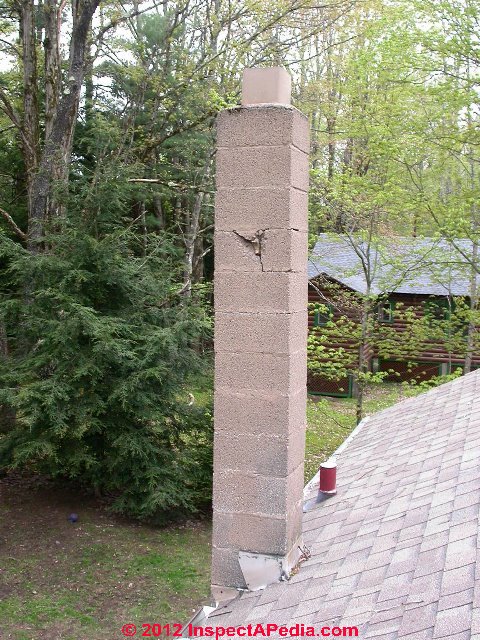
Our photo (left) illustrates serious frost cracking damage in a concrete block (or masonry block or "cinder block") chimney serving a home in upstate New York.
Notice that there is no rain cap and no chimney cap protecting this chimney against water intrusion - defects likely to lead to frost damage and an unsafe flue, especially in freezing climates.
Cracks in a masonry block chimney always deserve further investigation to identify the probable cause, to decide on the remedy and to evaluate the safety and function of the chimney.
Watch out: We recommend that you have any cracked or damaged chimney thoroughly inspected by a professional, including an inspection of the integrity of the chimney flue and of any fireplaces or other attached heating systems.
Common Causes of Concrete Block ("cinder block") Chimney Cracking
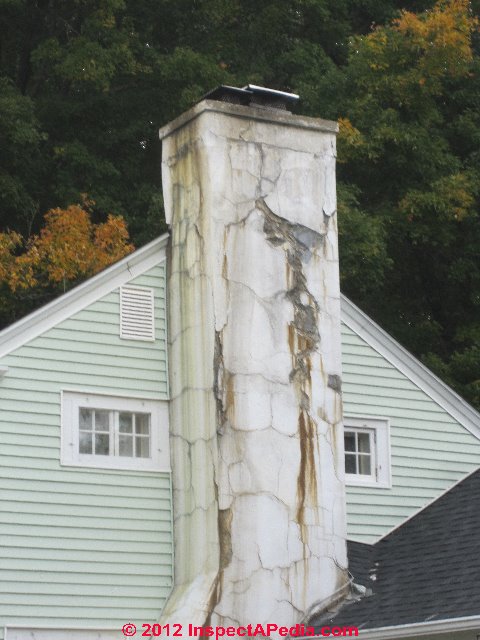
Our photo (left) illustrates a concrete block chimney suffering from both extensive cracking as well as spalling surfaces . We think there are leaks into the internal structure of this chimney, probably originating at the chimney cap.
See details at CHIMNEY SPALLING
It looks as if someone thought they might repair the chimney by coating its exterior with a masonry sealer paint or a thin stucco covering. But as leaks are originating from the chimney top and passing within the chimney structure, that repair did little good.
Cracks in a masonry chimney, particularly concrete block chimneys (this article) and perhaps brick may be caused by
- chimney footing tipping or settlement (inadequate foundation) -
see CHIMNEY LEANING, SEPARATION, MOVEMENT - expansive clay soil disturbing a chimney footing
- frost (poor drainage, missing rain cap, porous masonry, improper construction in freezing climates) -
see CHIMNEY CAP & CROWN DEFINITIONS - thermal expansion of the clay flue liner (improper construction, omission of an expansion joint at the chimney cap)
- a chimney fire
- mechanical damage or lack of adequate support for tall chimney sections -
see BRACING for MASONRY CHIMNEYS - or perhaps other events such as earthquake -
see EARTHQUAKE CHIMNEY COLLAPSE DANGERS
Readers should also see CHIMNEY INSPECTION FROM GROUND CHIMNEY CRACKS, SEPARATION, MOVEMENT.
Cracks in Masonry Chimneys May be Very Dangerous
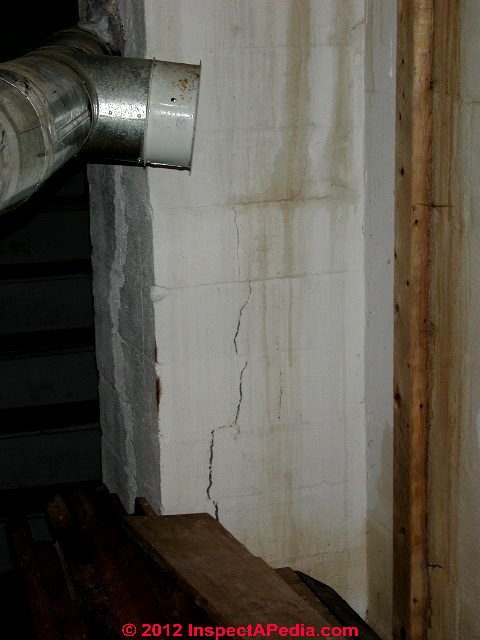
Watch out: a chimney fire, even if it does not set the building ablaze, is likely to have caused serious damage to the chimney itself, leaving it unsafe, as may other chimney cracks or movements for any reason. The risks include building fires, potentially fatal flue gas leaks, improper draft, and unsafe heating equipment operation.
Our photo at left shows dangerous cracking indoors in a concrete block chimney used to vent a heating appliance.
You might also notice that the barometric damper is not level - a much simpler problem to correct.
As a chimney leans away from the house we might find several serious problems caused by that movement:
- Damaged, unsafe chimney liner
(flue gas leaks or sparks into the building interior, a fire or potentially fatal carbon monoxide hazard) - Damaged, unsafe fireplaces where the chimney has pulled the firebox
away from the building or created dangerous openings around the fireplace into the building structure, risking both sparks (and fire) or air leaks (and inability to control the draft). - Leaks into the building walls
(flue gas leaks or sparks into the building interior, a fire or potentially fatal carbon monoxide hazard)
Unsafe fireplaces in the building: hearth cracks, fireplace side cracks, chimney damage all present risks of sparks or smoke entering the building cavities, a fire and flue gas risk. Check for evidence of movement at the fireplace. (Flue gas leaks or sparks into the building interior, a fire or potentially fatal carbon monoxide hazard)
Also see CHIMNEY CRACK DETECTION & DIAGNOSIS
Evidence of Prior Repairs May Indicate a History of Chimney Cracking & Movement in a Concrete Block Chimney
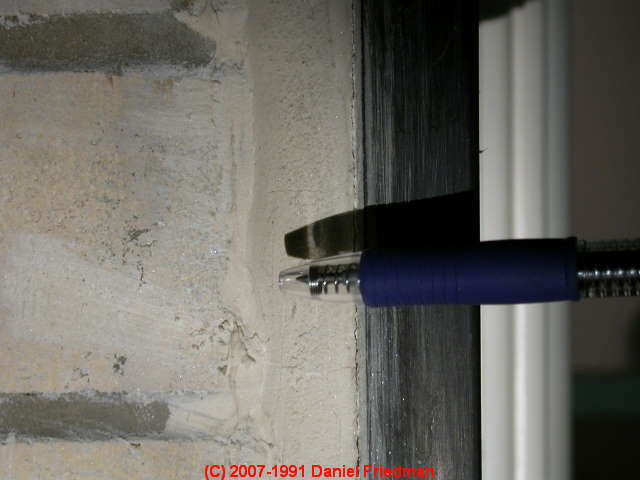
If you see repairs such as shown in the our photo (left) the chimney should be professionally inspected, especially to establish the condition of the flue liner as it may be unsafe.
Our pen points to a gap between masonry block chimney and a building wall, indicating chimney movement and raising question about other less obvious crack and damage to this structure.
It may be possible to repair minor chimney racks with masonry products provided that the underlying cause is also identified and corrected.
Also, some concrete blocks may be cracked during their individual drying/curing process, a condition not to be confused with chimney cracking.
The usual repair when a significant chimney crack has occurred, damaging the chimney and the flue is to remove and replace the chimney, though in some cases it may be possible to re-line the chimney and to jack an intact masonry chimney back to level and repair its connections into the building.
Repairs to Cracked Concete Block Chimneys
Extensive concrete block cracks, badly damaged masonry chimney flues, curved, leaning, broken masonry chimneys may need to be re-built to be safe and functional.
But minor chimney damage, and chimney damage that is confined to just above the roof line can usually be repaired or re-built.
- For a concrete block chimney, small areas of spalling or damage might be repaired using a masonry patching compound.
- If many blocks are damaged or when the damage is severe, rather than a "patch job" the mason will probably remove the damaged blocks from the lowest block up to the chimney top above the roof.
- Then she will replace any damaged flue tile or liner sections as well as replacing the damaged blocks themselves.
Watch out: be sure that the roof surface is protected from damage during rooftop chimney repairs, otherwise your chimney may be fixed but you could end up needing a new roof.
Also see CHIMNEY REPAIR METHODS.
Watch out: when there is any damage to any masonry chimney you want to be sure that the chimney flue or liner is itself un-damaged. A cracked or broken chimney flue risks fatal carbon monoxide poisoning of building occupants and in some cases also risks a building fire.
If your mason can't see enough of the entire flue to be confident of its condition, hire a chimney inspector who has a chimney flue scanning camera.
See details at CHIMNEY FLUE INSPECTION CAMERA
Reader Comments, Questions & Answers About The Article Above
Below you will find questions and answers previously posted on this page at its page bottom reader comment box.
Reader Q&A - also see RECOMMENDED ARTICLES & FAQs
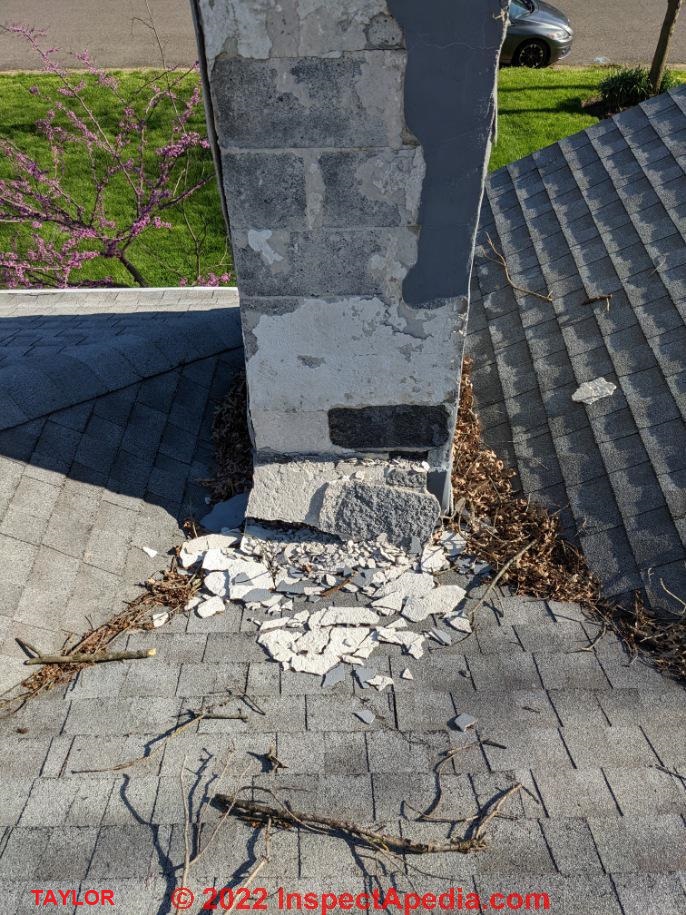
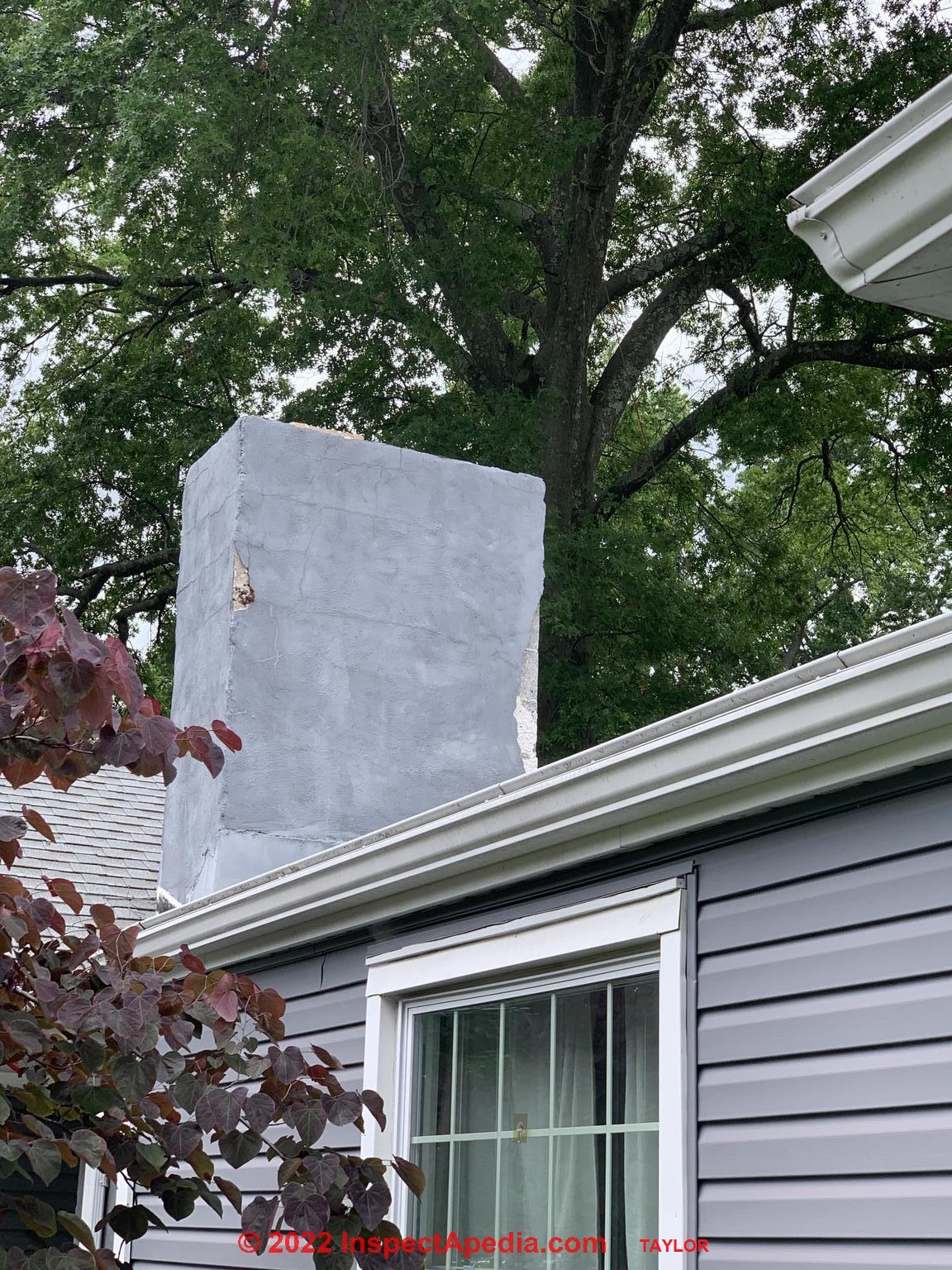
On 2022-06-08 by InspectApedia-911 (mod) - remove un-used chimney blocking roof valley drainage
 ...
... 
@Patrice Taylor,
That chimney installation is an example of one of the most trouble prone places you could possibly put a chimney on a roof.
It interrupts and blocks drainage from several roof slopes. That's probably why that side of the chimney has been repeatedly water damaged and repaired in the past.
That design also invites roof wear and roof leaks by causing water to back up on the roof surfaces.
You could simply re-parge we damaged chimney service but it would be a better project to remove it entirely.
I think that the cost of removing the chimney from the roof up and sealing the roof over that area might be similar to the cost of a technically correct solution if the chimney were left in place, which would be to trying to better-divert water around the base of the chimney by building a much larger cricket.
If, as I suspect from your message, you don't want to remove the chimney even though you say it is not used, then at the very least your repair of the chimney blocks should be pre-ceded by construction of a chimney saddle or cricket to better divert water around the chimney from the three roof slopes that all drain right against it.
See
CHIMNEY SADDLE / CRICKET FLASHING
that is found in our article
FLASHING, CHIMNEY MISTAKES & LEAKS
Then hire an experienced mason to repair the chimney if you're going to keep it. The mason will need to remove all of the debris, clean the chimney surfaces, perhaps use a concrete bonding agent painted onto the damaged concrete block surfaces, re-parge the block, and double-check that the chimney flashing over the new chimney saddle or cricket has remained properly in-place.
See also CHIMNEY SPALLING for more about cause and cure.
For more-understanding of the use of bonding agents when plastering with portland cement, see
On 2022-06-07 by Patrice Taylor - what's the best way to re-parge this block chimney to last another 30 years
I have a chimney exterior that appears to need re—parging on “one side”. It is about a 6 ft tall portion above my roof. It was a chimney to vent a heater only. I no longer have need for the chimney itself—— nothing is being vented out(new ventless heating system installed 5 years ago.)
The cinder block is in very good shape. As I noted above, it is only 1 side of a four sided structure where the cement like stuff fell off.
This chimney was painted 5 years ago (not sure what kind of paint).
House is 68 years old— never had a problem for the 30 years I’ve lived in it. Please advise on how to get about 30 more years out of it?
[Photos above]
On 2021-06-04 by inspectapedia.com.moderator (mod)
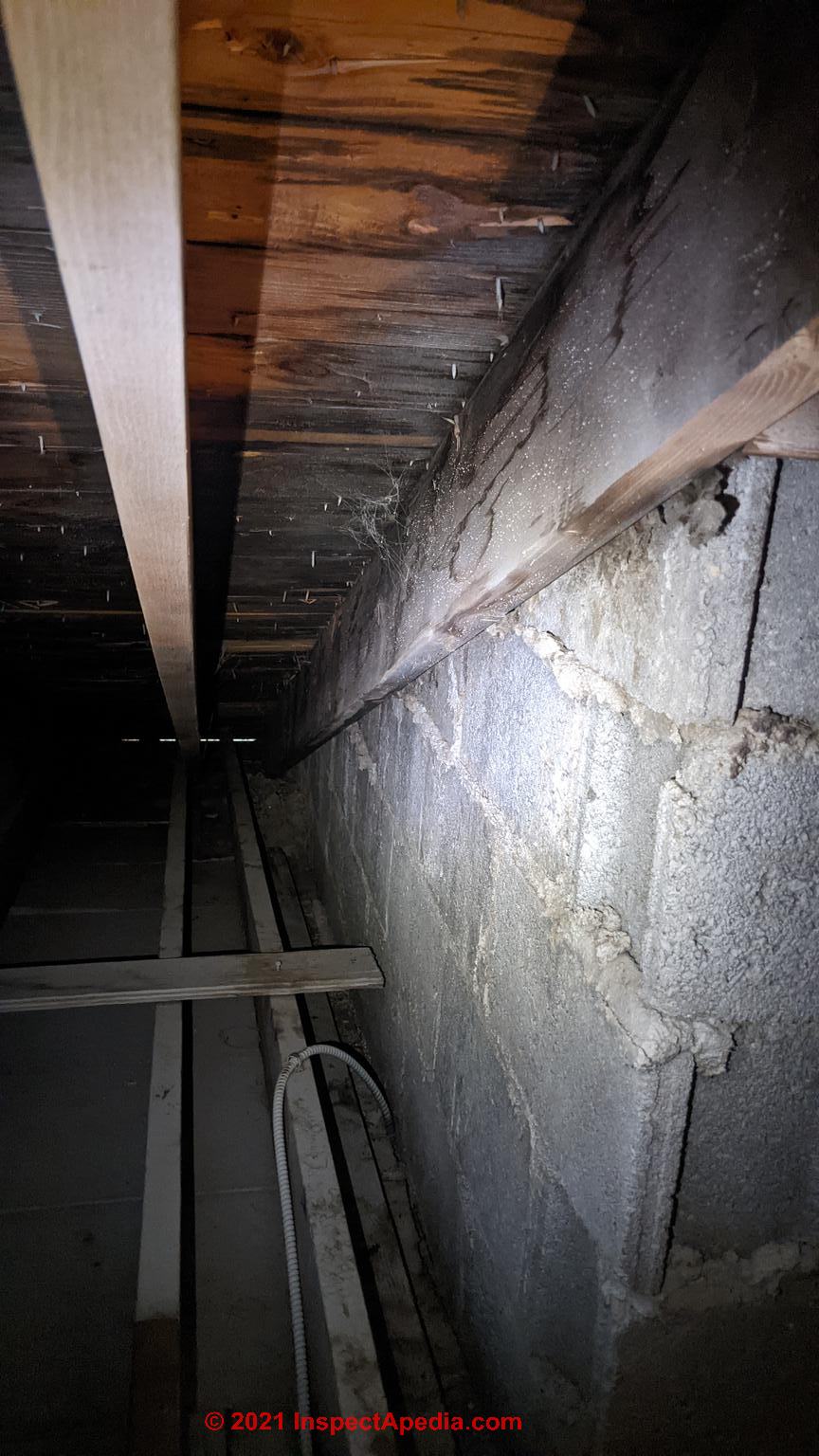 @Tom,
@Tom,
That black roof decking suggests that leaks at the chimney have been going on for a long time; You might check the attic side of the ceiling drywall (under the insulation) for mold contamination.
To see exactly what's wrong - missing, incomplete, improper flashing, or something else, you need an on roof inspection, but your photo strongly suggests leaky chimney flashing.
Watch out: Also have your chimney flue inspected for safety.
Don't hesitate to provide more details, photos, or to ask other questions. working together makes us smarter.
On 2021-06-04 by Tom
Hi there. I am trying to figure out if my chimney is saturated or my flashing and roof is the issue. Water is entering and it is in two rooms of home, on both sides of chimney.
On 2021-06-04 by Tom
Is this still active? Have lots of questions
On 2021-05-31 by mak.church (mod) - masonry repairs to broken concrete block chimney at rooftop
@Daisy, You're on the right page! In addition to reviewing the page itself, please note the specific section on Repairs to Cracked Concrete Block Chimneys
Let us know if you have additional questions.
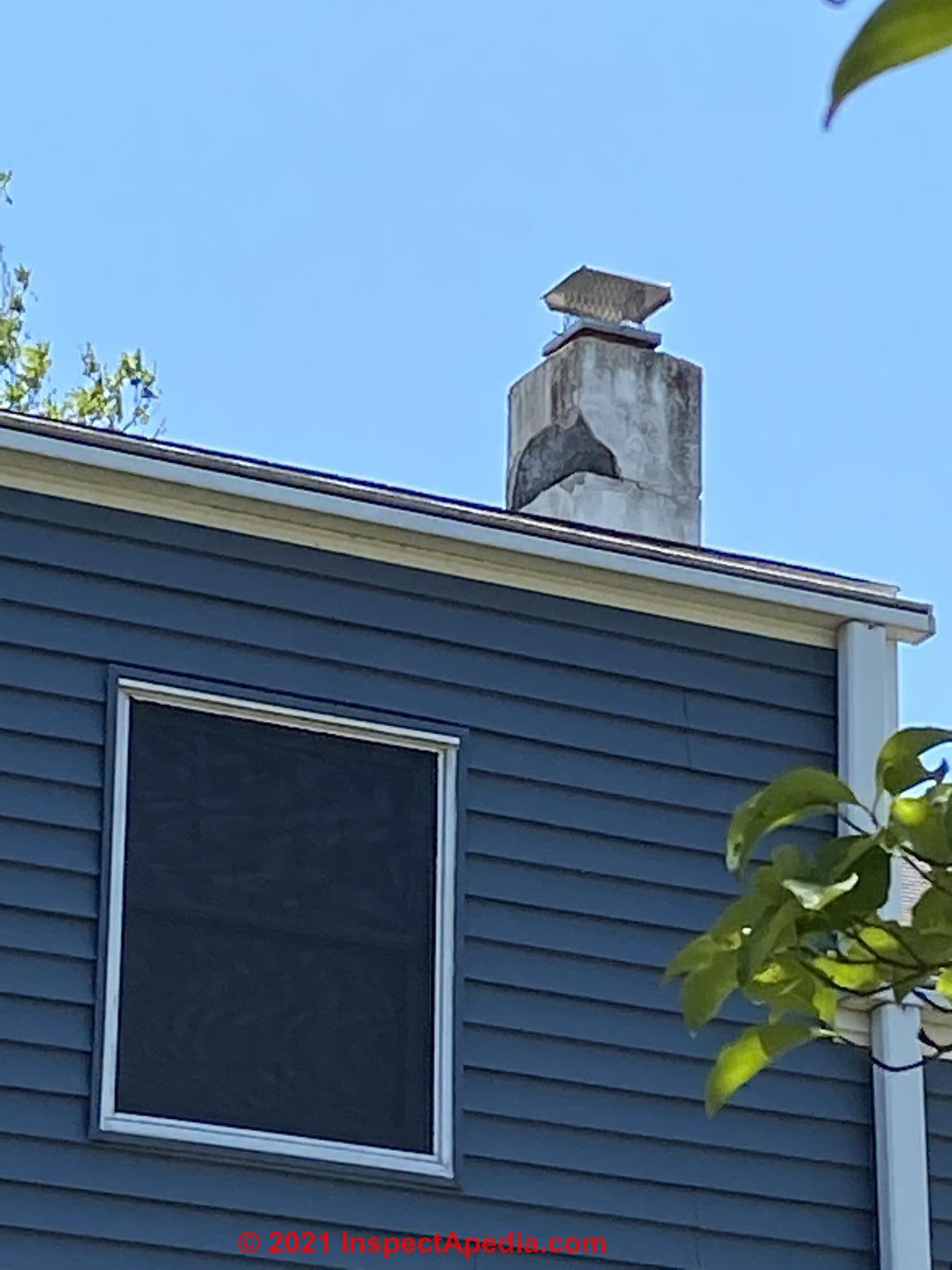
@Daisy, And here is the link to Chimney Repair Methods which should be helpful.
And ask your chimney repair mason about a complete inspection of the chimney flue to be sure it's not damaed, leaky, or unsafe.
Also see CHIMNEY FLUE INSPECTION CAMERA
On 2021-05-31 by Daisy
I would like to know the best way to pair this chimney? [Photo above]
On 2020-06-07 by (mod) - mortar & masonry fragments used to seal unused-chimney thimble vs. Pie Plates or Insulated Chimney Thimble Plugs
Donna
A hole at the chimney thimble location can be patched, filled in with a combination of masonry fragments or stone or even block fragments and some cement.
However if there are heating devices that vent into the chimney from below this point, then you may need your Mason to be sure that the flue liner is safe and intact.
And during the chinney repair we don't want to drop blobs of mortar down the flue where there may be a chance of blocking a lower thimble (chimney opening) used to vent other heating equipment - doing so would be unsafe.
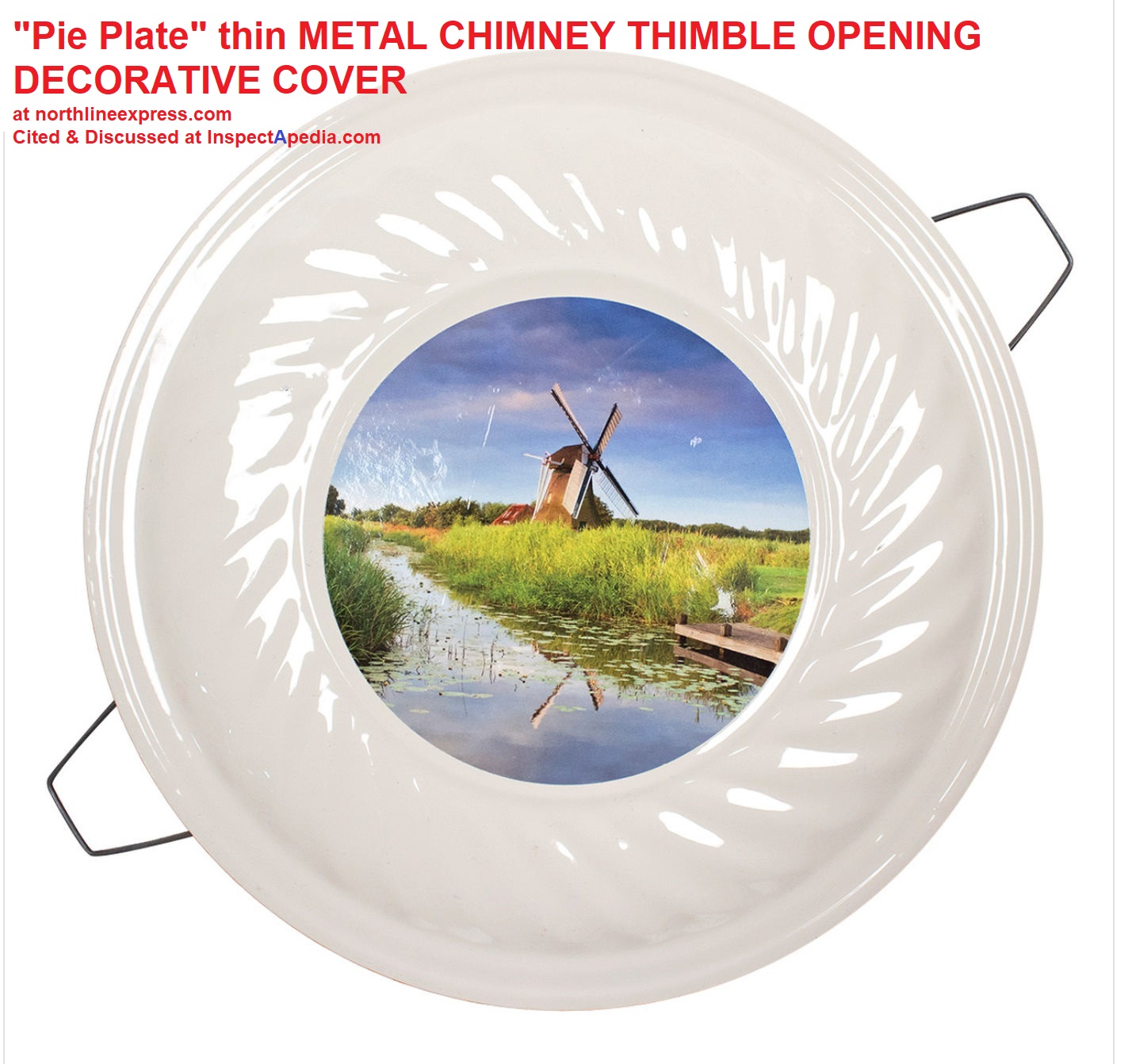
Watch out: occasionally we see, usually in an older home, a metal "pie-plate" chimney thimble opening cover held in place by wire springs.
We used to use these thimble covers to close off a chimney opening for a free-standing wood stover or coal stove when the heater was removed and stored during summer months and when the chimney flue is not being used by any other heating equipment elsewhere in the building .
But for long-term or permanent abandonment of a chimney opening and where a chimney remains in active use venting other heating equipment, those metal covers are inadquate, unsafe, and risk both a building fire and dangerous carbon monoxide gas leaks.
An example of this sort of decorative chimney opening cover is shown above, sold by Northlineexpress.com.
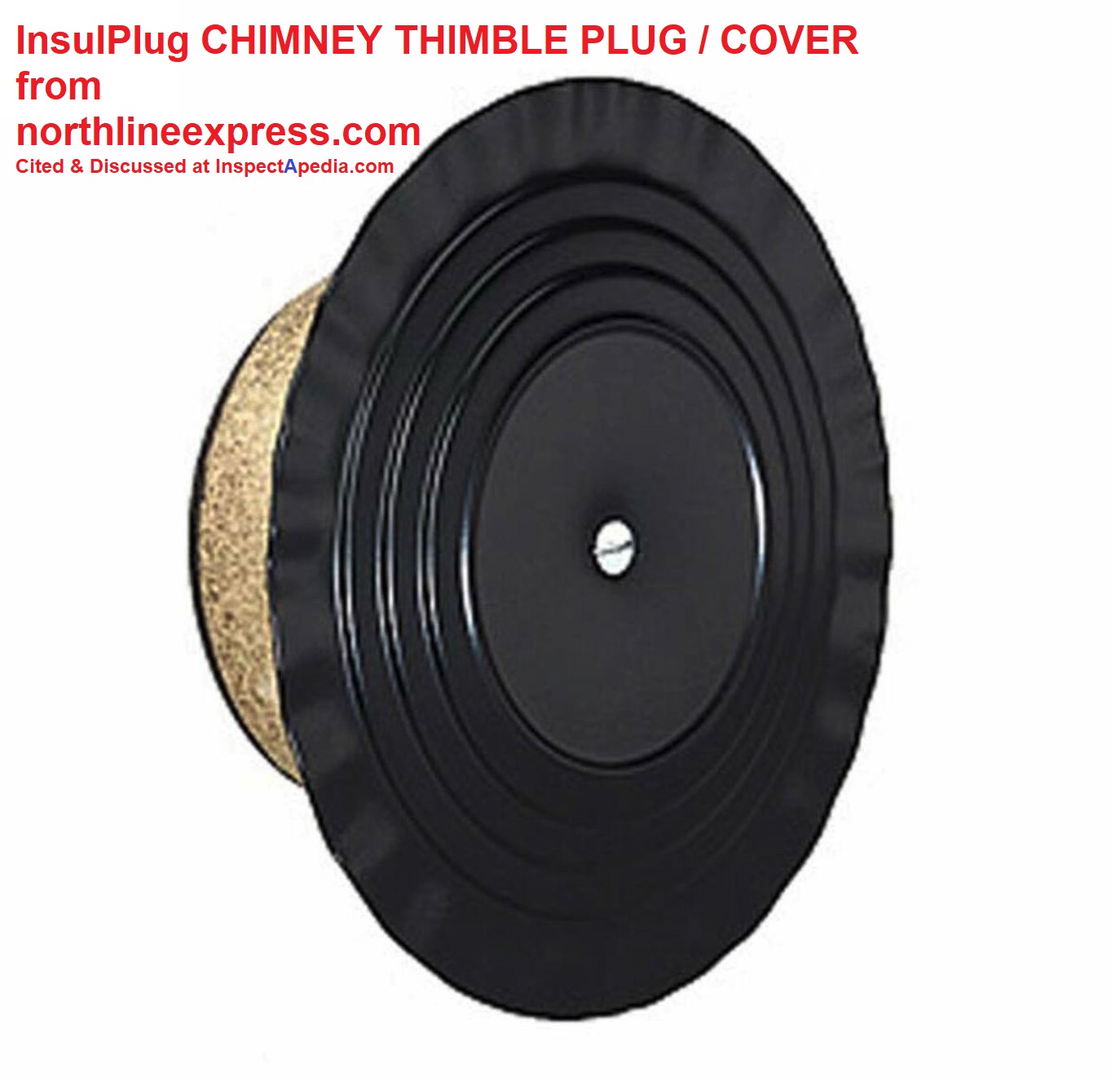
The same company also offers a 6-inch Insul-Plug insulating chimney thimble plug, shown below. The price is a stunning $218.00 USD - shown above.
Here is the company's description:
The Insul-Plug blocks old, unused thimble holes in masonry chimneys. It provides a thermal break from combustibles and prevents downdrafts from entering the room. The Insu-Plug is constructed of a ceramic based fireproof insulating material and will help stop the possibility of smoke and carbon monoxide from re entering the home.
The black outside plate covers up to a 10" diameter hole. Simply insert it in the old thimble opening screw on the face of the Insul-Plug. The sides expand and create a tight fit inside the thimble opening. It can always be removed by reversing the process. Also available in a 8".- source: NorthlineExpress.com retrived 2021/06/06
We don't know if the InsulPlug is UL-listed.
Similar products, such as a 6-inch insulated tee plug from selkirk sells for about $35. U.S. [Shown below] and carries a UL-103 listing.
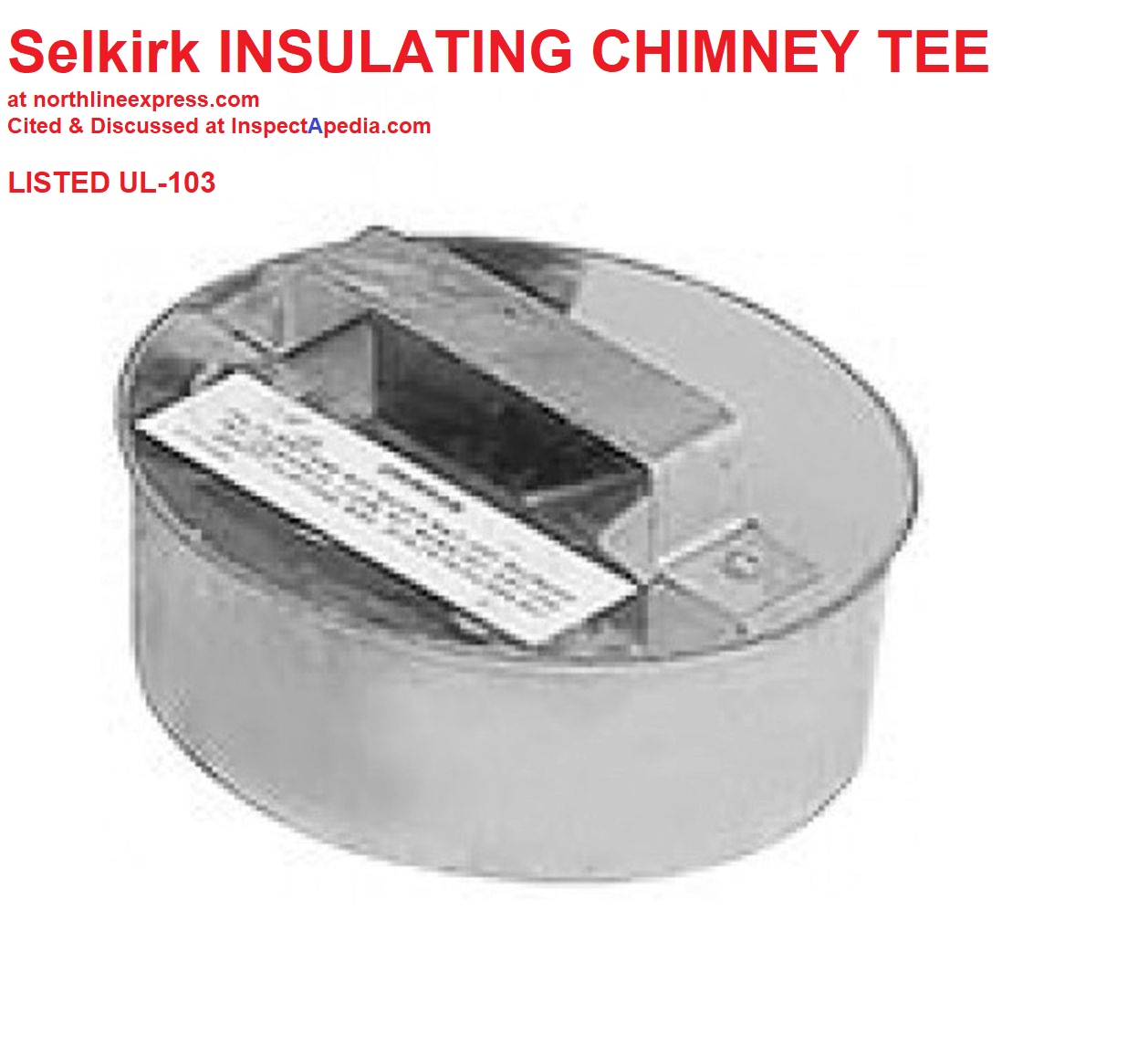
Northline describeds the Selkirk Chimney Tee cover as
The Insulated Chimney Tee may be used to start chimneys indoors or outdoors using a Wall Support assembly or a masonry pier. A length of Insulated Chimney Pipe is attached to the Tee snout to pass safely through combustible walls. An Insulated Tee Cap is included which can be removed from bottom opening for inspection.
Engineered for safety, Selkirk, also known as MetalBest or MetalBestos, chimneys are packed with one inch of premium fiber insulation, ensuring a 100% fill. This superior insulation maintains higher internal flue temperatures, enhancing draft and efficiency. Low temperatures are maintained on the outer casing, allowing installation as close as 2" from combustible materials.
Assembled with the Positive Joint Coupler, the safest and most secure locking system in the industry, Ultra-Temp and Galva-Temp chimney sections twist together with a 1/8 turn. A locking band ensures system integrity and strength for the life of the chimney. Selkirk again sets the industry standard.
The company notes that this Selkirk pipe can be used in Canada but ONLY FOR GAS AND OIL.- retrieved 2021/06/06 northlineexpress.com
On 2020-06-07 by Donna - how do I patch or fill this hole in the chimney where we removed a woodstove
I have a 6” round hole cut into a concrete block chimney where an old wood stove vented to the outside.
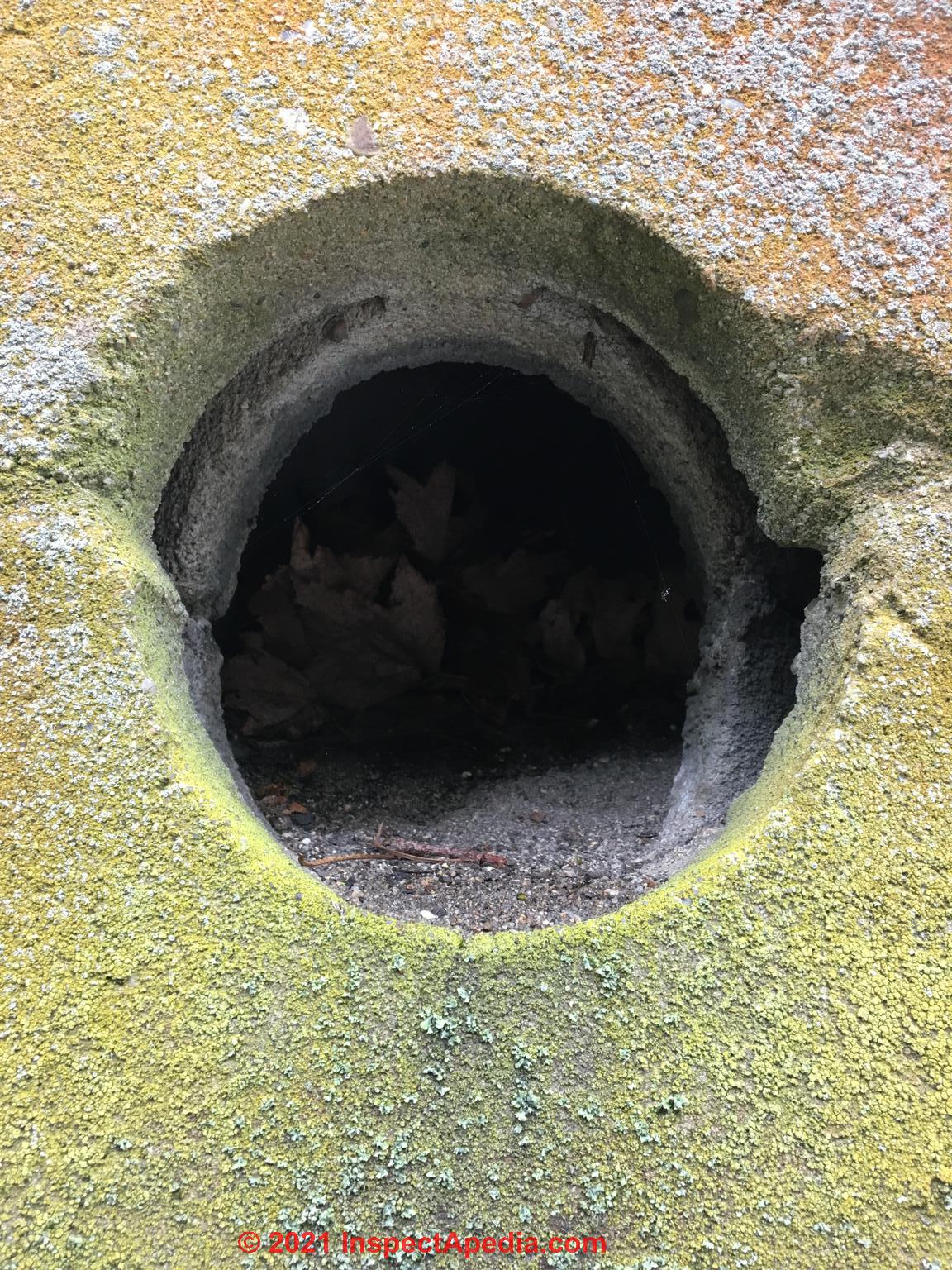
The stove and pipe have been removed. Can the hole be patched, or does the entire block need to be replaced?
On 2020-05-05 by (mod) - vertical split/crack in concrete block chimney: cause, repair
I'm up in Two Harbors, so I've seen the winter frost damage problem too.
Watch out: I don't assume that the flue us intact, but if you can finda chimney contractor with a camera then we can find out the flue condition and to be sure it's safe.
If you can stabilize the chinney structure and fix the leaks that sent water inside the blocks that I suspect caused frost splitting of the block chimney, then consider a chimney re-lining option.
PS: often when I see a crack pattern like the one on your block chimney I think that water got into the chimney at the top or near the top, from a bad top seal (perhaps), and ran down the space between the clay liner tiles and the block outer wall. If that was the case I expect frost damage to the liner too.
And sure you can replace a block chimney with a Class-A insulated metal chimney.
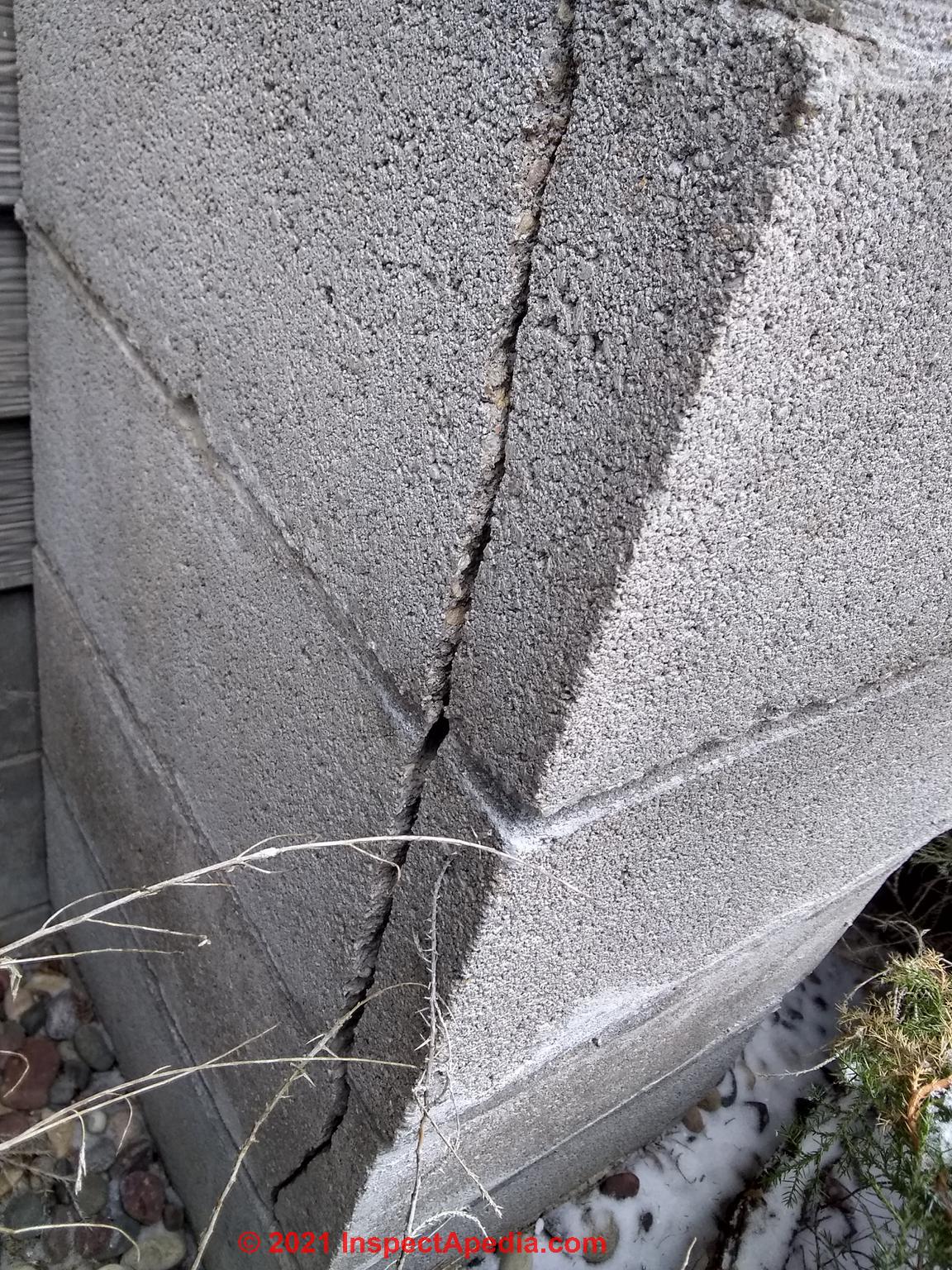 Let me know what you find. And take care to watch out meanwhile for a collapse of at least part of the chimney.
On 2020-05-05 by Kevin
I have a 20 year old cement block chimney for my wood burning stove in my basement. My blocks cracked in January 2020. I live in Minnesota, so we have cold winters. There are 2 main cracks, one on each side of the chimney that start at ground level and go up 4 blocks high.
When these cracks were discovered we stopped using our wood burner for the rest of the winter, in case the flue was cracked also, etc. I plan to have at least 2 different chimney professionals look at the damage and take bids.
My questions are as follows:
1) If we can repair the chimney cracks only (doubtful) and leave the current structure intact that would be my first choice…..assuming the flue is not damaged.
2) Besides the block and the flue being cracked, what else could be damaged? Or what else should I be concerned about?
3) If the chimney needs to be replaced what is your opinion going with a Class A chimney, instead of block?
It seems only a matter of time before cement has cracks, etc. I'm concerned going with another block chimney, not only because of the expense but, it's very difficult getting good quality workmanship these days.
Unfortunately I was only able to send one pic in your comments format, but hopefully you can get an idea of the block structure damage.
Thank you for any info you can provide. If you need me to send more pics, let me know.
Question: I was told that the building code in Massachusetts only allows block chimneys to be reparied with bricks
2017/04/26 Eddie Arroco said:
I need my fireplace chimney concrete blocks repaired or replaced above the roofline which are cracked and breaking up. I called in a contractor but I was told that the building code in Massachusetts only allow him to replace the blocks with bricks.
I'm afraid the bricks wihich is of different color will not look good at all. Is there any truth to this code since it is only a repair of existing structure? What do you suggest I should do? I would really appreciate your advise. Thank you very much.
Reply: Really? Ask again. Here are the Massachusetts Chimney Codes based on model building codes
I am really surprised at the claim that concrete block chimneys are not permitted in Massachusetts.
And I'm doubtful. It might be that the mason wants to work with and use the materials with which she is most-comfortable.
But on occasion a builder speaks as if God told him the Truth when in fact he has never read even the instructions on the box of the device he's installing.
Take a look at these two Massachusetts chimney code documents and you will see that the words "brick" or "concrete block" do not appear anywhere in the code.
- MASSACHUSETTS CHIMNEY CODE: Chapter 60, CHIMNEYS, FIREPLACES AND SOLID FUEL-BURNING APPLIANCES [PDF] - at inspectapedia.com/chimneys/Massachusetts-Chimney-Code.pdf
and
- MASSACHUSETTS CHIMNEY CODE: 780 CMR 68.00 CHIMNEYS and VENTS [PDF] - at /chimneys/Massachusetts-Chimney-Vent-Code-780-CMR-6801.pdf
A modern concrete block chimney uses a hard-fired clay chimney liner inside the blocks and a listed or UL-listed approved chimney cap. You should not have to replace blocks with bricks.
Now, call a chimney repair contractor or two in your area and let me know what they tell you.
While you're at it, have the entire flue interior inspected for safety too.
Question:
(Dec 18, 2012) chimney man said:
I just finished a blcok chimney with clay liner. 28 ft tall. i did it in cold weather but used a space heater.. days later to keep it warm i started a small kindling fire in the cleanout door..
half hour and let it go out. the next day i realized the block right above the cleanout door the mortar joint was cracked all the way around. the tile was not. and the thimbal is 4.5 feet about the cleanout. so heat wont touch that part from this point on once i get my stove in there.
i dont know why this happened. is it bad and what shuld i do?
(July 31, 2014) alan said:
I've got a question about a home that i saw on your web page, the picture shows the chimney in the back yard next to the deck and the house is tan with a brown roof. what kind of material is the outside of that chimney. It looks like some sort of vinyl paneling.
The reason i ask is because we have a brick fireplace that has been worked on 3 times over the last 15 years, we even had it torn down to the rooftop 8 years ago. Anyway, the inside of the chimney is solid per inspectiors, but the outside, even the newest part continues to pop and break
. I am looking for something new and cheaper to repair my chimney, would be nice to shore up the current chimney, and then put paneling around it. is this possible, and if so can you recommend a contractor in dayton ohio area that you work with? thanks for your help.
Reply:
Alan, I don't see the photo you describe in the article above. But indeed some chimneys are constructed as an insulated metal flue run inside of a vertical wooden chase whose exterior is covered with a choice of siding materials.
Details are at
Note that this is NOT a way to repair a damaged masonry chimney if the flue is unsafe.
But it MIGHT be possible to surround and cap a safe masonry flue with a new external chimney chase.
I'd be more tempted to simply stucco the chimney exterior of a spalling masonry instead.
On 2019-08-19 by (mod) - how to evaluate damage to a concrete block chimney
Jim
Evaluate the nature and extent of damage to a concrete block chimney:
I'd need to see some photos (one per comment) to make more specific suggestions, but if the damage is trivial a mortar patch compound would be ok.
There is much to ask first:
1. what kind of damage: cracking, leaning, spalling?
2. how extensive: small trivial areas or larger several inches or more of material loss
4. how serious: does the damage go all the way through the block or is it just superficial in depth
5. Safety concerns: is the damage caused by frost or movement that may also have damaged the flue liner making it unsafe?
On 2019-08-19 by Jim
How do I repair a deteriorating chimney block
On 2017-04-26 by (mod) - chimney repair codes for Massachusetts
Eddie,
I am really surprised at the claim that concrete block chimneys are not permitted in Massachusetts. And I'm doubtful. Way too often a builder speaks as if God told him the Truth when in fact he has never read even the instructions on the box of the device he's installing.
Take a look at these two Massachusetts chimney code documents and you will see that the words "brick" or "concrete block" do not appear anywhere in the code.
CHIMNEY CODE for MASSACHUSETTS https://inspectapedia.com/chimneys/Massachusetts-Chimney-Code.pdf
and
CHIMNEY VENTING CODE for MASSACHUSETTS
https://inspectapedia.com/chimneys/Massachusetts-Chimney-Vent-Code-780-CMR-6801.pdf
Now, call a chimney repair contractor or two in your area and let me know what they tell you.
While you're at it, have the entire flue interior inspected for safety too.
On 2017-04-26 by Eddie Arroco - I was told that the building code in Massachusetts only allow to replace blocks with bricks
I need my fireplace chimney concrete blocks repaired or replaced above the roofline which are cracked and breaking up.
I called in a contractor but I was told that the building code in Massachusetts only allow him to replace the blocks with bricks. I'm afraid the bricks wihich is of different color will not look good at all.
Is there any truth to this code since it is only a repair of existing structure?
What do you suggest I should do? I would really appreciate your advise. Thank you very much.
...
Continue reading at CHIMNEY REPAIR METHODS or select a topic from the closely-related articles below, or see the complete ARTICLE INDEX.
Or see these
Recommended Articles
- BRICK CHIMNEY CRACKS & COLLAPSE
- CHIMNEY CRACK DIAGNOSIS - types of crack, why they occur, what to do
- CHIMNEY INSPECTION DIAGNOSIS REPAIR - home
- CHIMNEY FLUE INSPECTION CAMERA
- CHIMNEY REPAIR METHODS
- CHIMNEY SPALLING
- CHIMNEY STAINS & LEAKS
Suggested citation for this web page
CRACKED CHIMNEYS, MASONRY BLOCK at InspectApedia.com - online encyclopedia of building & environmental inspection, testing, diagnosis, repair, & problem prevention advice.
Or see this
INDEX to RELATED ARTICLES: ARTICLE INDEX to CHIMNEYS & FLUES
Or use the SEARCH BOX found below to Ask a Question or Search InspectApedia
Ask a Question or Search InspectApedia
Try the search box just below, or if you prefer, post a question or comment in the Comments box below and we will respond promptly.
Search the InspectApedia website
Note: appearance of your Comment below may be delayed: if your comment contains an image, photograph, web link, or text that looks to the software as if it might be a web link, your posting will appear after it has been approved by a moderator. Apologies for the delay.
Only one image can be added per comment but you can post as many comments, and therefore images, as you like.
You will not receive a notification when a response to your question has been posted.
Please bookmark this page to make it easy for you to check back for our response.
Our Comment Box is provided by Countable Web Productions countable.ca
Citations & References
In addition to any citations in the article above, a full list is available on request.
- Arlene Puentes [Website: www.octoberhome.com ] , an ASHI member and a licensed home inspector in Kingston, NY, and has served on ASHI national committees as well as HVASHI Chapter President. Ms. Puentes can be contacted at ap@octoberhome.com
- NFPA 211 - Standards for Chimneys & Fireplaces, NFPA 211: Standard for Chimneys, Fireplaces, Vents, and Solid Fuel-Burning Appliances, 2006 Edition (older editions and standards are found at the same bookstore)
- NFPA #211-3.1 1988 - Specific to chimneys, fireplaces, vents and solid fuel burning appliances.
- NFPA # 54-7.1 1992 - Specific to venting of equipment with fan-assisted combustion systems.
- GAMA - Gas Appliance Manufacturers' Association has prepared venting tables for Category I draft hood equipped central furnaces as well as fan-assisted combustion system central furnaces.
- National Fuel Gas Code, an American National Standard, 4th ed. 1988 (newer edition is available) Secretariats, American Gas Association (AGA), 1515 Wilson Blvd., Arlington VA22209, and National Fire Protection Association (NFPA), Batterymarch Park, Quincy MA 02269. ANSI Z223.1-1988 - NFPA 54-1988. WARNING: be sure to check clearances and other safety guidelines in the latest edition of these standards.
- Fire Inspector Guidebook, A Correlation of Fire Safety Requirements Contained in the 1987 BOCA National Codes, (newer edition available), Building Officials and Code Administrators International, Inc. (BOCA), Country Club HIlls, IL 60478 312-799-2300 4th ed. Note: this document is reissued every four years. Be sure to obtain the latest edition.
- Uniform Mechanical Code - UMC 1991, Sec 913 (a.) Masonry Chimneys, refers to Chapters 23, 29, and 37 of the Building Code.
- New York 1984 Uniform Fire Prevention and Building Code, Article 10, Heating, Ventilating, and Air Conditioning Requirements
- New York 1979 Uniform Fire Prevention & Building Code, The "requirement" for 8" of solid masonry OR for use of a flue liner was listed in the One and Two Family Dwelling Code for New York, in 1979, in Chapter 9, Chimneys and Fireplaces, New York 1979 Building and Fire Prevention Code:
- "Top Ten Chimney (and related) Problems Encountered by One Chimney Sweep," Hudson Valley ASHI education seminar, 3 January 2000, contributed by Bob Hansen, ASHI
- Chimney Inspection Checklist, Carson Dunlop, Associates, Toronto, Ontario
- "Rooftop View Turns to Darkness," Martine Costello, Josh Kovner, New Haven Register, 12 May 1992 p. 11: Catherine Murphy was sunning on a building roof when a chimney collapsed; she fell into and was trapped inside the chimney until rescued by emergency workers.
- "Chimneys and Vents," Mark J. Reinmiller, P.E., ASHI Technical Journal, Vol. 1 No. 2 July 1991 p. 34-38.
- "Chimney Inspection Procedures & Codes," Donald V. Cohen was to be published in the first volume of the 1994 ASHI Technical Journal by D. Friedman, then editor/publisher of that publication. The production of the ASHI Technical Journal and future editions was cancelled by ASHI President Patrick Porzio. Some of the content of Mr. Cohen's original submission has been included in this more complete chimney inspection article: CHIMNEY INSPECTION DIAGNOSIS REPAIR . Copies of earlier editions of the ASHI Technical Journal are available from ASHI, the American Society of Home Inspectors.
- Natural Gas Weekly Update: http://tonto.eia.doe.gov/oog/info/ngw/ngupdate.asp Official Energy Statistics from the U.S. Government
- US Energy Administration: Electrical Energy Costs http://www.eia.doe.gov/fuelelectric.html
- Our recommended books about building & mechanical systems design, inspection, problem diagnosis, and repair, and about indoor environment and IAQ testing, diagnosis, and cleanup are at the InspectAPedia Bookstore. Also see our Book Reviews - InspectAPedia.
- Ceramic Roofware, Hans Van Lemmen, Shire Library, 2008, ISBN-13: 978-0747805694 - Brick chimneys, chimney-pots and roof and ridge tiles have been a feature of the roofs of a wide range of buildings since the late Middle Ages. In the first instance this ceramic roofware was functional - to make the roof weatherproof and to provide an outlet for smoke - but it could also be very decorative.
The practical and ornamental aspects of ceramic roofware can still be seen throughout Britain, particularly on buildings of the Victorian and Edwardian periods. Not only do these often have ornate chimneys and roof tiles but they may also feature ornamental sculptures or highly decorative gable ends. This book charts the history of ceramic roofware from the Middle Ages to the present day, highlighting both practical and decorative applications, and giving information about manufacturers and on the styles and techniques of production and decoration.
Hans van Lemmen is an established author on the history of tiles and has lectured on the subject in Britain and elsewhere. He is founder member and presently publications editor of the British Tiles and Architectural Ceramics Society. - Chimney Inspection Checklist, Carson Dunlop, Associates, Toronto, Ontario
- Chimney & Stack Inspection Guidelines, American Society of Civil Engineers, 2003 - These guidelines address the inspection of chimneys and stacks. Each guideline assists owners in determining what level of inspection is appropriate to a particular chimney and provides common criteria so that all parties involved have a clear understanding of the scope of the inspection and the end product required. Each chimney or stack is a unique structure, subject to both aggressive operating and natural environments, and degradation over time. Such degradation may be managed via a prudent inspection program followed by maintenance work on any equipment or structure determined to be in need of attention. Sample inspection report specifications, sample field inspection data forms, and an example of a developed plan of a concrete chimney are included in the guidelines. This book provides a valuable guidance tool for chimney and stack inspections and also offers a set of references for these particular inspections.
- Fireplaces, a Practical Design Guide, Jane Gitlin
- Fireplaces, Friend or Foe, Robert D. Mayo
- NFPA 211 - Standards for Chimneys & Fireplaces, NFPA 211: Standard for Chimneys, Fireplaces, Vents, and Solid Fuel-Burning Appliances, 2006 Edition (older editions and standards are found at the same bookstore)
- Principles of Home Inspection: Chimneys & Wood Heating, in (Principles of Home Inspection), Carson Dunlop, Associates, Toronto, Ontario
- NFPA 211 - 3-1.10 - Relining guide for chimneys
- NFPA 211 - 3-2 - Construction of Masonry Chimneys
- NFPA 211 - 3-3 - Termination Height for chimneys
- NFPA 211 - 3-4 - Clearance from Combustible Material
- NFPA 54 - 7-1 - Venting of Equipment into chimneys
- Brick Institute of America - Flashing Chimneys
Brick Institute of America - Proper Chimney Crowns
Brick Institute of America - Moisture Resistance of Brick - American Gas Association - New Vent Sizing Tables
- Chimney Safety Institute of America - Chimney Fires: Causes, Effects, Evaluation
- National Chimney Sweep Guild - Yellow Pages of Suppliers
- In addition to citations & references found in this article, see the research citations given at the end of the related articles found at our suggested
CONTINUE READING or RECOMMENDED ARTICLES.
- Carson, Dunlop & Associates Ltd., 120 Carlton Street Suite 407, Toronto ON M5A 4K2. Tel: (416) 964-9415 1-800-268-7070 Email: info@carsondunlop.com. Alan Carson is a past president of ASHI, the American Society of Home Inspectors.
Thanks to Alan Carson and Bob Dunlop, for permission for InspectAPedia to use text excerpts from The HOME REFERENCE BOOK - the Encyclopedia of Homes and to use illustrations from The ILLUSTRATED HOME .
Carson Dunlop Associates provides extensive home inspection education and report writing material. In gratitude we provide links to tsome Carson Dunlop Associates products and services.
 | HOME | ABOUT | ASK a QUESTION | CONTACT | CONTENT USE POLICY | DESCRIPTION | POLICIES | PRIVACY | |
| © 2024 - 1985 Publisher InspectApedia.com - Daniel Friedman | |||||||||