
InspectAPedia® FREE Encyclopedia of Building & Environmental Construction, Diagnosis, Maintenance & Repair |
Question? Just ask us! InspectAPedia
|
 Installation & Inspection of Type L Chimneys
& Type E Vents for Oil Fired Appliances
- POST a QUESTION or COMMENT about metal L-chimneys & vents for oil fired heating equipment
L-vent chimney specifications:
This article describes the installation and inspection of L-Vent chimneys used to vent oil-fired heating systems. We illustrate both safe and unsafe L-vent metal chimney installations, including chimneys that are too short, too close to other structures, are damaged, or are missing components.
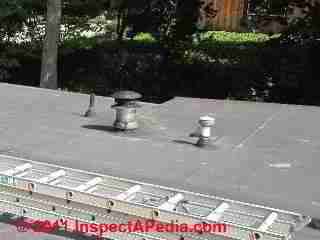
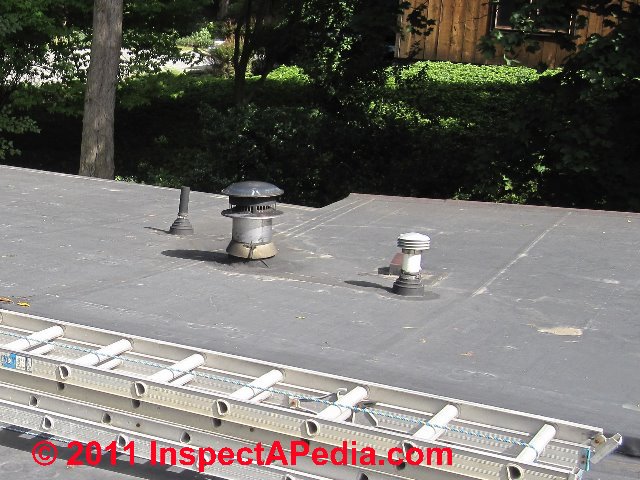
Our page top photo shows an L-vent chimney that is too short above the roof, and too short in total rise - the oil fired boiler it vents never worked properly and always had marginal draft until this chimney was replaced with a taller unit.
InspectAPedia tolerates no conflicts of interest. We have no relationship with advertisers, products, or services discussed at this website.
Type L Vents - Double Wall Metal Vents
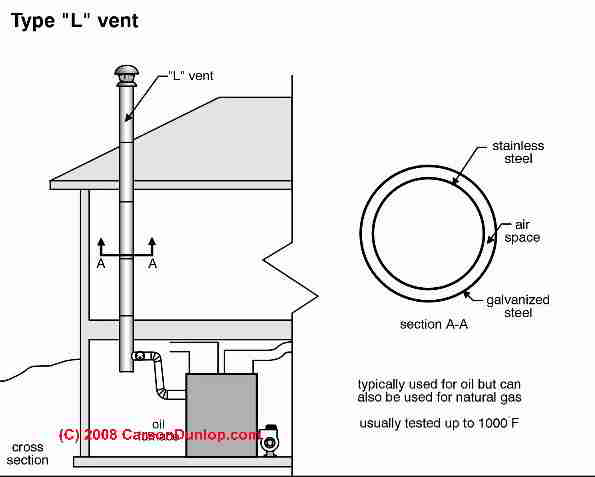 We use Type L-Vents, double-walled metal chimneys for venting heating appliances not only for fire safety but also because the insulation provided by the doubled walls improves draft - an important safety requirement when venting oil or gas fired appliances.
A Type-L vent is used for oil-fired appliances but can also be used for venting natural gas fired appliances.
But as we explain at TYPE B VENT vs L VENT DIFFERENCES, the reverse is not true - that is, you can substitute an L-vent chimney for a B-type vent, but you cannot go the other way: a B-type vent chimney cannot be used in high temperature applications where an L-vent chimney is required.
As Carson Dunlop Associates' [reference] sketch indicates, Type-L vents are tested to 1000 degF.
Some products list lower listing temperatures, as we explain here.
Some manufacturers such as Metal-Fab, Inc. provide installation manuals for L-Vents indicating that their L-Vent systems are listed for gas and oil furnaces that do not exceed 570 degF at the outlet temperature [of the furnace or boiler], and for 1700 degF. for a 10-minute "safety overfire" situation."
In the U.S. in the 1940s - 1960s, Type E vents, such as Condensing Engineering's Vitroliner were UL listed for use with multiple fuels such as gas and oil, and are in our opinon a predecessor of modern L-vent chimneys. See details at
Chimney Height Requirements for Type L Vents
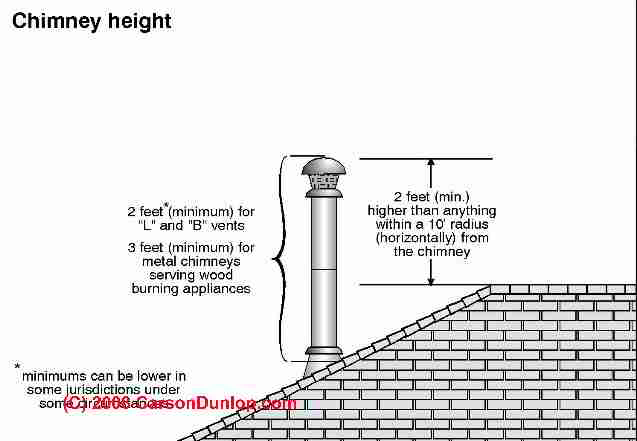
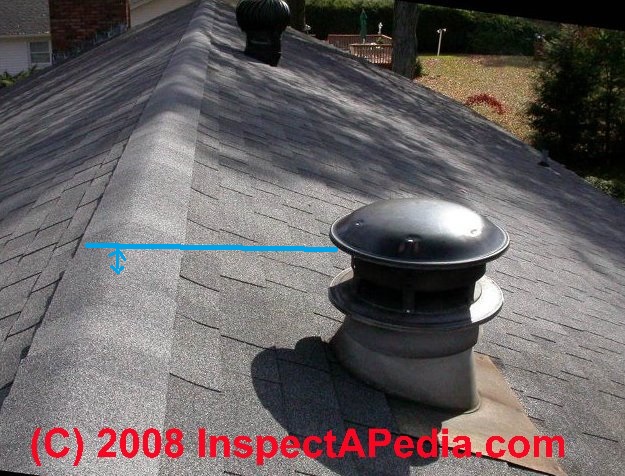 Heights for both L-Vent and B-Vent metal chimney vents are shown in Carson Dunlop Associates [at REVIEWERS] sketch. You will see that the L-Vent needs to be at least two feet above anything within ten feet of the chimney, and it should be at least two feet above the roof surface.
The sketch notes add that a metal chimney venting a wood burning appliance like a woodstove must be at least three feet above the roof surface.
Here is a metal chimney which is obviously too-short, violating both of the height specifications cited just above. The chimney is less than two feet above the ridge and less than three feet above the roof surface.
You may also notice that it was improperly installed - the roof flashing sides are open to leaks.
More complete details about chimney height requirements on buildings is
at CHIMNEY HEIGHT & CLEARANCE CODE
L-Vent Chimney Fire Clearance Details
More complete Details about L-Vent chimney fire clearances indoors can be read
at FIRE CLEARANCES, METAL CHIMNEYS.
L-Vent Type Chimney Defects, Goofs, and SNAFUs
In addition to the "too short" L-vent type chimneys already describe above, here are some other troubles to look for.
How about that rusty L-type chimney at below left?
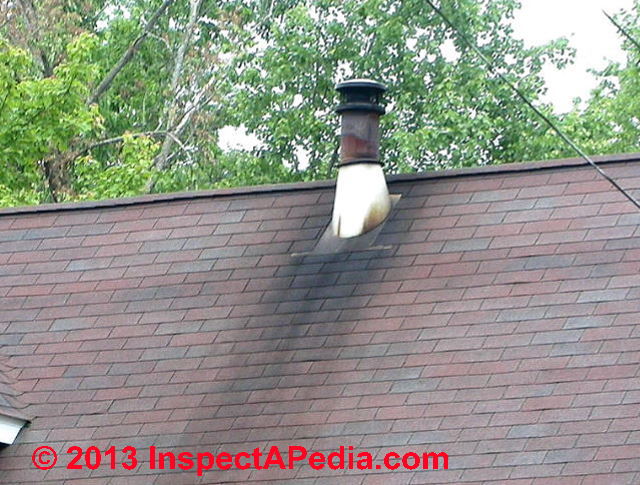
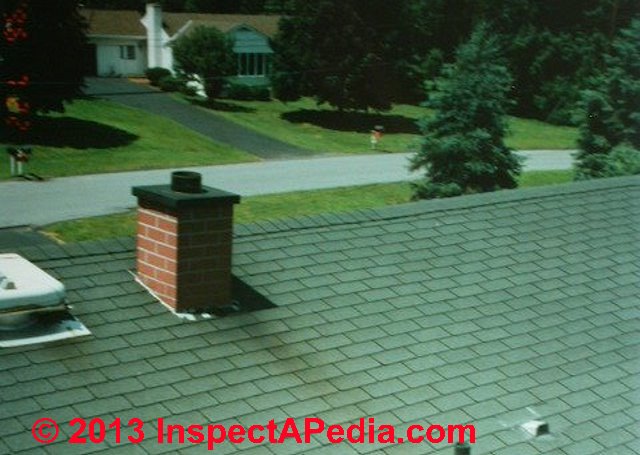
At above right the metal cap has rusted and blown off of this Type L vent serving an oil fired heating system. Rain down the flue invites corrosion, chimney damage, and unsafe flue, and a damaged heating appliance.
In my photo below we can see stains showing that water has been running down inside this chimney, leaking out inside the building. In some installations, depending on how the flue vent connector joins the chimney, water runs on into the heater itself.
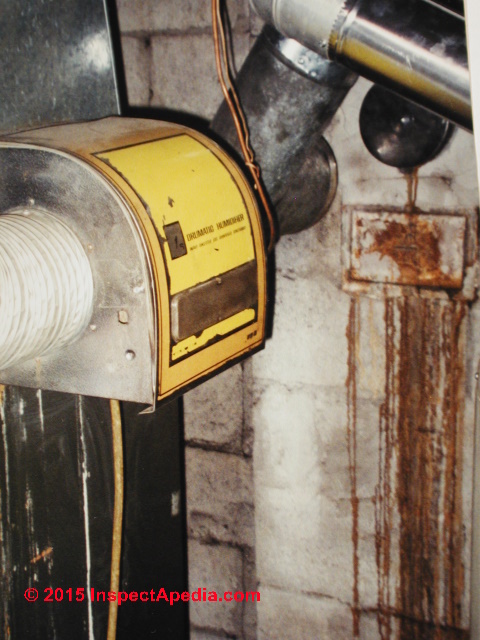
This article series on chimneys, chimney construction, and chimney safety provide detailed suggestions describing how to perform a thorough visual inspection of chimneys for safety and other defects.
Type E Vents: the Vitroliner Insulated Chimney
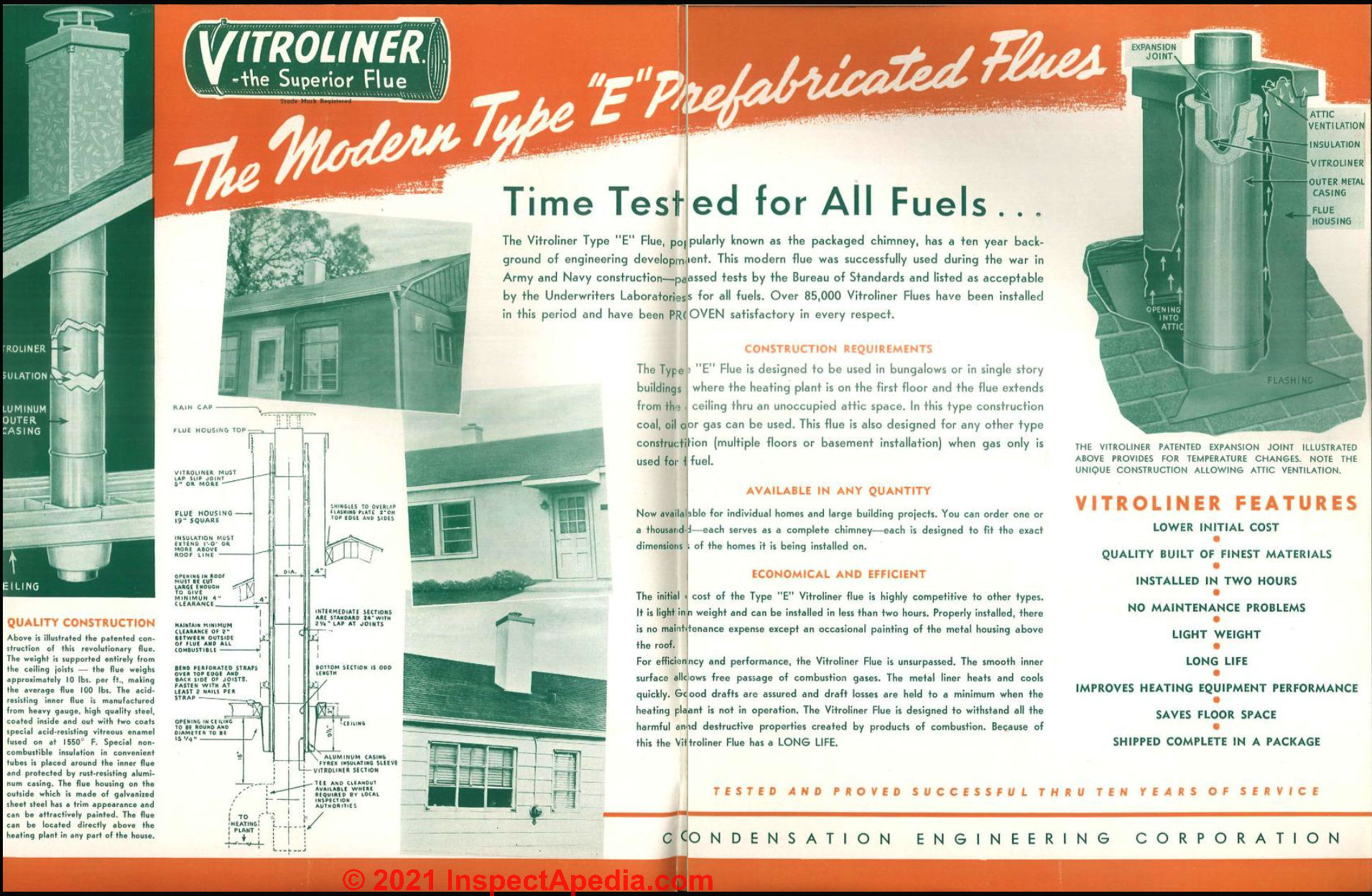
A predecessor to modern L-vent chimneys were E-vents, [shown above] an insulated metal (and other materials) chimney flue listed in the U.S. by Underwriters Laboratories as suitable for multiple fuels, such as the venting of natural gas and oil in the same chimney.
Watch out: nevertheless there are fue venting and fire hazards if you combining a wood burning appliance or some other solid fuel burning appliances with gas and/or oil fuel combustion gases into the same flue.
Photso below of a Vitroliner Type E chimney top and of a Vitroliner's UL label, provided courtesy of home inspector Lawrence Transue who found this Virtoliner type E chinney in a Pennsylvania home constructed in 1957.
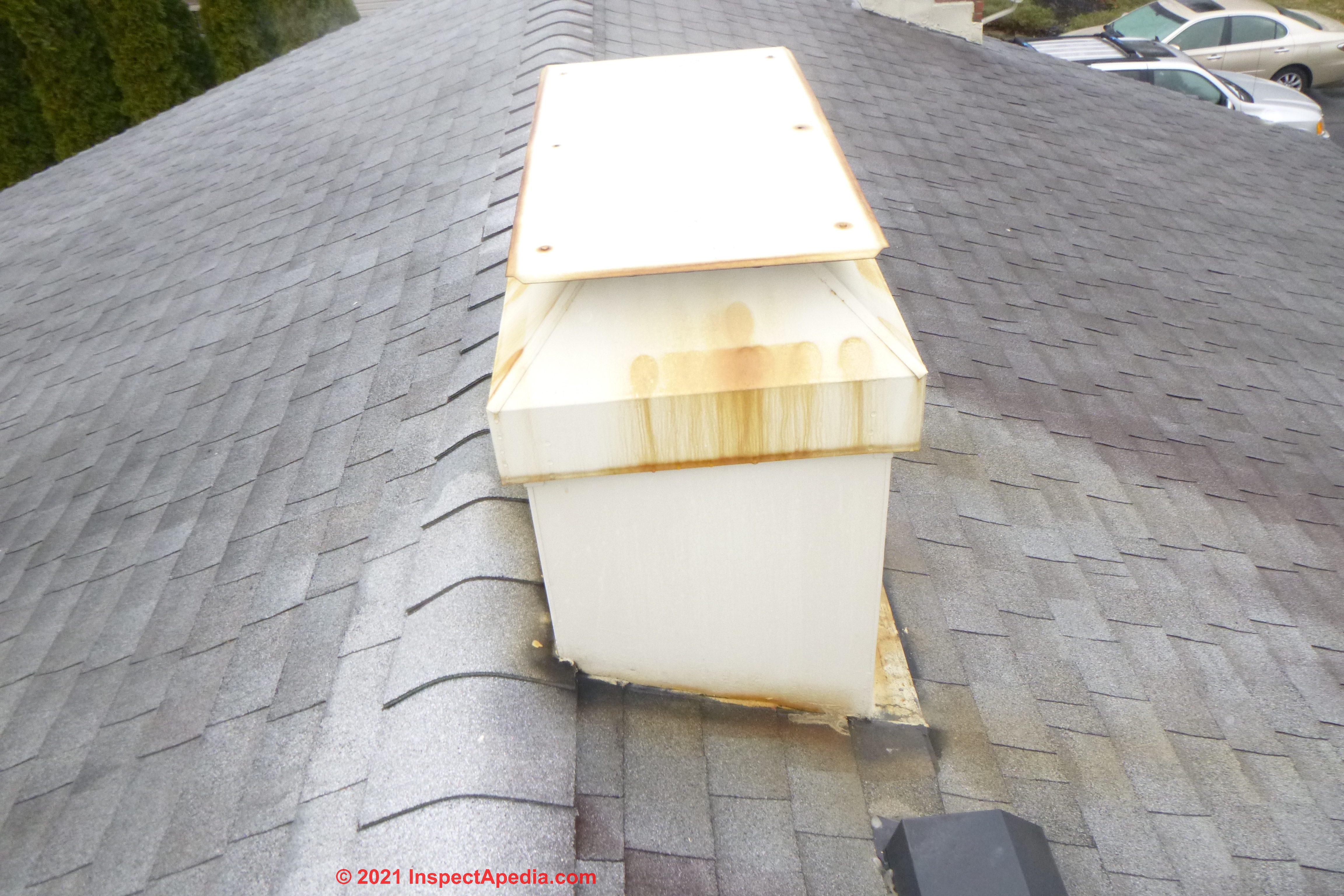
Watch out: in our OPINION, considering that the chimney is now 60 years old, even though it was a listed (approved) product at the time of original manufacture and installation, it would make sense to inspect the flue interior for signs of damage or corrosion.
That rust at the chimney top is typical and doesn't address the flue itself. Hidden from us are the condition of the chimney's interior surface, its insulation, and also the condition of the chimney's aluminum liner layer that in our OPINION is not necessarily very-long-term durable if exposed to corrosives from a combination of flue product deposits and condensation or leaks.
Really? An abundance of caution is appropriate where fire and life-safety questions pertain, but old doesn't necessarily mean "no-good" (the InspectApedia.com editor is ... old.)
In follow-up Mr. Transue reports:
The home buyer hired a chimney inspector who found that this chimney was is in nice shape. Just had a new furnace in 2016.
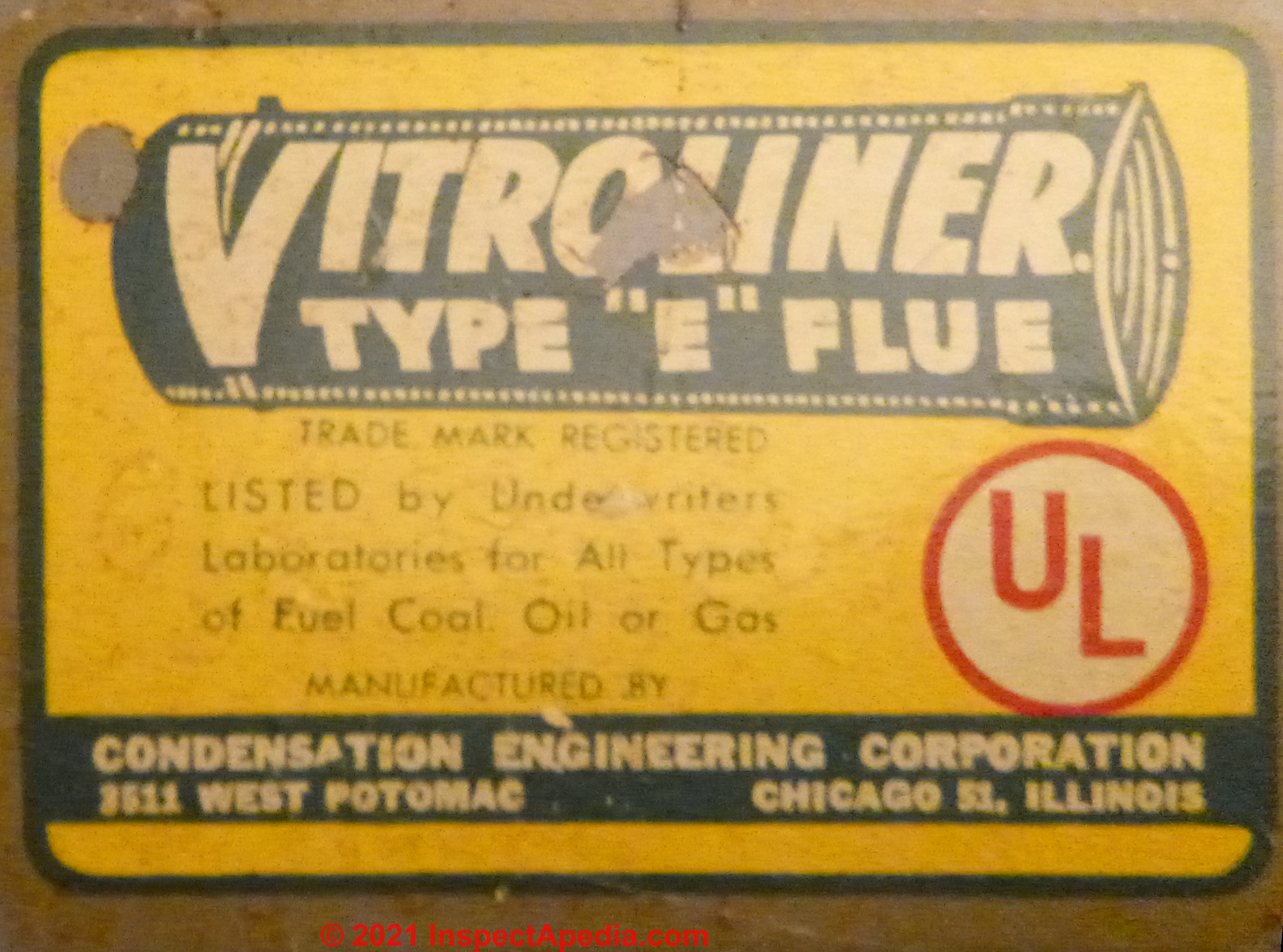
Type E Vent Chimneys and Vitroliner Type E Research
- Condensing Eng. VITROLINER TYPE “E” FLUE BROCHURE [PDF] 1948, Condensation Engineriong Corp., 122 S. Michigan Av., Chicago IL, USA produced vitreous enameled pipe, produced the Vitroliner prefabricated chimneys or “flues” consisting of a steel liner coated with an acid-resistant vitreous enamel, a “special non-combustible insulation” (asbestos?), and an outer aluminum casing and an ouer fluie housing made of galvanized sheet steel.
- Arts & Architecture, August, 1950, John Entenza, Ed., 3305 Wilshire Blvd., Los Angeles CA. (Est. 1911) provided in the magazines list of available manufacturer’s literature:
Excerpt: “( 25a) Prefabricated Chimney : Fold· Pr entitled "Vitroliner Type 'E' Flue"; functions as a complete chimn y for all home heating equipment; individually designed to fit the particular roof pitch of house with tailor-made roof flushing and flue housing; made of heavy-gauge steel, completely coated with acid-resisting porcelain; low intial cost; installs in two hours, li ght weight, saves floor space, improves heating efficiency, shipped complete in two cartons; listed by UL for all fuels; good product, definitely worth investigation . - Condensation Engineering Corporation , 122 South Michigan Avenue, Chicago 3, Ill. “ - p. 15 - The Vitroliner Type E prefabricated chimney was UL-listed for all fuels and was approved or added as approved by some individual municipalities in their local codes. E.g. Bremerton Washington Government ordinance NO. 1970 - http://lfpublic.bremertonwa.gov/WeblinkPublic/DocView.aspx?dbid=0&id=21949&page=1&cr=1
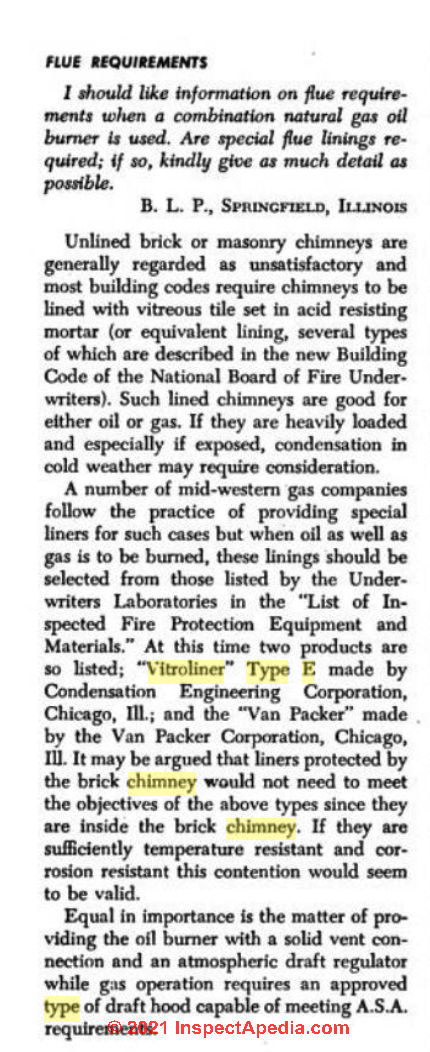
- Gas Appliance Merchandising, (January 1949) Vol. 21, p. 28, listed the Vitroliner type E as among just two chimneys or linings that were UL listed and approved for use in chimneys where combustion gases from multiple fuels (gas and oil) were to be vented.
Special thank you to:
- Lawrence Transue is a Pennsylvania building scientist and consultant, a certified ASHI home inspector, a Licensed Pesticide Applicator, a BPI Building Analyst & Envelope Professional, with 18 Years of Home Inspection Experience. He can be reached by Telephone: 610.417.0763, by Email: lawrence@lawrencetransue.com as well as at his WEBSITE and at FACEBOOK.
Reader Comments, Questions & Answers About The Article Above
Below you will find questions and answers previously posted on this page at its page bottom reader comment box.
Reader Q&A - also see RECOMMENDED ARTICLES & FAQs
Question:
(Nov 26, 2012) Ric said:
I have changed from an old Anthes furnace from 1970s to mid efficiency 60K BTU gas furnace. The furnace guy says that because it is less than 80K BTU therefore it needs a Type B venting. This does not make sense, as Type B has lower resistance to temperature than Type L.
Thus having Type L is more safe just in case there is overfiring etc. I suspect this guy is trying to make money in addition.
Also, the old furnace has a gas connection where the gas pipe coming down vertically has slight bent like 5 degrees max. This has been since I bought the house.
He says this bent is not right and needs a modified gas connection. Pls. advise what should I do regarding these issues. Also, previous gas connection had a street elbow instead of a regular one and he says street elbows are not allowed.
Reply:
Ric I think you're right that as long as the size dimensions & clearances are correct you can use a safer, better-insulated type chimney. Did you ask your local building department what they'll approve?
I'm not sure what to make of the bend in your gas piping, but I do warn that any gas leak is of course very dangerous, risking an explosion, fire or other hazards. Ask your licensed plumber to take a look.
...
Continue reading at FIRE CLEARANCES INDOORS or select a topic from the closely-related articles below, or see the complete ARTICLE INDEX.
Or see these
Recommended Articles
- BRACING for METAL CHIMNEYS
- CHIMNEY CODES & STANDARDS
- CHIMNEY HEIGHT & CLEARANCE CODE
- FIRE CLEARANCES, METAL CHIMNEYS
- HEIGHT REQUIRED for L VENTS & B VENTS
- METAL CHIMNEYS & FLUES - home
- METAL CHIMNEY INSTALLATION MANUALS
- TYPE B VENT vs L VENT DIFFERENCES
- TYPE B-VENT ROOFTOP CLEARANCE
- WOOD BURNING FIREPLACE ROOF CLEARANCE
Suggested citation for this web page
TYPE L VENT CHIMNEYS at InspectApedia.com - online encyclopedia of building & environmental inspection, testing, diagnosis, repair, & problem prevention advice.
Or see this
INDEX to RELATED ARTICLES: ARTICLE INDEX to CHIMNEYS & FLUES
Or use the SEARCH BOX found below to Ask a Question or Search InspectApedia
Ask a Question or Search InspectApedia
Try the search box just below, or if you prefer, post a question or comment in the Comments box below and we will respond promptly.
Search the InspectApedia website
Note: appearance of your Comment below may be delayed: if your comment contains an image, photograph, web link, or text that looks to the software as if it might be a web link, your posting will appear after it has been approved by a moderator. Apologies for the delay.
Only one image can be added per comment but you can post as many comments, and therefore images, as you like.
You will not receive a notification when a response to your question has been posted.
Please bookmark this page to make it easy for you to check back for our response.
Our Comment Box is provided by Countable Web Productions countable.ca
Citations & References
In addition to any citations in the article above, a full list is available on request.
- Thanks to Luke Barnes for suggesting that we add text regarding the hazards of shared chimney flues. USMA - Sept. 2008.
- Roger Hankeyis principal of Hankey and Brown home inspectors, Eden Prairie, MN, technical review by Roger Hankey, prior chairman, Standards Committee, American Society of Home Inspectors - ASHI. 952 829-0044 - hankeyandbrown.com
- NFPA 211 - Standards for Chimneys & Fireplaces, NFPA 211: Standard for Chimneys, Fireplaces, Vents, and Solid Fuel-Burning Appliances, 2006 Edition (older editions and standards are found at the same bookstore)
- New York 1984 Uniform Fire Prevention and Building Code, Article 10, Heating, Ventilating, and Air Conditioning Requirements
- New York 1979 Uniform Fire Prevention & Building Code, The "requirement" for 8" of solid masonry OR for use of a flue liner was listed in the One and Two Family Dwelling Code for New York, in 1979, in Chapter 9, Chimneys and Fireplaces, New York 1979 Building and Fire Prevention Code:
- "Top Ten Chimney (and related) Problems Encountered by One Chimney Sweep," Hudson Valley ASHI education seminar, 3 January 2000, contributed by Bob Hansen, ASHI
- Chimney Inspection Checklist, Carson Dunlop, Associates, Toronto, Ontario
- "Rooftop View Turns to Darkness," Martine Costello, Josh Kovner, New Haven Register, 12 May 1992 p. 11: Catherine Murphy was sunning on a building roof when a chimney collapsed; she fell into and was trapped inside the chimney until rescued by emergency workers.
- "Chimneys and Vents," Mark J. Reinmiller, P.E., ASHI Technical Journal, Vol. 1 No. 2 July 1991 p. 34-38.
- "Chimney Inspection Procedures & Codes," Donald V. Cohen was to be published in the first volume of the 1994 ASHI Technical Journal by D. Friedman, then editor/publisher of that publication. The production of the ASHI Technical Journal and future editions was cancelled by ASHI President Patrick Porzio. Some of the content of Mr. Cohen's original submission has been included in this more complete chimney inspection article: CHIMNEY INSPECTION DIAGNOSIS REPAIR . Copies of earlier editions of the ASHI Technical Journal are available from ASHI, the American Society of Home Inspectors.
- "Chimneys and Vents", 789 CMR 68.00 Massachusetts Building Code, web search 10/15/2010, original source:
http://www.mass.gov/Eeops/docs/dps/780%20CMR/780068.pdf 03/23/2007
780 CMR: STATE BOARD OF BUILDING REGULATIONS AND STANDARDS THE MASSACHUSETTS STATE BUILDING CODE - quoting:
6801.11 Multiple-Appliance Venting Systems. Two or more listed and labeled fossil fuel-fired appliances shall not be connected to a common natural draft venting system unless permitted per applicable requirements of 248 CMR or 527 CMR. For solid fuel-burning appliances, see 780 CMR 6801.12. - Chimneys and Vents, Chapter 18, M1801,model building code - [on file as Code_Chim_Res_C_18.pdf] - widely used by U.S. & Canadian Municipalities,
- "Model DFS L-Vent / Type B Gas Vent Installation Instructions", Selkirk Corporation, 5030 Corporate Exchange Blvd., Grand Rapids MI 49512, Tel: 800-433-6341 & Selkirk Canada Corporation, PO Box 526, Depot 1, Hamilton ON L8L 7X6, 888-735-5475, web search 10/15/2010, original source: www.mass.gov/Eeops/docs/dps/780%20CMR/780068.pdf
- "Type L Temperature Venting Systems [on file as L_Vent_Metal_Fab.pdf] - ", Installation and Maintenance Instructions, Metal-Fab Inc., PO Box 1138, Sichita KS 67201, 316-943-2351, Email: info@mtl-fabinc.com website: www.mtl-fabinc.com
- "Type L Vent Vent for Oil/Gas Fired Appliances, Installation and Maintenance Manual", Energy Vent Ltd., 241 Arvin Ave., Stoney Creek Ontario Canada L8E 2L9, web search 10/15/2010 original source: selkirkcorp.com/WorkArea/downloadasset.aspx?id=2380 www.selkirkcorp.com/WorkArea/downloadasset.aspx?id=1802
- Natural Gas Weekly Update: http://tonto.eia.doe.gov/oog/info/ngw/ngupdate.asp Official Energy Statistics from the U.S. Government
- US Energy Administration: Electrical Energy Costs http://www.eia.doe.gov/fuelelectric.html
- Our recommended books about building & mechanical systems design, inspection, problem diagnosis, and repair, and about indoor environment and IAQ testing, diagnosis, and cleanup are at the InspectAPedia Bookstore. Also see our Book Reviews - InspectAPedia.
- Chimney Inspection Checklist, Carson Dunlop, Associates, Toronto, Ontario
- Chimney & Stack Inspection Guidelines, American Society of Civil Engineers, 2003 - These guidelines address the inspection of chimneys and stacks. Each guideline assists owners in determining what level of inspection is appropriate to a particular chimney and provides common criteria so that all parties involved have a clear understanding of the scope of the inspection and the end product required. Each chimney or stack is a unique structure, subject to both aggressive operating and natural environments, and degradation over time. Such degradation may be managed via a prudent inspection program followed by maintenance work on any equipment or structure determined to be in need of attention. Sample inspection report specifications, sample field inspection data forms, and an example of a developed plan of a concrete chimney are included in the guidelines. This book provides a valuable guidance tool for chimney and stack inspections and also offers a set of references for these particular inspections.
- NFPA 211 - 3-1.10 - Relining guide for chimneys
- NFPA 211 - 3-2 - Construction of Masonry Chimneys
- NFPA 211 - 3-3 - Termination Height for chimneys
- NFPA 211 - 3-4 - Clearance from Combustible Material
- NFPA 54 - 7-1 - Venting of Equipment into chimneys
- In addition to citations & references found in this article, see the research citations given at the end of the related articles found at our suggested
CONTINUE READING or RECOMMENDED ARTICLES.
- Carson, Dunlop & Associates Ltd., 120 Carlton Street Suite 407, Toronto ON M5A 4K2. Tel: (416) 964-9415 1-800-268-7070 Email: info@carsondunlop.com. Alan Carson is a past president of ASHI, the American Society of Home Inspectors.
Thanks to Alan Carson and Bob Dunlop, for permission for InspectAPedia to use text excerpts from The HOME REFERENCE BOOK - the Encyclopedia of Homes and to use illustrations from The ILLUSTRATED HOME .
Carson Dunlop Associates provides extensive home inspection education and report writing material. In gratitude we provide links to tsome Carson Dunlop Associates products and services.
 | HOME | ABOUT | ASK a QUESTION | CONTACT | CONTENT USE POLICY | DESCRIPTION | POLICIES | PRIVACY | |
| © 2024 - 1985 Publisher InspectApedia.com - Daniel Friedman | |||||||||