
InspectAPedia® FREE Encyclopedia of Building & Environmental Construction, Diagnosis, Maintenance & Repair |
Question? Just ask us! InspectAPedia
|
 Metal Chimneys, Flues, Flashings
Inspection, Diagnosis, Cleaning, Manuals & Repair Guides

- POST a QUESTION or COMMENT about metal chimneys and flues: types, clearances, installation, inspection, fire hazards
This article describes the types of manufactured metal chimneys, their installation, inspection, troubleshooting & repair.
We explain the difference between Class-A Chimneys, Metalbestos chimneys, Type B Vents, Type L Vents, Triple Wall metal chimneys, and Super Chimneys, 629 Chimneys, and 650-C Chimneys.
Each of these chimney types has specific intended uses, fire clearances, and installation requirements. Improperly-installed chimneys, use of the wrong chimney type, or failure to properly maintain the chimney are likely to lead to unsafe conditions and risk a building fire.
InspectAPedia tolerates no conflicts of interest. We have no relationship with advertisers, products, or services discussed at this website.
Metal Chimneys & Flues: Types, Codes, Installation Requirements
 Types of Metal Chimneys and Metal Vents
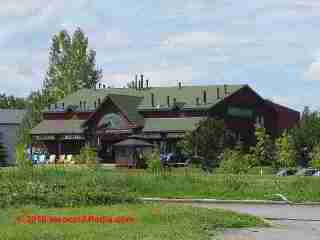
Our page top photo shows a remarkable number of metal chimneys (at least 24) on a Duluth Minnesota building. Can you explain it?
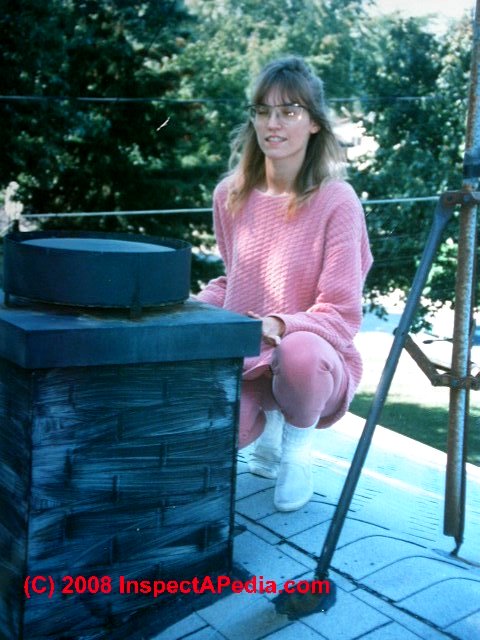
The metal faux-chimney top shown in our photo here is being inspected by an ASHI Headquarters staff member during a Chicago IL field trip.
Disassembly would be required to know much about the interior of this chimney, but from the exterior we can inspect for
- Missing chimney cap
- Rust damage (see photo of a Type B gas vent below)
- Creosote or soot & signs of overheating
- Flashing defects
- Other mechanical damage
Without more information we cannot see for sure just what kind of metal chimney terminates in the chimney cap shown by our ASHI Staff person.
Manufactured Metal Chimney Types
Here are the principal types of manufactured metal chimneys. We discuss each of these in the articles linked-to below.
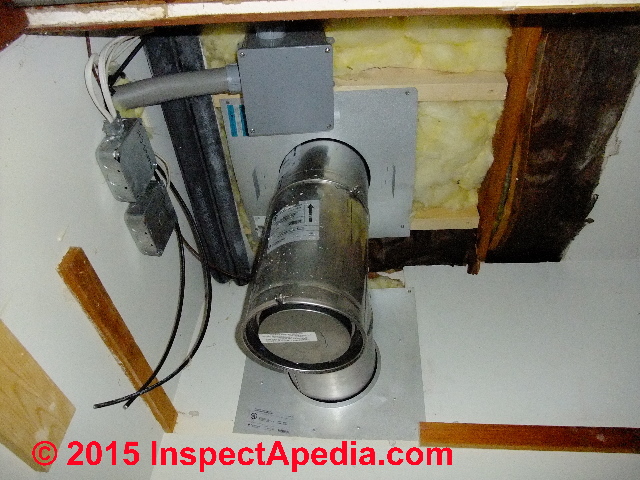
- CLASS A CHIMNEYS, Metalbestos™ Photo below shows a Class A chimney cleanout tee in process of installation.
Chimney installation manuals are included in each of our chimney type pages.
- This chimney cleanout tee was being installed in an existing closet. Therefore for fire safety the cleanout tee was later enclosed in 5/8" fire-rated drywall with an access panel to permit opening the cleanout tee (and for accessing the wiring junction boxes) when necessary.
- TYPE B-VENT CHIMNEYS TYPE L VENT CHIMNEYS
- TRIPLE-WALL METAL FIREPLACE CHIMNEYS
- SUPER CHIMNEYS, 629 CHIMNEYS
- FIRE CLEARANCES, FLUE VENT CONNECTORS are not chimneys but rather single-wall metal pipes used to connect a heating appliance to a chimney.
Metal chimney and flue: types, clearances, installation, inspection, fire hazards
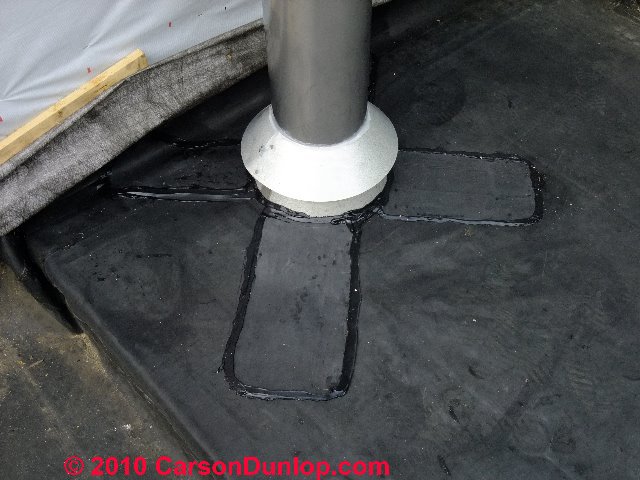
Photo above: a round collar and round chimney flashing have been installed at the penetration through this low-slope EPDM-covered roof of a Poughkeepsie, New York home.
Question: Metalbestos stove pipe fire clearances: roofing mastic was blobbed around our Metalbestos chimney
I have an 8 inch Metalbestos™ stove pipe going through an open beam ceiling, with an Avalon wood stove.
My question is how hot does the outside of the Metalbestos pipe get on the roof in the area of the stove pipe flashing, its a reddish rubber boot style?
The reason I am asking is a roofer installed a new metal roof and rubber boot flashing and cut the back side of boot to get it to fit then patched it with a black sticky flexible flashing, with flash point of 201 degrees. Thanks - R.W.
Our photo (left) shows a Class A "Metalbestos™ type chimney at a low slope EPDM roof penetration - not the chimney penetration in the reader question described above.
Reply: Follow the manufacturer's instructions for air spaces and chimney clearances
A competent onsite inspection by an expert usually finds additional clues that help accurately diagnose a problem or identify fire clearance and chimney safety issues including the one you raise. But when workmanship is amateur or incomplete, keep in mind that the same installer may have made other errors.
That said, here are some things to consider:
The temperature that you will find on the outside of the Metalbestos chimney pipe varies from cold (not in use) to warm (in normal use) to potentially higher, depending on what fuel is being burned, distance from the fire source, conditions in the chimney, and other variables.
Example of an insulated metal chimney surface temperature
At a new Class "A" insulated metal flue venting an oil fired heating boiler and located about 35" from the flue vent connector atop the boiler and with the boiler at operating temperature (about 450 deg F inside the flue vent connector at the boiler top) the outside temperature of the Metalbestos chimney was "hot" to the touch but less than 200 deg F
But because of the variables involved that cause variation in metal chimney surface temperatures, I'm not sure anyone could quote a specific number to answer your question.
You will find in the metal chimney installation instructions (and perhaps your local building codes) that the manufacturer wants 2" or 2 1/2" air space clearance between the Class "A" chimney sections and any nearby combustibles.
So if your roofer put combustible roofing mastic against a Class-A chimney chimney s/he has probably violated the instructions and possibly local and national building codes.
 Details about fire clearances for different types of metal flues and chimneys are found
at FIRE CLEARANCES, METAL CHIMNEYS
Readers of this section should also
see CHIMNEY DEFINITIONS.
Also
see FIRE CLEARANCES, METAL CHIMNEYS
These articles on chimneys and chimney safety provide detailed suggestions describing how to perform a thorough visual inspection of chimneys for safety and other defects. Chimney inspection methods and chimney repair methods are also discussed.
This article series explains the types, uses, characteristics, and installation requirements for different classes of metal chimneys.
All of these metal chimneys use multiple-walled metal pipe; some products add a fire-proof insulating material between the walls of the chimney pipe while others rely on air space.
Single-wall metal pipes used to connect heating appliances to chimneys (metal or masonry) are discussed separately
at FIRE CLEARANCES, SINGLE WALL METAL FLUES & VENTS where we provide details about single wall metal flues and their fire clearance requirements.
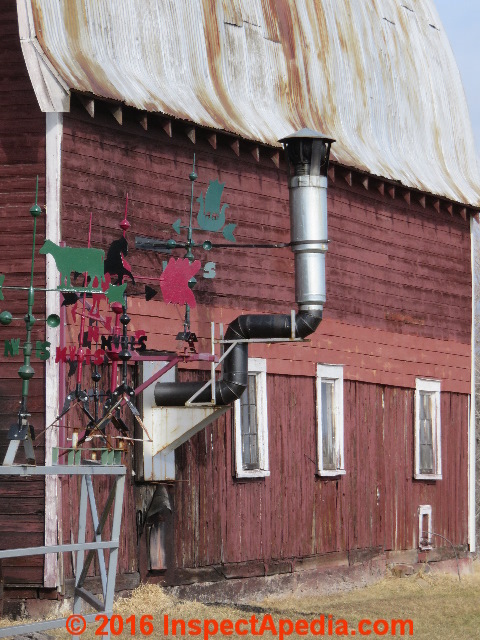
The installer of the single wall metal chimney (probably venting a woodstove) observed on this Minnesota barn on Highway 61 north of Duluth had to go to some trouble to clear the edges of the barn roof. This chimney made me nervous.
Metal Chimney / Flue Installation Manuals
- Ameri-Vent AMERIVENT MODEL HS/HSS FACTORY-BUILT CHIMNEY INSTALLATION & ASSEMBLY INSTRUCTIONS [PDF] Amerivent, 5030 Corporate Exchange Blvd. SE Grand Rapids, MI 49512 USA, Tel: (800) 252-8467 Email: info@americanmetalproducts.com retrieved 2020/02/21 original source: ameri-vent.com/assets/files/14v/803993-ameriventmodelhs-hsschimneyinstallationinstructions.pdf
- Dura-Vent (Simpson) DIRECT VENT PRO INSTALALTION INSTRUCTIONS [PDF] (2009) Venting system for direct vent gas stoves & fireplaces, Customer Service Support 800-835-4429 707-446-4740 FAX duravent.com - Simpson Dura-Vent is a division of Simpson Manufacturing Company. NYSE:SSD
- DuraVent, DuraFlex® AL INSTALLATION INSTRUCTIONS [PDF] (2017) M&G Duravent, Inc., Tel: 800-835-4429, Website: www.duravent.com
- DuraVent CONCENTRIC STAINLESS DOUBLE WALL VENT for PELLET FUEL, Category II, III & IV Condensing & Non-Condensing Gas Appliances [PDF]
- DuraVent DURA TECH ALL FUEL CHIMNEY SYSTEM INSTALLATION INSTRUCTIONS (5" to 8") [PDF] DuraVent, Vacaville, California Location, 877 Cotting Court Vacaville, CA 95688 USA, Albany, New York Location 10 Jupiter Ln. Albany, NY 12205 Customer Service Support: 800-835-4429 Email: customerservice@duravent.com Website: duravent.com, retrieved 2020/02/21 original source: www.duravent.com/docs/product/L150_W.pdf
- DuraVent, DURACHIMNEY® INSTALLATION INSTRUCTIONS [PDF] Air-Cooled, All-Fuel Chimney for Fireplaces, DuraVent Co., Tel: : 800-835-4429 Website: www.duravent.com
- DuraVent, DURALINER (SDL) 6"-8" Diameter (Round & Oval) Installation Instructions" Simpson Dura-Vent Inc., PO Box 1510, Vacaville CA 95696, 800-835-4429 www.duravent.com - metal chimney installation guidelines from the manufacturer"
- DuraVent, DURA VENT METAL CHIMNEY INTALLATION INSTRUCTIONS [PDF] retrieved 2018/02/12, original source: Dura Vent, 877 Cotting Court, Vacaville, CA 95688 USA Tel: 800.835.4429 Fax: 707.446.4740 Email: customerservice@duravent.com retrieved 2018/02/12 at duravent.com/docs/product/L150_W.pdf
Excerpt: DuraChimney is designed to stay cool on the outside, to provide a hot draft on the inside, and to provide for a fire-safe design thatprotects both the chimney and the building. The double-wall air-cooled design allows the chimney to expand under high temperatures.
Materials and Construction .016” 430 stainless steel inner wall and .021” galvanized steel outer wall. 2-inch clearance to combustibles. Listings UL Listed to UL 103 and ULC S604 standards. - Energy Vent, TYPE L VENT for OIL/GAS FIRED APPLIANCES, INSTALLATION & OPERATION MANUAL [PDF] (1999) Energy Vent Ltd, 241 Arvin Ave. Stoney Creek, Ontario, L8e 2l9, 905-662-1701
- Hart & Cooley B-VENT CHIMNEY SIZING GUIDE [PDF] (2020) TYPE B Gas Vent for Category 1 Appliances, All Fuel Chimney for Oil-Fired Appliances & Open-Face fireplaces, Hart & Cooley 5030 Corporate Exchange Blvd. SE Grand Rapids, MI 49512 P (800) 433-6341 F (800) 223-8461 hartandcooley.com
- Hart & Cooley B-VENT CHIMNEY SIZING INSTRUCTIONS [PDF] (2013) 5.1MB TYPE B Gas Vent for Category 1 Appliances, All Fuel Chimney for Oil-Fired Appliances & Open-Face fireplaces, Hart & Cooley 5030 Corporate Exchange Blvd. SE Grand Rapids, MI 49512 P (800) 433-6341 F (800) 223-8461 hartandcooley.com
- Heatfab SAF-T VENT® MODEL EZ SEAL AND MODEL GC SINGLE WALL AL 29-4C STAINLESS STEEL GAS VENT CONNECTOR CHIMNEY LINER & SPECIAL GAS VENT (USA) / Type BH Vent Class I/II (Canada) [PDF],
For Venting Residential, Commercial & Industrial Appliances Category I, II, III & IV Appliances, HeatFab, 5030 Corporate Exchange Blvd., Grand Rapids MI 49512 USA, Tel: 800-772-0739, Website: www.heatfab.com retrieved 2017/07/22, original source: http://heatfab.com/~/media/pigcins07302015.pdf - ICC Chimneys, Excel FACTORY BUILT CHIMNEY INSTALLATION & MAINTENANCE INSTRUCTIONS [PDF]Industrial Chimney Company 400, boulevard J-F Kennedy St-Jérome (Québec) Canada, J7Y 4B7 T. (450) 565-6336 Website: icc-rsf.com retrieved 2020/02/21 original source: icc-chimney.com/c/icc/file_db/docs_document.file_en/XLUSA-II_2012-01.pdf
- Metal-Fab TEMP/GUARD CHIMNEY INSTALLATION & MAINTENANCE INSTRUCTIONS [PDF] Metal-Fab Inc., 3025 May Street Wichita, Kansas 67213 USA, Tel: 1-800-835-2830 FAX: 316-943-2717 Email: info@mtlfab.com Website: mtlfab.com/ retrieved 2020/02/21 original source: mtlfab.com/media/TempGuard_All-Fuel_Chimney_Instructions_6-12_USA-L944.pdf
- Metal-Fab, Type L Temperature Venting Systems Installation and Maintenance Instructions [PDF] Metal-Fab Inc., PO Box 1138, Sichita KS 67201, 316-943-2351, Email: info@mtl-fabinc.com website: www.mtl-fabinc.com

- Oliver MacLeod Chimneys: History of Oliver Macleod square and round chimneys.
The Oliver MacLeod brand was purchased by Thomas Industries in the late 1970s, then sold off in the early 1990s. Security Chimneys discontinued sales of Oliver Macleod chimneys in 2018.
After 1986 in the U.S. and by 1990 in Canada, manufacturers stopped selling products that contained asbestos.
Asbestos warning: treat any pre 1990s Oliver Macleod chimneys, both square models and round versions, as presumed to contain asbestos inside the chimney's heat insulating body, as most of those were manufactured when asbestos was commonly-used for that purpose.
Historical details for Oliver Macleod chimneys:
Security Chimneys International, 2125 Monterey St., Laval, Quebec, Canada H7L 3T6 Tel.: (450) 973-9999
Security Chimneys discontinued the Oliver Macleod chimney line as of 2018, as you can read in this
OLIVER MACLEOD CHIMNEY PRODUCT DISCONTINUATION NOTICE [PDF] (2018) Security Chimneys
Security Chimneys FIREPLACE MODELS SB36 - SE36 SB42 Installation and Operating Instructions [PDF] Thomas Industries Inc., 4360 Brownsboro Road, Suite 300, P.O. Box 35120 Louisville, Kentucky 40232 U.S.A. Tel: (502) 893-4600
Web: thomasind.com
Excerpt: The chimney models HT6103+ and HT6000+ of Oliver MacLeod, division of Security Chimneys International Ltd are respectively equivalent to models ASHT+ and S-2100+. - Security Chimneys International - Selkirk Corporation 5030 Corporate Exchange Blvd. SE Grand Rapids, MI 49512 USA Tel: 1.800.992.VENT (8368) Email: info@selkirkcorp.com Web: selkirk.com
Selkirk Canada Corporation, P. O. Box 526, Depot 1, Hamilton, ON L8L 7X6 Tel: 1.888.SELKIRK (735.5475) info@selkirkcanada.com Selkirk Corporation, Tel: 1-800-882-8368 (USA) or 1-999-735-5475 (Canada), Email: sales@selkirkinc.com, Website: selkirkcorp.com
Selkirk U.K. contact Selkirk at selkirkchimney.co.uk/ - Selkirk Model DFS L-Vent / Type B Gas Vent Installation Instructions [PDF] Selkirk Corporation, 5030 Corporate Exchange Blvd., Grand Rapids MI 49512, Tel: 800-433-6341 & Selkirk Canada Corporation, PO Box 526, Depot 1, Hamilton ON L8L 7X6, 888-735-5475, web search 10/15/2010, original source: www.mass.gov/Eeops/docs/dps/780%20CMR/780068.pdf
- Selkirk, FLEXI-LINER Aluminum FLEXIBLE CHIMNEY LINER & GAS VENT CONNECTOR INSTALLATION INSTRUCTIONS [PDF] (2018) Model ALK/AFCL Selkirk, CO., 5030 Corporate Exchange Blvd. SE Grand Rapids, MI 49512 Toll Free: 1.800.VENT (8368) info@selkirkcorp.com info@hartcool.com
- Selkirk® Commercial & Industrial MODEL G, PS, IPS & ZC SINGLE WALL, DOUBLE WALL AIR & CERAMIC FIBER INSULATED POSITIVE PRESSURE PIPING SYSTEMS Boiler Exhaust, Engine Exhaust, Grease Duct, [PDF]
Commercial/Industrial Venting Products Sales Office Selkirk Corporation 5030 Corporate Exchange Blvd SE Grand Rapids, MI 49512 USA Tel: 800.848.2149 Selkirk Canada Corporation 375 Green Road Stoney Creek, ON L8E4A5 Tel: 888.735.5475
Website: www.selkirkcommercial.com retrieved 2017/07/22, original source: http://selkirkcommercial.com/~/media/selkirk/reference-documents/ common/file/installation/pressure-stacks/ model-psipspressure-stack/installation-instructionsmaintenanceguide.pdf - Selkirk METALBESTOS CHIMNEY INSTALLATION MANUAL, [PDF] Selkirk Metalbestos®, 14801 Quorum Drive Dallas, Texas 75240 1-800-992-VENT (8368) Website: www.selkirkinc.com retrieved 2017/07/22, original source: http://yaunco.com/images/ebay/metalbestos/mets3_inst.pdf
- Selkirk® ROUND TYPE B GAS VENT INSTALLATION INSTRUCTIONS [PDF] Selkirk Corporation
- Selkirk SUPERVENT 2100 & SUPERPRO2100 INSULATED CHIMNEY INSTALLATION & MAINTENANCE MANUAL, [PDF], Selkirk Corporation, op. cit., retrieved 2017/07/22, original source supervent.com/online-tools/onlineplanner/~/media/03da301ed8d1476dbd5a6159bf590690.ashx
- Selkirk SUPER VENT 2100 & SUPER PRO 2100 MAINTENANCE GUIDE [PDF] FACTORY-BUILT 650° C INSULATED CHIMNEY
GUIDE Tested To
CAN/ULC-S629 & UL103 Type HT, retrieved 2018/02/12, original source: h selkirkcorp.ca/~/media/selkirk/reference-documents/common/file/installation/chimney/superpro-2100-alt/2100-installation-instructions.pdf - New Zealand Chimney Support Brackets: Sigma Sheetmetal, 24 Princes Street, Onehunga , Auckland New Zealand at http://www.sigmasheet.co.nz/
Reader Comments, Questions & Answers About The Article Above
Below you will find questions and answers previously posted on this page at its page bottom reader comment box.
Reader Q&A - also see RECOMMENDED ARTICLES & FAQs
On 2020-06-24 - by (mod) -
Sherwood
I don't know for sure what's going on with your system from just a brief e-text, but it's possible that the system wasn't venting properly, producing corrosive condensate, corroding the flue vent connector.
A short cycling boiler could, as you wisely suggest, be blamed: if we never run long enough to heat up the flue then condensation is more likely to be a problem.
And condensate in a gas flue is indeed corrosive.
Worse, the system could be unsafe; be sure you have properly located, tested CO & Smoke detectors.
On 2020-06-24 by Sherwood Botsford
I have a combined radiant heating system/domestic hot water system. This unit is a middle effiiciency unit rated at 87% The boiler is connected to a B-vent chimney with single wall vent connector. The boiler is also equiped with an electric damper to reduce air going up the chimney when not operating.
The B-vent was replaced 15 years ago and is in good shape. The vent connector is so corroded that last night it collapsed. It was replaced at the same time.
I have shutdown the unit until I can get it vented properly again.
A: Why is my vent connector pipe corroding so badly?
B: How can I prevent this from happening again?
***
My suspicion is that the boiler is oversized (90,000 BTU) and is short cycling. Even on cold winter days it rarely runs more than 2-3 minutes at a time with 10-20 minute off times. This results in hot humid air in the vent and chimney which is kept there when the electric damper closes. Water condenses in the exhaust system, and never really dries out.
My thoughts:
* Disable the damper in the open position.
* Punch a hole in the damper so that it doesn't shut all the air off in the off position.
On 2019-06-23 - by (mod) -
In the article index you'll find an article in chimney height that gives all the details for above roof and other clearances. Yes your chimney needs to be rated for use with the type of fuel that it burns, such as wood.
On 2019-06-22 by Jean
We have a metal stove pipe to our wood stove, how far above our peeked roof must the stovepipe be and does it have to be triple wall
On 2017-05-23 - by (mod) -
Thanks for the remark, Jim.
On 2017-05-23 by Jim Osekowsky
@Anonymous,Galvanized is only for INSIDE the house use. As an aside, galvanized metal gives off toxic fumes at 500 degrees, use ss.
On 2016-12-15 by Stephen
Why does my neighbor newly install wood burning stove and new metal chimney stack which is not above his main roof have such down draft of smoke that comes out drifts down within 5ft of his building and drifts to other houses close to his also fills the ground area around in the neighbor hood with smoke which filters inside of houses close to his, my house is within 50ft of his place and my inside fills with smoke what are the fire installation codes for such an installation?
On 2015-12-06 - by (mod) -
Ron:
I think the reason you find people using stainless steel chimney liners is its durability against corrosion and its inclusion of flexible material that can pass chimney bends with best draft performance.
You should never us a chimney product or material in application for which it has not been certified safe - or in the parlance "listed" - the risk is death by carbon monoxide poisoning or building fire.
On 2015-12-06 by ron
please help me why cant type b or galvanized be used it will be inside clay liner and i can clean it very easy
On 2015-12-06 by Anonymous - Installing a 5790 Vogelzang pellet stove
Can someone tell why a pellet stove can't vent into masonory chimney with a clay liner.I live in VA and just bought pellet stove always had wood stove wife tired of mess bugs cutting of wood so on you get my point.
Installing a 5790 Vogelzang pellet stove in basement want to use existing thimble mad me a piece up 8 x 4 reducer.My manual came with stove says use simpson dura vent or metal fab pipe say don't use type b or galvanized pipe.
Can some one explain why can't use galvanized or type B its much cheaper and its already gonna be inside clay liner.
I have access to both liners cleanout doors.Whats the most economical way to vent both stoves and chimneys.Basement stove VG5790 its about 25ft. run to he top of liner clay liner is 8 1/2 by 12 1/2 .
Upstairs stove is older stove very well maitained Avalon 900 pi insert stove putitng in fireplace clay liner is 12 1/2 by 12 1/2 about 11ft to 12ft run at the most top of liner could someone please please help me trying to figure most cost efficent way to vent these and get the most out of my stoves HELP PLEASE!!!!
Question: rust stains on the wall of a cottage in Wales
(Aug 12, 2012) Mark Whitaker (UK) said:
The following information may be useful. I experienced problems with rust stains on the wall of a cottage in Wales beneath the outlet of a flue from an oil-fired boiler. The stains were due to rain falling on the outlet and dripping down.
I totally solved the problem by installing a protective cowl which I made from thin sheet aluminium fashioned into an inverted angular 'U' form (a bit like a metal paper staple in profile) to shield the outlet from the rain. This has saved me continually repainting the wall to erase the unsightly rust stains.
Reply:
Thanks for the idea and comment, Mark. Send us some photos if you can. It may assist other readers.
Question: bulged metalbestos chimney dangers
(Jan 17, 2013) Diane said:
We have a metalbestos II chimney that's been in use for 18 years. We use it with our Harmon wood boiler. We've noticed some bulges/buckles in the interior of the chimney for the past couple of years while cleaning it out. Are these dangerous? Has anyone had experience going back to Selkirk for a replacement?
Reply:
Diane:
a bulged metalbestos chimney sounds unsafe - as if its internal layers have been damaged by frost or some other expanding force. I'd have a professional chimney sweep inspect the chimney for safety. Let us know what you're told and we can comment further.
Question: what's inside of old chimneys?
(Jan 27, 2013) Kristina said:
I have opened up a closet wall to expose the original lath and plaster and discovered a metal (over ceramic?) tube full of old old ashes that i was able to clean out by opening a plate at the bottom and scooping out about 2 grocery bags full of old ashes.
I would like to remove or cap this off under the ceiling and then recover the wall with sheetrock AND I am unclear if this is something I should leave alone or if I can do this removal.
I have been told that this must have been the inner chimney for wood burning stove/cooking from the original house (built in 1926)I now have a gas stove and a hood that I dont think is attached to this circular chimney thing.
Do you have any idea what this is or how I can get more information on how to remove it or if I should just leave it alone? (asbestos?) thansk so much!
Reply:
Kristina
If you are confident that the old chimney is no longer in use, its blockage or abandonment are less of a concern - if it were in use the situation would be quite dangerous - enough that I'd shut off anything venting into that flue.
A second concern is possible presence of asbestos - or cement asbestos - if the flue were transite - an asbestos cement material. If the chimnney is really metallic it's not transite but if it's a multi-walled chimney and is an older product its internal insulation could be or contain asbestos.
So removal could raise safety concerns. If it can be safely sealed in place and left alone that'd make the least disturbance.
Question:
(Nov 9, 2014) Wes said:
I have an external masonry brick chimney (with an internal clay flu, that has began to separate from the home about 70% up. The bottom half is fine, and is still aligned well. Is it possible for me to remove the top 30%, and connect steel chimney pipe to replace the masonry? wesgull@hotmail.com
Reply:
Wes:
Indeed having just traveled throughout New Zealand where earthquakes have damaged many masonry chimneys, we saw a number of installations that did just what you suggest.
The damaged or unsafe upper portion of the masonry chimney was removed entirely, an insulated metal chimnney was constructed to provide safe above-roof venting and was installed, connected, and sealed to the intact lower masonry flue by a chimney professional.
A detail that's important is the treatment of the "flat" masonry top - to be sure that there is no leakage into the masonry.
...
Continue reading at BRACING for METAL CHIMNEYS or select a topic from the closely-related articles below, or see the complete ARTICLE INDEX.
Or see these
Recommended Articles
- BRACING for METAL CHIMNEYS
- CLASS A CHIMNEYS, MetalBestos™ - includes installation manuals
- CHIMNEY CLEANOUT CLEARANCE to COMBUSTIBLES
- CHIMNEY HEIGHT & CLEARANCE CODE
- CHIMNEY INSPECTION DIAGNOSIS REPAIR - home
- FIRE CLEARANCES, FLUE VENT CONNECTORS
- FIRE CLEARANCES, METAL CHIMNEYS
- FLASHING, CHIMNEY MISTAKES & LEAKS
- METAL CHIMNEYS & FLUES - home
- METAL CHIMNEY INSTALLATION MANUALS
- METAL CHIMNEY CONNECTIONS
- METAL CHIMNEY FLASHING & STORM COLLARS
- TYPE B-VENT CHIMNEYS TYPE L VENT CHIMNEYS
- TRIPLE-WALL METAL FIREPLACE CHIMNEYS
- SUPER CHIMNEYS, 629 CHIMNEYS
Suggested citation for this web page
METAL CHIMNEYS & FLUES at InspectApedia.com - online encyclopedia of building & environmental inspection, testing, diagnosis, repair, & problem prevention advice.
Or see this
INDEX to RELATED ARTICLES: ARTICLE INDEX to CHIMNEYS & FLUES
Or use the SEARCH BOX found below to Ask a Question or Search InspectApedia
Ask a Question or Search InspectApedia
Try the search box just below, or if you prefer, post a question or comment in the Comments box below and we will respond promptly.
Search the InspectApedia website
Note: appearance of your Comment below may be delayed: if your comment contains an image, photograph, web link, or text that looks to the software as if it might be a web link, your posting will appear after it has been approved by a moderator. Apologies for the delay.
Only one image can be added per comment but you can post as many comments, and therefore images, as you like.
You will not receive a notification when a response to your question has been posted.
Please bookmark this page to make it easy for you to check back for our response.
Our Comment Box is provided by Countable Web Productions countable.ca
Citations & References
In addition to any citations in the article above, a full list is available on request.
- Thanks to Mark Cramer, Tampa Florida, for assistance in technical review of the "Critical Defects" section and for the photograph of the deteriorating gray Owens Corning flex duct in a hot attic. Mr. Cramer is a Florida home inspector and home inspection educator.
- NFPA 211 - Standards for Chimneys & Fireplaces, NFPA 211: Standard for Chimneys, Fireplaces, Vents, and Solid Fuel-Burning Appliances, 2006 Edition (older editions and standards are found at the same bookstore)
- NFPA #211-3.1 1988 - Specific to chimneys, fireplaces, vents and solid fuel burning appliances.
- NFPA # 54-7.1 1992 - Specific to venting of equipment with fan-assisted combustion systems.GAMA - Gas Appliance Manufacturers' Association has prepared venting tables for Category I draft hood equipped central furnaces as well as fan-assisted combustion system central furnaces.
- National Fuel Gas Code, an American National Standard, 4th ed. 1988 (newer edition is available) Secretariats, American Gas Association (AGA), 1515 Wilson Blvd., Arlington VA22209, and National Fire Protection Association (NFPA), Batterymarch Park, Quincy MA 02269.
- ANSI Z223.1-1988 - NFPA 54-1988. WARNING: be sure to check clearances and other safety guidelines in the latest edition of these standards.
- Fire Inspector Guidebook, A Correlation of Fire Safety Requirements Contained in the 1987 BOCA National Codes, (newer edition available), Building Officials and Code Administrators International, Inc. (BOCA), Country Club HIlls, IL 60478 312-799-2300 4th ed. Note: this document is reissued every four years. Be sure to obtain the latest edition.
- Uniform Mechanical Code - UMC 1991, Sec 913 (a.) Masonry Chimneys, refers to Chapters 23, 29, and 37 of the Building Code.New York 1984 Uniform Fire Prevention and Building Code, Article 10, Heating, Ventilating, and Air Conditioning Requirements
- New York 1979 Uniform Fire Prevention & Building Code, The "requirement" for 8" of solid masonry OR for use of a flue liner was listed in the One and Two Family Dwelling Code for New York, in 1979, in Chapter 9, Chimneys and Fireplaces, New York 1979 Building and Fire Prevention Code
- "Top Ten Chimney (and related) Problems Encountered by One Chimney Sweep," Hudson Valley ASHI education seminar, 3 January 2000, contributed by Bob Hansen, ASHI
- Chimney Inspection Checklist, Carson Dunlop, Associates, Toronto, Ontario
- "Rooftop View Turns to Darkness," Martine Costello, Josh Kovner, New Haven Register, 12 May 1992 p. 11: Catherine Murphy was sunning on a building roof when a chimney collapsed; she fell into and was trapped inside the chimney until rescued by emergency workers.
- "Chimneys and Vents," Mark J. Reinmiller, P.E., ASHI Technical Journal, Vol. 1 No. 2 July 1991 p. 34-38."Chimney Inspection Procedures & Codes," Donald V. Cohen was to be published in the first volume of the 1994 ASHI Technical Journal by D. Friedman, then editor/publisher of that publication. The production of the ASHI Technical Journal and future editions was cancelled by ASHI President Patrick Porzio. Some of the content of Mr. Cohen's original submission has been included in this more complete chimney inspection article:
CHIMNEY INSPECTION DIAGNOSIS REPAIR . Copies of earlier editions of the ASHI Technical Journal are available from ASHI, the American Society of Home Inspectors. - "Chimneys and Vents", 789 CMR 68.00 Massachusetts Building Code [PDF] web search 10/15/2010, original source:
http://www.mass.gov/Eeops/docs/dps/780%20CMR/780068.pdf 03/23/2007
780 CMR: STATE BOARD OF BUILDING REGULATIONS AND STANDARDS THE MASSACHUSETTS STATE BUILDING CODE - quoting:
6801.11 Multiple-Appliance Venting Systems. Two or more listed and labeled fossil fuel-fired appliances shall not be connected to a common natural draft venting system unless permitted per applicable requirements of 248 CMR or 527 CMR. F
or solid fuel-burning appliances, see 780 CMR 6801.12.Chimneys and Vents, Chapter 18, M1801,model building code - [on file as Code_Chim_Res_C_18.pdf] - widely used by U.S. & Canadian Municipalities, - "Type L Vent Vent for Oil/Gas Fired Appliances, Installation and Maintenance Manual", Energy Vent Ltd., 241 Arvin Ave., Stoney Creek Ontario Canada L8E 2L9, web search 10/15/2010 original source: www.selkirkcorp.com/WorkArea/downloadasset.aspx?id=2380 www.selkirkcorp.com/WorkArea/downloadasset.aspx?id=1802Natural Gas Weekly Update: http://tonto.eia.doe.gov/oog/info/ngw/ngupdate.asp Official Energy Statistics from the U.S. Government
- Ceramic Roofware, Hans Van Lemmen, Shire Library, 2008, ISBN-13: 978-0747805694
Brick chimneys, chimney-pots and roof and ridge tiles have been a feature of the roofs of a wide range of buildings since the late Middle Ages. In the first instance this ceramic roofware was functional - to make the roof weatherproof and to provide an outlet for smoke - but it could also be very decorative.
The practical and ornamental aspects of ceramic roofware can still be seen throughout Britain, particularly on buildings of the Victorian and Edwardian periods. Not only do these often have ornate chimneys and roof tiles but they may also feature ornamental sculptures or highly decorative gable ends.
This book charts the history of ceramic roofware from the Middle Ages to the present day, highlighting both practical and decorative applications, and giving information about manufacturers and on the styles and techniques of production and decoration.
Hans van Lemmen is an established author on the history of tiles and has lectured on the subject in Britain and elsewhere. He is founder member and presently publications editor of the British Tiles and Architectural Ceramics Society. - In addition to citations & references found in this article, see the research citations given at the end of the related articles found at our suggested
CONTINUE READING or RECOMMENDED ARTICLES.
- Carson, Dunlop & Associates Ltd., 120 Carlton Street Suite 407, Toronto ON M5A 4K2. Tel: (416) 964-9415 1-800-268-7070 Email: info@carsondunlop.com. Alan Carson is a past president of ASHI, the American Society of Home Inspectors.
Thanks to Alan Carson and Bob Dunlop, for permission for InspectAPedia to use text excerpts from The HOME REFERENCE BOOK - the Encyclopedia of Homes and to use illustrations from The ILLUSTRATED HOME .
Carson Dunlop Associates provides extensive home inspection education and report writing material. In gratitude we provide links to tsome Carson Dunlop Associates products and services.
 | HOME | ABOUT | ASK a QUESTION | CONTACT | CONTENT USE POLICY | DESCRIPTION | POLICIES | PRIVACY | |
| © 2024 - 1985 Publisher InspectApedia.com - Daniel Friedman | |||||||||