
InspectAPedia® FREE Encyclopedia of Building & Environmental Construction, Diagnosis, Maintenance & Repair |
Question? Just ask us! InspectAPedia
|
 Shared Chimney Flue Exceptions
Examples of (sometimes) Permitted Chimney Flue Sharing
- POST a QUESTION or COMMENT about cases when shared chimneys or chimney flues may be permitted.
When is it acceptable for appliances or heaters to share a single chimney flue?
This article describes exceptions to the general case of prohibiting shared chimney flues, multiple heating appliances, fireplaces, woodstoves all using the same chimney venting path through a building and to outside.
We also provide a more comprehensive INDEX to RELATED ARTICLES for this topic, or you can try the page top or bottom SEARCH BOX as a quick way to find information you need.
InspectAPedia tolerates no conflicts of interest. We have no relationship with advertisers, products, or services discussed at this website.
Shared Chimney Flues - Legal or not?
 Shared flues can create fire and smoke spread hazards and carbon monoxide hazards in buildings. In some communities or jurisdictions for certain cases, it is permissible to share a single chimney flue among more than one heating appliance or fireplace.
But important safety constraints still apply.
[Click to enlarge any image]
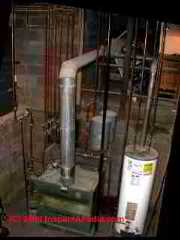
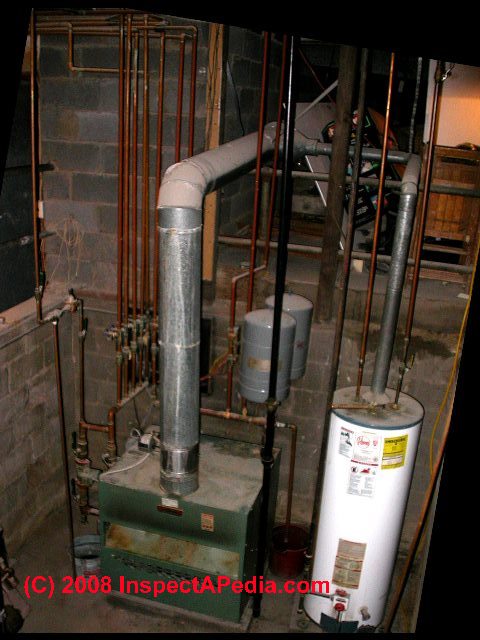
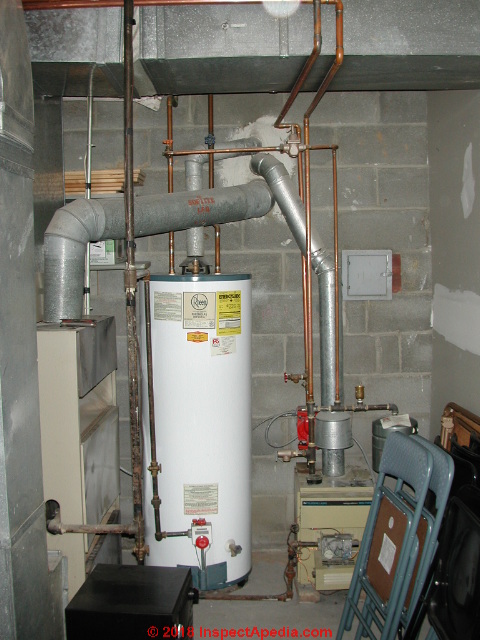
Our photo (page top) shows two gas-fired appliances sharing a single flue.
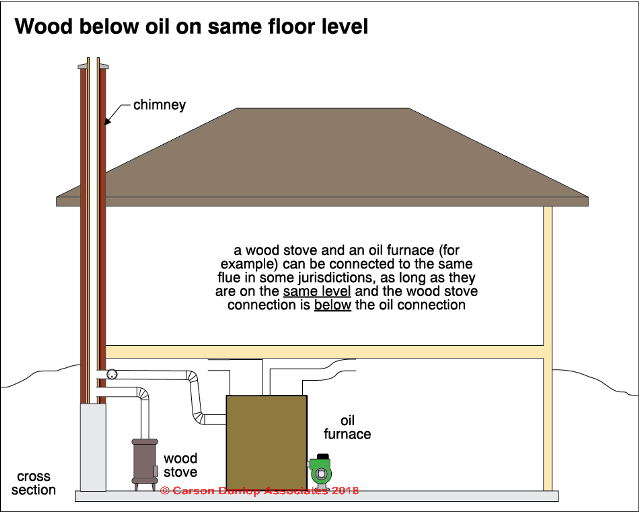
In Carson Dunlop Associates sketch shown here, a wood fired heating appliance is sharing a flue with an oil fired heater, both entering the shared flue on the same floor (an essential reqirement).
Watch out: this arrangement is prohibited in many jurisdictions. For example per NFPA 31 and NFPA 211
Although two openings are permitted into a single chimney flue; NO
combination of solid fuel-fired appliances are permitted to be vented into an oil-fired or
gas-fired flue.
This article reviewscommonly occurring shared chimney flues. Sketch above provided courtesy of Carson Dunlop Associates a Toronto home inspection, education, and report writing tool company.
Article Contents
Combination Wood / Oil Fired Appliances on Same Floor May Share a Common Flue
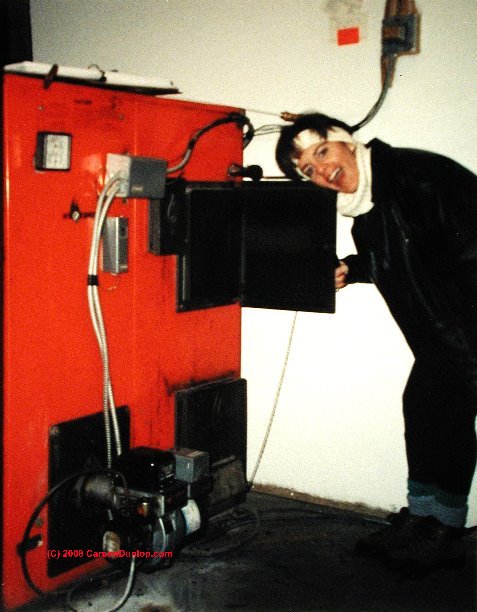
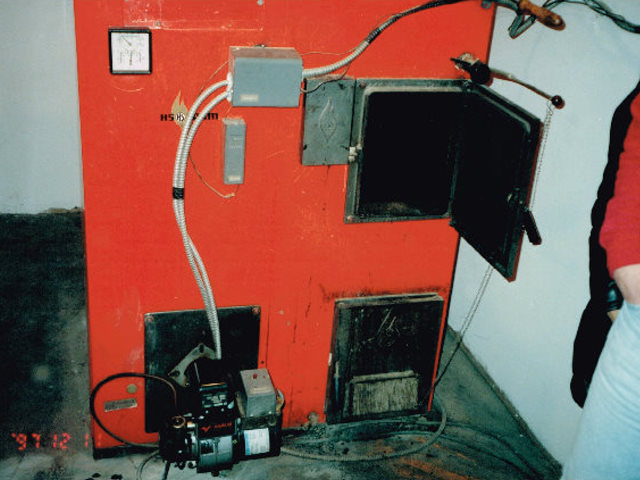
A wood-fired heating appliance may be vented into the same chimney flue as an oil-fired heating appliance provided that they are on the same floor - in some jurisdictions.
Combination wood-oil fired heating boilers join wood and oil burners in the same physical unit, making this exception necessary if the boiler is to be used at all.
However we found some difficulty in tuning the oil burner to work at its best when a combined fuel unit was installed, because on the models we serviced the draft requirements were different depending on which fuel was in use, and because it was not the case of these systems working in an "either-or" mode - that is exclusively burning only heating oil or only wood at a particular time.
More common, the wood fire might be burning down low and no longer providing enough heat, requiring the oil burner to turn on.
We also opine that it is very important to keep the chimney well cleaned in a combination unit or a shared wood and oil device chimney.
A slow-burning woodstove can deposit thick combustible creosote on chimney walls, especially if the users are burning wood that is still green, or if the wood heater is not run at a sufficiently hot temperature.
We worry that the oil burner exhaust or the exhaust from a later and hotter wood fire might set the creosote afire - causing a very dangerous chimney fire.
Be sure your chimney is inspected and cleaned at least as often as the manufacturer of your appliances and your local fire marshal recommend.
Pertinent Code Citations:
- New Hampshire DPS, VENTING AND INTERCONNECTION OF FUEL FIRED APPLIANCES [PDF] (2010) New Hampshire Department of Public Safety, retrieved 2018/12/02 original source: https://www.nh.gov/safety/divisions/firesafety/bulletins/documents/2010-04VentingofResidentialHeatingAppliances.pdf
Excerpts:
NFPA 211 (Section 9.8) prohibits the interconnection of solid fuel-burning appliances into any chimney serving another appliance.
Meaning:
Each chimney flue may only service one solid fuel-burning appliance.
No combination of fuel-gas, oil-fired, or additional wood, wood pellet, coal or corn stoves may be vented into the same chimney flue as a solid fuel-burning appliance.
Exception: A solid fuel-burning appliance designed, constructed and listed to operate on a combination of fuels is permitted to be installed in a single chimney flue.
The exception contends that the appliance is designed and constructed in such a manner that both fuels could not be used in conjunction with each other, and that safety controls have been integrated in such a manner as to prevent and/or shut down the appliance before it reaches its over firing and venting capacity. - NFPA 31 Standard for the Installation of Oil-Burning Equipment
- NFPA 211 Section 9.2: solid-fuel-burning appliances cannot be vented into a chimney serving another appliance
- SHARED CHIMNEY & FLUE HAZARDS - companion article
- WOOD-OIL COMBINATION HEATERS discusses the innate conflict of sharing two fuels in a single flue and chimney
Two Gas Fired Appliances Venting into a Single Flue permitted from Different Floors in Some Jurisdictions
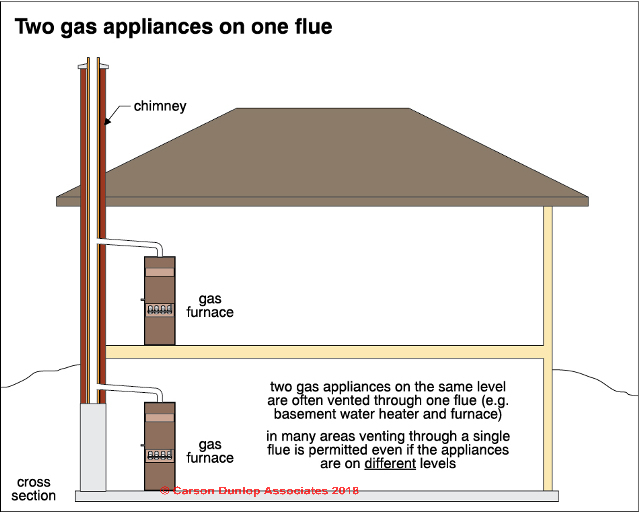
Two gas-fired appliances, such as a water heater and heating boiler may be vented into the same flue if your local jurisdiction approves of that installation.
In some locales fire officials also permit two gas appliances to vent into a single flue when the heaters are on different floors, as we see in Carson Dunlop Associates [at REVIEWERS] sketch.
Watch out: Since there is a potential of increased risk of fire or gas leak spreads between floors in this shared flue arrangement, additional installation details may be required, if this is permitted at all.
Check with your local fire officials and building code enforcement officers.
Multiple oil-fired devices may be vented into the same flue from the same utility area and same building floor provided the flue capacity is adequate.
Also see safety and functional notes about draft balance and regulation
at DRAFT REGULATORS & DAMPERS.
In some jurisdictions it is permitted to vent a gas fired appliance into a chimney where oil fired appliances are also vented, with special design details needed to prevent back-drafting out of the gas fired appliance.
Watch out: venting gas fired heating equipment into an older masonry chimney may be unsafe. The lower exhaust gas temperatures produced by gas fired appliances using many clay lined chimneys may mean inadequate draft and risk fatal carbon monoxide poisoning of building occupants.
Below are three gas fired heating appliances sharing a single flue. Is the chimney size able to safely accomodate all of the possible operating scenarios?
Multiple Fireplaces on Different Floors Sharing a Single Flue
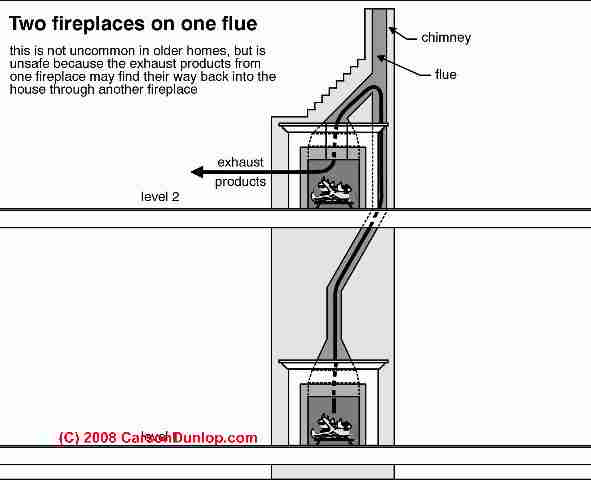
Older homes were often constructed with two fireplaces sharing the same flue on the same floor or even on different floors.
Although this arrangement is sometimes found still in use today, this installation may not be permitted in your locale, and there are fire and smoke spread hazards as well as possible draft adequacy questions.
Watch out: Be sure you have your fireplace flues inspected for safety, and where a shared flue is discovered check with your fire marshal and local building code official before attempting to use either fireplace.
Sketches courtesy of Carson Dunlop Associates, a Toronto Home Inspection & Education firm.
Can Oil & Gas Heaters Share a Single Flue?
Yes, with some provisions and restrictions an oil and a gas fired heating appliance may be vented into the same chimney flue.
In some jurisdictions an oil fired heater and a gas fired heating appliance, such as an oil fired heating boiler and a gas fired water heater may be permitted to share the same flue provided
- The two appliances are on the same floor level
- The chimney entrances for the two appliances are properly installed relative to one another - usually gas appliance OR the smaller diameter flue vent connector is installed above the larger or oil fired vent.
- Watch out: The installer must produce the math and/or reference charts from NFPA 54 (The National Fuel Gas Code) to verify that the chimney flue will be large enough to properly vent the exhaust gasses when both units are operating simultaneously, yet small enough to provide sufficient draft when only the hot water heater operates in the summer months. (NFPA 31 & 211)
- Watch out: Although two openings are permitted into a single chimney flue; NO combination of solid fuel-fired appliances are permitted to be vented into an oil-fired or gas-fired flue.
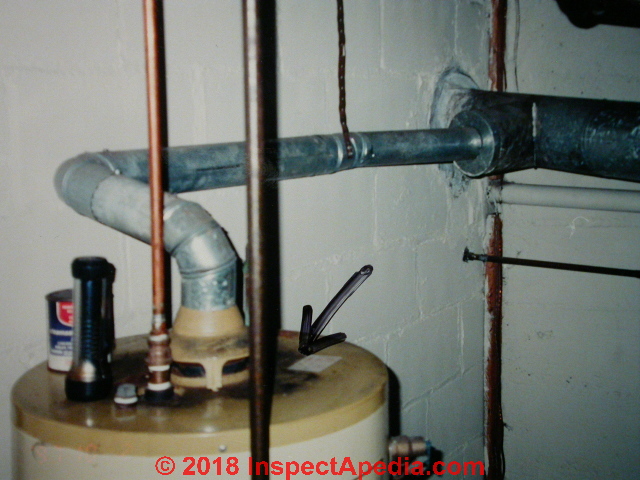
Photo below: oil exhaust stains around the draft hood of a gas-fired water heater provide evidence of unsafe back-drafting of exhaust from the larger heating appliance back out at the smaller gas fired appliance.
Pertinent Chimney & Venting Code Citations
- 2015 CHAPTER 5, CHIMNEYS AND VENTS, SECTION 501 (IFGC), [PDF] (2015) Seattle building code, Retrieved 2017/07/22, original source: http://www.seattle.gov/dpd/cs/groups/pan/@pan/documents/web_informational/p2622099.pdf
- New Hampshire DPS, VENTING AND INTERCONNECTION OF FUEL FIRED APPLIANCES [PDF] (2010) New Hampshire Department of Public Safety, retrieved 2018/12/02 original source: https://www.nh.gov/safety/divisions/firesafety/bulletins/documents/2010-04VentingofResidentialHeatingAppliances.pdf
Excerpt re: oil & gas combination venting:
Both the NFPA 31 (Section 6.5) & 211(Section 9.8.3 &9.8.4) standards permit the combination of multiple oil burning appliances or fuel gas and oil appliances.
Careful attention should given by the official to compel the properly licensed installer for their calculated confirmation that the chimney flue in question will be sized to handle both the maximum load of combined BTU’s, as well as the minimum BTU load when the smallest appliance is operating by itself.
Although both the oil-fired and gas-fired appliances are permitted to be joined an approved or listed vent connector; both NFPA 211 and NFPA 31 require that the chimney have sufficient draft and that both units are equipped with primary safety controls and are located in the same room.
In most cases where a combination of oilfired equipment and gas-fired equipment is vented into the same chimney flue;
two separate openings into the chimney flue are recommended.
When two or more openings to the chimney flue are used; they must be at different levels and the smaller vent pipe shall be at the higher level.
Officials should verify that proper clearances to combustible materials have been met. - U.S. National Fuel Gas Code (ANSI Z223.1) 12. 4. 3. 4,
Excerpt:
Vent connectors serving appliances vented by natural draft shall not be connected into any portion of mechanical draft systems operating under positive pressure.
...
Gas Appliance Vent Categories (ANSI Z223.1)International Fuel Gas Code (2012) Chapter 5 Chimneys and Vents | |||
| Appliance Category | Exhaust Vent Pressure | Appliance Type | Flue Vent Material |
Category I Gravity furnace Induced draft furnace Plus-80 |
Non-positive Natural Draft |
Non-condensing | B-Vent |
Category II Boilers & wall-vented heaters No shared flues |
Non-positive Natural Draft |
Condensing | Special from Manufacturer |
Category III Tankless water heaters Cannot share flue with natural draft appliances |
Positive | Non-Condensing | Stainless Steel |
Category IV High-efficiency water heaters Cannot share flue with natural draft appliances |
Positive | Condensing | Plastic |
Reader Comments, Questions & Answers About The Article Above
Below you will find questions and answers previously posted on this page at its page bottom reader comment box.
Reader Q&A - also see RECOMMENDED ARTICLES & FAQs
 On 2020-03-28 - by (mod) - chimney / flue temperatures of gas, oil, & wood-fired heaters & ignition point of creosote deposits
I agree about the heat reclaimer cooling the heater vent, but let's flip the question over on itself;
Gas heating appliance temperatures are usually far lower than temperatures produced by a woodstove and are usually lower than oil fired heating equipment as well.
Here is an off-the-cuff recap of chimney and operating temperatures of gas, oil, and wood-fired heaters, concluding with a note about the ignition temperature of creosote deposits in a chimney.
Propane flue gas temperatures vary by type of heater; a high-efficiency gas heater will have lower flue temperatures, rarely above 167 °F and more-likely in the 100-130 °F range - of course depending on where the temperature is measured. (Close to the appliance vent connector is correct.
)
Older low-efficiency gas heaters are typically just under 300F (275 °F is a "standard" number) but under some conditions might get as hot as 400-500 °F.
An oil burner fired appliance usually runs around 400 °F but can be well over 600 °F especially if sooty or improperly adjusted - potentially even a bit hotter.
A woodstove flue temperature can get much hotter depending on fire size, wood species, and air supply given to the woodstove, easily soaring over 600 °F.
Summary of Chimney or Flue Exhaust Temperatures for Heater Types & Fuels |
||
Fuel Heater Type |
Typical Flue vent connector temperature |
Typical High Limit |
| Propane LPG High-Efficiency Heater | 100-300 °F | 167 °F |
| Propane LPG Conventional Heater | 200 - 350 °F 1 400 - 475 °F 2 |
400-500 °F |
| Natural Gas Heaters | 350 - 350 °F 1 400 - 475 °F 2 |
|
| No. 2 Heating Oil / Oil burner | 350 - 500 °F | 500-650 °F |
| No. 2 Heating Oil / Oil burner w/ induced draft | 300 - 400 °F | 500-650 °F |
| Coalstove | 110 - 550 °F | 650-850 °F |
| Woodstove | 200 - 450 °F | 650-900 °F |
Notes to the table above
Authoritative citations needed. in addition to Engineering Toolbox at https://www.engineeringtoolbox.com/fuels-exhaust-temperatures-d_168.html
1. LPG or natural gas heating appliance exhaust temperature with draft hood
2. LPG or natural gas heating appliance exhaust temperature without a draft hood
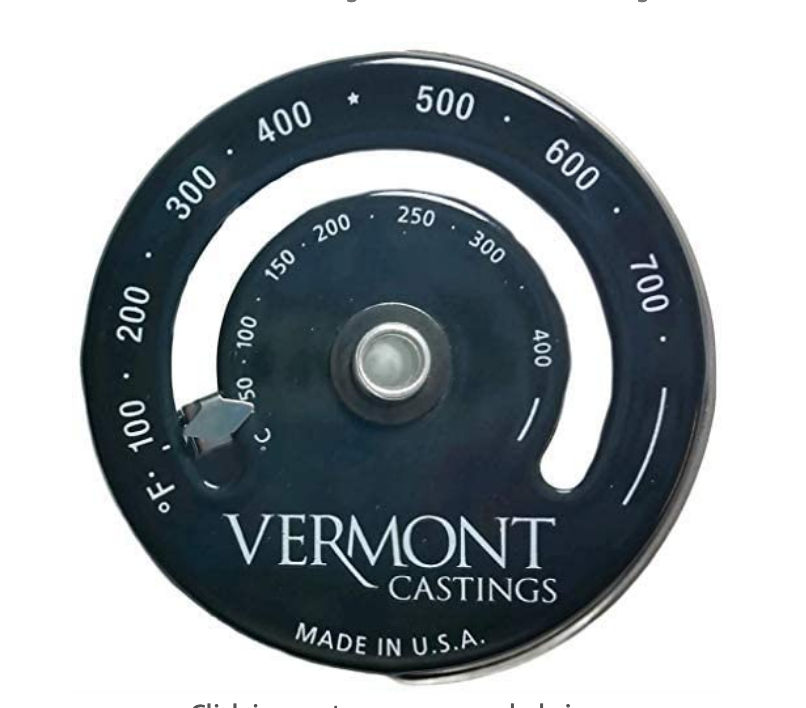
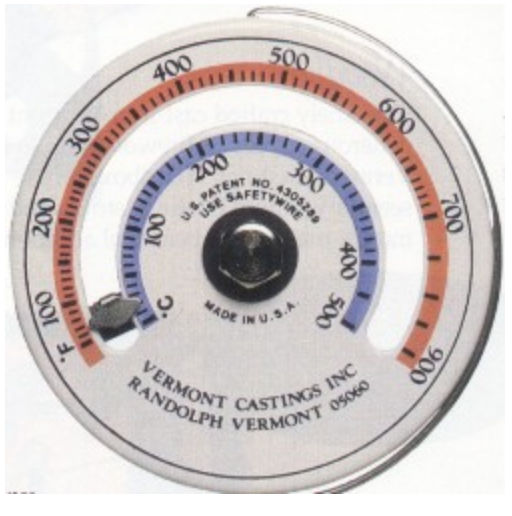
On a typical woodstove thermometer like this one from Vermont Castings you'll see the thermometer scale soars up to 700 F and older models of the same thermometer had a scale going up to 900F.Woodstove experts and researchers typically cite keeping the fire at 250F as a way to avoid excessive or rapid creosote formation.
Typically burning the stove "hot" around that temperature for 10-30 minutes will burn off thin creosote deposits
A typical wood stove thermometer will have a "best operating temperature" scale that has you run the stove between 250F and 450F.
Watch out: newer woodstoves that are more-efficient and more airtight also want to run at lower flue temperatures and can produce creosote more-quickly than the older, less efficient, hotter models.
Watch out : a creosote fire in a chinmney can reach temperatures between 1200F and 2000 °F. !
see details at WOOD STOVE OPERATION & SAFETY
and
CREOSOTE FIRE HAZARDS
Check the installation instructions for your equipoment. For example Vermont Casting's Defiant stove instructions are filled with advice on proper chimney and flue vent or single-wall connector materials, types, temperature ratings etc.
E.g.
"Single-wall connectors should be made of 24 gauge or heavier steel. Do not use galvanized connector; it cannot withstand the high temperatures that can be reached by smoke and exhaust gases, and may release toxic fumes under high heat. The connector may be 6" (152 mm) or 8" (203 mm) in diameter."
...
Close the damper when the griddle temperature reaches 450°F (230°C) and sufficient ember bed is established.
...
A temperature reading over 650°F. (340°C) is a sign to reduce the air supply to slow the burn rate.
- VERMONT CASTINGS DEFIANT WOODSTOVE MANUAL [PDF] Vermont Castings, 352 Mountain House Road • Halifax, PA 17032 USA Website: www.vermontcastings.com
Watch out: at temperatures over 450 °F. your chimney or flue is hot enough to ignite creosote deposits.
Also see WOOD-OIL COMBINATION HEATERS
Reader Comments, Questions & Answers About The Article Above
Below you will find questions and answers previously posted on this page at its page bottom reader comment box.
Reader Q&A - also see RECOMMENDED ARTICLES & FAQs
 On 2021-02-18 - by (mod) -
No, Paul sharing a flue between mixed fuels (a gas or oil fired water heater) and a woodstove chimmey is unsafe and most-likely is prohibited by building codes where you live.
In the article above at
"Pertinent Chimney & Venting Code Citations"
-You'll see that flue sharing is permitted - within certain limits - for heating appliances using the same fuel (oil, or gas) and sometimes between oil and gas.
There are several concerns: draft regulation and chimney fires being the two obvious ones.
On 2021-02-17 by paul
can you vent a hot water heater into a woodstove chimney
On 2020-12-03 - by (mod) -
Amy
Foremost: I do not have a full and clear understanding of your chimneys, flues, usages, and therefore cannot be confident that your chimneys are safe.
A few suggestions for safety and function:
1. An open "flue pipe" or flue vent connector that connected something to a chimney flue should not be left open as you invite unnecessary loss of heat up the chimney through the opening,
AND
if that opening was improper in the first place it's potentially unsafe, impinging draft, causing unsafe heater operation - it is never - proper, for example to share a chimney flue between devices on different floors of a building
If the open vent connection is indeed sharing a chimney flue with an upstairs fireplace (or anything else) it's reducing draft and making for a smoky fireplace.
2. It would be smart to have your chimneys and flues inspected by a certified chimney sweep, including the flue interior, for cleanliness, safety, general condition, as well as to give you a clear map of what chimneys and flues are in use.
That can include a review of the chimney caps and you can ask if there's a suggestions of an improvement - cosmetic or functional, such as a listed chimney shroud - that you'll find in the ARTICLE INDEX above.
On 2020-12-03 by Amy
Hi—
I have an old house with three fireplaces, one area where there might have been an indoor barbecue (replaced with a cabinet), a mysterious flue pipe in the basement (uncapped) which might have once connected to an oil furnace, and four separate chimneys. (With four ugly and expensive chimney caps...)
If it weren’t for the area where there might have been an indoor barbecue, I would assume the fireplace and flue pipe had their own chimney. But, presumably, the open flue pipe connects in to one of the fireplaces. We used one of the fireplaces exactly once in 20 years during a weeklong power outage in the winter, but otherwise find them useless.
Is there any reason why the open flue pipe should remain uncapped, or can I just close it off with a metal cap?
On 2020-04-02 - by (mod) -
Actually my friend Paul has been heating his New York home with this Jotul for years.
I had installed it in a super-insulated second floor addition I'd built and found that the stove put out so much heat that it either drove us out of the room or it had to be run soooo slowly that we had a constant creosote chimney fire worry.
Finally I traded the stove to Paul - considering the Seiko watch I'd say the stove was more or less a gift. He's still using the Jotul, having occasionally over the several decades, replaced a gasket and bit of stove cement here and there.
I gave my Seiko to the Salvation Army.
We look forward to seeing your fire-safe installation.
On 2020-04-01 by Cal
I hope you got an equally sweet wristwatch in the deal, DanJoe! I love that old Jotul! The Norwegian script (which I'll need to copy into Google translate when I find some spare time) and the rural life graphics set it apart from anything production-made in a very long time.
I just got back from the dealer with my new Jotul. I drove through 2 to 3 hours of moderate snow over Lolo pass to get it but it strapped-in nicely under the cap on my pickup truck and stayed out of the snow and rain. This site has been a gem of a discovery for me. Thanks again! I'll post pics when it's operation, but that won't really be until next season, because I don't have any seasoned wood to burn in it right now.
On 2020-03-31 - by (mod) - Quadrafire propane stove chimney venting
Well smart that you looked carefully before charging ahead.
I'm a fan of Jotul woodstoves and once traded one for a wristwatch.
You can see that stove at
WOOD STOVE OPERATION & SAFETY
On 2020-03-30 by Cal
mod danjoefriedman,
I just dropped the stove pipe and chimney plate down on our Quadrafire propane stove, and peered up the chimney. My idea is a total no-go with this propane stove.
The Quadrafire uses a 4" liner for exhaust venting and draws its air supply down the chimney.
From the little I could see with a flashlight and mirror, the chimney looks great, but I'll need to do a more thorough inspection after the weather warms up and I can pull the Quadrafire out for storage in our barn.
The previous owner told me that he previously had a Blaze King wood stove connected to this chimney but he replaced it with the more convenient Quadrafire propane stove.
Tomorrow I'll pick up a brand new Jotul F55 Carrabassett wood stove that I got on a spring clearance sale for $1600!
I don't know if the model will survive 2020 EPA but I'm glad I got the last one from this dealer, because Its simplicity appeals to me and I saw too many people complaining about the F50TL Rangeley's flimsy ash box and not terribly useful top load feature.
On 2020-03-28 - by (mod) -
Calin Brabandt
For space and to preserve our discussion to invite further comment I've moved it into the bottom of the article above on this page.
More comments, questions, critique are of course welcome.
On 2020-03-28 - by (mod) -
I so appreciate the discussion and added detail. I'll give this some more thought and coment further tomorrow.
On 2020-03-27 - by (mod) -
Right and that's pretty interesting isn't it. Having some experience in servicing and repairing multi-fuel stoves I have found that it was just about impossible to find one that worked correctly and efficiently using both fuels.
That doesn't mean they're illegal however. Some multi fuel systems used separate chimneys.
The ones that did not wear the ones of greatest concern. For example there are cases in which an oil-fired heater set creosote deposits from a wood heater on fire leading to a chimney fire. I realize that's not your case.
On 2020-03-27 by Calin Brabandt
I've been reviewing the New Hampshire code linked on this site (thanks). It does provide an exception for multi fuel use in a SINGLE stove, if prescribed controls are present in the stove:
"Exception:
A solid fuel-burning appliance designed, constructed and listed to operate on a combination of fuels is permitted to be installed in a single chimney flue.
The exception contends that the appliance is designed and constructed in such a manner that both fuels could not be used in conjunction with each other, and that safety controls have been integrated in such a manner as to prevent and/or shut down the appliance before it reaches its over firing and venting capacity."
So the non-simultaneous burning (singly and separately) of different fuels into a single chimney flue is not, in and of itself, deemed to be hazardous.
-Cal
...
Thanks for your comments and insights, (mod)
" a plethora of fire extingishers, CO detectors, fire and smoke alarms, and paying attention " seems like a good idea anyway.
Even code and professional installation does not guarantee that safe practices will be followed. You should see the 19 year old hot tub that came with this old farm house. It was installed professionally but I discovered several atrocious errors in the controller and installation wiring when I overhauled the controller!
I'm looking for hidden "gotchas" so I can evaluate and perhaps mitigate them--sort of like the pyrolysis issue you mentioned that exists apart from my specific and unusual installation goal.
The only risk that I can identify that's unique to the configuration I seek might be creosote buildup that is ignited by the propane-fired exhaust. Perhaps this can be mitigated with a cleaner burning wood stove (catalyst) and frequent chimney brushing along with a chimney flue temperature gauge to monitor best wood fire operational temperatures.
Yes--for safety, the dampers would need to be configured correctly for the stove in use and I have no desire to complicate the dampers with automation. I was a DC-8 flight engineer and pilot so I'm accustomed to dealing with valves that my life depends upon! ;)
The way our chimney is installed above a large stone alcove for the stove(s), I could simply tear down and replace the stove pipes to exhaust only a single stove whenever I wanted to use that stove, but it seems like a lot of extra work to isolate a single stove by re-plumbing when flipping manual dampers could provide the isolation and additional safety instead.
Do you actually know of anyone who has implemented a one-stove-at-a-time configuration to a shared chimney? It seems like shared stoves, furnaces and boilers are typically installed to run simultaneously and I don't think most people give much thought to what I desire to achieve.
I don't think I'd ever sell the house with the wood stove installed. I'd remove it and either take it with me or sell it separately. I'd restore the pipes to the regular single-stove flue configuration.
Thanks again,
-Cal
Also, maybe a "heat reclaimer" on only the propane stove pipe would mitigate risk. After all, some people say that an occasional hot fire reduces creosote but maybe they are only the people selling those crystals and creosote logs. Or maybe it would make things worse!
On 2020-03-27 - by (mod) - Wood and propane side-by-side (same level) stoves connected to single chimney but never fired simultaneously?
 Cal
Cal
I appreciate that you want to do something that "works for you" and understand that you're not so interested in code compliance out in rural Idaho.
Forgive me but sitting far away across trumplandia's wall in central Mexico I just am way too chicken to bet your life and safety on a guess by e-text that concludes "sure, go ahead."
A few of points I consider:
- building codes are very much concerned with life-safety hazards and often address only the MINIMUM acceptable standard of safety
- building codes and guidelines also consider not what one smart and careful guy (you) might do in a building but also what some inept person might do later-on.
E.g. I've inspected woodstoves that were set too close to combustibles only to hear the owner say "I've had fires in this stove for 30 years with no trouble!"
But: 1. the owner doesn't know about pyrolysis and how the combustion point of wood can be lowered over time until one day it bursts into flame PYROLYSIS EXPLAINED describes such a case
Also see FIRE CLEARANCES INDOORS
and 2. the owner isn't considering what a dope the new owner of his home might be. The dope built a very hot wood fire and the very first night set the house on fire.
So yeah, you could work around the reasons why sharing a flue with a woodstove and propane heater is unsafe, supplemented by a plethora of fire extingishers, CO detectors, fire and smoke alarms, and paying attention ... but one can't be sure what else may happen or who else may fool with the system.
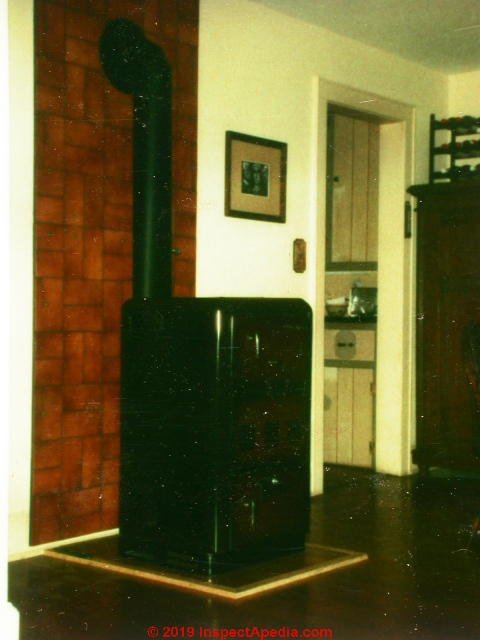
And to be candid, I've done such things: in a NY home we shared a flue across 2 floors with a coal stove and a gas fired boiler - taking care similar to what you suggested.
A photo of that coal stove is shown above along with the tile-covered heat shield we installed behind the stove. .
When we moved out of the home we removed the coal stove (illegal as it was) and bricked up the hole in the flue that had vented the coal burner.
BUT later it was pointed out that IF we had had a fire or loss our insurance company would have failed to cover ANY of the loss because of our illegal, improper, and unsafe installation.
On 2020-03-26 by Calin Brabandt - Wood and propane side-by-side (same level) stoves connected to single chimney but never fired simultaneously?
In the following discussion, also assume a modern EPA catalytic wood stove.
The idea is to have the capability of using either heat source from side-by side stoves, but to never run both stoves simultaneously. Unused stove would always be isolated via dampers in each feed pipe to the single chimney pipe. A CO detector could also be installed nearby to monitor for leakage.
I live in rural Idaho so I'm more interested in the safety issues than any code that might apply in some jurisdictions. This is also an unusual configuration ("dual-fuel" but always single-stove fired) that I could not find in any of your scenarios on this website.
A wood stove is free heat around here (76 acres of timberland). Propane is convenient and runs on a thermostat. I'd like to be able to selectively choose one or the other, depending on needs.
On 2020-01-28 - by (mod) - shared pellet stove and oil burner heater flue
Basic answer; approval of a shared pellet stove and oil burner heater flue depends on local codes, permits, inspections, approval - and may be permitted in some jurisdictions.
Opinion: Though not widely installed, since at least the 1970s in the U.S. there have been mutli-fuel boilers, such as wood-oil burning boilers that use a common chimney. The few that I serviced back in the 70s and 80s had trouble running properly; we had trouble regulating the draft properly for both fuels. I also found that homeowners burning green wood had significant creosote and flue blockage problems and serious chimney fire risks.
In general you don't share a common flue venting a conventional wood stove flue and a separate oil fueled heaters. The history of that prohibition is that the oil heater risks setting of a creosote fire in the chimney.
There are other technical issues. The draft regulator that sets the proper draft for the oil burner can, by feeding air at the regulator, cool the flue when burning wood product and increase the creosote formation rate and thus increase the risk of a chimney fire.
For example, a pellet stove installation manual may specifically state "Do Not install a draft regulator on the vent for this stove" - doing so may make the stove operate improperly or may make it unsafe.
cf:
- PELLET STOVE OPERATING & INSTALLATION INSTRUCTIONS [PDF] Hudson River Stove Works, 1871 Rte. 9H, Hudson NY 12534 USA Tel: 518-828-6363 retrieved 2020/01/27 original source: http://www.hudsonriverstoves.com/pdf/saranac.pdf
A pellet stove burns cleaner than a conventional woodstove, so the risk is probalby less. I wouldn't consider sharing a flue with the pellet stove without discussing the specific installation with the manufacturer and with the local fire inspector and code officials.
Code answers to the shared flue among different fueled heaters vary by jurisdiction;
A few things will be common:
1. both heating appliances must be on the same floor
2. there must be adequate combustion air and adequate draft in the chimney for both devices
3. ANY woodstove installation in just about any jurisdiction in North America (if that's where you are) requires a local building permit, inspections, and approval - all of which, by your compliance and by the inspections, should increase the safety of your installation
4. SOME jurisdictions permit venting a pellet stove and oil fired heater into the same flue
Maine since sometime in 2011
5. Do not install any auxiliary wood fired heater without having properly installed and tested smoke detectors and CO detectors in your home
6. Be sure you meet ALL of the safety specifications of your pellet stove (and oil burner ) manufacturer, such as fire clearances
Check as well with the company that issues your homeowners / fire policy.
Example standards that apply In Canada, the
CSA B365 Installation Code for Solid Fuel Burning Appliances and Equipment and the
CSA C22.1 Canadian National Electrical Code are to be followed in the absence of local code
requirements. In the USA, the ANSI NFPA 211 Standard for Chimneys, Fireplaces, Vents and Solid
Fuel-Burning Appliances and the
ANSI NFPA 70 National Electrical Code are to be followed in the
absence of local code requirements.
Or in other pellet stove installation instructions a special venting system is required:
"This stove must be connected to a pellet vent system complying with the requirements for Pellet
Vent in the standards UL 103, ULC S629M, ULC S609 and UL 641or to a code-approved masonry
chimney with a stainless steel flue liner." -
- Osburn PELLET STOVE INSTALLATION MANUAL [PDF] Osburrn, 250 De Copenhague
St-Augustin-de-Desmaures (Quebec)
G3A 2H3, CanadaTel: 1-877-356-6663 Website: https://www.osburn-mfg.com/en/ original source: https://sbiweb.blob.core.windows.net/media/3891/45548a_05-07-2018.pdf
On 2020-01-28 by Anonymous
Can you put oil burner with a pellet stove on the same chimney
On 2019-10-08 - by (mod) -
No Eric, it's generally prohibited and unsafe to use the same chimney flue
- by heating appliances on different building floors or levels
- by heating appliances using different fuels
On 2019-10-06 by Eric
My chimney has an insert in and my boiler is connected to it in the basement my question is in my living room there is a cutout in the chimney and the area is fireproofed for a wood stove but there is not one there can I use the same chimney the boiler uses for a pellet stove
On 2018-11-03 1 - by (mod) -
Why not have the wood-stove removed completely?
About converting from oil to gas because ... "The oil burner keeps shutting off" ... I would first get help from an experienced oil heat service technician to diagnose and fix the problem with the present system. That is almost certainly far more-economical.
On 2018-11-03 by M.J.
We have an HS Tarm oil-fired boiler with an attached wood stove for hot water heat in the concrete slab floor. We have never used the wood stove and don't plan to. The oil burner keeps shutting off, so we want to change it to a gas burner. The man from the gas company said we could not have gas and wood in the same unit.
If there was a gas explosion, everyone involved in the installation could be sued, insurance wouldn't pay, etc.
We may sell the house in the next 10 years and propose to remove the two access doors to the woodstove and replace them with heavy steel plates so no one else would use the stove. (Of course, they might retrofit it - no control after we are gone from here!)
On 2014-11-24 - by (mod) -
Stacey
Creosote deposited by a wood stove into a chimney can indeed ultimately contribute to a chimney fire. Besides it's quite possible that the shared flue you describe is unsafe and illegal. Check with your building department. And ask for a professional chimney inspection by a certified chimney sweep.
On 2014-11-22 by Stacey Camp
Can a shared flue between a wood burning stove and a gas hot water heater cause a fire?
On 2014-10-06 - by (mod) -
If smoke shows up in the basement when using an upstairs fireplace there are at least two serious problems, maybe more:
1. You have a flue shared between floors - which is unsafe and is not code-permitted in most jurisdictions
2. There is probably a downdraft which suggests the chimney is not working properly or might be blocked - also unsafe.
I'd ask for an inspection and diagnosis by a chimney cleaning expert such as a member of the Chimney Sweeps Guild.
On 2014-10-05 by Brian
How do I keep smoke from entering my basement fireplace when I use my upstairs fireplace?
On 2014-03-09 - by (mod) -
Not in IMO, No.
There are more problems that may meet the eye with shared flues, including the risk of a creosote caused chimney fire when two fuels try to use the same flue. There are dual-fuel heating systems that try this - oil and wood fired boilers and furances; those chinmneys need special attention.
On 2014-03-07 by Anonymous
Say, jurisdiction does not permit flue sharing between oil burner and wood burner on the same floor.
Is it OK in this case to install a single-wall T-joint and 2 dampers (or maybe you can suggest another switching device?), so that only one burner is connected to the flue at one time, and the second one is blocked by damper, thus eliminating possibility of the back draft from the second burner? Would it pass inspection?
On 2011-11-17 by MV
* forget the part about the same flue- the fireplace definitely has its own flue below the vent for the furnace or water heater.
Is it ever permitted for a fireplace to share the same chimney and flue with either a furnace or a water heater? Not sure which is venting into our fireplace chimney, but both are gas powered, and the vent appears to be a few feet above the fireplace opening. The fireplace has a gas starter that we are not planning on using, but just using it a natural burning wood fireplace. Is this safe? Do I need to keep the fireplace flue permanently open then regardless for the furnace or water heater to vent outside?
...
...
Continue reading at SHARED CHIMNEY & FLUE HAZARDS or select a topic from the closely-related articles below, or see the complete ARTICLE INDEX.
Or see SHARED CHIMNEY FLUES OK FAQs - questions and answers posted originally on this page.
Or see these
Recommended Articles
- CHIMNEY CODES for downloadable copies of common chimney and appliance venting codes and standards
- CHIMNEY CODES & STANDARDS - home
- CHIMNEY SAFETY, WOOD BURNING - CPSC
- COAL STOVE OPERATION & SAFETY
- CREOSOTE DEPOSITS, FIRE HAZARD
- DRAFT INDUCER FANS
- FIRE CLEARANCES INDOORS
- FIRE CLEARANCES, WOOD COAL & PELLET STOVES
- PYROLYSIS EXPLAINED
- SHARED CHIMNEY & FLUE HAZARDS - home
- SHARED CHIMNEY FLUES OK
- WOOD-OIL COMBINATION HEATERS
- WOOD STOVE OPERATION & SAFETY
Suggested citation for this web page
SHARED CHIMNEY FLUES OK at InspectApedia.com - online encyclopedia of building & environmental inspection, testing, diagnosis, repair, & problem prevention advice.
INDEX to RELATED ARTICLES: ARTICLE INDEX to CHIMNEYS & FLUES
Or use the SEARCH BOX found below to Ask a Question or Search InspectApedia
Ask a Question or Search InspectApedia
Try the search box just below, or if you prefer, post a question or comment in the Comments box below and we will respond promptly.
Search the InspectApedia website
Note: appearance of your Comment below may be delayed: if your comment contains an image, photograph, web link, or text that looks to the software as if it might be a web link, your posting will appear after it has been approved by a moderator. Apologies for the delay.
Only one image can be added per comment but you can post as many comments, and therefore images, as you like.
You will not receive a notification when a response to your question has been posted.
Please bookmark this page to make it easy for you to check back for our response.
Our Comment Box is provided by Countable Web Productions countable.ca
Citations & References
In addition to any citations in the article above, a full list is available on request.
- Mark Cramer Inspection Services Mark Cramer, Tampa Florida, Mr. Cramer is a past president of ASHI, the American Society of Home Inspectors and is a Florida home inspector and home inspection educator. Mr. Cramer serves on the ASHI Home Inspection Standards. Contact Mark Cramer at: 727-595-4211 mark@BestTampaInspector.com
- John Cranor [Website: /www.house-whisperer.com ] is an ASHI member and a home inspector (The House Whisperer) is located in Glen Allen, VA 23060. He is also a contributor to InspectApedia.com in several technical areas such as plumbing and appliances (dryer vents). Contact Mr. Cranor at 804-873-8534 or by Email: johncranor@verizon.net
- Thanks to Luke Barnes for suggesting that we add text regarding the hazards of shared chimney flues. USMA - Sept. 2008.
- Roger Hankeyis principal of Hankey and Brown home inspectors, Eden Prairie, MN, technical review by Roger Hankey, prior chairman, Standards Committee, American Society of Home Inspectors - ASHI. 952 829-0044 - hankeyandbrown.com
- NFPA 211 - Standards for Chimneys & Fireplaces, NFPA 211: Standard for Chimneys, Fireplaces, Vents, and Solid Fuel-Burning Appliances, 2006 Edition (older editions and standards are found at the same bookstore)
- NFPA #211-3.1 1988 - Specific to chimneys, fireplaces, vents and solid fuel burning appliances.
- NFPA # 54-7.1 1992 - Specific to venting of equipment with fan-assisted combustion systems.
- GAMA - Gas Appliance Manufacturers' Association has prepared venting tables for Category I draft hood equipped central furnaces as well as fan-assisted combustion system central furnaces.
- National Fuel Gas Code, an American National Standard, 4th ed. 1988 (newer edition is available) Secretariats, American Gas Association (AGA), 1515 Wilson Blvd., Arlington VA22209, and National Fire Protection Association (NFPA), Batterymarch Park, Quincy MA 02269. ANSI Z223.1-1988 - NFPA 54-1988. WARNING: be sure to check clearances and other safety guidelines in the latest edition of these standards.
- Fire Inspector Guidebook, A Correlation of Fire Safety Requirements Contained in the 1987 BOCA National Codes, (newer edition available), Building Officials and Code Administrators International, Inc. (BOCA), Country Club HIlls, IL 60478 312-799-2300 4th ed. Note: this document is reissued every four years. Be sure to obtain the latest edition.
- Uniform Mechanical Code - UMC 1991, Sec 913 (a.) Masonry Chimneys, refers to Chapters 23, 29, and 37 of the Building Code.
- New York 1984 Uniform Fire Prevention and Building Code, Article 10, Heating, Ventilating, and Air Conditioning Requirements
- New York 1979 Uniform Fire Prevention & Building Code, The "requirement" for 8" of solid masonry OR for use of a flue liner was listed in the One and Two Family Dwelling Code for New York, in 1979, in Chapter 9, Chimneys and Fireplaces, New York 1979 Building and Fire Prevention Code:
- "Top Ten Chimney (and related) Problems Encountered by One Chimney Sweep," Hudson Valley ASHI education seminar, 3 January 2000, contributed by Bob Hansen, ASHI
- Chimney Inspection Checklist, Carson Dunlop, Associates, Toronto, Ontario
- "Rooftop View Turns to Darkness," Martine Costello, Josh Kovner, New Haven Register, 12 May 1992 p. 11: Catherine Murphy was sunning on a building roof when a chimney collapsed; she fell into and was trapped inside the chimney until rescued by emergency workers.
- "Chimneys and Vents," Mark J. Reinmiller, P.E., ASHI Technical Journal, Vol. 1 No. 2 July 1991 p. 34-38.
- "Chimney Inspection Procedures & Codes," Donald V. Cohen was to be published in the first volume of the 1994 ASHI Technical Journal by D. Friedman, then editor/publisher of that publication. The production of the ASHI Technical Journal and future editions was cancelled by ASHI President Patrick Porzio. Some of the content of Mr. Cohen's original submission has been included in this more complete chimney inspection article: CHIMNEY INSPECTION DIAGNOSIS REPAIR . Copies of earlier editions of the ASHI Technical Journal are available from ASHI, the American Society of Home Inspectors.
- Natural Gas Weekly Update: http://tonto.eia.doe.gov/oog/info/ngw/ngupdate.asp Official Energy Statistics from the U.S. Government
- US Energy Administration: Electrical Energy Costs http://www.eia.doe.gov/fuelelectric.html
- Our recommended books about building & mechanical systems design, inspection, problem diagnosis, and repair, and about indoor environment and IAQ testing, diagnosis, and cleanup are at the InspectAPedia Bookstore. Also see our Book Reviews - InspectAPedia.
- Ceramic Roofware, Hans Van Lemmen, Shire Library, 2008, ISBN-13: 978-0747805694 - Brick chimneys, chimney-pots and roof and ridge tiles have been a feature of the roofs of a wide range of buildings since the late Middle Ages. In the first instance this ceramic roofware was functional - to make the roof weatherproof and to provide an outlet for smoke - but it could also be very decorative.
The practical and ornamental aspects of ceramic roofware can still be seen throughout Britain, particularly on buildings of the Victorian and Edwardian periods. Not only do these often have ornate chimneys and roof tiles but they may also feature ornamental sculptures or highly decorative gable ends. This book charts the history of ceramic roofware from the Middle Ages to the present day, highlighting both practical and decorative applications, and giving information about manufacturers and on the styles and techniques of production and decoration.
Hans van Lemmen is an established author on the history of tiles and has lectured on the subject in Britain and elsewhere. He is founder member and presently publications editor of the British Tiles and Architectural Ceramics Society. - Chimney Inspection Checklist, Carson Dunlop, Associates, Toronto, Ontario
- Chimney & Stack Inspection Guidelines, American Society of Civil Engineers, 2003 - These guidelines address the inspection of chimneys and stacks. Each guideline assists owners in determining what level of inspection is appropriate to a particular chimney and provides common criteria so that all parties involved have a clear understanding of the scope of the inspection and the end product required. Each chimney or stack is a unique structure, subject to both aggressive operating and natural environments, and degradation over time. Such degradation may be managed via a prudent inspection program followed by maintenance work on any equipment or structure determined to be in need of attention. Sample inspection report specifications, sample field inspection data forms, and an example of a developed plan of a concrete chimney are included in the guidelines. This book provides a valuable guidance tool for chimney and stack inspections and also offers a set of references for these particular inspections.
- Fireplaces, a Practical Design Guide, Jane Gitlin
- Fireplaces, Friend or Foe, Robert D. Mayo
- NFPA 211 - Standards for Chimneys & Fireplaces, NFPA 211: Standard for Chimneys, Fireplaces, Vents, and Solid Fuel-Burning Appliances, 2006 Edition (older editions and standards are found at the same bookstore)
- Principles of Home Inspection: Chimneys & Wood Heating, in (Principles of Home Inspection), Carson Dunlop, Associates, Toronto, Ontario
- NFPA 211 - 3-1.10 - Relining guide for chimneys
- NFPA 211 - 3-2 - Construction of Masonry Chimneys
- NFPA 211 - 3-3 - Termination Height for chimneys
- NFPA 211 - 3-4 - Clearance from Combustible Material
- NFPA 54 - 7-1 - Venting of Equipment into chimneys
- Brick Institute of America - Flashing Chimneys
Brick Institute of America - Proper Chimney Crowns
Brick Institute of America - Moisture Resistance of Brick - American Gas Association - New Vent Sizing Tables
- Chimney Safety Institute of America - Chimney Fires: Causes, Effects, Evaluation
- National Chimney Sweep Guild - Yellow Pages of Suppliers
- In addition to citations & references found in this article, see the research citations given at the end of the related articles found at our suggested
CONTINUE READING or RECOMMENDED ARTICLES.
- Carson, Dunlop & Associates Ltd., 120 Carlton Street Suite 407, Toronto ON M5A 4K2. Tel: (416) 964-9415 1-800-268-7070 Email: info@carsondunlop.com. Alan Carson is a past president of ASHI, the American Society of Home Inspectors.
Thanks to Alan Carson and Bob Dunlop, for permission for InspectAPedia to use text excerpts from The HOME REFERENCE BOOK - the Encyclopedia of Homes and to use illustrations from The ILLUSTRATED HOME .
Carson Dunlop Associates provides extensive home inspection education and report writing material. In gratitude we provide links to tsome Carson Dunlop Associates products and services.
 | HOME | ABOUT | ASK a QUESTION | CONTACT | CONTENT USE POLICY | DESCRIPTION | POLICIES | PRIVACY | |
| © 2024 - 1985 Publisher InspectApedia.com - Daniel Friedman | |||||||||