
InspectAPedia® FREE Encyclopedia of Building & Environmental Construction, Diagnosis, Maintenance & Repair |
Question? Just ask us! InspectAPedia
|
 How to Inspect & Repair Unlined Chimney Flues, Evaluate Chimney Wall Thickness - Masonry Chimney Safety Requirements
- POST a QUESTION or COMMENT about un-lined masonry flues: safety, inspection, diagnosis, repair or replacement: is a new chimney liner really necessary? Not always.
Unlined chimney flues: are they safe?
How do we inspect and evaluate the safety of older masonry chimney flues? This document describes safety issues and building code requirements for unlined masonry chimney flues.
Proper flue thickness, lining, cleaning, rain protection, and design are important to avoid building fires and potential escape of dangerous flue gases into the building.
InspectAPedia tolerates no conflicts of interest. We have no relationship with advertisers, products, or services discussed at this website.
Chimney Safety Inspection Recommendations & Procedures: Have your chimney flue inspected for safety
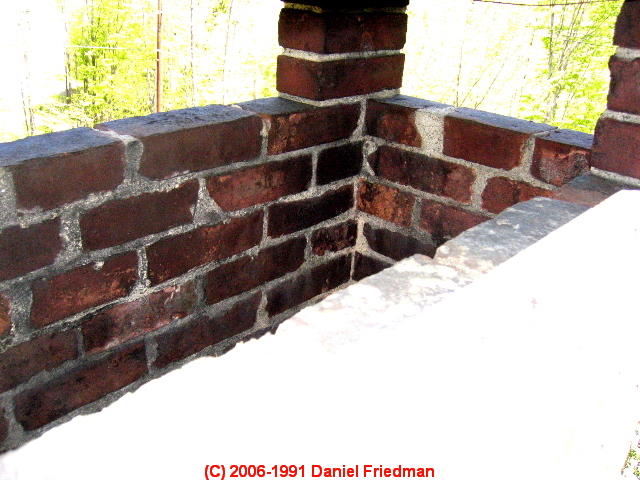
 In Canada, single wythe brick flues are accepted. In many United States locales, single wythe brick flues remain in use but several standards require
or recommend either re-lining (and other safety measures) or the confirmation
that 8 inches of solid masonry exists - i.e. a double wythe or greater flue.
In Canada, single wythe brick flues are accepted. In many United States locales, single wythe brick flues remain in use but several standards require
or recommend either re-lining (and other safety measures) or the confirmation
that 8 inches of solid masonry exists - i.e. a double wythe or greater flue.
Periodic inspection of all chimneys and flues is important for fire and gas safety. Gas safety includes carbon monoxide hazards, especially where gas-fired equipment is in use in a building. The level of inspection you request may depend on the level of probable risk involving the chimney.
- Heating system service inspections of chimneys: Ask your heating service technician to check the chimney for signs of a problem when your heating
system receives its annual service.
This is especially critical for older chimneys which may use a "dead end" flue - one which terminates right at the top of the foundation, with no ash pit or clean out door lower than the chimney thimble which accepts the flue vent connector from your boiler or furnace. Dead end chimney flues can become blocked quickly by any debris falling down the chimney.
See DEAD END FLUES - Chimney sweep inspection of flues: Ask your chimney sweep to clean fireplace flues regularly - the frequency depends in part on how
much you use the chimney, what type of use is made (open fireplace, airtight woodstove, coal stove), and
if burning wood, how green the burned wood may have been. High sap content makes lots of creosote and greatly increases
the risk of a chimney fire.
See CLEANING CHIMNEYS. - Chim scan cameras to inspect chimney flues: Many professional chimney sweeps use a "chim scan" camera, basically a fisheye lens on a video camera, to examine
the condition of the interior of the chimney flue. This is about the only way you can make a thorough examination of
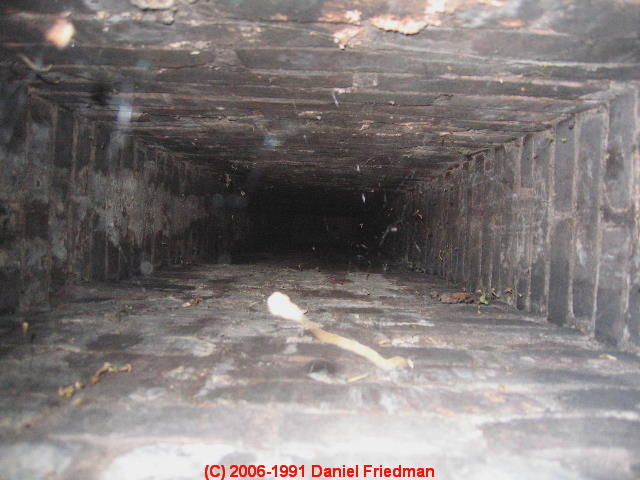
the chimney interior. When I shine even a bright light down a chimney from the top it's a bit like looking into an
abyss of blackness. The photos at the top of this page were taken using special methods.
See see CLEANING CHIMNEYS.
SINGLE BRICK FLUE HAZARDS - Single Wythe Unlined Masonry Chimney Flue Construction & Hazards
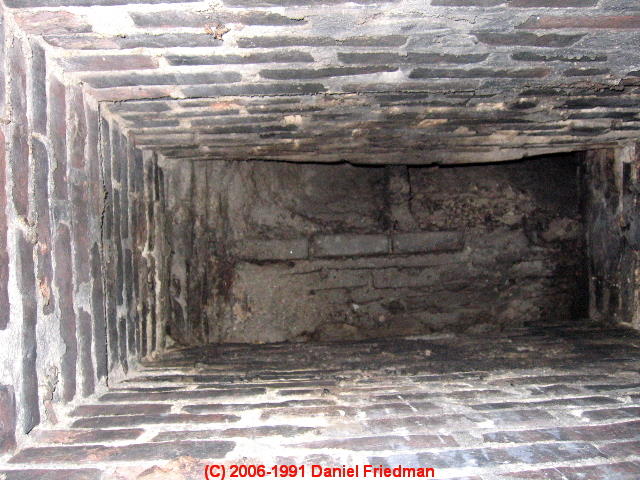
 First let's look at the interior of the chimney shown at the top of this page.
This view of the interior of an un-lined brick chimney, combined with the initial outside view (at the top of this page) shows even the casual on-roof building inspector that the chimney was constructed as a single wythe chimney flue.
"Single wythe" means that the chimney wall was constructed using a single thickness of brick running in stretcher or "long-way" for construction of the chimney wall. The significance of this construction is that there is only a single thickness of masonry (brick and mortar) of roughly 4" forming the chimney wall.
Any defect such as a cracked brick or lost mortar risks sparks or flue gases entering the building - a potential fire or gas hazard. A more-safe construction used at least two bricks to form the thickness of the chimney wall, and staggered masonry joints so that even if some mortar is lost there is not a direct path for sparks to enter the building structure.
And of course most modern brick or masonry chimneys use a high-temperature fired clay flue tile or chimney liner (not shown in these photos).
This view of the bottom of interior of this un-lined brick chimney,
shows an added condition which is not permitted in modern construction. Near the bottom of this large single-brick-thick
chimney flue you can see that the chimney splits into two sub-flues as it passes further down in the building.
Each of the sub-flues supports a different use: a fireplace in one case and a gas-fired furnace in the second case for this building.
Shared-flues passing between floors in a building present several safety hazards including potential dangerous gas leaks, fire passage among floors, and difficulties in establishing proper draft.
This chimney needs to be re-lined with two separate flues from the chimney to all the way down to the appliance.
Chimney flue re-lining alternatives include complete reconstruction using conventional masonry and clay flue lining tiles, use of a lightweight chimney lining concrete such as Permaflue™ or Supaflue™ which is pumped into the flue from the top, and stainless-steel chimney liners.
These options are listed in rough order of cost. When a chimney is sound enough for pumping a masonry flue liner I prefer the middle option for safety and durability. Any of these options can be safe if properly installed.
Dangerous Blocked Chimney Flue Case Study - unsafe single wythe brick flue
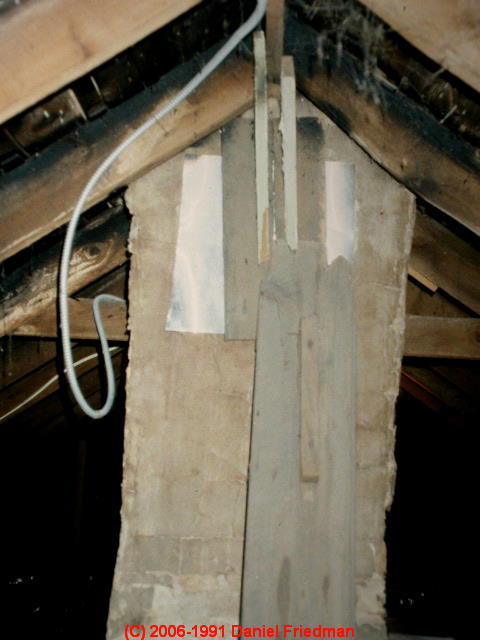 In a [DJ Friedman's] now infamous Port Jervis New York chimney safety and carbon monoxide poisoning case, the entire
gas-fired appliance brick chimney flue was totally
blocked in the basement [by fallen bricks from near the top of a single wythe
brick flue in a home built before 1900].
In a [DJ Friedman's] now infamous Port Jervis New York chimney safety and carbon monoxide poisoning case, the entire
gas-fired appliance brick chimney flue was totally
blocked in the basement [by fallen bricks from near the top of a single wythe
brick flue in a home built before 1900].
The gas-fired heating boiler, located in the basement, was venting 100% of its flue gas exhaust into the basement area, sending water, a normal byproduct of the combustion of natural gas, streaming down masonry walls.
The owner had apparently seen a hole in the chimney in the attic of this pre-1900 home and had "fixed" it by using a piece of lumber as a prop to hold a piece of aluminum flashing over the hole in the flue. Notice the charring on the underside of the roof deck? (Most likely the charring was from a prior use of the chimney, perhaps for a woodstove.)
CHIMNEY INSPECTION GUIDE contains detailed suggestions for inspecting building chimneys including the detection of blocked chimney flues or indications that a chimney may be blocked.
The owner had asked me to visit the property to make a diagnostic inspection to address a "basement water entry problem." Because the owner had observed water running down the basement walls, she thought there was a water entry problem from wet soils.
 In fact, the occupants had followed a practice of
keeping their basement windows open all year in an effort to "dry out" this problem area.
In fact, the occupants had followed a practice of
keeping their basement windows open all year in an effort to "dry out" this problem area.
With the windows open, of course it wasn't a particularly warm area in winter. But nonetheless, this was a stroke of luck as the outdoor air was probably diluting the carbon monoxide spilling into the basement. Perfect combustion of gas fuel produces CO2 and water vapor. (Imperfect combustion, such as when a chimney is blocked, may produce CO - carbon monoxide.)
Our inspection found that this unlined chimney was unsafe for these reasons
- This chimney was constructed as a single wythe flue which had been covered at its top with a piece of slate - I still have no idea why the owner did this but I think they thought they were losing "heat" up the flue.
- The chimney had missing bricks leaving a hole into the attic. (Bricks might fall from the interior of a multi-wythe brick flue too, but they might not immediately show up as a hole you can see. So caution about the condition of multi-wythe flues is also in order.)
- From the attic, bricks had fallen into and blocked the chimney flue down near the thimble into which the
gas-fired heating boiler was vented in the basement. On seeing the hole in the attic,
I wondered about the location of the bricks that had once occupied what was now a
hole in the chimney.
There were no bricks on the attic floor. The owner said that no one had carried any bricks out of the attic. I asked her, "Where do you suppose we might find the bricks that used to fill this hole in the chimney?" She shrugged. "I've no idea. You'd have to ask my husband. He put this patch on the chimney."
 Investigation confirmed that loose bricks had
fallen down from near the top of the chimney in the attic.
Investigation confirmed that loose bricks had
fallen down from near the top of the chimney in the attic.
In fact, the roof deck in the attic had been charred, probably by prior appliances, but was no longer in danger as the chimney now vented directly into the basement by spilling all of the gas-fired boiler combustion products out of the boiler's draft hood and into the living space!
Where states such as NY have gone to a performance code, we are probably jeopardizing our clients if we are not aware of what some reasonable benchmarks are for acceptable chimneys, and if we don't make people aware of telltale signs and conditions in which further investigation is warranted.
Safety Lessons from this Unsafe Un-Lined Chimney Flue Investigation
- The ability of the chimney to draw properly is related to its cross-sectional area and the appliance(s) size (BTUH). So venting a gas-fired appliance into an old flue, especially a large one, might mean that the chimney will not work safely, especially in cold weather and especially if the chimney is on the outside of the building.
- If a chimney is venting any combustion products, but particularly if it's combustion products from a gas-fired
appliance, anything that interferes with proper venting, such as a blocked flue, or anything that interferes with
provision of adequate combustion air, can result in production of dangerous, potentially fatal, carbon monoxide poisoning.
People in dangerous buildings which have not reached unconsciousness or fatality-producing levels might report headaches or flu-like symptoms that should not be ignored. - The durability of the chimney may be affected by condensation. This is typical of a natural gas burning appliance, but not an oil or solid wood burning appliance.
- The safety of the chimney has two different aspects. If the heat is high, as might be the case in a wood burning appliance exhaust, there is a chance that heat may escape through the chimney and ignite combustible building components.
- Combustible deposits in the chimney flue: the other issue it is the combustible deposits (such as creosote) that do they accumulate on the interior walls of the chimney.
- Watch out: for incompetent chimney "repair" people: the reason that I recall this case so well is that at the time of my inspection, I told the owner that the chimney was dangerous and that
it needed to be fixed immediately - it was very cold weather and boiler was in use.
To convince the owner that the chimney flue was blocked, I showed that if she put her hand under the draft hood - she could feel the hot flue gas spillage from the boiler. This may have been a bad idea. In any case I must not have been sufficiently clear that the spillage was the symptom of a blocked chimney.
The flue gas spillage was the effect, not the cause, of the problem. Luckily I also tell clients they are encouraged to call me with questions.The owner called me that very night at 11PM to say that she was worried because her heat kept "going off" - the temperature was around 10 degF. and she was worried about freezing pipes. What we reconstructed was that she called a "chimney expert" from the yellow pages - he came and offered to "fix" the flue immediately, and for a very low price, too.
My client showed the repairman what I had shown her as a "safety demonstration" - combustion gas spillage from the heating boiler's draft hood. The repairman said "Geez I can fix THAT!" and proceeded to simply remove the draft hood completely - replacing it with solid flue pipe.
The result seems to have been that the spillage moved down to the burner and so blocked oxygen that the system kept (luckily) going off, the flame sensor pilot would shut it down. Fortunately the follow-up call enabled us to get someone competent out to the home.
I was terrified that by giving my client a safety warning I had precipitated a bogus repair that could have killed everyone in the house. I think that warnings need to not only make the risk clear, but need to give some pointer to an authority or follow up or something that can be sure that the repair is safe, too. In some communities, that authority is the local gas supply company or utility, or the fire inspector, building inspector, a properly trained heating service technician, or a properly-qualified certified member of the chimney sweeps guild.
Thanks to Alan Carson, Carson Dunlop, Toronto, for suggesting these clarifications.
CHIMNEY INSPECTION GUIDE contains detailed suggestions for inspecting building chimneys including the detection of blocked chimney flues or indications that a chimney may be blocked.
LINED vs UNLINED FLUES - U.S. vs. Canadian Lined or Unlined Masonry Chimney Flue Requirements
Because single thickness (wythe) brick flues may involve extra risk of fire and gas hazards, and to address the obligations of home inspectors, in 1993 an email discussion of the safety and other chimney concerns occurred between Daniel Friedman (ASHI Technical Committee Chair, Poughkeepsie, New York) and Alan Carson (ASHI President and principal of Carson Dunlop, Toronto, Ont.) to find the determining building regulations and advice for this matter.
New York State FLUE CONSTRUCTION - NY Chimney Flue Construction Requirements - e.g. New York
- New York 1979 Code:
The "requirement" for 8" of solid masonry OR for use of a flue liner was listed in the One and Two Family Dwelling Code for New York, in 1979, in Chapter 9, Chimneys and Fireplaces, New York 1979 Building and Fire Prevention Code:
Para R-906 - Flue Lining (Material) Masonry chimneys shall be lined with fireclay flue liners not less than 5/8 of an inch in thickness or with other approved liner material that will resist, without cracking or softening, a temperature of 1800 deg. [F]
Exception: Masonry chimneys may be constructed without flue liners when walls are at least 8" in thickness.
This requirement was dropped when New York changed from an explicit specification code to a [stupid] "performance" code in January 1984. - - New York 1984 Uniform Fire
Prevention and Building Code,
Article 10, Heating, Ventilating, and Air Conditioning Requirements
1000.2h-1 Equipment for burning solids or liquid fuel shall be connected to suitable chimneys or flues, or vented as set forth in 1000.2h-4 and shall not be connected to gas vents.
.2h4 addresses direct-venting equipment
1005 Chimneys and Gas vents
1005.1a Masonry and factory-built. Chimneys, gas vents and their supports shall be designed and constructed so as to be structurally safe, durable, smoke tight, noncombustible, and capable of withstanding the action of flue gases without softening, cracking, corroding or Spalling. .../ 1005.1d Flue linings shall be capable of withstanding the action of flue gas without softening, cracking, corroding or spalling at the temperature to which they shall be subjected.
Other paragraphs bring up the requirement that no adjacent materials can be heated (by the chimney/vent) higher than 175 degF. [Surely in concern for pyrolysis.)
Chimney Lining Building Code Requirements
Arlene Puentes (October Home Inspections, Kingston, NY) has sent me the following code citation regarding unlined chimney flues:
RR1001.8 Flue lining (material). Masonry chimneys shall be lined. The
lining material shall be appropriate for the type of appliance connected,
according to the terms of the appliance listing and manufacturer's
instructions.


RR1001.8.1 Residential-type appliances (general). Flue lining systems
shall comply with one of the following:


1. Clay flue lining complying with the requirements of ASTM C 315 or
   equivalent.


2. Listed chimney lining systems complying with UL 1777.


3. Factory-built chimneys or chimney units listed for installation
   within masonry chimneys.


4. Other materials that will resist, without cracking, softening or
   corrosion, flue gases and condensate at temperatures up to 1,800F
   (982C).
DF to AC: since the [New York] state backed off of quantitative code, many inspectors continue to require something explicit, particularly when examining older building to which older codes pertained - and I am probably not the only one who keeps two older generations of code manuals around as "interpretation" aides for the current more vague writing.
UMC FLUE REQUIREMENTS - Uniform Mechanical Code Chimney Flue Construction Requirements - - UMC 1991
Uniform Mechanical Code - UMC 1991, Sec 913 (a.) Masonry Chimneys, refers to Chapters 23, 29, and 37 of the Building Code.
Gas venting into existing masonry chimneys.
Existing lined masonry chimneys and unlined chimneys with not more than one side exposed to the outside may be used to vent gas appliances provided:
- An approved liner shall be installed in an existing unlined masonry chimney when deemed necessary by the building official considering local problems of vent gas condensate
- The effective cross sectional area is not more than four times the cross sectional area of the vent and chimney connectors entering the chimney
- The effective area of the chimney when connected to more than one appliance shall be not less than the area of the largest vent or chimney connector plus 50% of the area of the additional vent or chimney connectors [This is identical to my detailed flyer and sketches I obtained from Beckett Corp on this issue.]
There are other restrictions, getting a bit far out here, except for requiring checkout for blockage, cleaning old creosote, providing cleanout or capped tee, etc.
Unlined chimneys with more than one exposed side (outside) have to be lined per this paragraph.
The UMC has nice details and tables on what devices can be vented through what types of chimneys, clearances, shared flues, etc. They don't address (far as I can see) masonry thickness questions, except as follows
Table No. 9-D--Chimney Connector Systems and clearances from room wall combustibles for residential heating appliances
System A, 12" clearance - A 3 1/2" brick wall shall be framed into the combustible wall. A 5/8" thick fire clay liner shall be firmly cemented in the center of the brick wall maintaining a 12" clearance to combustibles. The clay liner shall run from the outer surface of the bricks to the inner surface of the chimney liner, but it shall not protrude into the chimney liner.
The above was not changed by amendments as of 1993.
This, of course, is discussing thimbles, not flues. We need to take a look
at Building Code 23 29 and 37 - which I don't have - Douglas H. might, or
perhaps you do.
[DF note: follow-up on this resource and general updating of resource list
is still required for this topic.]
Also see SEPARATION of CHIMNEY FLUES for a discussion of the need for solid masonry separation between multiple flues in a masonry chimney.
GAS vs OIL-FIRED - Chimney Hazards - Gas versus Oil-fired equipment
Flues venting oil-fired appliances: Summarizing our discussion of risks to clients, I agree that oil and solid fuels are probably more risky of fire than gas - for the obvious reasons of operating flue temperatures and combustible flue deposits.
Flues venting gas-fired appliances: Gas in turn seems to do more damage to old soft bricks - precisely what were used in single-wythe old unlined flues. OTOH, if there's an opening in the old flue the risk of venting CO into the house (excepting blocked flues) is probably less than the risk of reduced draft due to infiltration *in* to t he leaky chimney.
For a complete and very detailed photo guide to inspection of all types of chimneys, please also
see CHIMNEY INSPECTION & REPAIR.
...
Continue reading at CHIMNEY FLUE INSPECTION CAMERA or select a topic from the closely-related articles below, or see the complete ARTICLE INDEX.
Or see these
Recommended Articles
- MASONRY CHIMNEY GUIDE - home
- CHIMNEY CLEANING ADVICE & PROCEDURES includes help locating a chimney professional.
- CHIMNEY CLEANING PROCEDURE - home
- CHIMNEY INSPECTION CHECKLIST
- CHIMNEY REPAIRS, TOP & CLAY FLUE TILE
- CHIMNEY RE-LINING CHOICES
- CHIMNEY REPAIR METHODS
- CREOSOTE FIRE HAZARDS
Suggested citation for this web page
UNLINED FLUE INSPECTIONS at InspectApedia.com - online encyclopedia of building & environmental inspection, testing, diagnosis, repair, & problem prevention advice.
Or see this
INDEX to RELATED ARTICLES: ARTICLE INDEX to CHIMNEYS & FLUES
Or use the SEARCH BOX found below to Ask a Question or Search InspectApedia
Ask a Question or Search InspectApedia
Questions & answers or comments about un-lined masonry flues: safety, inspection, diagnosis, repair or replacement: is a new chimney liner really necessary? Not always.
Try the search box just below, or if you prefer, post a question or comment in the Comments box below and we will respond promptly.
Search the InspectApedia website
Note: appearance of your Comment below may be delayed: if your comment contains an image, photograph, web link, or text that looks to the software as if it might be a web link, your posting will appear after it has been approved by a moderator. Apologies for the delay.
Only one image can be added per comment but you can post as many comments, and therefore images, as you like.
You will not receive a notification when a response to your question has been posted.
Please bookmark this page to make it easy for you to check back for our response.
Our Comment Box is provided by Countable Web Productions countable.ca
Citations & References
In addition to any citations in the article above, a full list is available on request.
- Chimney Safety Institute of American, CSIA, CSIA Technology Center, 2155 Commercial Drive, Plainfield, IN 46168. CSIA directory of CISA certified chimney professionals: Website: http://www.csia.org/ Email: mmcsweeney@ncsg.org
- National Chimney Sweeps Guild, NCSG, 2155 Commercial Drive, Plainfield, IN 46168, Tel: 317) 837-1500, Website: http://www.ncsg.org/ , Email: mmcsweeney@ncsg.org
- Douglas Hansen for review
- Ceramic Roofware, Hans Van Lemmen, Shire Library, 2008, ISBN-13: 978-0747805694 - Brick chimneys, chimney-pots and roof and ridge tiles have been a feature of the roofs of a wide range of buildings since the late Middle Ages. In the first instance this ceramic roofware was functional - to make the roof weatherproof and to provide an outlet for smoke - but it could also be very decorative.
The practical and ornamental aspects of ceramic roofware can still be seen throughout Britain, particularly on buildings of the Victorian and Edwardian periods. Not only do these often have ornate chimneys and roof tiles but they may also feature ornamental sculptures or highly decorative gable ends. This book charts the history of ceramic roofware from the Middle Ages to the present day, highlighting both practical and decorative applications, and giving information about manufacturers and on the styles and techniques of production and decoration.
Hans van Lemmen is an established author on the history of tiles and has lectured on the subject in Britain and elsewhere. He is founder member and presently publications editor of the British Tiles and Architectural Ceramics Society. - Chimney Inspection Checklist, Carson Dunlop, Associates, Toronto, Ontario
- Chimney & Stack Inspection Guidelines, American Society of Civil Engineers, 2003 - These guidelines address the inspection of chimneys and stacks. Each guideline assists owners in determining what level of inspection is appropriate to a particular chimney and provides common criteria so that all parties involved have a clear understanding of the scope of the inspection and the end product required. Each chimney or stack is a unique structure, subject to both aggressive operating and natural environments, and degradation over time. Such degradation may be managed via a prudent inspection program followed by maintenance work on any equipment or structure determined to be in need of attention. Sample inspection report specifications, sample field inspection data forms, and an example of a developed plan of a concrete chimney are included in the guidelines. This book provides a valuable guidance tool for chimney and stack inspections and also offers a set of references for these particular inspections.
- Fireplaces, a Practical Design Guide, Jane Gitlin
- Fireplaces, Friend or Foe, Robert D. Mayo
- NFPA 211 - Standards for Chimneys & Fireplaces, NFPA 211: Standard for Chimneys, Fireplaces, Vents, and Solid Fuel-Burning Appliances, 2006 Edition (older editions and standards are found at the same bookstore)
- Principles of Home Inspection: Chimneys & Wood Heating, in (Principles of Home Inspection), Carson Dunlop, Associates, Toronto, Ontario
- Woodstove & Fireplace Maintenance & Safety, L. L. Helwig
- "Chimneys and Flues materials, safety standards, requirements," D. Cohen, ASHI Technical Journal, with edits, updates, and additional text by Daniel Friedman.
- Chimneys, Flues, Wood stoves & Fireplaces at our main web page.
- CHIMNEY SAFETY ALERT for Wood Burning Appliances - US CPSC Alert Document 5017, wood stoves, fireplace inserts
- Metal Chimney Safety Alert - CPSC Document #5047.
- NFPA 211: Chimneys, fireplaces, vents, & Solid fuel burning appliances - Readers can order this reference from NFPA 800-344-3555 Item LT-211-92 $18.75.
- "Residential Masonry Fireplaces and Chimney Handbook" (which is on the ASHI Home Inspection and National Home Inspection Certification Exam reading list.)
- ASTM C-315 in the section on flue construction.
[Thanks to Douglas for these 4 references, 1993 -- DF] - Wood Heat Safety, Jay W. Shelton, Garden Way Publishing, Charlotte VT
- Chimneys, Fireplaces, Vents, and Solid Fuel Burning Appliances," NFPA
- Solid Fuel Encyclopedia," Wood Heating Alliance, 1101 Connecticut Ave N. W., Suite 700, Washington DC 20036 202-857-1181
The 3 references above were added per note from Bob Klewitz to Daniel Friedman 11:46PM 10/30/93
Bob's note did not provide citations regarding basis for requiring 8" solid masonry where lined flues not installed. - Our recommended books about building & mechanical systems design, inspection, problem diagnosis, and repair, and about indoor environment and IAQ testing, diagnosis, and cleanup are at the InspectAPedia Bookstore. Also see our Book Reviews - InspectAPedia.
- In addition to citations & references found in this article, see the research citations given at the end of the related articles found at our suggested
CONTINUE READING or RECOMMENDED ARTICLES.
- Carson, Dunlop & Associates Ltd., 120 Carlton Street Suite 407, Toronto ON M5A 4K2. Tel: (416) 964-9415 1-800-268-7070 Email: info@carsondunlop.com. Alan Carson is a past president of ASHI, the American Society of Home Inspectors.
Thanks to Alan Carson and Bob Dunlop, for permission for InspectAPedia to use text excerpts from The HOME REFERENCE BOOK - the Encyclopedia of Homes and to use illustrations from The ILLUSTRATED HOME .
Carson Dunlop Associates provides extensive home inspection education and report writing material. In gratitude we provide links to tsome Carson Dunlop Associates products and services.
 | HOME | ABOUT | ASK a QUESTION | CONTACT | CONTENT USE POLICY | DESCRIPTION | POLICIES | PRIVACY | |
| © 2024 - 1985 Publisher InspectApedia.com - Daniel Friedman | |||||||||