
InspectAPedia® FREE Encyclopedia of Building & Environmental Construction, Diagnosis, Maintenance & Repair |
Question? Just ask us! InspectAPedia
|
 Chimney Fires & Fire Prevention
Metal & Masonry Chimney Safety Advice
- POST a QUESTION or COMMENT about chimney fires, chimney causes, what to do if you have a chimney fire, & how to prevent a chimney fire
Chimney fires:
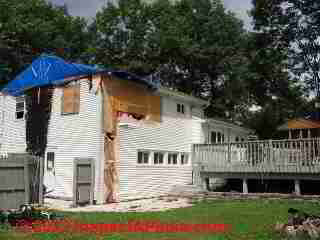
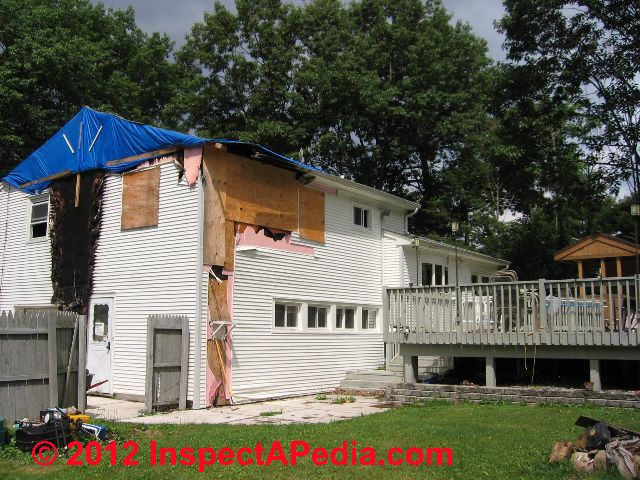
Here are photos and examples of the cause and effects of a chimney fire traced to an unattended woodstove.
Steps to prevent a chimney fire from a fireplace, woodstove, or woodstove or fireplace insert safety include making sure that your metal chimney or "flue" is safe.
"Safe" means clean, properly constructed and installed, using proper materials and proper fire clearances.
InspectAPedia tolerates no conflicts of interest. We have no relationship with advertisers, products, or services discussed at this website.
Fireplace Safety Advice from the US Consumer Product Safety Commission - US CPSC Document 5047 - expanded
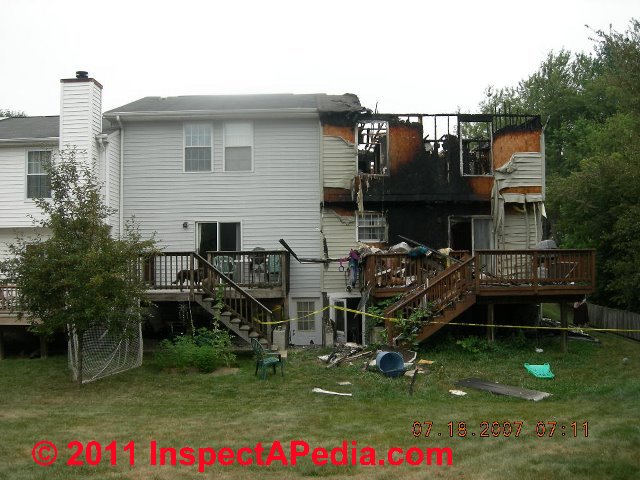 If You Have A Chimney Fire [or any other house fire] Here is What to Do
Know what to do in the event of a chimney fire:
- Get everyone out of the building.
- Call the fire department from a cellphone or neighbor's telephone.
- If you can safely re-enter the building and access the fireplace or wood or coal stove without becoming trapped in the building:
- Close down the combustion air supply to the woodstove or coal stove. If you have a fireplace that has glass firedoors, close them.
- If there is a manual flue damper in the wood stove or coal stove flue vent connector (the stackpipe between the stove and the chimney), close it.
- If you have a chimney fire extinguisher device put it into the woodstove or fireplace or coal stove. Chimflex™ sells a chimney fire extinguisher "stick" that can be ignited and placed "alongside the fire" in a fireplace or woodstove to attempt to suppress a chimney fire.[5] However keep in mind that the fire is in the chimney, not the woodstove or fireplace.
Watch out: be sure to follow the chimney fire extinguisher device manufacturer's instructions or you may make matters worse. - If you have a dry chemical fire extinguisher (recommended for anyone using a woodstove, coalstove or fireplace, use it to extinguish the fire in the fireplace or woodstove.
- While waiting for the fire department, if you have access to a garden hose, use it to wet down the roof surfaces to reduce fire spread.
The US CPSC offers some succinct advice to avoid having a costly and dangerous house fire or an unsafe gas leak hazard. Consumer Product Safety Commission Metal Chimneys: Safety Alert CPSC Document #5047 [7]. We have added to the original CPSC information. For a succinct pamphlet on chimney and woodstove safety see
this CHIMNEY & WOODSTOVE FIRE SAFETY CODE Information Sheet [PDF] from Vermont.
Before Using a Wood Stove, Coal Stove, or Fireplace Insert: Safety Checks
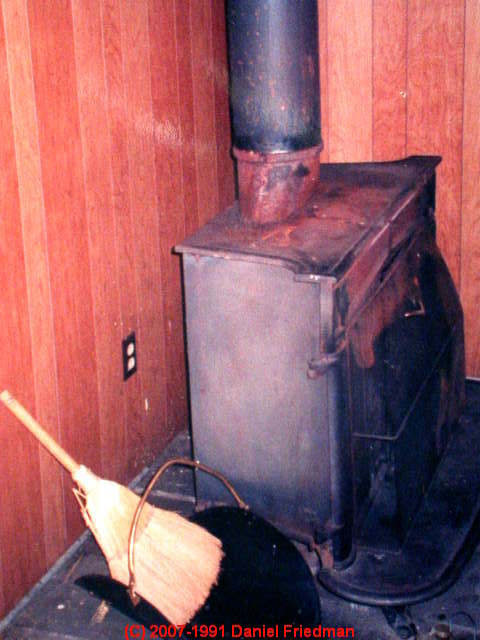
Details about wood stove choices, installation, inspection, repair and safety are now
at WOOD STOVE OPERATION & SAFETY.
Excerpts are below.
[Before using your wood stove, coal stove in the coming or current heating season] the US Consumer Product Safety Commission [since 1983 has] strongly urged you, if you have a [wood stove or coal stove] or fireplace connected to a metal chimney, to check for any damage that may have occurred in the past heating season.
[Click to enlarge any image]
Even when the heating appliance is properly installed, people with both metal and masonry chimney systems should
frequently check the chimney for creosote deposits, soot build-up or physical damage. Details are
The US Consumer Product Safety Commission advises owners of metal woodstove or fireplace insert chimneys to:
- Be sure that the chimney and stove pipe were installed correctly in accordance with the manufacturers' recommendations and local building codes. If there is any doubt, a building inspector or fireman can determine whether the system is properly installed.
- Have the chimney checked routinely by a chimney "sweep" at least once a year, and more frequently if a stove is heavily used (for example, if it's used as a primary heat source for the home).
- Check air intake and flue damper operation: Check that the chimney flue damper and/or wood stove or coal stove air intake damper can be operated properly. While checking a flue damper you may get a clue that the flue is heavily coated with creosote if you can no longer move the damper freely.
Watch out: if the incoming combustion air cannot be shut down because of leaky woodstove or coal stove gaskets or other damage, the coal stove, woodstove, or pellet stove is unsafe as its burn-rate cannot be regulated.
See DAMPERS & DRAFT REGULATOR TYPES - Always operate your appliance within the manufacturers' recommended temperature limits. Too low a temperature increases creosote build-up and too high a temperature may lead to a fire. Chimney temperature monitors are available and should be used.
- Make sure that your home has working smoke detectors properly installed and located
- Make sure that your home has appropriate fire extinguishers, located by the home exit doors, and of an appropriate size and type if you use a fireplace or woodstove.
If you have had a fire or other safety problem with your chimney, please provide this information to the Commission by calling the Commission's toll-free Hotline 800-638-CPSC.
Research
- Isenhour, Jerry E., Sr., Chairman James P. Brewer Ashley Eldridge P.C. Luter III, David S. Johnston, CHIMNEY FIRES: CAUSES, EFFECTS & EVALUATION [PDF] (2007) Chimney Safety Institute of America 2155 Commercial Drive Plainfield, Indiana 46168 (317) 837-5362 Fax: (317) 837-5365 www.csia.org - retrieved 2021/05/19 original source: https://www.csia.org/uploads/9/0/7/3/90732795/chimney_fires_white_paper.pdf
...
Continue reading at CREOSOTE FIRE HAZARDS or select a topic from the closely-related articles below, or see the complete ARTICLE INDEX.
Or see these
Recommended Articles
- CHIMNEY CHASE FIRE
- CHIMNEY FIRE REPORT & chimney fire safety advice: Vista Fire Department, [PDF]
- FIREPLACE DAMAGE & UNSAFE HEARTHS - fireplace and hearth hazards that can be found by visual inspection
- OIL BURNER ROARING NOISE
Suggested citation for this web page
CHIMNEY FIRE ACTION / PREVENTION at InspectApedia.com - online encyclopedia of building & environmental inspection, testing, diagnosis, repair, & problem prevention advice.
Or see this
INDEX to RELATED ARTICLES: ARTICLE INDEX to CHIMNEYS & FLUES
Or use the SEARCH BOX found below to Ask a Question or Search InspectApedia
Ask a Question or Search InspectApedia
Try the search box just below, or if you prefer, post a question or comment in the Comments box below and we will respond promptly.
Search the InspectApedia website
Note: appearance of your Comment below may be delayed: if your comment contains an image, photograph, web link, or text that looks to the software as if it might be a web link, your posting will appear after it has been approved by a moderator. Apologies for the delay.
Only one image can be added per comment but you can post as many comments, and therefore images, as you like.
You will not receive a notification when a response to your question has been posted.
Please bookmark this page to make it easy for you to check back for our response.
Our Comment Box is provided by Countable Web Productions countable.ca
Citations & References
In addition to any citations in the article above, a full list is available on request.
- In addition to citations & references found in this article, see the research citations given at the end of the related articles found at our suggested
CONTINUE READING or RECOMMENDED ARTICLES.
- Carson, Dunlop & Associates Ltd., 120 Carlton Street Suite 407, Toronto ON M5A 4K2. Tel: (416) 964-9415 1-800-268-7070 Email: info@carsondunlop.com. Alan Carson is a past president of ASHI, the American Society of Home Inspectors.
Thanks to Alan Carson and Bob Dunlop, for permission for InspectAPedia to use text excerpts from The HOME REFERENCE BOOK - the Encyclopedia of Homes and to use illustrations from The ILLUSTRATED HOME .
Carson Dunlop Associates provides extensive home inspection education and report writing material. In gratitude we provide links to tsome Carson Dunlop Associates products and services.
 | HOME | ABOUT | ASK a QUESTION | CONTACT | CONTENT USE POLICY | DESCRIPTION | POLICIES | PRIVACY | |
| © 2024 - 1985 Publisher InspectApedia.com - Daniel Friedman | |||||||||