
InspectAPedia® FREE Encyclopedia of Building & Environmental Construction, Diagnosis, Maintenance & Repair |
Question? Just ask us! InspectAPedia
|
 Backup Electrical Generators
Backup or standby electrical generator types, sources, transfer switches, wiring guides, + car power inverters, DC to AC Converters
- POST a QUESTION or COMMENT about backup electrical generators for home use and backup generators, isolation switches, electrical wiring installation, inspection, diagnosis, & repair
Guide to backup electrical generators & other emergency electrical power sources for residential & light commercial use.
This article series discusses the use of emergency generators for electrical power backup at residential properties.
We describe how to determine how much back up generator capacity or power in watts you'll require.
We explain how to hook up or wire an electrical generator at a building, and we describe the transfer switch or isolation switch necessary to avoid dangerous electrical shock or fire hazards. We include other safety warnings where generators are used. We describe electrical grounding and other wiring & control or installation procedures backup electrical generators.
InspectAPedia tolerates no conflicts of interest. We have no relationship with advertisers, products, or services discussed at this website.
Guide to Installing & Using Emergency & Temporary Electrician Power Generators, Switches, & AC-DC Power Converters
 Here we describe several methods for obtaining temporary or emergency electrical power from a car, RV or other 12-V or 24-V vehicle or system.
We include a list of manufacturers and sources for backup generators for residential & commercial use and a list of manufacturers of DC - AC power converters, inverters, or transverters that permit using a car or other vehicle to power small electrical devices & tools.
Also discussed here: How to Connect or Hook up a backup electrical generator. Isolation Switches, Transfer Switches, Double-Throw Switches to Prevent Backfeeds, Fires, Electrical Shock.
Double-throw switches used as transfer switches for electrical generators. Electrical Grounding Requirements for Back-up Electrical Generators.
High Capacity Commercial & Automatic Backup Electrical Generators & Automatic Transfer Switches. Use a car or truck as an emergency electrical generator for charging cell phones & operating tools.
Sources of 12-volt to 120-volt DC to AC power converters & inverters. Sources of Emergency & Temporary-Use Electrical Generators & Typical Backup Generator System Costs.
Article Series Contents
- BACKUP ELECTRICAL GENERATORS - home - you are on this page
- ELECTRIC GENERATOR CAPACITY REQUIREMENTS - separate article
- HOW TO WIRE UP an ELECTRIC GENERATOR
- ISOLATION SWITCH REQUIREMENTS
- DOUBLE THROW TRANSFER SWITCH for BACKUP GENERATORS
- INTERLOCK KITS for BACKUP GENERATORS
- AUTOMATIC TRANSFER SWITCHES
- ELECTRICAL GROUNDING for GENERATORS
- PORTABLE ELECTRIC GENERATOR CLEARANCE DISTANCES
- CAR or TRUCK 120V GENERATORS
- GAS PRESSURE FLOW INADEQUATE
- GAS SUPPLY for ELECTRIC GENERATORS
- HOW TO TURN ON / OFF a BACKUP GENERATOR
- MANUALS for BACKUP GENERATORS
- WHERE TO BUY of 12-volt to 120-volt DC to AC power converters & inverters
- WHERE TO BUY ELECTRICAL GENERATORS
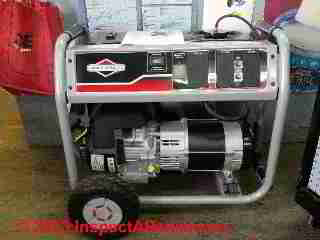
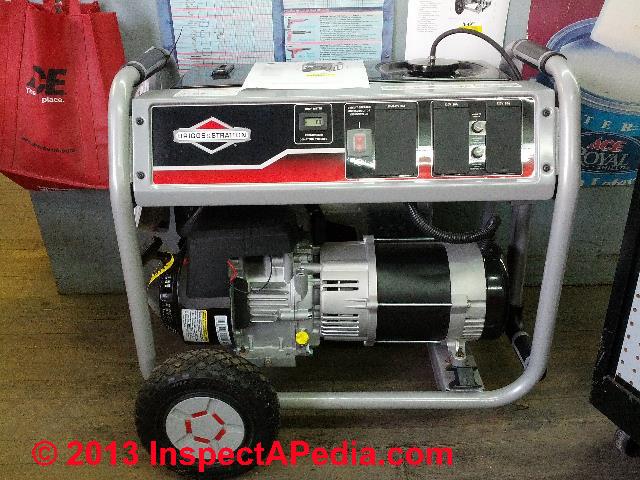
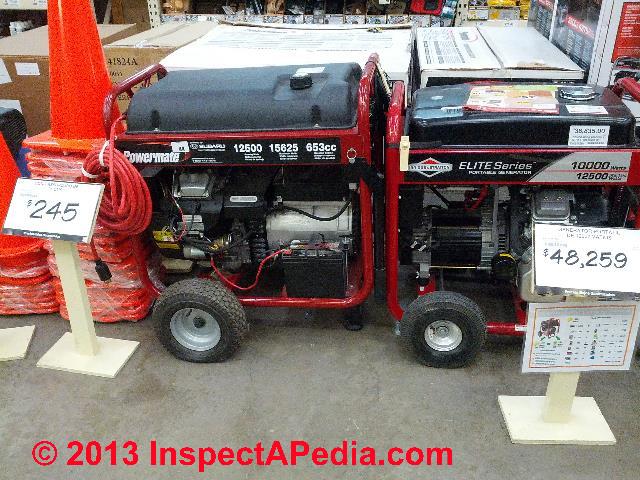
Our page top photo illustrates a Briggs & Stratton portable generator capable of delivering 5000 watts with both 120V and 240V electrical output available; This unit is able to run for 10 hours continuously at 50% load. Photo courtesy of Davies Hardware, Poughkeepsie, NY.[12] Similar models found at building suppliers range in capacity with common sizes in the 10,000 - 12,500 watt range for residential use.
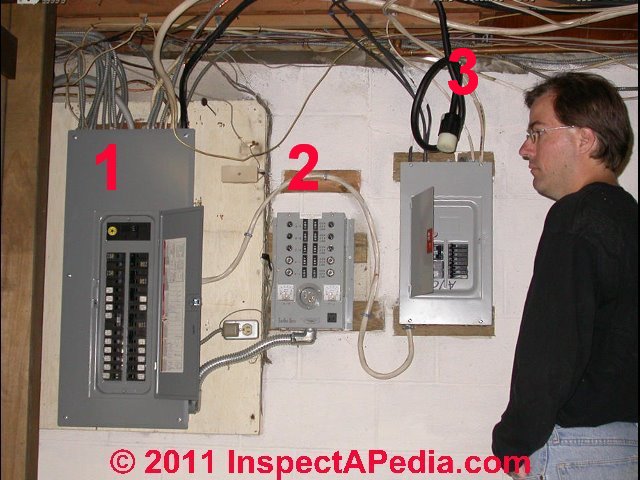
At above left we illustrate an electrical transfer switch required for safe connection of a backup generator to a building's electrical system.
How to Connect or Hook up a backup electrical generator
 A common exception to the practice of using only a single power source at an electrical sub panel is the provision for backup electrical generator power that feeds an electrical sub panel (or panel) that contains critical electrical circuits for a building (such as heat, refrigeration, communications equipment, medical equipment).
In that case indeed there are two electrical power sources that in a sense "feed" an individual panel or sub panel but only one power source can be connected at a time. Typical instructions for a backup home electrical generator system include variations on the following safety warning:
Watch out: Emergency backup electrical generators produce 120V and 240V which may cause fatal electrical shock if precautions are not followed.
DO NOT under any circumstances connect your electrical generator to any circuit or receptacle that is receiving electrical power (home, office, etc) from any other sources as this is likely to result in a fire and damage all electrical systems and could also shock someone working on the system.
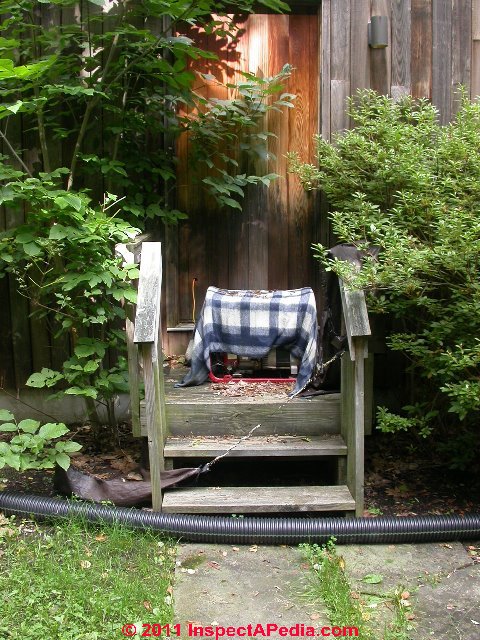
Our auxiliary electric generator photo at left shows a backup "home" generator that the owner had set up to keep a basement sump pump working. Some owners connect an extension cord to the generator's electrical supply receptacle and connect the other cord end to a tool or appliance - which may be safe
. But using that same extension cord to "back-feed" a home electrical circuit without an isolation switch is unsafe and should not be done.
Other key safety warnings include the warning that the backup generator should not be operated indoors nor in an enclosed area - there are fire and also potentially fatal carbon monoxide hazard risks.
Note that other safety precautions also apply - be sure to see the instructions provided with the generator.
Electric Generator Isolation Switches,
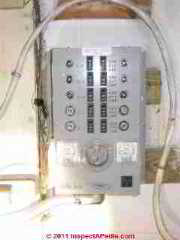 Transfer Switches, Double-Throw Switches to Prevent Backfeeds, Fires, Electrical Shock
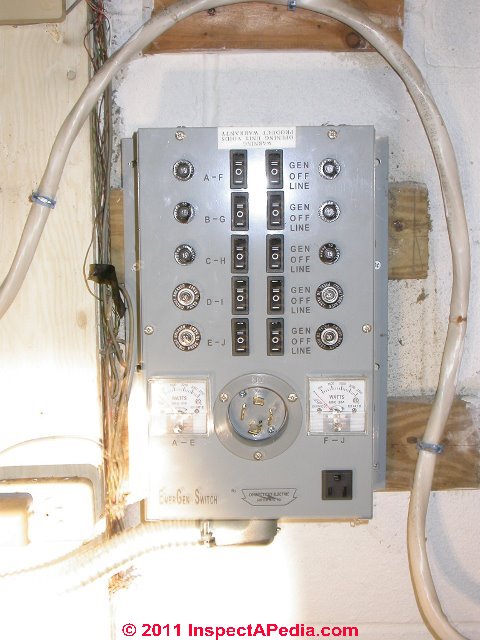
Auxiliary or Backup Electrical Generators & Isolation Switch Requirements
Key in making that a safe installation is the use of an isolation switch that switches to provide an electrical power feed into the panel (or sub panel) from EITHER the electrical service entry from the utility company OR from the backup electrical generator.
An isolation switch, also referred to in many sources as a "transfer switch" is a double-throw switch that changes electrical connections between two alternative sources.
This is an "exclusive OR" switch that flips the panel power feed between the two sources but never allows both to be "on" or "connected" to the sub panel simultaneously. The design prevents simultaneous electrical power feed from two sources.
Our photo (left) shows a close-up view of the same isolation switch in our earlier picture. [Click any of our images to see an enlarged, detailed version]. You'll see that each individual electrical circuit is switched between "Generator", "Off", and "Line" voltage.
An isolation switch allows only one electrical power source to be connected to feed a sub panel at a given time.
This avoids, for example, the hazard of shocking electrical workers who might be repairing the main electrical service.
As an example of an isolation switch set-up for an auxiliary electrical power generator hookup at a private home, our photo (above left) shows the backup generator hookup that provides limited electrical power for critical building circuits during a power outage from the electrical utility.
Use of Double-throw switches used as transfer switches for electrical generators
As pointed out by various sources including Janet Lewis, Chief Electrical Inspector for Washington State,
Listed double-throw "Enclosed Switches" that have been investigated for switching a common load from a normal supply to an optional standby system are marked "Suitable For Use In Accordance With Article 702 of the National Electrical Code" and acceptable for load transfer use on optional standby systems only.
All other approved transfer switches are listed as "Transfer Switches" and marked as suitable for the intended use (such as Service Equipment, Emergency Systems, Optional Standby Systems, Automatic or Non-Automatic Transfer).
Question: Can I Hook Up Two Power Sources to One Electrical Panel?
Is it possible to connect two sources of Electricity to one Sub-Panel? - Muhammad K., Jordan
Reply: Use an isolation switch or "transfer switch" to avoid simultaneous (and unsafe) electrical power feeds to an electrical panel or sub panel - use backup electrical generator hookups as an example
 By "possible to connect two sources of Electricity to one Sub-Panel" I presume you don't mean is it physically possible to connect two power sources to a single electrical panel since that would be trivial to accomplish;
Rather I presume you mean is it acceptable practice or is it "safe" to connect multiple power sources into a single electrical panel or sub-panel.
The basic answer is no. In general it is very dangerous to have multiple sources of power into a single panel or sub panel because of the possibility of back feeding and shocking someone who thinks power is off from a given source.
So we don't hookup simultaneous live electrical power sources to a single electrical sub panel or main panel.
We do not hook up multiple electrical power sources to a single electrical sub panel without using an isolation switch.
In our photograph of an isolation switch hook-up (above left), the main electrical panel
(1) is at left. In the photo center is an isolation switch
(2) that allows the homeowner to switch individual circuits from being powered either by the main electrical panel's service entry mains or by an electrical generator (located outdoors) that is connected to the isolation switch by a removable plug shown hanging on the wall
(3). You can see the receiving plug receptacle at the bottom center of the isolation switch (2).
The sub panel shown at right (next to our client) was an addition to the original electrical system to support central air conditioning and is not part of this discussion.
Comment: on installing pre-wired automatic transfer switches for home backup generator system use
 2016/08/07 NHFireBear said:
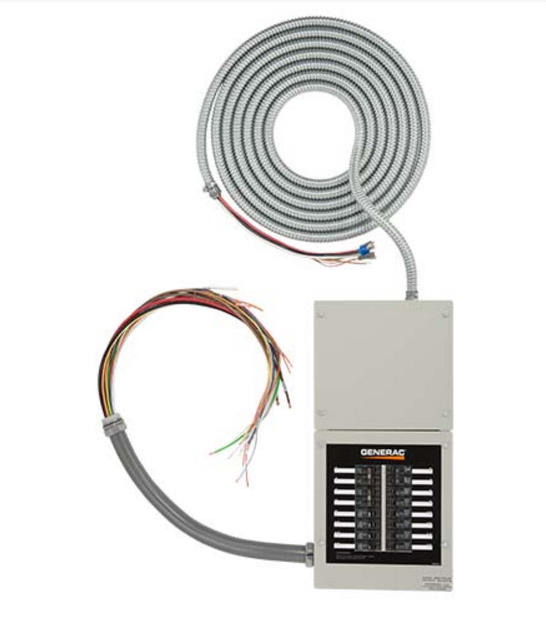
Comment for those adding transfer switches: When I installed Generac Guardian automatic transfer switches with panels at four different locations, and inspected numerous others, they each came with a pre-wired panel of 8 or more breakers.
Each branch has a color-coded wire (12AWG) threaded through a short, liquid-tight conduit.
The idea is that you open a knock-out hole in the existing panel and attach the conduit and wires.
You then select which existing branch circuits you want to have powered via the transfer panel (heating/cooling, pumps, lights, etc).
All you need to do is remove the wire from the existing breaker and attach it (using a wire nut) to the wire leading to the corresponding breaker in the transfer panel.
There are also three larger conductors that you run to the neutral and the two "hots" (on a 240v, single-phase feed) via a suitable two-pole breaker (e.g., 65 Amps for a 16kw generator). This breaker "feeds" the normal line voltage to the circuits in the transfer panel.
You then remove the abandoned breakers and insert a blank cover in the panel cover for each breaker slot, or rearrange the remaining breakers so that the open spaces are adjacent to each other and put the blank plates over those slots.
Don't forget to re-label the branch legend on both of the panel covers, as required by code.
Some people also run another feeder (e.g., 30 amps) from the transfer panel to one or more additional subpanels with the "backup" circuits individually protected and switched there. - NH Fire Bear 2016/08/07 is a regular contributor of technical information at InspectApedia.com [ Ed.]
Reply:
Thanks NH FireBear. An added comment worth noting for readers is that transfer switches for backup generators should be installed by a trained, licensed electrician, or where DIY wiring is permitted, the installation needs to be done with a building permit and with the required inspections.
The risks of a mistake include, beyond the obvious dangers of shock or fire for the installer or the building, risks of back-feeding live power into the local electrical grid, risking shocking an electric-company worker who's working on restoring power after a power loss.
Shown above is a Generac automatic transfer switch intended for use with backup generators. Generac, a home backup generator provider, supplies transfer switches such as the Generator switch discussed here.
- Generac Power Systems, Corporate Headquarters, S45W29290 Wisconsin 59 Waukesha, WI 53189, USA, Tel: 1-888-436-3722 Website: http://www.generac.com/all-products/transfer-switches/home-backup
Electrical Panel Interlock Kits for Backup Generators
This discussion of an alternative to transfer switches has moved to its own page
at INTERLOCK KITS for BACKUP GENERATORS
Electrical Grounding Requirements for Back-up Electrical Generators
According to ASHI home inspector Bob O'Connor, ... "If there is a ground conductor connected to the grounding electrode from the emergency power source [the generator], there must be a sign identifying the emergency and the normal ground connections posted at that location. "
O'Connor also warns that the generator must be located where exhaust fumes cannot enter the building (a carbon monoxide hazard), and about unsafe storage of fuel containers for the backup generator.
Clearance Distances for Backup Generators
On 2018-02-17 by Jim asked: Is there a code for clearance of an automatic whole house generator ...
Is there a code for clearance of an automatic whole house generator from an a/c condenser? Maybe at least the exhaust end?
This Q&A were posted originally at CLEARANCE DISTANCE, HVAC
On 2018-02-18 by (mod) - code for clearance distance of a backup generator from an a/c condenser?
Fair question, Jim, not one I find in HVAC installation guides since the electrical generator is a pretty-specific device. Codes and guidelines can't anticipate everything that might be installed around a building, so usually more general constraints are given.
Clearance distances for electrical generators used at private homes are specified for the following reasons:
Proper air flow around the generator for proper generator operation
Fire safety - clearance from combustibles
Carbon monoxide fatal poisoning safety - clearances from building openings like windows and doors
Typical residential electrical generator minimum clearance distances
- Do not use or operate a portable generator indoors - there is risk of fatal carbon monoxide poisoning
- Install the generator within 1/2" of dead level and on a suitable pad or gravel base as recommended by its manufacturer
- Install the generator so as to minimize the necessary natural gas (NG) or propane (LPG) piping distances. Longer piping distances may require larger diameter pipe and even a different regulator.
- Do not put the generator under a deck or in any other location or structure that would restrict air flow - some details are below.
You can install a generator under a deck or roof provided it meets required clearances such as in the Generac sources below:
At least 5 ft. (1.52m) above the generator
At least 3 ft (.91m) on the generator's sides and front
at least 18" (457mm) at the generator's back - 60" (1524mm) from closest edge of the generator to the nearest edge of a window or door
- 60" from top of generator to closest edge of roof eaves or overhang, or for some smaller units, 48" from the top of the generator to the roof eaves, soffit, or other overhang
- 36" from the closest edge of the generator side to any obstruction
- 36" working clearance at the front of the generator
- 18" minimum to the building wall (special allowance according to Generac) or 60" (recommended in various sources)
- Do not block air inlets or outlets by anything: grass, leaves, snow. Use a wind-break if drifting snow can block the generator's air flow.
- Do not install an electric generator where it will be sprayed with water from lawn sprinklers, irrigation systems, aerobic septic sprays nor where it will be wet by roof drainage from overflowing gutters or from a downspout
- Do not install a generator in a low spot subject to flooding or standing water; use high ground. Never operate a generator that's flooded or that has been flooded.
- Do not install an electric generator over or blocking access to underground utilities like gas, electric, or water service entries
- Do not install a generator in such tight spaces that there is no access room for clearance (see NFPA 37 below).
- Do not install an electric generator with its air outlets would face into prevailing winds. Face the generator's air inlet openings towards the direction from which prevailing winds blow.
- Review local building and plumbing and fire codes and regulations as your local laws may impose additional or different generator installation requirements.
Sources:
- NFPA 37 Section 4.1.4 Engines Located Outdoors
NEW INSTALLATION GUIDELINES for GENERAC STATIONARY AIR-COOLED 8, 10, 12, 14, 16, 17 & 20KW GENERATORS [PDF] SCPDC, South Central Planning & Development Commission, 5058 West Main St. Houma, LA 70360 Phone (985) 851 – 2900 retrieved 2018/02/17, original source: http://www.scpdc.org/wp-content/uploads/generator-installation.pdf
In that document you'll see nothing about A/C compressors but other recommended clearance distances from windows and from combustibles but concern for fire safety and for avoiding dangerous or fatal carbon monoxide hazards. . - GENERAC® 8-22 kW AIR-COOLED GENERATORS INSTALLATION GUIDELINES [PDF] (2014)
The installation of a backup electric generator must comply strictly with NFPA 37, NFPA 54, NFPA 58 and NFPA 70 standards. We give excerpts from NFPA 37 below.
NFPA 37, Section 4.1.4, Engines Located Outdoors. Clearance Distances
Engines, and their weatherproof housings if provided, that are installed outdoors shall be located at least 5 ft. from openings in walls and at least 5 ft. from structures having combustible walls. A minimum separation shall not be required where the following conditions exist:
1. The adjacent wall of the structure has a fire resistance rating of at least 1 hour.
2. The weatherproof enclosure is constructed of noncombustible materials and it has been demonstrated that a fire within
the enclosure will not ignite combustible materials outside the enclosure.
You may find closer distances allowed by the installation manual for specific generators including Generac who in some documents supports clearance to combustible walls of as little as 18" - again no mention of A/C compressors.
The following quote is from a Generac brochure and is pretty standard, notwithstanding smaller distances I've just cited.
Allow at least five feet of clearance on all sides of the generator when operating. - source: Generac, "Portable Generators" [brochure, PDF], retrieved 2018/02/17, original source: Generac Power Systems, Inc.S45 W29290 Hwy. 59, Waukesha, WI 531891-888-GENERAC (1-888-436-3722)0180710SBY Rev. B 08/2014
Gas Supply for LPG or Natural Gas Backup Generators
This topic is now found at GAS SUPPLY for ELECTRIC GENERATORS
Examples of High Capacity Commercial & Automatic Backup Electrical Generators & Automatic Transfer Switches
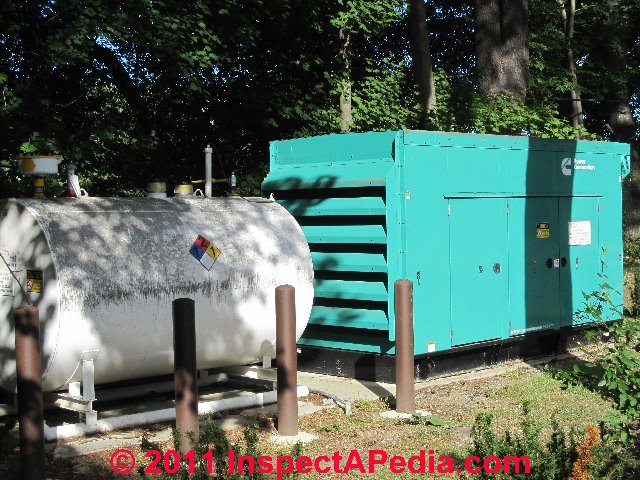
The commercial backup electrical power generator shown at left includes its own fuel storage tank (at left in the photo).
In the event of a power failure the system may start automatically and the necessary isolation switch may also be switched automatically to keep critical equipment in operation.
More information about backup and alternative electrical power systems and how they are connected is
and WIND ENERGY SYSTEMS,
and at WIND TURBINES & LIGHTNING
True Installation Cost for Backup Electrical Generators Must Include Fuel Storage, Transfer Switches, Electrical Circuits, & Flood or Disaster Protection
Watch out: as we describe at Step 8. Rebuild and Flood proof, locating a backup generator onto upper building floors or the rooftop may not be enough to assure that the system can continue to operate during times of area flooding.
The fuel supply and isolation or transfer switches must also be located where they are protected from flood waters.
A significant portion of the cost of installing a backup generator system will involve the provision for fuel storage, transfer switches, and the establishment & connection of the system to critical electrical circuits in the building.
Steps to Turn a Backup Generator On or Off
Question:
Del said:
I just bought a house with generator and transfer switch. I am wondering if someone can outline steps to switching from grid to generator and back.
Specifically I am looking for order of steps. (Ex. Start generator, connect generator, flip transfer switch) to ensure no surges and safety to the power grid. I am curious if flipping the switch while grid power is on can cause damage. - 2018/02/01
Reply:
Watch out: The installation and operation manual for your portable or permanently-installed backup generator will have explicit instructions that you should follow, since the manufacturer may have steps in mind that are not in my general answer below.
Be sure to take a look as there are life-safety concerns involved in any electrical system operation.
In general that if you have a correctly installed transfer switch, it's an either-or switch.
That is your electric panel is connected either to the incoming electrical service from the utility company OR a portion of its circuits are connected to the generator supply and the rest of the panel is considered offline.
Summarizing: the purpose of the transfer switch is twofold, one is to switch the power source for critical circuits out of the main electric panel service entry source and on to the generator as the electricity source for just those critical circuits.
The second purpose that transfer switches serve is preventing you from back feeding power from your generator into the electric panel and out through the entry mains where you could shock or electrocute a line worker who's working outside to restore power.
General Procedure to Turn ON a Backup Electrical Generator using a Manually-Operated Transfer Switch
- At the main electrical panel:
Optional: turn off the main switch in the main electrical panel. This manually isolates your whole home from the electrical grid, doing a favor for the utility company by reducing the power surge that the grid experiences when everyone's power is turned back on at once. - Connect the generator:
For a generator that is not permanently connected to the transfer switch, connect the generator to the transfer switch power-in receptacle. Usually this is a special electrical receptacle on or close to the transfer switch itself. The generator's output power cord is connected to that receptacle. - At the transfer switch box:
Turn off the circuit breakers in the transfer switch box - Start the generator.
If your portable generator was in storage you'll usually need to move it outdoors to a sheltered location close-enough to connect its power cord to the transfer box before you start the engine. - Run the generator to let it get up to speed and to normal operating temperature.
Inspect the generator to make sure it's operating safely, for example that it is not sending exhaust fumes into the building (risking fatal carbon monoxide poisoning), then - Flip the transfer switch to the Generator position
- Turn on the sub breakers in the transfer box.
Doing this 1 by 1 minimizes load surge on the generator
General Procedure to Turn the Backup Emergency Electrical Generator OFF
- At the transfer switch box:
turn the transfer switch back to Utility Power (or an equivalent label that means you are disconnecting from the generator and connecting those circuits back to the utility company's system) - At the main electrical panel:
turn on the main circuit breaker if you previously turned it off. Turn on any other circuit breakers that you'd turned off. - At the generator:
turn off the backup generator motor - Disconnect the backup generator power cord
from the transfer box - Store the backup generator
Return the backup generator to its storage location - Re-Fuel the backup generator?
If your generator uses a refillable fuel canister, you probably want to assure that the fuel tank or canister (e.g. LP gas) has been re-filled promptly to be ready for the next use.
Procedure for Using a Backup Electrical Generator with an Automatic Transfer Switch
Automatic transfer switches, also referred to as "universal" transfer switches, will automatically switch the pre-selected electrical circuits over to the backup generator in the event of a loss of electrical power from the utility company.
If you have such a system installed you should not have to take any steps to provide backup electrical power when the utility's power system is down.
However all backup electrical generator systems should be tested periodically to assure that the system is in good operating condition and available for use when needed.
Backup Electrical Generator Installation & Operation Manuals
Watch out: all of these devices and their manuals contain instructions that, if not strictly complied with, will result in serious personal injury, including death, in addition to property damage.
- BRIGGS & STRATTON STANDBY GENERATOR INSTALLATION & START-UP MANUAL [PDF] (2015), Briggs & Stratton Power Products Group, LLC, POB 702, Milwaukee WI 53201, retrieved 2018/02/02, original source: https://www.norwall.com/product_pdfs/8023_40517_instl_2015.pdf
- Champion PORTABLE GENERATOR OWNERS MANUAL & OPERATING INSTRUCTIONS [PDF] (2016) Champion Generators (made in China), 12039 Smith Ave.
Santa Fe Springs CA 90670
USA / 1-877-338-0999
www.championpowerequipment.com Email: Customer Service
tech@championpowerequipment.com
11500 Starting Watts / 9200 Running Watts, Elecric Start. - CUMMINS ONAN BACKUP GENERATOR INSTALLATION MANUAL [PDF], Models: C13N6H, C71N6H, C20N6H, C20N6HC, Cummins Power Products, Offices world-wide.
Argentina: 0800 12 26 467
Australia: 1-300-CUMMINS (1-300-286646)
Brazil: 0800 CUMMINS (0-800-2866467)
China: 400-810-5252 or (+86) 400-810-5252
India: 1-800-210-2525
USA Tel: 1-800-286-6467
Europe - UK, Ireland, Germany, France and The Netherlands: 00-8000-286-6467
Europe - All other areas: +44 (0) 1327 886464
Mexico: 01-800-CUMMINS (01-800-286-6467)
New Zealand: 0-800-CUMMINS (0800-286646)
retrieved 2018/02/02, original source: https://www.norwall.com/product_pdfs/8895_rs20a_install_2_2017.pdf - CUMMINS ONAN BACKUP GENERATOR OPERATION MANUAL [PDF], Models: C13N6H, C71N6H, C20N6H, C20N6HC, Generac Power Systems, Inc.,
retrieved 2018/02/02, original source: https://www.norwall.com/product_pdfs/8895_rs20a_install_2_2017.pdf - EATON 9-22 kW STANDBY GENERATOR MANUAL [PDF] This is a Generac generator sold under Eaton brand.
- Generac 7 kW POWERPACT GENERATOR INSTALLATION GUIDELINES [PDF] (2014)
Generac Power Systems, Inc., POB 297, Whitewater WI 53190 USA, Website: WWW.GENERAC.COM, Tel: 888-436-3722
Para español , visita: http://www.generac.com/service‐support/product‐support‐lookup
Pour le français, visiter : http://www.generac.com/service‐support/product‐support‐lookup - GENERAC 7, 10, 13 kW AUTOMATIC STAND-BY GENERATORS INSTALLATION & OPERATION MANUAL [PDF] (2005) Models: 005251 (6 kW NG, 7 kW LP)
005252 (9 kW NG, 10 kW LP)
005253 (13 kW NG, 13 kW LP)
005254, 005255 (15 kW NG, 16 kW LP)
- GENERAC® 8-22 kW AIR-COOLED GENERATORS INSTALLATION GUIDELINES [PDF] (2014) Generac Power Systems, Inc.,
S45 W29290 Hwy. 59
Waukesha, WI 53189 USA Tel:
1-888-GENERAC (1-888-436-3722)
Website: generac.com - GENERAC AUTOMATIC TRANSFER SWITCH MANUAL [PDF]
- GENERAC INSTALLATION GUIDELINES FOR STATIONARY STANDBY INDUSTRIAL GENERATORS [PDF]
- Generac QUIET TEST GENERATOR INSTALLATION INSTRUCTIONS [PDF]
- GUARDIAN GENERATOR TRANSFER SWITCH INSTALLATION MANUAL [PDF] This is a Generac generator brand sold at Home Depot stores and elsewhere.
Generac Power Systems, Inc., POB 297, Whitewater WI 53190 USA, Website :www.guardiangenerators.com - GUARDIAN AUTOMATIC STANDBY GENERATORS INSTALL & OWNERS MANUAL [PDF] 7, 10, 13 and 16kW Air-cooled, Models: 005240, 005280 (6 kW NG, 7 kW LP) 005241, 005281 (9 kW NG, 10 kW LP) 005242, 005282 (13 kW NG, 13 kW LP) 005243, 005244, (15 kW NG, 16 kW LP) 005283, 005284
- KOHLER POWER SYSTEMS RESIDENTIAL GENERATOR INSTALLATION MANUAL [PDF] Models 15RESA & 30 RESA, KOHLER CO. Kohler, Wisconsin 53044
Phone 920-565-3381, Fax 920-459-1646
Tel: 1-800-544-2444
KohlerPower.com
Kohler Power Systems Asia Pacific Headquarters 7 Jurong Pier Road Singapore 619159 Phone (65) 6264-6422, Fax (65) 6264-6455 retrieved 2018/02/02 original source http://www.kohlerpower.com/onlinecatalog/pdf/tp6725.pdf - Reliance Controls, PRO/TRAN 2 MANUAL TRANSFER SWITCHES IO MANUAL [PDF] (2000 - 2014) Reliance Controls Corporation / 2001 Young Court / Racine, Wl 53404 USA Tel: (800) 634-6155 retrieved 2021/09/21
- Reliance Controls ProTran MANUAL TRANSFER SWITCHES Q-SERIES INSTALLATION INSTRUCTIONS [PDF] (2005) Reliance Controls Corporation / 2001 Young Court / Racine, Wl 53404
USA Tel: (800) 634-6155 retrieved 2019/02/08 original source: http://www.reliancecontrols.com/Documents/Q%20Series%20Installation%20and%20Operating%20Instructions.pdf
Excerpt: Warning: Improper installation of this transfer switch could cause damage or personal injury by electrocution or fire. Installation must be performed by a qualified electrician in compliance with all applicable electrical codes - Reliance Controls, PRO/TRAN 2 MANUAL TRANSFER SWITCH INSTALLATION & OPERATION INSTRUCTIONS [PDF] (2014)
Manufacturers of Emergency & Temporary-Use Electrical Generators & Typical Backup Generator System Costs
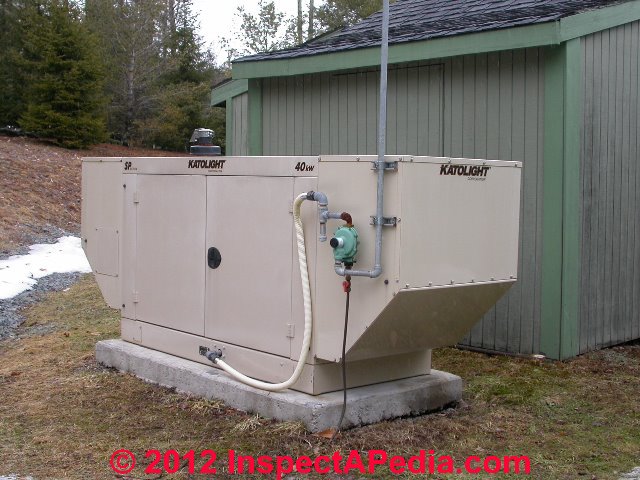 This article topic has moved to WHERE TO BUY ELECTRICAL GENERATORS
Here are all 41 brands of electrical generator brands & product sources listed by Electric Generators Direct whose list we found was longest: [10].
Asco Electrical Generators, Baldor Electric Generators Briggs & Stratton Electrical Generators, Camco Electrical Generators, Century Electrical Generators, Classic Electrical Generator Accessories, Conntek Electrical Generators, Cummins Onan Electrical Generators, DeWalt Electrical Generators, DynaGen Electrical Generators, Generac Electrical Generators, GenTran Electrical Generators, Gillette Electrical Generators, Honda Electrical Generators, Honeywell Electrical Generators, IMD LLC Electrical Generators, JohnDow Industries Electrical Generators, Katolight Corporation, Protected Home Electrical Generators, Kohler Electrical Generators, PowerBoss Electrical Generators, PowerMate Electrical Generators, Praitiac Electrical Generators, Reliance Electrical Generators, Scepter Electrical Generators, Seafoam Electrical Generators, Slime Electrical Generators, StaBil Electrical Generators, Subaru Electrical Generators, TechMate Electrical Generators, TruFuel Electrical Generators, U.S. Wire & Cable Electrical Generators, Voltmaster Electrical Generators, Wagan Electrical Generators, Winco Power Systems Electrical Generators, Yamaha Electrical Generators
How Much Backup Generator Capacity do We Need?
In a separate article found at ELECTRIC GENERATOR CAPACITY REQUIREMENTS [live link just below] we give backup generator size requirements tables for both backup electrical generators for home or commercial use and for smaller car or truck AC adapters.
Use a car, RV, truck or its battery as an emergency electrical generator for charging cell phones & operating tools
This discussion is now is a separate article found
at CAR or TRUCK 120V GENERATORS
Sources of 12-volt to 120-volt DC to AC power converters & inverters (power transverters)
This discussion is now is a separate article found
at WHERE TO BUY of 12-volt to 120-volt DC to AC power converters & inverters
Reader Comments, Questions & Answers About The Article Above
Below you will find questions and answers previously posted on this page at its page bottom reader comment box.
Reader Q&A - also see RECOMMENDED ARTICLES & FAQs
On 2020-11-22 - by (mod) - 10 gauge wire or do I need to use 8 gauge?
30A uses #10 copper wire.
Also see ELECTRICAL WIRE TYPES CODES USES
On 2020-11-19 by Kerry
Email
kclipper@atlanticbb.net
I am wanting to put in my reliance 30A transfer kit with outdoor power input for 6000w peak and 5500w running generator.
My kit includes the Pb30 box. I will need 35' of wire for the outlet and a 50' generator cable with L1430 connectors.
My question is can I use 10 guage wire or do I need to use 8 guage
Another question is what wire type for connection from panel to the outside outlet box mounted under my deck and do I need conduit. Can I use 10 guage for outlet and a. 10 or 8 guage for generator cord. Thanks for your help
On 2019-10-14 by Rufus
Hi Dan - In follow-up to my question regarding generators and furnaces, I will try to answer your questions.
First, I am new to generators, and have a 4000W gas generator (non-inverter) that has been in a box since Y2K that I am just unboxing now as I get a pigtail added to my natural gas furnace so that I could run it off a generator using just a cord (straight from generator to furnace for 2000 square foot home).
The comments regarding "dirty electricity" can be confusing to a newbie. It seems to mean two things to different people. Either (1), power that is inconsistent (either low volt variations, or surges caused by the generator 'hunting' when on lite loads ), or the sine wave that is formed by the generator itself.
My concern regarding the first (staying close to 120) is that my generator appears to have no volt meter, so I won't know what it is putting out. The power conditioner could give me piece of mind.
The second is, will sine wave corruption hurt the control boards in the furnace, or maybe even the thermostat (which I assume is on the same circuit as the furnace and gets stepped down by the furnace's transformer).
Maybe these concerns are much to do about nothing, and it is garbage in/out from things you can see/find on You-Tube, but some commentators on the pig tail set up claim you will fry your furance using that set-up. With everything becoming more computerized, it is hard for the unitiated to know if this is just well intentioned nonsense, or placement by folks trying to sell power conditioners, or a real concern.
I want to be able to run my furnace and fridge in a power outage, directly off cords, but want to feel I have a reasonable chance of not hurting them.
Regarding the need for a 4000W conditioner, that is me just thinking if I was going to buy something (assuming it is truly needed and effective, which is debatable) in the power conditioner category that I try to match the max output of the generator in case I want to for example run the furnace, a fridge, and a sump pump all at the same time and account for start up wattage etc.
If I can get away with a smaller conditioner according to someone in the know like you I would certainly do that. I recall seeing a 1800 being pushed by others, but as a newbie, my first thought was if your load was 2000 or 3000, does that either trip the conditioner or make it useless. I can include some YouTube comments and website links for further info, but don't want to inadvertently violate your posting rules.
Other people are really pushing either a power conditioner or that I need to trash the "old" (but never used) gas generator and get a new inverter one, which they say creates less problems in this area. Let me know what I can post regarding outside contents, and if I can provide more clarification. Thanks!
On 2019-10-13 by (mod) - "dirty electricity" ruining a furnace
Rufus
Thanks for the interesting question. I have not heard about "dirty electricity" ruining a furnace (though it can kill electronic boards) so I would appreciate any references or citations you can offer for review.
It is true that some electric motors will perform badly and might be damaged by unstable electrical power or low voltage delivery to the motor - not something that ought to be an issue with a lightly-loaded, adequately sized backup electrical generator with or without a power conditioner. I'm unclear why you'd need a 4000 watt power conditioner for a typical gas or oil fueled heating furnace.
Perhaps I'm missing something but ...
There are two electrical power consumers on a typical fossil-fueled heating furnace:
1. the oil burner (if it's oil fueled) motor or on a gas burner, low voltage gas valves
2. the blower motor in the air handler
A typical blower motor runs at about 2.3 Amps (120VA) - that's at most about 240 Watts.
A typical refrigerator compressor motor (the greatest power consumer in a refrigerator) is about 1/10 hp to 1/5 hp or about 75 watts - even a 2 HP commercial compressor is going to approach no more than about 1500 watts.
On 2019-10-13 by Rufus - Hooking up a portable gas generator (non-invertor) up to a furnace or refrigerator.
Hooking up a portable gas generator (non-invertor) up to a furnace or refrigerator.
So, I own a typical 4000W portable gas generator or the non-inverter variety. I really only care about powering my furnace in winter emergencies or my fridge in summer emergencies, so would just be running cords to power these devices. I had a pigtail installed on the furnace for example. I read two very different and conflicting thoughts on this.
One is that I will absolutely RUIN my furnace by doing this because of dirty electricity.
The other thought is that this is hogwash, and that the furnace will run on dirty electricity fine without damaging the unit, because a built in transformer in the furnace will reduce things to 24 volts regardless that oculd be damaged.
Again, others disagree and say buying a power conditioner to place between the generator and a furnace is a must. Here to things get questionable
. I see 1800 and 2400 power conditioners, but nothing close to 4000. And, makers such as Tripp-Lite say their power conditioners are not meant to be used with generators, and will not keep things at 120.
People testing this seem to confirm this. So, the main question is (1) will the generator destroy the furnace, and (2) if I need a power conditioner of some kind, what kind. To a certain extent, I have the same question regarding my refrigerator. Thank you.
On 2018-02-02 - by (mod) -
Del
Please see HOW TO TURN ON / OFF a BACKUP GENERATOR at https://inspectapedia.com/electric/Backup_Electrical_Generators.php#TurnOn
and let me know if you have further questions.
On 2018-02-02 by Del
I just bought a house with generator and transfer switch. I am wondering if someone can outline steps to switching from grid to generator and back.
Specifically I am looking for order of steps. (Ex. Start generator, connect generator, flip transfer switch) to ensure no surges and safety to the power grid. I am curious if flipping the switch while grid power is on can cause damage.
Thanks
On 2016-10-22 - by (mod) -
Anon:
Yes if the total load is within the output capacity of the generator. But you may need to install two separate transfer switches.
On 2016-10-21 by Anonymous
I have a manufactured home with a meter pedestal that feeds two structures which are 150 feet apart and both having their own breakers. One being the house and the other being the shop, garage and pump house.
The pump house feed provides power for the well pump (240v), a jet pump to get the water to the house under pressure, double garage doors, a freezer and outlets. Can both of these feeds be energized with one generator? Thank you......CB
On 2016-08-07 - by (mod) -
NH Fire Bear - thanks; your comments about pre-wired transfer switches for backup generators have been moved to the article above.
Question: Our electrical panel does not have room to connect to the backup electrical generator system
I hope you can give me some practical advice. We have a Cutler-Hammer CH series panel. We are in the process of hooking up an auxiliary generator.
Our electrician tells me that our panel is full and to get a panel with at lest 24 circuits. As the house was built in 1971 that is not surprising. So I went to Lowes and picked up a 30 by 30 panel.
Now I am told that this panel cannot use the existing breakers as they are CH and it take BR. What can you suggest?
Can we get a CH Cutler Hammer panel that is larger then the 20 circuit one we have now? If so where and at what prices? Thank for your help. - P.C., North Hampton NH
Reply: Electric panel expansion options for backup generator hookups
A competent onsite inspection by an expert usually finds additional clues that help accurately diagnose a problem or in this case to make recommendations for what you actually need. That said, here are some things to consider:
Eaton Cutler Hammer provides a range of larger and replacement electrical panel sizes (a common synonym for "electrical panel" as you are using it is "load center") though your local supplier may not stock them.
Eaton Corp., Cutler Hammer Products Adjustable Retrofit Kits, E-CH Load Centers and load center parts can be purchased through any E-CH distributor. Cutler Hammer Contact Points: Telephone: 800-330-6479
Email: FlexCenterLincoln@eaton.com.[5]
Or see FPE REPLACEMENT PANELS This article describes Cutler Hammer's replacement options for FPE and other problematic electrical panels and load centers.
But in my OPINION, if your panel is an older one, it would be safer not to re-use the old circuit breakers during a new panel replacement, even if they fit onto the new panel bus. A whole new larger electrical panel with new circuit breakers can often be obtained for economically from your local electrical or building suppliers. Most of the upgrade cost is in the installation labor.
Before you replace your existing panel to expand the existing unit you first have a clear and correct plan for how you're going to hook up your generator to the existing house circuits.
If your electrician's concern with the fully populated existing panel is that s/he has no room to add a circuit breaker to back-feed the existing panel from the generator, that would be an unsafe and improper installation - you should not be simply back-feeding your electrical panel from the generator.
Safe hookup of a generator requires an isolation switch that isolates the subset of circuits and original panel from the incoming electrical service mains when you are running the generator - it's got to be an exclusive OR - setup.
Finally, while I prefer to completely replace an older, obsolete, under-sized existing electrical panel, and while I will often upgrade the entire electrical service (incoming mains, main disconnect) at the same time (to be better able to meet contemporary electricity usage and the expanded number of circuits found in modern or upgraded homes) there are other options.
For example the electrician might install an additional sub panel, remove a pair of circuits from the existing (full) electrical panel, feed the new sub panel by a 240V
Follow-up: shopping for circuit breakers?
Thank you very much. You have given me rationale that changing the whole panel would be safer, even if I were not configuring for a generator setup. We do have a interlock device for the system.
Do you suggest I shop for the breakers, or just get a list of what I need and get them at the electrical parts distributor where I purchased the panel? In other words do I go to Lowes or Home depot, or Rockingham Electrical Supplies?
Thanks for your complete and quick response.
Reply:
If money's tight it may be worth comparing prices between the electrical supplier and Home Depot. But watch out for third party "look alike" breakers - the panel manufacturer may object to their use, and indeed some substitute breakers made in China have performed poorly.
Question: service entry cable to hook up a generator
Can I use service the electrical service entry cable (SEC) to hook up a generator ? - Anon
Reply:
Anon, if you mean can you use SEC grade or weight wire, sure, though depending on your generator size (output capacity) and distance from the building it may be overkill in wire size.
If you mean can you connect the generator to the same lugs in the electric panel as the entering SEC wires, absolutely not. You need an isolation switch.
Question: Reader comments on using the Reliance TCA 1006 single load transfer switch to install a generator at an overcrowded electrical panel
I considered installing the standard transfer panel when I got a backup generator, but my main panel was already way too crowded. I installed a Reliance TCA1006 single load transfer switch instead.
The transfer switch is fed by a 60amp dual breaker in the main and the transfer switch has a 60amp dual breaker for supplying the sub panel I installed with 8 circuits in it. The Transfer switch also has a 30amp Dual breaker for feeding the new sub when I am using the generator.
The TCA1006 is designed so when one breaker is switched "on", the other breaker is switched "off".
This prevents the generator power from feeding the commercial power lines. The only draw back is that I had to physically remove the wiring for 8 circuits from the main panel and move them to the sub panel.
I used a couple of junction boxes to accomplish this since some of the wires were too short to reach the sub. Overall, it wasn't too bad of a job. I saved about $100.00 by using the single load transfer switch and my main isn't as crowded now. - Mr. Telco 07/27/2012
Reply:
Thanks for the helpful comment Mr. Telco. Indeed a common solution to wiring a backup generator is to feed a sub panel through an individual transfer switch, then wiring the critical building circuits out of the sub panel.
Quoting from Reliance Controls' product literature adds a few details about this product:
"The Panel/Link TCA offers circuit breaker combinations of 60A - 125A utility and 30A - 125A generator. The interlinked circuit breakers keep the generator isolated from the utility at all times, even with the deadfront removed.
The TCA features a heavy-duty copper bus. The TCA is suitable for service entrance and may be used as a main panel for a single load or to feed a sub-panel. Available in indoor and outdoor enclosures, the TCA has no provision for branch circuits breakers."
Contact information for Reliance Controls who sells this product can be found in our reference listing just below. [5]
Question: electrical panel connections for a standby or backup generator
(Jan 6, 2015) Cory A. Hicks said:
I am installing a standby generator on a meter/main panel. The panel has bus bars that connect the main disconnect to the breaker bus. The bottom of the bus has lugs that feed the house sub panel without any breakers between the disconnect and the house sub.
My question is can I remove the bus bars and route 4awgcu from the disconnect to the transfer switch and then the load from the switch to the breaker bus? I know I have to remove the ground/neutral bond in the panel as it will become a "sub" panel and the ATS will become the "Main"
Thank You for your reply,
coryahicks@gmail.com
Reply:
Cory, I don't have a full understanding of your electrical system, wiring, panels etc. but since all wiring runs should be protected against over current I'd expect a sub panel to be fed through a circuit breaker.
One does not normally install a standby generator to power all of the circuits in a building nor a main panel nor a house sub panel that is really running all of the house circuits. To do so would require a larger standby generator than we usually find at residential properties.
Rather, key circuits that must be kept powered such as medical equipment, heat and / or cooling, refrigeration, and a few key lighting and receptacle circuits are wired through a transfer switch that swaps between the electrical utility's incoming power fed into the main panel and the generator as a power source.
it sounds as if you have a different idea and one I don't understand.
As life and safety issues as well as permit and code issues are involved I'd expect one to use a licensed electrician who is familiar with aux generator and transfer switch wiring.
On 2014-07-23 by (mod) - until the laws of thermodynamics are repealed for our universe, more carefully at the "free" claims - they're fake
Larry,
In the more reading links above please see
VOLTAGE at the SEC
(you'd help out our workload if you'd post individual questions on just one web article).
If you try connecting 2000 volts to your home system you'll probably burn the place down, blow it up, or electrocute someone. It would be safer to get some help from a licensed electrician who knows about transfer switches or isolation panels and home generator hookups.
The Kapandazie Coil Generator system has a bit of poplular attention and online articles, but about free energy, until the laws of thermodynamics are repealed for our universe, I'd look more carefully at the "free" claims you may have read. Energy is not free.
On 2014-07-23 by Larry
How many volts does Utility Co. supply to a dwelling for 200 amp service?
I am interested in installing a Kapandazie Coil Generator system. Is it legal & can you put any excess voltage back into the grid & get paid for it as some say they are doing on Utube?
If so, I want to generate 2000 volts or 4ooo volts. If legal is it practical to do this & put 2000 volts on each leg coming in on the House side of main breaker from two different coils. {Guess you can tell i am a greenhorn at this}.
On 2013-03-27 by (mod)
Sorry, "dc shuttle bus" is ambiguous.
On 2013-03-27 by Teresa
could you put ac panel and say 30 amp ina dc shuttle bus? would there be books on this
On 2012-11-27 - by (mod) -
Makko in NJ commented:
For a Generator hook up; can you use an Interlock Kit made for your specific panel and not add an addtional transfer or isolation switch? The Interlock Kit by Generator InterLock Technologies, looks to be a good solution.
[Links in comments are deleted]
On 2012-10-05 - by (mod) -
Thank you, Den.
Perhaps you could take a look at our articles on wind generators - see te article links at page left.
On 2012-10-04 by Den
Measure the prevailing wind speed on your property before considering a wind generator. In order for wind energy to be cost-effective, you need a wind speed greater than 8.5 to 9 MPH at least sixty percent of the time. Any slower, and the turbine won't spin fast enough to generate much electricity.
...
Continue reading at ELECTRIC GENERATOR CAPACITY REQUIREMENTS or select a topic from the closely-related articles below, or see the complete ARTICLE INDEX.
Or see these
Recommended Articles
- BACKUP ELECTRICAL GENERATORS - home
- ELECTRIC GENERATOR CAPACITY REQUIREMENTS
- CAR or TRUCK 120V GENERATORS
- GAS PRESSURE FLOW INADEQUATE
- GAS SUPPLY for ELECTRIC GENERATORS
- MANUALS for BACKUP GENERATORS
- WHERE TO BUY ELECTRICAL GENERATORS
- DISASTERS: BUILDING INSPECTION & REPAIR
- GAS REGULATORS & APPLIANCE / HEATER CONTROLS
- GAS PRESSURES LP vs NATURAL GAS
- GAS REGULATORS for LP TANKS
Suggested citation for this web page
BACKUP ELECTRICAL GENERATORS at InspectApedia.com - online encyclopedia of building & environmental inspection, testing, diagnosis, repair, & problem prevention advice.
Or see this
INDEX to RELATED ARTICLES: ARTICLE INDEX to ELECTRICAL INSPECTION & TESTING
Or use the SEARCH BOX found below to Ask a Question or Search InspectApedia
Ask a Question or Search InspectApedia
Try the search box just below, or if you prefer, post a question or comment in the Comments box below and we will respond promptly.
Search the InspectApedia website
Note: appearance of your Comment below may be delayed: if your comment contains an image, photograph, web link, or text that looks to the software as if it might be a web link, your posting will appear after it has been approved by a moderator. Apologies for the delay.
Only one image can be added per comment but you can post as many comments, and therefore images, as you like.
You will not receive a notification when a response to your question has been posted.
Please bookmark this page to make it easy for you to check back for our response.
Our Comment Box is provided by Countable Web Productions countable.ca
Citations & References
In addition to any citations in the article above, a full list is available on request.
- [1] "What to look for when looking at back-up electrical generators", Bud O'Connor, The ASHI Reporter, April 1998 p. 11
- [2] National Electrical Code (U.S.A.), Article 702
- [3] "Double-throw switches used as transfer switches", Electrical Code issues and answers, Vol. 1. No. 1, January 1998, Janet Lewis, Chief Electrical Inspector, Washington State, web search 07/13/2011, original source: http://www.lni.wa.gov/tradeslicensing/electrical/files/currents/elc9801.pdf
- [4] "Basic Housing Inspection," US DHEW, S 352.75 U48, p.144, out of print, but is available in most state libraries.
- [5] Eaton Corp., Cutler Hammer Products Adjustable Retrofit Kits, E-CH Load Centers and load center parts can be purchased through any E-CH distributor. Cutler Hammer Contact Points: Telephone: 800-330-6479 EMAIL: FlexCenterLincoln@eaton.com.
- [5] Reliance Controls Corporation ,
2001 Young Court, Racine, WI., USA 53404 Tel:
(262) 634-6155 (800) 634-6155
Email: support@reliancecontrols.com The Reliance Controls corporation has been in business for more than 100 years and supplies backup electrical generators and generator controls such as switching panels and transfer switches. - [6] Sima DC to AC power converter/inverters, distributed widely including online via TheEpicenter.com. Epicenter Supplies, LLC 384 Wallis Street #2, Eugene, OR 97402, Tel: 541-684-0717, Email: info@theepicenter.com Website: http://theepicenter.com/dc_to_ac_power_converters_and_inverters.html
- [7] Stanley power converters, (distributed at WalMart stores) include the little Stanley 100W inverter that plugs directly into a vehicle cigarette lighter socket and provides a 120V AC electrical receptacle, the larger Stanley XO Vision DC to AC 300W Power Inverter and other higher wattage models.
- [8] Wagan DC to AC power converter/inverters, including the tiny Wagan - Smart AC 80 USB Power Inverter that includes both a USB adapter (for your cellphone or tablet computer) and a 120V electrical outlet, as well as higher capacity power inverters ranging from 100W to 5000W - distributed widely including online via BestBuy.com. WAGAN Corporation, 31088 San Clemente Street, Hayward, CA 94544, USA, Tel: U.S. & Canada Toll Free: +1.800.231.5806, Email: sales@wagan.com, Website: http://www.wagan.com/
- [10] Electric Generators Direct, distributes nearly all brands of backup generators. Electric Generators Direct 1325 Rodeo Drive Bolingbrook, IL 60490, Tel: 1 (866) 437-7998, Website http://www.electricgeneratorsdirect.com/
- [11] Winpower, Inc., "Miscellaneous Wattage Requirements", HOV Series, 1999
- [12] Davies Hardware, 806 Main St., Poughkeepsie, NY 12603, Tel: 845-452-6741
- "Electrical System Inspection Basics," Richard C. Wolcott, ASHI 8th Annual Education Conference, Boston 1985.
- "Simplified Electrical Wiring," Sears, Roebuck and Co., 15705 (F5428) Rev. 4-77 1977 [Lots of sketches of older-type service panels.]
- Our recommended books about building & mechanical systems design, inspection, problem diagnosis, and repair, and about indoor environment and IAQ testing, diagnosis, and cleanup are at the InspectAPedia Bookstore. Also see our Book Reviews - InspectAPedia.
- In addition to citations & references found in this article, see the research citations given at the end of the related articles found at our suggested
CONTINUE READING or RECOMMENDED ARTICLES.
- Carson, Dunlop & Associates Ltd., 120 Carlton Street Suite 407, Toronto ON M5A 4K2. Tel: (416) 964-9415 1-800-268-7070 Email: info@carsondunlop.com. Alan Carson is a past president of ASHI, the American Society of Home Inspectors.
Thanks to Alan Carson and Bob Dunlop, for permission for InspectAPedia to use text excerpts from The HOME REFERENCE BOOK - the Encyclopedia of Homes and to use illustrations from The ILLUSTRATED HOME .
Carson Dunlop Associates provides extensive home inspection education and report writing material. In gratitude we provide links to tsome Carson Dunlop Associates products and services.
 | HOME | ABOUT | ASK a QUESTION | CONTACT | CONTENT USE POLICY | DESCRIPTION | POLICIES | PRIVACY | |
| © 2024 - 1985 Publisher InspectApedia.com - Daniel Friedman | |||||||||