
InspectAPedia® FREE Encyclopedia of Building & Environmental Construction, Diagnosis, Maintenance & Repair |
Question? Just ask us! InspectAPedia
|
 Table of Underground Electrical Service Cable Sizes & Amps
Types & Marking Codes
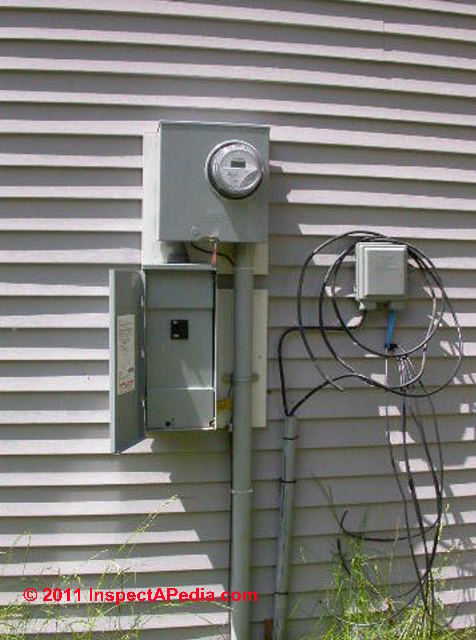
- POST a QUESTION or COMMENT about buried or underground electrical service entry cabling or wiring
Buried or underground electrical service entry cable ampacity & underground electrical service ampacity ratings: what are the required electrical cable sizes & types, conduit sizes, and burial depths for underground electrical service entry wiring?
We also discuss, for building inspectors or owners, how to determine the size, capacity, or ampacity of electrical service at a building.
This article explains how to estimate the electrical service size, (or "electrical power" or "service amps") at a building by visual examination of the buried service entry cables and other details that are available by simple visual inspection.
InspectAPedia tolerates no conflicts of interest. We have no relationship with advertisers, products, or services discussed at this website.
Underground Electrical Service Laterals - deliver current to a building
Electrical Services provided through underground conduit do not permit visual inspection of the service conductor prior to the electric meter and actual conductors are visible only in the service panel.
It is possible to guess at the cable run in a conduit by the diameter of the conduit itself [Table 2.] But for conductors from the utility company's drop to the meter, conduit size sets only the maximum conductor that could be contained, not necessarily the actual size.
Table 1: Electrical Service Conduit Sizes & Amps Ratings for Service Conductors in Conduit |
|
| Service AMPS-USA |
Rigid non-metallic conduit or iron pipe diam. |
| 30 | 3/4" 1" in Canada |
| 60 | 1" |
| 100 | 1 1/4" |
| 150 | 2" |
| 200 | 2" |
Notes to the table above
Pipe sizes are nominal; for copper wires.
Watch out: Do not attempt to open the meter base. If you are unable to determine the wire ampacity because there is no view, or because its dimension is not one with which you are familiar, say so.
Service Entry Wiring Guides, Procedures, & More Sizing Tables
- SE CABLE & BRANCH CIRCUIT WIRE SIZES vs AMPS - gives cable sizes for service entry wiring including in underground conduit or raceways
in our table titled: Electrical Wire Sizes vs Ampacities for 1-3 Current-Carrying Conductors in Cable, Earth, or Raceway
Also see
SE CABLE & WIRE SIZES FOR LONG RUNS - Goodheart-Wilcox, "THE SERVICE ENTRANCE" [PDF], Email: orders@g-w.com Mail: Goodheart-Willcox Publisher 18604 West Creek Drive Tinley Park, IL 60477-6243, 800.323.0440, 708.468.8692 E-mail: custserv@g-w.com Sample Chapter labeled FOR REVIEW PURPOSES ONLY retrieved 2017/10/05, original source: https://www.g-w.com/pdf/sampchap/9781605255828_ch10.pdf
- NIPSCO, SERVICE ENTRANCE - UNDERGROUND, Single & Three Phase 200 & 300/400 Amp [PDF] (2017), ER 19-270-P, Northern Indiana Public Service Company
- Noble REMC RESIDENTIAL UNDERGROUND SERVICE INSTALLATION 100-200 AMP, 120/240 VOLT, 3 WIRE, SINGLE PHASE [PDF] Noble REMC, (A Touchstone Energy Cooperative), 300 Weber Road Albion, IN 46701 USA Tel: 800-933-7362m Web: www.nobleremc.com Email: remc@nobleremc.com
- Mjobee, CONDUCTOR SIZING and the National Electrical Code [PDF] Mjobee, 46 S. Del Puerto Avenue, Suite B, 134, Patterson, CA 95363 Email: dmjobee@msn.com Web: mjobee.org, - retrieved 2023/03/24, original source: http://mjobee.org/NEC%20Art%20310.15.pdf
Underground Electrical Service Burial Depth
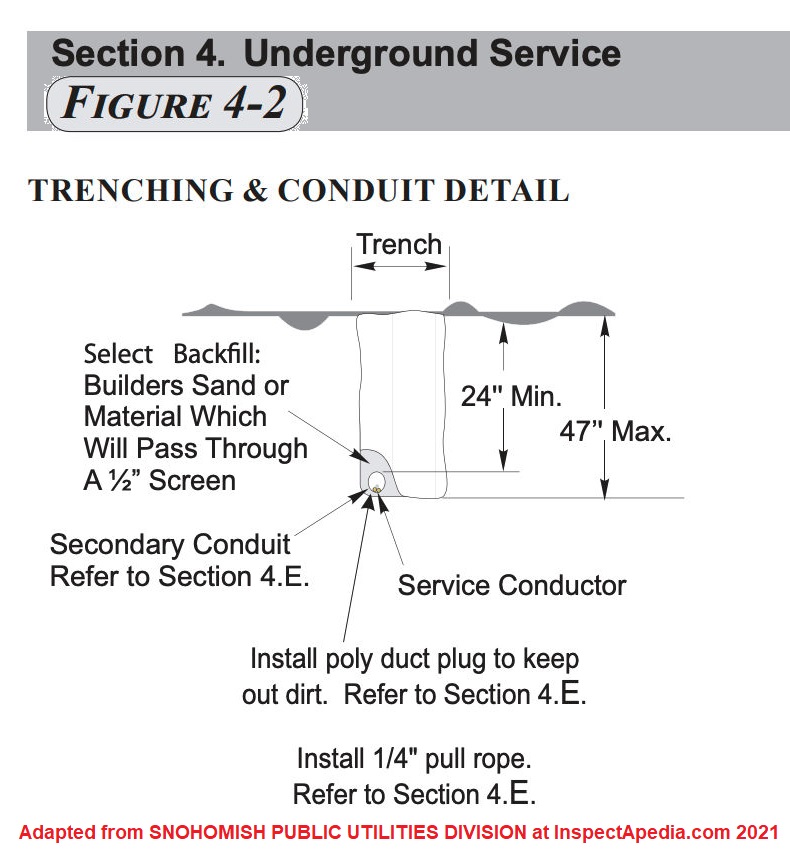
[Click to enlarge any image]
How deep below the ground surface or below a concrete slab, walk, or a driveway must we bury electrical service entry cabling?
Watch out: Your local electrical inspector is the final legal authority on the required depth at which to bury an electrical service entry cable, but here are some common depths:
Typical Underground SEC or Electrical Wire Burial Depth |
|
| Type of Circuit | Minimum Burial Depth [6] |
| Direct Burial of SEC Cabling or Conductors | 600 mm or 24 in |
| Rigid metal conduit or intermediate metal conduit | 150 mm or 6 in |
| Nonmetallic raceways [1] | 450 mm or 18 in |
| Residential branch circuits 120VAC or less [2] | 300 mm or 12 in |
| 30V or less special circuits | 150mm or 6 in. |
Notes to the table above
- Raceway must be listed for direct burial without concrete encasement
- Residential circuit must have GFCI protection and maximum overcurrent protection of 20A
- Example: irrigation or landscape lighting circuits with UF or in a listed cable or raceway
- Burial depth: means below the surface of the soil; some codes refer to this as the "required cover" or "required depth of soil cover" over the electrical conduit or cable or UF (Underground Feeder)
- Source: Carmel CA's Building Safety Division, cited below.
- Typical maximum is 48" - e.g. from Snohomish County PUD 24" to 48" is the recommended depth for electrical SEC cable conduit.
- For current ratings and wire types for underground SEC cables
see NEC TABLE 310-13 - and this study guide NEC ARTICLE 310 WITH TABLES [PDF] cited in detail below.
Other electrical wire burial depths from Snohomish - cited below
- Metal conduit carrying SEC - at least 6 inches below soil top
- Metal conduit carrying SEC - 4 inches under a 4-inch concrete slab.
- Metal conduit carrying SEC - no less than 18 inches
- Metal conduit carrying SEC - no less than 24 inches
In the UK and other countries the required depth of electrical cables will vary from the above.
Underground Electrical SEC or Circuit Burial Depth References
- Ausgrid, NS113 SITE SELECTION AND CONSTRUCTION DESIGN REQUIREMENTS FOR CHAMBER SUBSTATIONS [PDF] (2022) Australia Power Grid, GPO Box 4009, Sydney, NSW 2001 Australia Tel: 13 13 65 Web: ausgrid.com.au/
Excerpts:
This Network Standard applies to site selection, design and construction of new contestable and non-contestable chamber substation installations and refurbishment of existing chamber substations.
Types of chambers addressed include surface-level, upper-level, basement and elevated chamber substations as well as Control Point Chambers and chambers for the control of HVC connections. - Carmel CA, UNDERGROUND ELECTRICAL CABLE BURIAL DEPTHS [PDF] retrieved 2021/04/28 original source: https://ci.carmel.ca.us/
- Ergon Energy, DISTRIBUTION NETWORK STANDARD STANDARD FOR SITE SELECTION AND CONSTRUCTION REQUIREMENTS FOR CHAMBER SUBSTATIONS [PDF] Ergon Energy PO Box 1090 Townsville QLD 4810, AU Australia, Tel: 13 74 66 Web: ergon.com.au/
Abstract:
This Standard provides minimum site selection, building design and construction requirements for the establishment of new Chamber Substations with ratings up to and including 22kV.
This Standard applies to Surface, Elevated, Upper Level and Basement Chamber Substations, Switching Station Chambers and Chambers for High Voltage Customer Connections.
Purpose:
This Standard specifies Ergon Energy’s requirements for the site selection and construction design requirements for chamber substations, for supplying electricity to premises.
The requirements of this Standard shall apply throughout Ergon Energy’s supply area, for contestable and non-contestable projects. The design and construction requirements specified in this Standard are intended to satisfy Ergon Energy performance and economic requirements to meet statutory obligation.
The substations specified utilise readily available components which have demonstrated reliability.
This Standard may be amended or updated at any time to reflect improvements in design, technology advances, in history, practice, standards, etc. The Service Provider shall ensure that the latest version of the Standard is used for the substations to which it applies. - Kansas ELECTRICAL CODE SECTION E3803 UNDERGROUND INSTALLATION REQUIREMENTS [PDF] retrieved 2021/04/27 original source: https://up.codes/s/underground-installation-requirements
- Snohomish PUD UNDERGROUND ELECTRICAL SERVICE REQUIREMENTS Section 4PDF] (1990) Snohomish County PUD, PO Box 1107, Everett, WA 98206-1107, USA Tel: 425-783-1000
- U.S. NEC, Table 300.5 Minimum Cover Requirements, U.S. National Electrical Code (2017) Excerpted below
- NEC TABLE 310-13 - just table 310-13 - source cited below (next)
- NEC ARTICLE 310 WITH TABLES [PDF] study guide for electrical codes reprinted with permission - retrieved 2023/03/24 original source: https://pdf4pro.com/view/article-310-conductors-for-general-wiring-6487ed.html
- NEC ARTICLE 310 CONDUCTORS for GENERAL WIRING including National Electric Code (NEC) [PDF] - retrieved 2023/03/24 original source: \https://flylib.com/books/en/2.419.1/article_310_conductors_for_general_wiring.html
- ARTICLE 310 - CONDUCTORS for GENERAL WIRING [PDF] - courtesy of Thomas Betts - retrieved 2023/03/24, original source: https://media.distributordatasolutions.com/ThomasAndBetts/v2/part2/files/File_7437_emAlbumalbumsOcal20(USA)oc_1_g_nec31016pdfClickHerea.pdf
Table 310.16 Allowable Ampacities of Insulated Conductors Rated 0 Through 2000 Volts, 60°C Through 90°C (140°F Through 194°F), Not More Than Three Current-Carrying Conductors in Raceway, Cable, or Earth (Directly Buried), Based on Ambient Temperature of 30°C (86°F)
NEC 230-41(b), underground conductors. NEC 230-41(b-1), (b-2). In single-family dwellings with six or more two-wire branch circuits or with an initial computed load of ten kw or more, conductors shall have an ampacity of not less than 100 amperes three-wires.
National Electric Code (NEC) Table 310-13
U.S NEC 300.5 Underground Installations - minimum cover requirements
(A) Minimum Cover Requirements. Direct-buried cable, conduit, or other raceways shall be installed to meet the minimum cover requirements of Table 300.5.
[Click to enlarge any image]
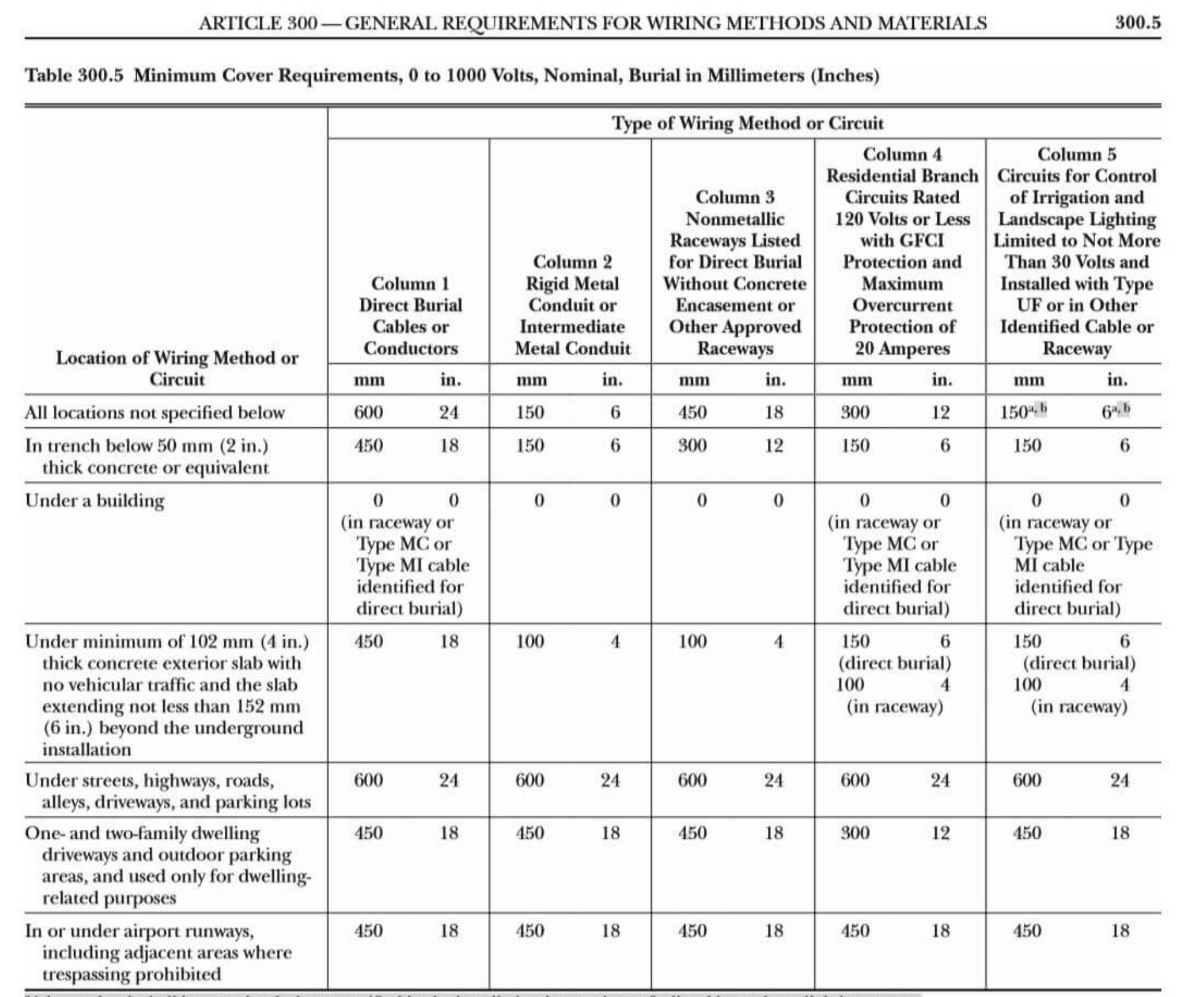
Notes to US NEC Table 300.5
a - A lesser depth shall be permitted where specified in the installation instructions of a listed low-voltage lighting system.
b - A depth of 150 mm (6 in.) shall be permitted for pool, spa, and fountain lighting, installed in a nonmetallic raceway, limited to not ore than 30 volts where part of a listed low-voltage lighting system.
Notes:
1. Cover is defined as the shortest distance in mm (in.) measured between a pont on the top surface of any direct-buried conductor,cable, conduit or other raceway and the top surface of finished grade, concrete, or similar cover.
2. Raceways approved for burial only where concrete encased shall require concrete envelope not less than 50mm (2 in.) thick
3. Lesser depths shall be permitted where cables and conductors rise for termination or splices or where access is otherwise required.
4. Where one of the wiring method types listed in Columns 1 through 3 is used for one of the circuit types in Columns 4 and 5, the shallowest depth of burial shall be permitted.
5. Where solid rock prevents compliance with the cover depths specified in this table, the wiring shall be installed in metal or nonmetallic raceway permitted for direct burial. The raceways shall be covered by a minimum of 50 mm (2 in.) of concrete extending down to rock.
Electrical Code for Underground Service Entrance Conductors
The following is based on the U.S. NEC, as adopted by Centerville IN cited in more-detail
at RESIDENTIAL ELECTRICAL WIRING CODE (Eg)
152.26 SERVICE ENTRANCE CONDUCTORS.
(A) The minimum requirements for service entrance conductors under this chapter shall be the same minimum requirements as set forth in the most current edition of the National Electric Code (NEC), and subsequent revisions.
(B) The conductors from the point where the service drops end, up to the service equipment, are called service-entrance conductors.
Types TW, THW, RHW or any other type conductor suitable for outdoor (wet) locations may be used. They may be separate wires brought into the service-entrance weatherhead through conduit to the meter base or cables made up into a service-entrance cable approved for this purpose.
(C) Service-entrance cables are governed by the National Electric Code as follows.
(1) NEC 230-40(a). Service-entrance conductors shall be insulated.
(a) Exceptions 1, 2 and 3. Bare copper-grounded conductor is acceptable if in a raceway, or direct burial is acceptable where suitable for the soil condition, or in soil when the cable has moisture and fungus-resistant covering.
(b) Exception 4. Aluminum-grounded conductor without individual insulation or covering is acceptable if in a raceway, or direct burial is acceptable when part of the cable assembly which has a moisture and fungus-resistant outer covering and which is approved for the purpose.
(2) NEC 230-41(a). Service-entrance conductors shall have ampacity to carry loads as per NEC Article 220.
(3) NEC 230-41(b), underground conductors.
NEC 230-41(b-1), (b-2). In single-family dwellings with six or more two-wire branch circuits or with an initial computed load of ten kw or more, conductors shall have an ampacity of not less than 100 amperes three-wires.
(4) NEC 230-41(b-3). Not smaller than 60 amperes for other loads.
(a) Exception 1. Not smaller than No. 8 copper or No. 6 aluminum for more than two two- wire branch circuits.
(b) Exception 2. Not smaller than No. 8 copper or No. 6 aluminum if by special permission for loads limited by demand or by source of supply, according to the town’s Municipal Electric Utility.
(c) Exception 3. Not smaller than No. 14 copper or No. 10 aluminum for limited loads of a single-branch circuit, but never smaller than the branch-circuit conductors. (See NEC 220-3b.)
(5) NEC 230-54. A maintight service head is required.
(6) NEC 230-54(c). Service heads shall be located above the service drop conductors; however, where it is impracticable to locate the service head above drops, it may be located not more than 24 inches to one side.
(7) NEC 230-54(e). Service conductors shall be brought out through separately bushed holes in the service heads. (Prior Code, § 152.16)
NEC reference:
For calculation of wire size for allowable ampacities, see Tables 310-16 through 310-19 and Articles 220 and 220-22
Grounding electrode conductor, see Table 250-94
Service entrance conductors, see Articles 230 and 238
Service entrance equipment disconnecting means and overcurrent protection, see Article 230
§ 152.27 INSTALLATION OF SERVICE EQUIPMENT, CONDUCTORS.
(A) Service equipment shall be installed on the first floor or in the basement of the residence.
It shall not be installed in the attic, on the second floor, or in a clothes closet. In every case service conductors shall enter the building as soon as possible and service conductors shall not be in the hollow part of the wall.
Service equipment shall be installed in accordance with National Electric Code (NEC) Article 230.
(B) Branch circuits and feeder calculations as designated in NEC Article 220 shall be used to compute the load requirements of a one- and two- family residence.
It is recommended that where load requirements are large, as in a totally electric home, the calculations shall be discussed with the town’s Municipal Electric Utility (CMEU) and the Building Commissioner to insure adequate service to the customer.
(C) All service equipment mounted outdoors or on unenclosed porches shall be rain-tight. No meter shall be mounted inside of a building. All meter bases shall be mounted approximately five feet six inches above the finished grade.
If the adding of a room or garage will enclose a meter, the customer shall move the service at his or her own expense. The CMEU will in turn relocate the service drop if necessary; however, if this change requires setting an additional pole or the replacement of the service drop the work shall be done at the customer’s expense. (Prior Code, § 152.17)
NEC reference:
For additional provisions, see Articles 230-79C and 230-41(b)(3)
(A) National Electric Code (NEC) Table 310-13 identifies acceptable types of underground service entrance cable. Underground feeder and branch circuit cable shall be an approved type UF cable in sizes No. 14 copper, or No. 12 aluminum or copper-clad aluminum through No. 4/0.
Excerpted below as adopted by Centerville Indiana.
NEC § 152.28 UNDERGROUND INSTALLATIONS.
(A) National Electric Code (NEC) Table 310-13 identifies acceptable types of underground service entrance cable.
Underground feeder and branch circuit cable shall be an approved type UF cable in sizes No. 14 copper, or No. 12 aluminum or copper-clad aluminum through No. 4/0.
(B) Provisions as set forth in NEC Articles 339-1(a) (b), 339-2, 300 through 300-5, and sections 310-13, 240-3 and 310-12(c) concerning installation of underground feeder and branch circuit cable shall be applicable.
(C) In addition to the insulated conductors, the cable shall be permitted to have an approved size of insulated or bare conductor for equipment grounding purposes only. The overall covering shall be flame- retardant, moisture-, fungus- and corrosion-resistant, and suitable for direct burial in the earth.
(D) The underground service is the chosen option of the customer. A weatherproof fused switch or breaker must be installed on the feeder end of the cable before going underground (Rule 32, Utility Company Rules).
Underground service cost shall be paid by the customer; however, overhead service cost may be deducted as this is normally furnished by CMEU when the underground cable and fixtures are purchased by CMEU for the customer.
(E) Service-entrance underground installation. The underground service installation is covered by National Electric Code requirements.
(1) Service lateral conductors shall be insulated.
(a) Exceptions A, B and C. Bare copper-grounded conductors are acceptable if in a raceway, or direct burial is acceptable where suitable for soil conditioning, or in any soil when cable has moisture and fungus-resistant covering.
(b) Exception D. Bare aluminum- grounded conductors are acceptable if in a raceway, or direct burial is acceptable if in a cable with moisture and fungus-resistant covering.
(2) Conductors shall have sufficient ampacity to carry the load. Service laterals shall not be smaller than No. 8 copper or No. 6 aluminum, except for limited loads; and not smaller than No. 12 copper or No. 10 aluminum for limited loads.
(3) When the service lateral conductors are installed by the electrician, the installation must conform to NEC 230-48 and 230-49, which refer to the protection of the conductors against damage and the sealing of underground conduits where they enter the house. NEC 230-49 refers to 300-5, which covers all situations relative to underground wiring.
(4) A minimum 200 ampere service entrance installation is required for all underground services (Rule 32, Utility Company Rules). The trench, service conductors and equipment, except the meter base, shall be furnished and maintained by the customer.
(5) A trench depth of 24 inches minimum is required, as in NEC Table 300-5. The bottom of the trench must be free of loose or projecting stones and debris, and backfill shall be sand or screened earth free of stones and sharp objects for the first six inches above the conductor, as explained in NEC Article 300-5(F).
(6)
(a) The line conduit shall be two inches minimum, galvanized steel or P.V.C.-approved for the use (Type 80), as explained in NEC 300-5(i).
(b) It shall be securely installed with a threaded collar and nut at the bottom of the meter base to a minimum depth of one foot below ground level, as explained in NEC Table 300-5.
(7) Conductors shall be 2/0 copper or 4/0 Al with insulation suitable for underground installation, as explained in NEC Article 310-13. Conductors shall be installed in the meter base and trench to the base of the service pole by the customer
. The customer’s conductors, conduit and weatherhead will be installed on the pole by the town’s Municipal Electric Utility. The customer has the option of purchasing wire and material from the town’s Municipal Electric Utility at cost.
(8) If trenching is done by the customer, it shall be his or her responsibility to call the excavation in at telephone number 962-9090 for the cable locating service. (Prior Code, § 152.18)
NEC ® Article 310, Table 310-13 - Conductors For General Wiring
Note: this is not an exaustive list of all electrical wire codes and designations but gives a general guideline to electrical wire codes.
A — Asbestos (obsolete; now must be glass fiber or similar material)
FEP — Fluorinated ethylene propylene insulation
H —75 o C (Note: Lack of “H” indicated 60 o C)
HH — 90 o C
L — Lead sheath
N — Nylon jacket
PF — Perfluoroalkoxy insulation
R — Thermoset insulation
S — Silicone (Thermoset) insulation
T — Thermoplastic insulation
U — Underground use
W — Moisture resistant
X — Cross-linked synthetic polymer insulation
Z — Modified tetrafluoroethylene insulation
Examples: RHW THHN
(B) Provisions as set forth in NEC Articles 339-1(a) (b), 339-2, 300 through 300-5, and sections 310-13, 240-3 and 310-12(c) concerning installation of underground feeder and branch circuit cable shall be applicable.
(C) In addition to the insulated conductors, the cable shall be permitted to have an approved size of insulated or bare conductor for equipment grounding purposes only. The overall covering shall be flame- retardant, moisture-, fungus- and corrosion-resistant, and suitable for direct burial in the earth.
(D) The underground service is the chosen option of the customer. A weatherproof fused switch or breaker must be installed on the feeder end of the cable before going underground (Rule 32, Utility Company Rules).
Underground service cost shall be paid by the customer; however, overhead service cost may be deducted as this is normally furnished by CMEU when the underground cable and fixtures are purchased by CMEU for the customer.
(E) Service-entrance underground installation. The underground service installation is covered by National Electric Code requirements.
(1) Service lateral conductors shall be insulated.
(a) Exceptions A, B and C. Bare copper-grounded conductors are acceptable if in a raceway, or direct burial is acceptable where suitable for soil conditioning, or in any soil when cable has moisture and fungus-resistant covering.
(b) Exception D. Bare aluminum- grounded conductors are acceptable if in a raceway, or direct burial is acceptable if in a cable with moisture and fungus-resistant covering.
(2) Conductors shall have sufficient ampacity to carry the load. Service laterals shall not be smaller than No. 8 copper or No. 6 aluminum, except for limited loads; and not smaller than No. 12 copper or No. 10 aluminum for limited loads.
(3) When the service lateral conductors are installed by the electrician, the installation must conform to NEC 230-48 and 230-49, which refer to the protection of the conductors against damage and the sealing of underground conduits where they enter the house. NEC 230-49 refers to 300-5, which covers all situations relative to underground wiring.
(4) A minimum 200 ampere service entrance installation is required for all underground services (Rule 32, Utility Company Rules). The trench, service conductors and equipment, except the meter base, shall be furnished and maintained by the customer.
(5) A trench depth of 24 inches minimum is required, as in NEC Table 300-5. The bottom of the trench must be free of loose or projecting stones and debris, and backfill shall be sand or screened earth free of stones and sharp objects for the first six inches above the conductor, as explained in NEC Article 300-5(F).
(6) (a) The line conduit shall be two inches minimum, galvanized steel or P.V.C.-approved for the use (Type 80), as explained in NEC 300-5(i).
(b) It shall be securely installed with a threaded collar and nut at the bottom of the meter base to a minimum depth of one foot below ground level, as explained in NEC Table 300-5.
(7) Conductors shall be 2/0 copper or 4/0 Al with insulation suitable for underground installation, as explained in NEC Article 310-13. Conductors shall be installed in the meter base and trench to the base of the service pole by the customer.
The customer’s conductors, conduit and weatherhead will be installed on the pole by the town’s Municipal Electric Utility. The customer has the option of purchasing wire and material from the town’s Municipal Electric Utility at cost.
(8) If trenching is done by the customer, it shall be his or her responsibility to call the excavation in at telephone number 962-9090 for the cable locating service. (
Prior Code, § 152.18) §
Reader Comments, Questions & Answers About The Article Above
Below you will find questions and answers previously posted on this page at its page bottom reader comment box.
Reader Q&A - also see RECOMMENDED ARTICLES & FAQs
On 2022-04-18 by Inspectapedia Com Moderator
@John,
SE CABLE & WIRE SIZES FOR LONG RUNS - SEE THIS ARTICLE for wire size for long runs
On 2022-04-17 by John
Have a garage that’s 900 feet away from power meter. What size underground wire do I need to run or 200 amp service?
On 2022-02-17 by Inspectapedia Com Moderator - Plastic High Heat (PHH) electrical wire temps and ampacity
@David,
As RHH refers to "Rubber High Heat" my guess would be that PHH on electrical wire insulation refers to Plastic High Heat electrical wire.
See our "Table of Wire Types vs. Temperature Ratings Reflected in the Wire Ampacity Chart Above"
found in
https://inspectapedia.com/electric/Electrical_SEC_Sizes_Amps.php
SE CABLE & BRANCH CIRCUIT WIRE SIZES vs AMPS has additional details on wire sizing. (Live link at the Recommended Articles list)
No surprise that the neutral or ground conductors in some electrical wire products may be a smaller wire gauge than the current carrying conductors.
On 2022-02-17 by David
My house was built in 1976. The neutral conductor is made by Philips and is labelled TWH 3. The two hot wires between the meter base and panel are labelled as PHH 1. I have not been able to find specs or ampacity numbers for this wire. Is this an earlier vintage of RHH 1 ?
On 2022-01-20 by Inspectapedia Com Moderator
@Randall,
UF is wire rated for use as an underground feeder. Wire sizes are given above on this page. Please take a look and let me know if any of that is unclear.
On 2022-01-20 by Randall
What size and type of underground cable do I need for a 100 amp sub panel box 50 ft away from main box?
On 2021-09-16 by inspectapedia.com.moderator - what size underground conduit do I need?
@Ned,
On the page above please see the conduit sizing chart given in
Table 2. Electrical Service Conductor Cable Sizes & Amps Ratings for Service Conductors in Conduit
On 2021-09-15 by Ned
What size underground conduit do I need for 100 A sub panel
On 2021-06-05 by mak.church (mod)
@Tom,
See this article for wire size for long runs:
ELECTRICAL SERVICE ENTRY CABLE SIZES FOR LONG WIRE RUNS
On 2021-06-05 by Tom
200 amp service 135 feet length what size teck cable would I need
On 2021-05-13 by danjoefriedman (mod)
@Bill,
At the WIRE SIZE & AMPACITY TABLES
You'll see #8 copper wire is rated for 40 Amps
As you'll see in the articles in this series you'll see some voltage drop at longer runs.
Also it's always safer to fuse at a lower amperage such as 30 amps on that wire.
On 2021-05-13 by Bill
I have underground 100 feet to garage. In panel is two 6g wire and two 8g wire (copper) If I use the 8 gauge for power and 6g for neutral what size breaker should I use
On 2021-04-09 by danjoefriedman (mod)
@Thomas Hocker, take a look at
SE CABLE SIZES FOR LONG WIRE RUNS
On 2021-04-09 by Thomas Hocker
I need to run 775ft from meter pole to 100 amp box in a cabin. what size and kind of direct bury cable should I use? I know there will be a voltage drop its OK.
On 2021-01-27 - by (mod) - isn't there an app that just tells me what wire I need and how to hook it up?
Don you're quite right, and there may already be such electrical design apps, though I suspect designers will be darn scared about pretending they can guide you safely through electrical wiring when there are many safety details that would be apparent to a licensed electrician but may not be apparent thus not mentioned nor considered by a normal person who's not already trained in the field.
Meanwhile this article series does take a stab at giving general wiring guidelines with simple tables: amps, distance, cable sizes, etc. Please take a look.
On 2021-01-26 by Don
In this day and age, can't someone build an app where you start with a specific subpanel, plug into the app what breakers you intend to install (how many 240, how many 120, what amps for each breaker) and then what distance it is to the main panel and it tells you what wire size you need, how many amps on the main panel disconnect breaker, what underground conduit as applicable etc.?
Seems like the rules ought to be known well enough to get the computers in our life to figure out the hard stuff. Example, I'm building a shop 100 feet from the main panel and intend on having a 240v split AC requiring a 20 amp breaker.
The rest of the sub panel will be 120v normal loads of outlets and lights of about 6 breakers 15 amps each. Do I need to size my feeder wire for 100 amps of 120V or am I sizing for 100' of 240 V 50 amps? I mean each hot leg isn't going to see the full panel load? Be so simple to plug the components into an app and it tell me what the wire requirements would be.
On 2020-10-05 by (mod) - what size & type of electrical cable do i need
SE CABLE & WIRE SIZE TABLES vs AMPS gives cable sizes
do let me know if that's unclear
Thanks Dave
On 2020-10-05 by dave
what size & type cable do i need from load side of meter socket to 100 amp service panel going underground in conduit about 25 feet
On 2020-10-01 - by (mod) -
Walter
Just above on this page please see the live link to the following article
SE CABLE SIZES FOR LONG WIRE RUNS - SEE THIS ARTICLE for wire size for long runs
On 2020-10-01 by Walter
what cable do I need for a 400 amp service 650 ft run and what transformer
On 2020-08-26 y Mike Lange
I am looking for underground wire size needed to run 1200 feet .. I would like a 30 amp 240 volt service
On 2020-08-20 by frank
what size underground wire do I use for 200 amp service for generator that is 200 ft away from the service meter?
On 2020-07-05 - by (mod) - translate: CSA USEB90 2CDR AWG4/0 1 CDR AWG1
Thanks, Mike, that's a helpful question.
Translating the markings & letters on your electrical wire: CSA USEB90 2CDR AWG4/0 1 CDR AWG1 is broken down and explained as follows:
CSA = Canadian Standards Association
USEB90 = USEB-90 Underground Service Entrance Cable consists of two compact aluminum conductors individually insulated with RW90 XLPE insulation, laid in parallel, with a helical plain copper wire serving and an overall PVC jacket covering. The copper wire serving is the neutral. The product meets the USEB-90 cable requirements of CSA.
So we know your wire is rated for underground use and from its size, it's intended to serve as an underground service entry cable.
For completeness I explain that OTHER electrical wires designated as designed for underground use will be marked "UF" for "Underground Feeder" - a non-metallic cable that can be used in wet locations or in un-protected locations such as by burying the wire directly in the ground (without a protective conduit). The usual color for UF cable is gray. Where used above ground the cable should be marked UF_B (sunlight resistant).
2CDR = 2 conductors
AWG4/0 = wire gauge or size is 4/0 (for aluminum wire that's suitable for 200A)
1 CDR = 1 conductor
AGW1 = wire gauge 1
So we have two 4/0 conductors (those will be the current carrying wires) and 1 AWG-1 conductor (that'll be the neutral conductor - or grounded conductor and so is a smaller size)
For a nice succinct summary of the properties of USEB-90 or USEB90 electrical cable take a look at General Cable's
PowrServ® XL Underground Secondary Cable Type USEB-90 600 V, Aluminum Conductor, XLPE Insulation, Overall PVC Jacket, CSA Listed [PDF] retrieved 2020/07/05 original source: www.stabiloy.com/NR/rdonlyres/F06452BB-E816-4B70-ABE0-6E4B5E8317EA/0/GCCDN_pg67_PwrServ_USEB_90.pdf or contact General Cable at https://www.generalcable.com/ Telephone: +1.859.572.8000
Available at InspectApedia.com
Question: What do the letters mean on wire: CSA USEB90 2CDR AWG4/0 1 CDR AWG1
2020/07/05 mike said:
What do the letter mean on wire CSA USEB90 2CDR AWG4/0 1 CDR AWG1
Moderator reply: Guidelines for USEB90 Feeder Cable
Thanks, Mike, that's a helpful question.
Translating the markings & letters on your electrical wire: CSA USEB90 2CDR AWG4/0 1 CDR AWG1 is broken down and explained as follows:
- CSA = Canadian Standards Association
- USEB90 = USEB-90 Underground Service Entrance Cable consists of two compact aluminum conductors individually insulated with RW90 XLPE insulation, laid in parallel, with a helical plain copper wire serving and an overall PVC jacket covering. The copper wire serving is the neutral. The product meets the USEB-90 cable requirements of CSA.
So we know your wire is rated for underground use and from its size, it's intended to serve as an underground service entry cable.
For completeness I explain that OTHER electrical wires designated as designed for underground use will be marked "UF" for "Underground Feeder" - a non-metallic cable that can be used in wet locations or in un-protected locations such as by burying the wire directly in the ground (without a protective conduit). The usual color for UF cable is gray. Where used above ground the cable should be marked UF_B (sunlight resistant).
- 2CDR = 2 conductors
- AWG4/0 = wire gauge or size is 4/0 (for aluminum wire that's suitable for 200A)
- 1 CDR = 1 conductor
- AWG1 = wire gauge 1
where
- AWG = American Wire Gauge (AWG) also referred to as the Brown & Sharpe wire gauge. This is a standard method of describing wire sizes or "gauges" that has been in use in North American since 1857.
AWG is further defined and used in
ASTM Standard B 258, Standard Specification for Standard Nominal Diameters and Cross-Sectional Areas of AWG Sizes of Solid Round Wires Used as Electrical Conductors, available from ASTM or astm.org
So putting together all of those wire markings into a prose description, we have two 4/0 conductors (those will be the current carrying wires) and 1 AWG-1 conductor (that'll be the neutral conductor - or grounded conductor and so is a smaller size)
Guidelines for using USEB-90 Underground Feeder Electrical Cable
For a nice succinct summary of the properties of USEB-90 or USEB90 electrical cable take a look at General Cable's
- PowrServ® XL Underground Secondary Cable Type USEB-90 600 V, Aluminum Conductor, XLPE Insulation, Overall PVC Jacket, CSA Listed [PDF] retrieved 2020/07/05 original source: www.stabiloy.com/NR/rdonlyres/F06452BB-E816-4B70-ABE0-6E4B5E8317EA/0/GCCDN_pg67_PwrServ_USEB_90.pdf or contact General Cable at https://www.generalcable.com/ Telephone: +1.859.572.8000
About using USEB-90 cable, and assuming you're in Canada, you might want to see this Canadian electrical code on service entry wiring - a resource provided by the Alberta government:
- CANADIAN ELECTRICAL CODE - SUBJECT: Section 6 – SERVICES & SERVICE EQUIPMENT [PDF] retrieved 2020/07/05, original source: open.alberta.ca/dataset/7887ccca-d84e-4156-8e32-8f3ebd3ed66d/resource/dcc203d3-f30c-4d09-aaec-eef61285222a/download/452-cec-6-rev5.pdf
On 2020-07-02 - by (mod) - what aluminum wire size and type do I need for a 200A service entry of 150 ft in run?
 My goodness, Billy, I've never been mistaken for a computer-bot. Probably a bot would not make spelling errors when trying to respond when only a smartphone was at hand. Thank you for the feedback.
I'm back at the lab and have access to a keyboard for a more-detailed reply to your electrical service UF wire size question.
I also hope you'll help me avoid re-creating "off the cuff" information that we've got more thoroughly stated and organized in the article(s) to which I refer you.
[Click to enlarge any image]
At the page I recommended where we have a detailed table of SEC size vs amps for both aluminum and copper wires,
the SEC CABLE SIZE table in
SE CABLE & WIRE SIZE TABLES vs AMPS you'll see the data that I excerpted in my earlier reply to you. There is not a single "right" answer to your wire size question without a little more information.
In that more-thorough data, we see that choosing an electrical service wire size bears considering not only ampacity but also run length (as you know) and temperature rating of the wire.
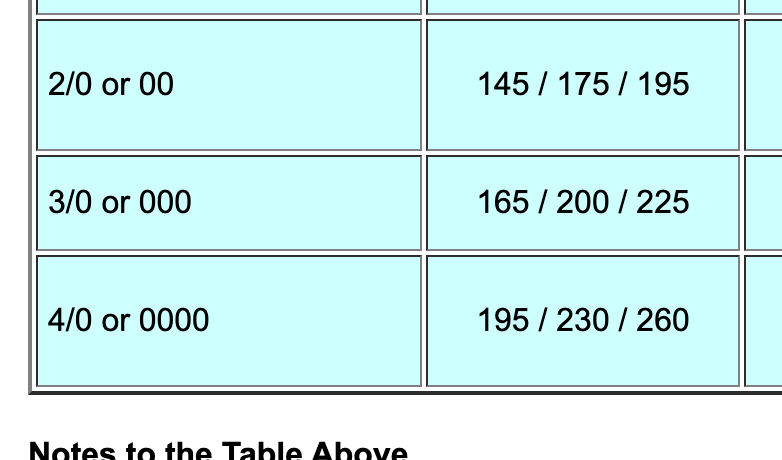
For example the table notes that the rated ampacity for 2/0 or 00 depends:
Conductor Rating Temperature of 60 / 75 / 90 °C permits an amperage of 145 / 175 / 195 respectively for 2/0 - 00 COPPER
while for an ALUMINUM SEC wire the ratings were 115 / 135 / 150 Amps at those temperature ratings.
That's why you're going to find that not 2/0 wire (as you offered) bur rather 4/0 will be where you start for Aluminum SEC cabling if your electrical service size is 200 Amps.
Keep in mind that manufacturers may produce and certify aluminum wire - and mark it right on the wire - for ampacities different than the standard tables that we excerpted from the US National Electrical Code.
Please NOTICE that the manufacturer's remarks that I will site in the next posting are the same as in our table that I recommended, that's 4/0 Aluminum for a 200A service, and that's BEFORE going to a larger size that might be required for longer runs.
Thank you for the discussion - getting SEC wire size right is critical for safety and so your question can help other readers. Below: data for COPPER SEC wire as an example.
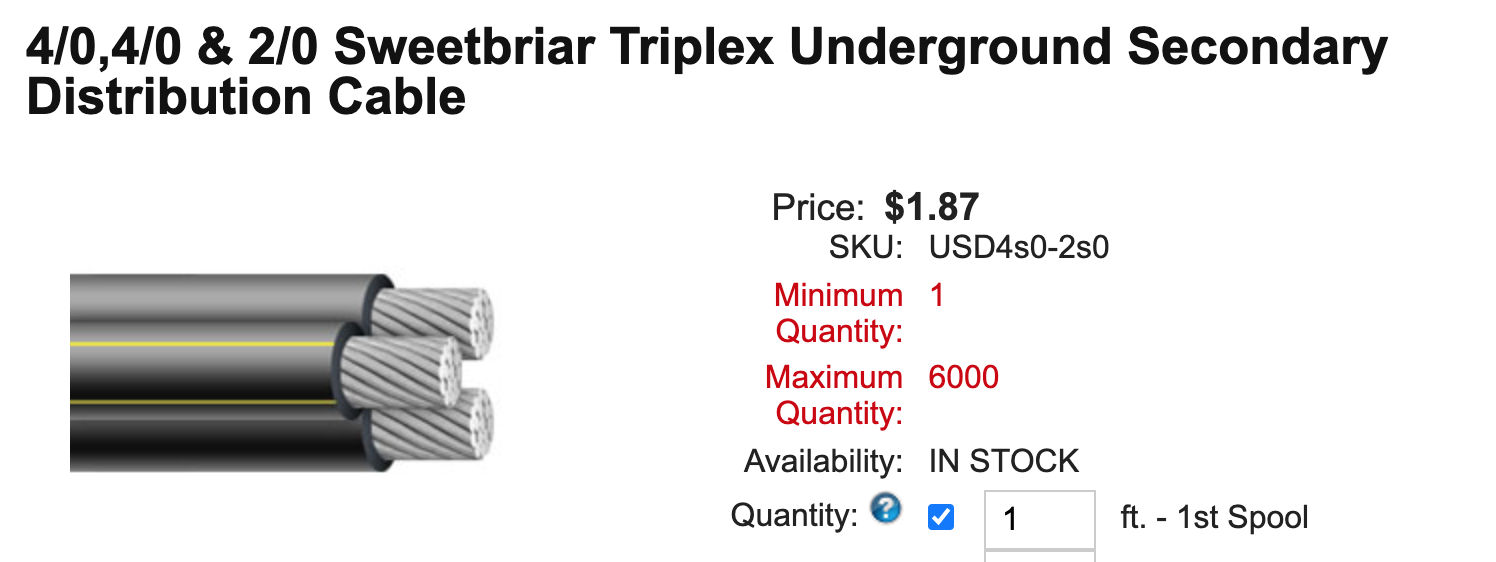 From a retail site example courtesy of Wire & Cable, illustrated here for underground feeder electrical service wiring, we have this specification:
Description:
Underground Secondary Distribution Cables are twisted assemblies of alloy 1350 aluminum conductors insulated with cross-linked polyethylene. THey are used in various underground applications in secondary distribution circuits.
Conductor:
Compressed Class B compressed stranded, 1350 series aluminum alloy.
Insulation:
Black cross-linked polyethylene (XLPE)
Assembly:
Phase conductors and neutral conductors are cabled together to form a twisted assembly.
Applicable Standards:
- UL 854: Service Entrance Cables
- ICEA S-105-692 Standard for 600 Volt Single Layer Thermoset Insulated Utility Underground Distribution Cables
Specifications*:
Phase Conductor Size: 4/0
Phase Conductor Insulation Thickness: 0.080 inches
Neutral Conductor Size: 2/0
Neutral Conductor Insulation Thickness: 0.080 inches
Outside Diameter: 1.38 inches
AC Resistance @ 75°C: 0.101
AC Resistance @ 90°C: 0.105
Inductive Resistance @ 60 Hz: 0.0265
Allowable Ampacity-Direct Burial: 301 Amps at 90°C
Allowable Ampacity-In-Duct: 240 Amps at 90°C
*Data provided on this page is subject to change based on different manufacturers variances.
A you found the wire markings a bit confusing - as do I - that same article translates - for example:
90°C rated wire is marked RHH, RHW-2, XHHW, XHHW-2, XHH, THHW, THWN-2, THW-2, THHN, USE-2
And that same page that I urge you to check out, includes a section titled
"Increase in Electrical Wire Size for Long Distance Wire Runs"
There you'll find a "distance" table that shows how to increase the wire size depending on run length and wire material - copper vs aluminum.
A 200A aluminum SEC running 150 ft needs 600 kcmil wire
If you want more detail, Detailed tables of copper or aluminum SEC cable sizes for long runs and where we give sizes for both single phase and three phase power are at
SE CABLE & WIRE SIZES FOR LONG RUNS
How to Translate the Electrical Wire Markings on NMC Cable
Where we see wire markings like XHHW, we need the decoder that I give just below, organized alphabetically rather than by the order in which letters usually appear on the wire jacket.
- 12/2 = 12-gauge, 2 conductors
- 14/2 = 14-gauge, 2 conductors, etc.
- 14/2 wG = 14-gauge, 2 conductors with ground, etc.
- 600 V = maximum voltage rating for typical residential NM electrical cable
- AL = aluminum conductor
- CU = copper conductor
- H = heat resistant insulation to 167°F.
- HH = high-heat resistant insulation to 194°F.
- N = Nylon-coated wire insulation, resistant to damage by exposure to petroleum chemicals, oil, gasoline, wire may be marked "NYLON"
- NM = non-metallic insulated wire or cable
- NM-B = non-metallic type B electrical cable, has greater heat resistance than straight NM cable.
- Sunlight Resistant - may be marked on such cables that resist damage from sunlight or UV (ultra-violet light)
- T = fire-resistant wire, made using a fire-resistant insulating material
- UF = Underground Feeder - rated for underground use or in wet locations.
- W = Wet-location use wire: approved for damp or wet locations, this wire is also OK to use in dry locations.
- X = flame-resistant wire insulation, made of a flame-retardant polymer
See details in
- Australia, IDENTIFYING WIRE and CABLE [PDF] retrieved 2020/07/05 original source: https://www.casa.gov.au/file/152106/download?token=oG0KQKBG
- UL: WIRE and CABLE MARKING and APPLICATION GUIDE [PDF] (2016), UL, Underwriters Laboratory, retrieved 2020/07/05 original source: https://legacy-uploads.ul.com/wp-content/uploads/2014/04/WC_MG.pdf
Finally:
Of course you want to follow the advice of your electrical power company and your onsite electrician who can see the actual site conditions and requirements - something that I, a mere semi-bot - cannot do from mere e-text sent via internet to our office here on the other side of the US Wall.
Your local electrical inspector is the final legal authority on what's permitted and acceptable for your installation.
On 2020-07-02 by BILLY M.
Sorry if I'm being dense but that table is not consistent with what I've been told by local professionals or the reps from the power company. Are you a real person or a computer bot? Canned answers are not what I'm looking for.
On 2020-07-02 - by (mod) - Billy was told to use 2/0 Aluminum wire for a 200A underground service entry cable
Billy
Check the SEC CABLE SIZE table in
SE CABLE & WIRE SIZE TABLES vs AMPS
For 200A and 150 ft, and select a UF or Underground Feeder rated cable type. That's more critical than the number of strands.
You'll see that if you're using 2/0 wire for 200A you're almost certainly using copper, not aluminum.
An aluminum SEC for 200 A is typically 4/0 and underground will be labeled UF for "underground Feeder"
On 2020-07-02 by BILLY M.
I need to install underground service entrance cable from the power company's pole to the 200 amp service entrance panel.on my house
The distance is roughly 150 feet. I'm told that 2/0 aluminum wire is appropriate for this connection.
However I see there are a number of different types of 2/0 aluminum wire such as SER and SEU, as well as various number of strands within each type...e.g. 2-strand, 2-strand with ground, 3-strand, etc. Exactly what type of wire should I be using for this job? .
On 2020-06-12 by mike
i am running 500 ft underground cable and powering a 80 amp breaker
On 2020-03- by (mod) - adjust underground SEC wire size for longer runs
Mo
Assuming you're using the properly-sized conduit and SEC cabling, the answer is no. Be sure to see the wire size requirements discussed
at SE CABLE & WIRE SIZES FOR LONG RUNS for wire size for long runs - live link is given above on this page
On 2020-03-01 by Mo
I plan to put underground, in conduit, the power supply to my house. The distance is about 80 feet. Do I need to use larger than normally recommended wire to compensate for heat captured in the conduit? Thanx.
On 2019-09-10 by Tim
I want to install 200 amp direct burial wire to my barn that is 400 feet from the meter then in the future I would like to take the service from the barn to another barn that is 600 ft from the first barn . I want to do this in two steps because of cost . What size wire should I use for the first 400 ft in direct burial?
On 2019-08-30 - by (mod) -
Rush
I'm not sure what question you are asking; but in most countries the wire from the utility company's pole to the service connection at the building at a masthead is the responsibility of and is installed by the electric company and is sized by them.
In some locations, particularly where long lines must be run from the utility company's power line across one or more poles across private property to a building, the property owner is responsible for installing the required poles; or service wiring may run underground.
On 2019-08-30 by Rushik
Pole to sarvish cable
On 2019-08-09 - by (mod) -
Greg
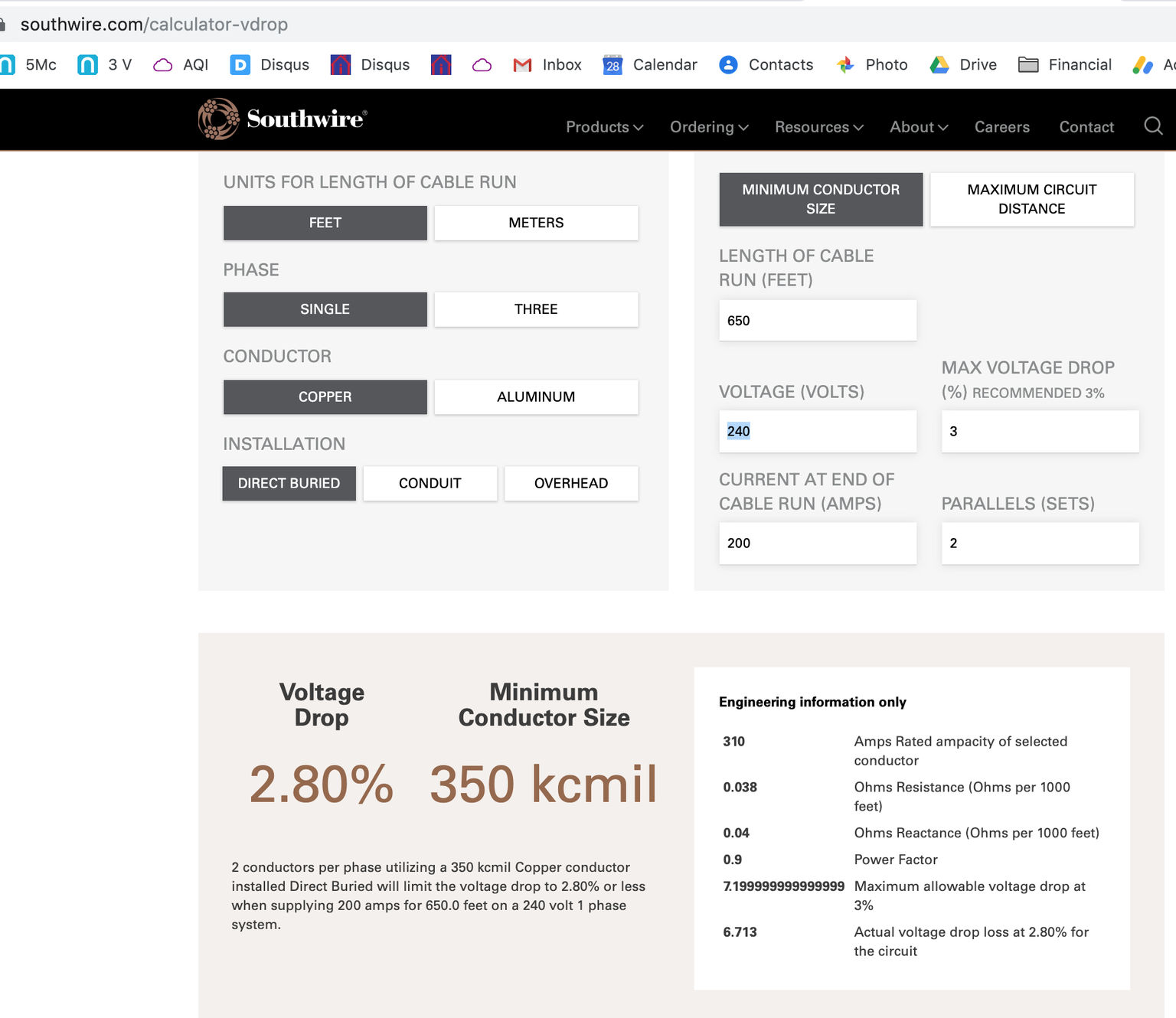
Using the online calculator itself cited at the article I'll cite just below to support a 200A load at the end of the run
you'd see an acceptable (under 3%) voltage drop of 2.80% with 350 kcmil wire
PROVIDED you're running 2 parallel sets of 240VAC cables
you'll find the longest runs we've documented along with wire sizes at
SE CABLE & WIRE SIZES FOR LONG RUNS for help with wire sizing.
On 2019-08-08 by greg
I have a 650' run from the service pole and I'm not sure with the voltage drop what size wire is needed for a 200 amp service.
...
Continue reading at SE CABLE & BRANCH CIRCUIT WIRE SIZES vs AMPS for more wire size guidelines, or select a topic from the closely-related articles below, or see the complete ARTICLE INDEX.
Or see UNDERGROUND SERVICE LATERAL FAQs - questions & answers about wiring an underground electrical service entry, posted originally at the end of this page.
Or see these
Recommended Articles
- AMPS VOLTS DETERMINATION - home
- ELECTRICAL INSPECTOR SAFETY PROCEDURES
- SERVICE ENTRY WIRING & AMPACITY - home
- ELECTRICAL SERVICE ENTRY DAMAGE
- SE CABLE & BRANCH CIRCUIT WIRE SIZES vs AMPS
- SE CABLE & WIRE SIZES FOR LONG RUNS - SEE THIS ARTICLE for wire size for long runs
- SERVICE AMPACITY
- SERVICE DROP
- SERVICE GROUNDING DEFECTS
- UNDERGROUND SERVICE LATERALS
- SIZE of WIRE REQUIRED for ELECTRICAL RECEPTACLES
Suggested citation for this web page
UNDERGROUND SERVICE LATERALS at InspectApedia.com - online encyclopedia of building & environmental inspection, testing, diagnosis, repair, & problem prevention advice.
Or see this
INDEX to RELATED ARTICLES: ARTICLE INDEX to ELECTRICAL INSPECTION & TESTING
Or use the SEARCH BOX found below to Ask a Question or Search InspectApedia
Ask a Question or Search InspectApedia
Questions & answers or comments about buried or underground electrical service entry cabling or wiring.
Try the search box just below, or if you prefer, post a question or comment in the Comments box below and we will respond promptly.
Search the InspectApedia website
Note: appearance of your Comment below may be delayed: if your comment contains an image, photograph, web link, or text that looks to the software as if it might be a web link, your posting will appear after it has been approved by a moderator. Apologies for the delay.
Only one image can be added per comment but you can post as many comments, and therefore images, as you like.
You will not receive a notification when a response to your question has been posted.
Please bookmark this page to make it easy for you to check back for our response.
Our Comment Box is provided by Countable Web Productions countable.ca
Citations & References
In addition to any citations in the article above, a full list is available on request.
- The Original Authors: Alan Carson is an ASHI Member, national home inspection educator, author and building failures researcher in Toronto, Ontario. Daniel Friedman, an original author of this article and the editor and producer of InspectAPedia where this article now appears is an ASHI Member, first ASHI Technical Committee chairman, editor and publisher of the ASHI Technical Journal, licensed home inspector, educator, and building failures researcher in Poughkeepsie, NY. Robert Klewitz is a licensed professional engineer, a professional home inspector, an ASHI Member, and has served on the ASHI Technical Committee as well as in other ASHI activities. His practice is in Issaquah, WA.
- ASHI Technical Journal, Vol. 2. No. 1, January 1992, "Determining Service Ampacity," Dan Friedman and Alan Carson, and the
- ASHI Technical Journal, Vol. 3. No. 1, Spring, 1993, "Determining Service Ampacity - Another Consideration," Robert L. Klewitz, P.E., with subsequent updates and additions to the original text ongoing to 2/19/2006. Reprints of the originals and reprints of the Journal are available from ASHI, the American Society of Home Inspectors www.ashi.com.
- Mark Cramer Inspection Services Mark Cramer, Tampa Florida, Mr. Cramer is a past president of ASHI, the American Society of Home Inspectors and is a Florida home inspector and home inspection educator. Contact Mark Cramer at: 727-595-4211 mark@BestTampaInspector.com 11/06
- Douglas Hansen, Robert Stead. Mark Cramer. Photographs: Daniel Friedman.
- N. Srinivasan, MSEE, is a senior member of IEEE with 30 years experience in the electrical industry. Mr. Srinivasan is in Vienna VA.
- Louis P. Babin generously contributed technical editing about the effects of doubling ampacity in an electrical circuit (September 2007)
- "Electrical System Inspection Basics," Richard C. Wolcott, ASHI 8th Annual Education Conference, Boston 1985.
- "Simplified Electrical Wiring," Sears, Roebuck and Co., 15705 (F5428) Rev. 4-77 1977 [Lots of sketches of older-type service panels.]
- "How to plan and install electric wiring for homes, farms, garages, shops," Montgomery Ward Co., 83-850.
- "Simplified Electrical Wiring," Sears, Roebuck and Co., 15705 (F5428) Rev. 4-77 1977 [Lots of sketches of older-type service panels.]
- "Home Wiring Inspection," Roswell W. Ard, Rodale's New Shelter, July/August, 1985 p. 35-40.
- "Evaluating Wiring in Older Minnesota Homes," Agricultural Extension Service, University of Minnesota, St. Paul, Minnesota 55108.
- In addition to citations & references found in this article, see the research citations given at the end of the related articles found at our suggested
CONTINUE READING or RECOMMENDED ARTICLES.
- Carson, Dunlop & Associates Ltd., 120 Carlton Street Suite 407, Toronto ON M5A 4K2. Tel: (416) 964-9415 1-800-268-7070 Email: info@carsondunlop.com. Alan Carson is a past president of ASHI, the American Society of Home Inspectors.
Thanks to Alan Carson and Bob Dunlop, for permission for InspectAPedia to use text excerpts from The HOME REFERENCE BOOK - the Encyclopedia of Homes and to use illustrations from The ILLUSTRATED HOME .
Carson Dunlop Associates provides extensive home inspection education and report writing material. In gratitude we provide links to tsome Carson Dunlop Associates products and services.
 | HOME | ABOUT | ASK a QUESTION | CONTACT | CONTENT USE POLICY | DESCRIPTION | POLICIES | PRIVACY | |
| © 2024 - 1985 Publisher InspectApedia.com - Daniel Friedman | |||||||||