
InspectAPedia® FREE Encyclopedia of Building & Environmental Construction, Diagnosis, Maintenance & Repair |
Question? Just ask us! InspectAPedia
|
 Inspect Main Circuit Breaker or Fuse
Should you Pull a Main Fuse or Test a Main Circuit Breaker?
Are old fuse panels safe?
- POST a QUESTION or COMMENT about how to inspect main fuses and main circuit breakers
Electrical Main Fuse/Breaker Inspection:
Should you ever pull the main fuse or switch off the main circuit breaker in the electrical panel?
Special hazards are faced when pulling a main fuse block even though this is a device intended for emergency use by a homeowner. Special hazards are faced when switching on or off a main circuit breaker.
This article discusses safety hazards at residential electrical panels when the main fuse is pulled or main breaker is switched. While we recommend that a professional inspector check these devices in some circumstances s/he should not do so, and extra care is always needed.
InspectAPedia tolerates no conflicts of interest. We have no relationship with advertisers, products, or services discussed at this website.
Testing Main Circuit Breakers or Main Fuses in Electrical Panels
 Fatal Shock Hazard Warning: Inspecting electrical components and systems risks death by electrocution as well as serious burns or other injuries to the inspector or to others. Do not attempt these tasks unless you are properly trained and equipped.
These articles suggest safety procedures for the electrical inspector, home inspector, or other professionals who examine residential electrical systems. Readers of this article should also see Touching Electrical Equipment and also Safety for Building Inspectors
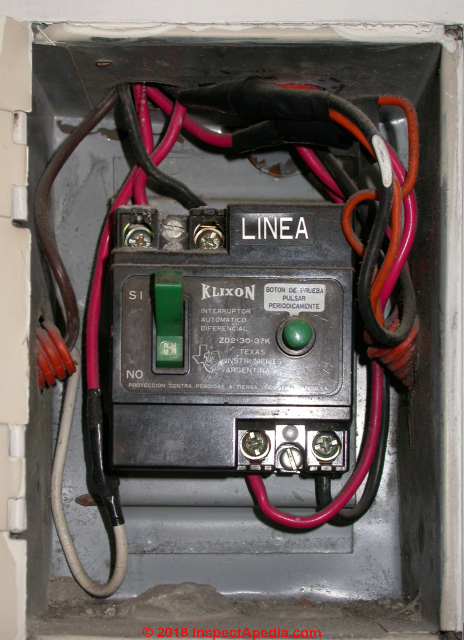
Photo: with cover removed on this main electrical panel in Buenos Aires you can see that it would be too easy to accidentally touch a live electrical terminal or wire. [Click to enlarge any image]
Homeowner advice for electrical panel safety: These safety suggestions are for professional inspectors and are not a guide for homeowners.
Homeowners should not remove the cover from an electrical panel - it is unsafe to do so. Homeowners should look at their electrical equipment for signs of trouble and should contact a licensed electrician to address any concerns that arise.
Without removing the electrical panel cover, but by opening the hinged electrical panel access door, homeowners can access the main circuit breaker or fuse, as well as individual circuit breakers and fuses. These devices may be turned on or off by the homeowner as safety or other needs require.
8.1.D. [The inspector shall observe] branch circuit conductors, their overcurrent devices, and the compatibility of their ampacities and voltages
In addition to examining the electrical panel before touching it, looking for dangerous conditions like water, rust, sheet metal screws, rats, and blocking client access, the inspector should also recognize that certain brands or models of electrical equipment are known to be unsafe and may be dangerous to inspect or operate.
Federal Pacific Electric Stab-Lok equipment includes breakers which remain internally "on" when switched "off", as well as too often failing to trip off in response to an overcurrent, and which have been reported to result in electrical arc explosions when manually or otherwise exercised.
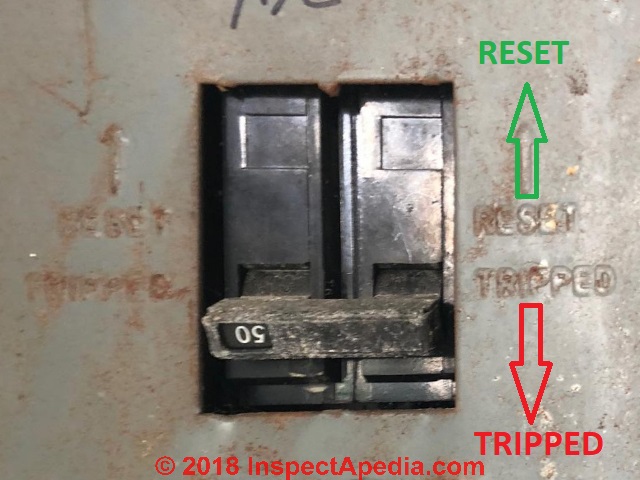 Circuit breaker photo: in a GE-branded FPE circuit breakers panel (unsafe) you see rust and you see that the breaker is recessed in the panel - either the cover is loose or the breaker and / or cover are not properly mounted.
See FEDERAL PACIFIC FPE HAZARDS for details.
Zinsco: Similar bus burnups and electrical arc explosions have been reported regarding Sylvania/Zinsco electrical panels.
See ZINSCO / SYLVANIA HAZARDS for details.
Contact Us by email to add field reports of problems regarding these or other electrical products.
8.3.B. [The inspector is NOT required to] test or operate any overcurrent device except Ground Fault Circuit Interrupters
I continued to put my arm behind my back and close the breaker with my left hand with my head turned to the left.
BAM, a light as bright as the sun and an explosion. This knocked us down and blinded us.
We were rushed to the hospital. I spent the night in the ER with an ICU nurse and was off of work for 3 weeks and have had to have a stronger prescription. These FPE panels are all over the building
Pulling fuse blocks: At one inspection the author pulled the main fuse block in a 60-Amp panel, only to have the pullout block disintegrate in his hand.
The failure left one fuse in place and one half out of the panel.
"What did you just do to the panel?" asked the client (from a safe distance).
"I destroyed it." was the answer.
With permission of the owner, and following accepted home inspection practice of exercising normal user controls intended for use by the homeowner, the home inspector was performing a normal, if uncommon operation which a homeowner would be expected to do, for example, during an emergency or other need to shut off electrical power to the building.
At a minimum one would have had to perform this operation during an emergency or if the panel were to be worked on.
The client wanted to know if the fuse pullout disintegration was normal. [No.]
The inspector wanted to know if he was going to pay for a new panel. [No.]
A new panel was needed as the service and equipment were obsolete, not because the fuse pullout needed replacement. But we pose that it may be difficult to find a replacement fuse pull-out for some older fuse panels.
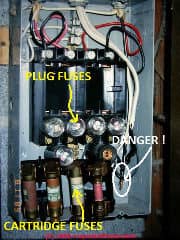
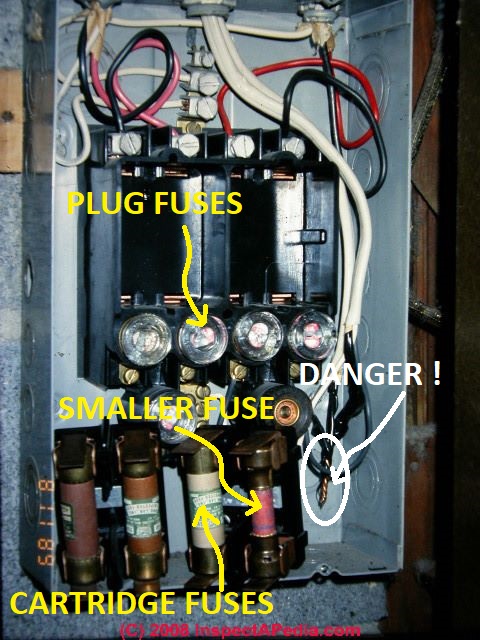
If you had not pulled the fuse shown at lower right in this photo, something interesting would have been missed.
Is that smaller fuse unsafe? No, installing a smaller fuse means that the overcurrent device will open the circuit under less current flow.
What about the other wiring in the panel? There is an unsafe open splice at the right side of the panel.
Are some of the edison-base fuses oversized? Can't tell for sure from the photo. In older fuse panels people are too often tempted to get around a frequent problem with blown fuses by installing an over-sized fuse - this is an unsafe action and is a fire hazard. Be sure that fuses in the panel are matched properly to the wire size.
- #14 copper wire wants a 15-Amp fuse.
- #12 copper wire circuits can be fused with at 20-Amp fuse.
Are Old Fuse Panels Safe?
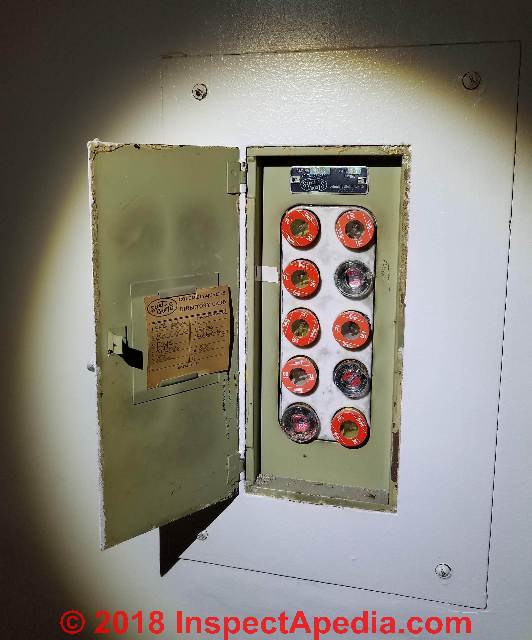 Shown here is an antique fuse panel that was produced by the Columbia Metal Box Company and marketed under the brand Safe-T-Cirkits.
This is a 62-Amp rated fuse panel carrying ten fuses, providing power to ten electrical circuits in an older Poughkeepsie New York home.
A complete safety assessment of this electrical panel would require further inspection of the panel interior, the condition of its fuses, wiring, and connections as well as a check for signs of over-fusing or overheating.
But here are some initial antique fuse panel safety observations we can make from even a cursory inspection.
- Fuses are reliable:
In my OPINION, one shared at least some older electricians, fuses are inherently safe, perhaps safer than more-modern circuit breakers as the fuse is less likely to fail to "blow" to turn off an electrical circuit in unsafe conditions.
The fusible strip inside the fuse melts at over-current giving a reliable switch-off of power to the circuit.
In a damp or corrosive environment fuses may be more-reliable than a typical residential circuit breaker that may jam due to corrosion. - No Main Switch: "Rule of 6" Circuit breakers
the ten circuit fuse panel shown has no main fuse nor main switch. Modern electrical safety practice recommends the provision of a local main switch for any electrical panel having more than six circuits.
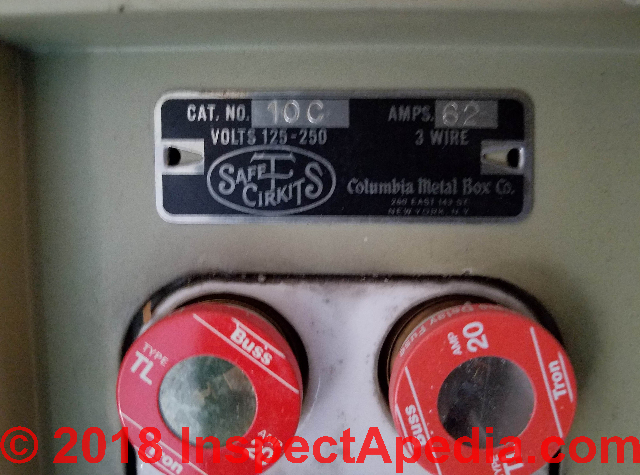
- Over-fusing is unsafe:
Over-fusing is a common safety hazard we find in buildings where there are too-few electrical circuits and/or circuits are regularly over-loaded.
To stop fuses from blowing and turning off the circuit the occupants simply screw-in a larger-ampacity fuse. We are probably seeing this in the photo above where two 20A fuses have been inserted on what is probably a #14 wire - a 15-Amp electrical circuit.
The fuse size or ampacity must be proper for the wiring size and ampacity. It is safer to install a lower ampacity fuse if you're not sure about the circuit wire size or condition. It is never safe to install a higher-ampacity-rated fuse than the circuit intends.
See details at CIRCUIT BREAKER / FUSE INSPECTION. - Fuses are less convenient than circuit breakers:
a blown fuse has to be replaced while a circuit breaker can be simply switched back-on.
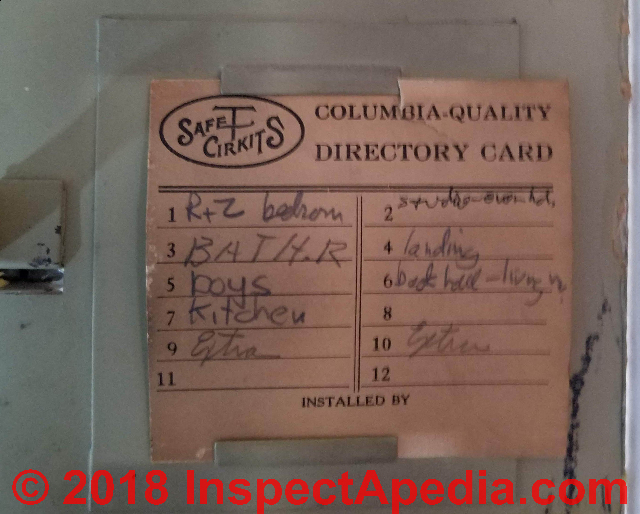
Research on Old Fuse Panel or Circuit Breaker Panel Safety
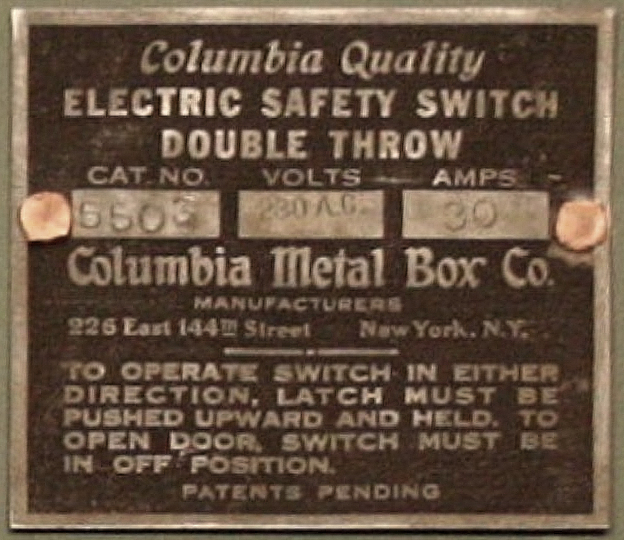
- History of the Columbia Metal Box Company, 260 East 143rd St., New York, NY. Notice that our image of a Cloumbia Qualith electric safety switch data tag sows a different address: 226 East 144th St., New York, NY.
The Columbia Metal Box company made a variety of steel cabinets including bathroom cabinets, electrical enclosures, mail boxes, panel boards, conduit fittings, even steel radiator enclosures. The company operated at least in the 1930's - 1950's in New York. - McFate, Kenneth L., and Fred M. Crawford. Is Your Wiring System Safe and Energy Efficient? [PDF] Universithy of Missouri Extension publications (MU) (1993).
Abstract & Excerpts:
Electricity is a safe and convenient source of energy for heat, light and power in your home and on your farm, provided it is distributed in correctly sized and properly protected conductors. Good wiring systems are safe and energy-efficient.
Many older homes and service buildings are not adequately wired to serve today's electrical loads. Some new homes fall into this category, too. The safety of the system depends first on how well you have maintained the safety valves — your electrical fuses or your circuit breakers.
It also depends upon the care taken by the home builder or electrician in the placement of electric cables.
All cables in attics should be placed on top of attic insulation materials. It is especially important that circuit conductors that carry near-capacity current are on top of attic insulation so that heat generated within cable jackets will not be trapped.
Where a circuit carries near-full load (90 to 100 percent of rated capacity) for long periods of time and heat is trapped by attic insulation, the conductor insulation could deteriorate.. - Rasdall, Joyce. Aging Residential Wiring Issues: Concerns for Fatalities, Personal Injuries, and Loss of Property [PDF] In Annual Household Equipment Technical Conference, Louisville, Kentucky, pp. 26-28. 2005. retrieved 2019/01/10 original source http://www.chaneyelec.com/wp-content/uploads/2011/06/Aging-Residential-Wiring-Issues.pdf
Abstract excerpt: Aging residential wiring is a major issue as the number of housing units over age 40 increases, historic preservation and restoration increases, and old wiring falls further behind with regard to improvements in the National Electric Code.
Corroded wiring and arcing at poor connections behind faceplates of outlets and switches and in light fixtures are a few of the causes of 40,000 fires annually from poor wiring, often in older homes.
This annually results in 350 fatalities, 1,400 personal injuries, and upwards of $1 billion of property losses, not to mention inconveniences and frustrations (Larder, p. 1, 2004).
The U.S. Consumer Product Safety Commission continues to study these issues and to report statistics regarding this growing issue.
...
Continue reading at ELECTRICAL INSPECTION CLIENT SAFETY or select a topic from the closely-related articles below, or see the complete ARTICLE INDEX.
Or see these
Recommended Articles
- AFCIs ARC FAULT CIRCUIT INTERRUPTERS
- BLOWN FUSE REPLACEMENT
- CIRCUIT BREAKER FAILURE RATES
- BACK-WIRED ELECTRICAL DEVICES
- BRYANT ELECTRICAL PANEL AGE & PROPERTIES
- Classified CIRCUIT BREAKER WARNING
- FEDERAL PIONEER PANEL SAFETY
- FEDERAL PACIFIC FPE HAZARDS - home
- FPE FAILURE FIELD REPORTS
- MURRAY CIRCUIT BREAKER HAZARDS
- MURRAY SIEMENS Recall
- PUSHMATIC - BULLDOG PANELS
- SIEMENS MURRAY Recall
- SPLIT BUS ELECTRICAL PANEL HAZARDS
- SQUARE-D AFCI RECALL 2004
- SQUARE-D COUNTERFEIT BREAKER RECALL
- TEST MAIN BREAKERS & FUSES
- UBI FPE CIRCUIT BREAKER TEST RESULTS
- ZINSCO CIRCUIT BREAKER INDEPENDENT TESTS
- ZINSCO CIRCUIT BREAKER TEST REPORT
- CIRCUIT BREAKER / FUSE INSPECTION
- CIRCUIT BREAKER LOCKS
- CIRCUIT BREAKER HANDLE TIES
- CIRCUIT BREAKER MAIN or FUSE TEST
- CIRCUIT BREAKER REPLACEMENT
- CIRCUIT BREAKER RESET STEPS
- CIRCUIT BREAKERS RE-CONDITIONED USED
- CIRCUIT BREAKER RELIABILITY TESTS
- CIRCUIT BREAKER SIZE for A/C or HEAT PUMP
- ELECTRICAL INSPECTOR SAFETY PROCEDURES - important basic safety procedures, clothing, and equipment for home inspectors and electrical inspectors
- ELECTRICAL PANEL INSPECTION SAFETY
- ELECTRICITY TURN ON AFTER BREAKER TRIP
- GFCI PROTECTION, GFCI CODES
- GFCI DEVICE SELECTION & WIRING
- GFCI TEST PROCEDURES
- MOBILE HOME ELECTRICAL GFCI DIAGNOSIS
- OLD HOUSE ELECTRICAL SYSTEMS
Suggested citation for this web page
CIRCUIT BREAKER MAIN or FUSE TEST at InspectApedia.com - online encyclopedia of building & environmental inspection, testing, diagnosis, repair, & problem prevention advice.
Or see this
INDEX to RELATED ARTICLES: ARTICLE INDEX to ELECTRICAL INSPECTION & TESTING
Or use the SEARCH BOX found below to Ask a Question or Search InspectApedia
Ask a Question or Search InspectApedia
Questions & answers or comments about how to inspect main fuses and main circuit breakers.
Try the search box just below, or if you prefer, post a question or comment in the Comments box below and we will respond promptly.
Search the InspectApedia website
Note: appearance of your Comment below may be delayed: if your comment contains an image, photograph, web link, or text that looks to the software as if it might be a web link, your posting will appear after it has been approved by a moderator. Apologies for the delay.
Only one image can be added per comment but you can post as many comments, and therefore images, as you like.
You will not receive a notification when a response to your question has been posted.
Please bookmark this page to make it easy for you to check back for our response.
Our Comment Box is provided by Countable Web Productions countable.ca
Citations & References
In addition to any citations in the article above, a full list is available on request.
- Electrical shock injury statistics: www.healthatoz.com - September 2008;
- Jim Simmons: Personal communication, J. Simmons to Daniel Friedman, 9/19/2008. Photographs contributed to this website by Jim P. Simmons, Licensed Electrician, 360-705-4225 Mr. Electric, Licensed Master Electrician, Olympia, Washington Contact Jim P. Simmons, Licensed Master Electrician, Mr. Electric, 1320 Dayton Street SE
Olympia, WA 98501, Ph 360-705-4225, Fx 360-705-0130 mrelectricwa@gmail.com - Kenneth Kruger: Original author of the sidebar on testing VOM DMM condition: Kenneth Kruger, R.A., P.E. AIA ASCE, is an ASHI Member and ASHI Director in Cambridge, MA. He provided basis for this article penned by DJ Friedman.
- "How to Use DMM's Safely," Leonard Ogden, CEE News, 888 Seventh Ave., New York, NY 10106, Dec 1990 p.10.
- Dr. Jess Aronstein, consulting engineer, Poughkeepsie NY, 1991 protune@aol.com
- Rex Cauldwell, master electrician and contributor to the Journal of Light ConstructionOn electrical topics
- New York State Central Hudson Gas and Electric Company, G&E/1-2/85 consumer safety pamphlet
- American Society of Home Inspectors, ASHI Training Manual, Al Alk -[obsolete, and includes unsafe practices-DF]
- In addition to citations & references found in this article, see the research citations given at the end of the related articles found at our suggested
CONTINUE READING or RECOMMENDED ARTICLES.
- Carson, Dunlop & Associates Ltd., 120 Carlton Street Suite 407, Toronto ON M5A 4K2. Tel: (416) 964-9415 1-800-268-7070 Email: info@carsondunlop.com. Alan Carson is a past president of ASHI, the American Society of Home Inspectors.
Thanks to Alan Carson and Bob Dunlop, for permission for InspectAPedia to use text excerpts from The HOME REFERENCE BOOK - the Encyclopedia of Homes and to use illustrations from The ILLUSTRATED HOME .
Carson Dunlop Associates provides extensive home inspection education and report writing material. In gratitude we provide links to tsome Carson Dunlop Associates products and services.
 | HOME | ABOUT | ASK a QUESTION | CONTACT | CONTENT USE POLICY | DESCRIPTION | POLICIES | PRIVACY | |
| © 2024 - 1985 Publisher InspectApedia.com - Daniel Friedman | |||||||||