
InspectAPedia® FREE Encyclopedia of Building & Environmental Construction, Diagnosis, Maintenance & Repair |
Question? Just ask us! InspectAPedia
|
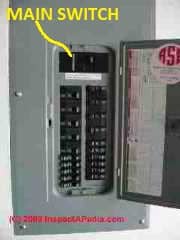 Electrical Panel Cover Removal Safety Hazards and Panel Cover Removal Procedures
- POST a QUESTION or COMMENT about life safety hazards during touching or removing the cover on an electrical panel or fuse box.
Elecrical safety: hazards when removing the electrical panel cover.
This article discusses hazards that can be spotted at the electrical panel before even touching it and provides safety procedures to protect bystanders during an electrical inspection. Home inspectors & electrical inspectors can reduce the hazards of this very dangerous step (opening the electrical panel) by looking carefully at conditions before approaching the task. We also provide suggestions to improve the safety of bystanders during an electrical inspection.
InspectAPedia tolerates no conflicts of interest. We have no relationship with advertisers, products, or services discussed at this website.
Safety Suggestions for Inspecting the Electrical Panel Interior
 These electrical inspection suggestions are not a complete inventory of all electrical safety procedures nor of all electrical components that should be inspected; these notes focus on identification of conditions that may present special electrical hazards for the electrical inspector. Contact Us by email to suggest changes, corrections, and additions to this material.
Fatal Shock Hazard Warning: Inspecting electrical components and systems risks death by electrocution as well as serious burns or other injuries to the inspector or to others. Do not attempt these tasks unless you are properly trained and equipped.
Homeowner advice for electrical panel safety: These safety suggestions are for professional inspectors and are not a guide for homeowners. Homeowners should not remove the cover from an electrical panel - it is unsafe to do so.
[Click to enlarge any image]
Homeowners should look at their electrical equipment for signs of trouble and should contact a licensed electrician to address any concerns that arise. Without removing the electrical panel cover, but by opening the hinged electrical panel access door, homeowners can access the main circuit breaker or fuse, as well as individual circuit breakers and fuses. These devices may be turned on or off by the homeowner as safety or other needs require.
8.3.C. [The inspector is NOT required to] dismantle any electrical device or control other than to remove the covers of the main and auxiliary distribution panels.
How might the astute inspector spot trouble in an electrical panel cover before opening it?
At least one death, that of an electrician, has been reported to have occurred during the removal of a panel cover
Atlanta GA, a licensed electrician was opening the panel for inspection.] Apparently there was an incipient problem with the spring-loaded bus-bar assembly. When the cover was removed the bus assembly moved, an arc caused an electrical explosion, killing the inspector. -- J. Aronstein to D. Friedman, personal communication, 12/1991.
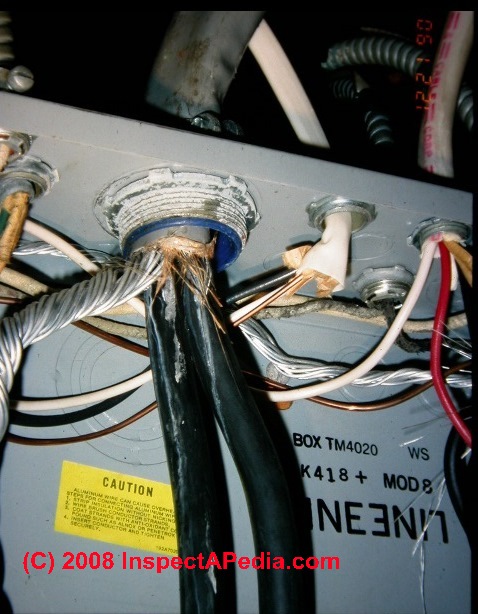
The following photos and text provide examples of external evidence that may let the inspector avoid trouble or a nasty surprise when inspecting electrical equipment.
Before touching the electrical panel the inspector should look for these conditions:
- Escape path: make sure that you know where you will turn and/or step back to retreat from the equipment if you discover a sudden and dangerous surprise (sparks, rats, bees, etc).
- Wet floors or other wet conditions:
- Do not touch electrical equipment if you are standing on a wet surface.
- Notice the cold water pipe condensation dripping onto and into the electrical panel in the left hand photo below
This photo shows a common way that water may enter an electrical panel as well as drip on its exterior.
A cold water pipe produces condensation which drips on the panel top. This pipe is too close and is in a poor location over this electrical service box.
Is there:
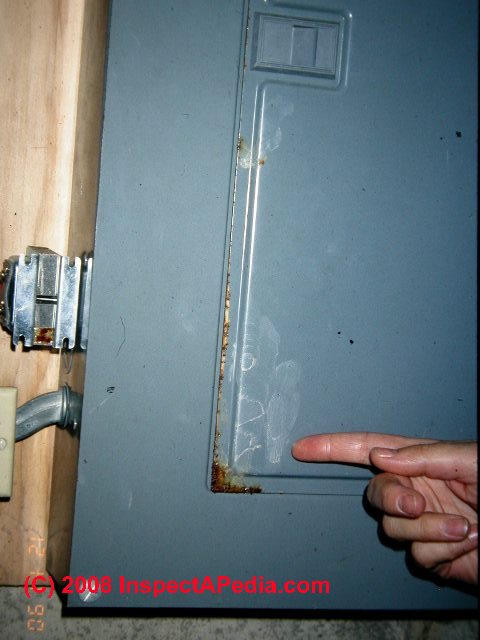
- Wet equipment: the electrical panel cover is wet
- Panel Rust: the electrical panel cover is rusty
The pair of photographs below show two clear warnings that water has been entering an electrical panel - watch out for rust, and for circuit breakers that may not trip in response to an overcurrent, due to internal corrosion.
This defect is not one for which a home inspector (nor most electricians) can reliably test in a home, but the warning remains appropriate. Replace such breakers, and if the electrical panel is badly corroded the entire panel needs replacement.
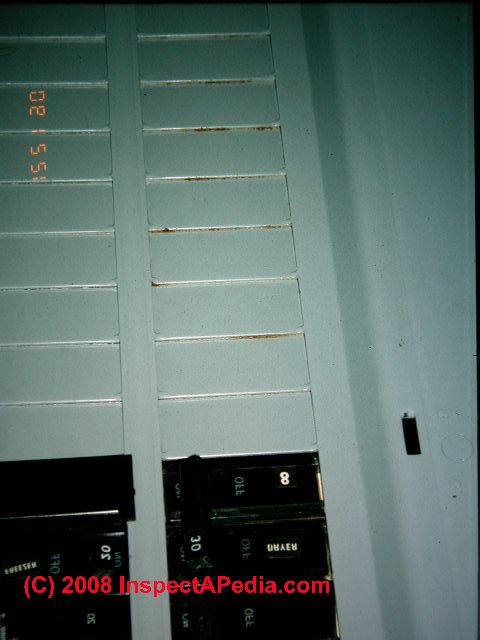
See RUST in ELECTRICAL PANELS for a detailed account of the sources of water and rust in electrical panels and the frequency of observation of rust and water damage in that equipment.
What about Testing a Suspect Panel Enclosure Box or Cover to See if it is Electrically Charged?
The electrical panel enclosure can be tested for electrical safety before it is touched by hand. Do not perform this task using the "handyman" procedures suggested by some people who rap or tap the panel with one hand. Use the proper electrical test instrument and procedure to make this safety check instead.
See these three articles for details on how to use test instruments to check for live voltage where it should not be. Touching Electrical Equipment (don't do it), Guide to Electrical Test Equipment (what are some common and inexpensive electrical test tools used by home inspectors and electrical inspectors), and DMMs VOMs SAFE USE OF (how to use electrical test devices properly).
Safety Procedures for Removing Electric Panel Covers: for Electrical Inspectors & Home Inspectors
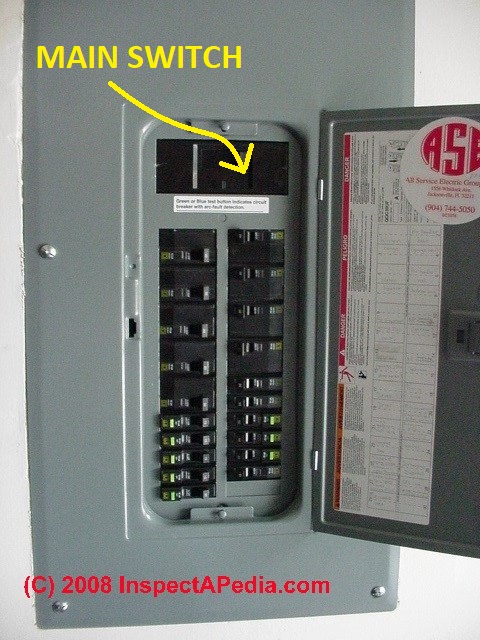 ASHI Standards 8.1.B [The inspector shall observe] service equipment, grounding equipment, main overcurrent device, main and distribution panels.
- Distance: Warn clients to remain at a safe distance.
- Assistance: Do not permit your client
to assist you in removing or installing the panel cover. Only one person should be touching electrical components at any time.
The author asks clients to stand a little back while removing the cover, which makes it easier to remain in a blocking position (below).
We might inform the client that opening the panel is a dangerous step, and that if sparks fly the client should not touch the inspector - though other parties present at the inspection might want to kick the inspector or take similar measures if necessary.
- Blocking: Stand so as to block your client from touching the panel or its components.
- Touching: Do not permit your client to touch electrical equipment.
See Touching Electrical Equipment.At an inspection in a damp dark crowded basement the author was standing blocking the very curious and active participatory client from the open electrical panel after the cover had been removed.
The client reached over the author's shoulder.
The client asked, "What's this?" as he stuck his finger straight into an open fuse socket while his arm contacted the inspector's shoulder, assuring that they both would get an electrical shock. - Grounding: Check visually (and electrically if needed) for presence of system grounding before touching electrical components.
Details about inspecting electrical grounding and definitions are
at ELECTRICAL GROUND SYSTEM INSPECTION. - And don't count on the safety of the "backup ground" back at the utility company's service lines and poles: that ground may have been interrupted too.
See DOUBLE FAULT, LOSS OF ELECTRICITY for an account of loss of both local ground and utility company ground at a property.
Reader Comments, Questions & Answers About The Article Above
Below you will find questions and answers previously posted on this page at its page bottom reader comment box.
Reader Q&A - also see RECOMMENDED ARTICLES & FAQs
On 2018-07-19 by (mod) - is it legal for a non-electrician to remove, inspect, and restore the cover of an electrical panel?
Larry
You don't give your country and city, but in general I'm not aware of a law that explicitly forbids removal of the cover as you describe.
What follows is my OPINION based on experience only as you'll see, I don't know of an explicit code, law, or rule that pertains explicitly to this case:
There are in many countries, states, provinces, cites, jurisdictions, local codes that state explicitly that "electrical work in or on a building must be performed by a licensed electrician"
It's not clear to me whether or not just removing the panel cover for visual inspection would constitute "work" as nothing is being modified, but I'd wager that if, god forbid, someone is injured or there's a fire or loss that can be blamed on cover-removal, you and everyone involved will be called to task, regardless of how careful you were.
You could argue, as I would, that there are existing standards, such as home inspection standards by ASHI and some of the other clubs, that actually require that the cover be removed for inspection (unless there's a reason not to do so such as safety and that in that case the non-removal, reason, and its implications must be communicated to the people involved).
You're doubtless not operating under a home inspector's license but the existence of that standard would be helpful.
Here is an example from the New York State home inspection licensing law
§197-5.9 Electrical System.
(a) Home inspectors shall observe and report upon readily accessible and observable portions of:
1. Service drop;
2. Service entrance conductors, cables and raceways;
3. The main and branch circuit conductors for property over currentprotection and condition by visual observation after removal of thereadily accessible main and sub electric panel covers;
4. Service grounding;
5. Interior components of service panels and sub-panels;
- see the full NEW YORK STATE HOME INSPECTION LICENSING LAW [PDF] and regulations at https://inspectapedia.com/home_inspection/New-York-Home-Inspector-Licensing-Law-2016.pdf
Watch out: Nevertheless as you read in the article on this page and in this series, panel cover removal can be dangerous, even fatal.
In my opinion your instructions would require
1. the panel be inspected for evidence of hazards that would make removing the panel cover unsafe, such as evidence of leaks, rust, loose parts, arc or burn marks on the exterior, wet floor, access space hazards, or anything else that in the opinion of the building maintenance staff would make removing the cover unsafe.
[Be warned as in the article above that some covers are spring-loaded and moving parts during their removal can result in a fatal arc explosion]
2. the cover should not be removed if for any reason, even just general concern by the qualified maintenance staff, removal would be unsafe
3. You'd do your own inspection for visual clues suggesting the cover or panel are unsafe and report those to the appropriate people immediately orally and promptly in writing
On 2018-07-19 by Larry
I am a certified themographer. I take infrared photos of breaker boxes to find over heating breakers the naked eye cannot detect.
I have been asking the owner of commerical buildings only, to have their maintanence guy unbutton the panel covers on each breaker box ahead of my inspection.
When I am done with camera and my visual inspection of the box, the maintenance guy buttons it back up.
Are we violating any law by do this since neither the maintenance guy or myself are licensed electricians?
On 2018-03-18 - by (mod) -
Use the picture frame icon next to the comment button to send me some photos of your fuse box and perhaps I can see what's going on.
Be careful don't force anything you could be shocked or killed.
On 2018-03-18 by Arlene
I am almost sure.the fuse to my electric plug is blown as my dryer was working and my washing machine was working. Both use same outlet. All of the sudden they stopped
Plug a hair dryer In the outlet and it would not turn on but can't get cover to fuses to open. It is a metal panel box
I live in a 1998 travel supreme
On 2018-03-18 by Arlene
My fuse box is metal. I can see on one side there are hinges but no latch to open. Can not get it to budge
On 2018-03-18 by Arlene
My fuse box is metal and I can not get it to open. I live in a 1998 travel supreme Rv.
On 2017-06-27 by Mark Streisfeld
Do you have an electric panel box cover 14" wide and 30" high? Cover only.
On 2016-12-11 - by (mod) -
Delia,
An electric panel has a hinged to cover door with a latch that is meant to be opened by the consumer - typically there's a finger opening in the latch that slides to one side to pull the door open.
Actual electrical wires and connectors remain covered and protected against being touched.
Separately the cover assembly is actually screwed onto the face of the electrical panel.
That cover should not be removed by building occupants because of the danger of electric shock from exposed wiring inside.
On 2016-12-11 by Delia Y. Saenz
I just want to see how you open it
Question:
28 March 2015 Kent higgins said:
My breaker panel for my home is slightly open due to the plastic latch having been broken. I have closed the door with a small piece of duct tape. I have been unable to locate a new latch for the panel. What next?
Reply:
Kent you will want to contact the manufacturer with the model of your panel to ask about a replacement door or latch.
...
Continue reading at ELECTRICAL PANEL COVER SCREWS or select a topic from the closely-related articles below, or see the complete ARTICLE INDEX.
Or see these
Recommended Articles
- ELECTRICAL PANEL INTERIOR HAZARDS
- ELECTRICAL PANEL INSPECTION SAFETY
- SAFETY for ELECTRICAL INSPECTORS
Suggested citation for this web page
ELECTRICAL PANEL COVER REMOVAL at InspectApedia.com - online encyclopedia of building & environmental inspection, testing, diagnosis, repair, & problem prevention advice.
Or see this
INDEX to RELATED ARTICLES: ARTICLE INDEX to ELECTRICAL INSPECTION & TESTING
Or use the SEARCH BOX found below to Ask a Question or Search InspectApedia
Ask a Question or Search InspectApedia
Try the search box just below, or if you prefer, post a question or comment in the Comments box below and we will respond promptly.
Search the InspectApedia website
Note: appearance of your Comment below may be delayed: if your comment contains an image, photograph, web link, or text that looks to the software as if it might be a web link, your posting will appear after it has been approved by a moderator. Apologies for the delay.
Only one image can be added per comment but you can post as many comments, and therefore images, as you like.
You will not receive a notification when a response to your question has been posted.
Please bookmark this page to make it easy for you to check back for our response.
Our Comment Box is provided by Countable Web Productions countable.ca
Citations & References
In addition to any citations in the article above, a full list is available on request.
- "Frequency of Occurrence and Sources of Rust and Corrosion in Electrical Panels," Daniel Friedman, IEEE HOLM Conference, Philadelphia PA, 1992 - see ELECTRIC PANEL RUST for an online version of this article.
- Jim Simmons: Personal communication, J. Simmons to Daniel Friedman, 9/19/2008. Photographs contributed to this website by Jim P. Simmons, Licensed Electrician, 360-705-4225 Mr. Electric, Licensed Master Electrician, Olympia, Washington Contact Jim P. Simmons, Licensed Master Electrician, Mr. Electric, 1320 Dayton Street SE
Olympia, WA 98501, Ph 360-705-4225, Fx 360-705-0130 mrelectricwa@gmail.com - Kenneth Kruger: Original author of the sidebar on testing VOM DMM condition: Kenneth Kruger, R.A., P.E. AIA ASCE, is an ASHI Member and ASHI Director in Cambridge, MA. He provided basis for this article penned by DJ Friedman.
- "How to Use DMM's Safely," Leonard Ogden, CEE News, 888 Seventh Ave., New York, NY 10106, Dec 1990 p.10.
- Dr. Jess Aronstein, consulting engineer, Poughkeepsie NY, 1991 protune@aol.com
- Rex Cauldwell, master electrician and contributor to the Journal of Light ConstructionOn electrical topics
- New York State Central Hudson Gas and Electric Company, G&E/1-2/85 consumer safety pamphlet
- American Society of Home Inspectors, ASHI Training Manual, Al Alk -[obsolete, and includes unsafe practices-DF]
- "Electrical System Inspection Basics," Richard C. Wolcott, ASHI 8th Annual Education Conference, Boston 1985.
- "Simplified Electrical Wiring," Sears, Roebuck and Co., 15705 (F5428) Rev. 4-77 1977 [Lots of sketches of older-type service panels.]
- "How to plan and install electric wiring for homes, farms, garages, shops," Montgomery Ward Co., 83-850.
- "Simplified Electrical Wiring," Sears, Roebuck and Co., 15705 (F5428) Rev. 4-77 1977 [Lots of sketches of older-type service panels.]
- "Home Wiring Inspection," Roswell W. Ard, Rodale's New Shelter, July/August, 1985 p. 35-40.
- "Evaluating Wiring in Older Minnesota Homes," Agricultural Extension Service, University of Minnesota, St. Paul, Minnesota 55108.
- "Electrical Systems," A Training Manual for Home Inspectors, Alfred L. Alk, American Society of Home Inspectors (ASHI), 1987, available from ASHI. [DF NOTE: I do NOT recommend this obsolete publication, though it was cited in the original Journal article as it contains unsafe inaccuracies]
- "Basic Housing Inspection," US DHEW, S352.75 U48, p.144, out of print, but is available in most state libraries.
- In addition to citations & references found in this article, see the research citations given at the end of the related articles found at our suggested
CONTINUE READING or RECOMMENDED ARTICLES.
- Carson, Dunlop & Associates Ltd., 120 Carlton Street Suite 407, Toronto ON M5A 4K2. Tel: (416) 964-9415 1-800-268-7070 Email: info@carsondunlop.com. Alan Carson is a past president of ASHI, the American Society of Home Inspectors.
Thanks to Alan Carson and Bob Dunlop, for permission for InspectAPedia to use text excerpts from The HOME REFERENCE BOOK - the Encyclopedia of Homes and to use illustrations from The ILLUSTRATED HOME .
Carson Dunlop Associates provides extensive home inspection education and report writing material. In gratitude we provide links to tsome Carson Dunlop Associates products and services.
 | HOME | ABOUT | ASK a QUESTION | CONTACT | CONTENT USE POLICY | DESCRIPTION | POLICIES | PRIVACY | |
| © 2024 - 1985 Publisher InspectApedia.com - Daniel Friedman | |||||||||