
InspectAPedia® FREE Encyclopedia of Building & Environmental Construction, Diagnosis, Maintenance & Repair |
Question? Just ask us! InspectAPedia
|
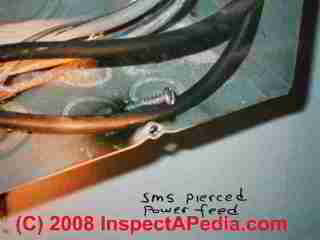 Electrical Panel Cover Screw & Fastener Safety Hazard Warnings
- POST a QUESTION or COMMENT about screws or other fasteners used to secure the electrical panel cover; replacement of lost electric panel screws.
Shock & short circuit hazards at electrical panel covers & cover screws:
This article discusses safety hazards involving the screws used at some electrical panels and suggests safety procedures for the electrical inspector, home inspector, or other professionals who examine residential electrical systems.
Safe electrical inspection procedures and safe use of volt meters, DMMs, multimeters, and similar electrical test equipment is discussed at the end of the article.
InspectAPedia tolerates no conflicts of interest. We have no relationship with advertisers, products, or services discussed at this website.
Electrical Panel Cover Fastener Screws & Electrical Meter Box Mounting Screw Hazards
[Click to enlarge any image]
- Looking:
Look carefully for evidence of burning, arcing, or other damage before touching or moving components. Eg.: sharp sheet metal screws in panel covers may short hot wires.
- Unsafe Electrical Panel Screws:
the electrical panel cover screws have been replaced with sharp pointed sheet metal screws - Electrical Panel Access, Rats & Other Distractions:
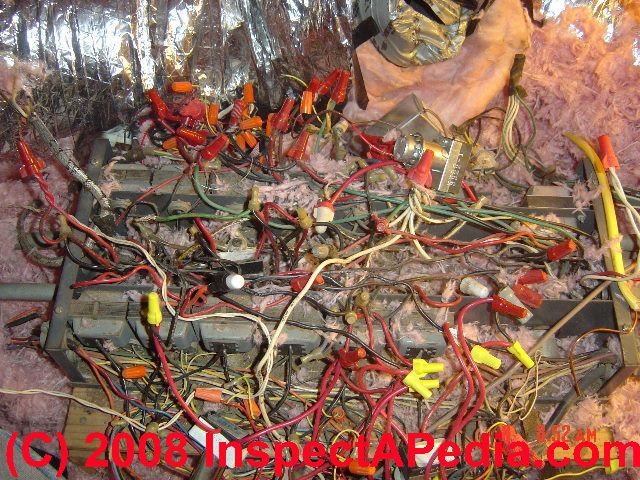
(distractions from being careful) there are rats at your feet, or there is a rats nest of wires or other obstruction to safe cover removal - watch what you say.
At an inspection the author had encouraged a nervous buyer to accompany him into an ugly dark muddy basement to inspect the mechanical systems.
The client, a woman not properly dressed for an inspection, wore high heels and a tight skirt.
She was wobbling in the dirt floor in a dark crowded corner of the basement, terrified and already shaking in the dim light. The author, encountering a maze of wires in the way of the electrical panel, forgot to edit his thoughts, and muttered aloud: "geez what a rats nest."
The client screamed "RATS!!!" and ran terrified from the basement, falling towards the dark stairs.
- Distractions during an electrical inspection are themselves dangerous.
A NE ASHI inspector reported that
As I just touched an electrical panel cover screw with my Milwaukee screwdriver I saw a tremendous flash of light - as bright as the sun. I was certain I was dead. As moments passed I realized I was still standing there, alive.
Am I alive? I asked myself. I learned that from behind me and my client, the real estate agent had chosen that moment to take a flash photograph of the proceedings. - to DF Randolph MA 09/2008
This distraction is more risky than it may appear. A sudden flash, a sudden shout or movement, could cause an inspector to lurch, touching an electrically live and dangerous component. It is important for the inspector to learn and practice calm, steady movements and to resist distractions.
How to Look for Unsafe Panel Cover Screws & for Evidence of Burning and Arcing When Approaching the Electrical Panel
- Look at the electrical panel before touching
the electrical panel cover; is there evidence of a problem such as - Arcing, Overheating or Burnups:
you see evidence of electrical failures such as burned or overheated components. In the photo at left the ground wires are clearly overheated - something is wrong. In this case a homeowner was badly shocked when he touched his metal workbench.
See Case History:Loss of Neutral Shocks Homeowner for details.
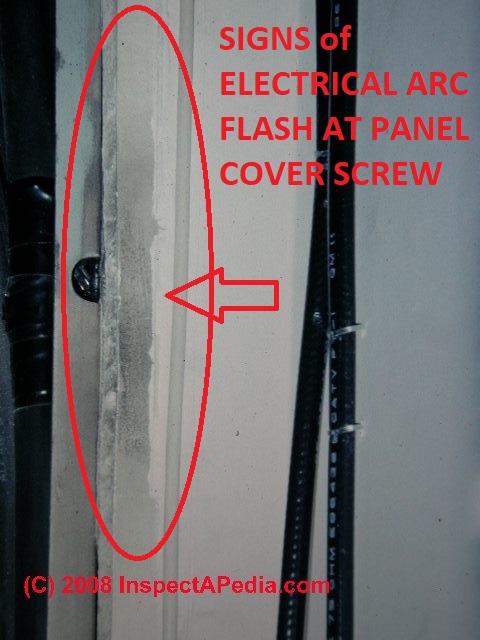
The pair of photos whoen here illustrate (above) electrical arc flashover soot, and below, the repair - tape on the electrical wire, but the wire is still too close to the screw mounting hole for the panel cover.
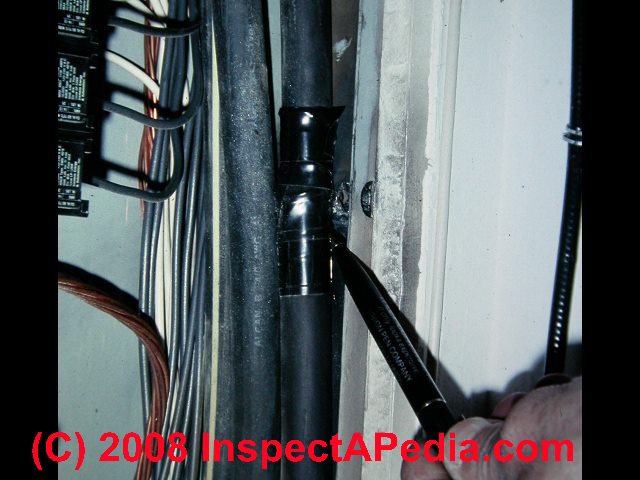
- Look for improper and unsafe electrical cover screws, sharp pointed sheet metal screws, and look for electrical cables that pass too close to the screw openings in the electrical panel.
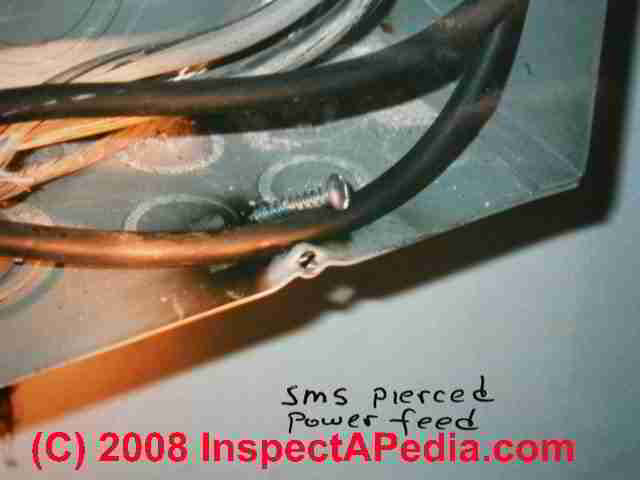 Sharp sheet metal screws:
If you find that a sharp-tipped sheet metal screw has been used (usually to replace a lost original fastener) you should be alert for pierced, damaged, short-circuited wires in the panel - both during removal and during panel cover replacement.
We will
not reinstall a sharp-pointed screw in a panel cover if wires are crowded close to the screw opening.
Having seen more than one shorted
and burned panel from precisely this cause, we warn clients about this unsafe detail. It is trivial to correct.
It's an easy fix: use a blunt tipped screw, or file off the sharp point of the SMS.
Before re-installing the cover of the electrical panel, check to assure that no electrical wires have moved close to the panel cover screw mounting holes where they might be pierced or damaged.
ELECTRICAL INSPECTOR SAFETY PROCEDURES describes important basic safety procedures, clothing, and equipment for home inspectors and electrical inspectors.
...
Continue reading at ELECTRICAL PANEL INTERIOR HAZARDS or select a topic from the closely-related articles below, or see the complete ARTICLE INDEX.
Or see these
Recommended Articles
Suggested citation for this web page
ELECTRICAL PANEL COVER SCREWS at InspectApedia.com - online encyclopedia of building & environmental inspection, testing, diagnosis, repair, & problem prevention advice.
Or see this
INDEX to RELATED ARTICLES: ARTICLE INDEX to ELECTRICAL INSPECTION & TESTING
Or use the SEARCH BOX found below to Ask a Question or Search InspectApedia
Ask a Question or Search InspectApedia
Questions & answers or comments about screws or other fasteners used to secure the electrical panel cover; replacement of lost electric panel screws..
Try the search box just below, or if you prefer, post a question or comment in the Comments box below and we will respond promptly.
Search the InspectApedia website
Note: appearance of your Comment below may be delayed: if your comment contains an image, photograph, web link, or text that looks to the software as if it might be a web link, your posting will appear after it has been approved by a moderator. Apologies for the delay.
Only one image can be added per comment but you can post as many comments, and therefore images, as you like.
You will not receive a notification when a response to your question has been posted.
Please bookmark this page to make it easy for you to check back for our response.
Our Comment Box is provided by Countable Web Productions countable.ca
Citations & References
In addition to any citations in the article above, a full list is available on request.
- Electrical shock injury statistics: www.healthatoz.com - September 2008;
- Mark Cramer Inspection Services Mark Cramer, Tampa Florida, Mr. Cramer is a past president of ASHI, the American Society of Home Inspectors and is a Florida home inspector and home inspection educator. Mr. Cramer serves on the ASHI Home Inspection Standards. Contact Mark Cramer at: 727-595-4211 mark@BestTampaInspector.com
- John Cranor [Website: /www.house-whisperer.com ] is an ASHI member and a home inspector (The House Whisperer) is located in Glen Allen, VA 23060. He is also a contributor to InspectApedia.com in several technical areas such as plumbing and appliances (dryer vents). Contact Mr. Cranor at 804-873-8534 or by Email: johncranor@verizon.net
- "Frequency of Occurrence and Sources of Rust and Corrosion in Electrical Panels," Daniel Friedman, IEEE HOLM Conference, Philadelphia PA, 1992 - see ELECTRIC PANEL RUST for an online version of this article.
- Jim Simmons: Personal communication, J. Simmons to Daniel Friedman, 9/19/2008. Photographs contributed to this website by Jim P. Simmons, Licensed Electrician, 360-705-4225 Mr. Electric, Licensed Master Electrician, Olympia, Washington Contact Jim P. Simmons, Licensed Master Electrician, Mr. Electric, 1320 Dayton Street SE
Olympia, WA 98501, Ph 360-705-4225, Fx 360-705-0130 mrelectricwa@gmail.com - Kenneth Kruger: Original author of the sidebar on testing VOM DMM condition: Kenneth Kruger, R.A., P.E. AIA ASCE, is an ASHI Member and ASHI Director in Cambridge, MA. He provided basis for this article penned by DJ Friedman.
- "How to Use DMM's Safely," Leonard Ogden, CEE News, 888 Seventh Ave., New York, NY 10106, Dec 1990 p.10.
- Dr. Jess Aronstein, consulting engineer, Poughkeepsie NY, 1991 protune@aol.com
- Rex Cauldwell, master electrician and contributor to the Journal of Light ConstructionOn electrical topics
- New York State Central Hudson Gas and Electric Company, G&E/1-2/85 consumer safety pamphlet
- American Society of Home Inspectors, ASHI Training Manual, Al Alk -[obsolete, and includes unsafe practices-DF]
- "Electrical System Inspection Basics," Richard C. Wolcott, ASHI 8th Annual Education Conference, Boston 1985.
- "Simplified Electrical Wiring," Sears, Roebuck and Co., 15705 (F5428) Rev. 4-77 1977 [Lots of sketches of older-type service panels.]
- "How to plan and install electric wiring for homes, farms, garages, shops," Montgomery Ward Co., 83-850.
- "Simplified Electrical Wiring," Sears, Roebuck and Co., 15705 (F5428) Rev. 4-77 1977 [Lots of sketches of older-type service panels.]
- "Home Wiring Inspection," Roswell W. Ard, Rodale's New Shelter, July/August, 1985 p. 35-40.
- "Evaluating Wiring in Older Minnesota Homes," Agricultural Extension Service, University of Minnesota, St. Paul, Minnesota 55108.
- In addition to citations & references found in this article, see the research citations given at the end of the related articles found at our suggested
CONTINUE READING or RECOMMENDED ARTICLES.
- Carson, Dunlop & Associates Ltd., 120 Carlton Street Suite 407, Toronto ON M5A 4K2. Tel: (416) 964-9415 1-800-268-7070 Email: info@carsondunlop.com. Alan Carson is a past president of ASHI, the American Society of Home Inspectors.
Thanks to Alan Carson and Bob Dunlop, for permission for InspectAPedia to use text excerpts from The HOME REFERENCE BOOK - the Encyclopedia of Homes and to use illustrations from The ILLUSTRATED HOME .
Carson Dunlop Associates provides extensive home inspection education and report writing material. In gratitude we provide links to tsome Carson Dunlop Associates products and services.
 | HOME | ABOUT | ASK a QUESTION | CONTACT | CONTENT USE POLICY | DESCRIPTION | POLICIES | PRIVACY | |
| © 2024 - 1985 Publisher InspectApedia.com - Daniel Friedman | |||||||||