
InspectAPedia® FREE Encyclopedia of Building & Environmental Construction, Diagnosis, Maintenance & Repair |
Question? Just ask us! InspectAPedia
|
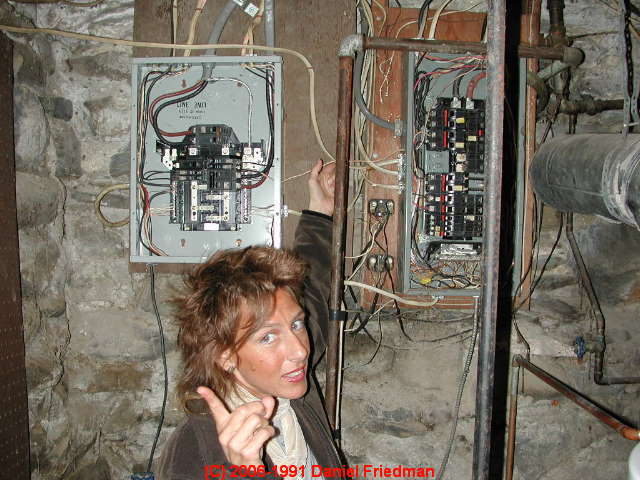
 Electrical Panel Inspection Safety Hazards and Safety Procedures for Electrical Inspectors & Home Inspectors
- POST a QUESTION or COMMENT about how to inspect the condition of electrical systems: servicen entry, meter, electrical panels, breakers, fuses, wiring, grounding - using safe procedures to avoid shock, injury, or death
Procedures for inspecting the fuse panel or electrical panel:
This article discusses safety hazards during inspection of the electrical panel at residential properties and suggests safety procedures for the electrical inspector, home inspector, or other professionals who examine residential electrical systems.
We review several standards for electrical system inspections - at the electrical panel. How to use test equipment at the electrical panel during electrical. inspections in order to improve safety.
InspectAPedia tolerates no conflicts of interest. We have no relationship with advertisers, products, or services discussed at this website.
Safety Suggestions for Inspecting the Electrical Panel Interior
 Fatal Shock Hazard Warning: Inspecting electrical components and systems risks death by electrocution as well as serious burns or other injuries to the inspector or to others. Do not attempt these tasks unless you are properly trained and equipped.
[Click to enlarge any image]
Homeowner advice for electrical panel safety: These safety suggestions are for professional inspectors and are not a guide for homeowners. Homeowners should not remove the cover from an electrical panel - it is unsafe to do so.
Homeowners should look at their electrical equipment for signs of trouble and should contact a licensed electrician to address any concerns that arise.
Without removing the electrical panel cover, but by opening the hinged electrical panel access door, homeowners can access the main circuit breaker or fuse, as well as individual circuit breakers and fuses. These devices may be turned on or off by the homeowner as safety or other needs require.
8.3.C. [The inspector is NOT required to] dismantle any electrical device or control other than to remove the covers of the main and auxiliary distribution panels.
How might the astute inspector spot trouble in an electrical panel cover before opening it?
At least three deaths have been reported to have occurred during the inspection of an electrical panel.
Atlanta GA, a licensed electrician was opening the panel for inspection.] Apparently there was an incipient problem with the spring-loaded bus-bar assembly. When the cover was removed the bus assembly moved, an arc caused an electrical explosion, killing the inspector. -- J. Aronstein to D. Friedman, personal communication, 12/1991.
The Assistant [Fire] Chief accompanied a contract electrician, the Assistant Building Engineer, and the Loss Control Manager to the engineering room on the first floor which houses electrical panels for the store.
During testing of one of the panels, a fault occurred, resulting in the formation of a fireball, killing the Assistant Chief and the electrician. The Assistant Building Engineer received serious burns. - NFPA - 06/11/1999
The following photos and text provide examples of external evidence that may let the inspector avoid trouble or a nasty surprise when inspecting electrical equipment.
Before touching the electrical panel the inspector should look for these conditions:
- Escape path:
make sure that you know where you will turn and/or step back to retreat from the equipment if you discover a sudden and dangerous surprise (sparks, rats, bees, etc). - Electrical safety equipment:
depending on the type of electrical equipment to be examined and the circumstances, special safety protective gear is required, such as eye protection, protective clothing, gloves, grounding straps, etc. Examples are
at ELECTRICAL INSPECTOR SAFETY PROCEDURES. - Electrical hazard assessment:
depending on the type of electrical equipment to be examined and the circumstances, it may be necessary to first perform a special assessment of the risk of electrical explosion, arcing, fires, etc. as suggested in the NFPAarticle at ourReferences or Citations .
Below we continue with less technical electrical safety hazards and safety concerns likely to be encountered in the residential or light commercial environment. - Wet floors or other wet conditions affecting electrical inspection safety:
- Do not touch electrical equipment if you are standing on a wet surface.
- Notice the cold water pipe condensation dripping onto and into the electrical panel in the left hand photo below
This photo shows a common way that water may enter an electrical panel as well as drip on its exterior.
A cold water pipe produces condensation which drips on the panel top. This pipe is too close and is in a poor location over this electrical service box.
Is there:
- Wet electrical quipment:
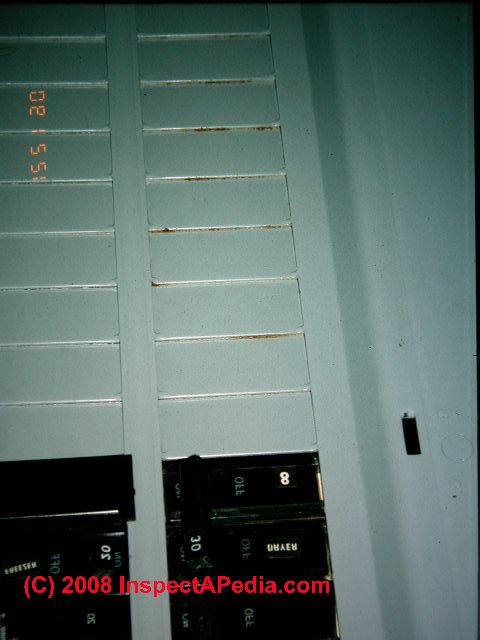
the electrical panel cover is wet - Electrical Panel Rust:
the electrical panel cover is rusty
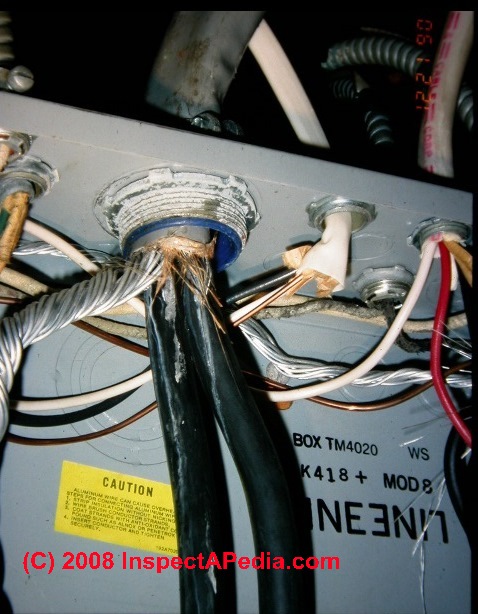
The pair of photographs below show two clear warnings that water has been entering an electrical panel - watch out for rust, and for circuit breakers that may not trip in response to an overcurrent, due to internal corrosion.
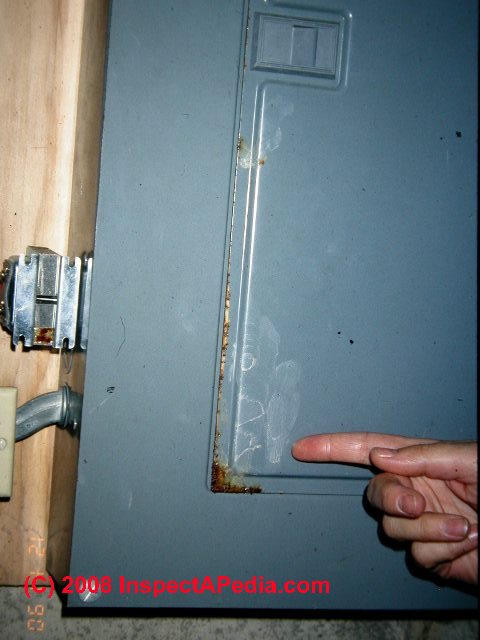
This defect is not one for which a home inspector (nor most electricians) can reliably test in a home, but the warning remains appropriate. Replace such breakers, and if the electrical panel is badly corroded the entire panel needs replacement.
See RUST in ELECTRICAL PANELS for a detailed account of the sources of water and rust in electrical panels and the frequency of observation of rust and water damage in that equipment.
Safety Procedures for Removing Electric Panel Covers: for Electrical Inspectors & Home Inspectors
ASHI Standards 8.1.B [The inspector shall observe] service equipment, grounding equipment, main overcurrent device, main and distribution panels.
Details are at ELECTRICAL PANEL COVER REMOVAL
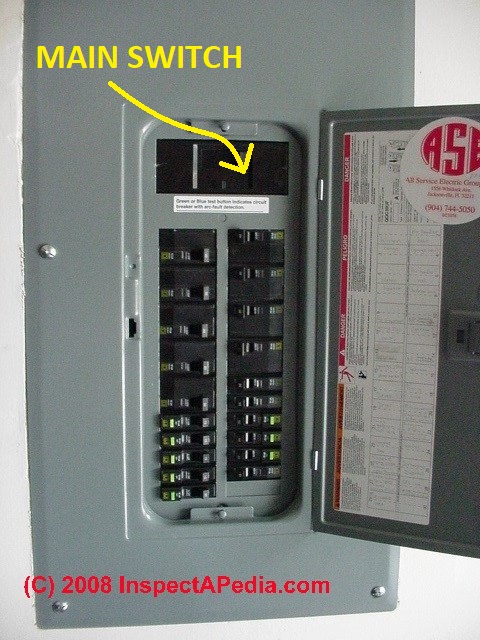
- Distance:
Warn clients to remain at a safe distance. - Assistance:
Do not permit your client to assist you in removing or installing the panel cover. Only one person should be touching electrical components at any time.The author asks clients to stand a little back while removing the cover, which makes it easier to remain in a blocking position (below).
We might inform the client that opening the panel is a dangerous step, and that if sparks fly the client should not touch the inspector - though other parties present at the inspection might want to kick the inspector or take similar measures if necessary.
- Blocking:
Stand so as to block your client from touching the panel or its components. - Touching:
Do not permit your client to touch electrical equipment.At an inspection in a damp dark crowded basement the author was standing blocking the very curious and active participatory client from the open electrical panel after the cover had been removed.
The client reached over the author's shoulder.
The client asked, "What's this?" as he stuck his finger straight into an open fuse socket while his arm contacted the inspector's shoulder, assuring that they both would get an electrical shock. - Grounding:
Check visually (and electrically if needed) for presence of system grounding before touching electrical components.
Details about inspecting electrical grounding and definitions are
at ELECTRICAL GROUND SYSTEM INSPECTION
And don't count on the safety of the "backup ground" back at the utility company's service lines and poles: that ground may have been interrupted too. - See DOUBLE FAULT, LOSS OF ELECTRICITY for an account of loss of both local ground and utility company ground at a property.
...
Continue reading at ELECTRICAL PANEL INTERIOR HAZARDS or select a topic from the closely-related articles below, or see the complete ARTICLE INDEX.
Or see these
Recommended Articles
- ELECTRICAL INSPECTOR SAFETY PROCEDURES important basic safety procedures, clothing, and equipment for home inspectors and electrical inspectors.
- SAFETY for ELECTRICAL INSPECTORS
Suggested citation for this web page
ELECTRICAL PANEL INSPECTION SAFETY at InspectApedia.com - online encyclopedia of building & environmental inspection, testing, diagnosis, repair, & problem prevention advice.
Or see this
INDEX to RELATED ARTICLES: ARTICLE INDEX to ELECTRICAL INSPECTION & TESTING
Or use the SEARCH BOX found below to Ask a Question or Search InspectApedia
Ask a Question or Search InspectApedia
Questions & answers or comments about how to inspect the condition of electrical systems: servicen entry, meter, electrical panels, breakers, fuses, wiring, grounding - using safe procedures to avoid shock, injury, or death.
Try the search box just below, or if you prefer, post a question or comment in the Comments box below and we will respond promptly.
Search the InspectApedia website
Note: appearance of your Comment below may be delayed: if your comment contains an image, photograph, web link, or text that looks to the software as if it might be a web link, your posting will appear after it has been approved by a moderator. Apologies for the delay.
Only one image can be added per comment but you can post as many comments, and therefore images, as you like.
You will not receive a notification when a response to your question has been posted.
Please bookmark this page to make it easy for you to check back for our response.
Our Comment Box is provided by Countable Web Productions countable.ca
Citations & References
In addition to any citations in the article above, a full list is available on request.
- Electrical shock injury statistics: www.healthatoz.com - September 2008;
High-tension current generally causes the most serious injuries, although fatal electrocutions may occur with household current (e.g., 110 V in the United States and Canada and 220 V in Europe, Australia, and Asia). Contact with alternating current at 60 cycles per second (the frequency used in most US household and commercial sources of electricity) may cause tetanic skeletal muscle contractions, preventing self-release from the source of the electricity and thereby leading to prolonged exposure. The repetitive frequency of alternating current also increases the likelihood of current flow through the heart during the relative refractory period (the "vulnerable period") of the cardiac cycle. This exposure can precipitate ventricular fibrillation (VF), which is analogous to the R-on-T phenomenon.-- circ.ahajournals.org - September 2008
- Mark Cramer Inspection Services Mark Cramer, Tampa Florida, Mr. Cramer is a past president of ASHI, the American Society of Home Inspectors and is a Florida home inspector and home inspection educator. Mr. Cramer serves on the ASHI Home Inspection Standards. Contact Mark Cramer at: 727-595-4211 mark@BestTampaInspector.com
- John Cranor [Website: /www.house-whisperer.com ] is an ASHI member and a home inspector (The House Whisperer) is located in Glen Allen, VA 23060. He is also a contributor to InspectApedia.com in several technical areas such as plumbing and appliances (dryer vents). Contact Mr. Cranor at 804-873-8534 or by Email: johncranor@verizon.net
- "Frequency of Occurrence and Sources of Rust and Corrosion in Electrical Panels," Daniel Friedman, IEEE HOLM Conference, Philadelphia PA, 1992 - see ELECTRIC PANEL RUST for an online version of this article.
- Jim Simmons: Personal communication, J. Simmons to Daniel Friedman, 9/19/2008. Photographs contributed to this website by Jim P. Simmons, Licensed Electrician, 360-705-4225 Mr. Electric, Licensed Master Electrician, Olympia, Washington Contact Jim P. Simmons, Licensed Master Electrician, Mr. Electric, 1320 Dayton Street SE
Olympia, WA 98501, Ph 360-705-4225, Fx 360-705-0130 mrelectricwa@gmail.com - Kenneth Kruger: Original author of the sidebar on testing VOM DMM condition: Kenneth Kruger, R.A., P.E. AIA ASCE, is an ASHI Member and ASHI Director in Cambridge, MA. He provided basis for this article penned by DJ Friedman.
- "How to Use DMM's Safely," Leonard Ogden, CEE News, 888 Seventh Ave., New York, NY 10106, Dec 1990 p.10.
- Dr. Jess Aronstein, consulting engineer, Poughkeepsie NY, 1991 protune@aol.com
- Rex Cauldwell, master electrician and contributor to the Journal of Light ConstructionOn electrical topics
- New York State Central Hudson Gas and Electric Company, G&E/1-2/85 consumer safety pamphlet
- "Electrical Panel Explosion Claims the Life of a Career Assistant Fire Chief, an Electrician, and Seriously Inures an Assistant Building Engineer", NFPA: National Fire Protection Association, www.nfpa.org/assets/files//PDF/Member%20Sections/BFSS_3.pdf "This incident was investigated by: Ted A. Pettit, Senior Fire Fighter Investigator, Division of Safety Research, National Institute for Occupational Safety and Health (NIOSH) and Dr. Wils Cooley, Professor, College of Engineering and Mineral
Resources, West Virginia University. Jay L. Tarley, Safety And Occupational Health Specialist, from NIOSH assisted with the completion of the final report." The NFPA provides these additional electrical safety references:
- 29 CFR 1910.333. Selection and use of work practices. Code of Federal Regulations, U.S. Department of Labor, Occupational Safety and Health Administration.
- NIOSH[1999]. Preventing worker deaths from uncontrolled release of electrical, mechanical, and other types of hazardous energy. National Institute for Occupational Safety and Health.
- NFPA 70E, 3-3. Standard for Electrical Safety Requirements for Employee Workplaces, 2000 Edition.
- NFPA 70E, 2-1. Standard for Electrical Safety Requirements for Employee Workplaces, 2000 Edition.
- American Society of Home Inspectors, ASHI Training Manual, Al Alk -[obsolete, and includes unsafe practices-DF]
- "Electrical System Inspection Basics," Richard C. Wolcott, ASHI 8th Annual Education Conference, Boston 1985.
- "Simplified Electrical Wiring," Sears, Roebuck and Co., 15705 (F5428) Rev. 4-77 1977 [Lots of sketches of older-type service panels.]
- "How to plan and install electric wiring for homes, farms, garages, shops," Montgomery Ward Co., 83-850.
- "Simplified Electrical Wiring," Sears, Roebuck and Co., 15705 (F5428) Rev. 4-77 1977 [Lots of sketches of older-type service panels.]
- "Home Wiring Inspection," Roswell W. Ard, Rodale's New Shelter, July/August, 1985 p. 35-40.
- "Evaluating Wiring in Older Minnesota Homes," Agricultural Extension Service, University of Minnesota, St. Paul, Minnesota 55108.
- In addition to citations & references found in this article, see the research citations given at the end of the related articles found at our suggested
CONTINUE READING or RECOMMENDED ARTICLES.
- Carson, Dunlop & Associates Ltd., 120 Carlton Street Suite 407, Toronto ON M5A 4K2. Tel: (416) 964-9415 1-800-268-7070 Email: info@carsondunlop.com. Alan Carson is a past president of ASHI, the American Society of Home Inspectors.
Thanks to Alan Carson and Bob Dunlop, for permission for InspectAPedia to use text excerpts from The HOME REFERENCE BOOK - the Encyclopedia of Homes and to use illustrations from The ILLUSTRATED HOME .
Carson Dunlop Associates provides extensive home inspection education and report writing material. In gratitude we provide links to tsome Carson Dunlop Associates products and services.
 | HOME | ABOUT | ASK a QUESTION | CONTACT | CONTENT USE POLICY | DESCRIPTION | POLICIES | PRIVACY | |
| © 2024 - 1985 Publisher InspectApedia.com - Daniel Friedman | |||||||||