
InspectAPedia® FREE Encyclopedia of Building & Environmental Construction, Diagnosis, Maintenance & Repair |
Question? Just ask us! InspectAPedia
|
 Electrical Safety Hazards
When Should an Inspector Shut Down Unsafe Electrical Equipment
- POST a QUESTION or COMMENT about how to decide when to turn off electrical systems or equipment for safety reasons
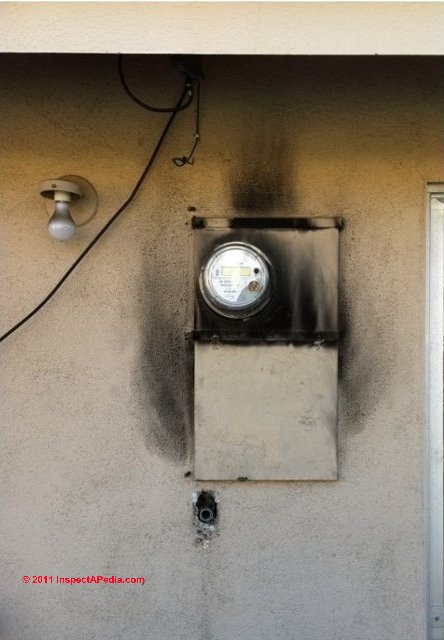
Electrical hazards that mean TURN IT OFF!
This article discusses safety hazards at residential electrical systems that may lead an inspector to turn off or shut down equipment, even if there is risk of collateral damage such as loss of heat. There are also circumstances in which an inspector should not turn off electrical equipment during testing because doing so may create a greater hazard.
These electrical inspection suggestions are not a complete inventory of all electrical safety procedures nor of all electrical components that should be inspected; these notes focus on identification of conditions that may present special electrical hazards for the electrical inspector. Contact Us by email to suggest changes, corrections, and additions to this material.
InspectAPedia tolerates no conflicts of interest. We have no relationship with advertisers, products, or services discussed at this website.
When to Shut Down Unsafe Electrical Equipment
ASHI Home Inspector Educational Seminar Proceedings: ASHI-NE Chapter Annual conference September 22-23, 2008, Randolph, MA. -- Daniel Friedman. This is the full text version. A powerpoint presentation version of this class is also available.
Original text - Daniel Friedman, as ASHI Technical Journal Staff, January 1992,updates February 2006, September 2008.
This is the full text version. A powerpoint presentation version of this class is also available. Readers of this article should also see these other building inspection safety articles: Safety for Building Inspectors and Septic Inspection Safety and also STAIRS, RAILINGS, LANDINGS, RAMPS - INSPECTIONS, CODESSome inspectors, with adequate training, exceed the requirements of the standards and will actually shut down extremely dangerous equipment themselves.
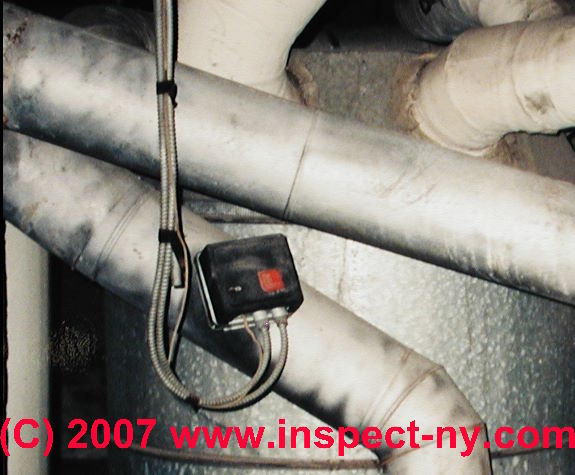
Even the simple task of pulling the cover on a marginal bimetallic stack relay switch on an oil-fired heater can result in failure or inadvertent shutdown of the equipment.
Stack relays (shown below) have a stepping lever which is reset by the service person if the switch, often fragile on old systems, is disturbed.
Be warned that whether you touch a building component or not there are grave responsibilities.
Touching a building component: if you precipitate a catastrophe, will of course be viewed as a mistake.
Not touching a building component: Failing to act effectively to protect occupants of a building you inspect will, of course, also be viewed as a mistake. If you failed to inspect, detect, report a hazard in a building you may bear liability if later an event occurs.
Disclaimers: A simple disclaimer "not inspected" is in adequate. An adequate disclaimer that meets ASHI standards makes sure that the client understands the significance of an observation [or of steps to omit making an observation].
The last man in rule: Trade and professional education classes concerning mechanical systems, which can involve life-safety concerns, commonly teach the "last man in" rule. Home inspectors know this problem as well. The last "expert" to set foot on the property is vulnerable to blame for any ensuing failures, even if s/he acted entirely correctly and even if s/he never touched the component later in question.
During an electrical inspection, it's your judgment call. Document your judgment
In the final analysis then, the precise safety steps to be taken are up to the judgment of the inspector at the scene. The inspector should also document his or her action. Failing to do anything and failing to even serve notice may be viewed as very dangerous and seriously irresponsible.
With proper training, knowledge, and procedures, electrical inspections can be done safely and accurately. Be careful.
If in your opinion unsafe conditions exist at a property you are inspecting you should notify all parties concerned, including building occupants/management/owners, realtors involved, and other appropriate authorities.
December 18, 1988 - Smyrna, GA - A Smyrna family's troubles with a faulty circuit breaker in their mobile home ended in tragedy when a fire broke out and killed 18-year-old Jeffrey Scott Auton. Auton's family, experiencing problems with the main circuit breaker, went to a home products store to buy a new one for their trailer, said Fire Investigator David Herndon.
The store did not have a circuit
breaker to fit the family's needs and a new one had to be ordered.
.... Herndon said the fire was started when the circuit breaker shut
down completely as three space heaters were running. The family had
a history of problems with the breaker, particularly from a load put
on it by a large heating unit. Herndon stated that after the fire
there was not a trace left of the circuit breaker; it was completely
gone from
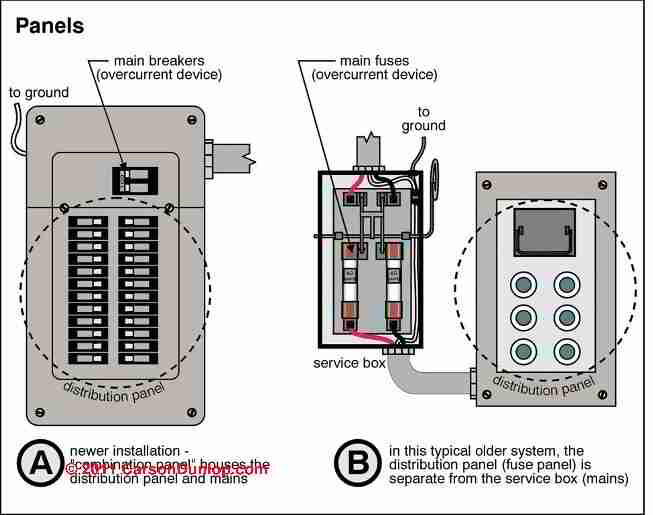
For example, what if the case above had happened the day after the property described had been examined by an ASHI inspector? Were there perhaps clues which telegraph a developing problem? What about anecdotal reports from the occupants of recurrent breaker tripping, visible signs of overheating in the panel, widespread and unusual use of electric heaters, or evidence of work in the panel by untrained people? These risks to occupants are also a hazard to the inspector on several bases.
...
Continue reading at TOUCHING ELECTRICAL EQUIPMENT or select a topic from the closely-related articles below, or see the complete ARTICLE INDEX.
Or see these
Recommended Articles
- ELECTRICAL INSPECTION, DIAGNOSIS, REPAIR - home
- ELECTRICAL INSPECTOR SAFETY PROCEDURES - important basic safety procedures, clothing, and equipment for home inspectors and electrical inspectors.
Suggested citation for this web page
SHUT DOWN EQUIPMENT, WHEN TO at InspectApedia.com - online encyclopedia of building & environmental inspection, testing, diagnosis, repair, & problem prevention advice.
Or see this
INDEX to RELATED ARTICLES: ARTICLE INDEX to ELECTRICAL INSPECTION & TESTING
Or use the SEARCH BOX found below to Ask a Question or Search InspectApedia
Ask a Question or Search InspectApedia
Try the search box just below, or if you prefer, post a question or comment in the Comments box below and we will respond promptly.
Search the InspectApedia website
Note: appearance of your Comment below may be delayed: if your comment contains an image, photograph, web link, or text that looks to the software as if it might be a web link, your posting will appear after it has been approved by a moderator. Apologies for the delay.
Only one image can be added per comment but you can post as many comments, and therefore images, as you like.
You will not receive a notification when a response to your question has been posted.
Please bookmark this page to make it easy for you to check back for our response.
Our Comment Box is provided by Countable Web Productions countable.ca
Citations & References
In addition to any citations in the article above, a full list is available on request.
- Electrical shock injury statistics: www.healthatoz.com - September 2008;
- Mark Cramer Inspection Services Mark Cramer, Tampa Florida, Mr. Cramer is a past president of ASHI, the American Society of Home Inspectors and is a Florida home inspector and home inspection educator. Mr. Cramer serves on the ASHI Home Inspection Standards. Contact Mark Cramer at: 727-595-4211 mark@BestTampaInspector.com
- John Cranor [Website: /www.house-whisperer.com ] is an ASHI member and a home inspector (The House Whisperer) is located in Glen Allen, VA 23060. He is also a contributor to InspectApedia.com in several technical areas such as plumbing and appliances (dryer vents). Contact Mr. Cranor at 804-873-8534 or by Email: johncranor@verizon.net
- "Frequency of Occurrence and Sources of Rust and Corrosion in Electrical Panels," Daniel Friedman, IEEE HOLM Conference, Philadelphia PA, 1992 - see ELECTRIC PANEL RUST for an online version of this article.
- Jim Simmons: Personal communication, J. Simmons to Daniel Friedman, 9/19/2008. Photographs contributed to this website by Jim P. Simmons, Licensed Electrician, 360-705-4225 Mr. Electric, Licensed Master Electrician, Olympia, Washington Contact Jim P. Simmons, Licensed Master Electrician, Mr. Electric, 1320 Dayton Street SE
Olympia, WA 98501, Ph 360-705-4225, Fx 360-705-0130 mrelectricwa@gmail.com - Kenneth Kruger: Original author of the sidebar on testing VOM DMM condition: Kenneth Kruger, R.A., P.E. AIA ASCE, is an ASHI Member and ASHI Director in Cambridge, MA. He provided basis for this article penned by DJ Friedman.
- "How to Use DMM's Safely," Leonard Ogden, CEE News, 888 Seventh Ave., New York, NY 10106, Dec 1990 p.10.
- Dr. Jess Aronstein, consulting engineer, Poughkeepsie NY, 1991 protune@aol.com
- Rex Cauldwell, master electrician and contributor to the Journal of Light ConstructionOn electrical topics
- New York State Central Hudson Gas and Electric Company, G&E/1-2/85 consumer safety pamphlet
- American Society of Home Inspectors, ASHI Training Manual, Al Alk -[obsolete, and includes unsafe practices-DF]
- "Electrical System Inspection Basics," Richard C. Wolcott, ASHI 8th Annual Education Conference, Boston 1985.
- "Simplified Electrical Wiring," Sears, Roebuck and Co., 15705 (F5428) Rev. 4-77 1977 [Lots of sketches of older-type service panels.]
- "How to plan and install electric wiring for homes, farms, garages, shops," Montgomery Ward Co., 83-850.
- "Simplified Electrical Wiring," Sears, Roebuck and Co., 15705 (F5428) Rev. 4-77 1977 [Lots of sketches of older-type service panels.]
- "Home Wiring Inspection," Roswell W. Ard, Rodale's New Shelter, July/August, 1985 p. 35-40.
- "Evaluating Wiring in Older Minnesota Homes," Agricultural Extension Service, University of Minnesota, St. Paul, Minnesota 55108.
- "Electrical Systems," A Training Manual for Home Inspectors, Alfred L. Alk, American Society of Home Inspectors (ASHI), 1987, available from ASHI. [DF NOTE: I do NOT recommend this obsolete publication, though it was cited in the original Journal article as it contains unsafe inaccuracies]
- "Basic Housing Inspection," US DHEW, S352.75 U48, p.144, out of print, but is available in most state libraries.
- In addition to citations & references found in this article, see the research citations given at the end of the related articles found at our suggested
CONTINUE READING or RECOMMENDED ARTICLES.
- Carson, Dunlop & Associates Ltd., 120 Carlton Street Suite 407, Toronto ON M5A 4K2. Tel: (416) 964-9415 1-800-268-7070 Email: info@carsondunlop.com. Alan Carson is a past president of ASHI, the American Society of Home Inspectors.
Thanks to Alan Carson and Bob Dunlop, for permission for InspectAPedia to use text excerpts from The HOME REFERENCE BOOK - the Encyclopedia of Homes and to use illustrations from The ILLUSTRATED HOME .
Carson Dunlop Associates provides extensive home inspection education and report writing material. In gratitude we provide links to tsome Carson Dunlop Associates products and services.
 | HOME | ABOUT | ASK a QUESTION | CONTACT | CONTENT USE POLICY | DESCRIPTION | POLICIES | PRIVACY | |
| © 2024 - 1985 Publisher InspectApedia.com - Daniel Friedman | |||||||||