
InspectAPedia® FREE Encyclopedia of Building & Environmental Construction, Diagnosis, Maintenance & Repair |
Question? Just ask us! InspectAPedia
|
 Electrical Breakers, Fuses, Circuit Inspection Safety Procedures
- POST a QUESTION or COMMENT about how to examine electrical circuit breakers, fuses, and overcurrent devices for their safety and operating condition
How to inspect circuit brearkers & fuses: this article discusses suggests safety procedures for the electrical inspector, home inspector, or other professionals during inspection of individual circuit breakers, fuses, or branch circuit conductors - home electrical wiring safety inspection details.
InspectAPedia tolerates no conflicts of interest. We have no relationship with advertisers, products, or services discussed at this website.
Safety Procedures When Inspecting Branch Circuit Conductors, Breakers,Fuses, &c.
Fatal Shock Hazard Warning: Inspecting electrical components and systems risks death by electrocution as well as serious burns or other injuries to the inspector or to others. Do not attempt these tasks unless you are properly trained and equipped.
[Click to enlarge any image]
These electrical inspection suggestions are not a complete inventory of all electrical safety procedures nor of all electrical components that should be inspected; these notes focus on identification of conditions that may present special electrical hazards for the electrical inspector. Contact Us by email to suggest changes, corrections, and additions to this material.
ASHI Home Inspection Standards 8.1.D. [The inspector shall observe] branch circuit conductors, their overcurrent devices, and the compatibility of their ampacities and voltages
In addition to examining the electrical panel before touching it, looking for dangerous conditions like water, rust, sheet metal screws, rats, and blocking client access, the inspector should also recognize that certain brands or models of electrical equipment are known to be unsafe and may be dangerous to inspect or operate.
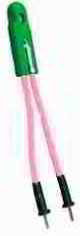
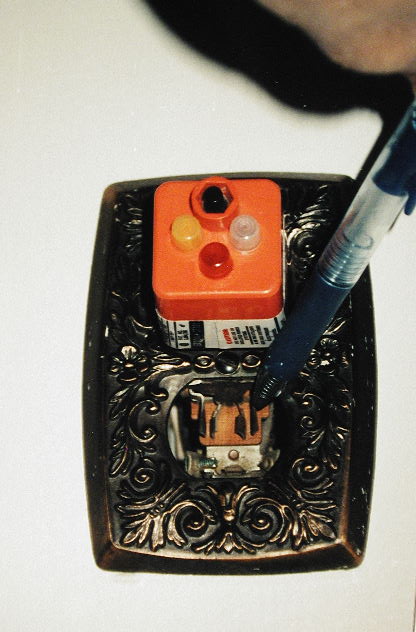
The simple neon-tester shown at above left is a quick easy way to check for the presence of electrical power at an electrical receptacle, lighting fixture, or switch. The receptacle tester shown at above right includes a test button and circuit for testing GFCI devices; however it works equally well testing an ordinary electrical receptacle such as the one shown here.
But beware: notice that theelectrical receptacle in our photo at above right was damaged - the plastic face of the lower connectors has been lost.
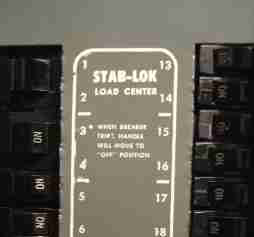
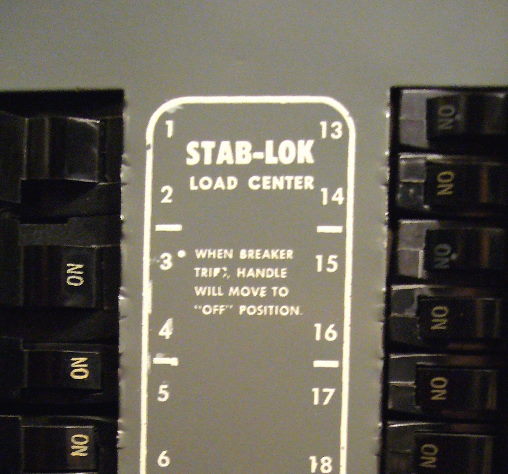 Examples of unreliable electrical panels include Federal Pacific Electric Stab-Lok equipment - this product uses breakers which remain internally "on" when switched "off", as well as too often failing to trip off in response to an overcurrent, and which have been reported to result in electrical arc explosions when manually or otherwise exercised.
A careless inspector who touches this device or inserts a metal tool into it while showing it to a client is at risk of getting burned or shocked.
Proper use of test tools during an electrical inspection is critical for safety and is discussed beginning
at GUIDE to ELECTRICAL TEST EQUIPMENT
Opening the electrical panel to examine overcurrent devices - fuses or circuit breakers, is discussed
Inspecting overcurrent devices - visual:
see ELECTRIC PANEL AMPACITY
and ELECTRIC PANEL INSPECTION for detailed procedures. There is a huge amount of information about the electrical system inside of the electrical panels.
Reporting unsafe electrical panels and unreliable circuit breakers:
see FEDERAL PACIFIC FPE HAZARDS
and
see ZINSCO / SYLVANIA HAZARDS.
As we mentioned
at TEST MAIN BREAKERS & FUSES, we advise against testing FPE Stab-Lok or Zinsco equipment by switching it on or off.
The inspector is not required to insert anything, finger, screwdriver, probe, into the electrical panel. The required inspection is visual. Observe. However an inspector is of course permitted to perform other tests or services which s/he chooses to provide (presuming s/he is qualified, trained, and that three are no conflicts of interest).
Inspecting Electrical Branch Circuit Wiring
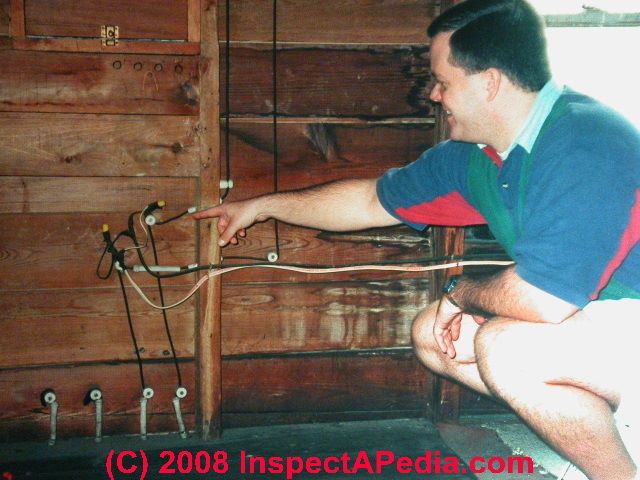 Inspecting wiring - visual: gain, a visual inspection of the wire size compared with breaker
ratings is what is meant by this section. If you need them, plastic,
non-conductive wire gauges are available.
Inspecting wiring - visual: gain, a visual inspection of the wire size compared with breaker
ratings is what is meant by this section. If you need them, plastic,
non-conductive wire gauges are available.
Do not use metal wire gauges in or around electrical equipment.
Do not let your client touch wiring such as the knob and tube connections shown in the photograph at left.
Reporting aluminum wire:
see ALUMINUM WIRING HAZARDS & REPAIRS
Reporting knob and tube wiring: s
Safety Procedures When Inspecting Electrical Outlets, Switches, Lights
8.1.E. [The inspector shall observe] the operation of a representative number of installed lighting fixtures, switches, and receptacles located inside the house, garage, and on its exterior walls
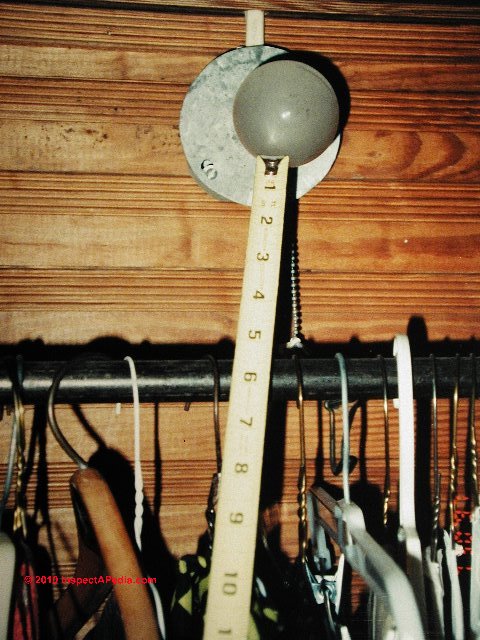 Before operating a switch or device perform a visual inspection for
damage, looseness, burning or arcing, or heat.
Before operating a switch or device perform a visual inspection for
damage, looseness, burning or arcing, or heat.
Devices missing cover plates are unsafe and risk both shock and fire.
Metal cover plates also add shock risks.
Watch out about turning on switches found off in the service panel.
A circuit found in the off position may be that way due to an unsafe condition or a repair in progress. Leave it off and document the finding. The property owner should be consulted for permission before turning on any electrical device which has been found shut down.
The light shown in our photo is a fire hazard and needs to be moved or replaced with an enclosed florescent fixture.
Also be careful about turning off switches found on. You may damage a computer data base, turn off a heart-lung machine, reset an alarm system, or turn off a marginal switch for the heat that leaves the property with no heat in freezing weather. Be safe and avoid disputes.
An example of accidentally switching off circuits in a building occurs often during removal of an awkward electrical panel cover - it's easy to accidentally push one or more circuit breakers into their off position during cover removal or replacement.
...
Continue reading at MAIN ELECTRICAL DISCONNECT or select a topic from the closely-related articles below, or see the complete ARTICLE INDEX.
Or see these
Recommended Articles
- AFCIs ARC FAULT CIRCUIT INTERRUPTERS
- CIRCUIT BREAKER FAILURE RATES
- CIRCUIT BREAKER / FUSE INSPECTION
- CIRCUIT BREAKER LOCKS
- CIRCUIT BREAKER HANDLE TIES
- CIRCUIT BREAKER MAIN or FUSE TEST
- CIRCUIT BREAKER REPLACEMENT
- CIRCUIT BREAKER RESET STEPS
- CIRCUIT BREAKERS RE-CONDITIONED USED
- CIRCUIT BREAKER RELIABILITY TESTS
- CIRCUIT BREAKER SIZE for A/C or HEAT PUMP
- GFCI PROTECTION, GFCI CODES
- GFCI DEVICE SELECTION & WIRING
- GFCI TEST PROCEDURES
- MOBILE HOME ELECTRICAL GFCI DIAGNOSIS
Suggested citation for this web page
INSPECT CIRCUIT BREAKERS, FUSES at InspectApedia.com - online encyclopedia of building & environmental inspection, testing, diagnosis, repair, & problem prevention advice.
Or see this
INDEX to RELATED ARTICLES: ARTICLE INDEX to ELECTRICAL INSPECTION & TESTING
Or use the SEARCH BOX found below to Ask a Question or Search InspectApedia
Ask a Question or Search InspectApedia
Try the search box just below, or if you prefer, post a question or comment in the Comments box below and we will respond promptly.
Search the InspectApedia website
Note: appearance of your Comment below may be delayed: if your comment contains an image, photograph, web link, or text that looks to the software as if it might be a web link, your posting will appear after it has been approved by a moderator. Apologies for the delay.
Only one image can be added per comment but you can post as many comments, and therefore images, as you like.
You will not receive a notification when a response to your question has been posted.
Please bookmark this page to make it easy for you to check back for our response.
Our Comment Box is provided by Countable Web Productions countable.ca
Citations & References
In addition to any citations in the article above, a full list is available on request.
- Electrical shock injury statistics: www.healthatoz.com - September 2008;
- Mark Cramer Inspection Services Mark Cramer, Tampa Florida, Mr. Cramer is a past president of ASHI, the American Society of Home Inspectors and is a Florida home inspector and home inspection educator. Mr. Cramer serves on the ASHI Home Inspection Standards. Contact Mark Cramer at: 727-595-4211 mark@BestTampaInspector.com
- John Cranor [Website: /www.house-whisperer.com ] is an ASHI member and a home inspector (The House Whisperer) is located in Glen Allen, VA 23060. He is also a contributor to InspectApedia.com in several technical areas such as plumbing and appliances (dryer vents). Contact Mr. Cranor at 804-873-8534 or by Email: johncranor@verizon.net
- "Frequency of Occurrence and Sources of Rust and Corrosion in Electrical Panels," Daniel Friedman, IEEE HOLM Conference, Philadelphia PA, 1992 - see ELECTRIC PANEL RUST for an online version of this article.
- Jim Simmons: Personal communication, J. Simmons to Daniel Friedman, 9/19/2008. Photographs contributed to this website by Jim P. Simmons, Licensed Electrician, 360-705-4225 Mr. Electric, Licensed Master Electrician, Olympia, Washington Contact Jim P. Simmons, Licensed Master Electrician, Mr. Electric, 1320 Dayton Street SE
Olympia, WA 98501, Ph 360-705-4225, Fx 360-705-0130 mrelectricwa@gmail.com - Kenneth Kruger: Original author of the sidebar on testing VOM DMM condition: Kenneth Kruger, R.A., P.E. AIA ASCE, is an ASHI Member and ASHI Director in Cambridge, MA. He provided basis for this article penned by DJ Friedman.
- "How to Use DMM's Safely," Leonard Ogden, CEE News, 888 Seventh Ave., New York, NY 10106, Dec 1990 p.10.
- Dr. Jess Aronstein, consulting engineer, Poughkeepsie NY, 1991 protune@aol.com
- Rex Cauldwell, master electrician and contributor to the Journal of Light ConstructionOn electrical topics
- New York State Central Hudson Gas and Electric Company, G&E/1-2/85 consumer safety pamphlet
- American Society of Home Inspectors, ASHI Training Manual, Al Alk -[obsolete, and includes unsafe practices-DF]
- "Electrical System Inspection Basics," Richard C. Wolcott, ASHI 8th Annual Education Conference, Boston 1985.
- "Simplified Electrical Wiring," Sears, Roebuck and Co., 15705 (F5428) Rev. 4-77 1977 [Lots of sketches of older-type service panels.]
- "How to plan and install electric wiring for homes, farms, garages, shops," Montgomery Ward Co., 83-850.
- "Simplified Electrical Wiring," Sears, Roebuck and Co., 15705 (F5428) Rev. 4-77 1977 [Lots of sketches of older-type service panels.]
- "Home Wiring Inspection," Roswell W. Ard, Rodale's New Shelter, July/August, 1985 p. 35-40.
- "Evaluating Wiring in Older Minnesota Homes," Agricultural Extension Service, University of Minnesota, St. Paul, Minnesota 55108.
- "Electrical Systems," A Training Manual for Home Inspectors, Alfred L. Alk, American Society of Home Inspectors (ASHI), 1987, available from ASHI. [DF NOTE: I do NOT recommend this obsolete publication, though it was cited in the original Journal article as it contains unsafe inaccuracies]
- "Basic Housing Inspection," US DHEW, S352.75 U48, p.144, out of print, but is available in most state libraries.
- In addition to citations & references found in this article, see the research citations given at the end of the related articles found at our suggested
CONTINUE READING or RECOMMENDED ARTICLES.
- Carson, Dunlop & Associates Ltd., 120 Carlton Street Suite 407, Toronto ON M5A 4K2. Tel: (416) 964-9415 1-800-268-7070 Email: info@carsondunlop.com. Alan Carson is a past president of ASHI, the American Society of Home Inspectors.
Thanks to Alan Carson and Bob Dunlop, for permission for InspectAPedia to use text excerpts from The HOME REFERENCE BOOK - the Encyclopedia of Homes and to use illustrations from The ILLUSTRATED HOME .
Carson Dunlop Associates provides extensive home inspection education and report writing material. In gratitude we provide links to tsome Carson Dunlop Associates products and services.
 | HOME | ABOUT | ASK a QUESTION | CONTACT | CONTENT USE POLICY | DESCRIPTION | POLICIES | PRIVACY | |
| © 2024 - 1985 Publisher InspectApedia.com - Daniel Friedman | |||||||||