
InspectAPedia® FREE Encyclopedia of Building & Environmental Construction, Diagnosis, Maintenance & Repair |
Question? Just ask us! InspectAPedia
|
 Basic Electrical Safety Equipment & Procedures for Electrical Inspectors & Home Inspectors
- POST a QUESTION or COMMENT about electrical inspection safety procedures
Safety tips for electrical inspectors: this electrical safety procedures article lists the critical equipment and procedures for the electrical inspector, home inspector, or other professionals who examine residential electrical systems. These electrical inspection safety suggestions are not a complete inventory of all electrical safety procedures.
InspectAPedia tolerates no conflicts of interest. We have no relationship with advertisers, products, or services discussed at this website.
General Safety Suggestions for Electrical Inspectors
 Electric shocks are responsible for about 1,000 deaths in the United States each year, or about 1% of all accidental deaths.- Refs.
Fatal Shock Hazard Warning: Inspecting electrical components and systems risks death by electrocution as well as serious burns or other injuries to the inspector or to others. Do not attempt these tasks unless you are properly trained and equipped.
Reports of deaths during home inspections: ASHI, the American Society of Home Inspectors, has reported (to DF) a single death of an inspector while at work. A Canadian home inspector fell from an improperly installed steel ladder "affixed" to a multi-story building. That tragic death which was reported (by NY Metro ASHI News) in 1990.
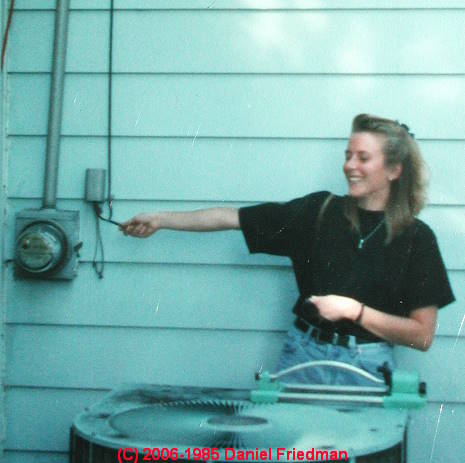
Inspectors climbing in, on, around buildings should guard against becoming complacent, overconfident, or careless. ASHI Standards of Practice provide that an inspector may refuse to enter, inspect, access any component based on concern for safety. In our photo the inspector is pointing out how easily an inspector might touch live electrical components while also becoming grounded by a gas pipe.
High-tension current generally causes the most serious injuries, although fatal electrocutions may occur with household current (e.g., 110 V in the United States and Canada and 220 V in Europe, Australia, and Asia).
Contact with alternating current at 60 cycles per second (the frequency used in most US household and commercial sources of electricity) may cause tetanic skeletal muscle contractions, preventing self-release from the source of the electricity and thereby leading to prolonged exposure.
The repetitive frequency of alternating current also increases the likelihood of current flow through the heart during the relative refractory period (the "vulnerable period") of the cardiac cycle.
This exposure can precipitate ventricular fibrillation (VF), which is analogous to the R-on-T phenomenon.-- circ.ahajournals.org - September 2008
Pay attention, look carefully, move slowly before opening or exploring electrical equipment. Learn to recognize indications of a problem, such as but not limited to the examples in this article.
Do not assume anything when performing dangerous tasks such as inspecting electrical equipment.
- Do not assume that electrical power is "off" without confirming that using proper test equipment and methods
- Do not assume that system grounding is complete and correct
- Do not assume that all circuit breakers and GFCI's and AFCI's will work
- Do not assume that bystanders or clients won't move suddenly into the path of danger, or push you into it.
Do not touch live wires or connections. Watch your hands and other body parts. Handling live electrical wires without special training and equipment is highly questionable and often fatal.
December 12, 1988 - Madison, WI - Michael E. Hammes, 26, died in an apparent electrocution while working in Madison. Hammes had been hired by CUNA Mutual Insurance Society to change ballasts on fluorescent lights. Authorities said he was replacing a fixture in a fourth floor bathroom while standing on a stepladder when he slumped to the floor.
Hammes apparently was electrocuted when he touched live wire with one hand and a metal partition with his body or other hand, according to Dana County Coroner Ray Wosepka.
Hammes was a first-year electronics student. Wosepka said his investigation showed the light fixture had been properly wired. Hammes apparently replaced a ballast, a [transformer] that controls the electrical flow to the light bulbs, and was attaching the live wire when it electrocuted him, Wosepka said. -- Ibid.
If in your opinion unsafe conditions exist at a property
you are inspecting you should notify all parties concerned, including building occupants/management/owners, realtors involved, and other appropriate authorities.
December 18, 1988 - Smyrna, GA - A Smyrna family's troubles with a faulty circuit breaker in their mobile home ended in tragedy when a fire broke out and killed 18-year-old Jeffrey Scott Auton. Auton's family, experiencing problems with the main circuit breaker, went to a home products store to buy a new one for their trailer, said Fire Investigator David Herndon.
The store did not have a circuit breaker to fit the family's needs and a new one had to be ordered. .... Herndon said the fire was started when the circuit breaker shut down completely as three space heaters were running.
The family had
a history of problems with the breaker, particularly from a load put
on it by a large heating unit. Herndon stated that after the fire
there was not a trace left of the circuit breaker; it was completely
gone from
For example, what if the case above had happened the day after the property described had been examined by an ASHI inspector?
Were there perhaps clues which telegraph a developing problem? What about anecdotal reports from the occupants of recurrent breaker tripping, visible signs of overheating in the panel, widespread and unusual use of electric heaters, or evidence of work in the panel by untrained people? These risks to occupants are also a hazard to the inspector on several bases.
How much electrical energy would it take to kill a home inspector?
Wet skin (standing in water, sweaty) has a resistance of about 1000 ohms. (Dry skin will have a higher resistance, and of course an inspector wearing protective gear such as rubber gloves, rubber-soled shoes, standing on an insulated mat, will have still higher electrical resistance, and safety.)
At this skin resistance, a current of only 0.1 to 0.3 amps at 100 Volts is sufficient to cause potentially fatal ventricular fibrillation. -- Wikipedia September 2008.
Protect yourself and your client from injury
using but not limited to the suggestions we provide here and just below.
Electrical Inspection Safety Suggestions from Rex Cauldwell, a Master Electrician
OPINION-RC: "As a master electrician, here is how I teach opening a service panel in my seminars: "The lucky 7""
- Eye protection: Wear safety glasses--electrical panels have been know to explode upon opening.
- Insulating gloves: Wear rubber dishwashing gloves--panels have been known to become electrically hot as a screw falls when cover is removed.
- Look before touching: Don't approach the panel until you give an overall look of the surrounding area to see if anything looks wrong--such as water on the floor under the panel.
- Avoid Shock Pathways: Don't have any part of your body touching items adjacent to the panel.
- Insulating floor pad: On a concrete or dirt floor, lay down a thick rubber Welcome mat and stand on it as you open the panel (wear rubber-soled shoes).
- Insulating tools: Use insulated handle tools--I use a Milwaukee electric screwdriver.
- Panel Door & Screws: Once door is open (in a Federal Pacific panel (and some other models) beware of falling trim and breakers that pop out), set door aside and don't lose the screws
Further Safety Warning --DF: these are helpful electrical safety suggestions from an experienced electrician. No list of suggestions is complete and these presume that they are being followed by an experienced, licensed electrician. [Thanks to reader Mike D. for careful editing.]
For example, there are almost certainly gloves and/or boots specifically recommended for this application; there are specific safety details to look at and for before touching an electrical panel, and procedures for using electrical test equipment to test or examine a suspect electrical panel.
Books on electrical wiring:
- Rex Cauldwell's WIRING a HOUSE - available online.
- Rex Cauldwell's SAFE HOME WIRING PROJECTS - book available online
Safe Home Wiring Projects, (Paperback) by Rex Cauldwell (Author). "When working with electricity, knowledge is the key to safety-ignorance literally hurts."
...
Continue reading at ELECTRIC METER & SERVICE ENTRY or select a topic from the closely-related articles below, or see the complete ARTICLE INDEX.
Or see these
Recommended Articles
- DMMs VOMs, USING SAFELY
- DO IT YOURSELF ELECTRICAL WORK
- ELECTRIC METER & SERVICE ENTRY
- ELECTRIC PANEL INSPECTION SAFETY
- SAFETY for ELECTRICAL INSPECTORS - home
Suggested citation for this web page
ELECTRICAL INSPECTOR SAFETY PROCEDURES at InspectApedia.com - online encyclopedia of building & environmental inspection, testing, diagnosis, repair, & problem prevention advice.
Or see this
INDEX to RELATED ARTICLES: ARTICLE INDEX to ELECTRICAL INSPECTION & TESTING
Or use the SEARCH BOX found below to Ask a Question or Search InspectApedia
Ask a Question or Search InspectApedia
Try the search box just below, or if you prefer, post a question or comment in the Comments box below and we will respond promptly.
Search the InspectApedia website
Note: appearance of your Comment below may be delayed: if your comment contains an image, photograph, web link, or text that looks to the software as if it might be a web link, your posting will appear after it has been approved by a moderator. Apologies for the delay.
Only one image can be added per comment but you can post as many comments, and therefore images, as you like.
You will not receive a notification when a response to your question has been posted.
Please bookmark this page to make it easy for you to check back for our response.
Our Comment Box is provided by Countable Web Productions countable.ca
Citations & References
In addition to any citations in the article above, a full list is available on request.
- Electrical shock injury statistics: www.healthatoz.com - September 2008;
- Mark Cramer Inspection Services Mark Cramer, Tampa Florida, Mr. Cramer is a past president of ASHI, the American Society of Home Inspectors and is a Florida home inspector and home inspection educator. Mr. Cramer serves on the ASHI Home Inspection Standards. Contact Mark Cramer at: 727-595-4211 mark@BestTampaInspector.com
- John Cranor [Website: /www.house-whisperer.com ] is an ASHI member and a home inspector (The House Whisperer) is located in Glen Allen, VA 23060. He is also a contributor to InspectApedia.com in several technical areas such as plumbing and appliances (dryer vents). Contact Mr. Cranor at 804-873-8534 or by Email: johncranor@verizon.net
- "Frequency of Occurrence and Sources of Rust and Corrosion in Electrical Panels," Daniel Friedman, IEEE HOLM Conference, Philadelphia PA, 1992 - see ELECTRIC PANEL RUST for an online version of this article.
- Jim Simmons: Personal communication, J. Simmons to Daniel Friedman, 9/19/2008. Photographs contributed to this website by Jim P. Simmons, Licensed Electrician, 360-705-4225 Mr. Electric, Licensed Master Electrician, Olympia, Washington Contact Jim P. Simmons, Licensed Master Electrician, Mr. Electric, 1320 Dayton Street SE
Olympia, WA 98501, Ph 360-705-4225, Fx 360-705-0130 mrelectricwa@gmail.com - Kenneth Kruger: Original author of the sidebar on testing VOM DMM condition: Kenneth Kruger, R.A., P.E. AIA ASCE, is an ASHI Member and ASHI Director in Cambridge, MA. He provided basis for this article penned by DJ Friedman.
- "How to Use DMM's Safely," Leonard Ogden, CEE News, 888 Seventh Ave., New York, NY 10106, Dec 1990 p.10.
- Dr. Jess Aronstein, consulting engineer, Poughkeepsie NY, 1991 protune@aol.com
- Rex Cauldwell, master electrician and contributor to the Journal of Light ConstructionOn electrical topics
- New York State Central Hudson Gas and Electric Company, G&E/1-2/85 consumer safety pamphlet
- American Society of Home Inspectors, ASHI Training Manual, Al Alk -[obsolete, and includes unsafe practices-DF]
- * Safety Hazards and Safe Inspection Procedures for Electrical and Home Inspectors at Residential Electric Panels
- Aluminum Wiring Information WebsiteAluminum Electrical Wiring Hazards and Repairs: in-depth authoritative info, photos, documents including selection of proper vs. ineffective repair methods. E.g.: Ideal 65 "Twister" purple connector fails in field and lab testing with aluminum wire.
- Ampacity of an Electrical Service: How to determine the electrical service size or ampacity entering a building
- Circuit Breaker, a bad one fails to trip failure at aluminum bus-to-circuit breaker connection - field report and photographs
- Electrical Panels, How to Inspect in buildings, safety for electrical inspectors, electrical panel, fusing, wiring defects, defective products. Inspection Class Presentation
- Federal Pacific Electric (FPE) Stab-Lok Circuit Breaker Panel Hazards Website - Latent fire hazards, in-depth authoritative research, documents, advice on Stab-Lok electric panel and circuit breaker failures and what to do when this equipment is found in buildings.
- "Electrical System Inspection Basics," Richard C. Wolcott, ASHI 8th Annual Education Conference, Boston 1985.
- "Simplified Electrical Wiring," Sears, Roebuck and Co., 15705 (F5428) Rev. 4-77 1977 [Lots of sketches of older-type service panels.]
- "How to plan and install electric wiring for homes, farms, garages, shops," Montgomery Ward Co., 83-850.
- "Simplified Electrical Wiring," Sears, Roebuck and Co., 15705 (F5428) Rev. 4-77 1977 [Lots of sketches of older-type service panels.]
- "Home Wiring Inspection," Roswell W. Ard, Rodale's New Shelter, July/August, 1985 p. 35-40.
- "Evaluating Wiring in Older Minnesota Homes," Agricultural Extension Service, University of Minnesota, St. Paul, Minnesota 55108.
- "Electrical Systems," A Training Manual for Home Inspectors, Alfred L. Alk, American Society of Home Inspectors (ASHI), 1987, available from ASHI. [DF NOTE: I do NOT recommend this obsolete publication, though it was cited in the original Journal article as it contains unsafe inaccuracies]
- "Basic Housing Inspection," US DHEW, S352.75 U48, p.144, out of print, but is available in most state libraries.
- In addition to citations & references found in this article, see the research citations given at the end of the related articles found at our suggested
CONTINUE READING or RECOMMENDED ARTICLES.
- Carson, Dunlop & Associates Ltd., 120 Carlton Street Suite 407, Toronto ON M5A 4K2. Tel: (416) 964-9415 1-800-268-7070 Email: info@carsondunlop.com. Alan Carson is a past president of ASHI, the American Society of Home Inspectors.
Thanks to Alan Carson and Bob Dunlop, for permission for InspectAPedia to use text excerpts from The HOME REFERENCE BOOK - the Encyclopedia of Homes and to use illustrations from The ILLUSTRATED HOME .
Carson Dunlop Associates provides extensive home inspection education and report writing material. In gratitude we provide links to tsome Carson Dunlop Associates products and services.
 | HOME | ABOUT | ASK a QUESTION | CONTACT | CONTENT USE POLICY | DESCRIPTION | POLICIES | PRIVACY | |
| © 2024 - 1985 Publisher InspectApedia.com - Daniel Friedman | |||||||||