
InspectAPedia® FREE Encyclopedia of Building & Environmental Construction, Diagnosis, Maintenance & Repair |
Question? Just ask us! InspectAPedia
|
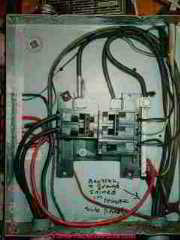 Loss of the Neutral Connection in a Sub Panel Led to a Dangerous Electrical Shock
- POST a QUESTION or COMMENT about neutral wire troubleshooting: what can happen when the neutral connections are lost or weak at a building?
Lost neutral wire - lost grounded conductor wire:
Lost neutral or weak neutral wire electrical connections at a building: what can happen?
This document describes a case history of loss of the neutral connection in an electrical panel combined with failure to isolate the neutral and ground buses leading to an electrical shock.
InspectAPedia tolerates no conflicts of interest. We have no relationship with advertisers, products, or services discussed at this website.
Case History of an Electrical Ground Failure - Loss of a Neutral Connection in an Electrical Sub Panel Badly Shocks a Homeowner
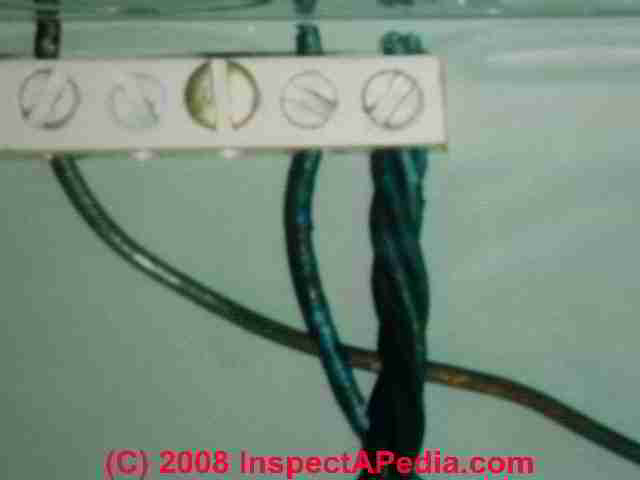
Building owner gets a nasty electrical shock: In an electrical failure case which we investigated, a building owner asked us to determine why he had received a severe electrical shock when he touched his metal work bench located in a detached garage.
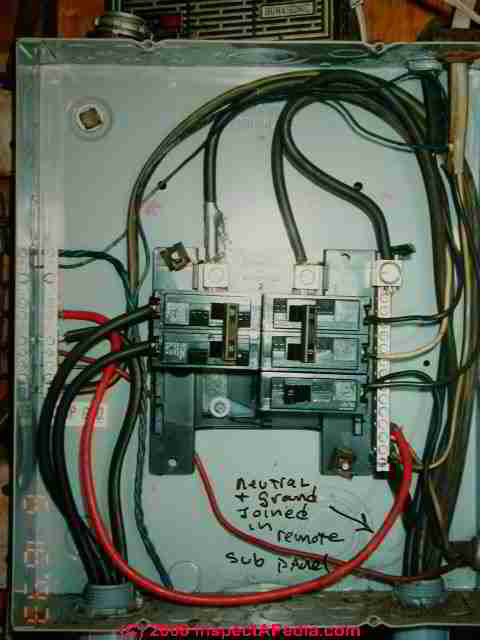
Here is what we found in the electrical sub panel in the detached garage:
[Click any image in these articles to see an enlarged, detailed version.]
- Remote sub panel: The detached garage received its electricity through a sub panel mounted in the garage and connected back to the main electrical panel in the home.
- Local grounding: A ground wire ran from the panel ground bus to a local grounding electrode at the garage.
- Evidence of overheating ground wires: The panel's copper ground wire was blackened - it was obviously dark from overheating (none of the other copper wires in the panel were discolored).
- Other circuit ground wires that had been twisted together in the sub panel were also black from overheating.
- Improper bonding of neutral bus and ground bus in a sub panel led to electric shock: The owner, intending to make his electrical panel "safer", had violated electrical code and good practice by bonding together the neutral bus and the grounding bus in his electrical panel.
- There was no ground wire connection back to the main electrical panel, just incoming hot wires and incoming neutral wire.
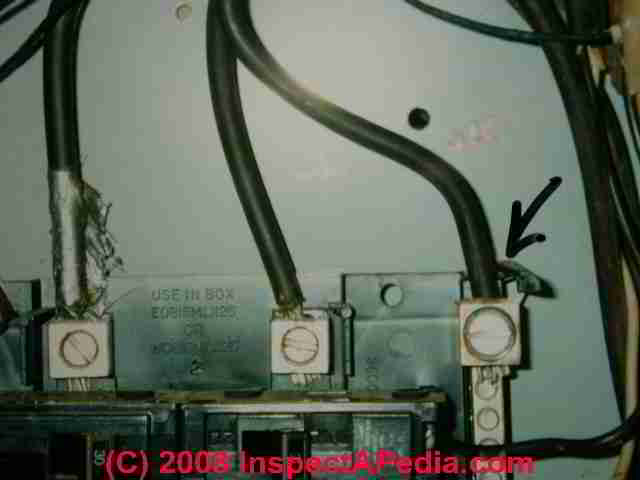
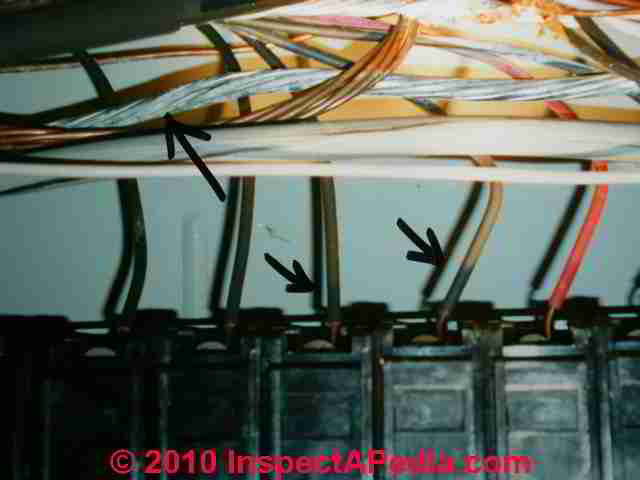
- The panel's incoming neutral wire from the home was not connected. It looked connected but when we wiggled it (power had been shut off at the main building) the neutral wire lifted right out of the connector.
Our photo at left has a black arrow pointing to the incoming neutral wire in the sub panel. The neutral wire looked connected, but it was not.
Technical note: as reader Jim Benson pointed out, the proper and electrical-code term for the popularly-referred-to "neutral wire" is "grounded conductor wire".
See DEFINITIONS of ELECTRICAL TERMS for details.
- The owner had a high horsepower 3-phase ("converted magically to 2-phase") electric motor driven air compressor in use in the garage. He had modified the motor's electrical wiring as well.
See also ELECTRIC MOTORS, 3-PHASE - The owner had, for safety, grounded his compressor motor and his metal work bench back to the electrical panel's grounding bus.
Question: What did all of these sub panel neutral and ground wire problems & electrical wiring errors mean?
When the air compressor motor was running it was producing a significant current on the compressor's neutral circuit.
The garage neutral circuit had no connection back to the main building (where it would have been connected to earth in the main panel, but because the owner had (improperly) bonded together the ground and neutral bus in his garage sub panel, the garage neutral circuit was indeed finding a path to earth through a small diameter (and thus overheated and dark) copper ground wire and a local grounding electrode.
Bud, a master electrician from Minnesota points out that in the 2005 NEC there are 2 ways to connect a subpanel in a detached garage. In both methods grounding electrode(s) are required at the garage.
- Hot-hot-neutral-ground are run to the garage. The neutral bar is isolated. Separate ground bar. The grounding electrode(s) connect to the ground bar.
- Hot-hot-neutral are run to the garage (NO ground). This is connected like a service. A “main bonding jumper” is installed to connect the neutral bar to the enclosure. The grounding electrodes are connected to the neutral (or ground) bar. (This method is no longer allowed in the 2008 NEC.)
The description of the garage event above is a case of example #2 above - there needs to be a MBJ [jumper wire] to connect the neutral and “ground”.
The connection was not an error. Without the Neutral-to-Ground bond there is no metal return path for ground fault currents back to the utility transformer. The path would depend on an earth connection, which is not effective and is not allowed. (This is the same error as in my original complaint.)
Normally the neutral-to-ground bond is made in the main electrical panel and not in sub panels, lest grounding conductors end up carrying current during normal operations - a shock hazard.
As Bud describes above, in the now obsolete, not allowed case, it was possible to wire a remote outbuilding sub panel as if it were a "main", with no ground returning to the actual remote main panel, and with a neutral-ground bond in the sub panel plus an effective local grounding electrode. We do not recommend this obsolete wiring approach. - Ed.
The problem in this case is the loss of the feeder neutral.
Summarizing some key observations in this lost neutral sub panel case:
- Neutral wire between sub panel & main panel was not connected; there was a loose, bad connection in sub panel
- The only grounding in this outbuilding was a local ground rod (maybe ineffective?)
- A 3-phase compressor was "DIY" wired to run 240V - something fishy there
- The compressor circuit included two "hot" wires (black and neutral - the upper right two-pole breaker in the page top photo), and a bare ground wire that was overheated and burned.
- A metal workbench was connected to subpanel ground and was "live" when the compressor was running - owner got shocked
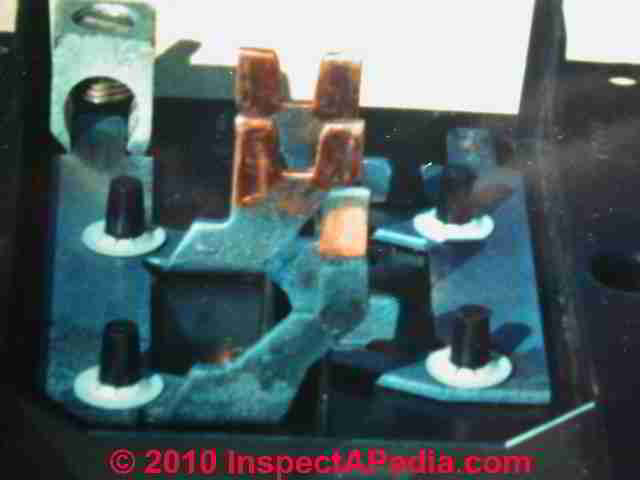
- Wires to circuit breakers in the panel were overheated (feeding the compressor)
- The internal bus in the panel was overheated (behind the CBs)
- Ground wires were overheated and burned (and were new at the outset) at the sub panel
- No mis-wiring nor overheating related to this case were observed in the property's main electrical panel
- In the sub panel, the neutral bus and ground bus were connected, so any neutral circuit current that should have traveled back on the main neutral to the main panel was forced to travel on the local ground wiring and grounding conductors.
Summarizing our conclusions (we will amend if with readers we develop a different analysis of this case):
A combination of missing main neutral in sub panel back to main panel, connecting neutral and ground buses in the sub panel, local ground at the sub panel, connection of metal work bench to panel ground bus, and modified 3-phase compressor in operation produced an electrically live workbench (owner was shocked), and conspired to visibly overheat grounding conductors, hot wires to the panel, panel bus behind the breakers, and grounding wire to the local electrode.
Additional photographs from this case are shown just below. Thanks to reader Randy Gardner for discussing this lost neutral case and opening an argument for clarification of just what was going on.
Below left: metal workbench that was connected to ground wire bus in the sub panel. Below right: overheated corroded main bus connections in the sub panel.
 ...
... 
Below left: 3-phase compressor "re-wired" to run on 240V (we suspect that a 3rd leg was connected to a neutral or ground wire at this hookup. Below right: overheated wires in the sub panel at circuit breakers (we suspect these were powering the compressor motor).
 ...
... 
See also
Why Do Electrical Power Surges or Lightning Strike Current Go to Ground While Short Circuits Follow a Path to the Utility Ground?
Question: We were a little unclear as to why surges find their way to the local earth connection (higher resistance path) while in an emergency such as a short circuit hot to neutral or hot to ground wire, the current does not.
Answer: Bud continued this helpful explanation:
It is a question of what is path is necessary to complete the circuit.
If you want to trip a circuit breaker the fault is hot to “ground” you must complete a path back from “ground” to the transformer neutral. If you wan t to trip a breaker, the path must be metal. That requires a N-G bond and return on the service neutral.
For lightning, you accumulate a different charge between the cloud and the earth. The path is then to the earth to neutralize the charges. (A service panel surge suppressor would have current hot-to-ground/earth.) (Any surge current on the neutral connects to earth through the N-G bond.)
The next most major cause of surges is probably utility switching (normal and abnormal). Switching power factor correction capacitors can be a major source. There the path is probably hot to neutral. (A service panel suppressor would have current hot-to-neutral.)
If there is a utility short that causes a fuse to open, there is high current through the inductance of the power wires that stores energy in a magnetic field. When the fuse opens, the current falls causing the magnetic field to collapse which produces a high voltage. Surge current is probably hot to neutral.
If a high voltage distribution wire falls on the wires to a house, the path needs to be back to the high voltage transformer. The path is likely through the earth, but could be through the service neutral if there is a path (there is probably a continuous neutral connection between transformers that feed houses).
Question: Isn't it the case that current always prefers the path of least resistance and that the current can actually be calculated to flow on two (for example) different paths as a direct function of the relative resistance of each path?
Answer: Nicely stated, particularly the end.
And in the case of the ground fault tripping a breaker there will be some current through the earth, just like there is some normal neutral current through the earth. But the resistance of the service neutral is far lower than the earth.
The root causes of this electrical shock were:
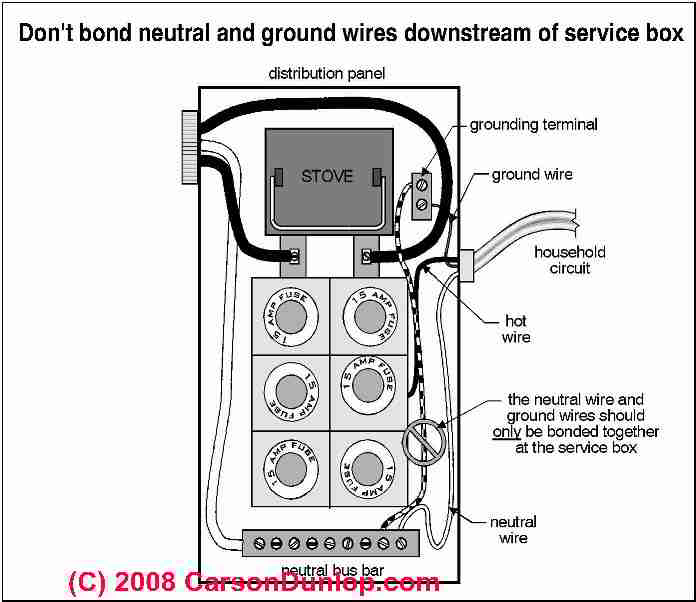
- Improper electrical wiring - bonding the ground and neutral wires together in the sub panel
- A binding steel screw in an aluminum wiring lug in the sub panel's incoming neutral wire connector - tightening the screw made the installer think he was securing the neutral wire when he was not.
[Click to enlarge any image]
Because the garage electrical system was carrying current that should have been flowing only on the insulated neutral wires in the building, when the owner touched his grounded metal work bench and was also touching a damp floor, current flowed through the ground wire, through the metal work bench, through the owner, to earth.
Sketch courtesy of Carson Dunlop Associates, a Toronto home inspection, education & report writing tool company [ carsondunlop.com ].
Our case study of a DOUBLE FAULT involving loss of both the utility company ground and the local building ground shows how power can simply be lost in a building due to grounding system defects.
Reader Comments, Questions & Answers About The Article Above
Below you will find questions and answers previously posted on this page at its page bottom reader comment box.
Reader Q&A - also see RECOMMENDED ARTICLES & FAQs
On 2020-10-30 - by (mod) -
hooked generator to electrical panel, devices then burned-upYes Sam, that sounds very dangerous to me.
Watch out: First, hooking an electrical generator directly to your electric panel without going through a transfer switch could kill a line worker who is outside working on the utility company's power lines.
Second you are likely to overload the generator when trying to feed the whole panel. That's because almost no home backup generator is going to be big enough to provide as much total current capacity (Amps) as your main electrical panel and all of the circuits it supports.
That's another reason we use a transfer switch: to isolate as an EITHER-OR device, giving power to key building circuits like heat, refrigerator, and some lighting, providing that EITHER from the main panel OR from the generator but never connecting to both at the same time.
If individual devices like a surge protector and cable box were damaged I suspect it's because the generator and the load it was trying to satisfy were not matched.
On 2020-10-30 by Sam
I hooked my generator to my panel and the neutral and common came loose when generator started it surged burned up a serge protector and cable box why and could it cause other issues nut everything seems ok with regular power
On 2020-08-22 - by (mod) -
Re-posting without duplicative links
Rui said:
1Ø, 3-Wire 100/200~110/220V
Lost Neutral(Overvoltage)Protection circuit breaker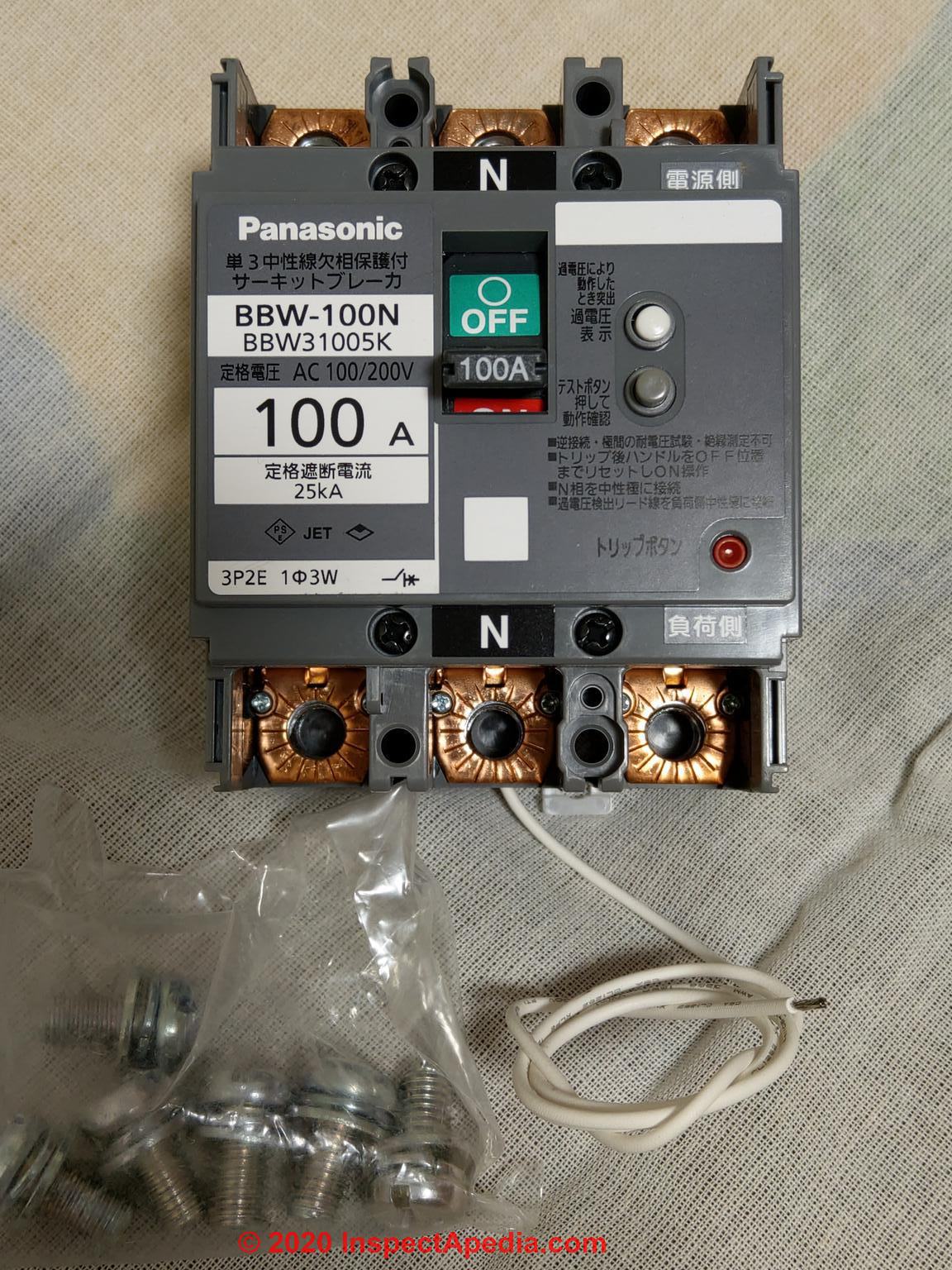
On 2018-01-27 - by (mod) -
brownout protection for pellet stoveSure R.W.
For an actual electrical outage you will need an auxiliary electrical generator to power the pellet stove circuit - as most pellet stoves require electricity to operate.
To handle voltage surges and variations, there are voltage stabilizer devices on the market.
On 2018-01-27 by R. Wendt
I am having a pellet stove installed in my house. Is there anyway to provide "brown-out" protection as a surge protector protects from power surges. I am most interested in "brown-out" protection or dual protection for both "brown-outs & surges?"
On 2017-02-17 by Anonymous
A friend of mine called 10 minutes ago from Oak St. Beach to get me to come out biking. I told him the problem I'm having and he asked what was on the circuit. I told him the outlet and the dimmer switch. He replied, "It's got to be the dimmer switch because that's the only thing you haven't checked". Guess what? I removed the dimmer switch and connected the 2 wires and no blinking!!! HOORAY.
You told me 5 days ago to start by checking what else is on the circuit. Well, I thought the current came from the breaker box to the outlet which doesn't make sense if there's a dimmer switch. So, the current goes from the breaker box to the dimmer switch and then to the outlet. Silly me. Thanks for your sage advice.
On 2017-02-11 by (mod) - table lamp with a curly florescent type low watt energy saving bulb in it flickered very dimly on-off-on-off
Bill:
Lights that flicker at the same frequency as the supply voltage - say 120VAC - are usually responding to fluctuations in the supply voltage itself. That may be more noticeable with some light bulb types than others and may not be visible at all on other electrical devices that are buffered, for example at a computer that is powered by a low-voltage battery charger.
In fact on a normal 120VAC 60Hz (60 cycle) electrical circuit normal light flickering is occurring at 120 cycles/min but is generally not observable. 60 cycles per second flickering is slightly faster than most people can see except perhaps in high-intensity lighting systems. More people can see flickering in lower-intensity flourescent lighting.
To diagnose regular high-frequency flickering in a single light fixture in a building where the same light types and bulbs are in use elsewhere where no flickering is seen, I'd start by looking at what else is on the circuit: motors, appliances that may be sparking internally, dimmer switches, and of course for flourescent lights, a failing ballast.
If it's a loose connection problem or an overheated connection problem it's most-likely to be right in the light fixture itself - wire connections or bulb socket. I've found cracked socket shells, corroded socket base connectors, as well as loose wires and even defective bulbs.
The problem could also be a failing dimmer switch as some of those in some models and applications can overheat, or simply have a bad electrical connection. Usually that flickering isn't at the same frequency as the 60 cycle or 50 cycle electrical supply. Also some bulbs including fluorescents are not able to work with a dimmer switch.
If you're confident that there are no defects in the circuit, I'd try an LED replacement light bulb with the same total LUMENS or equivalent watts output as the flickering incandescent bulb that's been annoying. An LED bulb is likely to show less flicker.
On 2017-02-10 by bill
P.S. There is an entryway on/off dimmer switch on the wall across the room for this 'Demon' socket.
On 2017-02-10 by bill
I have previously swapped out a tested good: bulb, lamp, wall socket and circuit breaker.. There is no Aluminum in this Murray panel installed in 1957 and it has been left alone the past 30 years that I know.
No problem w/the 168 others in the building, but the socket is on a high up floor on the East wall facing Lake Michigan weather. We are all using ITE circuit breakers. (I swapped out a new Siemens 30 Amp and another original ITE Circuit breaker DK. Amp. with the baffling same results.) Circuit breakers are 6 singles and have no Amp. listed. Murray panel cover says ' 70 AMP MAX 120-240 V AC ' .
Go figure??? Any idea where to specifically look for a loose wire or connection in the panel because this flickering only effects one socket.
On 2017-02-08 - by (mod) -
Bill
Did you try just swapping in a new bulb?
If it's not the socket or bulb I suspect a loose wire or connection, or more urgent, overheating aluminum wire connections (an electrican an check for that starting in your electrical panel) or a defective circuit breaker (Search InspectApedia.com for FPE BREAKERS or ZINSCO BREAKERS for some examples, though failures are not limited to those brands).
On 2017-02-06 by Bill
I returned from an errand to find a table lamp with a curly florescent type low watt energy saving bulb in it flickered very dimly on-off-on-off, etc. repetitively in equal cadence with the same timing and very weak pulse of electricity.
No diming, just very low on-off power. My computer was attached and left on but now was not working but showed steady power probably from it’s battery. A small electrical area heater/fan with a thermostat for blowing hot or cool air was attached, showed electricity pulsing on-off from a red power light that shows it’s plugged in, but it was not not heating.
A TV was attached but not on with remote boxes and works well now plugged in to another socket. The faulty socket is on the buildings East wall which is exposed to winds and rain off Lake Michigan which can be fierce.
I have tested the computer, lamp and mini-heater/fan on other outlets in my apt and they all work fine. Same with the TV.
I have loaned the heater fan to my neighbor and she said it is working fine for three months now.
I installed another socket that I knew worked, and again a new socket of the same type, which are the same make as in most of the other outlets. The same pulsing occurred.
Thes wall sockets have been working well since upgraded 7 or so years ago throughout the apartment.
So I figured it must be a circuit breaker. I tried installing a new circuit breaker at the box. Same results. This was discouraging.
The box is a Murray LOAD CENTER Mfgr’d, in Brooklyn, NY. Installed 1957
The new sercuit breaker is a Seimens 30 Amp. Which is recommended for Murray/ITE Circuit breakers.
The Circuit Breakers in my box are (six), ITE singles. They have no amperage on them I could discern but the panel inside the box, said 70 Amp. or less MAX 120-240V AC
There is 220 in two outlets for my two A/C’s, one in each room.
I don’t know where to go from here. I am 70, have ability to attach lamps, change sockets, and breakers. I have never heard of this type of electrical problem anywhere from anyone. I have spoken to the building engineer, manager, Condo board pres., and everyone I who has owned a home for some feedback. I have gone to Menards, home depot, and a few small contractors. No one has heard of this in my building, their life, or on line. On line all I have found is sporadic dimming. No repetitive dim sequential pulsing.
Your article seemed to address a similar problem.
I am reluctant to hire an electrician until I find out more because I don’t want to pay for someone’s ‘tinkering’ or installing a whole new box when it is not needed or may not be the solution anyway. I don’t want to upset my wiring system here either.
I need help with a solution or finding an electrician who is experienced with this kind of apparently unusual problem.
Please advise.
Bill
773-338-8242 Cell
773-340-6909 Home
Bill1620@yahoo.com
Question: neutral lost at transformer connection
(June 10, 2011) Ralph Griswold said:
The electric utility servicing my sister's home in West Boylston, MA lost the neutral on the transformer connection so she only had single phase 240 volt service. In turn her TV, stove, and refrigerator as well as a few lights were lost. Is there any way that the home owner can protect his home when the failure is the Utility?
Reply:
A residential electrical system should have a local ground that offers SOME protection should the neutral line from the utility company become lost. However such a condition is still UNSAFE for several reasons including that the local ground itself may be unreliable and also because unexpected live electrical current may be present on un-insulated ground system components - someone could be shocked or electrocuted.
More, from what you describe there appears to have been more than one problem - such as losing half of the electrical panel.
In an any case the safe procedure would have been to turn off ALL electrical power pending repairs from the electrical company and a local licensed electrician.
The ONLY setup that occurs to me that could be SAFE in the condition you describe is one in which an isolation switch is installed such as the system used when a backup home generator is installed and in use. The isolation switch disconnects the electrical panel from the utility company wiring entirely and connects it over to the backup generator system. It's an "either-or" system: either you are connected to the utility company or your are connected to the local generator, but never to both at the same time.
Question:
12/21/2014 Jim Benson said:
Hi, I really like all the info for guys and gals coming up in the trade, I was gonna do it but my patience just wasn't in it. Im disabled and get bored so all I do is read code and do electronics. Ive been in the biz for 32 yrs and have been a licensed master and inspector in NJ and PA
. I wanted to ask you if you ever thought of removing the word "neutral" and using grounded conductor, not grounding just grounded as the NEC uses. Its hard to change I know because Im in a world of electronics I wanna see if you have any material on. Thanks! Really great work....... Jim
Reply:
Thanks Jim you are of course entirely correct, that is, speaking codewise or electrically properly we'd call the neutral wire the grounded conductor.
As an editor and writer I've got a different, messier idea. If I want our readers to be able to find information or to understand it, I need to use both the technically correct language AND the terms that those readers use themselves.
We've also got to recognize that we have readers all over the world. So for example we may refer to a septic drainfield also as a leach field or as a soakpit or as a soakaway bed and so-on.
If you see specific places in the text where we ought to add language to make this point more clear I'd appreciate having those editorial suggestions.
...
Continue reading at FALSE NEUTRAL CONNECTIONS or select a topic from the closely-related articles below, or see the complete ARTICLE INDEX.
Or see these
Recommended Articles
- ELECTRICAL INSPECTION, DIAGNOSIS, REPAIR - home
- ELECTRICAL PANEL FUSED NEUTRAL WIRE HAZARDS
- FLICKERING LIGHTS, LOST NEUTRAL
- FALSE GROUND at RECEPTACLES
- FALSE GROUND, BOOTLEG & FLICKERING LIGHTS
- FALSE NEUTRAL CONNECTIONS
- FLICKERING LIGHTS, LOST NEUTRAL - field report of flickering lights traced to a bad utility company neutral wire
- LIGHTNING DAMAGE to ELECTRICAL SYSTEM
- LOST NEUTRAL SHOCKS HOMEOWNER
Suggested citation for this web page
LOST NEUTRAL SHOCKS HOMEOWNER at InspectApedia.com - online encyclopedia of building & environmental inspection, testing, diagnosis, repair, & problem prevention advice.
Or see this
INDEX to RELATED ARTICLES: ARTICLE INDEX to ELECTRICAL INSPECTION & TESTING
Or use the SEARCH BOX found below to Ask a Question or Search InspectApedia
Ask a Question or Search InspectApedia
Try the search box just below, or if you prefer, post a question or comment in the Comments box below and we will respond promptly.
Search the InspectApedia website
Note: appearance of your Comment below may be delayed: if your comment contains an image, photograph, web link, or text that looks to the software as if it might be a web link, your posting will appear after it has been approved by a moderator. Apologies for the delay.
Only one image can be added per comment but you can post as many comments, and therefore images, as you like.
You will not receive a notification when a response to your question has been posted.
Please bookmark this page to make it easy for you to check back for our response.
Our Comment Box is provided by Countable Web Productions countable.ca
Citations & References
In addition to any citations in the article above, a full list is available on request.
- Roger Hankey is principal of Hankey and Brown Inspections, Winter Park, CO. Mr. Hankey is a past chairman of the ASHI Standards Committee and served in other ASHI chapter and national leadership roles. Mr. Hankey is a National Radon Proficiency Program certified measurement professional and a Level II infrared thermographer. Contact Roger Hankey at: 970-393-6604 - rogerhankey47@gmail.com . Website: www.HankeyandBrown.com Mr. Hankey is a frequent contributor to InspectAPedia.com.
- In addition to citations & references found in this article, see the research citations given at the end of the related articles found at our suggested
CONTINUE READING or RECOMMENDED ARTICLES.
- In addition to citations & references found in this article, see the research citations given at the end of the related articles found at our suggested
CONTINUE READING or RECOMMENDED ARTICLES.
- Carson, Dunlop & Associates Ltd., 120 Carlton Street Suite 407, Toronto ON M5A 4K2. Tel: (416) 964-9415 1-800-268-7070 Email: info@carsondunlop.com. Alan Carson is a past president of ASHI, the American Society of Home Inspectors.
Thanks to Alan Carson and Bob Dunlop, for permission for InspectAPedia to use text excerpts from The HOME REFERENCE BOOK - the Encyclopedia of Homes and to use illustrations from The ILLUSTRATED HOME .
Carson Dunlop Associates provides extensive home inspection education and report writing material. In gratitude we provide links to tsome Carson Dunlop Associates products and services.
 | HOME | ABOUT | ASK a QUESTION | CONTACT | CONTENT USE POLICY | DESCRIPTION | POLICIES | PRIVACY | |
| © 2024 - 1985 Publisher InspectApedia.com - Daniel Friedman | |||||||||