
InspectAPedia® FREE Encyclopedia of Building & Environmental Construction, Diagnosis, Maintenance & Repair |
Question? Just ask us! InspectAPedia
|
 Outdoor Electrical Safety Hazards for Electrical Inspectors & Home Inspectors
- POST a QUESTION or COMMENT about how to safely conduct the inspection of outside electrical components at buildings
This electrical safety procedures article discusses outdoor safety hazards at residential properties and suggests safety procedures for the electrical inspector, home inspector, or other professionals who examine residential electrical systems.
InspectAPedia tolerates no conflicts of interest. We have no relationship with advertisers, products, or services discussed at this website.
The Electrical Panel Inspection for Water & Rust Begins Outside
 ASHI Home Inspector Educational Seminar Proceedings: ASHI-NE Chapter Annual conference,
September 22-23, 2008, Randolph, MA. -- by Daniel Friedman.
ASHI Home Inspector Educational Seminar Proceedings: ASHI-NE Chapter Annual conference,
September 22-23, 2008, Randolph, MA. -- by Daniel Friedman.
8. System: Electrical Inspection Standards for Home Inspectors (ASHI and other Associations & State Regulations)
8.1.C. [The inspector shall observe] amperage and voltage ratings of the service
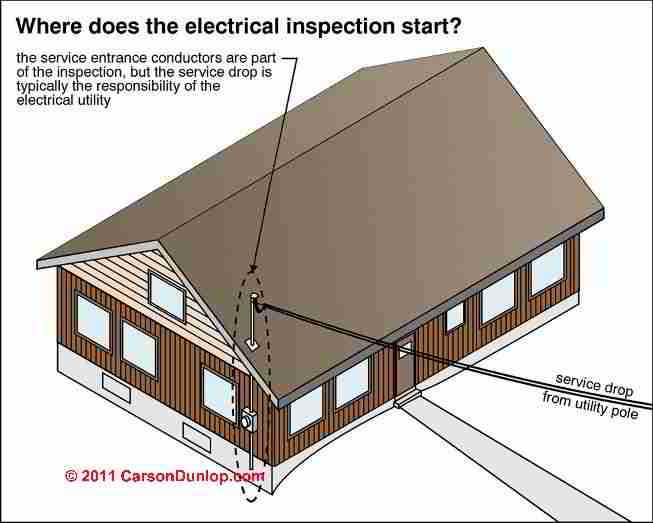
Keep in mind that this determination is required by ASHI Standards and is to be derived based on visual inspection of the wiring and equipment. It is not required to use test equipment for this purpose. Sketch courtesy of Carson Dunlop Associates, a Toronto home inspection, education & report writing tool company [ carsondunlop.com ].
Safe electrical inspection procedures and safe use of
volt meters, DMMs, multimeters, and similar electrical test equipment
is discussed at the end of the article.
These electrical inspection suggestions are not a complete inventory of all electrical safety procedures nor of all electrical components that should be inspected; these notes focus on identification of conditions that may present special electrical hazards for the electrical inspector.
Contact Us by email to suggest changes, corrections, and additions to this material.
Electric shocks are responsible for about 1,000 deaths in the United States each year, or about 1% of all accidental deaths.- Refs.
Fatal Shock Hazard Warning: Inspecting electrical components and systems risks death by electrocution as well as serious burns or other injuries to the inspector or to others. Do not attempt these tasks unless you are properly trained and equipped.
See ELECTRIC METERS & METER BASES for a discussion of examining the electric meter and meter base portion of the service entry.
See AMPS& VOLTS DETERMINATION for determining the ampacity of an electrical service: How to determine the electrical Ampacity and Voltage provided to a building discusses in detail how to determine the service amps and voltage by visual inspection.
Also see AMPACITY - the LIMITING FACTOR.
8.1 The electrical inspector shall observe:
Observe does not mean touch except where removing access covers or operating certain devices is explicitly required.
8.1.A. Electrical service entrance conductors Inspection Procedure
When new service entry cables are installed don't assume that those exposed bare ends of old SEC you see are "dead." Non-contact voltage sensing devices can determine if any questionable wiring is "hot."
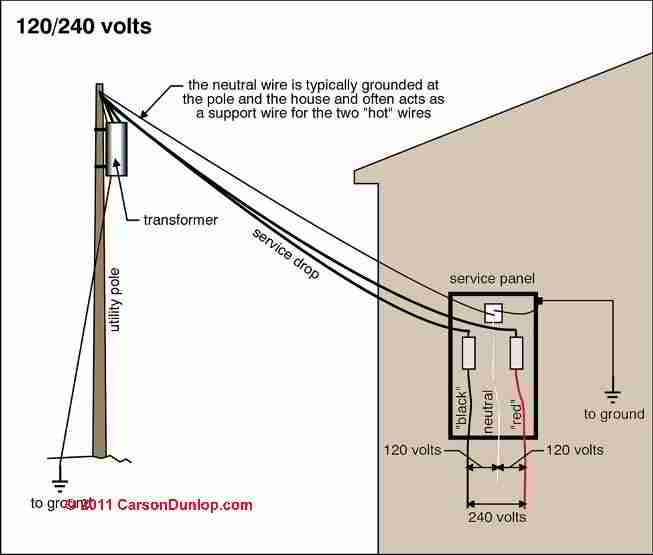
Sketch courtesy of Carson Dunlop Associates, a Toronto home inspection, education & report writing tool company [ carsondunlop.com ].
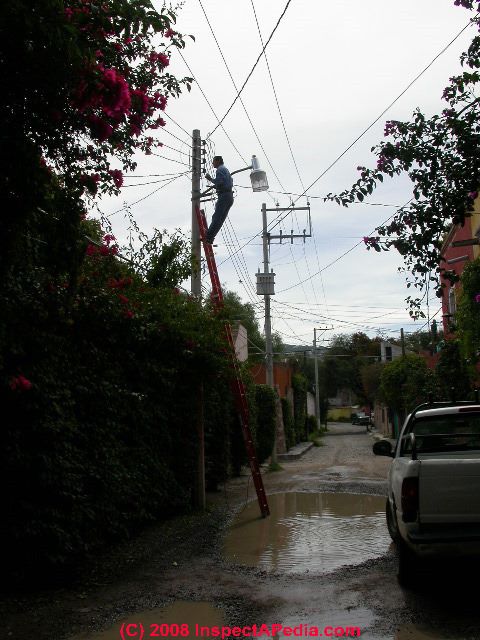 Watch the location of overhead lines when moving ladders to access
roof and if the roof is walked, watch for the location of power lines,
antennas, guy-wires, and masts when getting to, walking on, and getting
off the roof.
Watch the location of overhead lines when moving ladders to access
roof and if the roof is walked, watch for the location of power lines,
antennas, guy-wires, and masts when getting to, walking on, and getting
off the roof.
November 10, 1988 - Marshall, TX - Donald Cleveland Jones, 45, was electrocuted when equipment he was moving came into contact with electrical wires, according to deputies. -- Same source as previous news report.
If you see fallen wires do not go near them. Notify the utility company and appropriate others promptly.
Also watch out for TV antennas which can be pushed into or fall onto electric wires. -- advice from NY Central Hudson Gas and Electric Company, G&E/1-2/85 consumer safety pamphlet.
Use extreme caution in crawl spaces and wet crawl or basement areas - avoid contacting electrical components.
We advise against entering wet or flooded sub areas at all. we have an unsubstantiated report of an inspector [or contractor] death by electrocution while inspecting a damp crawl space using a light plugged into an extension cord.
Use battery-powered lighting or if an extension cord is required, inspectors should provide their own portable GFCI protected receptacle.
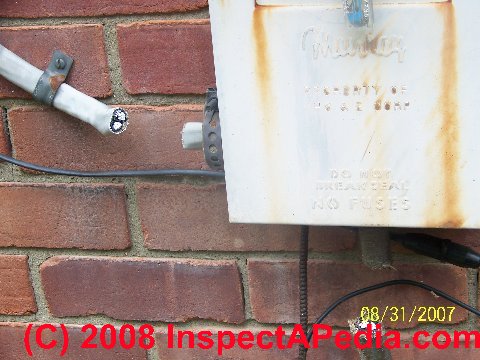
Do Not Assume that "Old Wires" are "Dead"
The Tiff Tic TracerTM [Figure 2, page 11 in the original article, and shown in the next text section below] will not make a quantitative measurement of voltage.
But this instrument is very helpful in checking for live 120/240V voltage at wires and devices.
Without physical contact, the instrument will indicate the presence of a nearby live AC voltage field.
We found a property at which the old service entry cable (SEC) at the building corner was left in place, cut with a hacksaw about 6' from the ground, bare wire ends exposed, electrically live - it had been left connected in an old main panel which was used by the installer as a "sub panel" when the new larger main was installed.
This was an exciting installation!
See AMPS & VOLTS DETERMINATION for details of how to determine the ampacity and voltage of electrical service at a building.
Advice For Handling Immediate Threats to Life and Safety at a Building Inspection
If in the inspector's judgment equipment is an immediate threat to life and property, such as a boiler whose flue connection has fallen off, we recommend that dangerous equipment be shut down and the appropriate people notified.
See SHUT DOWN UNSAFE EQUIPMENT. In some cases "appropriate people" includes not only the client and building owner, but also building occupants.
In some instances such as sparking electrical panels, gas leaks, or evidence of a fire, the inspector and everyone else should leave the building immediately and from outside, call the fire department and as appropriate, the gas company, police, or rescue personnel.
Reader Comments, Questions & Answers About The Article Above
Below you will find questions and answers previously posted on this page at its page bottom reader comment box.
Reader Q&A - also see RECOMMENDED ARTICLES & FAQs
Question:
2779 Mcallister San Francisco California has exterior light outside 2779 cottage that had white vertical waving cloud pop sound and smelled bad. this resulted said electrican of destroying 2779 outdoor light connected to 2781 mcallister which destroyed 2781 mcallister garage indoor lights.
The disconnect labeled 2779 did not turn off the short circuit so I turn off the main circuit breaker panel for 2779.
2779 disconnect and 2781 and 2783 mcallister san Francisco CA are Murray and Westinghouse brands.
What facts tell me what is a good electrican. I am physically disabled and old. outdoor wood doors over outdoor 2779 disconnect and 2781 and 2783 circuit breaker panels do not cover completely.
The open air gap spaces allow rainwater and fog to touch 2779 disconnect that has a horizontal switch that looks like a indoor light switch that has no metal cover over 2779 disconnect. moisture touches he circuit breaker panels with metal doors covering circuit breakers. - L.L. 4/2/2014
Reply:
L.L. I recall that we have discussed your electrical safety worries previously, at we discussed electrical issues before - see report #3 at FPE FAILURE FIELD REPORTS though now I see you are reporting two other electrical panel brands, Murray & Westinghouse.
I agree that electrical codes will require outdoor electrical panels to be weather-tight, rated for outdoor use, and properly installed.
Electricians are licensed by your state and often local municipality; beyond that we're in trouble trying to evaluate them by email. It's a tougher question to ask how to evaluate electricians as eductaion, experience, skill and importantly, attitude vary among inviduals all of whom may have obtained a license.
Perhaps your local building department can make a suggestion, particularly as you cite unsafe conditions in the homes and addresses in your email.
...
Continue reading at ELECTRICAL INSPECTOR SAFETY PROCEDURES or select a topic from the closely-related articles below, or see the complete ARTICLE INDEX.
Or see these
Recommended Articles
- ELECTRICAL GROUND INSPECTION SAFETY
- SAFETY HAZARDS & SAFE ELECTRICAL INSPECTION PROCEDURES for Inspectors examining Residential Electrical Systems
Suggested citation for this web page
OUTDOOR ELECTRICAL INSPECTION SAFETY at InspectApedia.com - online encyclopedia of building & environmental inspection, testing, diagnosis, repair, & problem prevention advice.
Or see this
INDEX to RELATED ARTICLES: ARTICLE INDEX to ELECTRICAL INSPECTION & TESTING
Or use the SEARCH BOX found below to Ask a Question or Search InspectApedia
Ask a Question or Search InspectApedia
Try the search box just below, or if you prefer, post a question or comment in the Comments box below and we will respond promptly.
Search the InspectApedia website
Note: appearance of your Comment below may be delayed: if your comment contains an image, photograph, web link, or text that looks to the software as if it might be a web link, your posting will appear after it has been approved by a moderator. Apologies for the delay.
Only one image can be added per comment but you can post as many comments, and therefore images, as you like.
You will not receive a notification when a response to your question has been posted.
Please bookmark this page to make it easy for you to check back for our response.
Our Comment Box is provided by Countable Web Productions countable.ca
Citations & References
In addition to any citations in the article above, a full list is available on request.
- Electrical shock injury statistics: www.healthatoz.com - September 2008;
High-tension current generally causes the most serious injuries, although fatal electrocutions may occur with household current (e.g., 110 V in the United States and Canada and 220 V in Europe, Australia, and Asia). Contact with alternating current at 60 cycles per second (the frequency used in most US household and commercial sources of electricity) may cause tetanic skeletal muscle contractions, preventing self-release from the source of the electricity and thereby leading to prolonged exposure. The repetitive frequency of alternating current also increases the likelihood of current flow through the heart during the relative refractory period (the "vulnerable period") of the cardiac cycle. This exposure can precipitate ventricular fibrillation (VF), which is analogous to the R-on-T phenomenon.-- circ.ahajournals.org - September 2008
- Mark Cramer Inspection Services Mark Cramer, Tampa Florida, Mr. Cramer is a past president of ASHI, the American Society of Home Inspectors and is a Florida home inspector and home inspection educator. Mr. Cramer serves on the ASHI Home Inspection Standards. Contact Mark Cramer at: 727-595-4211 mark@BestTampaInspector.com
- John Cranor [Website: /www.house-whisperer.com ] is an ASHI member and a home inspector (The House Whisperer) is located in Glen Allen, VA 23060. He is also a contributor to InspectApedia.com in several technical areas such as plumbing and appliances (dryer vents). Contact Mr. Cranor at 804-873-8534 or by Email: johncranor@verizon.net
- "Frequency of Occurrence and Sources of Rust and Corrosion in Electrical Panels," Daniel Friedman, IEEE HOLM Conference, Philadelphia PA, 1992 - see ELECTRIC PANEL RUST for an online version of this article.
- Jim Simmons: Personal communication, J. Simmons to Daniel Friedman, 9/19/2008. Photographs contributed to this website by Jim P. Simmons, Licensed Electrician, 360-705-4225 Mr. Electric, Licensed Master Electrician, Olympia, Washington Contact Jim P. Simmons, Licensed Master Electrician, Mr. Electric, 1320 Dayton Street SE
Olympia, WA 98501, Ph 360-705-4225, Fx 360-705-0130 mrelectricwa@gmail.com - Kenneth Kruger: Original author of the sidebar on testing VOM DMM condition: Kenneth Kruger, R.A., P.E. AIA ASCE, is an ASHI Member and ASHI Director in Cambridge, MA. He provided basis for this article penned by DJ Friedman.
- "How to Use DMM's Safely," Leonard Ogden, CEE News, 888 Seventh Ave., New York, NY 10106, Dec 1990 p.10.
- Dr. Jess Aronstein, consulting engineer, Poughkeepsie NY, 1991 protune@aol.com
- Rex Cauldwell, master electrician and contributor to the Journal of Light ConstructionOn electrical topics
- New York State Central Hudson Gas and Electric Company, G&E/1-2/85 consumer safety pamphlet
- American Society of Home Inspectors, ASHI Training Manual, Al Alk -[obsolete, and includes unsafe practices-DF]
- "Electrical System Inspection Basics," Richard C. Wolcott, ASHI 8th Annual Education Conference, Boston 1985.
- "Simplified Electrical Wiring," Sears, Roebuck and Co., 15705 (F5428) Rev. 4-77 1977 [Lots of sketches of older-type service panels.]
- "How to plan and install electric wiring for homes, farms, garages, shops," Montgomery Ward Co., 83-850.
- "Simplified Electrical Wiring," Sears, Roebuck and Co., 15705 (F5428) Rev. 4-77 1977 [Lots of sketches of older-type service panels.]
- "Home Wiring Inspection," Roswell W. Ard, Rodale's New Shelter, July/August, 1985 p. 35-40.
- "Evaluating Wiring in Older Minnesota Homes," Agricultural Extension Service, University of Minnesota, St. Paul, Minnesota 55108.
- "Electrical Systems," A Training Manual for Home Inspectors, Alfred L. Alk, American Society of Home Inspectors (ASHI), 1987, available from ASHI. [DF NOTE: I do NOT recommend this obsolete publication, though it was cited in the original Journal article as it contains unsafe inaccuracies]
- "Basic Housing Inspection," US DHEW, S352.75 U48, p.144, out of print, but is available in most state libraries.
- In addition to citations & references found in this article, see the research citations given at the end of the related articles found at our suggested
CONTINUE READING or RECOMMENDED ARTICLES.
- Carson, Dunlop & Associates Ltd., 120 Carlton Street Suite 407, Toronto ON M5A 4K2. Tel: (416) 964-9415 1-800-268-7070 Email: info@carsondunlop.com. Alan Carson is a past president of ASHI, the American Society of Home Inspectors.
Thanks to Alan Carson and Bob Dunlop, for permission for InspectAPedia to use text excerpts from The HOME REFERENCE BOOK - the Encyclopedia of Homes and to use illustrations from The ILLUSTRATED HOME .
Carson Dunlop Associates provides extensive home inspection education and report writing material. In gratitude we provide links to tsome Carson Dunlop Associates products and services.
 | HOME | ABOUT | ASK a QUESTION | CONTACT | CONTENT USE POLICY | DESCRIPTION | POLICIES | PRIVACY | |
| © 2024 - 1985 Publisher InspectApedia.com - Daniel Friedman | |||||||||