
InspectAPedia® FREE Encyclopedia of Building & Environmental Construction, Diagnosis, Maintenance & Repair |
Question? Just ask us! InspectAPedia
|
 Pushmatic Bulldog & ITE Circuit Breakers & Electrical Panels
Pushmatic Safety Advice & Field Failure Reports
- POST a QUESTION or COMMENT on Bulldog & ITE Pushmatic Circuit Breaker Performance
ITE / Siemens Bulldog Pushmatic Circuit Breakers & Electrical Panels:
This article describes potential fire and safety hazards where certain Bulldog & ITE-Pushmatic circuit breakers and electrical panels are used. We provide Pushmatic circuit breaker identification photographs including of electrical panels and of individual circuit breakers.
Discussed here: Pushmatic Bulldog Circuit Breaker & Electrical Panel Brands & Identification & Compatibility or Interchangeability.
ITE Pushmatic Bulldog History & Distribution. Pushmatic Bulldog Circuit Breaker & Electrical Panel failure hazard description.
Legal Documents, References on Pushmatic & Bulldog Circuit Breakers & Electrical Panels.
Advice for Owners of Properties Using a Pushmatic or Bulldog Electrical Panel. Compatibility of Bulldog, Pushmatic, ITE-Pushmatic, Siemens Pushmatic Circuit Breakers.
The article series discusses the history of Pushmatic breakes, gives advice to homeowners whose building is served by a Pushmatic electrical panel, and we discuss both compatability of and concerns when using replacement circuit breakers or used Pushmatic circuit breakers sold by salvage operatoers.
We solicit field failure and field inspection reports of questionable or possibly problematic electrical equipment in buildings such as the Bulldog™ and ITE-Pushmatic® brands described here.
InspectAPedia tolerates no conflicts of interest. We have no relationship with advertisers, products, or services discussed at this website.
Pushmatic & Bulldog Circuit Breakers & Electrical Panel Safety Warnings
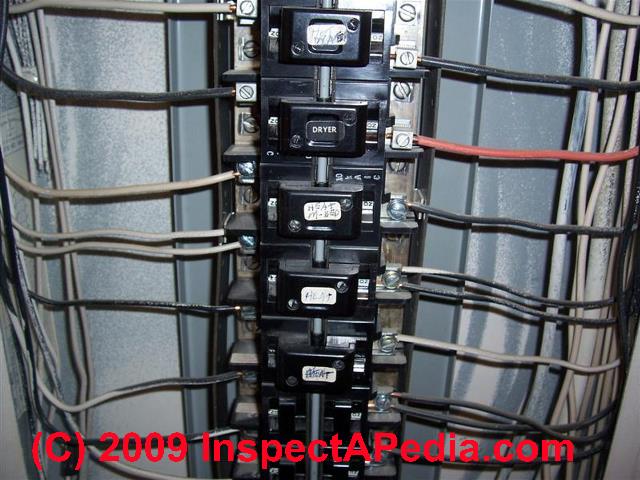
 Beginning in 1986 and continuing to the present we had received occasional field reports on product failures of PushMatic circuit breakers, as wekk as similar, older Bulldog circuit breakers and electrical panels. There may not be sufficient data to reach a solid conclusion about the reliability and safety of this electrical equipment. We had been unable to find independent research reports on this product.
However some field reports include a particularly dangerous failure: the breaker may remain ON internally while appearing to have been turned OFF..
Our OPINION is that it woudl be prudent and thus safer to replace this equiment and to avoid re-use of used Bulldog / Pushmatic electrical panels and circuit breakers.
In April 2011, preliminary results of yet incomplete testing of a wider range of brands of residential electrical panels and circuit breakers, conducted by David Carrier, an electrical engineer, had begun to suggest some failures to trip among certain Bulldog, ITE & Siemens ITE.
That testing remained incomplete. Interestingly, in addition to the anticipated higher failure to trip rates among FPE Stab-lok design breakers Carrier was seeing an unanticipated trip failure rate among certain Murray circuit breakers and certain Challenger circuit breakers, Crouse Hinds circuit breakers. [1]
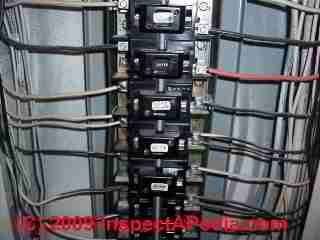
Photo of a Pushmatic electrical panel below is provided courtesy of Matt Steger. [Click to enlarge any image]
Our own personal experience with inspecting and on occasion using ITE Pushmatic circuit breakers and panels did not encounter product failures and our lay opinion was that the product appeared (to visual inspection) well made. But at InspectAPedia.com we have received increasing questions about and mixed reviews about this product design.
This web page provides a contact point for inspectors to send field inspection reports, field failure reports, and reports of research, product history, and safety opinions regarding Pushmatic brand and Bulldog brand electrical panels.
Pushmatic Bulldog Circuit Breaker & Electrical Panel Brands & Identification & Compatibility or Interchangeability
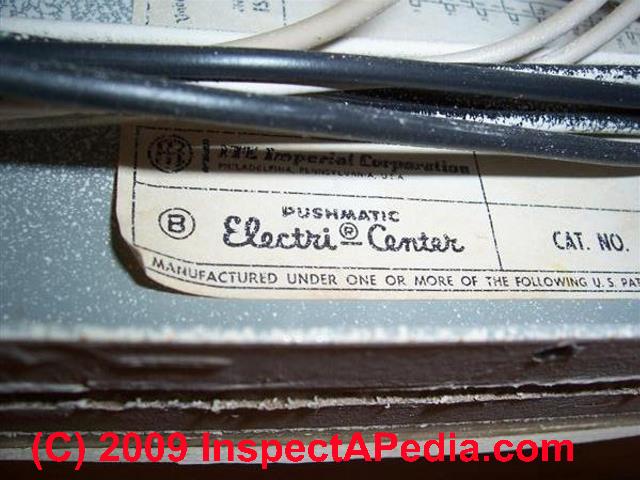
- ITE Siemens Pushmatic™ - Pushmatic Electri-Center® "ITE Bulldog" and ITE Pushmatic products continue for sale new from various electrical suppliers. [Note: Previously ITE was a separate brand before the mark was purchased by Siemens.]
Watch out: new ITE Bulldog or ITE Pushmatic products may not be suitable for some older electrical panels carrying those brand names. Our understanding is that the Pushmatic brand is currently owned by Siemens.
For example, dual 15A P1515 "condensed-space" Pushmatic circuit breakers will not fit in an older Gould ITE Pushmatic electrical panel - insertion is blocked by a vertical bar. DO NOT modify electrical equipment to "force" it to fit. Doing so is a violation of the electrical code and unsafe. - ITE Imperial Corporation, Philadelphia, PA (photo at above left)
- Gould ITE Pushmatic™
- Ace Hardware Pushmatic™ Replacement circuit breakers (not necessarily usable in older equipment)
- Bulldog Pushmatic - Automatic Protection Push Button Control by Bulldog Electric Prod. Co. of Detroit, MI. Note: Bulldog "Pushmatic" circuit breakers include designs by William H. Frank & Joseph Messing, dating from at least 1934 (US 1982289 A) assigned to the Bulldog Electric Products Company with relevant patents extending at least into 1966.[7][8][9][10][11][12][13]
ITE Pushmatic Bulldog History & Distribution
These products were sold throughout North America. The original product name was Bulldog Pushmatic Electric Company, a company also known for designing the Vac-U-Break circuit breaker. ITE purchased the brand (ITE Intermatic).
Siemens purchased ITE. An electrical panel bearing the Bulldog brand and found in a home in North America today probably dates from the 1950's through the 1960's, though indeed the product label was produced as early as the mid 1930's.
Pushmatic Bulldog Circuit Breaker & Electrical Panel Possible Safety & Operating Concerns
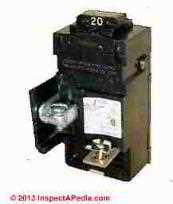
- Pushmatic & Bulldog circuit breakers use a thermal breaker design with no magnetic trip mechanism. Modern breakers incorporate both magnetic and thermal tripping mechanisms, increasing safety and the likelihood that they will function properly in the event of an overload or short circuit.
- Operating difficulty: The design of the breaker is such that, over time, they become very stiff and difficult to operate or reset.
- State of breaker On-Off unclear: Push-Matic breakers have an indicator flag showing whether the circuit is on or off. Many times, on old Push-Matic breakers, this on/off flag will stay fixed in either position, giving you a false indication of the condition of the circuit.
Watch out: the internal flagging mechanism that indicates the state of the circuit breaker as "on", "Tripped", "off" fails inside of individual circuit breakers, making it difficult for a building occupant or owner to know the condition of the breaker - in our opinion this is a significant potential shock hazard.
Greg Bell, a Florida home inspector offers the following additional details, (edited and supplemented by DJF)
Bulldog or Bulldog-Pushmatic electrical panels use a unique, proprietary type of circuit breaker called a "Pushmatic." Bulldog panels with Pushmatic breakers indicate an older system that is no longer manufactured, making replacement parts difficult or expensive to find. There appear to be two major problems with Pushmatic Breakers:
- Bulldog circuit breakers use a solely-thermal breaker design (they have no internal magnetic trip mechanism [according to Mr. Bell])
- what this means to consumers is that the circuit breaker lacks one of the mechanisms used by newer equipment to increase the probability that the breaker will trip OFF when it should to protect the building from a fire - it may be therefore less inherently safe and reliable than other designs - Bulldog circuit breakers are "grease fed" - if the circuit breaker is not not used (exercised) and serviced regularly they become stiff and difficult to operate or reset.
(Mr. Greg doesn't conclude that this means they also don't trip, but that is plausible question) . Greg adds and we agree that no official study has been conducted documenting unusually high failure to trip rates and opinions of electrical professionals vary on the need to replace or upgrade thee panels.[3]
The inspector concludes with an advice paragraph suggesting that the home inspector call for an electrician to shut down the panel power, inspect and check the contacts for rust and corrosion, and proper bus-bar contact.
Really? Our OPINION is that this is unreliable advice since it begs the question of whether or not the INTERNAL parts of the breaker are unreliable and it may fail to trip in response to overcurrent.
Early patents for Bulldog & Pushmatic include product descriptions that describe a mechanical-only device patented in 1934 and a device including both a thermally-warping tripping element and magnetic components.
While there appears to be a basis for Bell's claim that the device was mechnical-only in operation, that may not be the case for all versions of the product. Further, from field reports this role of this circuit breaker feature in Bulldog Pushmatic circuit breaker field failure reports is unclear. [5][6][7][8][9][10][11][12][13]
ITE Imperial Employee Comments about Bulldog/ITE Pushmatic breakers ca 1974-1978
I worked for ITE Imperial (the company name seems incorrect above) from 1974 until 1978. I am certain that the Bulldog/ITE Pushmatic breakers sold at that time and for many years prior did have a magnetic trip.
The was an old display that I found and used then which compared the tripping time for both overload and short circuit type faults between the Pushmatic device and others sold at the time. Under all normal circumstances, the Pushmatic breaker operated more quickly under short circuit than any competitive device.
Based on the older sales engineers in the office at the time (and product literature) this was due to the "five turn coil" used in the magnetic portion of the tripping mechanism.
I sold literally thousands of these breakers for use on job site temporary power poles since the loadce
This fact also led to the Pushmatic being used on projects where the specification was for bolt-on panels. There was -- for at least a short period -- even a three phase version manufactured.
For both the pole pole application, and when used in outdoor residential metering equipment (which was very common in Southern California), there were issues associated with dust entering the breaker and not allowing it to reset.
Whether it was appropriate or not, the generally applied solution was to spray the breaker with WD-40. - (Jan 28, 2012) Edward Rossi [Via Comments Box feature at page bottom - Ed.]
Thank you for this report Mr. Rossi, we've added it as you see, but with a troubling reservation:
Really? a requirement that consumers spray circuit breakers with a lubricant to permit the breaker to operate normally is surely not reliable and considering that the lubricant discussed is one that thickens and gums with age, even that recommendation may in our opinion be unsafe as well - Ed.
Legal Documents, References on Pushmatic & Bulldog Circuit Breakers & Electrical Panels
Patent Infringement [image] 1953 case of Westinghouse v Bulldog Electric Products Co - giving us an idea of the age and history of the Bulldog brand.
Westinghouse sued Bulldog for patent infringement.
The document is useful for pointing out technical differences among similar-looking products.
The Plaintiff's complaint was dismissed.
A copy of the court document is at Westinghouse v. Bulldog [web page]
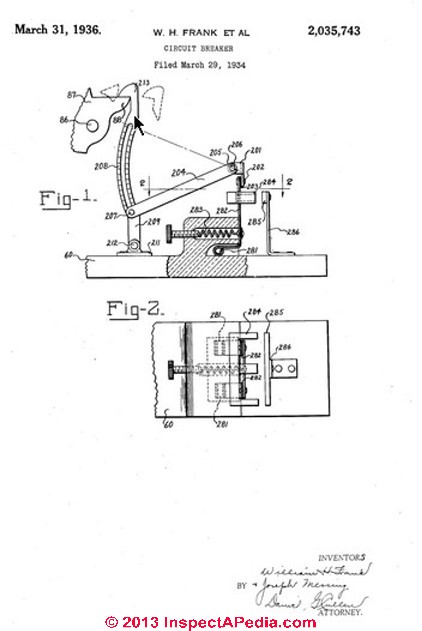
At left - a 1936 Bulldog circuit breaker patent illustration. This is the earliest patent document we've found - indicating that this version of the circuit breaker was: Patented Mar. 31, 1936 PATENT OFFICE CIRCUIT BREAKER William Frank and Joseph Messing, Detroit, Mich, assignors to Bulldog Electric Products Company, Detroit, Mich, a corporation of West Virginia Application March 29, 1934, Serial No. 717,989.
Quoting this patent:
On the base 66 is pivotally mounted at 2M a thermal warping element 282 urged toward the base by a coiled tension spring 283 connected in circuit through the pivot hinge at 28 l, or through a flexible jumper, and adapted to warp on overload to the right.
Secured to and disposed transversely across and preferably insulated from the warping element is an E-shaped magnetic material piece 284 which, together with the magnetic material plate 285 mounted upon the pedestal 286, forms a magnetic circuit with the ther- 30 mal element 282 forming a single turn coil to provide the magnetomotive force.
A bracket 2M is rigidly secured to warping element 282 by rivets 262, there preferably being insulation 203 between the element and the brackets. An arm 204 is pivotally connected to bracket 2M by a pin ZOB-and is provided with a lock washer 206 which maintains arm 20; in any desired preset position, relative to the element.
A pin 20! on the outer or free end of arm 204 rides freely in a circular slot 208 of a lever-latch 209 pivotally secured to a foot 2| l bya rivet M2 and thus mounted on the base 50. A hook M3 on the upper end of latch 209 holds the breaker pawl 81 firmly when the breaker is in the on position, or in its normal 0 position.
When an overload occurs, the warping element 282 moves to the right, due to thermal forces, or magnetic forces, or a combination of both forces. This motion is magnified by the leverage ratio 50 provided by the lever latch 209 moving the hook end 213 thereof to release the pawl 81.[7][8]
[Click to enlarge any image]
Patent information for Bulldog / Pushmatic circutit breakers offer some product design details dating to at least 1936 is provided at [7][8]
Current Advice for Owners of Properties Using a Pushmatic or Bulldog Electrical Panel
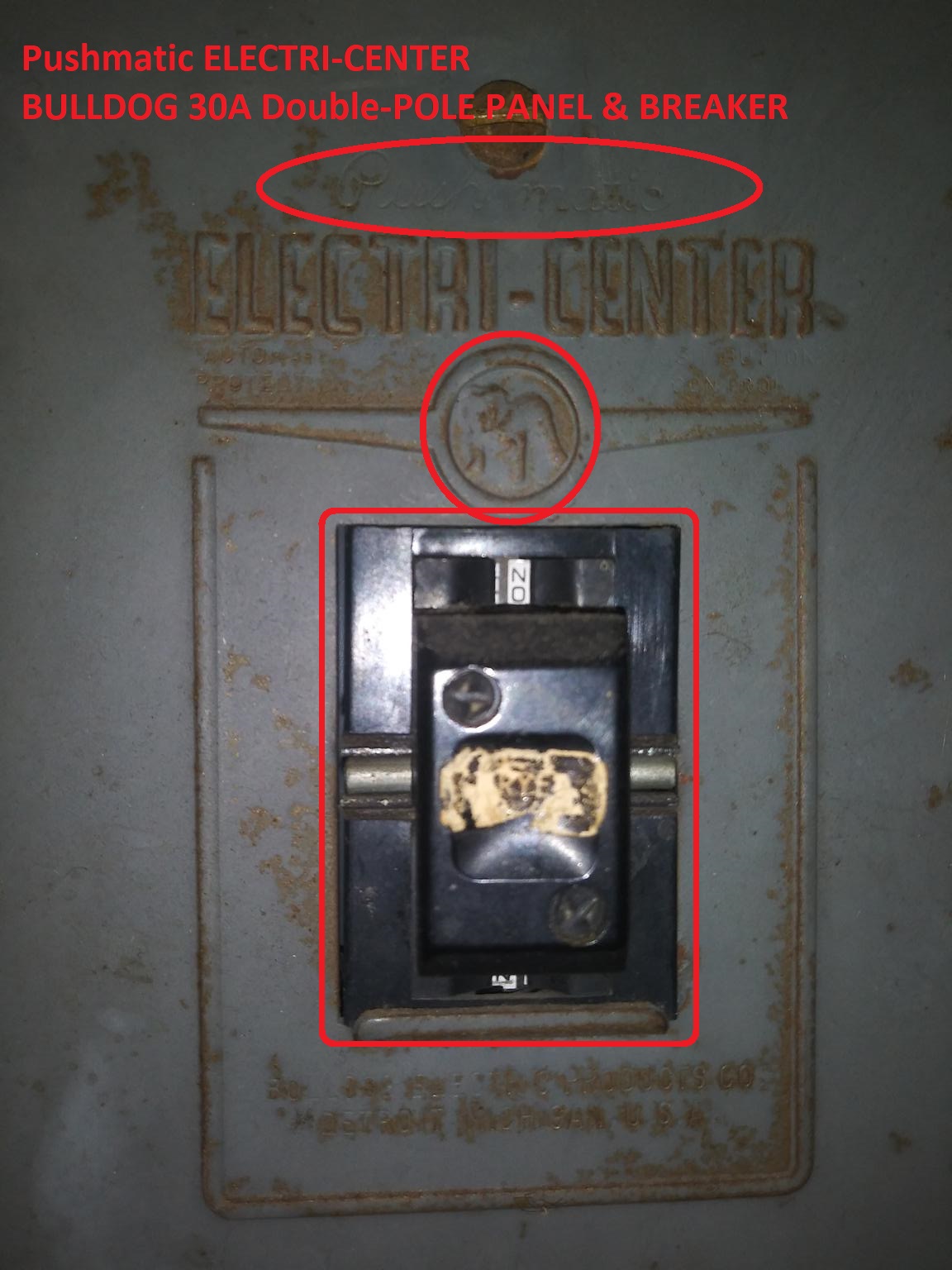
Click to enlarge this image and look closely and you will see the script-text "Pushmatic" inscribed above the embossed tect ELECTRI-CENTER and you'll also notice the little bulldog in the circle below that text. This is a 30A 220V Bulldog Pushmatic electrical box, courtesy of reader Kelly 2020/02/19.
[Click to enlarge any image]
Home inspectors encountering a Pushmatic or Bulldog brand electrical panel should warn consumers that
- There are safety warnings but conflicting opinions among inspectors and electricians about these electrical panels under either the Pushmatic™ or Bulldog™ brand names
- There are some reports of Pushmatic™ or Bulldog™ brand circuit breakers failure to trip -
- There are some reports of Pushmatic™ or Bulldog™ brand circuit breakers being difficult to operate (pushing the breaker in may not reliably "reset" the unit)
Examples of Pushmatic field failiures can be read
at PUSHMATIC BREAKER FAILURE REPORTS.
- It is asserted that Pushmatic™ or Bulldog™ brand circuit breakers, use a less-reliable trip mechanism (no internal magnetic trip - Bell [3]) than that offered by modern equipment. [cf Bell's remarks and patent information above and
at BULLDOG PUSHMATIC DESIGN HISTORY for discussion of this claim] - On this basis and pending further research we consider these products questionable with conflicting opinions that currently deserve a warning but not a condemnation.
Consumers should take advantage of evidence of any failures of the equipment, remodeling, or panel upgrade to meet growing usage requirements as opportunities to replace this obsolete equipment. - Consumers should be sure that their property is properly protected by smoke alarms properly installed and at recommended locations
Contact Us to Provide Pushmatic or Bulldog Electrical Equipment Field Failures & Observations
We would be very grateful if readers, owners, home inspectors encountering this equipment CONTACT Us by EMAIL with any field observations of apparent failures, overheating, damage, product photos. We will continue to collect data, credit contributors, and report the results.
Report ITE Pushmatic or Bulldog Electrical Panel Failures to the US CPSC
In addition to informing us of an ITE Pushmatic or Bulldog electrical panel or breaker event so that we can add this incident report to the data base we maintain, we encourage readers to report such events also to the US Consumer Product Safety Commission - it's easy: you can use a simple form at the CPSC's website: https://www.cpsc.gov/incident.html or you can send the CPSC email on incidents to: info@cpsc.gov
And we would appreciate hearing from professionals, home inspectors, electricians, engineers, regarding their opinion on what is sound, professional, unbiased advice that protects consumers without making unsupportable claims in this matter.
Research & Reports On Electrical Hazards - Bulldog Pusmatic Panels & Breakers
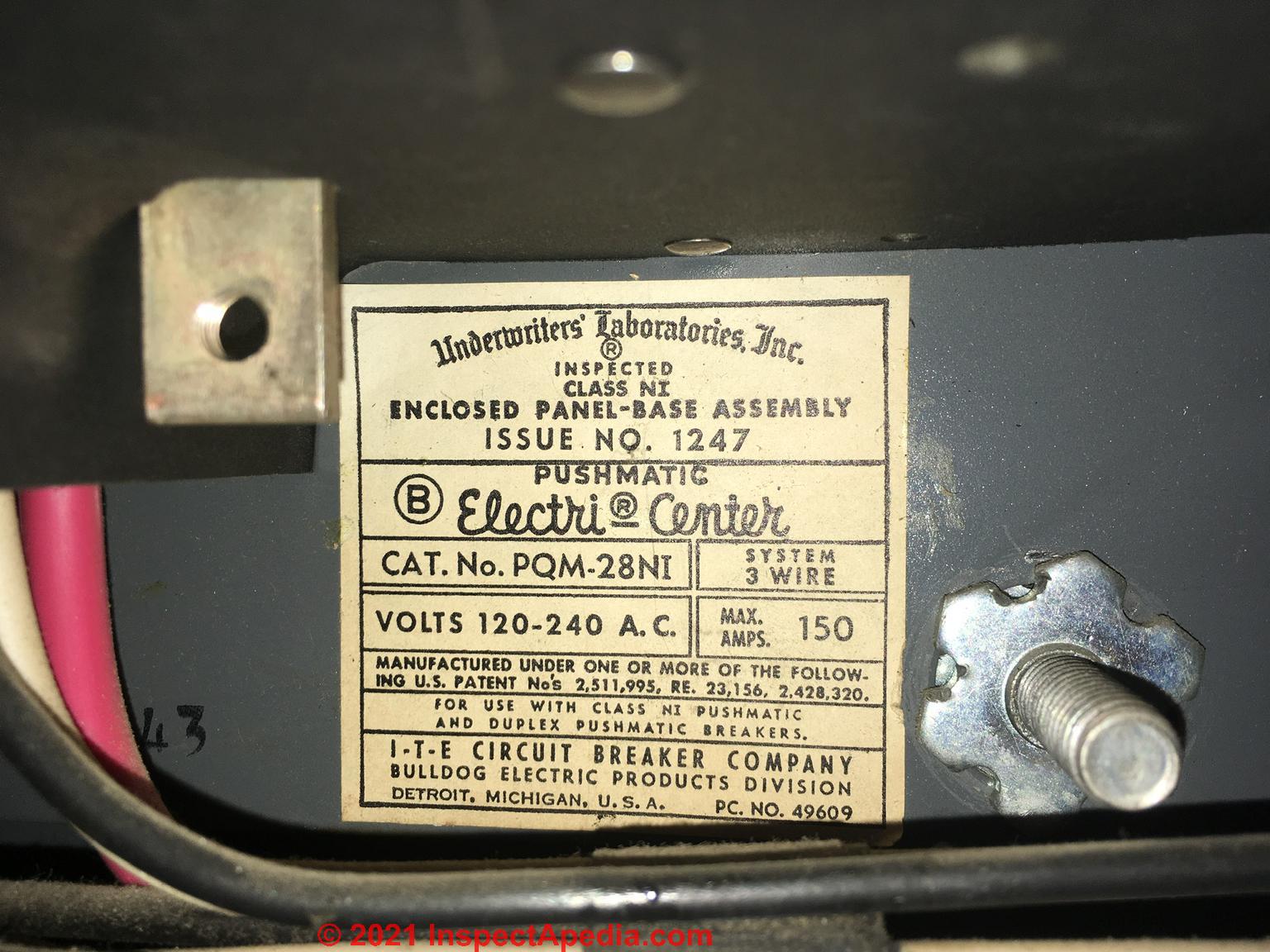
Photo of the UL sticker inside of a Pushmatic Electri-Center electrical panel provided courtesy of InspectApedia reader Karl.
- Bates, W. F. "Electrical incidents in Great Britain." (1998): 2-2.
- Bennett, Peter, A Full House Inspection Co., provided technical editing of this text. Mr. Bennett can be contacted in New Jersey at 732-758-9887 or Cell: 732-245-9817, or by email to: afullhouseinspectionco@gmail.com Thanks to Mr. Bennett for discussing ITE Bulldog Pushmatic circuit breaker differences, compatibility, and substitution, May 2010.
- DeWitt, Gary, HOME INSPECTION REPORT [PDF] (2016), Burbank Home Inspections, Los Angeles, CA, Tel: 818 919-2123 Website: http://www.burbankhomeinspections.com.
Mr DeWitt provides an example report citing a common opinion among home inspectors that Bulldog & Pushmatic circuit breakers and panels are hazardous, retrieved 2020/01/22 & updated 2020/02/01 [copy on file]
Excerpts:
The subpanel was manufactured by ITC pushmatic. This panel has been known to present latent hazards by malfunctioning under certain conditions resulting in jammed circuit breakers. The breakers may not trip (disconnect) under imposed load conditions. This is a fire hazard. I recommend replacing the panel - cf p. 3
- Forest, Park. "Control enclosure." US Patent USD 220695S 1971, May 11
Excerpt:
FIG. 5 is an end elevational view thereof. I claim: Pushmatic brochure #493, Bulldog Electric Products Co. 1949, p. 20, upper left narrow column panel. - Journal of Light Construction online help forum: http://forums.jlconline.com/forums/showthread.php?t=30720 - this article talks about home inspectors "playing it safe" by "failing" a Pushmatic panel - without supporting data
- McCann, Michael, Katherine L. Hunting, Judith Murawski, Risana Chowdhury, and Laura Welch. "Causes of electrical deaths and injuries among construction workers." American journal of industrial medicine 43, no. 4 (2003): 398-406.
- Mant, Jonathan, Sue Wilson, Jayne Parry, Pam Bridge, Richard Wilson, Will Murdoch, Terry Quirke et al. "Clinicians didn't reliably distinguish between different causes of cardiac death using case histories." Journal of clinical epidemiology 59, no. 8 (2006): 862-867.
- Messing, Joseph. "Circuit breaker." U.S. Patent 2,035,743, issued March 31, 1936.
Patent information: Publication number US2035743 A Publication type Grant Publication date 31 Mar 1936 Filing date 29 Mar 1934 Priority date 29 Mar 1934, original text (with some OCR scan errors) is reproduced
at BULLDOG PUSHMATIC DESIGN HISTORY - O'Neil, Louise. "JAMES HUGGINS & SON, INC. v. AVENARIUS BROTHERS (ATTORNEY GENERAL OF THE UNITED STATES, substituted)."
Excerpt:
... for electric switches is not confusingly similar with PUSHMATIC for electrical circuit breakers. Opposition proceeding by Bulldog Electric Products Co. v. Anderson, application serial no. 571,398 filed December 31, 1948. - PREVENTION, KENTUCKY INJURY. "Fatality Assessment and Control Evaluation (FACE) Report for Kentucky: Licensed Electrician Dies When Electrocuted by 480 Volts." (2006).
- Rasdall, Joyce. "Aging Residential Wiring Issues: Concerns for Fatalities, Personal Injuries, and Loss of Property." Annual Household Equipment Technical Conference, Louisville, Kentucky. 2005.
- Schradergroup Architects, LLC, "Bristol Township School District Facilities Assessment and Distdrict-Wide Facilities Master Plan", [PDF] (2012) Schradergroup Architecture, LLC, retrieved 2020/01/22 original source: http://citeseerx.ist.psu.edu/viewdoc/download?doi=10.1.1.729.6437&rep=rep1&type=pdf
Excerpt:
Electrical Electrical Service poor Service is 208/120V, 3Ø, 4W system. Service entrance equipment, including CT and meter, are located in the Boiler Room. There is a 400A fused disconnect by Pushmatic serving as the main disconnect. The equipment appears to be original to the building.
Replace existing service entrance equipment with a new Switchboard style. Increase the size of the service to accommodate the new demands of the school and provide surge suppression at service entrance.
- Vergara, Ximena P., et al. "New electric‐shock job exposure matrix." American journal of industrial medicine 55.3 (2012): 232-240.
- Westinghouse v Bulldog: Patent infringement lawsuit: Westinghouse v Bulldog http://bulk.resource.org/courts.gov/c/F2/206/206.F2d.574.6544.html A copy of the court document is avaiulable
at WESTINGHOUSE v. BULLDOG
Reader Comments, Questions & Answers About The Article Above
Below you will find questions and answers previously posted on this page at its page bottom reader comment box.
Reader Q&A - also see RECOMMENDED ARTICLES & FAQs
In addition to the most recent comments shown at the end of this article we post here some useful remarks from earlier readers.
Question: where do I get a Bulldog Pushmatic main switch?
I have the Bulldog pushmatic in my rustic cabin. It has never given me any problems and looks to be in good condition.
Is there a 220 breaker available for the Bulldog? I will eventually be replacing the Bulldog panel but need to get 220 up and running quickly. - Anonymous by private email 2018/06/03
Reply:
Sorry to say that although I grew up admiring Bulldog Pushmatic electrical panels, based on the infdormation given here I'd replace the panel now rather than wait.
Otherwise you may end up with either an unreliable patch-job or you may have to buy an external main switch that could instead have been part of your new replacement panel.
Question / Comment: How do I determine total panel ampacity?
(Oct 20, 2012) Jan Gates said:
Our home was built in the late 60's. There is a Bulldog Push-matic, Electri-Center panel. How do i find the total ampage. My insurance company wants to know. There are two switches that say 30amp on both sides, then there are 6 more that say 20.
Reply:
Re Jan Gates question
How do i find the total ampage. My insurance company wants to know.
Please see our article titled AMPS VOLTS DETERMINATION - How to find out the electrical service ampacity & voltage level entering a building where we provide those details.
From just your note it sounds as if the panel you describe is obsolete. You will also want to review the safety and performance questions discussed above. If you elect to replace the panel, we ask you to consider preserving the old one intact and to contribute it for testing. You can contact me for shipping information to D. Carrier, and independent electrical engineer who is conducting circuit breaker testing if you decide to do so.
Question / Comment: buzzing ITE Pushmatic circuit breaker and Aluminum wiring
(Dec 22, 2012) Rick said:
Condo I own, built in the mid-1970's has aluminum wiring and ITE Pushmatic breaker box.
When the water heater cuts in, I can hear a buzzing sound from 30A circuit breaker (?) that feeds the water heater.
In addition, this breaker is difficult to reset if I use it to shut off hot water heating.
I'm thinking I should replace that 30A double pole breaker.
Good idea? Could this be a wire connection that has loosened due to aluminum wire?
Thanks In Advance.
Reply:
Re: Rick's comment
I can hear a buzzing sound from 30A circuit breaker
Since at least in some circumstances a buzzing circuit breaker is one having trouble tripping, the breaker and circuit it protects may be unsafe; I would switch it off pending inspection and repair by a licensed electrician.
If your home has aluminum electrical wiring that is itself a fire hazard that needs proper repair. See
ALUMINUM WIRING HAZARDS & REPAIRS
to read about that topic.
In the event that failures in the panel are detected please report that to us and to the US CPSC.
Question / Comment: Bulldog Pushmatic Breakers don't tell me if the breaker is tripped, ON, or OFF
(Jan 4, 2013) JACK DOUGLASS said:
I would like to replace the pushmatic breaker for the "throw type" I can never tell which breaker it tripped as the flag stays in one position. Is there a replacement brand that you could suggest
Thanks
Reply:
Re Jack Douglas' comment
I can never tell which breaker it tripped as the flag stays in one position.
That field observation confirms one of the safety defects discussed for this equipment. Just about any contemporary electrical panel brand preferred by your installing electrician should be acceptable and properly installed should be safer than the equipment you have.
We prefer to stay away from specific replacement brand recommendations. My worry is that some replacement breakers may be no safer, or even less safe than the ones we take out of the panel - it depends on the panel brand, model, design.
For electrical panels subject to frequent reports of field failures or that have been documented by independent research as having abnormally high failure rates (see FPE and perhaps Zinsco) it makes more sense to replace the panel.
Question / Comment: Has anyone ever been electrocuted just opening a Bulldog Pushmatic electrical panel?
(Feb 17, 2014) Oscar C said:
I recently purchased a home with a Bulldog Pushmatic electrical panel. I've read on other sites that there is potential danger in opening the panel as the "bussing" iis usually energized and you could be electricuted.just from taking off the cover.
How often has this been known to happen with this type of panel?
Reply:
Oscar, it is indeed true that opening ANY electrical panel that is acting strangely can be dangerous; an electrician was killed when he was removing a panel cover (not just opening the door,
and though I don't recall for sure I don't think it was a Pushmatic) and internal parts that were faulty formed an electrical connection and caused an arc explosion. And I've rec'd other reports of similar burns and injuries.
Certainly we've not received a large number of fatalities or serious burns, but as Aronstein has pointed out, because only a very small percentage of electrical failures, probably less than 1 or 2%, are ever reported through official channels eg. to the CPSC or to industry associations, the few reports most likely represent a larger number.
Similarly, fire inspectors may be untrained in sufficient depth to correctly identify the root cause of an apparently-electrical-system-related fire or injury or death, as are even people in the medical profession (see citation 2 below).
A related concern with the Pushmatic line is that you can switch a breaker to the "off" position but be unsure that it is really switched off internally.
So while it would normally be reasonable to tell the electrician to just switch off the main breaker before working on the panel (or replacing it) a safer course would be to have the electric company drop power outside - by pulling the meter.
On 2021-01-18 by Jason - my 50A Pushmatic Breakers not working properly
At my job, a automotive repair facility that was built in the 1950's in Wheat Ridge Colorado. We have those type of breakers. Lately here the of the bigger 50 amp breakers has been not working properly. This is the breaker that is hooked up to the air compressor which is outside if the building in a small compressor closet.
You can imagine this breaker being turned off and on 5 days a week since 1950. It recently has not been clicking in and out fully and loud electrical buzzing if it is not fully compressed. It obviously needs to be replaced. What type of replacement is advised that will fit in that panel? For daily use for 70 or so years that's pretty good in my humble opinion. Now that it is failing it is a hazzard but how many other brands would last or do that long with heavy start up loads as a air compressor and being turned off and on consistently for that many years. I am not biased in any way. It repair things for a living and something with that much abuse that still works even failing is amazing.
On 2021-01-18 - by (mod) - 50A Pushmatic Breakers not working properly
Jason
There are a couple of problems that you describe, and I agree that the installation is unsafe. As you can read in this article series, some circuit breaker brands fail at a remarkably higher rate than others - they're absolutely not all equal in performance.
Watch out: In addition, circuit breakers are not designed nor intended to be used as regular on-off switches for equipment. So when you replace the Bulldog Pushmatic panel and breakers with new, safer equipment, you will also want to have installed an appropriate shutoff control for the compressor - typically located close to the compressor itself.
I appreciate your vote for being an un-biased, independent professional voice. I am on exactly the same page.InspectAPedia is an independent publisher of building, environmental, and forensic inspection, diagnosis, and repair information for the public - we have no business nor financial connection with any manufacturer or service provider discussed at our website.
We very much welcome critique, questions, or content suggestions for our web articles. Website content contributors, even if it's just a small correction, are cited, quoted, and linked-to from the appropriate additional web pages and articles - which benefits us both. Working together and exchanging information makes us better informed than any individual can be working alone.
More about us is at ABOUT InspectApedia.com https://inspectapedia.com/Admin/About_InspectApedia.php
On 2020-06-21 by Debi - replacement outdoor Pushmatic electrical panel cover
I’m looking for a replacement outdoor panel cover. The original one has been lost. The apt building was built in 1965. The landlord currently has an aluminum type cover on it. Can a proper replacement be purchased?
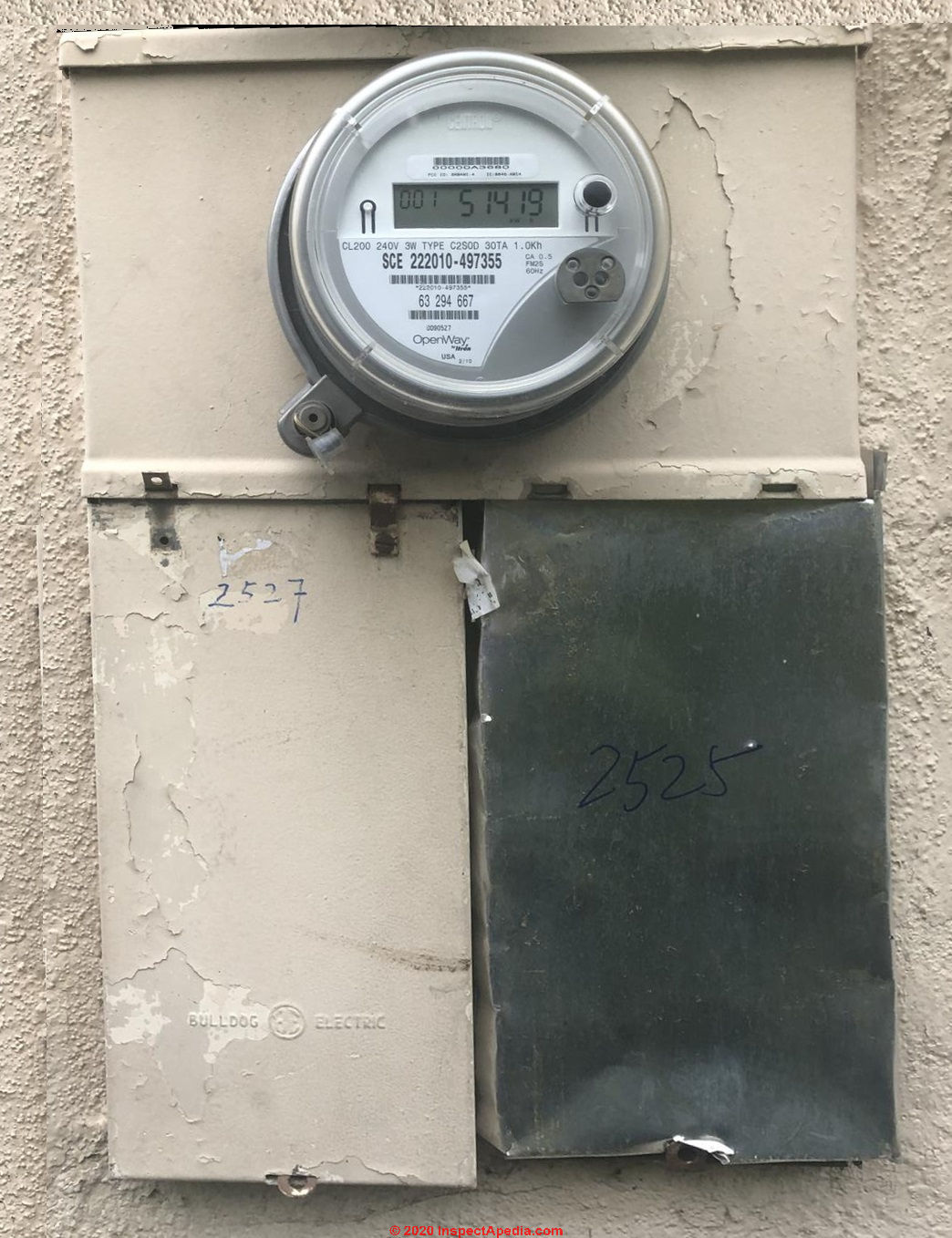
On 2020-06-24 - by (mod) - looking for a replacement outdoor Pushmatic electrical panel cover
I'm doubtful, Debi, given the age of the meter base. It may best be replaced.
On 2020-05-23 by Anonymous - Push Maddoc electrical panel?
I have a customer with a push Maddock I believe 100 amp sub panel that needs a 20 amp breaker where can I get it from
On 2020-05-24 - by (mod) - customer with a push Maddock
Anon
In my opinion it would be a mistake for the contractor or electrician to replace a pushmatic circuit breaker.
If you take a look at the data in the article above, you'll see the it's an unsafe electrical panel.
What that means for you is that in the future when there is a panel or breaker failure and a fire, shock, or other loss, you will be blamed.
In addition you should inform your customer that the panel is unsafe and should be replaced.
You might want to print this article and give it to your customer to read.
On 2020-05-23 by william - cover for a Bulldog Electric 100 amp box
I have a Bulldog Electric 100 amp box. I need to know if i can get a new cover. The label inside says ISSUE NO 5,293
CAT. No. PM-12NI
On 2020-05-23 - by (mod) - replace your Bulldog Electric panel.
Several companies sell replacement electrical panel box covers, William, but
Watch out: please read the article above on this page: you will see that Bulldog Pushmatic circuit breakers are not safe. The breaker may, for example, remain "on" internally or elecctrically even when switched "off" - a mistake that can lead to a fire or death.
You should replace your Bulldog Electric panel.
On 2020-04-06 by Caesar - cycling the breaker to "fix" it?
Lots of opinion and very little evidence here. I wouldn’t install one, but they are no where near “unsafe”. Homeline breakers aren’t always clear that they are tripped either, should we replace all of those as well?
How about being prudent and cycling the breaker if there’s a doubt and if you are working on the circuit, always check for voltage and not rely on the breaker?
On 2020-04-06 - by (mod) - flipping breakers on and off does not fix anything and may make the problem worse
Thank you for your opinion, Caesar.
You are right to question what you read.
However in this case we have
- a history of field failure reports
- independent testing of breaker no-trip failure rates
- a particularly onerous safety hazard: a breaker that sometimes remains "ON" even when switched "OFF" - that alone can easily someone.
Watch out: cycling some circuit breakers to "exercise" them does not increase safety even though intuitively one might think-so. At lest some brands such as FPE were shown to have a greater chance of jamming and failing to trip after having been switched on- and off.
I used to think, as you, that cycling a circuit breaker might "free up" a stuck breaker that's not working.
Unfortunately for some designs not only is that not true (Pushmatic for one) but worse, for other breakers such as FPE, cycling the breaker actually increases the probability that in the event of a future over-current the breaker won't trip.
Therefore a blanket "cycle the breaker" trick is not a great idea. Something that sounds good can end up burning down the house or killing someone.
Your final advice on always checking for voltage and not relying on the breaker is dead right - I agree, and always suggest the same - but that's for people working on electrical systems.
That is not helpful for a homeowner who, in the face of an emergency (Junior stuck his hand into the toaster and is getting shocked), is going to rush to switch off the breaker to avoid or stop a fire or shock event - only to find, for some Pushmatics - that switching the breaker off was no use whatsoever.
Thanks for the discussion.
On 2020-01-22 by Ron - ok to re-use old Pushmatic breakers?
Is it safe to reuse pushmatic breakers that were working properly in a panel I removed
On 2020-02-21 - by (mod) - No - see Pusmatic circuit breaker failure reports
Rugg
While there are some vendors of used and also replacement Bulldog breakers in our opinion you should not buy any of them as they are not reliable, failing to turn off or failing to trip when they should, a significant percent of the time. Please take a look at
PUSHMATIC BREAKER FAILURE REPORTS for some examples
Replace the panel instead. Toss out the used breakers.
On 2020-01-11 by Nicole - how to turn off a Pushmatic breaker
I have an old bulldog circuit breaker and I'm unsure as to where the ac area is located. My ac fan have been on all night and won't turn off so I want to completely shut it off until I can get someone out to look at it.
On 2020-01-11 - by (mod) -
Nicole
In the electrical panel, most likely there will be a breaker that is 220V or double pole - occupying two slots - that controls your air conditioning equipment.
Alternatively, right at the air handler (if you mean the indoor AC fan) or close to the outdoor compressor condenser unit (if you mean the outdoor condenser unit fan) you should find a service switch that can be turned off to shut down the equipment right there.
Watch out: One of the Bulldog Pushmatic breaker concerns is that the breaker can fail internally so that even though you push it to try to turn it OFF, it remains ON internally.
Let me know if this works for you and if not we'll take it from there.
On 2019-11-14 by frank verrastro - field experience with bad electric panels
I have had trouble with zinco and federal pacific breakers four years. pushmatic on the other hand I found a very safe breaker panel, found new guys try wiring this panel same as others , same phase all the way down one side phase two other side, they never made a three phase panel. what I liked was they where not push in breakers, they screwed in.
I had a tool too remove stops on buss two install twins very safe and reliable breaker. I am 50 years an inside wireman
to me the safest thing was the fuse. if its the right size!
On 2019-11-15 - by (mod) -
Indeed, Frank, until learning of the Bulldog-Pushmatic failures described here I was a fan of the panel as the physical appearance of the hardware looked to me to be high quality. Unfortunately the breaker failure track record is by now pretty well documented.
We agree as well on fuses. A lifetime ago it was an electrician as old as I am now (rather old) who opined that breakers may be really convenient, but when it came to a really big hazard such as an overcurrent at the mains, he preferred to rely on the old fashioned fuses.
Truth is - or opinion is - there are safety drawbacks to just about every electrical safety choice; fuses were pretty reliable at blowing when they ought, but one of the most common safety hazards home inspectors and electrical inspectors find in older homes is over-fusing. It was just too easy to screw in a 20A or even a 30A fuse on what should have been a 15A circuit.
Of course someone can install an oversized or wrong-sized breaker, too, but homeowners are far less likely to do that than to screw in a higher-ampacity fuse.
Question / Comment: who made 1970s Pushmatic panels?
(Feb 18, 2014) Anonymous said:
Just bought a home in Mission Vejo built in 1970 with pushmatic panel breaker system. By reading these posts who do I consider would be the actual manufacturer of pushmatic in 1970 in order to get breakers?
Reply:
Anon, while you might look at the older manufacturers like ITT Pushmatic I think that's not useful.
When looking for replacement circuit breakers we're generally limited to the current manufacturers of breakers whose specifications, including not just performance but electrical panel bus connector design, that mean the current, new breakers fit and work properly. This is, of course completely aside from questions of whether one would be smarter to replace the equipment entirely.
Question / Comment: where can I find TCC cures for Bulldog Circuit Breakers?
3/5/2014 David R said:
Does anyone know where to find TCC curves for Bulldog breakers?
Reply:
Great question David - certainly I haven't found that data. Sometimes reviewing for academic studies or patents we can find that data.
Here are a few citations pertinent to Bulldog / Pushmatic circuit breakers. More are in the References section of our article on these breakers.
- Messing, Joseph. "T BREAKER." U.S. Patent No. 1,952,040. 20 Mar. 1934.
- Bingenhelmer, Melvin. "Circuit breaker." U.S. Patent No. 2,568,423. 18 Sep. 1951.
- Krasser, Fritz. "Circuit breaker with switching rocker." U.S. Patent No. 4,167,720. 11 Sep. 1979.
- Huang, Albert. "Circuit breaker." U.S. Patent No. 6,621,402. 16 Sep. 2003. (Cites earlier Bulldog patents)
- Finally, in Poughkeepsie NY David Carrier has been testing a variety of circuit breakers beyond the scope of Aronstein's original FP & FPE series - he may have some TCC data of interest.
Reader follow-up:
Thanks for that info Dan. We are currently pricing out a pretty big AF project and when doing a walk through, I found many Bulldog panels installed in the 50s.
I need those breaker curves, but more importantly, I doubt any of these breakers have been exercised. So I might need to time the incident energy calculation at two seconds (per IEEE 1584 and produce an AF label opposed to relying on the curves.
I will continue to do my due-diligence and follow up on your suggestions though.
Thanks!
Reply:
David,
In my experience exercising a breaker does not necessarily improve its performance. In fact for FPE Stab-Lok units exercising the breaker can significantly increase the risk of a future jam-type failure.
Tests showed a still greater concern: testing a breaker - not in general but ones with a problematic design that led to jamming and no-trip failures - could appear to have acceptable results but leave the breaker jammed so that on a future overcurrent the breaker wouldn't trip under any load.
This was found with FPE but I would not assume the problem was unique to that marque. In general in-situ testing is considered very dangerous.
Are you considering deciding to leave equipment in place based on visual inspection, testing, or worse, in-situ testing?
If so you might want to consult with Dr. Jess Aronstein.
Question / Comment: electrician's experience with Pushmatic panels
3/6/2014 Anonymous said:
Greetings, JK in VT. Read thru many comments re: Pushmatics. As a lic.electrician
and elec.engr. I leave nothing to chance. Just compl. repl. of 1960's Electri-Center with"newer" Gould-ITE-Siemens Pushmatic Load Center(s). 40 space dual-buss in the res. and 8 space PL8 load center subpanel in outbldg. Rem.all AL wire,used THHN copper,etc.
NOTE: All brkrs.from all mfgrs. should be tested,cleaned,lubed prior to svc.Incl.Pushmatics. Dirt,time,environment worst enemy of all things electrical.
Have seen shoddy new installs of non-Pushmatics by inexper. homeowners who perf. DIY rewiring projects courtesy of local big-box stores.
I preferred the Pushmatic for sev. reasons. My own home over 30+ yrs. NEVER had one
prob. or failure due to Pushmatic design. I use newest type brkrs avail.10KA I.C.
for peace-of-mind. Have doc. 6 diff. configs. of one Pushmatic from Bulldog-ITE-Gould
to Siemens. The newest mfgd. in gray color oval tops have ques.mfg. qual,I won't use them.
About the tandem P1515 breakers insertion to older load centers,most have dedicated spaces to accom. those types.Usually at bottom of ea.buss. The latter have cutout notches to accept the P1515 tandems. Not an issue w. P2020 tandems,BTW.
To-date, I have discarded many high-current Bulldog Pushmatics from 30-60A range. As mentioned before, above,dirt,age,use and environment can be root causes. Overheated contacts,same as old A/C unit, fridge, or sim. hi-amp. applicance. Not a surprise here.
Also dissected a few Pushmatics to verify the thermal-magnetic debates here.
Thermal-magnetic circuit breakers are explained and their history given
FINDING (IMHO): The newest Pushmatic have both, but earlier Bulldogs do not. I purposely ran a short-ckt. test on newer P115 and P120. Cut-out faster than a SQD unit.
Summary: Perf. cost analysis to convert to rocker-style brkrs. and load center vs. repl.older Pushmatics w. newer types. You might be surprised!
SAFETY: Make certain there's a 100A or 200A main breaker feeding the Pushmatic (sub)panel. Then, "off" is def. OFF. Good Luck and pls. be careful! -JK-
Reply:
Thanks for the comments Anon, I [mostly] agree with your opinions, including that the presence or absence of internal trip mechanism components (magnetic for example) in the product line appears to depend on when the product was made. There are other failure issues that are very serious, including the difficulty with knowing if a breaker is ON or OFF - a dangerous shock risk.
Telling people to lubricate a crictuit breaker is an unreliable approacy. In my opinion it's a poor product design or specification that calls for the installer or homeowner to do something that we know perfectly well nobody ever does and nobody is ever going to do - it's "design to fail" in my book.
Nobody installing circuit breakers disassembles or lubricates them in residential applications and certainly no homeowner would nor should attempt such a task. Worse, perhaps, some people reading the "lubrication" advice for breakers may try (as some readers reported) spraying the panel and interior with an arbitrarily chosen spray lubricant - a product that may make matters worse rather than better.
Also let's keep in mind that absence of evidence [of a product faiilure] is not evidence of absence [proof that failures are not occurring] - more specifically, one person's observation something like "I've never had a problem" is much too small to be statistically valid. Add to that the very low reporting rate of electrical failures - probably less than 2% - and we instead need to pay careful attention to the failures that are reported. - DF, Ed.
Question: Does this Small Pushmatic Electrical Panel provide 100A service
 Jake_Infinity said:
I have a service panel with no manufacturers label and our local building inspector wants us to verify our panel is rated for 100amps.
Is there a way i can get the bus/panel rating without the label?
The house was built in 1955 and has a old pushmatic panel with no main breaker. any extra info would be a big help
Reply: Not likely
Jake
I suspect this was no more than a 50A or 60A panel enclosure. It should be replaced as I will elaborate:
Watch out: This is an obsolete Pushmatic-brand panel - as we discuss beginning at PUSHMATIC - BULLDOG PANELS
The photo is a bit blurry - I'd like to see a sharper one that lets me see the ampacity of the circuit breakers. You might even see "Pushmatic" on some of the breaker labels.
An electrician would take a look at the size of the mains or main wires entering the panel from the electric meter: that will give the limit on the ampacity of this enclosure.
Watch out: Also as you noted and as I can see, there is no main breaker and there are more than 6 breakers with no main - another reason this panel is considered unsafe and should be replaced.
This type of electrical panel was allowed under the so-called "Rule of Six" in the National Electrical Code (NEC): "The service disconnecting means ... for each set of service entrance conductors ... shall consist of not more than six switches or six circuit breakers ..." (NEC 1981, section 230-71a, for example.)
In an emergency need to turn off all electrical power to the building, having to switch more than six breakers was considered unsafe. In addition there is no second-level protection at the building should one of the breakers jam and refuse to open in event of an over-current.
See ELECTRIC PANEL AMPACITY for an explanation of how to determine the ampacity rating of an electrical service at a building. You'll find that the smallest capacity component is the limiting factor.
On 2014-06-24 0 by Wayne Jensen - need emergency power interlock for Pushmatic
We have Bulldog Electric Panel Cat# UGPMC10014-20. We would like to add an emergency power mechanical interlock for the main breaker. Can this be accomplishe
On 2014-06-24 - by (mod) -
It's a question of cost and trouble.
I would take a different approach and one that's probably preferred anyway.
Ask your electrician to install a isolation switch. The switch is used to switch between the utility company's power source and your electrical generator as a source. It's an "either-or" switch so when you flip it to emergency power it disconnects from the utility company.
The isolation switch panel will usually NOT switch your entire main panel over to emergency power since your generator is not likely to provide enough amperage to handle the sum of all of your home circuits.
Rather certain critical circuits (heat, refrigerator, some lighting, water pump) are routed out of their original place in the main panel over to the transfer switch and then back to connect to the original circuit in the main box.
See details at
https://inspectapedia.com/electric/Backup_Generators.htm
On 2014-03-06 by Sparky Jerry The K - reader opinion about Pushmatic panel safety
Hi DJF (mod). Thanks for posting my orig. anon.(JK In VT)comment.
Was meant for genl.info,not defacto global advice. As PT Barnum oft said "You can't please
all the people all the time." As lic.electrician ,whenever I come across a suspect Bulldog panel (esp. w. stamped Bulldog atop), my mantra is : "when in doubt, throw it out."
The safest electrical antiques are those in museums. I agree 150% not to recomm. to
spray anything to lube the Pushmatic. I found (during R&D) that a solvent or
cleaner causes the brkr. to bind-up worse than B4. Bench test only.
My newer Pushmatic installs at my home have covers on load centers. Therefore
clean 24/7/365. Add to that mod,incorp. NEC specs for THHN feed cable,insulated bushings,
10KA C.I. ratings,polished busses,etc. My finished Pushmatic project is every bit
dependable as a new SQD QO-Series comm. panel.
The latter which BTW, I inst. in my elderly mother's home 300 mi.away for peace-of-mind.
Your forum is very helpful to educate-inform homeowners,inspectors,and devel. people
for safest,economical ways to dist. pwr. thru a res. or business. If money were no option,
I'd prob. go the full-Monty on a SQD QO-Series panel upgrade. But the Pushmatic brkrs.
in use should be on case-by-case basis. If their closed(ON) resistance is anything more than Zero-ohms,or fail to mech.activate ON-OFF, toss 'em.
As mentioned in init. posting,I've seen shoddy rewires of non-Pushmatic load centers,
mostly as DIY weekend projects by inexp.homeowners visiting the big-box stores.
For now,I'm remaining w. my choice using ITE-Gould-Siemens Pushmatics in home-workshop.
What works for me may NOT be what works for another. As always,be safe & Good Luck! -JK-
On 2014-03-06 by Anonymous
Greetings, JK in VT. Read thru many comments re: Pushmatics. As a lic.electrician
and elec.engr. I leave nothing to chance. Just compl. repl. of 1960's Electri-Center with
"newer" Gould-ITE-Siemens Pushmatic Load Center(s). 40 space dual-buss in the res. and 8 space PL8 load center subpanel in outbldg. Rem.all AL wire,used THHN copper,etc.
NOTE: All brkrs.from all mfgrs. should be tested,cleaned,lubed prior to svc.Incl.Pushmatics. Dirt,time,environment worst enemy of all things electrical.
Have seen shoddy new installs of non-Pushmatics by inexper. homeowners who perf. DIY
rewiring projects courtesy of local big-box stores.
I preferred the Pushmatic for sev. reasons. My own home over 30+ yrs. NEVER had one
prob. or failure due to Pushmatic design. I use newest type brkrs avail.10KA I.C.
for peace-of-mind. Have doc. 6 diff. configs. of one Pushmatic from Bulldog-ITE-Gould
to Siemens. The newest mfgd. in gray color oval tops have ques.mfg. qual,I won't use them.
About the tandem P1515 breakers insertion to older load centers,most have dedicated spaces
to accom. those types.Usually at bottom of ea.buss. The latter have cutout notches to
accept the P1515 tandems. Not an issue w. P2020 tandems,BTW.
To-date, I have discarded many high-current Bulldog Pushmatics from 30-60A range.
As mentioned before, above,dirt,age,use and environment can be root causes.
Overheated contacts,same as old A/C unit, fridge, or sim. hi-amp. applicance.
Not a surprise here.
Also dissected a few Pushmatics to verify the thermal-magnetic debates here.
FINDING (IMHO): The newest Pushmatic have both, but earlier Bulldogs do not.
I purposely ran a short-ckt. test on newer P115 and P120. Cut-out faster than a SQD unit.
Summary: Perf. cost analysis to convert to rocker-style brkrs. and load center vs. repl.older Pushmatics w. newer types. You might be surprised!
SAFETY: Make certain there's a 100A or 200A main breaker feeding the
Pushmatic (sub)panel. Then, "off" is def. OFF. Good Luck and pls. be careful! -JK-
Bulldog, Pushmatic, ITE Breaker Compatability
This topic has moved to BULLDOG PUSHMATIC COMPATABILITY & FAQs
...
Continue reading at PUSHMATIC BREAKER FAILURE REPORTS or select a topic from the closely-related articles below, or see the complete ARTICLE INDEX.
Or see these
Recommended Articles
- CIRCUIT BREAKER FAILURE RATES
- CIRCUIT BREAKER LOCKS where we discuss circuit breaker locks for Pushmatic breakers.
- CIRCUIT BREAKERS RE-CONDITIONED USED
- ELECTRIC PANEL INSPECTION
- ELECTRICAL PANEL AGE
- PUSHMATIC - BULLDOG PANELS
- BULLDOG PUSHMATIC BREAKER REPLACEMENTS
- BULLDOG PUSHMATIC DESIGN HISTORY
- PUSHMATIC BREAKER FAILURE REPORTS
- WESTINGHOUSE v. BULLDOG
Suggested citation for this web page
PUSHMATIC - BULLDOG PANELS at InspectApedia.com - online encyclopedia of building & environmental inspection, testing, diagnosis, repair, & problem prevention advice.
Or see this
INDEX to RELATED ARTICLES: ARTICLE INDEX to ELECTRICAL INSPECTION & TESTING
Or use the SEARCH BOX found below to Ask a Question or Search InspectApedia
Ask a Question or Search InspectApedia
Try the search box just below, or if you prefer, post a question or comment in the Comments box below and we will respond promptly.
Search the InspectApedia website
Note: appearance of your Comment below may be delayed: if your comment contains an image, photograph, web link, or text that looks to the software as if it might be a web link, your posting will appear after it has been approved by a moderator. Apologies for the delay.
Only one image can be added per comment but you can post as many comments, and therefore images, as you like.
You will not receive a notification when a response to your question has been posted.
Please bookmark this page to make it easy for you to check back for our response.
Our Comment Box is provided by Countable Web Productions countable.ca
Citations & References
In addition to any citations in the article above, a full list is available on request.
- [1] Personal communication: Email, David Carrier, P.E. to Daniel Friedman, 28 March 2011.
- [2] Matthew Steger, CRI, WIN Home Inspection, 717-361-9467: msteger@wini.com
- [3] Greg Bell, a Florida home inspector: http://www.bellinspection.com/files/Electric_panels.pdf at www.bellinspection.com Bell Inspection Service provides Inspection Services to Daytona Beach, Melbourne and Orlando Florida.
- [4] http://www.selfhelpforums.com/archive/index.php/t-10032.html - conversation about Pushmatics, field failure report
- In addition to citations & references found in this article, see the research citations given at the end of the related articles found at our suggested
CONTINUE READING or RECOMMENDED ARTICLES.
- Carson, Dunlop & Associates Ltd., 120 Carlton Street Suite 407, Toronto ON M5A 4K2. Tel: (416) 964-9415 1-800-268-7070 Email: info@carsondunlop.com. Alan Carson is a past president of ASHI, the American Society of Home Inspectors.
Thanks to Alan Carson and Bob Dunlop, for permission for InspectAPedia to use text excerpts from The HOME REFERENCE BOOK - the Encyclopedia of Homes and to use illustrations from The ILLUSTRATED HOME .
Carson Dunlop Associates provides extensive home inspection education and report writing material. In gratitude we provide links to tsome Carson Dunlop Associates products and services.
 | HOME | ABOUT | ASK a QUESTION | CONTACT | CONTENT USE POLICY | DESCRIPTION | POLICIES | PRIVACY | |
| © 2024 - 1985 Publisher InspectApedia.com - Daniel Friedman | |||||||||