
InspectAPedia® FREE Encyclopedia of Building & Environmental Construction, Diagnosis, Maintenance & Repair |
Question? Just ask us! InspectAPedia
|
 Levels of Cancer Risk from exposure to EMF Electromagnetic Fields vs Other Cancer Risks
- POST a QUESTION or COMMENT On levels of health risk, leukemia, or other cancers associated with possible exposure to EMF from power lines, electrical meters, wiring, appliances, TV or computer monitors, & other sources.
EMF exposure as a possible carcinogen?
This article discusses electromagnetic radiation or electromagnetic fields (EMF) as a possible cancer risk and offers a brief analysis of the probable cancer risk from EMF compared with other hazards.
It graphs the effect of fear of power lines and EMF exposure as well as other environmental concerns as it affects property values over time.
We discuss these questions: What are the priorities of concern when avoiding cancer risk from EMF? What is the EMF Hazard? The normal pattern of rise and fall of public fear for most environmental hazards, real or imagined. The effect of environmental hazards and public fear on real estate prices or "property values"
InspectAPedia tolerates no conflicts of interest. We have no relationship with advertisers, products, or services discussed at this website.
Understanding Levels of Absolute Cancer Risk from Levels of Electromagnetic Field Exposure
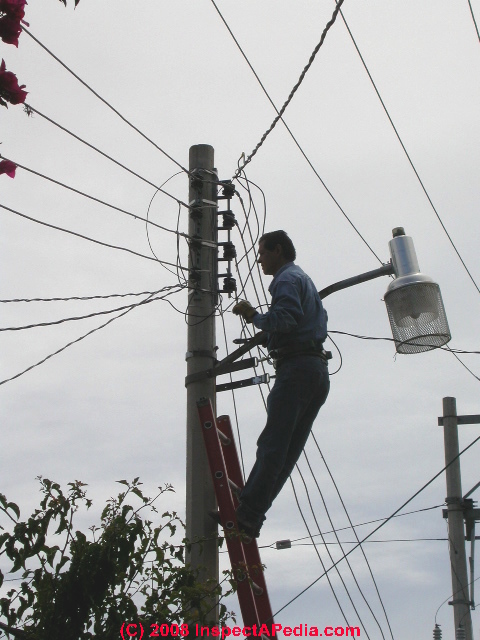
 Our page top photo shows an electrical worker repairing a local electrical power distribution line.
Electrical workers, because they are regularly have close exposure to strong electrical fields, are a group that has been closely studied for correlation between cancer occurrence and electrical field exposure.
See WORKPLACE EXPOSURE to Electromagnetic Fields for more information on workplace exposure to EMF.
We define "Enviro-Scare" (ES) and we use this cyclic fear pattern to describe the variation and effects of the level of public environmental worry by recapping the enviro-scare history of asbestos, EMF, UFFI, and other environmental concerns.
The red graph at EMF Cancer Scare depicts the varying level of ES or public fear for a given environmental concern. ES generally increases, peaks, and then diminishes over time, independently of the actual level of risk.
As people become acclimated to the particular topic it loses its initial shock value. Links to other resources
include EMF Procedures & Causes of EMF Measurement Error & Variation.
As a point of comparison also see Mold Enviro-Scare.
Because RF and EMF measurement tools need to be properly chosen to measure the particular type and frequency of RF or EMF signal that is of interest, be sure to also
see EMF RF FIELD & FREQUENCY DEFINITIONS for a simple explanation of different types of radio frequency (RF) and electromagnetic frequency (EMF) types and where they are found.
Also see Definitions of Gauss vs Milligauss for details about gauss and milligauss and definitions of these terms.
Here is a summary of the actual health risks and property value risks associated with EMF, electromagnetic fields.
Determining actual health risks from EMF exposure is complex. Not all experts agree about the danger.
However a growing body of articles and studies suggests that there may be health risks at EMF levels as low as 2 milligauss, probably depending on many variables including length of exposure in the field, actual field strength during the exposure period, person's age, body mass, general health and perhaps genetic predisposition or vulnerability to cancer. While debate continues, it remains possible that in some instances there are some hazards from EMF.
While prudent avoidance has been recommended by experts, to date (Marcy 2012) we know of no Federal nor State accepted standard for allowable exposure to EMF. My information is based on our understanding of current literature on this topic. When set, standards for acceptable levels of EMF exposure may then be higher or lower than 2 milligauss.
Measurements at the same site can vary widely because of variations in the load on the electric transmission facility and because of other variables discussed at t
his SUGGESTED EMF MEASUREMENT PROCEDURES AND MEASUREMENT VARIABILITY Paper. Measurements also vary widely if a standard procedure is not followed.
Very often EMF levels are not constant at all locations on a property. Using a procedure which may reduce this problem, I report measurements made at a series of standard locations and sometimes also at locations of special interest. I have made this procedure available to other professionals and I invite critique, feedback, and suggestions.
For currently popular concerns, economic risks to property owners remain even if there is no demonstrable health hazard. I call the cycle of increasing, peaking, then declining consumer fear "enviro-scare." The economic impact on property owners of these topics depends on this cycle.
One of my EMF measuring equipment manufacturers reports the following: " Magnetic radiation readings of 1 milligauss and less are considered below those which were shown to increase the level of leukemia in several medical epidemiological studies in the greater Denver area."
"Readings in the 1 to 3 milliGauss range were found to double the leukemia rate in children in the Denver studies." "Some epidemiological studies indicate a higher than normal incidence of cancer, including leukemia and brain tumors, among children and adults living or working close to power lines." Time Magazine, July 17, 1989.
"Dr. Savitz mentioned 2 milliGauss as the level at which cancer is produced in children. In the home of these people, I have measured 10 to 12 milliGauss, depending on how much current is flowing down the line." House of Representatives, 100th Congress.
We (DJ Friedman) have regularly found background levels of .5 to 1 milliGauss at residential properties, and higher levels in urban environments. It's unusual to find an urban or even suburban environment with lower EMF levels than .5-2 milligauss.
What does "double the risk of leukemia" really mean as true measure of danger?
Telling a prospective home buyer or home owner that "Exposure of your child to a 2 milligauss field can double his risk of childhood leukemia." is frightening. The statement may be true, but stated alone, this admonition lacks a very important perspective.
An informed viewpoint is very important for every environmental hazard. Let's review again the opening statement about "doubling cancer risk."
At the risk levels discussed in the Werth study, "doubling the risk of childhood leukemia" means increasing the chances from about 1 in 10,000 to 2 in 10,000. In either case, the risk is extremely low -- much less than the risks posed by a large number of much more common hazards to which people are exposed daily.
A clear summary of EMF risks and characteristics is
at MAGNETIC FIELD EXPOSURE AND CANCER: QUESTIONS AND ANSWERS [PDF] National Cancer Institute, U.S. National Institutes of Health (2005).
Importance of Identifying and Prioritizing Cancer & Other Health & Safety Risks
Cancer Risk from Lawn Herbicides is Greater than from Electromagnetic Fields
A Friday, March 26 editorial in the New York Poughkeepsie Journal, "Don't mix kids and chemicals." The editorial mentions a 1987 National Cancer institute study which "... found that children who lived in homes where lawn chemicals were applied were six times more likely to develop leukemia."
In other words, your lawn may be more dangerous than a 2 mg EMF.
Based on current research, EMF may be near the bottom of risks to children
. [In fact one wonders if some of the leukemia cases reported for children living along a power line right of way might have been influenced less by the EMF than by the strong herbicides commonly used by power companies to hold down brush growth under the power lines.
Readers might review the Agent Orange issue affecting veterans of the Vietnam war, for example.]
While this and any health hazard may change as new data is developed, consumers who are concerned with the health of their children should consider all risks and should, when worrying about individual ones such as EMR, keep them in perspective. If ones objective is to stay healthy and alive, a rational approach identifies and responds to risks first by identifying the most-significant ones and making sure that those concerns have been addressed.
Reader Comments, Questions & Answers About The Article Above
Below you will find questions and answers previously posted on this page at its page bottom reader comment box.
Reader Q&A - also see RECOMMENDED ARTICLES & FAQs
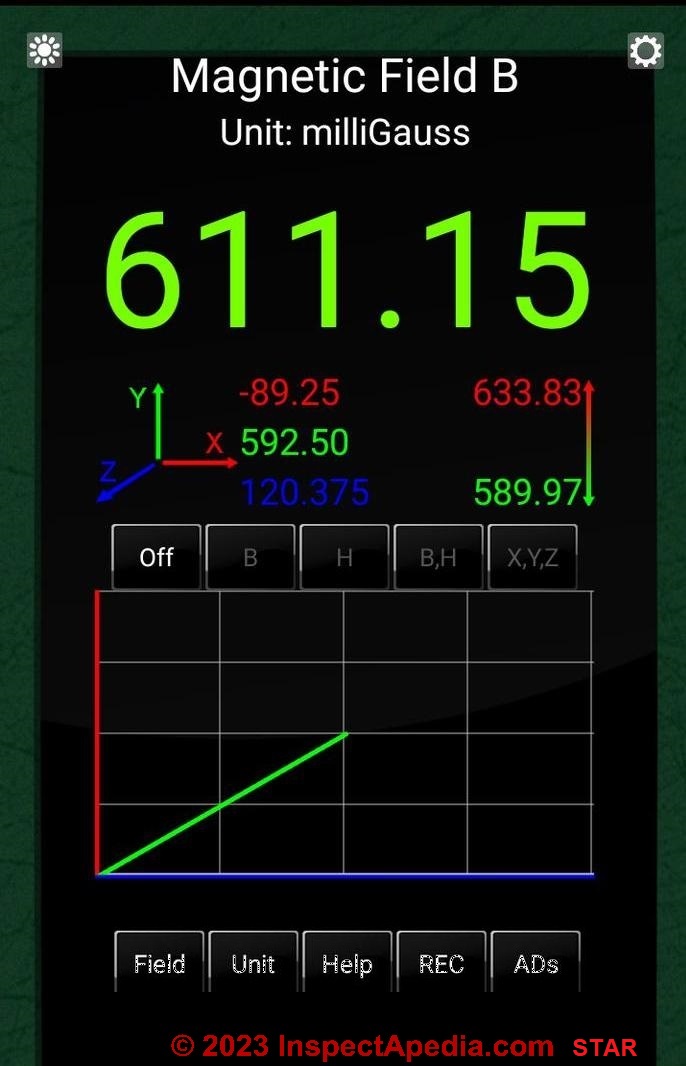
On 2023-05-27 by InspectApedia DF (mod) - is 600 mg EMF a high reading?
@Lucas Star,
Bottom line: maybe. I don't know what your EMF reading means, as I'll explain.
At EMF SURVEY REPORT INTERPRETATION
which is simply a field EMF measurement survey report example, I demonstrate measuring 100 milligauss emf field strength at ONE INCH from an electric meter. Just a short distance away the field strength falls off as the square of the distance from the source to the measurement.
You should look at that page for examples of common residential EMF level readings.
That said, by itself, 611 mg looks like very high EMF reading.
BUT we don't have one iota of information about your measurement
- the accuracy and positional sensitivity of your cellphone EMF reading app
- the location at which you made an EMF measurement
- any other factor that might affect the measurement result
So yes, that might be a rather high reading ... as Mark Cramer says, "... It depends."
It would be helpful to know
- the cell phone app you're using
- the cell phone you're using
- the details of just where and how you took your EMF measurement.
For some tips on consistent, repeatable EMF measurements, see
On 2023-05-27 by Lucas Star
Hi,
I have an EMF meter on my phone.
Is this reading high in my home?
On 2018-01-15 by danjoefriedman (mod)
Very interesting indeed. I too would be looking to discover what's the difference between your installation in the neighbouring ones. I could be there was an unbalanced electrical load or phases or different routing of wiring.
I've also seen EMF picked up my water piping or other metal building components that run near Bank of electrical panels and then transmitted elsewhere in the building
On 2018-01-10 by Michael
@danjoefriedman,
Danjoe,
I agree with you on everything you said, and the health hazards that accompany worrying about something that may or may not be the cause of health issues..
The part I take issue with, is that out of sixty+ units, my apt. is the only one with the elevated readings(city random confirmation,I witnessed and filmed).
4 meters on the siding outside my bedroom wall.
The other apts. have the same; four or five meters mounted on the outside of the building yet no significant elevated readings. The company did a remodel 4 years ago and I'm guessing somewhere in the electrical something is getting pinched.
I took some personal responsibility and put up some shielding; three pieces of 1/4" sheet metal, and four pieces of 1/8" metal sheets, weighs a ton(mild exaggeration).
Cut the bleeding through the outer wall by about half, but does nothing for the emf's emanating from the electrical lines moving through the ceiling and wall. Huh. Looks like I'll need to move to gain some piece of mind.
On 2018-01-09 by danjoefriedman (mod)
Michael
The owner is right that shielding from EMF is difficult and costly.
The anxiety of worrying about EMF exposure might be as much a health hazards as the field effects, possibly even more.
The actual health risk will be hard to pin down as there are many variables besides field strength including the genetic background and health of occupants, and the duration as well as level of exposure.
In my lay-OPINION the the choices are those you've already given.
On 2018-01-09 by Michael Cross
I have consistent level of high emf readings; 5-180mg running through my apartment. I have had the city electric dept confirm results. Their response was that it would be wise to move. The apt. is subsidized comples, and I am on disability.
The housing crisis in the city I live is ridiculous. The apt. complex I live in has a two year waiting list. The owner of the apt. says it would cost too much to fix and suggested that I move into a new unit when it becomes available.
In the mean time my health is deteriorating, chest pains, anxiety, high blood pressure mental confusion, the list goes on. I don't want to be the weirdo who complains of such things, but I feel like this is a serious issue and don't know what to do about it.
Any advice is welcome!
On 2017-02-02 by DAVE LEWIS
Who do you complain to if the levels of EMF/EMI are too high. The power supplier will not do anything about it, is there a government agency that can help?
Question: EMF hazards from solar collectors mounted on roofs?
(June 11, 2012) Leah Cooper said:
Would you like to live next to or closer than 100 meters from a 4 milligauss substation?
(Mar 14, 2013) Pedro said:
Hi,
I would like to install Solar panel in my roof, I have searching in google how dangerous is but I didn't really found anything. What do you think?
Reply:
Thanks for the question, Pedro.
I think the reason your Google Search for "Cancer Dangers of Electromagnetic Fields or EMFs when Installing a Solar Panel on a Roof" produced no results is because nobody has cited that concern.
First, even if your roof were near a power transmission line, the EMF exposure that would occur to workers just during solar panel installation would be beneath the level of measurement.
Next, there is no relationship that occurs to me between the presence of a solar panel on a building roof and electromagnetic fields from any source of any measurable consequence.
Finally, let's be clear:
The greatest danger in installing a solar panel on your roof would be an accidental fall during the work.
A smaller and different sort of problem could emerge if the rooftop solar panels were not properly installed and supported, such as panel mounts causing roof leaks or panels blowing off during a storm.
Question:
Re-Posting comment on 5/10/14 from Aidan (without disallowed link-security)
I think that you have hit the nail on the head with the issue here , so many reports - no definitive data ( as it is such a hard thing to pin down ) . One thing to add - have a look at this link -
Power-frequency EMF Exposure Standards applicable in Europe and elsewhere
Compiled by John Swanson
This is a constantly evolvi
ng document. This version is
a snapshot at 3 July 2013"
It seems some European countries - which can tend to be a little more on the side of the public are trending down towards 2-10 milligauss.
I have just taken readings on our street & house. The residential power lines are giving off between 30 -100 milligauss ( load dependent)15 feet from the front of the house. The house tends between 4 -> 8 milligauss. To be honest , its a deal breaker for me - had i known this , i would not have bought the house.
I think that the hard part is that we are all different & one person could have no probs with greater than 100 milligauss exposure & another could be sick with less than 3milligauss- its dependent on our genes/environment/food etc etc ...
I know of no way to attenuate the whole house , apart from turning it into a faraday cage
Thanks / thoughts
aidan
Reply:
Aidan,
Before beating yourself up too much ab out 4-8milligauss at your home, try taking some readings around the neighborhood and in other neighborhoods. I would not be surprised to year you report that it is common to find background electromagnetic field strength in that range in many areas of most cities.
If one wants to avoid EMF, it's useful as well to take a second look within the structure for unusually high field strengths. Usually these are smaller in area scope but can be quite strong, e.g. a head bedboard against a wall against which the electrical service entry runs outside may be much higher - and easy to avoid by moving furniture.
...
Continue reading at EMF/EMR MEASUREMENT OVERVIEW or select a topic from the closely-related articles below, or see the complete ARTICLE INDEX.
Or see these
Recommended Articles
- CELL PHONE RADIATION
- DEFINITIONS of EMF RF FIELD & FREQUENCY
- DEFINITIONS of HERTZ, KHz MHz GHz THz
- ELECTROMAGNETIC FIELD EMF ELF & RF DETECTION
- EMF ELECTROMAGNETIC FIELDS & HUMAN EXPOSURE
- EMF CANCER SCARE
- EMF CANCER RISK
- EMF/EMR MEASUREMENT OVERVIEW
- EMF LOCAL SOURCES MAY EXCEED POWER LINE STRENGTH
- EMF MEASUREMENT DISTANCE AFFECTS STRENGTH
- EMF MEASUREMENT INSTRUMENTS
- EMF MEASUREMENT INSTRUMENT ACCURACY
- EMF MEASUREMENT INSTRUMENT USE TIPS
- EMF MEASUREMENT PROCEDURES
- EMF MEASUREMENT STEP BY STEP
- EMF REFERENCES
- EMF SURVEY PROCEDURE
- EMF SURVEY REPORT INTERPRETATION
- EMF WORKSHEET for EMF MEASUREMENTS
- EMF WORKSHEET Example
- EMF WORKPLACE EXPOSURE
- ENVIRONMENTAL HAZARDS at BUILDINGS - home
- ENVIRO-SCARE - PUBLIC FEAR CYCLES
- HAZARD vs RISK
- RF RADIO FREQUENCY DETECTION METERS
Suggested citation for this web page
EMF CANCER RISK at InspectApedia.com - online encyclopedia of building & environmental inspection, testing, diagnosis, repair, & problem prevention advice.
Or see this
INDEX to RELATED ARTICLES: ARTICLE INDEX to BUILDING ENVIRONMENT
Or use the SEARCH BOX found below to Ask a Question or Search InspectApedia
Ask a Question or Search InspectApedia
Try the search box just below, or if you prefer, post a question or comment in the Comments box below and we will respond promptly.
Search the InspectApedia website
Note: appearance of your Comment below may be delayed: if your comment contains an image, photograph, web link, or text that looks to the software as if it might be a web link, your posting will appear after it has been approved by a moderator. Apologies for the delay.
Only one image can be added per comment but you can post as many comments, and therefore images, as you like.
You will not receive a notification when a response to your question has been posted.
Please bookmark this page to make it easy for you to check back for our response.
Our Comment Box is provided by Countable Web Productions countable.ca
Citations & References
In addition to any citations in the article above, a full list is available on request.
- Electric Power Lines, Electromagnetic Fields, Cancer Risk, & "Enviro-Scare" - The Normal Curve Cycle of Public Fear About Environmental Issues - online document by DF
- A Procedure for Measuring EMF electromagnetic fields online document by DF
- "Questions and Answers about Biological Effects and Potential Hazards of Radiofrequency Electromagnetic Fields", Federal Communications Commission, Office of Engineering and Technology, US FCC, OET Bulleting 56, 4th Edition, August 1999
" Many consumer and industrial products and applications make use of some form of electromagnetic energy. One type of electromagnetic energy that is of increasing importance worldwide is radiofrequency (or "RF") energy, including radio waves and microwaves, which is used for providing telecommunications, broadcast and other services. In the United States the Federal Communications Commission (FCC) authorizes or licenses most RF telecommunications services, facilities, and devices used by the public, industry and state and local governmental organizations. Because of its regulatory responsibilities in this area the FCC often receives inquiries concerning whether there are potential safety hazards due to human exposure to RF energy emitted by FCC-regulated transmitters. Heightened awareness of the expanding use of RF technology has led some people to speculate that "electromagnetic pollution" is causing significant risks to human health from environmental RF electromagnetic fields. This document is designed to provide factual information and to answer some of the most commonly asked questions related to this topic." - original source: U.S. Federal Communications Commission Office of Engineering and Technology, http://www.fcc.gov/Bureaus/Engineering_Technology/Documents/bulletins/oet56/oet56e4.pdf - EMF RF FIELD & FREQUENCY DEFINITIONS RF and EMF measurement tools need to be properly chosen to measure the particular type and frequency of RF or EMF signal that is of interest. See EMF RF FIELD & FREQUENCY DEFINITIONS for a simple explanation of different types of radio frequency (RF) and electromagnetic frequency (EMF) types and where they are found.
- "Evaluation of Potential Carcinogenicity of Electromagnetic Fields," EPA Report #EPA/600/6-90/005B October 1990. EPA: 513/569-7562.
- "Biological Effects of Power Frequency Electric and Magnetic Fields" background paper, prepared as part of OTA's assessment of "Electric Power Wheeling and Dealing: Technological Considerations for Increasing Competition," prepared for OTA by Indira Nair, M. Granger Morgan, H. Keith Florig, Department of Engineering and Public Policy, Carnegie Mellon University, Pittsburgh, PA 15213
- "Biological Effects of Power Line Fields," New York State Powerline Project. Scientific Advisory Board Final Report, July 1, 1987.
- "Extremely Low Frequency (ELF) Fields," Environmental Health Criteria 35. World Health Organization, Geneva, 1984.
- "Electric and Magnetic Fields at Extremely Low Frequencies: Interactions with Biological Systems. In: Non ionizing Radiation Protection, World Health Organization, Regional Office for Europe, Copenhagen, 1987.
- "Electric and Magnetic Fields from 60 Hertz Electric Power: What do we know about possible health risks?," Department of Engineering and Public Policy, Carnegie Mellon University, Pittsburgh, PA 15213 1989.
- "Electromagnetic Fields Are Being Scrutinized for Linkage to Cancer," Sandra Blakeslee, New York Times, Medical Science section, April 2, 1991
- In addition to citations & references found in this article, see the research citations given at the end of the related articles found at our suggested
CONTINUE READING or RECOMMENDED ARTICLES.
- Carson, Dunlop & Associates Ltd., 120 Carlton Street Suite 407, Toronto ON M5A 4K2. Tel: (416) 964-9415 1-800-268-7070 Email: info@carsondunlop.com. Alan Carson is a past president of ASHI, the American Society of Home Inspectors.
Thanks to Alan Carson and Bob Dunlop, for permission for InspectAPedia to use text excerpts from The HOME REFERENCE BOOK - the Encyclopedia of Homes and to use illustrations from The ILLUSTRATED HOME .
Carson Dunlop Associates provides extensive home inspection education and report writing material. In gratitude we provide links to tsome Carson Dunlop Associates products and services.
 | HOME | ABOUT | ASK a QUESTION | CONTACT | CONTENT USE POLICY | DESCRIPTION | POLICIES | PRIVACY | |
| © 2024 - 1985 Publisher InspectApedia.com - Daniel Friedman | |||||||||