InspectAPedia.com InspectAPedia®
 

Free Encyclopedia of Building & Environmental Inspection, Testing, Diagnosis, Repair

Ask a Question or Search InspectAPedia

  • HOME
  • AIR CONDITIONING
  • ELECTRICAL
  • EXTERIORS
  • HEATING
  • HOME INSPECTION
  • INTERIORS
  • PLUMBING
  • ROOFING
  • SEPTIC SYSTEMS
  • STRUCTURE
  • WATER SUPPLY
  • ENERGY SAVINGS
  • ENVIRONMENT
  • INDOOR AIR IAQ
  • INSULATION
  • MOLD INSPECT TEST REMOVE
  • NOISE
  • ODORS
  • SOLAR ENERGY
  • VENTILATION
  • EXPERTS DIRECTORY
  • CONTACT US


Mobile viewMobile View
ENVIRONMENTAL HAZARDS - INSPECT, TEST, REMEDY

Aerobiology Associations

AIR CLEANER PURIFIER TYPES
AIR FILTERS for HVAC SYSTEMS
AIR FILTERING STRATEGIES
AIR HANDLER / BLOWER UNITS
AIR LEAK DETECTION TOOLS

AIR POLLUTANTS, COMMON INDOOR
Air Quality Improvement Strategies
AIR LEAK SEALING PROCEDURE
AIR SEALING STRATEGIES
AIR TEST FOR MOLD: ACCURACY
AIR TEST SAMPLING CASSETTE STUDY
AIRBORNE MOLD SPORE COUNT ACCURACY

ALLERGEN TESTS for BUILDINGS
ANIMAL ALLERGENS / PET DANDER
ANIMAL ENTRY POINTS in BUILDINGS
ANIMAL ODORS IN BUILDINGS

ASBESTOS IDENTIFICATION IN BUILDINGS
ASBESTOS MATERIAL REGULATIONS
ASBESTOS Photo Guide to Materials / Products
ASBESTOS REMOVAL GUIDE, FLOORING
ASBESTOS RISK ASSESSMENT

ATTORNEYS and EXPERT WITNESSES

Backdrafting Appliances
BASEMENT MOLD
BATHROOM MOLD
BIBLIOGAPHY ENVIRONMENTAL HEALTH, MOLD, IAQ
BIOLOGICAL POLLUTANTS
Bisphenol-A, BPA

BLOWER DOORS & AIR INFILTRATION
BLOWER FAN OPERATION & TESTING
BLUE vs YELLOW COMBUSTION FLAMES
BOOKSTORE - ENVIRONMENTAL
BUILDING SAFETY HAZARDS GUIDE
BUY PRODUCTS for MOLD & ALLERGY CONTROL

Cadmium in the home
CARBON DIOXIDE - CO2
CARBON MONOXIDE - CO
Carbon Nanotube Hazards

CARPET DUST IDENTIFICATION
CARPET MOLD CONTAMINATION
CARPET STAIN DIAGNOSIS
CARPETING & INDOOR AIR QUALITY
CARPETING, SELECTION & INSTALLATION

CAT DANDER in BUILDINGS
Cell phone Radiation Hazards

CHIMNEY INSPECTION DIAGNOSIS REPAIR
COALSTOVE SAFETY
CHINESE DRYWALL HAZARDS
CHEMICAL CONTAMINANTS in WATER
CHLORINE IN DRINKING WATER
CHLORINE IN SEPTIC WASTEWATER
COMBUSTION GASES & PARTICLE HAZARDS

Disinfectants
Disinfecting Buildings with Bleach

DRAFT HOODS - gas fired
DRAFT MEASUREMENT, CHIMNEYS & FLUES
DRAFT REGULATORS, DAMPERS, BOOSTERS
DRINKING WATER
Diethylstilbestrol - DES
DUCT SYSTEM & DUCT DEFECTS
DUST ANALYSIS for FIBERGLASS
DUST SAMPLING PROCEDURE

EMF
EMF Cancer Scare
EMF RF FIELD & FREQUENCY DEFINITIONS
EMF ELECTROMAGNETIC FIELDS & HUMAN EXPOSURE
EMF Levels of Cancer Risk
EMF MEASUREMENT INSTRUMENTS
EMF MEASUREMENT PROCEDURES
EMF SURVEY PROCEDURE - Details
  Introduction to EMF Measurement
  EMF/EMR Measurement Procedure Overview
    EMF Variability
    Electrical Utility Workers & EMF Exposure
    EMF Instrument Sensitivity & Accuracy
    EMF Polarity & Shape Affect Measurements
    Distance from the EMF Source Affects Strength
    Time of day & Season Affect EMF Strength
  Local EMF Sources May Exceed Power Line Strength
  Recommended EMF Measurement Procedure
    Outside EMF Measurements
    Outside EMF Measurement Documentation
    Indoor EMF Measurements
    Other Indoor EMF Measurement Targets
    Workplace EMF Measurements
  EMF Measurement Documentation Details
  EMF Measurement Instrument Use
    Definitions of Gauss vs Milligauss
    Position-sensitive EMF Instrument Readings
  Interpreting Electromagnetic Field Strength EMF Survey
  Evaluation of Low-Cost EMF Instruments
    Accuracy & Calibration of EMF Instruments
    Calibration of EMF Instruments in the Field
    Calibration of EMF Instruments by Electric Company
  Electromagnetic Field EMF ELF Detection Instruments
    F.W. Bell Model 4060 ELF Meter
    Safeco™ analog EMF ELF EMR meter
    Walker Scientific ELF-50D™ Digital EMF Meter
  Radio Frequency RF Detection Meters
    BK RF Measurement Test Equipment
    Mobile Design Shipboard RF Measurements
    Safe Living RF Meters - Radio Frequency Detectors
    Zap Checker Radio Frequency Detection Hand Held Instruments
References for Electromagnetic Fields and Cancer
WORKSHEET for EMF MEASUREMENTS
WORKSHEET for EMF MEASUREMENTS - Example
WORKPLACE EXPOSURE to Electromagnetic Fields

ENERGY SAVINGS in BUILDINGS
ENVIRO-SCARE - PUBLIC FEAR CYCLES
EXTERIORS of BUILDINGS

Fiberboard Insulation Sheathing Mold

Fiberglass Enviro-Scare
FIBERGLASS HAZARDS
FIBERGLASS PARTICLE CONTAMINATION TEST
FIBERGLASS INSULATION MOLD
FIBERGLASS PARTICLE CONTAMINATION TEST

Fireplace Inserts
Fireplaces & Woodstove Contaminants
FLAME COLOR, BLUE vs YELLOW COMBUSTION

FLOOD DAMAGE ASSESSMENT, SAFETY & CLEANUP
FLOODS IN BUILDINGS-mold

FLOOR DAMAGE DIAGNOSIS
FLOOR TYPES & DEFECTS
FLOOR TILE ASBESTOS IDENTIFICATION
FLOOR TILE HISTORY & INGREDIENTS
Floor Tile, Asbestos, Photo ID Guide

FORMALDEHYDE HAZARDS
Formaldehyde Gas Hazard Reduction

GAS DETECTION & MEASUREMENT
GAS EXPOSURE EFFECTS, TOXIC
GAS EXPOSURE LIMITS & STANDARDS
GASES, EXPOSURE TESTING
GAS FIRED WATER HEATERS
GAS LP & Natural Gas Safety Hazards
GAS MEASUREMENT TOOLS
GAS PIPING, VALVES, CONTROLS
GAS TOXICITY LEVELS
GLARE, Sunlight/Lighting Control

HUMIDITY CONTROL & TARGETS INDOORS

HVAC Systems
HEATING OIL EXPOSURE HAZARDS, LIMITS
HUMIDITY CONTROL & TARGETS INDOORS
House Dust Analysis

IAQ ISSUES, OTHER
INDOOR AIR QUALITY & HOUSE TIGHTNESS
INDOOR AIR QUALITY IMPROVEMENT GUIDE

INSULATION INSPECTION & IMPROVEMENT
INSULATION IDENTIFICATION GUIDE
INSULATION MOLD
INSULATION, UFFI UREA FORMALDEHYDE FOAM

LEAD POISONING HAZARDS GUIDE
LEED Building Designation & IAQ
Legionella Legionnaires' Disease
Legionella BACTERIA & HVAC Equipment
LIGHTNING PROTECTION
LP & Natural Gas Safety Hazards

METHANE GAS SOURCES
MILDEW REMOVAL & PREVENTION

MOISTURE CONTROL in BUILDINGS

MOLD ACTION GUIDE - WHAT TO DO ABOUT MOLD
MOLD AGE - Old is the Mold?
MOLD APPEARANCE - WHAT MOLD LOOKS LIKE
MOLD APPEARANCE - STUFF THAT IS NOT MOLD
MOLD CLEANERS - WHAT TO USE
MOLD CLEANUP COMPANIES
MOLD CLEANUP GUIDE- HOW TO GET RID OF MOLD
MOLD CLEANUP - BLEACH
MOLD CLEARANCE INSPECTIONS
MOLD CLINICAL REFERENCE TEXTS
MOLD CONSULTANTS/INSPECTORS
MOLD CONTAMINATION LEVELS
MOLD CULTURE TEST KIT VALIDITY
MOLD CULTURE SAMPLING METHOD

MOLD DETECTION & INSPECTION GUIDE
MOLD DOCTORS - ENVIRONMENTAL MEDICINE

MOLD EXPERT, WHEN TO HIRE
MOLD EXPOSURE RISK LEVELS
MOLD EXPOSURE STANDARDS
MOLD FAQ's
MOLD GROWTH ON SURFACES, PHOTOS
MOLD GROWTH on SURFACES, TABLE OF
MOLD GROWTH in/on BUILDING INSULATION

MOLD INFORMATION CENTER
MOLD INSPECTORS & MOLD TESTERS
MOLD INSPECTION SERVICE
MOLD INVESTIGATION PROCEDURE TIPS
MOLD INVESTIGATION REPORTS

MOLD KILLING GUIDE
MOLD LAB REPORTS
MOLD LEVEL IN AIR, VALIDITY
MOLD LEVELS IN BUILDINGS
MOLD by MICROSCOPE
MOLD ODORS, MUSTY SMELLS

MOLD PREVENTION GUIDE
MOLD RELATED ILLNESS GUIDE
MOLD RELATED ILLNESS SYMPTOMS
MOLD RESISTANT CONSTRUCTION
MOLD SPRAYS, SEALANTS, PAINTS
MOLD STANDARDS

MOLD TOXICITY VARIATION
MOLD TEST KITS for DIY MOLD TESTS
MOLD TEST METHODS, ACCURACY
MOLD TEST PROCEDURES
MOLD TESTING SERVICES

MSDS Material Safety Data Sheets

MVOCs & MOLDY MUSTY ODORS
MYCOTOXIN EFFECTS of MOLD EXPOSURE

Museum Artifact Preservation

Nanomaterials Hazards

NOISE / SOUND DIAGNOSIS & CURE

ODORS GASES SMELLS, DIAGNOSIS & CURE
OIL, HEATING, EXPOSURE HAZARDS, LIMITS
OIL HEAT ODORS
OIL SPILL CLEANUP / PREVENTION
OIL TANK LEAK ODORS
OIL TANKS INSPECT LEAK TEST ABANDON REGS
OXYGEN - O2
OZONE HAZARDS
OZONE for MOLD OR ODORS

PAINTS & COATINGS ODORS IN BUILDINGS

Particulates & Allergens Indoors
Pesticide Exposure Hazards
PET ALLERGEN REMEDIES
Pet Dander
PLASTIC ODORS-SCREENS, SIDING
PLUMBING SYSTEM ODORS
Pollen Photos
PVC - VINYL BUILDING PRODUCTS

RADON HAZARD TESTS & MITIGATION
Radon Enviro-Scare

ROT, FUNGUS, TERMITES

SAFETY HAZARDS GUIDE

SEPTIC SYSTEM INSPECT DIAGNOSE REPAIR
SEPTIC METHANE GAS
SEPTIC SYSTEM ODORS

SEWAGE BACKUP TEST & CLEANUP
SEWAGE & SEPTIC CONTAMINANTS
SEWAGE CONTAMINATION in BUILDINGS
SEWER GAS ODORS

SICK HOUSE IAQ QUESTIONNAIRE
SIDING VINYL
SMELL PATCH TEST to Track Down Odors

SOUND CONTROL in BUILDINGS

STAIN DIAGNOSIS on BUILDING EXTERIORS
STAIN DIAGNOSIS on BUILDING INTERIORS
STAINS & Thermal Tracking
SULPHUR & SEWER GAS SMELL SOURCES

THERMAL TRACKING Indicates Heat Loss

UFFI UREA FORMALDEHYDE FOAM INSULATION
URETHANE FOAM Deterioration, Outgassing

VAPOR BARRIERS & CONDENSATION in BUILDINGS
VAPOR BARRIERS & HOUSEWRAP
VAPOR CONDENSATION & BUILDING SHEATHING
VENTILATION in BUILDINGS
VINYL CHLORIDE HEALTH INFO
VINYL Siding or PLASTIC Window ODORS in buildings
Volatile Organic Compounds VOCs

WATER ODORS, CAUSE CURE
WATER TESTS, CONTAMINANTS, TREATMENT
WATER TEST CHOICES & WATER TEST FEES
WATER TREATMENT EQUIPMENT CHOICES
Well Pollution

WIND TURBINES & LIGHTNING
World Trade Center Collapse Dust Photos

More Information

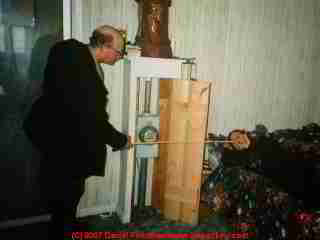
Photograph of an electric meter too close to a bed and sleeping area - high EMF will be measured if quite close to electrical meters EMF Survey Errors: Local Indoor & Site Sources of EMF Affect Site EMF Surveys
InspectAPedia®  -    

  • How small or local site or indoor EMF sources affect EMF property & power line surveys
  • Sources of error and variability in electromagnetic field strength measurement surveys
  • Questions & answers about the sources of error in EMF electromagnetic field surveys & reports

Here we describe the identification & measurement of local outdoor or indoor EMF electromagnetic field sources as part of a recommended procedure for performing electromagnetic field (EMF) or electro-magnetic radiation EMR measurements in gauss or milligauss.

InspectAPedia offers impartial, unbiased advice without conflicts of interest. We will block advertisements which we discover or readers inform us are associated with bad business practices, false-advertising, or junk science. Our contact info is at InspectAPedia.com/Contact.htm.

This article describes the identification & measurement of local outdoor or indoor EMF electromagnetic field sources as part of a recommended procedure for performing electromagnetic field (EMF) or electro-magnetic radiation EMR measurements in gauss or milligauss. We discusses sources of error and variation in EMF measurements and we review and make suggestions for using several low-cost EMF measurement devices to determine the instantaneous electromagnetic field exposure.

See ENVIRO-SCARE, EMF & Property Values if you don't know what EMF, ELF, or electromagnetic fields are or if you want a summary of the possible health effects of EMF exposure and the more likely effect on the property value of homes located very close to power transmission lines. Readers who intend to make their own EMF measurements should be sure to also see WORKSHEET for EMF MEASUREMENTS. Also see Electric Power Lines, Electromagnetic Fields, Cancer Risk, & "Enviro-Scare" - The Normal Curve Cycle of Public Fear of Environmental Issues which discusses the impact of EMF and other environmental concerns on property values. And see EMF ELECTROMAGNETIC FIELDS & HUMAN EXPOSURE which discusses EMF exposure in the workplace.

© Copyright 2012 InspectAPedia.com, All Rights Reserved. Information Accuracy & Bias Pledge is at below-left. Use page top links to major topics or use links at the left of each page to navigate within topics and documents at this website. Green links show where you are in a document series or at this website.

The information provided here is for research and study purposes. The author makes no representation of unique expertise on this topic, other than having field experience in EMF measurement, having studied technical literature and having conversed with other experts and authors in the field for a number of years. Readers are urged to consult expert sources and to give any suggestions regarding these notes to the author.

Other sources of electromagnetic fields may be greater than a power transmission line, may confuse readings, and might in some cases deserve attention.

Electrical appliances toaster coffee maker (C) Daniel FriedmanElectrical appliances commonly found in buildings (TV's, toasters, clocks, microwave ovens, electric motors), generate their own electrical fields, in some cases pretty strong ones.

However remember that the field strength falls off as the square of the distance from the source.

And remember that an appliance generates a field when it's electrically active or "turned on."

So unless your toaster is running 24-hours a day, and unless you're sleeping with your head next to the toaster, the fact that it generates an electrical field (while you're making toast) is, from an EMF health exposure view, pretty unimportant.

We conclude that power-company funded studies which focus attention on home appliances are simply funding a red herring to distract already-frightened consumers, but we also emphasize that in most cases the fear that some people have about EMF exposure is not appropriate and that other more dangerous hazards may be present.
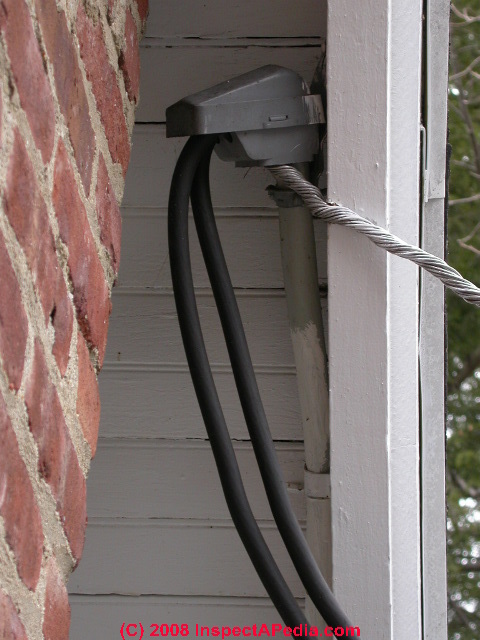
But having investigated a number of interesting cases and complaints, we have found cases where specific items in buildings were creating a strong and constant electromagnetic field. Occupants who wish to take the EPA's advice of "prudent avoidance" (that means avoid without going to extreme measures and without panic), might use their new EMF meter to look at the following cases:

Electrical service entry mast head and cable (C) Daniel Friedman

  • An electrical service entry cable (SEC) running down the outside of a home happened to be on a wall against which, inside, an infant's bed headboard was placed.

    The distance separating the infant's head from the SEC was thus only about 10", and at the pillow I found a very strong EMF. Solution for prudent avoidance: move the bed away from this building wall to a different location.

Moving even three or four feet away from this line usually reduces the measurable EMF field strength from the electrical service entry cable to below the range of detection.

we have found exceptions to that rule where metal building piping or steel beams (or in one case sewer piping) appear to carry EMF to other locations more distant from the source.
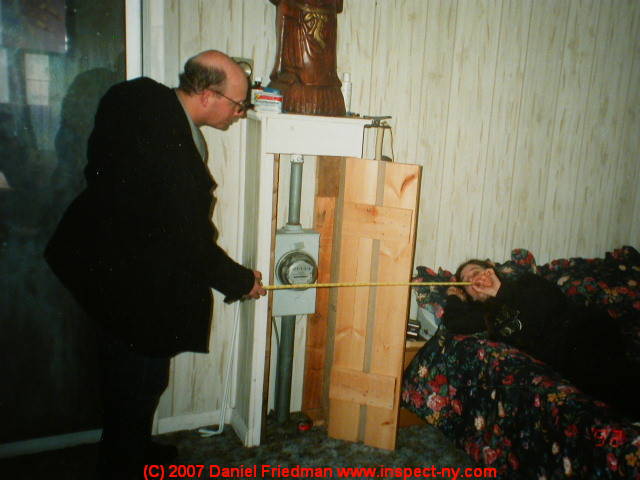
Photograph of an electric meter too close to a bed and sleeping area - high EMF will be measured if quite close to electrical meters

  • A bedroom had been built on a converted porch. The SEC and electric meter were enclosed in a wooden "box" and chaseway which was right next to the bed's headboard.

    EMF measurements and solution were the same as for the case above.

  • Steel piping carrying electrical fields from other locations in a building: In an basement apartment of a large building I found very strong EMF measurements near the ceilings of the apartment. I observed that steel building water pipes ran close and parallel to a large bank of 24 electrical meters serving the building. Apparently the electrical fields at the SEC wiring and meters were being picked up and transmitted across the building by its plumbing.

  • Steel sewer piping carrying electrical fields: At a suburban community local road which was crossed by a high voltage power transmission line, I found that the entire street appeared to generate a strong EMF. We observed that the street contained a large buried steel sewer line that appeared to conduct the EMF away from and at right angles to the power line. There was no measurable effect from the street's field at the nearby homes themselves.

  • A home's aluminum siding appeared to be showing a strong EMF. I found that improper electrical wiring, including a defective clothes dryer and improper grounding of the electrical system was causing some of the siding to actually carry current when the dryer was operating.

  • Other safety hazards may much more dangerous than EMFs: a final and really important example: while measuring EMF's at properties, or while performing other types of environmental inspections, I have often found sever immediate hazards such as unsafe chimneys, boilers without relief valves, combustible gas leaks, or dangerous electrical or fire hazards. It would be foolish to become so focused on an concern for electromagnetic fields (EMF) that one failed to notice immediate and severe threats to life and safety.

Some studies by some experts have suggested a possible link between exposure to electromagnetic fields and various cancers or other health problems. Other studies suggest that no definite correlation could be demonstrated. It is likely that the jury will be out on this matter for some time, for both economic and political reasons.

Our photo shows an uncommon exposure to an electrical field: the electrical meter and service entry cable produce a field which can be detected up to perhaps two to four feet away. But the history of construction at a building can bring surprises.

An outside porch first enclosed this electrical meter; later the porch was enclosed and converted to a bedroom. Our model shows that someone sleeping on the side of the bed next to the electrical meter was likely to be sleeping in an EMF that could easily have been avoided: move the bed to an opposite wall.

Small absolute health risk from EMF: Most researchers indicate that where a risk is present, the absolute risk level from EMF is likely to be small, and less than other less obscure hazards. (Automobile accidents, trip and fall, fire, and shock hazards, smoking and other health risks.) Consumers should not let focus on a specific emotionally-charged hazard distract them from these other more mundane but more dangerous concerns.

Often but not always, the relative strength of such fields falls off in much shorter distance than that from power transmission facilities. However in some instances where occupants wish to maintain prudent avoidance, it is possible to make a significant reduction in exposure by small changes in arrangement of devices or locations of working or sleeping areas.

Instead of contacting us with a request to perform EMF Electromagnetic or RF Radio Frequency Field Strength measurements, in most cases it is more economical and convenient for a property owner to purchase their own instrument, making measurements under varying conditions. See Recommended EMF Measurement Procedure for details of how to collect EMF measurement data.

Please do not contact us with a request buy EMF or RF measuring equipment. We do not sell anything. To do so would be a conflict of interest for this website. See Evaluation of Low-Cost EMF Instruments This article describes several low-cost and reasonably accurate EMF measurement devices that are readily available. See Radio Frequency RF Detection Meters This article describes several low-cost and accurate radio frequency or RF detection and measurement devices suitable for radio, TV, cellphone, microwave, and similar signals.

Questions & Answers regarding this article

.

Ask a Question or Search InspectAPedia

HTML Comment Box is loading comments...

Share this Article      

...

Technical Reviewers & References

  • InspectAPedia.com® - Daniel Friedman - Publisher & Editor.
  • InspectAPedia Bookstore lists recommended books, organized by topic & available for purchase. Most of our articles also include a list of recommended books for the specific article topic as well as other references, and information sources.
  • Critique, contributions wanted: Contact Us to suggest corrections or additions to articles at this website, and if you wish, to receive online listing and credit as a contributor. Particular thanks are due to the many experts and also consumers who read and critique technical articles at InspectAPedia.com.
  • Additional technical contributors & reference sources for this article are listed below.

Use links just below or at the left of each page to navigate this document or to view other topics at this website. Green links show where you are in our document or website.

EMF MEASUREMENT INSTRUMENTS
EMF MEASUREMENT PROCEDURES
EMF SURVEY PROCEDURE - Details
  Introduction to EMF Measurement
  EMF/EMR Measurement Procedure Overview
  Local EMF Sources May Exceed Power Line Strength
  Recommended EMF Measurement Procedure
  EMF Measurement Documentation Details
  EMF Measurement Instrument Use
  Interpreting Electromagnetic Field Strength EMF Survey
  Evaluation of Low-Cost EMF Instruments
  Electromagnetic Field EMF ELF Detection Instruments
  Radio Frequency RF Detection Meters
References for Electromagnetic Fields and Cancer
WORKSHEET for EMF MEASUREMENTS

References for Electromagnetic Fields and Cancer Risk/Carcinogenicity

  • Electric Power Lines, Electromagnetic Fields, Cancer Risk, & "Enviro-Scare" - The Normal Curve Cycle of Public Fear About Environmental Issues - online document by DF
  • A Procedure for Measuring EMF electromagnetic fields online document by DF
  • "Questions and Answers about Biological Effects and Potential Hazards of Radiofrequency Electromagnetic Fields", Federal Communications Commission, Office of Engineering and Technology, US FCC, OET Bulleting 56, 4th Edition, August 1999
    " Many consumer and industrial products and applications make use of some form of electromagnetic energy. One type of electromagnetic energy that is of increasing importance worldwide is radiofrequency (or "RF") energy, including radio waves and microwaves, which is used for providing telecommunications, broadcast and other services. In the United States the Federal Communications Commission (FCC) authorizes or licenses most RF telecommunications services, facilities, and devices used by the public, industry and state and local governmental organizations. Because of its regulatory responsibilities in this area the FCC often receives inquiries concerning whether there are potential safety hazards due to human exposure to RF energy emitted by FCC-regulated transmitters. Heightened awareness of the expanding use of RF technology has led some people to speculate that "electromagnetic pollution" is causing significant risks to human health from environmental RF electromagnetic fields. This document is designed to provide factual information and to answer some of the most commonly asked questions related to this topic." - original source: U.S. Federal Communications Commission Office of Engineering and Technology, http://www.fcc.gov/Bureaus/Engineering_Technology/Documents/bulletins/oet56/oet56e4.pdf
  • "Magnetic Field Exposure and Cancer: Questions and Answers [ copy on file as /emf/EMF_Fact_Sheet_NCI_NIH.pdf ] - ," National Cancer Institute, U.S. National Institutes of Health, web search September 2010, original source: http://www.cancer.gov/cancertopics/factsheet/Risk/magnetic-fields
    makes these five key points about EMF
    • Electric and magnetic fields (EMF) are areas of energy that surround any electrical device. EMFs are produced by power lines, electrical wiring, and appliances (see Question 1).
    • Electric fields are easily shielded or weakened by walls and other objects, whereas magnetic fields are not. Since magnetic fields are more likely to penetrate the body, they are the component of EMFs that are usually studied in relation to cancer (see Question 1).
    • Overall, there is limited evidence that magnetic fields cause childhood leukemia, and there is inadequate evidence that these magnetic fields cause other cancers in children (see Question 2).
    • Studies of magnetic field exposure from power lines and electric blankets in adults show little evidence of an association with leukemia, brain tumors, or breast cancer (see Question 3).
    • Past studies of occupational magnetic field exposure in adults showed very small increases in leukemia and brain tumors. However, more recent, well-conducted studies have shown inconsistent associations with leukemia, brain tumors, and breast cancer (see Question 4).
  • EMF RF FIELD & FREQUENCY DEFINITIONS RF and EMF measurement tools need to be properly chosen to measure the particular type and frequency of RF or EMF signal that is of interest. See EMF RF FIELD & FREQUENCY DEFINITIONS for a simple explanation of different types of radio frequency (RF) and electromagnetic frequency (EMF) types and where they are found.
  • Definitions of Gauss vs Milligauss for details about gauss and milligauss and definitions of these terms.
  • Consumer Product Safety Commission, 800-638-CPSC.
  • US Environmental Protection Agency, Office of Pesticides and Toxic Substances, TSCA Assistance Office (TS-799), 800-424-9065 or 202-554-1404.
  • "Evaluation of Potential Carcinogenicity of Electromagnetic Fields," EPA Report #EPA/600/6-90/005B October 1990. EPA: 513/569-7562.
  • "Biological Effects of Power Frequency Electric and Magnetic Fields" background paper, prepared as part of OTA's assessment of "Electric Power Wheeling and Dealing: Technological Considerations for Increasing Competition," prepared for OTA by Indira Nair, M. Granger Morgan, H. Keith Florig, Department of Engineering and Public Policy, Carnegie Mellon University, Pittsburgh, PA 15213
  • "Biological Effects of Power Line Fields," New York State Powerline Project. Scientific Advisory Board Final Report, July 1, 1987.
  • "Extremely Low Frequency (ELF) Fields," Environmental Health Criteria 35. World Health Organization, Geneva, 1984.
  • "Electric and Magnetic Fields at Extremely Low Frequencies: Interactions with Biological Systems. In: Non ionizing Radiation Protection, World Health Organization, Regional Office for Europe, Copenhagen, 1987.
  • "Electric and Magnetic Fields from 60 Hertz Electric Power: What do we know about possible health risks?," Department of Engineering and Public Policy, Carnegie Mellon University, Pittsburgh, PA 15213 1989.
  • "Electromagnetic Fields Are Being Scrutinized for Linkage to Cancer," Sandra Blakeslee, New York Times, Medical Science section, April 2, 1991

Books & Articles on Building & Environmental Inspection, Testing, Diagnosis, & Repair

  • Our recommended books about building & mechanical systems design, inspection, problem diagnosis, and repair, and about indoor environment and IAQ testing, diagnosis, and cleanup are at the InspectAPedia Bookstore. Also see our Book Reviews - InspectAPedia.
  • Electric Power Lines, Electromagnetic Fields, Cancer Risk, & "Enviro-Scare" - The Normal Curve Cycle of Public Fear of Environmental Issues
  • Electromagnetic Fields in the Workplace sample very good NIOSH document online, links to other NIOSH docs.
  • Electromagnetic Field Surveys & Hazards full list of our links to services and technical article
  • Electric Power Lines, Electromagnetic Fields, Cancer Risk, & "Enviro-Scare" - The Normal Curve Cycle of Public Fear About Environmental Issues - online document by DF
  • A Procedure for Measuring EMF electromagnetic fields online document by DF
  • Environmental Concerns in buildings, hazards: allergens, asbestos, brownfields
  • ...
Home About Us Accuracy Contact Us Content Use Policy Privacy Website Description © 2012 Copyright InspectAPedia.com