
InspectAPedia® FREE Encyclopedia of Building & Environmental Construction, Diagnosis, Maintenance & Repair |
Question? Just ask us! InspectAPedia
|
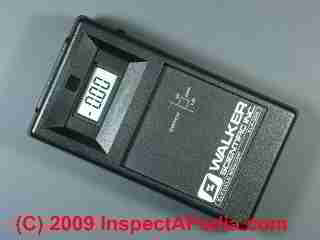 RF Measuring Equipment
Guide to Selecting & Using Electromagnetic Field Measurement Instruments for RF Radio Frequency Surveys
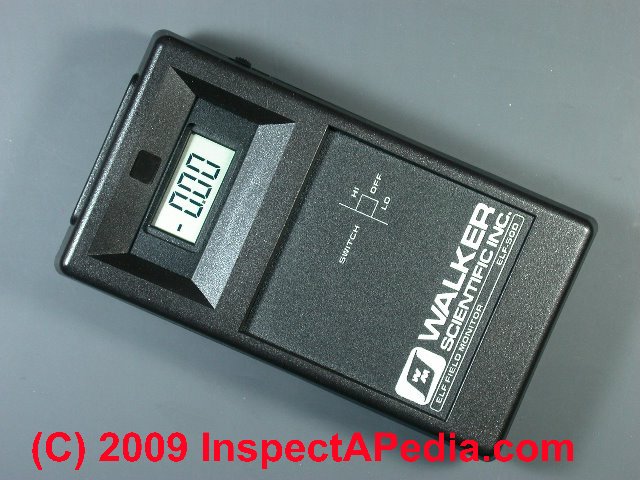
- POST a QUESTION or COMMENT about choosing an RF electromagnetic field measurement survey instrument or tool.
Radio Frequency (RF) Field Measurement Instrument Choices:
This article describes low-cost RF radio frequency electromagnetic field survey measurement instruments useful for performing electromagnetic field RF field detection and level measurements either by engaging a professional or by consumers using low-cost instruments which measure radio frequency level and direction.
We include higher frequency RF measurement instruments such as used for measuring in the marine radar frequency range.
InspectAPedia tolerates no conflicts of interest. We have no relationship with advertisers, products, or services discussed at this website.
RF Radio Frequency Field Strength Measurement Instruments - Examples
 Specific RF measurement tools (radio, TV, cell tower, microwaves) are described and their sources listed here - instruments suitable for radio, TV, cellphone, microwave, and similar signals.
Before buying an EMF or RF test instrument, in order to make sure that the device you are buying is the right one for the hazard you are trying to measure, see EMF RF FIELD & FREQUENCY DEFINITIONS for a simple explanation of different types of radio frequency (RF) and electromagnetic frequency (EMF) types and where they are found.
The information provided here is for research and study purposes. The author makes no representation of unique expertise on this topic, other than having field experience in EMF measurement, having studied technical literature and having conversed with other experts and authors in the field for a number of years.
This information is has not been sanctioned nor technically reviewed by the American Society of Home Inspectors nor the American Industrial Hygiene Association - AIHA. Use it at your own risk.
Radio frequency or RF detection equipment has a more extensive list of applications than the low frequency electromagnetic field EMF detection equipment described separately at Electromagnetic Field EMF ELF Detection Instrument..
What's the difference between radio frequency (RF) and electromagnetic frequency (EMF)?
While EMF or electromagnetic field low frequency 60 cycle or 60 Hertz signals are associated with power transmission lines and household wiring or appliances, higher frequency RF equipment includes radio and television signals, radio towers, TV towers, cell towers, cellular telephone signals, Wi-Fi signals, bluetooth radio signals, GSM, Radar, DECT, UMTS, WLAN, and all other wireless communication signals.
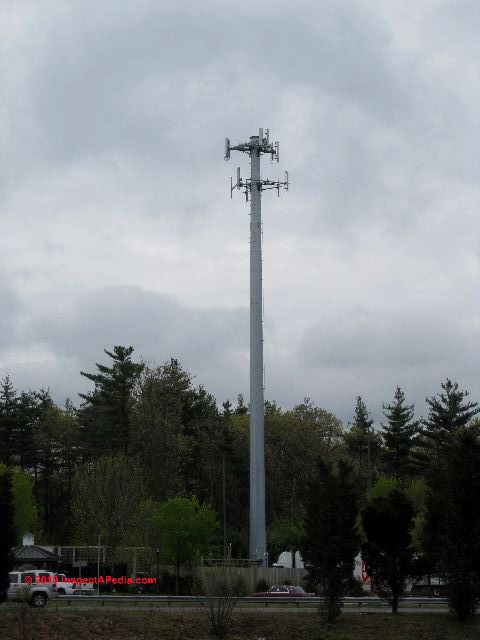
The cell phone tower in our photo (left) is located in Westchester County, New York. Exposure of electromagnetic radiation from cell towers is normally a separate question from EMR exposure from use of cellphones themselves.
RF Measurement Test Equipment Models & Manufacturers
Where to Buy RF Radio Frequency Monitoring or Measuring Equipment. In these articles we list manufacturers and suppliers of RF and EMF measuring equipment. These devices are readily available from many electrical equipment and home inspection equipment suppliers. Don't contact InspectAPedia to buy equipment - we do not sell anything.
The devices listed just below are for detection and measurement of higher frequency RF or radio frequency detection and measurement.
- BK Precision 103 - 1MHz to 3.0GHz Handheld Frequency Counter/Strength Meter for measuring RF radio frequency strength
- BK Precision 104 - 10Hz to 3.0GHz Handheld Frequency Counter/Strength Meter for measuring RF radio frequency strength
- BK Precision 106 - 30MHz to 2.8GHz Handheld Frequency Counter/Strength Meter for measuring RF radio frequency strength
For low frequency EMF (power line type) electromagnetic field detection and measurement, see
- EMF MEASUREMENT INSTRUMENTS describes several low-cost and reasonably accurate EMF measurement devices that are readily available suitable for measuring EMF from power transmission lines or home electrical wiring and appliances.
B&K Precision offers a variety of instruments to test and characterize RF and microwave devices operating from DC to 8.5 GHz. Here is the company's general product description:
RF Field Strength Meters detect the electric field of radio and microwave signals and measure the electric field strength. Field strength meters provide field technicians and engineers with a cost-effective measurement tool for basic signal investigations at only a fraction of the cost of a full-featured conventional spectrum analyzer.
Handheld RF Field Strength Analyzers are ideal tools for field testing, installing and maintaining Mobile Telecommunications systems such as Cellular and Cordless Phone, CB Paging, Paging, Cable and Satellite TV Systems and performing antenna site measurements and maintenance.
Website: http://www.bkprecision.com/products/categories/15/rf-test-instruments.html
Marine Radar RF Measurement Test Equipment & Measuring Meters
Reader Question: where can I buy an instrument to detect & measure my exposure to radar signals?
2016/03/07 Marine Radar Units said:
I am a lock and Dam Operator. Recently I was told to start having the pilots of these tow boats put there radars in stand by mode. If they are on, lime they have been for the last 6 years I have been working that they pose a heath hazard to us since we normally work with in 10 foot of these things and are pretty much at eye level with them.
I read the above article in hopes of finding a tool to measure the amount of radiation we are exposed to but didn't find what I was looking for. I may have missed it. Can you help me out. Thanks
This question was posted originally at DEFINITIONS of EMF RF FIELD & FREQUENCY
Reply:
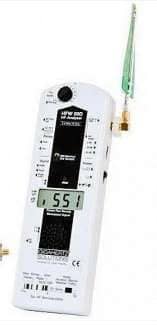
[Click to enlarge any image] Above, the Bonanza HFW59D_High_Frequency_RF_Meter
Thanks for the questions L&DO:
Radar operates in higher end of "Ultra High Frequency" into the lower end of the "Extremely High Frequency EHF - Microwaves" range given in the table in our article above. That is 30-300 Gigahertz GHz - 109 up to 1012. I'd say in general radar measurement instruments need to measure from 2 GHZ t0 10 GHZ.
From a quick search and quoting from Rice Electronics www.ricelectronics.com, we found this about the radio frequency of marine radar:
There are two basic marine radar frequencies commonly known as "X" and "S" band. "X" band, because of its higher frequency, 10 GHz provides a higher resolution and a crisper image while "S" band, at 3 GHz is less affected by rain and fog.
That means you'd need a measuring instrument that measures field strength in that frequency range. Or a radar receiver. Low frequency "gauss meters" popular at electronics suppliers are not suitable. In fact there are measuring instruments for every RF range, but you may find that in the radar range, say 3 - 10 Gigahertz, they'll be a bit pricey.
- The HFW59D High Frequency RF Meter from Bonanza - EMR Shielding Solutions can measure up to 10GHz ... It can measure upper radar frequencies used in air traffic control, ships, military and traffic monitoring. This instrument costs about $1,200. You can contact the company at http://www.bonanza.com/
Perhaps you can find a source to rent the device, though considering your exposure you might want longer term or even continuous monitoring since otherwise you may not know whose radar is on or off as boats come through your lock.
Mobile Design Shipboard RF Measurements
Special difficulties ensue in making microwave measurements on Navy ships, including cramped space, multiple RF sources, and many sources of RF interference.
Hand-held instruments for shipboard RF measurements are provided by Mobile Design at
Website: http://mobiledevdesign.com/hardware_news/radio_handheld_instruments_aid/
We agree with the company's instrument use advice, in particular using the instrument in a consistent, standard, repeatable manner, and taking into account background signals and other sources of interference.
Sources: Zap Checker - http://www.zapchecker.com/ - Alan Broadband, 751 Laurel St #12, San Carlos, CA 94070 USA Ph: 650-345-9627
Safe Living RF Meters - Radio Frequency Detectors
- Safe Living RF Meter - 27 MHz - 6 GHz, detecting cellular telephone signals, Wi-Fi signals, bluetooth radio signals, GSM, Radar,DECT, UMTS, WLAN, and all other wireless communication signals
Safe Living Technologies Inc., 34 Queen Street P.O. Box 72 Morriston, Ontario N0B 2C0 Canada Phone: 519-240-8735 Fax: 519-821-5724
Website: http://www.safelivingtechnologies.ca/contact[dot]htm
Zap Checker Radio Frequency Detection
The Zap Checker - a series of hand-held ultra-sensitive instruments intended to detect and display radio frequency (RF) signals over varying spans of radio frequency range. Instrument prices range from around $160 to $2800. (March 2010). The company describes the Zap Checker as a counter surveillance, bug detector, field strength meter. Here is the company's general product line description:
All Zap Checker models are easy to use, small, handheld products with internal fixed antennas which require no adjustments. All models employ linear (regular) as well as logarithmic (compressed) amplification and detection. Each model has an analog meter and LED display. (The LED displays are visible from a distance and at night time.)
Most Zap Checkers have an audio output to hear signal strength levels and identify sources by their characteristic sounds. Some products have a switch enabled silent vibrator. The more professional models employ specialized external antennas and, in the case of the ABC 126, a high frequency band that filters out noise and interfering signals to allow for the highly sensitive detection of signals above 1.5 GHz. The ABC 126 also has a USB output connection for distant monitoring, remote powering and accessory switching.
- Zap Checker Model ZC 185 - 3MHz to 5 GHz
- Zap Checker Model ZC 190B - 1MHz to 8 GHz
- Zap Checker Model ZC 300 - 1MHz to 8 GHz with connector for special filtering antennas, directional logging
- Zap Checker Model ZC 126 - 1 MHz to 14 GHz bandwidth professional RF testing instrument, omni directional, high sensitivity, -90 dBm @ 2.4 GHz, -80 dBm @ 5.8 GHz, -60 dBM @ 12 GHz
Website: www.zapchecker.com/
Instead of contacting us with a request to perform RF Radio Frequency Field Strength measurements, in most cases it is more economical and convenient for a property owner to purchase their own instrument, making measurements under varying conditions. In this series of articles we describe how to make measurements using a consistent approach and using good documentation.
See EMF MEASUREMENT STEP BY STEP for details of how to collect RF and / or EMF measurement data.
Following good procedure and using instruments properly are two steps towards making accurate, repeatable RF measurements. But because the signal transmission for RF sources is not under control of an individual property owner, and because the field strength varies as the signal transmission activity varies, it is important to have an idea of that condition as well when attempting to characterize RF exposure at a specific location.
Please do not contact us with a request buy electronic measuring equipment. We do not sell anything. To do so would be a conflict of interest for this website. These devices are readily available from many electrical equipment and home inspection equipment suppliers.
Reader Question: hazards of open doors on microwave ovens
(Jan 8, 2013) Dennis Lee said:
Does the use of two separate 'open door' microwave ovens interference field increase the chances of causing ill health ?
I had a chat with some of my friends and we said yes. What do you think ?
Reply:
Dennis, the U.S. FDA, back in 1997, issued safety guidance regarding open microwave oven doors - a safety and health hazard that can occur if the microwave oven is not wired properly.
Here is a copy:
US FDA GUIDANCE ON HAZARDS OF OPEN MICROWAVE OVEN DOORS [PDF] (1997), retrieved 4 June 2015, original source: http://www.fda.gov/downloads/MedicalDevices/DeviceRegulationandGuidance/GuidanceDocuments/UCM095341.pdf
Reader Comments, Questions & Answers About The Article Above
Below you will find questions and answers previously posted on this page at its page bottom reader comment box.
Reader Q&A - also see RECOMMENDED ARTICLES & FAQs
(May 28, 2015)
Thanks for your article, it can help me.
Really your post is really very good and I appreciate it.
It’s hard to sort the good from the bad sometimes,
You write very well which is amazing. I really impressed by your post.
...
Continue reading at DEFINITIONS of HERTZ, KHz MHz GHz THz or select a topic from the closely-related articles below, or see the complete ARTICLE INDEX.
Or see these
Recommended Articles
- CELL PHONE RADIATION
- DEFINITIONS of EMF RF FIELD & FREQUENCY
- DEFINITIONS of HERTZ, KHz MHz GHz THz
- ELECTROMAGNETIC FIELD EMF ELF & RF DETECTION
- EMF ELECTROMAGNETIC FIELDS & HUMAN EXPOSURE
- EMF CANCER SCARE
- EMF CANCER RISK
- EMF/EMR MEASUREMENT OVERVIEW
- EMF LOCAL SOURCES MAY EXCEED POWER LINE STRENGTH
- EMF MEASUREMENT DISTANCE AFFECTS STRENGTH
- EMF MEASUREMENT INSTRUMENTS
- EMF MEASUREMENT INSTRUMENT ACCURACY
- EMF MEASUREMENT INSTRUMENT USE TIPS
- EMF MEASUREMENT PROCEDURES
- EMF MEASUREMENT STEP BY STEP
- EMF REFERENCES
- EMF SURVEY PROCEDURE
- EMF SURVEY REPORT INTERPRETATION
- EMF WORKSHEET for EMF MEASUREMENTS
- EMF WORKSHEET Example
- EMF WORKPLACE EXPOSURE
- ENVIRONMENTAL HAZARDS at BUILDINGS - home
- ENVIRO-SCARE - PUBLIC FEAR CYCLES
- HAZARD vs RISK
- RF RADIO FREQUENCY DETECTION METERS
Suggested citation for this web page
RF RADIO FREQUENCY DETECTION METERS at InspectApedia.com - online encyclopedia of building & environmental inspection, testing, diagnosis, repair, & problem prevention advice.
Or see this
INDEX to RELATED ARTICLES: ARTICLE INDEX to BUILDING ENVIRONMENT
Or use the SEARCH BOX found below to Ask a Question or Search InspectApedia
Ask a Question or Search InspectApedia
Try the search box just below, or if you prefer, post a question or comment in the Comments box below and we will respond promptly.
Search the InspectApedia website
Note: appearance of your Comment below may be delayed: if your comment contains an image, photograph, web link, or text that looks to the software as if it might be a web link, your posting will appear after it has been approved by a moderator. Apologies for the delay.
Only one image can be added per comment but you can post as many comments, and therefore images, as you like.
You will not receive a notification when a response to your question has been posted.
Please bookmark this page to make it easy for you to check back for our response.
Our Comment Box is provided by Countable Web Productions countable.ca
Citations & References
In addition to any citations in the article above, a full list is available on request.
- Electric Power Lines, Electromagnetic Fields, Cancer Risk, & "Enviro-Scare" - The Normal Curve Cycle of Public Fear About Environmental Issues - online document by DF
- A Procedure for Measuring EMF electromagnetic fields online document by DF
- "Questions and Answers about Biological Effects and Potential Hazards of Radiofrequency Electromagnetic Fields", Federal Communications Commission, Office of Engineering and Technology, US FCC, OET Bulleting 56, 4th Edition, August 1999
" Many consumer and industrial products and applications make use of some form of electromagnetic energy. One type of electromagnetic energy that is of increasing importance worldwide is radiofrequency (or "RF") energy, including radio waves and microwaves, which is used for providing telecommunications, broadcast and other services. In the United States the Federal Communications Commission (FCC) authorizes or licenses most RF telecommunications services, facilities, and devices used by the public, industry and state and local governmental organizations. Because of its regulatory responsibilities in this area the FCC often receives inquiries concerning whether there are potential safety hazards due to human exposure to RF energy emitted by FCC-regulated transmitters. Heightened awareness of the expanding use of RF technology has led some people to speculate that "electromagnetic pollution" is causing significant risks to human health from environmental RF electromagnetic fields. This document is designed to provide factual information and to answer some of the most commonly asked questions related to this topic." - original source: U.S. Federal Communications Commission Office of Engineering and Technology, http://www.fcc.gov/Bureaus/Engineering_Technology/Documents/bulletins/oet56/oet56e4.pdf - "Magnetic Field Exposure and Cancer: Questions and Answers [ copy on file as /emf/EMF_Fact_Sheet_NCI_NIH.pdf ] - ," National Cancer Institute, U.S. National Institutes of Health, web search September 2010, original source: http://www.cancer.gov/cancertopics/factsheet/Risk/magnetic-fields
makes these five key points about EMF- Electric and magnetic fields (EMF) are areas of energy that surround any electrical device. EMFs are produced by power lines, electrical wiring, and appliances (see Question 1).
- Electric fields are easily shielded or weakened by walls and other objects, whereas magnetic fields are not. Since magnetic fields are more likely to penetrate the body, they are the component of EMFs that are usually studied in relation to cancer (see Question 1).
- Overall, there is limited evidence that magnetic fields cause childhood leukemia, and there is inadequate evidence that these magnetic fields cause other cancers in children (see Question 2).
- Studies of magnetic field exposure from power lines and electric blankets in adults show little evidence of an association with leukemia, brain tumors, or breast cancer (see Question 3).
- Past studies of occupational magnetic field exposure in adults showed very small increases in leukemia and brain tumors. However, more recent, well-conducted studies have shown inconsistent associations with leukemia, brain tumors, and breast cancer (see Question 4).
- "Evaluation of Potential Carcinogenicity of Electromagnetic Fields," EPA Report #EPA/600/6-90/005B October 1990. EPA: 513/569-7562.
- "Biological Effects of Power Frequency Electric and Magnetic Fields" background paper, prepared as part of OTA's assessment of "Electric Power Wheeling and Dealing: Technological Considerations for Increasing Competition," prepared for OTA by Indira Nair, M. Granger Morgan, H. Keith Florig, Department of Engineering and Public Policy, Carnegie Mellon University, Pittsburgh, PA 15213
- "Biological Effects of Power Line Fields," New York State Powerline Project. Scientific Advisory Board Final Report, July 1, 1987.
- "Extremely Low Frequency (ELF) Fields," Environmental Health Criteria 35. World Health Organization, Geneva, 1984.
- "Electric and Magnetic Fields at Extremely Low Frequencies: Interactions with Biological Systems. In: Non ionizing Radiation Protection, World Health Organization, Regional Office for Europe, Copenhagen, 1987.
- "Electric and Magnetic Fields from 60 Hertz Electric Power: What do we know about possible health risks?," Department of Engineering and Public Policy, Carnegie Mellon University, Pittsburgh, PA 15213 1989.
- "Electromagnetic Fields Are Being Scrutinized for Linkage to Cancer," Sandra Blakeslee, New York Times, Medical Science section, April 2, 1991
- Electromagnetic Fields in the Workplace sample very good NIOSH document online, links to other NIOSH docs.
- Electric Power Lines, Electromagnetic Fields, Cancer Risk, & "Enviro-Scare" - The Normal Curve Cycle of Public Fear About Environmental Issues - online document by DF
- Our recommended books about building & mechanical systems design, inspection, problem diagnosis, and repair, and about indoor environment and IAQ testing, diagnosis, and cleanup are at the InspectAPedia Bookstore. Also see our Book Reviews - InspectAPedia.
- In addition to citations & references found in this article, see the research citations given at the end of the related articles found at our suggested
CONTINUE READING or RECOMMENDED ARTICLES.
- Carson, Dunlop & Associates Ltd., 120 Carlton Street Suite 407, Toronto ON M5A 4K2. Tel: (416) 964-9415 1-800-268-7070 Email: info@carsondunlop.com. Alan Carson is a past president of ASHI, the American Society of Home Inspectors.
Thanks to Alan Carson and Bob Dunlop, for permission for InspectAPedia to use text excerpts from The HOME REFERENCE BOOK - the Encyclopedia of Homes and to use illustrations from The ILLUSTRATED HOME .
Carson Dunlop Associates provides extensive home inspection education and report writing material. In gratitude we provide links to tsome Carson Dunlop Associates products and services.
 | HOME | ABOUT | ASK a QUESTION | CONTACT | CONTENT USE POLICY | DESCRIPTION | POLICIES | PRIVACY | |
| © 2024 - 1985 Publisher InspectApedia.com - Daniel Friedman | |||||||||