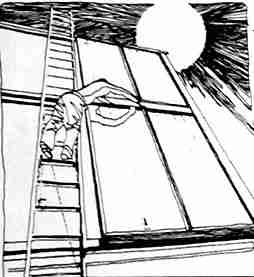
 Table of Coefficient of Expansion of Building Materials
- POST a QUESTION or COMMENT about the thermal expansion or contraction of building materials as temperatures vary
Thermal coefficient of expansion of building materials:
Here we provide a Table of Coefficient of Thermal Expansion of Building Materials - what is the linear expansion of glass, metal, wood, masonry or plastic in response to temperature changes.
We include a discussion of the definition of thermal coefficient of expansion, how thermal expansion causes trouble in building materials, and how to use the data in the thermal expansion table to calculate changes in material size as temperatures change.
InspectAPedia tolerates no conflicts of interest. We have no relationship with advertisers, products, or services discussed at this website.
- Daniel Friedman, Publisher/Editor/Author - See WHO ARE WE?
Table of Coefficients of Thermal Expansion of Common Building Materials
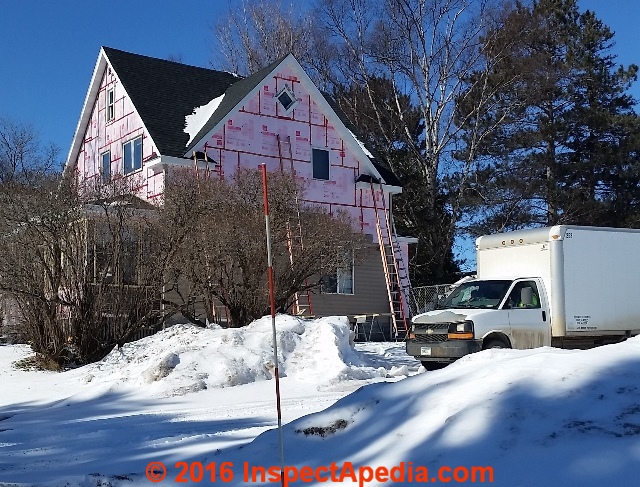 How do building materials change in dimension in response to temperature changes, sun, shade, ice, snow?How do the dimensions of different building materials vary with temperature, heat, cold?
Table of Coefficient of Expansion of Building Materials. Sketch at page top and accompanying text are reprinted/adapted/excerpted with permission from Solar Age Magazine - editor Steven Bliss.
Photo: vinyl siding being installed in very cold temperatures in Two Harbors, Minnesota.
[Click to enlarge any image]
Definition of CoTE: Coefficient of Thermal Expansion
CoTE or Coefficient of Thermal Expansion gives change per unit dimension of material in response to change (increase or decrease) in the material's temperature.
Definition of CLTE: Coefficient of Linear Theral Expansion
The coefficient of linear thermal expansion (CLTE) of any material is the change of a material's dimension per unit change in temperature. - special thanks to reader Eric, P.E.
The coefficient of thermal expansion or CLTE, Coefficient of Linear Thermal Expansion
The linear expansion of a heated solid (or liquid) is measured by
α = the coefficient of linear expansion,
The coefficient of thermal expansion is defined such that α measures the percentage change in the length of the material per degree of temperature change.
Be careful in comparing the coefficient of expansion of different materials from different reference sources for thermal expansion coefficients as various references quote α in degrees C, others in degrees F.
Usually people use the term CLTE or Coefficient of Linear Thermal Expansion as expansion along the long dimension of a material is most likely to be greater and thus of greater concern in construction. CLTE may be expressed as a fraction or as a power of ten as you'll see in the table below.
The following simple formula for the coefficient of thermal linear expansion in a building material is written to measure the percentage change in length per degree of temperature change:
α = (Change in Length / Original Length) / Change in Temperature
One can write similar formulas to calculate the coefficient of thermal expansion of a material in area (applicable, for example in thermal splitting of asphalt roof shingles ) or to calculate the coefficient of thermal expansion of volume. But because so many building material failures and leaks derive from cracks or openings due to thermal expansion of materials in length, that is our focus here.
Comparison of Coefficients of Linear Temperature Expansion (CLTE) of Common Building Materials |
|||
|---|---|---|---|
CLTE Ordered by Name of Material |
Ordered by Coefficient of Thermal [Temperature] Expansion |
||
| Material | Coefficient of Expansion in inches of expansion per inch of material per degree F. | Material | Coefficient of Expansion in inches of expansion per inch of material per degree F. |
| ABS plastic | 0.0000170 (glass fiber-reinforced) | Acrylic | 0.0001300 (extruded) |
| ABS plastics | 0.0000410 | Polyethylene | 0.0001110 |
| Vinyl2 (siding & trim) |
0.000045 or 4.5×10 −5 in/in/F 1, 2 | ||
| PVC (cellular) | 0.000045 or 4.5 x 10⁻⁵ in/in/F 1 | ||
| Acrylic | 0.0001300 (extruded) | Polycarbonates | 0.0000440 |
| Acrylic | 0.0000410 (sheet cast) | ABS plastics | 0.0000410 |
| Aluminum | 0.0000123 - 0.0000129 or 0.000029 (other sources) 0.000117 to 0.111137 or 11.7 to 13.7 x 10⁻⁵ in/in/F 1 α (ppm) = 29 (0–600 °C) |
Acrylic | 0.0000410 (sheet cast) |
| Aluminum Alloys | 0.0000117 or 11.7 x 10⁻⁶ in/in/F Note that "alloys" is not defined and could vary significantly |
||
| Brass | 0.0000104 - 190 | Epoxy | 0.0000310 |
| Brick | 0.011811 - 0.0629921 /degF vs 0.0000031 (brick masonry) 11, 13, 14, 15 5 - 7 x 10⁻⁶ per degC 18 best citation 13 |
Ice | 0.0000280 (effects of freezing water) |
| Cast iron | 0.0000058 | ABS plastic | 0.0000170 (glass fiber-reinforced) |
| Cast iron | 0.0000060 (gray cast iron) | Zinc | 0.0000165 |
| Cement | 0.0000060 | Lead | 0.0000151 |
| Clay tile | 0.0000033 | Aluminum | 0.0000123 - 0.0000129 |
| Concrete | 0.0000080 (Concrete structure = 0.0000055)14 0.000004 to 0.000007 or 0.4 to 0.7 x 10⁻⁵ in/in/F 1 |
Brass | 0.0000104 - 190 |
| Copper | 0.0000093 | Copper | 0.0000093 |
| Epoxy | 0.0000310 | Concrete | 0.0000080 (Concrete structure = 0.0000055) |
| Glass, hard | 0.0000033 0.0000040 or 0.4 x 10⁻⁵ in/in/F 1 |
Iron, pure | 0.0000067 |
| Glass, plate | 0.00000500 | Steel | 0.0000063 - 0.0000073 (also Iron, forged) |
| Glass, Pyrex | 0.0000022 | Cast iron | 0.0000060 (gray cast iron) |
| Granite | 0.0000044 (also Limestone, Marble) | Cement | 0.0000060 |
| Ice | 0.0000280 (effects of freezing water) | Cast iron | 0.0000058 |
| Iron, pure | 0.0000067 | Glass, plate | 0.0000050 |
| Lead | 0.0000151 | Granite | 0.0000044 (also Limestone, Marble) |
| Masonry | 0.0000026 - 0.0000050 | Nylon | 0.00000447 (molding & extruding compound) |
| Mortar | 0.0000041 - 0.0000075 | Mortar | 0.0000041 - 0.0000075 |
| Nylon | 0.0000447 (molding & extruding compound) | Clay tile | 0.0000033 |
| Polycarbonates | 0.0000440 | Glass, hard | 0.0000033 |
| Polyethylene | 0.0001110 | Brick | 0.0000031 (brick masonry) |
| Polystyrene | 4.16 x 10⁻⁵ in/in/F | ||
| Polyurethane | 11.0 x 10⁻⁴ in/in/F (Density Dependent) 1 | ||
| PVC1(rigid) | 0.000035 or 3.5x10,-5 in/in/F 1 | ||
| PVC (cellular) | 0.000045 or 4.5 x 10⁻⁵ in/in/F 1 | ||
Stainless Steel SS 301 (varies by alloy/composition) |
16.9 ppm/°C 17.3 14.9 16.0 16.7 9.9 10.45 10.6 11.15 |
||
| Steel | 0.0000063 - 0.0000073 (also Iron, forged) 0.000008 or 0.8 x 10⁻⁵ in/in/F 1 |
Wood,Oak | 0.0000030 (across grain) |
| Vinyl2 (siding & trim) |
0.000045 or 4.5×10 −5 in/in/F 1, 2 | ||
| Water | see HOT WATER PRESSURE EXPANSION RATE | ||
| Wood,Oak | 0.0000030 (across grain) | Wood, Pine | 0.0000028 |
| Wood, Oak | 0.0000027 (parallel to grain) | Wood, Oak | 0.0000027 (parallel to grain) |
| Wood, Pine | 0.0000028 or in other sources and 0.000034 to 0.000058 |
Masonry | 0.0000026 - 0.0000050 |
| Zinc | 0.0000165 | Glass, Pyrex | 0.0000022 |
Notes to the table above
- ASTM. 1997. Standard methods for testing small clears pecimens of timber. ASTM D143. West Conshohocken,PA: American Society for Testing and Materials.
- Kollman, F.F.P.; Côté, W.A., Jr. 1968. Principles ofwood science and technology I—solid wood. New York,Springer–Verlag New York, Inc.
- Panshin, A.J.; deZeeuw, C. 1980. Textbook of woodtechnology. New York: McGraw–Hill. Vol. 1, 4th ed
- Special thanks to Bob Fankhauser Email: blueboxconst@hevanet.com, a retired engineer / professional handyman and Habitat for Humanity volunteer who offered comments, suggestions, additions for vinyl CLTE (Coefficient of Linear Thermal Expansion), CPVC, PVC, cellular PVC, and vinyl (25 Feb 20-16) as well as helpful discussion concerning the wide variation in coefficients of expansion of materials given by various sources.
- Stainless steel coefficients of expansion: University of Chicago, LINEAR THERMAL EXPANSION COEFFICIENTS of METALS & ALLOYS, Table 17-1, [PDF] retrieved 2017.11.13, original source: https://psec.uchicago.edu/thermal_coefficients/cte_metals_05517-90143.pdf
- Smith, Thomas L., AIA, CRC, METAL ROOFING: 'FIXING' for THERMAL MOVEMENT [PDF] NRCA, National Roofing Contractors Association
- Weatherwax, R.C.; Stamm, A.J. THE COEFFICIENTS OF THERMAL EXPANSION OF WOOD AND WOOD PRODUCTS [PDF] (1956) Transactionsof American Society of Mechanical Engineers. 69(44):421–432
- Simpson, William, Anton TenWolde, WOOD HANDBOOK, PHYSICAL PROPERTIES of WOOD - Chapter 3 Physical Properties & Moisture RElations of Wood [PDF] p. 3-21, "Coefficients of Expansion" in Forest Products Laboratory. 1999. Wood handbook—Wood as an engineering material.Gen. Tech. Rep. FPL–GTR–113. Madison, WI: U.S. Department of Agriculture, Forest Service,Forest Products Laboratory. 463 p. USFPS, retrieved 2020/10/23 original source: https://www.fpl.fs.fed.us/documnts/fplgtr/fplgtr113/ch03.pdf
- Skaar, C. 1988. Wood–water relations. New York:Springer–Verlag. New York, Inc.
- See Notes 1 & 2 and details now found at VINYL SIDING COEFFICIENT of LINEAR EXPANSION
- Engineering Toolbox website, provides a more extensive table of coefficients of linear expansion at engineeringtoolbox.com/linear-expansion-coefficients-d_95.html
retrieved de-novo 2023/07/24 - Western Washington University Thermal Expansion is described and defined in a clear article that also gives both linear and volumetric coefficients of thermal expansion at 20 degC. for a variety of materials at ac.wwu.edu/~vawter/PhysicsNet/Topics/Thermal/ThermExpan.html
Web: www.wwu.edu - Ross, Culbertson W., THERMAL EXPANSION of CLAY BUILDING BRICKS [PDF] (1941) NIST, National Institute of Standards & Technology, retrieved 2023/07/24, original source: nvlpubs.nist.gov/nistpubs/jres/27/jresv27n2p197_A1b.pdf
Abstract:
The coefficients of thermal expansion of 139 bricks were measured over the range -10° to +400 C (140 to 1040 F). These bricks included 1 sample of sand-lime, 9 of fire-clay, and 61 of clay and shale bricks.
The clay and shale bricks represented a wide range in properties and included samples from various districts in the United States. The coefficients of 87 percent of the clay and shale bricks were between 5 and 7 millionths per 0 C (2.8 to 3.9 per 0 F).
The average coefficient of the clay bricks was 6.0 (3.3), of the shale bricks 6.1 (3.4), and of the fireclay bricks 3.9 millionths per 0 C (2.2 per 0 F).
No relation was observed between the thermal expansion and the other physical properties of the bricks.
Excerpts: The change in length of building bricks due to temperature changes is one of the factors sometimes blamed for cracking of brick-masonry walls.
The coefficients of thermal expansion ranged from 3.7 to 13.6 millionths per 0 C (2.1 to 7.6 per 0 F), with an average of 6.3 (3.5). - Kidger, Peter, Dickinson, Chris, CLAY vs BRICK MOVEMENT of MASONRY [PDF] (2016) Clay Brick Association of Southern Africa, Web: claybrick.org
Addresses movement of masonry due to changes in temperature or moisture or both. - AZO Materials, BRICK WALLS - Expansion and Expansion Gaps - (2022) retrieved 2023/07/24, original source: azom.com/article.aspx?ArticleID=1327
Excerpts:
The coefficient of expansion or ‘e’ value of clay bricks when tested in accordance with AS/NZS 4456.11 can vary from a very low 0.3mm/m (millimetres per metre) to over 1.6mm/m.
Most general purpose bricks have a coefficient of expansion in the range 0.5 to 1.0mm/m over 15 years.
Clay bricks have a once off, permanent expansion after manufacture due to the firing process that extracts all moisture from the brick. This expansion is between 0 and 0.2%.
CLAY BRICK: Thermal expansion and contraction is minimal throughout the year. Depending on the clay mixture and firing process, the coefficient of linear thermal movement is 4-8.
We think the authors mean 4-8 ? per ˚C - Ed. details needed.
CONCRETE BRICK: Moisture movement is exacerbated by a daily cycle of thermal expansion and contraction. Depending on the type of aggregate and proportions, the coefficient of linear thermal movement is 7-14.
CONCRETE BLOCK: The movement coefficient of concrete blocks is similar to concrete bricks, but because blocks are larger the magnitude of movement is greater. Large blocks show cracks and plaster crazing more than smaller concrete units. - NCMA, CONCRETE MASONRY MANUAL [PDF] 7th Ed (2005) National Concrete Manufacturers Association, P O Box 168 Halfway House 1685 / 18 McIntyre St 18 McIntyre St, Glenlily, Cape Town, 7500 South Africa, Tel: +27 11 805-6742 Facsimile: + 27 11 315-4683 e-mail: cma@mweb.co.za Web site: www.cma.org.za Seventh Edition – revised 2005. Illustrations: John L Betts MIA Editor: J W Lane ISBN: 0-9584142-7-0
- SABS, SOUTH AFRICAN NATIONAL STANDARD, Part K: WALLS [PDF] SABS Standards Division
1 Dr Lategan Road Groenkloof Image Private Bag X191 Pretoria 0001
Tel: +27 12 428 7911 Fax: +27 12 344 1568
www.sabs.co.za - retrieved 2023/07/24, original source: https://ia801406.us.archive.org/5/items/za.sans.10400.k.2011/za.sans.10400.k.2011.html
Excerpts from Table 19:
Burnt Clay moisture expansion: < .05 to 0.20 %
NOTE 1 SANS 227 contains a test procedure to establish the moisture expansion of burnt clay bricks.
Readers can see from these building material coefficients of thermal expansion (also called coefficient of linear temperature expansion) that assembling a building component that uses multiple materials requires methods that allow for these differences in the degree of expansion as temperatures change.
Failing to permit movement of abutting or connected building materials whose rate of thermal expansion varies significantly will lead to separation, cracks, leaks, or damage in many instances.
Examples of the problems caused by differences in thermal expansion of building materials are particularly seen in windows and skylights.
At SKYLIGHT LEAK DIAGNOSIS & REPAIR we include an example of failure of roof flashing cement that has lost its ability to tolerate thermal expansion and contraction on the building.
As we discuss at CRACKS & THERMAL SPLITTING in FIBERGLASS SHINGLES, we have not found a source defining the coefficient of thermal expansion of asphalt roof shingles
- CONTACT Us if you can provide that information.
Calculation Examples using the Thermal Coefficient of Expansion of Materials
How much does aluminum siding expand when heated by rising ambient temperatures or sunlight?
While an accurate answer would include the effect of the siding color on thermal gain from direct exposure to sunlight along with the angle of sunlight hitting the siding and the duration of sun exposure, what follows is a "ballpark" calculation ignoring those niceties.
The coefficient of linear expansion of Aluminium is about 22 x (10-6) m/mC or 22 x 0.000001 per unit-length per degree C of temperature rise.
Or re-stating, aluminum siding will expand along its length from 21 to about 24 micrometers (about 22 um) per meter of length for each 1°C increase in its temperature.
What would be the thermal expansion of aluminum siding of a single segment of 20 ft (6.1m) if we heat it from 41°F up to 81°F?
if the temperature increases by 25C (say from 5 C to 30C = 41F to 86F) the increase in length in the siding segment will be
22 x 20ft x 25C x (10-6) = 0.011ft of expansion
That doesn’t look like much. But wait! Let's convert that to inches:
0.11 ft x 12 (inches per foot) = 0.132 inches. (If we've got this right)
That's enough to make a popping or banging noise if the aluminum siding is installed too-tightly or is constrained between vertical abutting trim.
Sanity Check:
I looked at George Metaxas commenton Quorum quora.com 4 October 2020. George, a retired EE, wrote
The coefficient of linear expansion of Aluminium is about 22x(10^-6) m/mC.
As the piece is 3.6m long, for a temperature increase of 55C, the elongation will be: 22 x 3.6 x 55 x (10^-6) = 4356 x10^-6 m = 4.35 mm.
4.33 mm, for you inch-people, is 0.17 inches across just 12 ft. of length.
...
Reader Comments, Questions & Answers About The Article Above
Below you will find questions and answers previously posted on this page at its page bottom reader comment box.
Reader Q&A - also see RECOMMENDED ARTICLES & FAQs
On 2023-05-10 by InspectApedia Editor (mod) - correction to the table of coefficients of expansion of materials, arranged by value
@Mike,
Thank you SO much, really, for taking the time to write and offer a correction.
We've edited and re-arranged the table as per the error that you pointed out.
On 2023-05-10 by Mike - sorted table of thermal coefficients should put vinyl and pvc near the top
The sorted table of thermal coefficients is not correctly sorted, vinyl and pvc should be number 3 and 4 but without converting from engineering notation to decimal it is not immediately obvious unless you deal with engineering notation daily.
On 2021-11-04 y Inspectapedia Com Moderator (mod) - diagnosing bang & boom noises that might be due to thermal changes
@Yihang,
Please help us out by posting your questions just once in one place - we have thousands of readers we try to serve- tripling our workload makes it hard for us.
You posted and we replied at https://inspectapedia.com/noise_diagnosis/Bang-Boom-Noise-Sources.php
On 2021-11-03 by Yihang
Hi, I lived in an apartment in Auckland Central for one year. Everything was fine before.
But 3 weeks ago I started to hear strange
thudding/thumping noise almost every morning from about 10am to 1pm.
Sometimes I will also hear the noise at 4pm. The thudding noises seem to occur randomly throughout the time period, so two thumps, one is less louder and one is louder and then several minutes later another two thumps.
There is also another strange phenomenon is that, sometimes, within a very short time interval, say 30 seconds, there are about 5 thudding noises, like boom, boom, boom , boom, boom. It never happens at evening(but this is what I am afraid for).
What is actually going on?I lived in the top floor of the apartment and the thudding noises sometimes seem to coming from the ceiling but other times seem to coming from the floor where my downstairs neighbour promised me so many times that they did not make any of such noises!
On 2020-10-23 by danjoefriedman (mod) - coefficient of expansion of engineered wood.
Joe
Thanks for the question about the coefficient of expansion of engineered wood.
Composite wood beams, like other wood products, will expand and contract with changes in moisture (and less so with temperature) across the grain - across the width and thickness of the beam more than along the length (parallel to the grain).
The coefficient of thermal expansion of pine and spruce parallel to the wood-grain is about 0.4 to 0.5 x 10⁻⁵ and perpendicular to the fiber direction 3.4 to 5.8 x 10 -5.
Other sources like that used in my table above give Pine as 0.0000028 /inch as the Coefficient of Expansion in inches of expansion per inch of material per degree F.
So let's calculate the "worst case" or most expansion that occurs across the grain using Pine:
a 2x12 is roughly 11.25" deep (not really 12" unless it's rough cut)
-40C is about -40F too.
+ 30C is about + 86F
So we have a total F-degree change of 40+86 = 126 degrees F
(11.25 inches of material x 0.0000028 expansion per degree) x 126 degrees = about 0.004" across the grain
or using another source
0.4 to 0.5 x 10⁻⁵ expansion along the grain (parallel to the grain or in length) as a "worst case" for lengthening, we have
.000005 x (total beam length not given) x 126 degrees = ?? length change
Maybe if you post a sketch I'll understand better;
Interestingly, dry wood reacts less than damp wood to temperature variations.
I have not found stable estimates of the coefficients of expansion of wood in response to moisture alone or at a fixed temperature and am researching that.
On 2020-10-22 by Joe Tworek - thermal expansion/contraction in an engineered wood beam
I am building a shop mezzanine, the main beam will be a composite made out of 3, 2X12’s held together with 1/2 in carriage bolts spaced 4 in vertically every 3 ft the entire length of the beam. I don’t want the beam to contact the shop walls.
The 2x12’s are a soft lumber probably Spruce, I live in Alberta, Canada where the temp can vary from -40C in the winter to 30C in the summer. How much thermal expansion of the beam do you expect based on this. Thank You.
On 2020-07-19 by danjoefriedman (mod) - different coefficient of expansion for aluminum alloys.
Roger thanks so much for taking the time to give a different coefficient of expansion for aluminum alloys.
I can but speculate that there can be rather different LCTEs depending on just which alloy is being tested.
One may also get a different coefficient of expansion depending on the exact conditions, such as how aluminum wire of a particular alloy is employed, the use of antioxidents or thermal grease.
- Xu, Ling, Miaocao Wang, Yang Zhou, Zhengfang Qian, and Sheng Liu. "Effect of silicone gel on the reliability of heavy aluminum wire bond for power module during thermal cycling test." In 2016 IEEE 66th Electronic Components and Technology Conference (ECTC), pp. 1005-1010. IEEE, 2016.
- Ganesh, V. V., P. K. Tan, and M. Gupta. "Development and characterization of an aluminum alloy containing interconnected-wires as reinforcement." Journal of alloys and compounds 315, no. 1-2 (2001): 203-210.
One may also get a different LCTE depending on the measurement method used, as we see in some research articles.
- Otte, H. M., W. G. Montague, and D. O. Welch. "X‐Ray Diffractometer Determination of the Thermal Expansion Coefficient of Aluminum near Room Temperature." Journal of Applied Physics 34, no. 10 (1963): 3149-3150.
And of course how the aluminum is being employed
- Thomas, R. "Stress-induced deformation of aluminum metallization in plastic molded semiconductor devices." IEEE Transactions on Components, Hybrids, and Manufacturing Technology 8, no. 4 (1985): 427-434.
Let's do some further research on sources.
On 2020-07-19 by Roger - the LCTE of aluminum alloys is approximately 11 x 10^-6 /F rather than 11 x 10^-5 /F.
The Engineering Toolbox (and others) suggest that the LCTE of aluminum alloys is approximately 11 x 10^-6 /F rather than 11 x 10^-5 /F.
Any comments?
Question: find and fix banging & knocking noises from pillars & roof of this Florida Patio
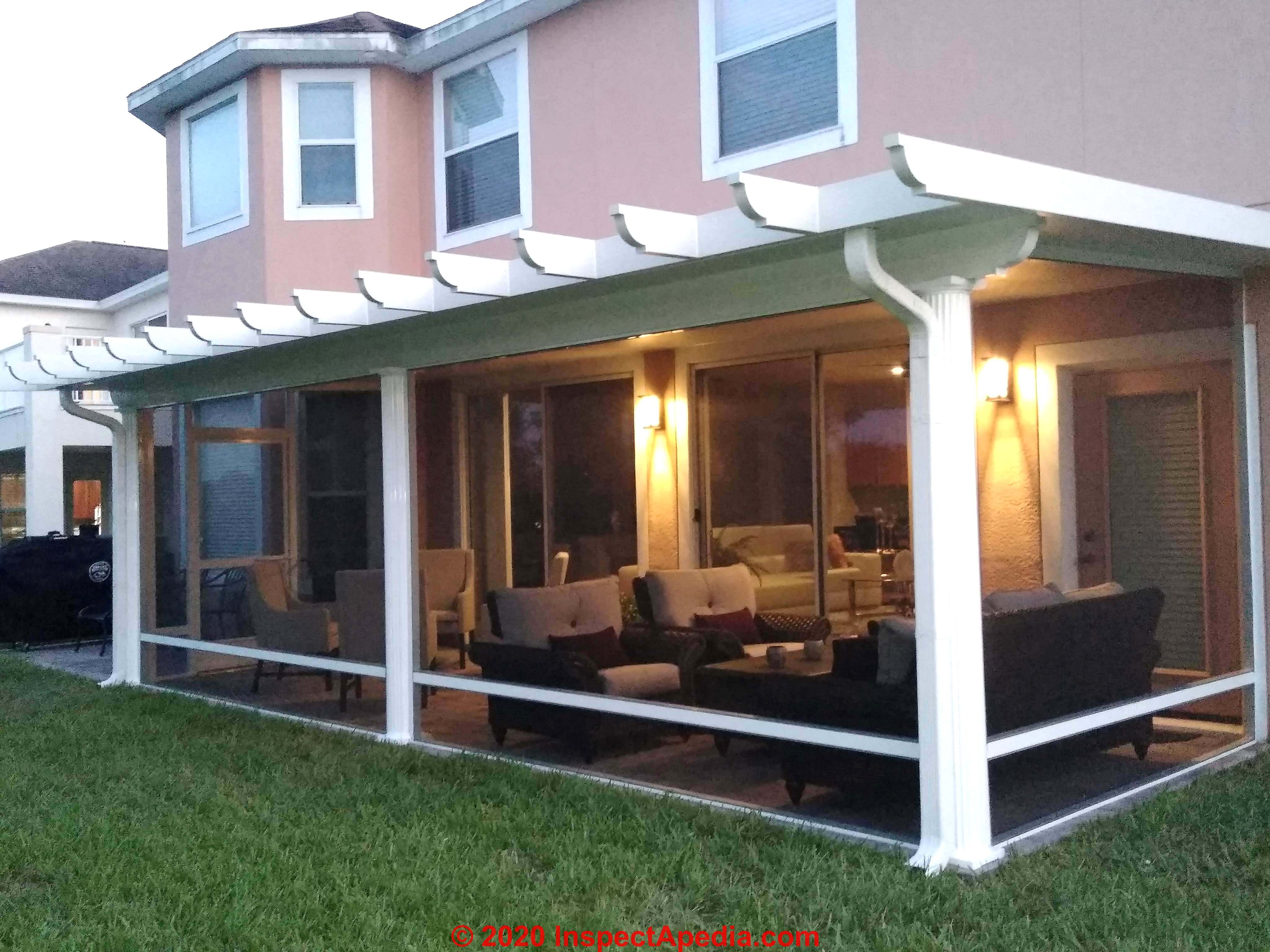 After endlessly searching online I happened across your site. I have been dealing with this problem for over a year. I'm in Florida and I had a patio screen room added to my home last August. It's constructed entirely of aluminum except for the roof which is an unknown material insulated with some sort of styrofoam. I attached a picture.
[Click to enlarge any image]
My problem is that I am hearing intermittent banging and knocking noises coming from the pillars and the areas of roof. It sounds as if something is hitting it. I have inspected for everything including birds, insects, lizards, squirrels etc. It is NOT any sort of animal.
What I do find interesting is that I do seem to hear it more frequently when there are slightly breezy conditions but I still hear it whether it's breezy or not.
Nothing is hanging or loose.
I contacted the builder and told him about it. He came out about 4-5 months ago to inspect it.
He checked it from top to bottom and couldn't find anything wrong with it.
He said it could possibly be expanding and releasing from temperature changes but he can't be sure.
But literally minutes after he left, it began knocking and banging again.
Obviously he can fix what isn't present. I am trying to figure out HOW I can capture these sounds as evidence of what is happening here daily! All I can seem to find online are voice activated devices. This clearly isn't a voice. I am desperate to fix this issue as these knocking sounds interfere with my peace and enjoyment.
Can you help me figure this out? This enclosure cost me $13,000 and I can't even enjoy it! It's extremely aggravating.
Thank you and I hope to hear from you soon. - Anonymoys by private email 2020/10/17
Moderator reply:
The most-common explanation is just what your builder gave,
Thermal expansion and contraction, is probably the culprit, anon.
Those noises can appear as banging, knocking, or clicks, squeaks, or tapping sounds as metal or other components of your Florida patio move against one another during temperature changes, also affected by wind and changes in humidity, even barometric pressure.
The conceptual explanation is that different materials expand and contract at different rates - as illustrated in the article above on this page on coefficients of thermal expansion. So they move differently and so move against one another to produce sound.
Reader follow-up:
So there's nothing that can be done? I feel I should have been advised of this BEFORE construction. I never would have agreed to this
Moderator reply:
I did not say that Dayna
But I'm reluctant to pretend to diagnose and repair sounds without any more information;
Of course there is something to be done, and in many cases the repair is economically reasonable.
Where we get into trouble fixing thermal expansion/contraction noises are where large, expensive materials have been "permanently" installed such as in some metal roof systems, as we discuss
at TEMPERATURE CHANGE & ROOF NOISE.
In that case we still have the option of insulating under the roof to reduce noise transmission into the building interior.
But for your Florida patio, with aluminum-wrappd components, the solution may be far more reasonable.
First identify the actual moving parts and confirm what's going on; often an adjustment in fasteners or use of sealants can solve the problem.
POPPING SNAPPING NOISE DIAGNOSIS is the topic home page where we organize all of our diagnostic and repair articles on this.
Ask your roofer to be prepared to come by quickly the next time there's a prolonged session of noises from your patio, and also see if you can yourself by careful observation, perhaps aided by a mechanic's stethoscope, pinpoint the location of at least one connection that's noisy.
If I were doing this I'd first look outside at the components that are getting the most heat from sun exposure.
On 2020-03-18 by (mod) - coefficient of expansion for marble
Re-posting Q&A
Jayantibhai
What thermal expansion of composite marble dimensions 20ft by 30 ft at 40degree centigrade?
This Q&A were posted originally
at FORENSIC INVESTIGATION of BUILDINGS
Moderator reply: The thermal expansion of marble is about the same as granite -
The thermal expansion of marble is about the same as granite -
Coefficient of Expansion in inches of expansion per inch of material per degree F.
Granite = 0.0000044 (also Limestone, Marble)
Use your browser's on-page search function such as Ctrl-F to search the page above for "marble" to find more details.
On 2019-12-29 by (Mod)- engineer tunes-up table of coefficients of expansion of materials
Thak you so much for taking the time to comment, Eric; we will edit the article above accordingly and will keep your comments with this page.
On 2019-12-29 by Eric
Suggestions from a licensed professional engineer:
1. "Definition of CLTE: The coefficient of linear thermal expansion (CLTE) of any material is the change in the material’s length [and to a much lesser degree the width or thickness] per unit change in temperature.
CLTE applies to the length, width, and thickness equally, not "too a much lesser degree". If the width and thickness are smaller, the expansion will be smaller, however the ratio remains the same. I'd suggest replacing with: "Definition of CLTE: The coefficient of linear thermal expansion (CLTE) of any material is the change of a material's dimension per unit change in temperature."
2. "The coefficient of thermal expansion is defined such that α measures the percentage change in the length of the material per degree of temperature change."
The CoTE does not indicate percentage change, it indicates change per unit dimension of material. Suggestion to take out "percentage".
Also, the table should list all numbers in the same format (i.e., you have "0.00000234", "16.9 ppm", "4.5 x 10(-5)", and also show (sometimes) the units in the table, even including C for a table that everything else is in F. The units are already given in the column header, so suggestion to take out units, convert those that are in C to F, and format all numbers to be in a single format.
On 2019-05-19 - by (mod) - dimensional changes in a wood framed house
Herman
You ask an interesting question but we need to be rather clear, and perhaps more narrow in our question and answer since even a traditional wood frame house has plenty of other materials involved in its construction besides wood.
The coefficient of expansion for pine is 0.0000028 inches per inch of material per degree F.
You could add up the widths of all of the framing members whose width or narrow dimension is along the same axis as a house exterior wall - but not all of those would change the building width. For example, even if a wall stud shrinks or expands in the middle of a wall, it's not likely to make a measurable change in overall building width - it simply expands and contracts inside its adjoining joist bays.
So you'd look only at framing members whose position is such that their thickness determines the overall wall width or length. That's probably pretty-few: corner posts, intermediate posts not abutting an open joist bay. That might be just three or four 2x4 or 2x6 widths (depending on how the house is framed) -
So take a look at the framing plan for your house, add up the pertinent widths along the long dimension, and then plug those into the table above, probably assuming the wood is pine.
You'll also have to make some assumptions about moisture levels and perhaps tightness of framing and framing connectors.
I suspect that other materials such as siding expand and contract more than the frame - considerably more - which is why installation instructions call for appropriate gaps.
On 2019-05-06 by Herman
If I had a traditional wood frame house, say 25' x 35' how many inches would it shrink and grow from -10°F to 100° F?
...
Continue reading at THERMAL EXPANSION of HOT WATER or select a topic from the closely-related articles below, or see the complete ARTICLE INDEX.
Or see THERMAL EXPANSION of MATERIALS FAQs - questions & answers posted originally at this page
Or see these
Recommended Articles
- FORENSIC INVESTIGATION of BUILDINGS
- FROST HEAVES, FOUNDATION, SLAB
- THERMAL EXPANSION of MATERIALS
- ALUMINUM WIRING HAZARDS & REPAIRS
- BRICK WALL THERMAL EXPANSION CRACKS
- BRICK WALL WOOD NAILER INSERTS
- CHIMNEY CRACK DETECTION & DIAGNOSIS
- FIBERGLASS SHINGLE CRACKS
- FORENSIC INVESTIGATION of BUILDINGS
- HOT WATER PRESSURE EXPANSION RATE
- SLOPED GLAZING DETAILS
- SPONTANEOUS GLASS BREAKAGE NiS
- TEMPERATURE CHANGE & ROOF NOISE
- TEMPERATURE CHANGE RELATED NOISES
- THERMAL EXPANSION CRACKS in BRICK
- THERMAL EXPANSION of HOT WATER
- THERMAL EXPANSION TPR VALVE LEAKS
- VINYL SIDING COEFFICIENT of LINEAR EXPANSION
- THERMAL IMAGING, THERMOGRAPHY
- THERMAL MASS in BUILDINGS
- TRUSS UPLIFT, ROOF
Suggested citation for this web page
THERMAL EXPANSION of MATERIALS at InspectApedia.com - online encyclopedia of building & environmental inspection, testing, diagnosis, repair, & problem prevention advice.
Or see this
INDEX to RELATED ARTICLES: ARTICLE INDEX to EXTERIORS of BUILDINGS
Or use the SEARCH BOX found below to Ask a Question or Search InspectApedia
Ask a Question or Search InspectApedia
Share this article:Ask a Question or Search the InspectApedia website using the box just below.
Need to make a private comment? Email editor@inspectApedia.com. We welcome email with your website content critique, corrections, suggestions or questions. Email is monitored daily but our workload may prevent an immediate reply. For immediate results, we hope you'll first try asking your question using the search box just above.
Citations & References
In addition to any citations in the article above, a full list is available on request.
- Bob Fankhauser <blueboxconst@hevanet.com>, 503 206 9824 Cell, a retired engineer / professional handyman and Habitat for Humanity volunteer who offered comments, suggestions, additions for vinyl CLTE (Coefficient of Linear Thermal Expansion), CPVC, PVC, cellular PVC, and vinyl (25 Feb 20-16) as well as helpful discussion concerning the wide variation in coefficients of expansion of materials given by various sources.
- Building Pathology, Deterioration, Diagnostics, and Intervention, Samuel Y. Harris, P.E., AIA, Esq., ISBN 0-471-33172-4, John Wiley & Sons, 2001 [General building science-DF - ** Particularly useful text **
- Certainteed Weatherboard fiber cement siding and trim products - see certainteed.com/ or see certainteed.com/resources/sidingandtrimspecsheet.pdf
- In addition to citations & references found in this article, see the research citations given at the end of the related articles found at our suggested
CONTINUE READING or RECOMMENDED ARTICLES.
- Carson, Dunlop & Associates Ltd., 120 Carlton Street Suite 407, Toronto ON M5A 4K2. Tel: (416) 964-9415 1-800-268-7070 Email: info@carsondunlop.com. Alan Carson is a past president of ASHI, the American Society of Home Inspectors.
Thanks to Alan Carson and Bob Dunlop, for permission for InspectAPedia to use text excerpts from The HOME REFERENCE BOOK - the Encyclopedia of Homes and to use illustrations from The ILLUSTRATED HOME .
Carson Dunlop Associates provides extensive home inspection education and report writing material. In gratitude we provide links to tsome Carson Dunlop Associates products and services.
 |
HOME | ABOUT | ASK a QUESTION | CONTACT | CONTENT USE POLICY | DESCRIPTION | POLICIES | PRIVACY | |
| © 2026 - 1985 Publisher InspectApedia.com - Daniel Friedman | |||||||||