
InspectAPedia® FREE Encyclopedia of Building & Environmental Construction, Diagnosis, Maintenance & Repair |
Question? Just ask us! InspectAPedia
|
 Roof Downspouts & Leaders: Defects, Leaks, Repair Guide
- POST a QUESTION or COMMENT about roof drainage systems: downspouts & leaders: installation, maintenance, repairs, leaks, screens, routing, clogs, and just about anything else.
Gutter roof drains, downspouts & leaders:
These articles, sketches and photographs decribe the types of defects or leaks in the downspouts or leaders for roof drainage systems: leaks or other defects that cause basement or crawl space water entry.
Our page top sketch is provided courtesy of Carson Dunlop Associates, a Toronto home inspection, education & report writing tool company [ carsondunlop.com ].
InspectAPedia tolerates no conflicts of interest. We have no relationship with advertisers, products, or services discussed at this website.
Roof Downspout or Leader Defects
This article series discusses how to choose, install, diagnose & maintain roof gutters & downspouts, & roof drainage systems to prevent building leaks and water entry.
Quoting from Carson Dunlop Associates' Home Reference Book:
Downspouts collect water from the gutters and discharge it into drains or onto the ground. Underground drains (usually made of clay tile, cast iron or plastic) become clogged or break below grade. If an underground downspout malfunctions, water problems will likely develop in that part of the basement. There are two options.
Exterior digging and repairs can be undertaken; however, it is faster and cheaper to simply disconnect the downspout and redirect it to discharge away from the house. It’s also easier to monitor the performance, and problems are corrected easily.
Downspouts should discharge above grade onto the ground at least six feet from the home. The slope of the ground in this area should be away from the house, to direct water away from the basement.
Common Downspout Defects Causing Building Water Entry or Leaks
[Click to enlarge any image]
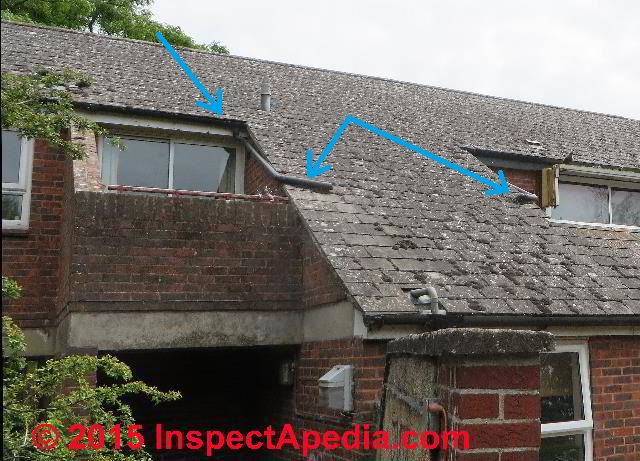
The small diameter gutter pipes (downspouts or leaders) on the roof drainage system shown above are on flats located in Oxford in the U.K. In an area of significant rainfall we speculate that this system may not be providing adequate drainage.
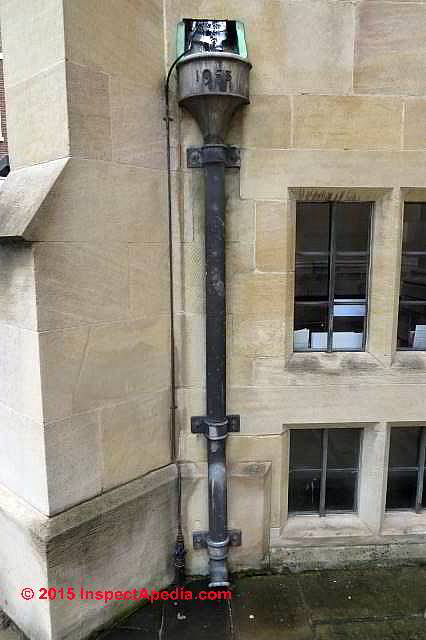
The roof drain pipes shown below, installed on a London building have been adequately sized and in-service since 1953.
Our list of common downspout or leader defects shown just below is followed by illustrations or photographs of many of these conditions.
- Downspout empties too close to the building,
concentrating water against the foundation, a very likely source of basement or crawl space water entry.
Details are at Downspout Extension Spills Too Close - Downspout empties onto soil that slopes back towards the building.
Details about controlling surface runoff and roof drainage disposal by proper site grading are found
at Surface Contouring to Dispose of Surface or Roof Drainage Runoff - Downspout connections facing wrong way - leaks.
Details are at DOWNSPOUT LEAKS - Downspout buried sections using perforated pipe near the building.
Details are PERFORATED PIPE DOWNSPOUT DRAINS - Downspouts connected to footing drains,
building interior drains, floor drains, or sewer system (storm drain connections are ok).
This is a common but serious mistake made by uninformed builders. Adding the load of roof runoff to building foundation drains overloads that drain system and invites basement or crawl space water entry and even flooding.
Watch out: A basement flood from this mistake can happen very suddenly, often less than 10 years after new construction, when a hand full of leaves or other debris enters and clogs the footing drain system through the gutter and downspout system.
Details are at DOWNSPOUTS BURIED / BELOW GRADE - Downspouts clogged at gutter connection, elbows, or anywhere in their routing.
See DOWNSPOUT DEFECTS, MORE - Downspouts damaged
by clogging, ice, frost, animals: splits, holes, tears, leaks.
See DOWNSPOUT LEAKS - Downspouts disconnected, loose, or missing.
See DOWNSPOUT LEAKS and DOWNSPOUT DEFECTS, MORE. - Downspouts (& gutters) missing from upper or secondary roofs.
See DOWNSPOUT DEFECTS, MORE - Insufficient size or number of downspouts
to handle roof drainage water volume. In general, provide a downspout for every 35-40' of gutter length. More downspouts may be needed around complex roof structures.
See DOWNSPOUT DEFECTS, MORE - Buried downspout lines made of perforated pipe
close to building.
Details are at PERFORATED PIPE DOWNSPOUT DRAINS
Downspout Extension Spills Too Close to the Building
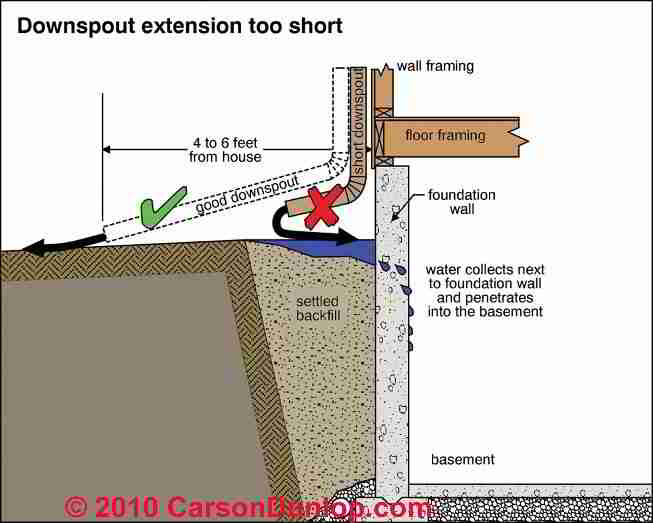
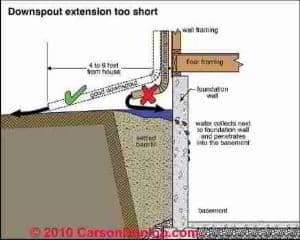
The sketch at left illustrates a major cause of wet basements and crawl spaces: the downspout ends too close to the building, backfill at the building has settled, and in addition, the original grade left from the excavation to build the foundation remains as hard-packed soil that directs spillage back towards the structure.
Sketch courtesy of Carson Dunlop Associates, a Toronto home inspection, education & report writing tool company [ carsondunlop.com ].
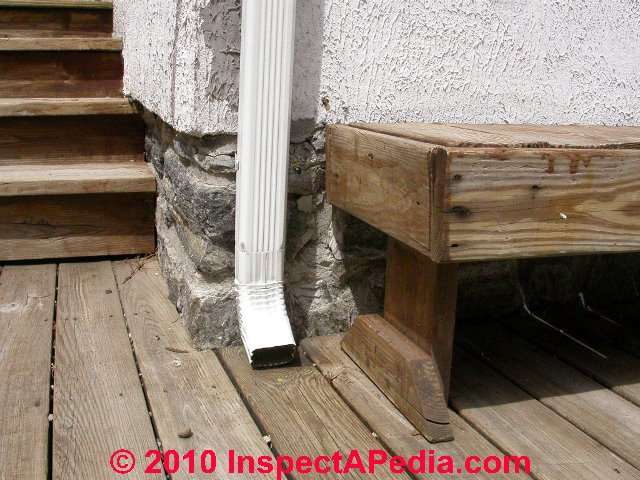
Our photos below illustrate downspouts emptying too close to the building.
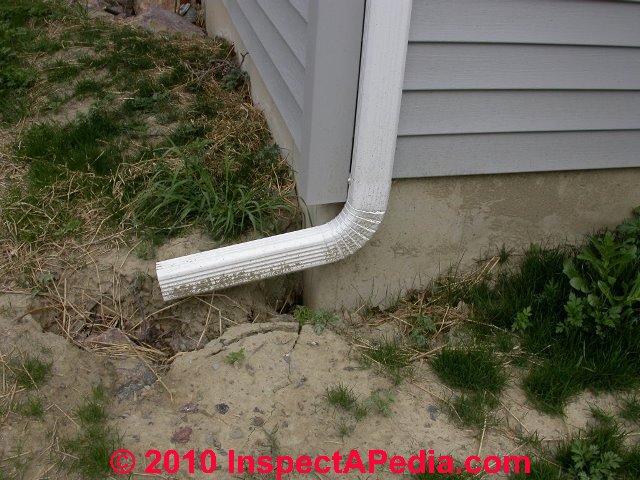
At below left you can see erosion that is sending most of the roof runoff out of the downspout and right down the foundation wall.
At below right a downspout is terminated on the deck surface. That detail can lead to slip/fall hazards (slippery algae-covered deck boards) and basement water entry (due to in-slope grade towards the building, hidden below the deck surface.)
Downspout Empties onto Settled Backfill
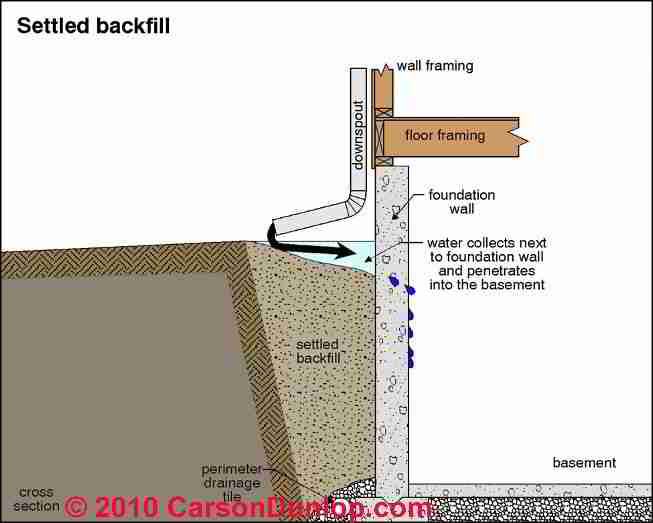
Here we show the most common roof drainage system error that leads to basement or crawl space water entry: the downspout empties too close to the building foundation wall.
This mistake, combined with settled backfill that slopes back towards the building sends this concentration of water from the roof right into the building.
While there are rules of thumb for the length of downspout extensions (minimum of six feet, or more from the building), the common sense downspout rule is:
When the water leaves the end of the downspout, it should keep going away from the building, not back towards it.
Sketch courtesy of Carson Dunlop Associates, a Toronto home inspection, education & report writing tool company [ carsondunlop.com ].
Downspout Empties onto Sloped backfill over compacted in-slope virgin soils or clay
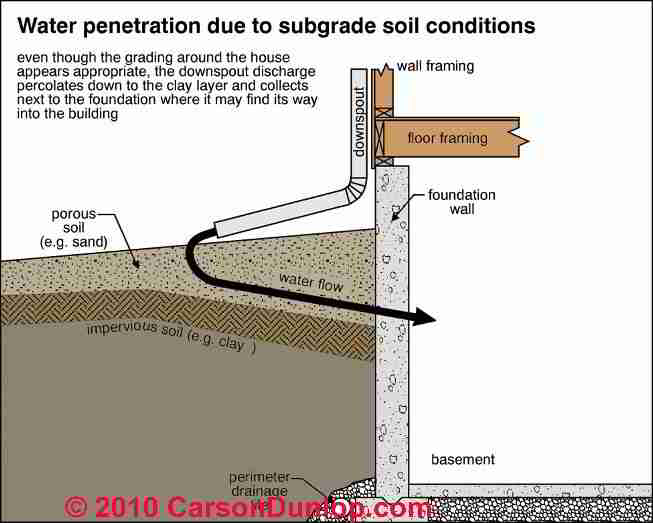
A more subtle version of the "downspout too close to the building" problem we described above is illustrated in the sketch at left.
After a building foundation and structure have been completed, backfill may have been spread around the building and may appear to slope nicely away from the structure.
But because the new backfill is less compacted than virgin soil, even though it slopes away from the building, water soaking through the backfill may encounter below-ground hard-packed original soils that slope towards the structure.
The result is a hidden in-slope grade problem sending roof spillage or downspout spillage right back into the building.
Sketch courtesy of Carson Dunlop Associates, a Toronto home inspection, education & report writing tool company [ carsondunlop.com ].
...
Continue reading at DOWNSPOUT LEAKS or select a topic from the closely-related articles below, or see the complete ARTICLE INDEX.
Or see these
Recommended Articles
- DOWNSPOUT / LEADER DEFECTS
- DOWNSPOUTS BURIED / BELOW GRADE
- ABANDON BURIED DOWNSPOUTS
- CLOGGED BURIED DOWNSPOUTS
- CONNECT DOWNSPOUTS to BUILDING DRAINS?
- PERFORATED PIPE DOWNSPOUT DRAINS
- BURIED ALUMINUM DOWNSPOUTS
- UNDER-SIZED DOWNSPOUT DRAINS
- SHARED DOWNSPOUT DRAINS
- DOWNSPOUT EXTENSIONS
- DOWNSPOUT ONTO BACKFILL
- DOWNSPOUT ONTO IN-SLOPE GRADE
- DOWNSPOUT LEAKS
- DOWNSPOUT DEFECTS, OTHER
Suggested citation for this web page
DOWNSPOUT / LEADER DEFECTS at InspectApedia.com - online encyclopedia of building & environmental inspection, testing, diagnosis, repair, & problem prevention advice.
INDEX to RELATED ARTICLES: ARTICLE INDEX to GUTTERS & DOWNSPOUTS
Or use the SEARCH BOX found below to Ask a Question or Search InspectApedia
Ask a Question or Search InspectApedia
Questions & answers or comments about roof drainage systems: downspouts & leaders: installation, maintenance, repairs, leaks, screens, routing, clogs, and just about anything else.
Try the search box just below, or if you prefer, post a question or comment in the Comments box below and we will respond promptly.
Search the InspectApedia website
Note: appearance of your Comment below may be delayed: if your comment contains an image, photograph, web link, or text that looks to the software as if it might be a web link, your posting will appear after it has been approved by a moderator. Apologies for the delay.
Only one image can be added per comment but you can post as many comments, and therefore images, as you like.
You will not receive a notification when a response to your question has been posted.
Please bookmark this page to make it easy for you to check back for our response.
Our Comment Box is provided by Countable Web Productions countable.ca
Citations & References
In addition to any citations in the article above, a full list is available on request.
- In addition to citations & references found in this article, see the research citations given at the end of the related articles found at our suggested
CONTINUE READING or RECOMMENDED ARTICLES.
- Carson, Dunlop & Associates Ltd., 120 Carlton Street Suite 407, Toronto ON M5A 4K2. Tel: (416) 964-9415 1-800-268-7070 Email: info@carsondunlop.com. Alan Carson is a past president of ASHI, the American Society of Home Inspectors.
Thanks to Alan Carson and Bob Dunlop, for permission for InspectAPedia to use text excerpts from The HOME REFERENCE BOOK - the Encyclopedia of Homes and to use illustrations from The ILLUSTRATED HOME .
Carson Dunlop Associates provides extensive home inspection education and report writing material. In gratitude we provide links to tsome Carson Dunlop Associates products and services.
 | HOME | ABOUT | ASK a QUESTION | CONTACT | CONTENT USE POLICY | DESCRIPTION | POLICIES | PRIVACY | |
| © 2024 - 1985 Publisher InspectApedia.com - Daniel Friedman | |||||||||