
InspectAPedia® FREE Encyclopedia of Building & Environmental Construction, Diagnosis, Maintenance & Repair |
Question? Just ask us! InspectAPedia
|
 Buried Downspouts & Underground Drains for Roof Runoff
- POST a QUESTION or COMMENT about installing, maintaining & repairing buried roof drainage piping, downspouts, leaders
Buried downspouts & downspout drains:
This article describes problems that occur in buried downspuout or roof leader drains, including broken or clogged lines that cause basement flooding.
This article series discusses how to choose, install, diagnose & maintain roof gutters & downspouts, & roof drainage systems to prevent building leaks and water entry.
InspectAPedia tolerates no conflicts of interest. We have no relationship with advertisers, products, or services discussed at this website.
Buried or "Below Grade" Downspouts
Photo of a Buried Drain Line that Should be Abandoned
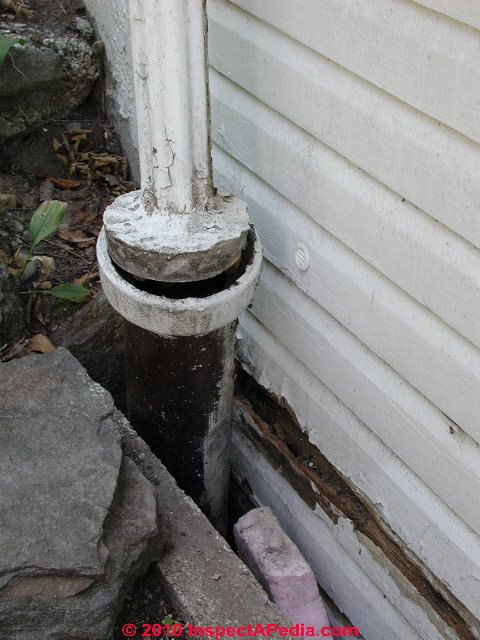
The buried downspout drain line shown at left is one that we'd recommend abandoning - it connects to a drain line that enters the building through the foundation wall and passes below the basement floor, incorporating a basement floor drain, ultimately connecting the the sewer line.
Buried or below-grade downspout extensions in new construction are (or should be) directed either to "daylight" downhill from the structure so that water will drain away from the building by gravity, or they are connected to a storm drain.
For flat sites it may be necessary to drain into a drywell or "French drain" system or into a pumping chamber that sends drainage to a remote storm drain or drywell.
See FRENCH DRAINS for details of handling roof runoff at flat or poorly-drained sites.
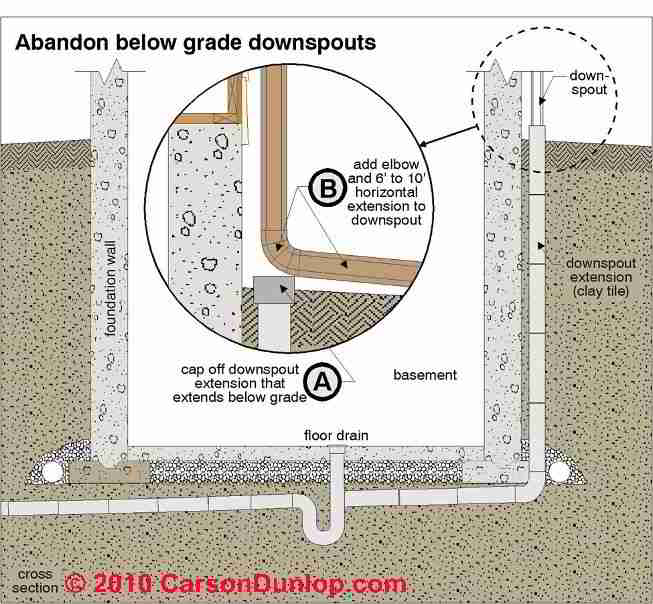
When a buried downspout line has become blocked (or if you're not sure if it has become blocked) we recommend that you disconnect the downspout above grade and install an above-ground extension to direct water away from the building. This step can stop basement flooding from several hidden downspout drain problems including
- Clogged or broken buried downspout drain line
- Buried downspout line (stupidly) connected to the building footing drains
- Buried downspout line connected to drains that run through and/or under the building basement floor
- Buried downspout line connected to local septic or sewer piping
Sketch courtesy of Carson Dunlop Associates, a Toronto home inspection, education & report writing tool company [ carsondunlop.com ].
How to Detect a Clogged Buried Downspout Line
Some visual clues that indicate a clogged buried downspout drain line include:
- Soil was areas visible around the top of the buried drain line
- Water flowing out over the top of the buried drain line during heavy rain
- Water stains, moisture, leaks, or actual water entry inside the building originating near the buried drain line
- Gutters overflowing from above.
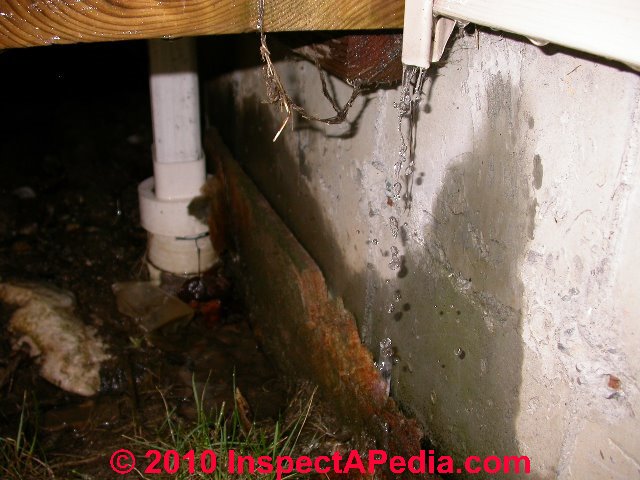
The dramatic roof drainage leak shown at left includes several interesting observations made at this nearly-new home:
- The roof gutters were overflowing, sending water down and behind vinyl siding - you can see water pouring out of the "J" channel at the center of our picture of this Pawling New York Home.
- The buried downspout line (visible under the deck) was blocked
- The ground under the deck was lower than surrounding soils (the deck was constructed before final backfill and grading were performed), forming a "pool" of water against the building rear foundation wall.
These conditions are likely to lead to basement flooding, if not immediately, as soon as the footing drains clog or a crack opens in the poured concrete foundation wall.
Don't Connect Downspout Drains to In-Building Drains & Floor Drain Systems
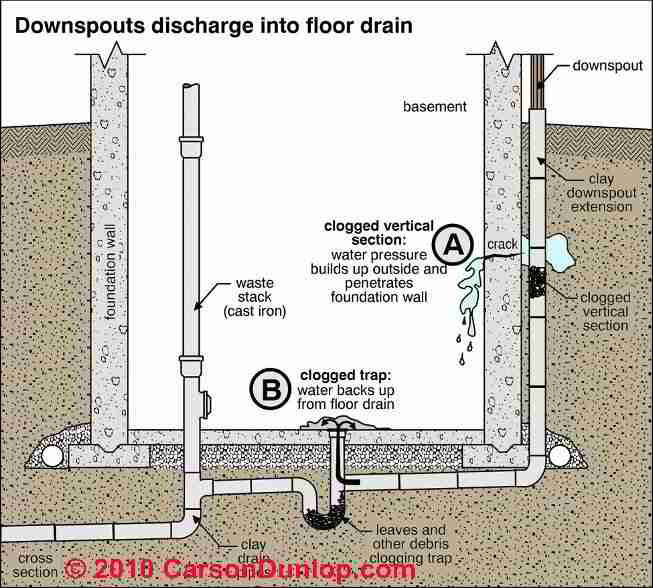
The sketch at left illustrates several reasons why it's a bad practice to connect roof drainage downspouts to drains that run through the building or under the building floors.
- Clogs in the vertical section of the downspout can lead to leaks through the building foundation wall.
- Blockages in the under-floor drain combined with high volumes of roof runoff water entering the system send the entire roof runoff into the building basement or crawl space
- Debris flowing down the downspout drain (leaves from gutters) can block floor drains or even the main building sewer line, leading to sewage backups into the structure.
- Debris flowing down a downspout drain that has been (foolishly) connected to the building foundation drain system can block that drain leading to basement flooding from either roof runoff or surface and subsurface runoff, or both.
Sketch courtesy of Carson Dunlop Associates, a Toronto home inspection, education & report writing tool company [ carsondunlop.com ].
Don't Use Perforated Drain Piping for Buried Downspout Drains (near the building)
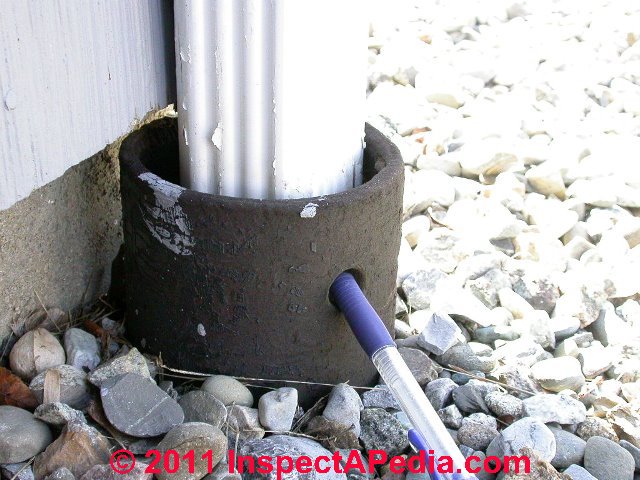
Some builders consider that if they use perforated 4" drain pipes to transport roof drainage away from the building, the water will "soakaway" harmlessly into the soil even if the end of the buried drain line is blocked or never taken to daylight. Both of those are mistakes.
- Perforated buried drain lines near the building allow roof spillage to leak against and into the foundation wall.
- If the downspout line end is not taken to daylight where water can continue draining away from the building (or to a storm sewer), the blocked line will eventually back up in times of heavy rainfall or wet soils, leading to building leaks and water entry.
If we see perforated drain lines close to the building (photo at left) we expect that the building will eventually have a basement water entry problem. A "fix" for this problem is to abandon the buried drain line entirely. See Buried or "Below Grade" Downspouts for more notes on abandoning buried drain lines.
Don't Bury Aluminum Downspout Drain Lines
Buried aluminum downspouts (photo, below left) corrode through and leak fairly quickly as the aluminum metal is thin and when exposed to corrosive soils or even acidic water from leaves and vegetation (or salt from ice-melts used nearby) the material will be damaged.
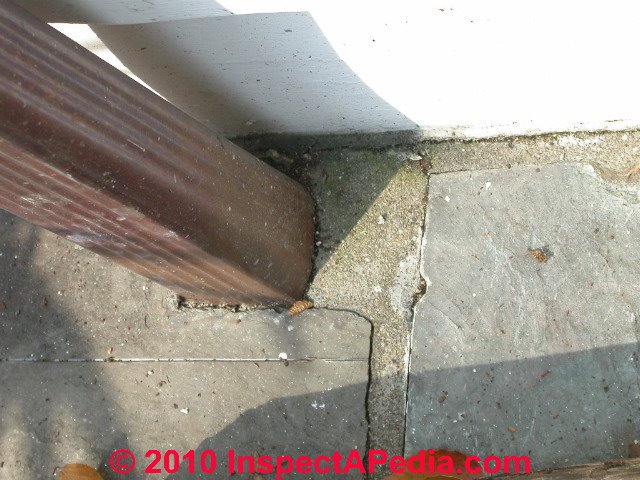
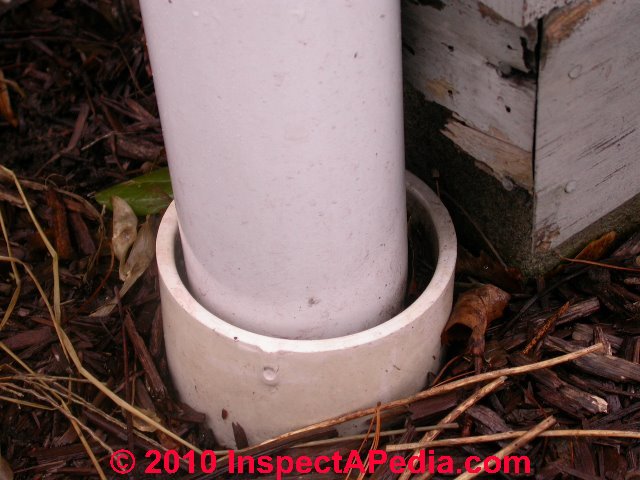
The results are hidden leaks below ground that lead to basement or crawl space water entry.
A better design uses plastic for buried downspout lines; the plastic should be solid piping and should be brought above grade for the downspout connection (photo, above right).
Under-sized Buried Downspout Drain Lines
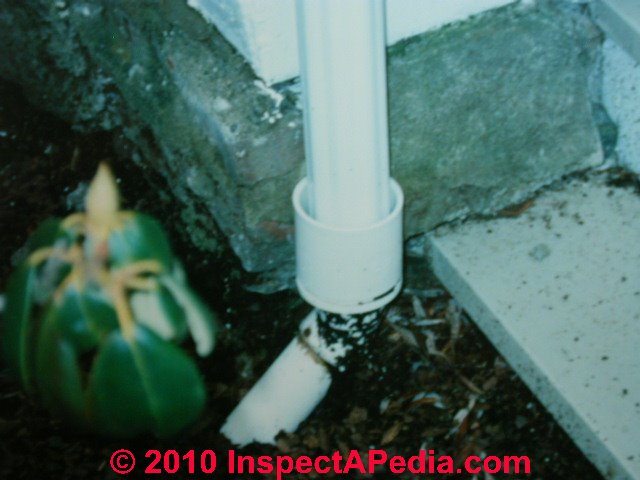
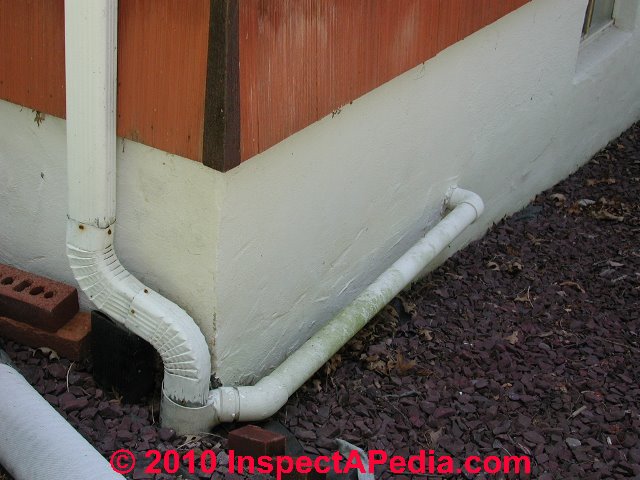
As our photo illustrates (left) it is usually a mistake to connect a downspout line to a buried pipe that is too small - in this case obviously smaller than the downspout drain itself.
In periods of heavy rain the small-diameter plastic pipe shown here won't handle the volume of water running off of the roof.
OK to Share Buried Downspout Lines
On occasion we find that a buried downspout line has been used to dispose of basement or crawl space sump pump water.
That's probably fine. But don't use your buried downspout line to dispose of graywater from sinks, laundry systems, or showers. In most communities it is illegal to dispose of gray water on to the soil surface or into nearby waterways.
Our photo (left) shows a basement sump pump drain line connected to a buried downspout drain.
And be sure that the buried downspout drain line that you are using to carry off sump pump water is properly installed and that it is not connected to the building footing drains.
Watch out: We have found buildings whose sump pumps were busily pumping away trying to get rid of basement water while discharging the water to an improperly installed drain that simply sent the water right back into the footing drain and right back into the basement.
Downspouts Used for Air Conditioning Refrigerant/Condensate Lines or Wiring
Don't mistake as part of the roof drainage system an aluminum downspout that has been used as a cosmetic cover for HVAC refrigerant lines as we illustrate in our photo above.
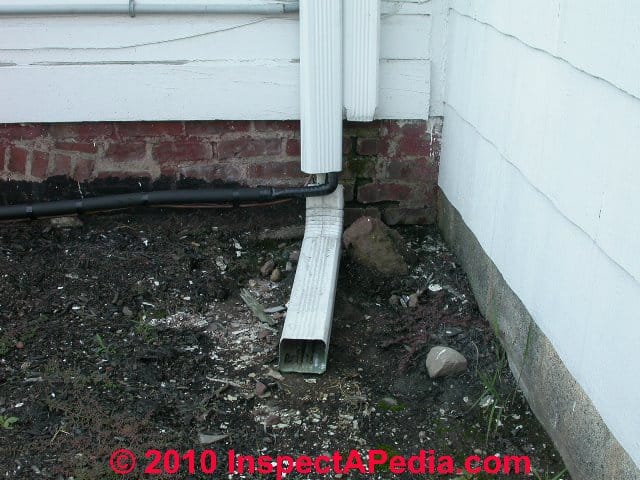
Some A/C installers use an aluminum downspout to cover the refrigerant and condensate lines that are routed from an attic-mounted air handler down to an outdoor ground-level compressor. But do not use downspout materials as electrical conduit.
In our second photo of downspout materials used to cover air conditioning refrigerant piping (just above), notice that the extension and elbow on the water-carrying downspout (the right-most downspout of this pair) has fallen off and we have a splash area on the ground at an "inside foundation corner" - conditions likely to cause basement water entry.
Reader Comments, Questions & Answers About The Article Above
Below you will find questions and answers previously posted on this page at its page bottom reader comment box.
Reader Q&A - also see RECOMMENDED ARTICLES & FAQs
On 2020-10-14 - by (mod) -
Phyllis
A buried downspout or any drainage system might cause a small subsidence but it's not, in my OPINION, likely in most climates that roof drainage would nor could produce a true, large-scale, sinkhole.
Watch out: I can't assess what's going on at your property from just a tidbit of information, but certainly if there is the slightest chance of a collapse hazard or of someone falling into or tripping at and thus being injured by the subsidence at your property, keep that area fenced off and keep people away while it is investigated and repaired.
Depending on the size of the hole that's forming it could be from something as simple as a buried stump or an old abandoned septic or oil tank, or it could be something larger; you may need an excavator to investigate and fill in the hole.
On 2020-10-14 by Phyllis B
Can a buried downspout be responsible for sink holes forming? I thought it was the septic tank but that checked out as OK by a reputable company. The buried line is about 1 1\2 feet from where the hole keeps forming. Any help greatly appreciated. Thanks.
On 2020-09-17 - by (mod) - building codes expect drain systems to stop 10 ft from a property line
Usually building codes expect drain systems to stop 10 ft from a property line but even that won't address a water problem when a neighbor's property slopes towards yours; You may need to correct grading on your property to direct the neighbor's runoff away from your home.
On 2020-09-17 by Lynn
Thank you so much for this very informative article. Our neighbor just installed a drain that never sees daylight and it ends at our property line. Should hey have gotten permits for this? The drain is by the corner by our garage and thankfully a long way from our basement but that area always floods anyways during heavy rain.
Do you have any suggestions? They did the other side with the drain pointing directly out of the side of the hill at the neighbor’s house.
On 2020-09-07 - by (mod) -
Loren
Don't use perforated pipe for roof drains buried near the building; doing so invites a water entry problem.
On 2020-09-05 by Loren
My “Tiny” house has a space 24” wide to run a drain line 24 feet to the alley then 90 degrees about 45 feet to the end of the property. I know one inch per ten feet grade drop, not a problem. My question is, do I use solid PVC along the house or perforated? Seems to me I need solid to get the rain water away from the side of the house sitting on pier blocks. How to proceed? Thanks...
On 2020-08-11 - by (mod) -
Barry
I would focus on getting water away from the building; concrete doesn't need to breathe, but yeah, painting it traps moisture and can cause paint failure and perhaps efflorescence - see details at
https://inspectapedia.com/Wet_Basements/Efflorescence-White.php
EFFLORESCENCE SALTS & WHITE DEPOSITS
On 2020-08-10 by Barry Ferguson
My garage wall sits on a small 8” thick 12” high concrete curb wall. The curb wall has the effervescence problem near the metal cribbing ties (ever 16” horizontally) . Those ties being metal I can see the rust marks which makes them easy to spot. They are above grade and also under the exterior parging which is strong and intact. There is an exterior downspout that was only 4’ long but past that is landscaping plastic that trapped saturated soil water 4-5” below grade, that may explain some the leaking near the house corner but not further up along the wallI where the grade appears to be satisfactory. Perhaps capillary action below the parging, not sure. At first I assumed effervescence was coming only from moisture from winter muck from the vehicles, but then on day when the garage floor and wall were dry, but was raining heavily outside I noticed the moisture spots at the tie points. think I also masked the problem by painting the curb wall trapping the moisture causing the effervescence to spread because the concrete could not breathe (curb wall is not moisture sealed on the outside). I will double ensure all grading is proper away from the house and ensure moisture can get past the landscaping plastic.
On 2019-07-29 - by (mod) -
Lisa
The answer to who can do buried downspout repairs depends on how deep the lines are buried and how much damage there is.
A handyman can dig a small trench and replace a small section of buried downspout line - an d by the way check to be sure the line drains properly away from the building and to daylight.
But if the line is more than a foot or so deep or there is extensive damage you probably need an excavation contractor with a small backhoe.
On 2019-07-29 by Lisa
What type of company do I call to find and fix where my underground downspout feed has been crushed by heavy equipment?
On 2019-04-19 - by (mod) -
Lynne
In my experience all such water absorption systems eventually become clogged and stopped working. Just how much life you will get from your system depends on several basic variables such as the volume of water in flow, the soil percolation rate, and of course the overall size of the trench that's being constructed as well as its constituents.
If it's physically possible the very best solution is not to bury roof drainage but to conduct it to Daylight away from the building in a location where it will not drain back toward the building
On 2019-04-19 by Lynne
I am running my downspouts into a perf pipe in a dispersal trench, with rock surrounding the pipe. My contractor wants to place the filter cloth on the bottom underneath the rock, as well as on the sides & top (rock, with pipe in middle of it, wrapped around "like a burrito").
My ? is, will the inside bottom of the filter cloth get silted up eventually (from silt carried in with roof water or infiltrating somehow) and not allow H2O through?
On 2018-08-15 - by (mod) -
Probably not, Dan if it's just handling roof-runoff; but check with your local building department: they're the final legal authority where you live.
On 2018-08-12 by DanJD
Is it illegal for a buried downspout across a lawn to exit into a road?
...
Continue reading at GUTTER DEFECTS LIST or select a topic from the closely-related articles below, or see the complete ARTICLE INDEX.
Or see DOWNSPOUTS BURIED / BELOW GRADE FAQs - questions and answers posted originally on this page
Or see these
Roof Gutter & Downspout Articles
- DOWNSPOUT / LEADER DEFECTS
- DOWNSPOUTS BURIED / BELOW GRADE
- DOWNSPOUT LEAKS
- DOWNSPOUT DEFECTS, OTHER
- DRYWELLS, FRENCH DRAINS for FLAT SITES
- FLAT ROOF DRAINAGE SYSTEMS
- FRENCH DRAINS for DOWNSPOUT
- GUTTERS & DOWNSPOUTS - home
- GUTTER DEFECTS LIST
Suggested citation for this web page
DOWNSPOUTS BURIED / BELOW GRADE at InspectApedia.com - online encyclopedia of building & environmental inspection, testing, diagnosis, repair, & problem prevention advice.
Or see this
INDEX to RELATED ARTICLES: ARTICLE INDEX to GUTTERS & DOWNSPOUTS
Or use the SEARCH BOX found below to Ask a Question or Search InspectApedia
Ask a Question or Search InspectApedia
Questions & answers or comments about installing, maintaining & repairing buried roof drainage piping, downspouts, leaders
.
Try the search box just below, or if you prefer, post a question or comment in the Comments box below and we will respond promptly.
Search the InspectApedia website
Note: appearance of your Comment below may be delayed: if your comment contains an image, photograph, web link, or text that looks to the software as if it might be a web link, your posting will appear after it has been approved by a moderator. Apologies for the delay.
Only one image can be added per comment but you can post as many comments, and therefore images, as you like.
You will not receive a notification when a response to your question has been posted.
Please bookmark this page to make it easy for you to check back for our response.
Our Comment Box is provided by Countable Web Productions countable.ca
Citations & References
In addition to any citations in the article above, a full list is available on request.
- Building Pathology, Deterioration, Diagnostics, and Intervention, Samuel Y. Harris, P.E., AIA, Esq., ISBN 0-471-33172-4, John Wiley & Sons, 2001 [General building science-DF - ** Particularly useful text **
- Dampness in buildings, Diagnosis, Treatment, Instruments, T.A. Oxley & E.G. Gobert, ISBN 0-408-01463-6, Butterworths, 1983-1987 [General building science-DF]
- In addition to citations & references found in this article, see the research citations given at the end of the related articles found at our suggested
CONTINUE READING or RECOMMENDED ARTICLES.
- Carson, Dunlop & Associates Ltd., 120 Carlton Street Suite 407, Toronto ON M5A 4K2. Tel: (416) 964-9415 1-800-268-7070 Email: info@carsondunlop.com. Alan Carson is a past president of ASHI, the American Society of Home Inspectors.
Thanks to Alan Carson and Bob Dunlop, for permission for InspectAPedia to use text excerpts from The HOME REFERENCE BOOK - the Encyclopedia of Homes and to use illustrations from The ILLUSTRATED HOME .
Carson Dunlop Associates provides extensive home inspection education and report writing material. In gratitude we provide links to tsome Carson Dunlop Associates products and services.
 | HOME | ABOUT | ASK a QUESTION | CONTACT | CONTENT USE POLICY | DESCRIPTION | POLICIES | PRIVACY | |
| © 2024 - 1985 Publisher InspectApedia.com - Daniel Friedman | |||||||||