
InspectAPedia® FREE Encyclopedia of Building & Environmental Construction, Diagnosis, Maintenance & Repair |
Question? Just ask us! InspectAPedia
|
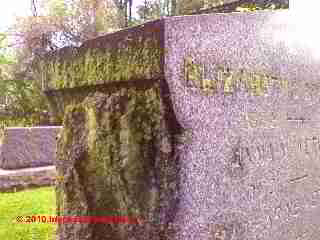 How to Clean & Prevent Lichens or Moss Growth on Stone Artifacts, Tombstones, Graves, Building Walls, Sidewalks

- POST a QUESTION or COMMENT about identifying & cleaning or removing lichens or moss from stone surfaces
Lichens growth, cleaning & prevention on stone surfaces:
This article describes and provide photographs and advice on identifying, cleaning, and preventing lichens growth on stone surfaces such as buildings, cultural artifacts, statues, gravestones, sidewalks, stone walls, and pictographs. We include links to references useful in the identification of algae, moss, lichens, and mold.
InspectAPedia tolerates no conflicts of interest. We have no relationship with advertisers, products, or services discussed at this website.
Appearance of Lichens on Stone Surfaces
Colors & Types of Lichens Growth Stone, Marble, Masonry, Tile or Slate Surfaces
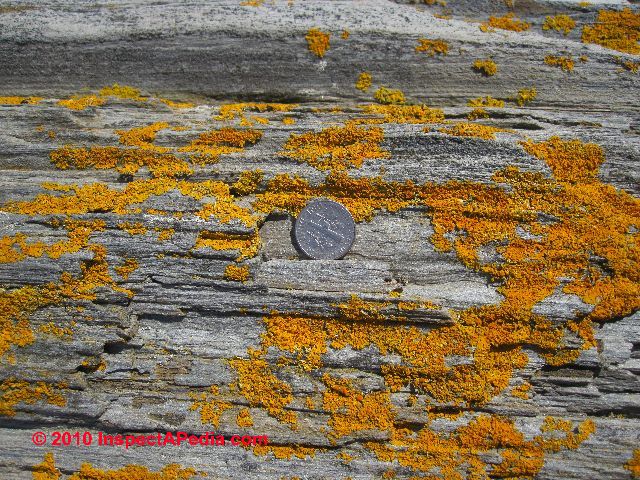
We discuss the cleaning/restoration of lichens and moss covered stone surfaces such as building components,cultural artifacts, and grave markers and lichens removal in more detail at Methods for Cleaning Stone Surfaces.
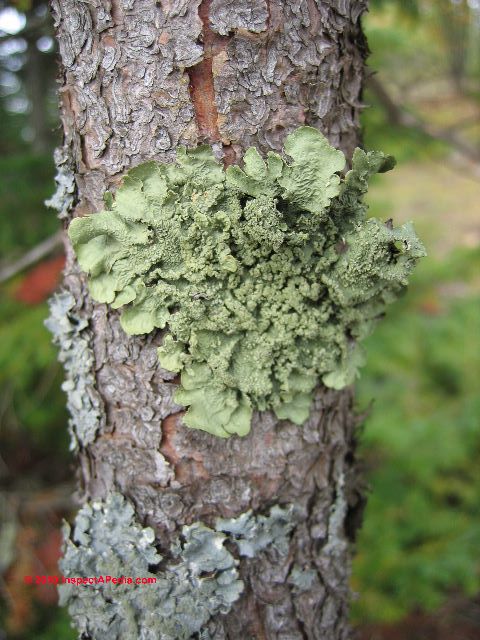
Once we include lichens (such as our photo at left, from Portland Maine), the range of colored growths or stains on stone surfaces is quite large. But the most common stain colors are
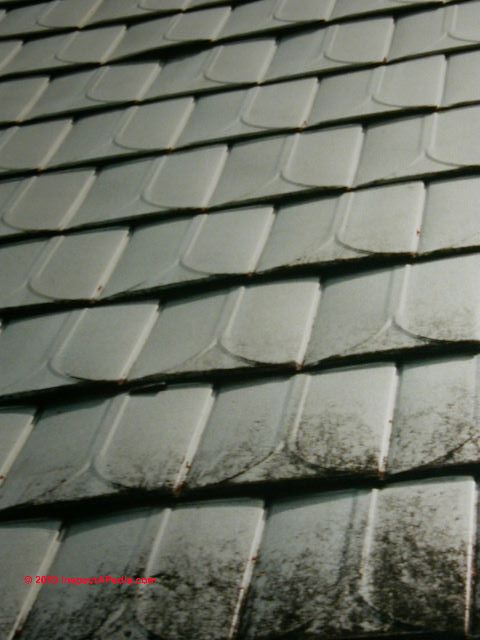
- Black (or dark brown) - most often due to algae, bacteria, dirt or soot, fungus. Fungus may also on occasion produce green or white films on stonework. [Photo of black-brown roof algae On antique metal roof shingles]
- Brown or red rust stains - occur on masonry usually due to combination of water and metal components
- Green - most often due to algae or moss
- Light green, yellow, red, gray, white - most often due to lichens.
Below we provide example photographs of different colors and sources of stain or contaminants on stone or masonry surfaces, followed by advice on cleaning and stain prevention.
Also see our Catalog of Biological Substances that Alter Stone or Other Inorganic Materials, and see ALGAE, FUNGUS, LICHENS, MOSS COMPARED for a comparison of algae, fungus, lichens, or moss on other building surfaces such as roof shingles.
Reindeer moss: Our second moss and lichens photo (above right, Quetico boundary canoe area, Canada) demonstrates that moss and lichens can coexist happily on the same surface, and even intermixed on a surface where we show two kinds of moss. In our photo, the taller pale growth among the green moss is itself "Reindeer Moss, Caribou Moss" or in other references "Antler Moss".
Our photograph shows Cladonia rangeferina or perhaps Cladonia sp. along with both moss and other lichens on the same stone. Reindeer moss is itself actually a lichen, and is an important food source for reindeer and caribou). Reindeer moss is quite fragile and slow growing, found in both hot and cold climates and in alpine tundra - don't trample it in the wild.
 Lichens, one of the most hardy growth organisms found in nature, can grow in harsh conditions. Moss and lichens are both more than a cosmetic issue on most materials.
By holding moisture against the stone or other material surface lichens but more so moss speed the wear of the surface in freezing climates by increasing frost damage to the surface and by action of the organism's "roots" that penetrate the material surface.
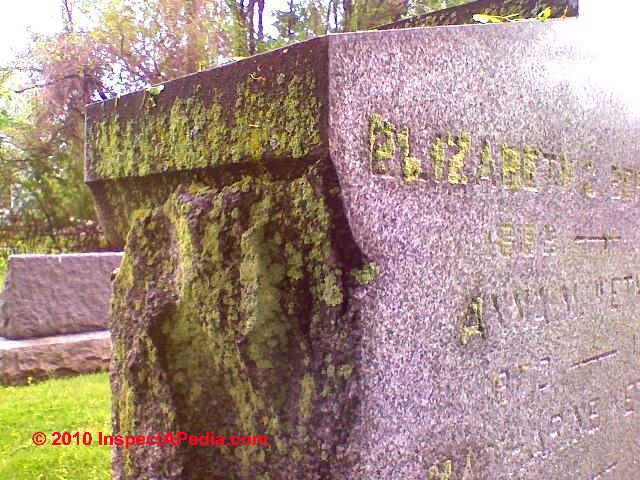
Our photo (left) shows green lichens growth on a gravestone near Vassar College, in Poughkeepsie, NY. Notice that the lichens appears first on the more roughened stone surfaces inside the carved gravestone lettering, and on the rough-cut north face of the stone.
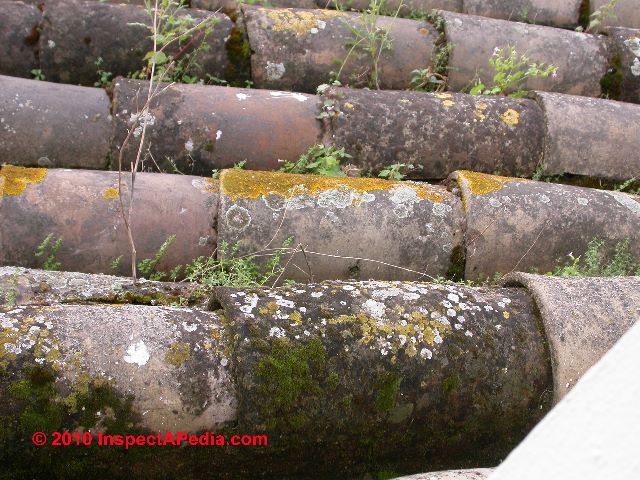
In addition to stone surfaces and mineral-covered roof surfaces, lichens also grows just fine on clay tile roofing and on wood (as those photo links show).
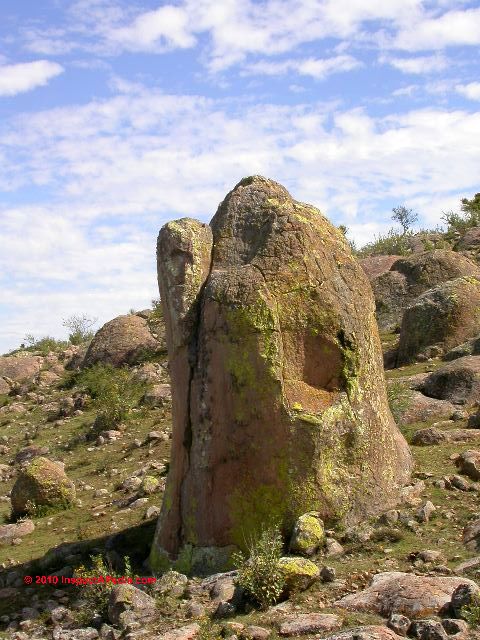
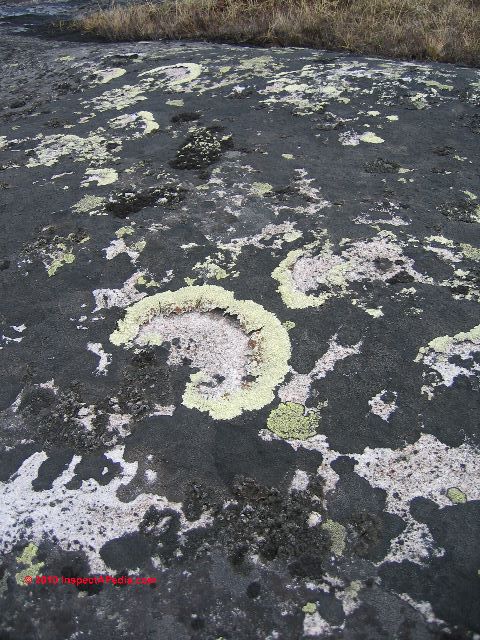
The lichens shown on the stone monument (above left), and the flat black stone (above right), demonstrate that this organism is happy in an enormous range of climates, from high elevation hot dry southern areas (Las Cabras, Guanajuato, Mexico, at about 7000' elevation) to arctic tundra (above right, elevation 50', in Northern Norway near Kirkenes [(Finnish: Kirkkoniemi, Sámi: Girkonjárga) the centre of the municipality of Sør-Varanger in Finnmark county, Norway], well above the arctic circle, courtesy Jennifer Church).
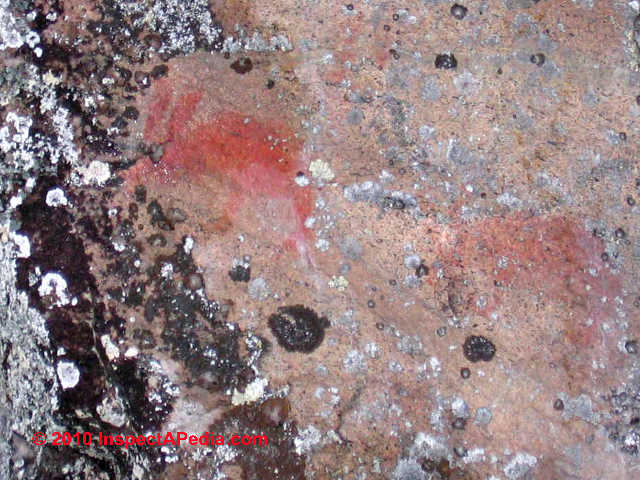 White Lichens photos: White & Pale Gray Lichens photos: The importance of lichens as an organism that can attack cultural artifacts is demonstrated by our photo (left) of lichens surrounding a pictograph from the Quetico boundary waters canoe area in Canada. Also see our pale lichens photos just above in this article. Also see these photos of gray-green roof lichens and gray roof lichens.
For more about conservation of stone artifacts such as this pictograph, consult "Microbial Communities in Caves: Ecology, Physiology, and Effects on Paleolithic Paintings" found in Art, Biology, and Conservation: Biodeterioration in Works of Art, Robert J. Koestler et als. Eds., Metropolitan Museum of Art, 2003, ISBN 1-58839-107-8, p. 210-225.
Green Lichens photos: See Green Stains on Stone for additional green lichens pictures - our photo of "Reindeer Moss, Caribou Moss" or in other references "Antler Moss". Our photograph shows Cladonia rangeferina or perhaps Cladonia sp. along with both moss and other lichens on the same stone.
Yellow Lichens photos: see Colors & Stains on Stone for our photo of yellow-orange lichens on stone.
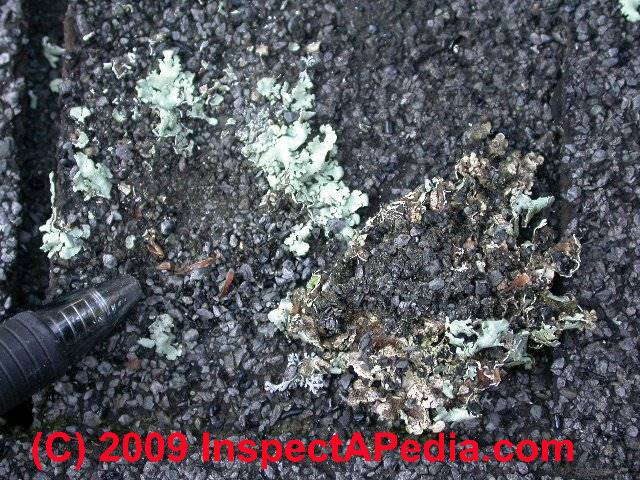
Lichens on Roofs demonstrate the mechanical damage that can be caused by lichens on surfaces.
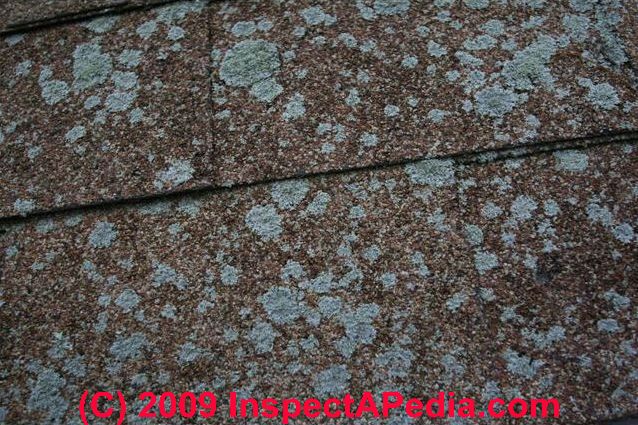
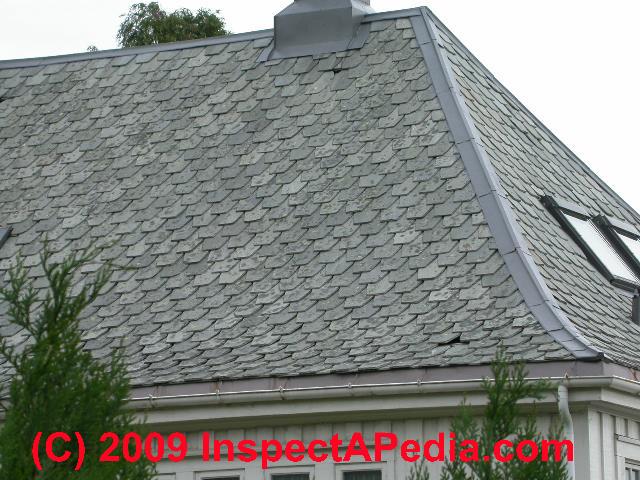
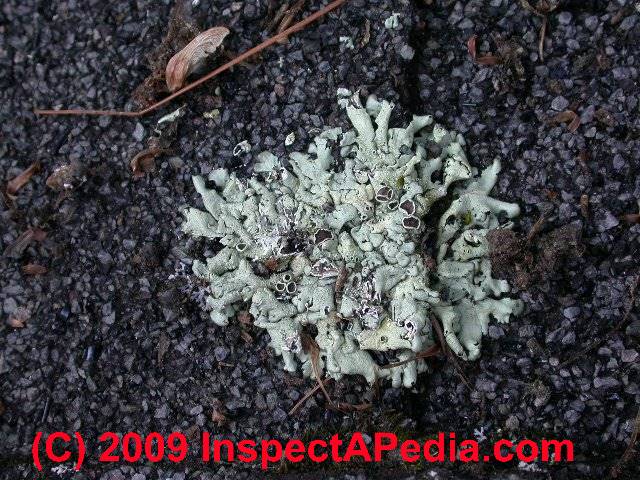
See LICHENS on ROOFS for details about the causes, effects, and prevention of lichens growth on roofing surfaces. Lichens is often found growing on roof shingles, especially asphalt and wood shingles as we show here where we demonstrate the damage to the surface when lichens is removed. Our photos (below) illustrate how serious lichens damage can be to a mineral surface.
Does Lichens Always Need to be Cleaned Off of Stone Surfaces?

No, of course not. The lichens growing on this stone wall in Poughkeepsie, NY (constructed by and found at Adams Fairacre Farms) is not going to do any harm, and in fact adds to the attractiveness of the wall.
Also see Lichens on Roofs for a discussion of lichen damage to shingles and how to prevent lichens growth on roofs.
This website tells readers how to identify, evaluate, remove or prevent stains on building surfaces.
Resistance of Stone Surfaces to Lichens, Moss, Algae
Reader Question:
4/21/2015 martin rowe said:
which stone is best for resisting lichens, algae & mosses?
Reply:
Martin,
Based on what I've seen of stone surfaces around the world and under lichens, algae and moss friendly conditions (cool, wet, shaded), stones with a hard-finished surface such as polished granite are more resistant to those organisms, principally because of the water-shedding property of the surface and perhaps secondarily because the smoother surface also allows spores to wash away.
Take a look at the gravestone at page top. I've seen this pattern quite often: moss is growing in the cut-out letters where the stone surface is smooth (and less vertical). You'll notice that the very mossy left side of this stone was left rough-cut.
For the guys who know, see
- Griffin, P. S., N. Indictor, and R. J. Koestler. "The biodeterioration of stone: a review of deterioration mechanisms, conservation case histories, and treatment." International Biodeterioration 28, no. 1 (1991): 187-207.
- Li, Gary, and Athol D. Abrahams. "Controls of sediment transport capacity in laminar interrill flow on stone‐covered surfaces." Water resources research 35, no. 1 (1999): 305-310.
- Lisci, Marcello, Michela Monte, and Ettore Pacini. "Lichens and higher plants on stone: a review." International biodeterioration & biodegradation 51, no. 1 (2003): 1-17.
- De los Rios, Asunción, and Carmen Ascaso. "Contributions of in situ microscopy to the current understanding of stone biodeterioration." International Microbiology 8, no. 3 (2005): 181.
- Tretiach, Mauro, Stefano Bertuzzi, and Fabio Candotto Carniel. "Heat shock treatments: a new safe approach against lichen growth on outdoor stone surfaces." Environmental science & technology 46, no. 12 (2012): 6851-6859.
- Scheerer, Stefanie, Otto Ortega‐Morales, and Christine Gaylarde. "Microbial deterioration of stone monuments—an updated overview." Advances in applied microbiology 66 (2009): 97-139.
...
Continue reading at STONE, STUCCO & BRICK CLEANING METHODS or select a topic from the closely-related articles below, or see the complete ARTICLE INDEX.
Or see these
Recommended Articles
- LICHENS on ROOFS - causes, effects, and prevention of lichens growth on roofing surfaces.
- STAINS on SANDSTONE, DIAGNOSE & CURE
- STAINS on STONE, STUCCO DIAGNOSE & CURE
- VINES & SHRUBS on BUILDING WALLS, CHIMNEYS
Suggested citation for this web page
LICHENS on STONE SURFACES at InspectApedia.com - online encyclopedia of building & environmental inspection, testing, diagnosis, repair, & problem prevention advice.
Or see this
INDEX to RELATED ARTICLES: ARTICLE INDEX to BUILDING STAINS
Or use the SEARCH BOX found below to Ask a Question or Search InspectApedia
Ask a Question or Search InspectApedia
Questions & answers or comments about identifying & cleaning or removing lichens or moss from stone surfaces.
Try the search box just below, or if you prefer, post a question or comment in the Comments box below and we will respond promptly.
Search the InspectApedia website
Note: appearance of your Comment below may be delayed: if your comment contains an image, photograph, web link, or text that looks to the software as if it might be a web link, your posting will appear after it has been approved by a moderator. Apologies for the delay.
Only one image can be added per comment but you can post as many comments, and therefore images, as you like.
You will not receive a notification when a response to your question has been posted.
Please bookmark this page to make it easy for you to check back for our response.
Our Comment Box is provided by Countable Web Productions countable.ca
Citations & References
In addition to any citations in the article above, a full list is available on request.
- Guides to identifying mosses, lichens, algae
Graphic Guide Ontario Mosses (some of which appear widely dispersed by climate and geographic area, not just in Ontario) which offers a graphic guide to mosses. worldofmosses.com/ggom/index.html - Also see the sources listed at worldofmosses.com/ggom/ggomBibliography.html
- Also see the Journal Folia Geobotanica, Springer, Netherlands ISSN1211-9520 (Print) 1874-9348 (Online) IssueVolume 11, Number 2 / June, 1976 DOI10.1007/BF02854759 Pages217-22
- The Ecology of Algae, F.E. Round, Cambridge University Press, 1984 ISBN-10: 0521269067 ISBN-13: 978-0521269063
After an introduction outlining the chemical and physical characteristics of the environment, the book goes on to look at the actual habitats in which algae occur. The communities of the individual habitats such as open water, sediments, rocky shores, coral reefs, hot springs, sea ice, soil, etc., are then discussed with special phenomena highlighted, for example rhythmic activity, nitrogen fixation and buoyancy. There are also chapters on seasonal cycles of algal growth, energy flow, geographical dispersion, palaeo-ecology and contribution to sediments. The importance of algae in symbiotic relationships and their considerable significance to animal grazers in aquatic food chains are also discussed. The final chapter deals with the relationships of algae to eutrophication and pollution of water. This is an important aspect, which can only be understood through an appreciation of algal ecology. - Lichens of North America, Irwin M. Brodo, Yale University Press, 2001, ISBN-10: 0300082495, # ISBN-13: 978-0300082494
Quoting from Library Journal:
Lichens are a combination of a fungus and an alga but have a unique structure and appearance quite different from either. Existing worldwide and growing on a variety of surfaces, including rocks, soil, and trees, they may appear leafy, shrubby, mossy, crusty, or jellylike and are seen in a wide range of colors, from brilliant oranges, yellows, and reds to dull grays and browns. This huge new book, written by a world authority on lichens and emeritus research scientist at the Canadian Museum of Nature, Ottawa, provides information on about 1500 of the roughly 3600 recognized North American lichens. Part 1 introduces lichens in 14 clearly written chapters that discuss their biology, ecology, geography, environmental roles, and collection. Part 2, the heart of the book, is a guide that offers identification keys to groups, genera, and species and their descriptions, with accompanying photographs and North American distribution maps. The more than 900 truly beautiful, full-color photos were taken by the Sharnoffs, nature photographers whose work has been widely published in National Geographic, Smithsonian, and elsewhere. Of value to professionals and amateurs alike, this book is certain to be a classic reference for decades to come. Highly recommended for academic and research libraries and for public libraries where interest warrants; libraries needing only a brief yet informative introduction to lichens should consider William Purvis's inexpensive Lichens (Smithsonian Institution, 2000). William H. Wiese, Iowa State Univ. Lib., Ames - Cultural Heritage and Aerobiology, Methods and Measurement Techniques for Biodeterioration Monitoring, Paolo Mandrioli, Guilia Caneva, and Cristina Sabbioni, Eds., Kluwer Academic Publishers, 2003 ISBN 1-4020-1622-0
See our book review of this reference.
The conservation of art objects relies on expert inspection, testing, and diagnosis of environmental contaminants and factors that affect the deterioration of artworks, such as mold, moisture, temperature, acid rain, and both indoor and outdoor air quality components. This text reviews these important art conservation concerns and describes methods for the inspection, testing, and monitoring of environmental conditions wherever artworks and other cultural artifacts are located. - Thanks to Patrick Walsh for discussing cleaning methods for gravestones & tombs May 2010
- Shingle Shield™ are zinc strips that are inserted under the shingle tabs of individual shingles to reduce moss, lichens, and algae growth on asphalt roofing - see shingleshield.com
- StainhandleR are zinc strips that are inserted under the shingle tabs of individual shingles to reduce moss, lichens, and algae growth on asphalt roofing- see stainhandler.com
- Zinc-Shield® - zincshield.com and Z-stop™ zinc roofing strips - z-stop.com, are roll-out zinc strips intended for installation near the ridge of a roof to reduce moss, lichens, and algae growth on roofs
- 04/09: thanks to William M. Norman, P.E., S.E., Keeler-Webb Associates, 486 Gradle Drive, Carmel, IN 46032 for opening discussion regarding the legitimacy of extractive bleeding as a term to apply to asphalt roofing material. Mr. Norman suggests that many (not all) black stains on asphalt roofing may be due to algal growth. We will report progress in this discussion as updates to this web article.
- How to Recognize & Control Sooty Molds, USDA publication on the recognition and control of black sooty molds, including on buildings. This publication is also available in printed form from the U.S. Government Printing Office, 1992 657-152 HT-69 1992. The original article was authored by Kenneth K.Kessler, Jr., Principal Plant Pathologist, U.S. Forest Service, in the Department of Agriculture of the United States. Copies are also available from North Central Distribution Center, Forest Products Laboratory, One Gifford Pinchot Dr., Madison WI 53705-2398.
- "Microbes Eating Away at Pieces of History", Vina Venkataraman, The New York Times, 27 June 2008 p. F3.
- Soiling and Cleaning of Building Facades (RILEM Report), L.G.W. Verhoef (Editor), Routledge; 1 edition (November 3, 1988), ISBN-10: 0412306700, USBN-13: 978-0412306709
The report of a comprehensive investigation by RILEM which examines all aspects of the cleaning of facades, subject to soiling by both biological and non-biological agencies. The contributors are international authorities working in this field giving essential advice to all those who need to know how to approach the problems connected with the soiling and cleaning of building facades. - Building Pathology, Deterioration, Diagnostics, and Intervention, Samuel Y. Harris, P.E., AIA, Esq., ISBN 0-471-33172-4, John Wiley & Sons, 2001 [General building science-DF - ** Particularly useful text **
- In addition to citations & references found in this article, see the research citations given at the end of the related articles found at our suggested
CONTINUE READING or RECOMMENDED ARTICLES.
- Carson, Dunlop & Associates Ltd., 120 Carlton Street Suite 407, Toronto ON M5A 4K2. Tel: (416) 964-9415 1-800-268-7070 Email: info@carsondunlop.com. Alan Carson is a past president of ASHI, the American Society of Home Inspectors.
Thanks to Alan Carson and Bob Dunlop, for permission for InspectAPedia to use text excerpts from The HOME REFERENCE BOOK - the Encyclopedia of Homes and to use illustrations from The ILLUSTRATED HOME .
Carson Dunlop Associates provides extensive home inspection education and report writing material. In gratitude we provide links to tsome Carson Dunlop Associates products and services.
 | HOME | ABOUT | ASK a QUESTION | CONTACT | CONTENT USE POLICY | DESCRIPTION | POLICIES | PRIVACY | |
| © 2024 - 1985 Publisher InspectApedia.com - Daniel Friedman | |||||||||