
InspectAPedia® FREE Encyclopedia of Building & Environmental Construction, Diagnosis, Maintenance & Repair |
Question? Just ask us! InspectAPedia
|
 Calibration And Condition Tests Of Molded Case Circuit Breakers
Federal Pacific Stab Lok Breakers - CPSC Data
- POST a QUESTION or COMMENT about the safety of and failure rate of FPE Stab Lok circuit breakers
FPE Sab-Lok circuit breaker failure rate data & information from the US CPSC:
This article presents research data demonstrating the failure rates of Federal Pacific Electric Stab-Lok® circuit breakers.
InspectAPedia tolerates no conflicts of interest. We have no relationship with advertisers, products, or services discussed at this website.
FPE Stab-Lok® Calibration Test Report - Failure Rate Summary
CPSC-C-81-1429 December 30, 1982
Final Report: Contract CPSC-C-81-1429
Date: December 30, 1982
Submitted by: Jesse Aronstein (original contains signature)
WRIGHTVM MALTA CORPORATION. Malta test station, Ballston Spa, New York 12020 518-899-2227
1.0 SUMMARY
Calibration tests have been performed on 122 two-pole Federal Pacific Electric circuit breakers. The calibration tests were performed -in accordance with UL Standard 489 except for or a difference in the sequence of calibrations. UL 489 is the applicable standard that the breakers are presumed to meet. In most cases, the calibration tests were repeated after 500 off-on mechanical operations of the toggle handle..
The circuit breakers tested were supplied by CPSC and came from several sources. Most were provided to CPSC by Federal Pacific Electric, some were purchased new by CPSC staff members at retail outlets, and a few were removed from existing installations. The breaker ratings tested were 30 A (30 two-pole breakers tested), 40A (35), 50A(20), 60A(7) and 80A (30). The tests include performance at 100%, 135%, and 200% of ratings, and dielectric tests.
A substantial number of breakers failed the calibrations testing, both before and after the mechanical toggle operations. Failures were evident with both poles carrying current as well as with one-pole operation. Specifically, the failures are summarized as follows:
|
TABLE 1 - SUMMARY OF FAILURES *UL 489 Test Conditions |
||
| FAILURE CONDITION |
FAILURES |
|
|
% (#failed / #tested) |
||
|
Before Mechanical Operations |
After Mechanical Operations |
|
|
No-trip: 200% of rating, both poles |
0% (0/122) |
1% (1/107) |
|
No-trip: 200% of rating, individual poles |
1% (3/244) |
10% (21/214) |
|
No-trip: 135% of rating, both poles* |
25% (31/122) |
36% (39/107) |
|
No-trip: 135% of rating, individual poles |
51% (125/244) |
65% (144/220) |
|
Trip: 100% of rating, both poles* |
3% (4/122) |
6% (7/111) |
|
Dielectric Breakdown (short)* |
0 |
1% (1/111) |
Notes to the table above
The failures appeared. among breakers of all ratings, none were failure-free. Most of the "no-trip' conditions were sustained for four hours well beyond the UL specification. These were not marginal failures with respect to the failure criteria. The data suggests that, on the average, the mechanical operations result in increased failures. This was .'not strictly the case on a sample-to-sample basis.
The failures relate to hazardous conditions in at least two ways. First, a fault in the wiring or utilization equipment which causes excessive- current-can result in fire if the circuit is not opened by the breaker -- this is its principal functional requirement.
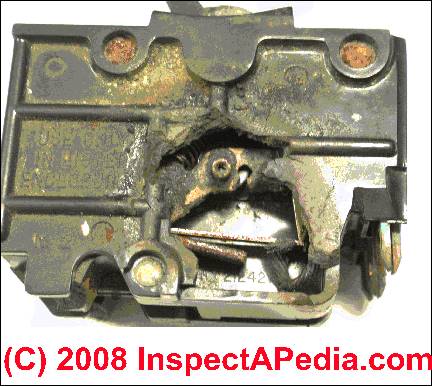
Secondly, it was determined in these tests that some of the breakers overheat to hazardous levels when subjected to overcurrent conditions (due to their own failure to trip) for sustained periods of time.
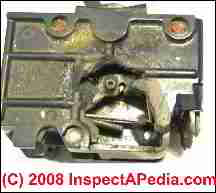
The overheating can result in incapacitation of the breaker (i.e.: it will no longer open under any condition), and the temperature can be high enough to ignite fire in the vicinity of the breaker, as evidenced by charring of the case on some samples.
NOTE: this text is quoted verbatim from pages 3-5 of "Calibration and Condition Tests of Molded Case Circuit Breakers, Final Report: Contract CPSC-C-81-1429 December 30, 1982," obtained from the US Consumer Product Safety Commission as a FOIA request.
...
Continue reading at CPSC FPE FAILURE DATA 1982 or select a topic from the closely-related articles below, or see the complete ARTICLE INDEX.
Or see these
Recommended Articles
- CPSC FPE FAILURE DATA 1982
- FEDERAL PACIFIC ELECTRIC FPE HAZARD ARTICLES, STUDIES - list of FPE Stab-Lok and FP and related brand circuit breaker hazard & failure study articles
- FEDERAL PIONEER PANEL SAFETY - do Canadian FP Federal Pacific breakers perform better than US-made FPE Federal Pacific Electric breakers? [no]
- FPE INVESTIGATION CPSC
- FPE INVESTIGATION CPSC 1983
Suggested citation for this web page
FPE INVESTIGATION CPSC at InspectApedia.com - online encyclopedia of building & environmental inspection, testing, diagnosis, repair, & problem prevention advice.
Or see this
INDEX to RELATED ARTICLES: ARTICLE INDEX to FPE STAB-LOK BREAKERS & PANELS
Or use the SEARCH BOX found below to Ask a Question or Search InspectApedia
Ask a Question or Search InspectApedia
Questions & answers or comments about the safety of and failure rate of FPE Stab Lok circuit breakers.
Try the search box just below, or if you prefer, post a question or comment in the Comments box below and we will respond promptly.
Search the InspectApedia website
Note: appearance of your Comment below may be delayed: if your comment contains an image, photograph, web link, or text that looks to the software as if it might be a web link, your posting will appear after it has been approved by a moderator. Apologies for the delay.
Only one image can be added per comment but you can post as many comments, and therefore images, as you like.
You will not receive a notification when a response to your question has been posted.
Please bookmark this page to make it easy for you to check back for our response.
Our Comment Box is provided by Countable Web Productions countable.ca
Citations & References
In addition to any citations in the article above, a full list is available on request.
- The Federal Pacific Stab-Lok® Electric Panel Hazard Website Safety Information for Consumers. 2009
- In addition to citations & references found in this article, see the research citations given at the end of the related articles found at our suggested
CONTINUE READING or RECOMMENDED ARTICLES.
- Carson, Dunlop & Associates Ltd., 120 Carlton Street Suite 407, Toronto ON M5A 4K2. Tel: (416) 964-9415 1-800-268-7070 Email: info@carsondunlop.com. Alan Carson is a past president of ASHI, the American Society of Home Inspectors.
Thanks to Alan Carson and Bob Dunlop, for permission for InspectAPedia to use text excerpts from The HOME REFERENCE BOOK - the Encyclopedia of Homes and to use illustrations from The ILLUSTRATED HOME .
Carson Dunlop Associates provides extensive home inspection education and report writing material. In gratitude we provide links to tsome Carson Dunlop Associates products and services.
 | HOME | ABOUT | ASK a QUESTION | CONTACT | CONTENT USE POLICY | DESCRIPTION | POLICIES | PRIVACY | |
| © 2024 - 1985 Publisher InspectApedia.com - Daniel Friedman | |||||||||