
InspectAPedia® FREE Encyclopedia of Building & Environmental Construction, Diagnosis, Maintenance & Repair |
Question? Just ask us! InspectAPedia
|
 Federal Pacific Electric Stab-Lok® Letter to IAEI
- POST a QUESTION or COMMENT about about infomercials, conflicts of interest, and claims regarding the presence or absence of hazards associated with Federal Pacific Electric Stab-Lok® electrical panels and circuit breakers
IAEI International Association of Electrical Inspectors ran an "infomercial" placed by an FPE attorney that claimed there are no FPE hazards.
How did that nonsensical article appear and what did it signify? This website explains the fire and shock hazards associated with Federal Pacific Electric Stab-Lok® circuit breakers and service panels, provides a history of the issue, recounts research on FPE failures, and recommends replacement of the panels.panel replacement or repair. The web author has no business, financial, or other connection with FPE products nor with their replacement.
Replacement FPE Stab-Lok® circuit breakers are unlikely to reduce the failure risk of this equipment. We recommend that residential FPE Stab-Lok® electrical panels be replaced entirely or the entire panel bus assembly be replaced, regardless of FPE model number or FPE year of manufacture. We do not sell circuit breakers nor any other products.
InspectAPedia tolerates no conflicts of interest. We have no relationship with advertisers, products, or services discussed at this website.
Letter to IAEI International Association of Electrical Inspectors News Magazine
re: FPE Public Relations Article asserts Federal Pacific Electric Stab-Lok® panels are OK
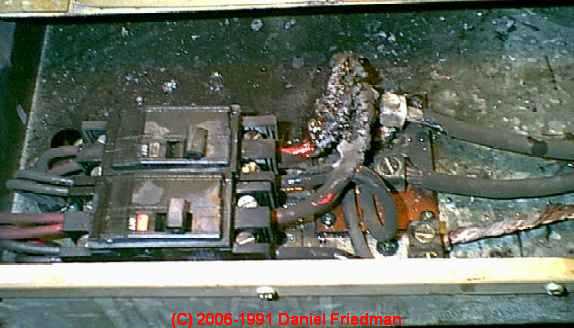 Field reports of FPE failures ranging from simple failure to trip to burn-ups and fires add support to independent studies confirming an unusually high no-trip rate for this circuit breaker line.
Photo: an electrical fire occurred in this FPE panel. These FPE circuit breakers, in double pole format, can fail to trip in response to an overcurrent about 60% of the time; most similar circuit breakers by other manufacturers fail to trip at a rate far less than 1%.
[Click to enlarge any image]
But a writer connected to Federal Pacific Electric wrote otherwise in an article to IAEI magazine. IAEI declined to ever address the dangerous inaccuracies in the original IAEI magazine article. The original IAEI magazine article appears to have been penned by an attorney charged with protecting the remaining interests of that FPE and its successors.
Below is a letter to the Philip Cox, the editor of that magazine, asking for more accurate reporting.
InspectAPedia.com is an independent publisher of building, environmental, and forensic inspection, diagnosis, and repair information provided free to the public - we have no business nor financial connection with any manufacturer or service provider discussed at our website.
We are dedicated to making our information as accurate, complete, useful, and unbiased as possible: we very much welcome critique, questions, or content suggestions for our web articles. Working together and exchanging information makes us better informed than any individual can be working alone.
8/11/1999
International Association of Electrical Inspectors
ATTN: Philip H. Cox, Editor-in-Chief, IAEI Magazine
PO Box 830848
Richardson TX 75083-0848
Dear Mr. Cox:
The May/June '99 IAEI NEWS ARTICLE [PDF] by an unidentified FPE consultant asserts that Federal Pacific Electric Stab-Loks are UL-Listed and thus without any concern.
The article fails to address a record of failures to trip, actual test results, field reports of failures, and improper UL listing practices.
The FPE author and IAEI News failed to report on the actual website content, failed to contact the author, and failed to give the correct website address so that readers could judge for themselves.
I am an IAEI member and the author of the informational website for home inspectors which was referred-to in the FPE article that was criticized - FEDERAL PACIFIC FPE HAZARDS - home page.
The correct Internet website address is https://InspectAPedia.com/fpe/FPE_Stab_Lok_Hazards.php
Publicly available information is compelling and sufficient to warrant warning contractors, inspectors, and consumers. The best data available substantiates that the 2-pole breakers cannot be relied upon to trip. CPSC found that was the case.
FPE agreed that was the case. Field reports confirm that is still the case. Inspectors should work towards replacing breakers that won't trip, not towards whitewashing the problem.
The problem with FPE breakers is that a significant portion of them will not trip on overload
or short circuit conditions in order to protect a building from fire ignition. Testing done by the CPSC showed that at a modest overload on both poles these failed 25% of the time, followed by a lockup.
The breaker would never trip in the future at any overload.
(See Table 1, Summary of Failures, CPSC-C-81-1429 December 30, 1982, attached.) There are other types of failures known to occur in FPE panels at lower probability and not as well documented as the 2-pole no-trip problem.
FPE did not refute the CPSC's test data. The no-trip problems with 2-pole Stab-Lok® breakers were acknowledged by FPE. FPE claims that when their circuit breakers do not trip it does not constitute a hazard.
The article in IAEI News by FPE is asking us to agree with FPE's position that breakers that won't trip are OK
because they are "listed and labeled." Let's keep in mind that a breaker that will not trip on certain overcurrent conditions is electrically the same as an Edison-base fuse with a penny behind it. No inspector should be encouraged to condone or whitewash the continued use of breakers that cannot be depended on to trip properly.
These problems were known. Reliance Electric Co. had bought FPE in 1979 when they discovered problems with FPE breakers.
They sued the company they had bought FPE from, claiming undisclosed potential liability made FPE not what they had bargained for and citing evidence that "improper and deceptive practices were employed for many years to secure UL listings for Federal Pacific's circuit protective products?
They wanted their money back. Reliance eventually settled the suit, kept FPE, and got back $41.85 million in return for which they agreed to indemnify the company they'd bought FPE from for product liability claims arising from products made by FPE before the purchase.
Continuing problems can't be ruled out. For example, see the Federal Pacific/Federal Pioneer circuit breaker warranty alert issued by the Ontario New Home Warranty Program in 1997 (copy attached). These products are still present in the field! Reports from consumers and electricians indicate failures to trip, overheating, and fires.
Note also that the author of the FPE article did not want to have his or her name associated with it and that the FPE contact listed is an attorney retained (presumably) by FPE.
The information address given in the article would have been more accurate if given as: Howard B. Abramoff Law Offices, 25700 Science Park Dr. Suite 260, Cleveland OH 44122. This is a law firm, not a circuit-breaker manufacturer.
This confirms that the article is biased towards the defense of FPE rather than providing information on "?the safe installation and use of electricity" (IAEI's mission statement in the magazine's masthead).
As a neutral professional, I'd be pleased to receive reliable information shedding new light on the situation. But a public relations article written by someone whose aim is to protect FPE's interests and which fails to address legitimate concerns and the known failures and problems occurring around the country is not something I'd rely upon.
Based on my experience and numerous reports from people with no axes to grind, it appears that FPE circuit breakers frequently fail to perform their function. A circuit breaker may sit in a building for twenty years, and as long as it never sees an overload or short circuit it may seem to work fine.
But if it cannot perform its function to interrupt current when overloaded or short circuited, that circuit breaker is a latent fire hazard. Such equipment should be replaced.
Respectfully,
Dan Friedman, IAEI #195930
Attachments:
1. "Calibration and Condition Tests of Molded Case Circuit Breakers, Final Report: Contract CPSC-C-81-1429," December 30, 1982, Wright Malta Corporation, Summary Pages 1-3.
2. Reliance Electric Co. Press Release, July 7, 1980, stating that "Underwriters Laboratories labels for most of FPE's circuit breakers were obtained through improper practices,?
3. Schneider Electric Canada Warranty Alert, recalling Federal Pioneer (Federal Pacific Canadian) circuit breakers NC015/NC015P, October 14, 1997
4. My resume/background (Since the article indicates the author did not know who I am)
5. WEB FaqS: Website author, credibility
6. "Federal Pacific Electric (FPE) Panels, a Summary," website page from https://InspectAPedia.com/fpe/FPE_Stab_Lok_Hazards.php (This is the root page of a collection of public documents and articles regarding this topic.)
FPE HAZARD REPORT - 2017 [PDF] independent research article by Jess Aronstein, supercedes older FPE hazard reports by this author.
03/27/2012 through 04/15/2019 follow-up note: IAEI never responded to this correspondence.
02/10/2009 follow-up note: IAEI never responded to this correspondence.
05/28/2008 follow-up note: IAEI did not respond to this correspondence
06/01/07 follow up note: IAEI and Mr. Cox have not replied to this correspondence.
10-1-00 follow up note: IAEI and Mr. Cox have declined to reply to this correspondence.
03/01/03 follow up note: IAEI has not retracted the un-signed article described above. Industry experts have confirmed that the IAEI article is inaccurate and dangerous in its advice as it exposes consumers to equipment which cannot be relied upon in event of an overcurrent. The result could be shock or fire. I have encountered one or two instances of electricians who, unfamiliar with FPE failures, cited this article in defense of a "no action" position, in all cases in defense of a home seller.
My advice to consumers who are faced with denials that this FPE electrical equipment is a latent safety hazard to ask for that opinion in writing, stating that there is no hazard. To date (30 August 2023) I have not had any reports of a professional who was willing to sign such a document.
The photos of FPE field failures and burn-ups shown on this page are discussed in more detail in the Recommended Articles below.
...
Continue reading at FPE HAZARD ARTICLES, STUDIES or select a topic from the closely-related articles below, or see the complete ARTICLE INDEX.
Or see these
Recommended Articles
- FPE FAILURE FIRE PHOTOS - photos of FPE field failures and burn-ups shown on this page are discussed in more detail
- FPE FAILURE FIELD REPORTS - consumer reports of FPE failures in situ
- FPE HAZARD REPORT - 2017 [PDF - ]independent research article by Jess Aronstein, supercedes older FPE hazard reports by this author. Independent testing confirms high level of no-trip hazards with FPE circuit breakers & panels
Suggested citation for this web page
FPE HAZARD IAEI LETTER INACCURATE at InspectApedia.com - online encyclopedia of building & environmental inspection, testing, diagnosis, repair, & problem prevention advice.
Or see this
INDEX to RELATED ARTICLES: ARTICLE INDEX to FPE STAB-LOK BREAKERS & PANELS
Or use the SEARCH BOX found below to Ask a Question or Search InspectApedia
Ask a Question or Search InspectApedia
Questions & answers or comments about infomercials, conflicts of interest, and claims regarding the presence or absence of hazards associated with Federal Pacific Electric Stab-Lok® electrical panels and circuit breakers.
Try the search box just below, or if you prefer, post a question or comment in the Comments box below and we will respond promptly.
Search the InspectApedia website
Note: appearance of your Comment below may be delayed: if your comment contains an image, photograph, web link, or text that looks to the software as if it might be a web link, your posting will appear after it has been approved by a moderator. Apologies for the delay.
Only one image can be added per comment but you can post as many comments, and therefore images, as you like.
You will not receive a notification when a response to your question has been posted.
Please bookmark this page to make it easy for you to check back for our response.
Our Comment Box is provided by Countable Web Productions countable.ca
Citations & References
In addition to any citations in the article above, a full list is available on request.
- "Federal Pacific Electric Co. Stab-Lok® ® Update [ copy on file as /fpe/IAEI_FPE_ArticleMayJune99.pdf ] - ", [no author name provided], IAEI News, May-June 1999, web search 11/16/2010, source: http://www.teamstrategy.org/teamstrategy/picture/fp_stablok_update.pdf
- Note: as we didn't add this reviewers list until 2007, this list of technical reviewers is incomplete; we have received comments and suggestions regarding this topic, edits and remarks included, from engineers and management from the US CPSC, electricians (many listed at our page on field reports of FPE failures), home inspectors, licensed electricians, and electrical engineers, and even a few attorneys and real estate agents, since 1986. Technical review, critique, content suggestions, questions, or clarifications are invited and where a contributor wishes, credit and links will be provided to that source. Contact us to provide feedback.
- Dr. Jess Aronstein, electrical engineer, Poughkeepsie, NY, forensic engineering services, independent laboratory testing for various agencies protune@aol.com (independent electrical panel testing, including FPE Stab-Lok® panels, to April 2010)
- David Carrier, electrical engineer, 53 Henmond Blvd., Poughkeepsie, NY 12603 845-430-7527 davidwcarrier@earthlink.net (independent electrical panel testing, including FPE Stab-Lok® panels, beginning 2010)
- Alan Carson, Carson Dunlop Associates, Toronto, Ontario. Mr. Carson is a home inspection professional, educator, researcher, writer, and a principal of Carson Dunlop Associates, a Toronto home inspection and education firm. Mr. Carson is a past president of ASHI, the American Society of Home Inspectors
- Mark Cramer Inspection Services Mark Cramer, Tampa Florida, Mr. Cramer is a past president of ASHI, the American Society of Home Inspectors and is a Florida home inspector and home inspection educator.
- Carl Grasso, Esq., Herzfeld & Rubin, New York, NY. Mr. Grasso is an attorney who managed a plaintiff's class action litigation against Federal Pacific Electric in New Jersey.
- William King, US CPSC Director of Electrical Engineering (Ret).
- The Consumer Product Safety Commission advises consumers to take certain safety
precautions with all circuit breakers and fuses. Consumers should:
-Know your electrical circuit. Know which outlets and products are connected to each circuit.
-Never overload any electrical circuit by connecting too many products to the circuit. Be particularly careful not to connect several products that demand high current (such as heating appliances) to a low amperage circuit.
-Comply with local building codes in wiring or adding electrical circuits. Make sure the wiring and devices used in the circuit are connected to a circuit breaker or fuse of the
-Immediately disconnect any electrical product if problems develop. Have the product examined by a competent repair person.
-Investigate to determine why a fuse blows or circuit breaker trips. Do not simply replace the fuse or reset the breaker. If a fuse blows or breaker trips, it is often a warning that the circuit is overloaded. Check the circuit for causes of overloading (for example, too many appliances plugged in, a malfunctioning product, a short circuit). When in doubt, consult a licensed electrician.
Consumers who have questions concerning circuit breakers, or who wish to report information relating to their safety, may call the U.S. Consumer Product Safety Commission's toll-free safety hotline at 800-638-CPSC, teletypewriter for the hearing impaired at 800-638-8270 (Maryland only 800-492-8104).
- In addition to citations & references found in this article, see the research citations given at the end of the related articles found at our suggested
CONTINUE READING or RECOMMENDED ARTICLES.
- Carson, Dunlop & Associates Ltd., 120 Carlton Street Suite 407, Toronto ON M5A 4K2. Tel: (416) 964-9415 1-800-268-7070 Email: info@carsondunlop.com. Alan Carson is a past president of ASHI, the American Society of Home Inspectors.
Thanks to Alan Carson and Bob Dunlop, for permission for InspectAPedia to use text excerpts from The HOME REFERENCE BOOK - the Encyclopedia of Homes and to use illustrations from The ILLUSTRATED HOME .
Carson Dunlop Associates provides extensive home inspection education and report writing material. In gratitude we provide links to tsome Carson Dunlop Associates products and services.
 | HOME | ABOUT | ASK a QUESTION | CONTACT | CONTENT USE POLICY | DESCRIPTION | POLICIES | PRIVACY | |
| © 2024 - 1985 Publisher InspectApedia.com - Daniel Friedman | |||||||||