
InspectAPedia® FREE Encyclopedia of Building & Environmental Construction, Diagnosis, Maintenance & Repair |
Question? Just ask us! InspectAPedia
|
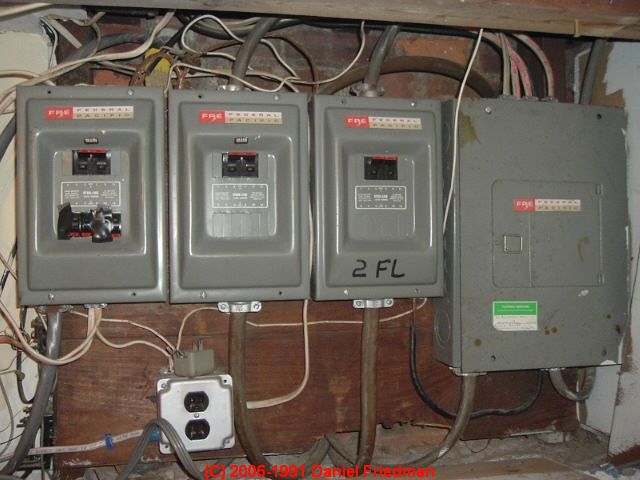
 Identify Federal Pacific Electric FPE Stab Lok circuit breakers & electrical panels
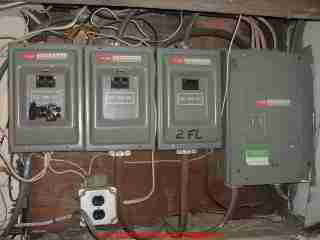
- POST a QUESTION or COMMENT about identifying FPE Stab-Lok® and Federal Pioneer electrical panels and circuit breakers and about their associated hazards, testing, failure rates
Here we describe how to reliably identify FPE Equipment:
How to identify Federal Pacific Electric FPE Stab-Lok® electrical panels and circuit breakers.
Find here: Photo guides to identification of Federal Pioneer Stab-Lok® electrical panels and circuit breakers, Photo guides to Federal NOARC load center identification, and Photo guides to identification of Federal Electric panels and circuit breakers.
This article series describes how to identify Federal Pacific Stab-Lok® Electric Panels and circuit breakers in buildings.
This FPE information is for building inspectors, home buyers, home owners, electricians exploring the background of possible hazards associated with Federal Pacific Electric Stab-Lok® circuit breakers and service panels.
Replacement FPE Stab-Lok® circuit breakers are unlikely to reduce the failure risk of this equipment. We recommend that residential FPE Stab-Lok® electrical panels be replaced entirely or the entire panel bus assembly be replaced, regardless of FPE model number or FPE year of manufacture. We do not sell circuit breakers nor any other products.
InspectAPedia tolerates no conflicts of interest. We have no relationship with advertisers, products, or services discussed at this website.
4 Steps to identify Federal Pacific Stab-Lok® (FPE) Electric Panels
 While this article series includes FPE Stab-Lok® equipment part or model numbers (see the complete FPE Stab-Lok ARTICLE INDEX given at the ARTICLE INDEX the bottom of this article ), those examples are provided to assist in the identification of this equipment - tests and field reports indicate that
all of the FPE Stab-Lok® equipment, electrical panels and circuit breakers sold and installed in the U.S. suffers the no-trip breaker and other problems across all residential equipment models and ages. Thanks to Patrick Hedderman for suggesting this clarification.
To identify a Federal Pacific Electric or FPE Stab-Lok electrical panel you will look for specific lettering, naming or labels on the electrical panel, on the panel labels, and inside the panel (opened by your electrician), and look for the characteristic circuit breaker toggle switches used by these brands.
1. Confirm that your Electrical Panel Uses Breakers not Fuses:
Confirm you're looking at a circuit breaker panel (switches) not a fuse panel.
Our photo above shows red-faced toggle switches in an electrical panel with a 125A main breaker in the "ON" position. This is a circuit breaker panel.
Older Federal Electric, Federal Pioneer and similar branded fuse panels do not sport the performance and design concerns we address in this article series.
However those panels or boxes may themselves be obsolete or they could have other unsafe conditions such as over-fusing, rust, corrosion.
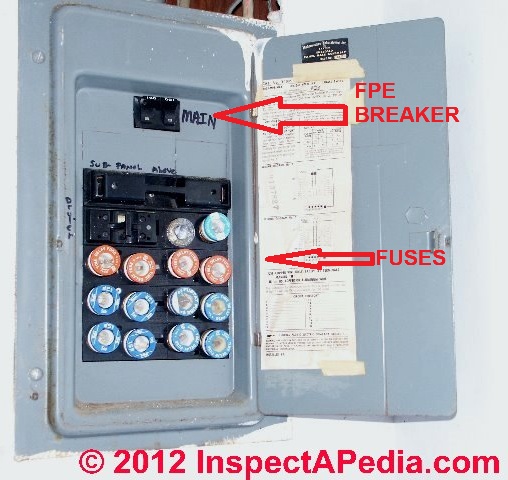
Below: our photo shows an example of an older FPE Fuse Panel. The Federal Pacific fuse panel below is not an FPE Stab-Lok product.
2. FPE, Federal Pacific or Federal Pioneer on the panel:
Those words on any residential electrical circuit breaker panel will correctly identify an FPE Stab-Lok design, as there were not panels sold under those brands that were not that design.
The phrase may appear as FPE or Federal Pacific, Federal Pacific Electric, or other variations;
see FPE BRAND NAMES below.
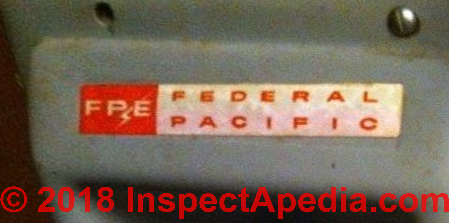
To identify the circuit breaker panels and breakers you should start with look for the product name "Federal Pacific Stab Lok" or "Federal Pioneer Stab Lok" on the equipment. Or the panel label may simply read FPE, FP, Federal Pacific, or Federal Electric or Federal Pioneer. If the panel bears any of these names and it's a circuit breaker panel, not a fuse panel, it's an FPE Stab-Lok design.
Watch out: Unfortunately all Stab-Lok panels bear the safety concerns discussed in this article series, regardless of panel age, country, use of replacement breakers, or absence of visual evidence of a prior failure. A summary of the Federal Pacific Electric FPE Panel & circuit breaker fire hazard is
at SUMMARY of the FPE Stab-Lok® HAZARD.
Readers of this article should also see FPE Stab-Lok® : FIRES WAITING TO HAPPEN
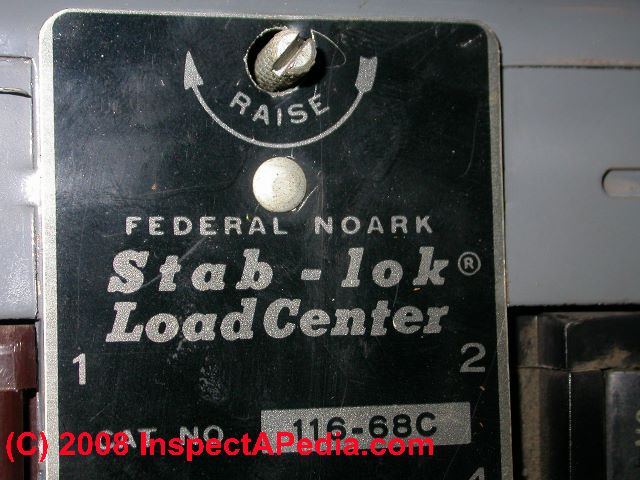
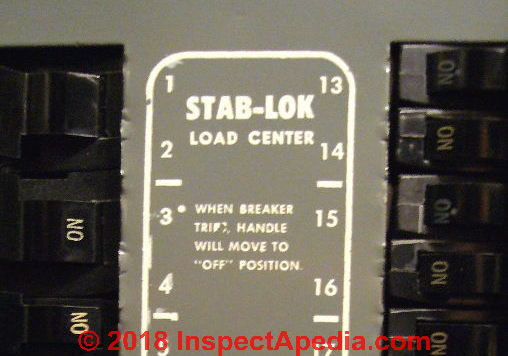
3. Stab-Lok Look for the phrase Stab-Lok® [shown below] on the electrical panel front or panel door marking or label but be warned that you will not find that phrase on all FP or FPE Stab-Lok electrical panels
4. E-Bus or F-Bus design:
E or F-shaped cutouts on the panel bus bars (shown below)
Watch out: Safety warning - while opening the hinged door provided for consumer use to access and reset the breakers is permitted, because there is risk of dangerous or even fatal electric shock in any electrical panel interior, only an expert should actually remove the front cover.
DO NOT try to open up your electrical panel nor to remove circuit breakers yourself. There is live electrical voltage in the panel interior - you could be shocked or killed. Never insert any tool nor should you insert your fingers into the interior of an electrical panel.

Scroll through each of the articles below for photographs and a written description of what you will see at each panel brand or type on the cover and inside.
Names and panel labels associated with the Federal Pacific Stab-Lok® design
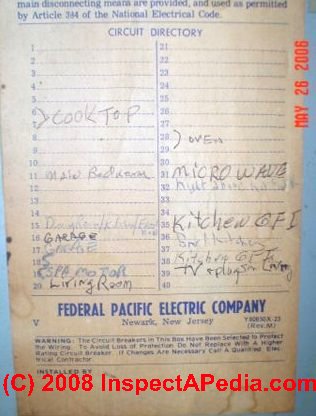 Because the names, labeling and appearance of FPE Panels varies both by age and by area of the country where the products were distributed, in this article series we include photographs of a variety of models from the East Coast of the U.S., the
West Coast (FPE in California), as well as some other areas such FPE Stab-Lok® panels in Florida, and FPE in Texas, and Federal Pioneer panels from Canada.
Because the names, labeling and appearance of FPE Panels varies both by age and by area of the country where the products were distributed, in this article series we include photographs of a variety of models from the East Coast of the U.S., the
West Coast (FPE in California), as well as some other areas such FPE Stab-Lok® panels in Florida, and FPE in Texas, and Federal Pioneer panels from Canada.
- ACBC American Circuit Breaker Company
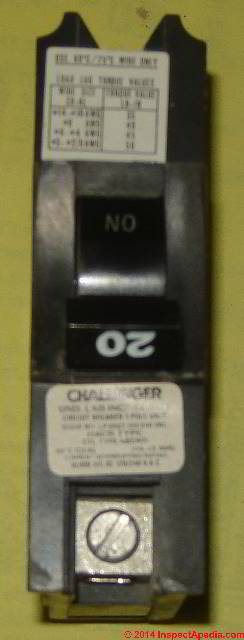
- Challenger electric, in the ownership chain of FPE may have distributed FPE Stab-Lok design panels under the Challenger brand.
Details are at CHALLENGER ELECTRIC PANELS
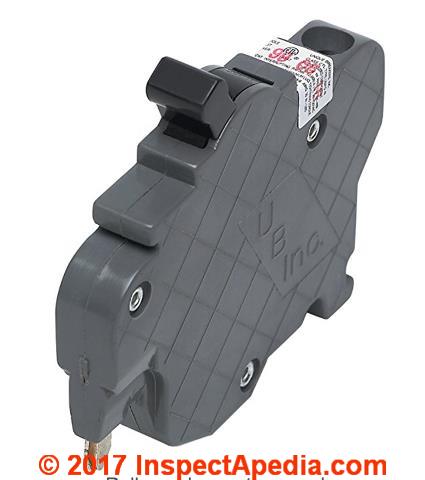
- Connecticut Electric (vendor of FPE REPLACEMENT BREAKERS) Connecticut Electric - aka Unique Breakers Inc. or UBI.
See UBI FPE CIRCUIT BREAKER TEST RESULTS
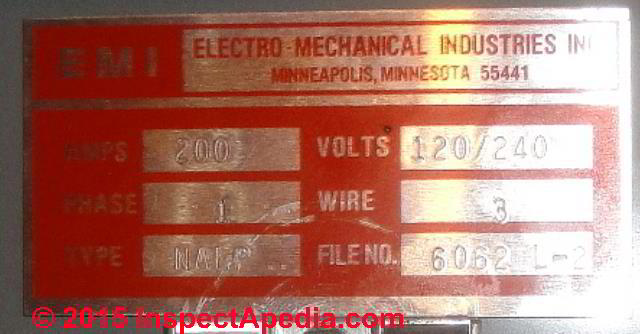
- EMI, Electro-Mechanical Industries, Inc., Minneapolis MN and possibly other private-brand labels found on FPE electrical panels
Details about EMI Federal Pacific Stab-Lok design panels are at
EMI & PRIVATE BRAND FPE PANELS
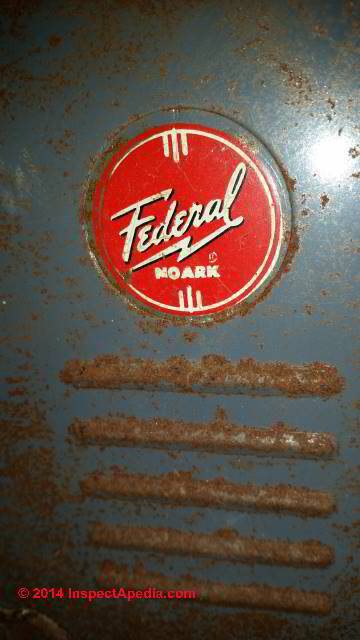
and/or
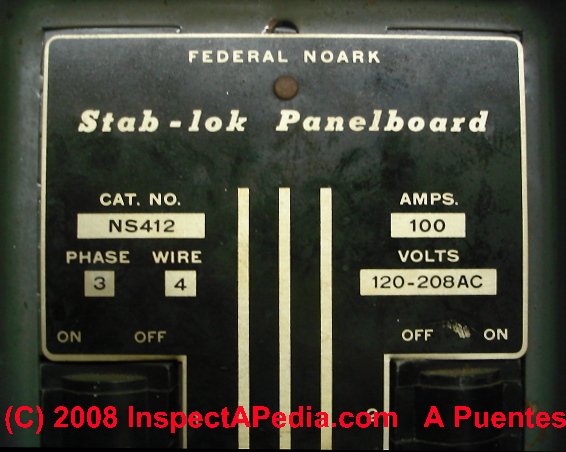
- Federal No Ark / Federal NOARK
Details are at FEDERAL NOARK PANELS
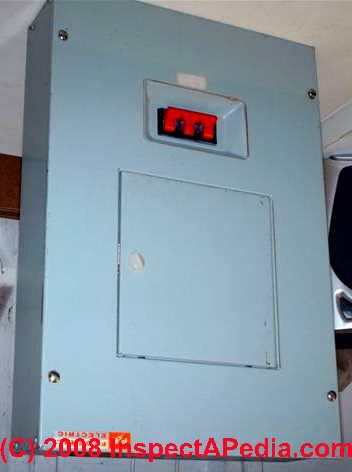
- Federal Electric Products Company Newark NJ
Details about Federal Electric panels are at FEDERAL ELECTRIC PANELS
- Federal Electric Stab Lok Breakers in England - UK Stab Loks are described at FEDERAL ELECTRIC PANELS UK Stab-Lok.
We have no UK FE Stab-Lok performance information and are seeking photos, field reports, historical data on UK Federal Electric FE Stab Lok breakers sold, installed, used in the UK.
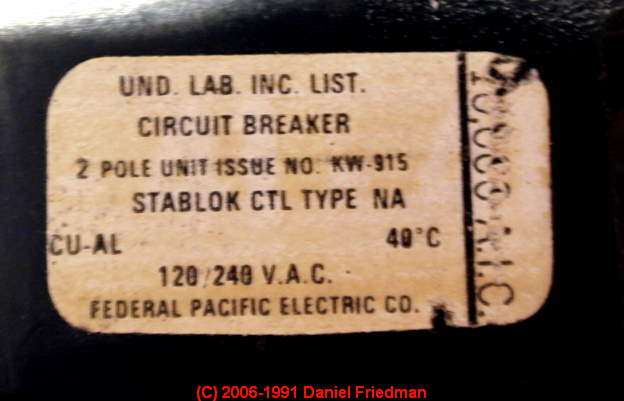
or
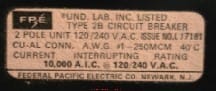
- Federal Pacific Electric / FPE Federal Pacific / Federal Pacific
Details about Federal Pacific, Federal Pacific Electric, and FPE panels and circuit breakers are at
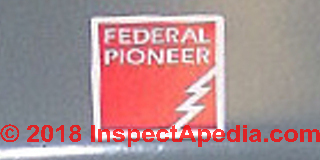
- Federal Pioneer
Details about Federal Pioneer electrical panels and breakers, a Canadian product, are
at FP FEDERAL PIONEER in CANADA
- FPE
or
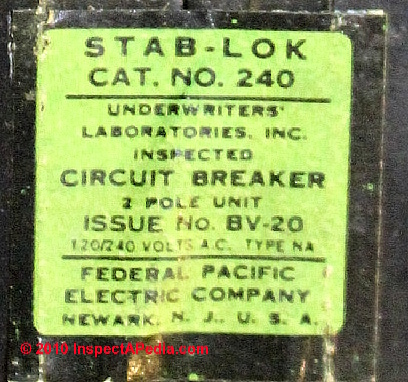
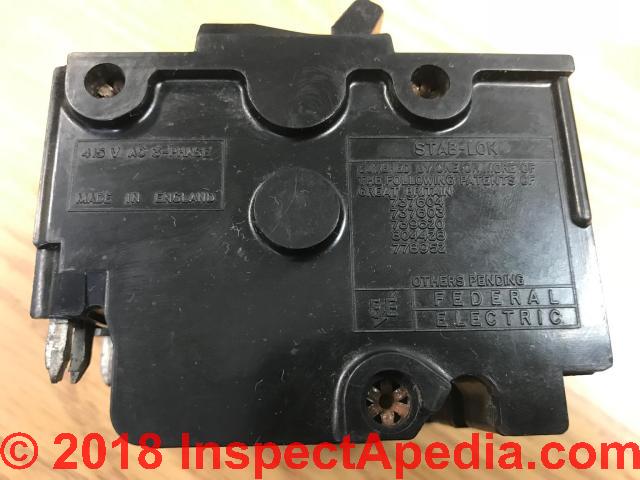
- General Electric NoArk Electrical panels - see FEDERAL NOARK GE GENERAL ELECTRIC
- Stab-Lok®
- FPE-Stab-Lok®
- Unique Breakers Inc. or UBI circuit breakers for FPE -
see FPE REPLACEMENT BREAKERS from Connecticut Electric selling UBI breakers, and
see UBI FPE CIRCUIT BREAKER TEST RESULTS - Also see COUNTERFEIT FPE CIRCUIT BREAKERS just below on this page.
The links given just above as well as the following pages of this article series provide identification photographs and descriptions of FPE Stab-Lok electrical equipment, explain the hazards involved, and recommend replacement offering some panel replacement options. (Note: to protect our readers' confidence, InspectApedia.com does not sell any products nor services.)
Below we provide a photographic library of various types of Federal Pacific (FPE) Stab Lok equipment, including FPE and Federal Pioneer electrical panel covers and labels which permit a consumer to identify the equipment from its exterior as well as circuit breaker labels and other details.
Since there is risk of dangerous or even fatal electric shock, only an expert such as a licensed electrician, electrical engineer, or home inspector should physically remove the front cover to permit inspection of the panel bus and other interior features.
Our Photo Guides to Identification of Federal Pacific Stab-Lok® Electrical Panels and Circuit Breakers Are Presented in the Topics Listed Below and begin
at FPE Stab-Lok® PANEL COVERS.
Counterfeit Federal Pacific Electric FPE Stab-Lok Circuit Breaker Warning

Watch out: separate from companies selling what they assert are new, non-counterfeit FPE Stab-Lok or Federal Pacific Electric circuit breakers that may not perform adequately, there have been absolute fake or counterfeit FPE Stab-Lok circuit breakers sold on eBay and perhaps from other vendors. See
BUSINESS OWNER PLEADS GUILTY TO TRAFFICKING IN COUNTERFEIT CIRCUIT BREAKERS [PDF] - source: U.S. Immigration and Customs Enforcement, retrieved 2018/05/02, original source
Elod Tamas Toldy, owner of Pioneer Breaker and Control Supply sentenced to federal prison for mail fraud and trafficking in counterfeit goods and services for
marketing COUNTERFEIT CIRCUIT BREAKERS on eBay [PDF], under the brand names Zinsco and FPE Stab-Lok. - source: U.S. Immigration and Customs Enforcement, retrieved 2018/05/02, original source https://www.ice.gov/news/releases/texas-business-owner-sentenced-counterfeit-circuit-breaker-scheme - ICE Office of Public Affairs at (202) 732-4242.
Members of the public can report suspected counterfeit operations by calling the U.S. Homeland Security Investigations HSI’s toll-free hotline at: 866-347-2423.
FPE Stab-Lok, Federal Pacific, Federal Pioneer and Other Circuit Breaker Identification Requests,Q&A
Question: confirm the identity of these as problematic Federal Pacific panels
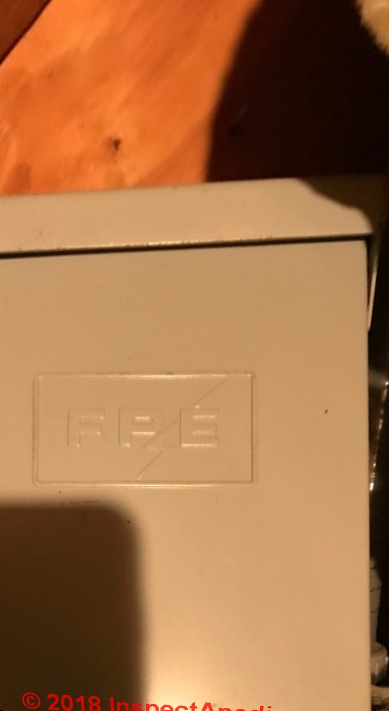 I‘m a home inspector and ran across two Fed. Pacific electric boxes with what looks to be one breaker in each used for two HVAC units as within reach/sight disconnects. I read your article, “The Federal Pacific Electric FPE Stab-Lok® Electrical Hazards Website”, studied it and went back to the house.
I cut power off and tried to pull the break out. It wouldn’t budge.
With the attached pictures, could you please tell me if this box is of concern? - Tim Early, ASHI, NACHI & other certifications, Early Home Inspections, Hampton Roads, Virginia, Tel: 757-478-1280, Email: tim@earlyhomeinspection.com
First photo: FPE Stab-Lok sub-panel identified by embossed "FPE" on the steel cover. [Click to enlarge any image]
Reply: Federal Pacific Stab-Lok circuit breaker sub-panels used as HVAC service/power switches
Yes Tim, those are FPE stab-lok Breakers of the design which raises the safety concerns about which you have read.
Your first photo shows the standard "FPE" (Federal Pacific Electric) embossed on the steel panel cover of the sub-panel.
When such a panel is opened, as might be done by a trained professional such as a home inspector or licensed electrician, you're likely to find labels affixed to the panel interior that will also identify the company as might labels on the circuit breakers themselves.
Below is another of your A/C sub panel breaker box photos showing a common Federal Pacific Electric label. All FPE breakers are variations of the "Stab-Lok" design and virtually all of them, even across decades of production, have shown the failure and reliability concerns discussed in this article series.
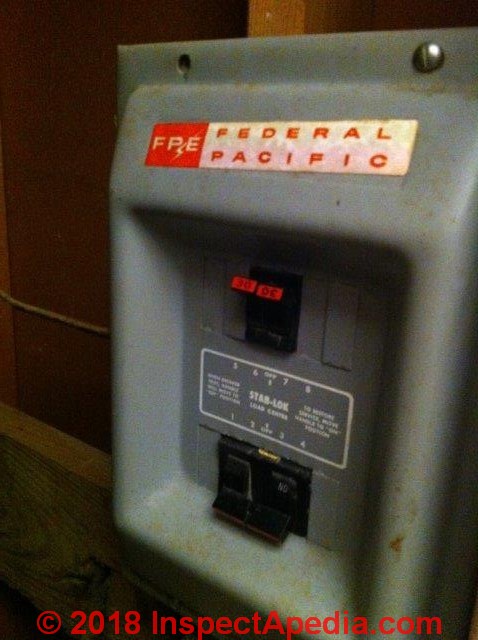
Also where the electrical panel bus is visible or partly visible you'll usually find the classic FPE E-shaped or F-shaped cutout openings in the bus bars. If readers "click to enlarge" the next photo below you might just make out the edge of the bus cutout openings.
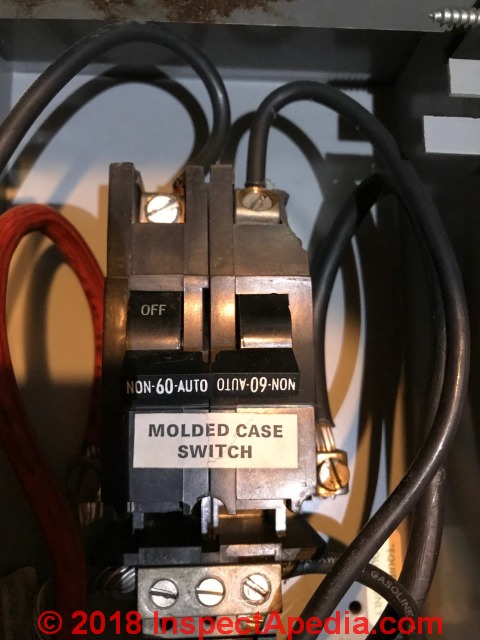
Below is an enlargement of part of this photo, showing details of the point of connection of the circuit breaker to the bus. There are some FPE Stab-Lok circuit breaker models that were held secured to the bus by a screw and could not be pulled out directly.
FPE Stab-Lok circuit breakers were produced in 1, 2, 3 and 4-pole designs and in a wide range of ampacities.
You can just make out the edge of the bus into which the breaker is connected and you'll note two screws that may be securing this circuit breaker in place.
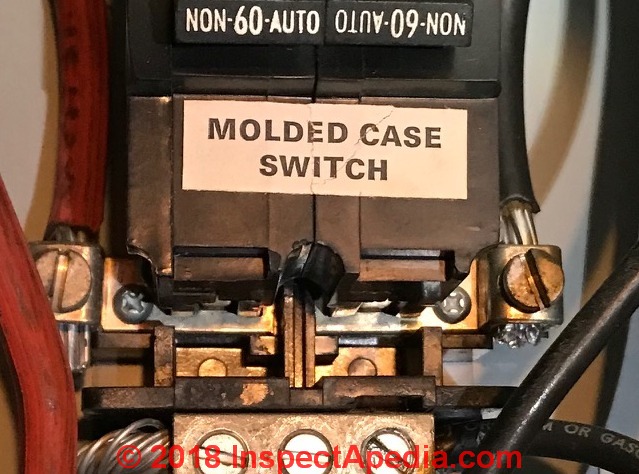
You may have read that the hazard of no trip in response to an overcurrent is in fact greater on the 2 pole Breakers such as these.
Watch out: During the course of an ordinary home inspection, I would advise against ever actually try to pull a circuit breaker out of a panel. There's a host of problems including risk of being killed. I speak from some experience although by luck haven't been injured yet.
I tried to pull out a cartridge-type fuse using the homeowner-use T-handle of a bakelite plastic fuse block. It was exciting, having the whole fuse bock base disintegrate under my hand.
I had to leave the building with half power off and half power on waiting for an electrician. My customer asked what I had done. I broke it I said.
Question: Someone substituted a FedPac breaker in a panel of a different brand - is that a problem?
Hi Daniel,
I'm a "neighbor" in Saugerties, NY and have so appreciated the information I've learned about the Fed Pac breakers on the site. My daughter is moving into a "new" home (built in '73) and we noticed that there is a fed pac main breaker switch that has been added to her non fed pac box with all the circuit breakers. (Please forgive if I use non electrical language)
It does not say "stab lok" on the main breaker box. I'm assuming they upgraded from 110 at some point, thus the additional main breaker box.
I'm having someone come look at it, and possibly replace the fed pac part.... but if it doesn't say "stab lok" on the fed pac main breaker which is the only fed pac product, does it need replacing? Thanks so much for any direction you can provide.
- J.P., Saugerties NY
Reply: Check the panel connecting bus bar design, assure compatible breakers, watch out for amateur work
A competent onsite inspection by an expert usually finds additional clues that help accurately diagnose a problem with an electrical system, and in this case, if odd parts have been substituted in a panel that makes me worry about amateur or "low budget" prior repairs and problems.
That said, it's worth a careful inspection of the property by an expert home inspector who might pick up other signs that increase or decrease our concern for the electrical system as well as all other topics pertinent to condition of the home.
An electrician can examine that connecting strips (the electrical panel "bus" or "bus bars") and tell you what breakers are supposed to connect onto it, and might confirm that by panel labels if they remain in place.
If someone "forced" into an electrical panel bus a breaker that was not designed for that particular bus, the connections are typically damaged and certainly unreliable and perhaps unsafe.
If you can send along some sharp photos of the circuit breaker in question, and when your electrician opens the panel, photos of the panel interior and the connecting metal bus bars we can make a more definite comment on what you've got.
Our photo illustrates a typical FPE Stab-Lok electrical panel bus showing an "F"-shaped cutout into which the breaker connectors are inserted. You'll probably notice that the third breaker position from the bottom has burned from overheating.
Watch out: in a fully-populated electrical panel with breakers in every slot you may have trouble seeing these breaker cutout openings. We recommend that you do NOT try to pull circuit breakers for a further look. That step is potentially dangerous, risking electrical shock, injury, fire or death.
Instead look at other clues that identify this circuit breaker brand.
FPE Stab-Lok® circuit breakers may say FPE or Federal Pacific but may not have the words stablok on the breaker - take a look at our circuit breaker identification photos
at FPE BREAKER ID PHOTOS.
The electrical connectors on a given circuit breaker must match the electrical bus bar design in the electrical panel. What will determine the proper and allowable circuit breaker in your panel, besides trying to avoid problem products, is the connecting bus design in the electrical panel - the metal strips into which circuit breakers clip and connect to obtain power.
So if someone substituted a breaker of a brand that does not match the panel brand, the connections might be improper and unsafe.
Question: Is this FP panel an FPE Stab-Lok® Unit?
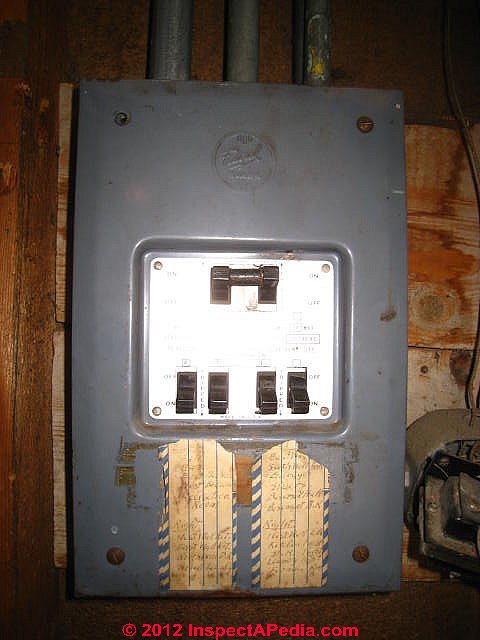 Over the past 12 years, I have called out hundreds of FPE Stab Lok panels. I am very familiar with these panels after initial learning about them through my ASHI training and gaining significant knowledge from your website. I commonly refresh my memory by visiting your site and direct my clients to your site when they are purchasing a house with one of these panels.
And I always recommend that FPE Stab Lok panels be replaced.
I have attached photos of the Federal Pacific sub panel in question below. Although it is clearly a Federal Pacific panel, there was no "Stab Lok" markings on the panel and the breakers are not the typical Stab Lok style and color.
I was under the impression that Federal Pacific made other panel styles but only Stab Lok models were problematic.
Is this a Stab Lok panel? - Chris Anderson, Home Spy Property Inspections, Denver CO.
Reply:
Chris thank you so much for the photos and correspondence. Because the panel in your photos is an old and uncommon model, your photos and field observations are important and I will as you suggest add them to our website data
at FPE & FP IDENTIFICATION, HOW TO along with a credit to you.
If you do not want to be identified as a contributor just let me know and I'll be glad to delete that information.
We would much appreciate hearing any comments, critique, suggestions, or further questions that you may have after you've taken a look at that article.
It is not surprising for someone to question whether or not this is a Stab-Lok® design panel as I agree that it does not, from externals, resemble the better-known FPE models in labeling.
And the physical layout of the panel and the close proximity of the four subordinate breakers to the main invites one to question how the bus and breaker design fit into the space behind that internal panel cover plate.
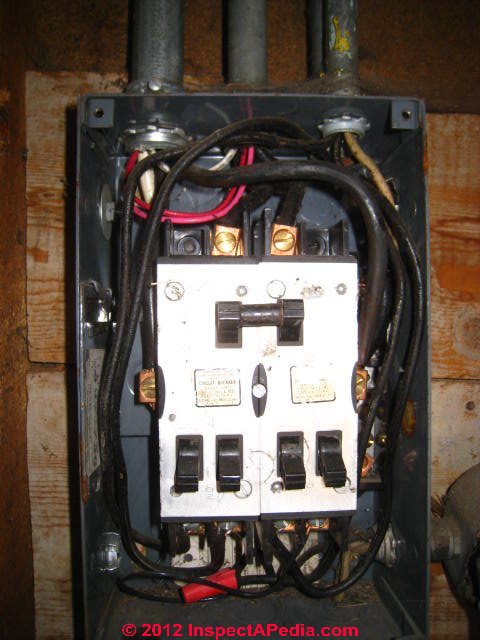 Even having studied many FPE products installed in the field and in photos, both residential and commercial, this exact model is not one I've seen before. It appears to use a copper bus, it is cramped, appears to be double-tapped, possibly improperly wired, and obsolete.
I'd guess this unit is quite old, probably a "Federal Electric" or a "Federal Noark" panel made before "Stab-Lok® " term was applied to that product design, and possibly dating from the 1950's. I couldn't quite make out the logo on the panel top.
I agree that the breakers look "different" in their toggle ends from the common Stab-Lok® breakers, but in other FPE Stab-Lok® design photos you'll see some toggle switches that do resemble those in your photos.
Without a direct view inside we can't be dead certain of the exact bus and breaker design, and I agree that it is possible that FPE produced other breaker panels that did not use the Stab-Lok® design, though I've yet to find a record or example of such.
More concisely, in answer to your question - Is this a Stab-Lok® panel? - without seeing the panel interior, I'm not sure. If it's not, it's a first.
I have not found data, field examples, nor photos of a Federal Pacific, FPE, FP, Federal Noark, Federal Electric &c. residential circuit breaker panel that did not use one of the several (problematic) Stab-Lok® bus & breaker designs, and the design shows up as commercial equipment as well.
I have passed on this question to our other FPE experts for comment and will update here accordingly, and we invite comment from other readers or experts on the FPE Stab-Lok® topic.
The FP/FPE fuse panels do not have the same "no-trip" issue, except for the models that used a combination of both fuses and circuit breakers.
For an example of Federal Electric
see FEDERAL ELECTRIC PANELS.
See FEDERAL NOARK PANELS for an example of Federal NoArk panels of the same design and hazard under an older brand name. .
Those panels, at least the models whose interior we've examined, including some commercial equipment, were indeed built to the Stab-Lok® design even though the product name did not necessarily include those words.
I would agree that you were also correct and acting in accord with home inspection standards to stop where you did, without further disassembly of the panel, as doing so can be dangerous and is beyond the scope of a home inspection. But it would be useful to see the internal bus details.
With 3,000 FPE type breakers already tested the statistical certainty of conclusions drawn from the data is very high. These breakers have a significantly-high rate of failure to perform safely.
Details are at CIRCUIT BREAKER FAILURE RATES and also
Even the most well-informed and conscientious building inspector or researcher is going to come across odd, obsolete, rare, or otherwise questionable equipment from time to time, and any reasonable expert should understand how one might have raised doubt about applying the "Stab-Lok® " design for the product in your photos.
Adding to the poor performance of FP / FPE breaker equipment this panel is obsolete, crowded, double tapped. Replacing it would make good sense to me.
See details at DOUBLE TAPPED CIRCUIT BREAKERS
We are dedicated to making our information as accurate, complete, useful, and unbiased as possible: we very much welcome critique, questions, or content suggestions for our web articles. Working together and exchanging information makes us better informed than any individual can be working alone.
Question: can you tell me if this is an FPE Stab-Lok Panel
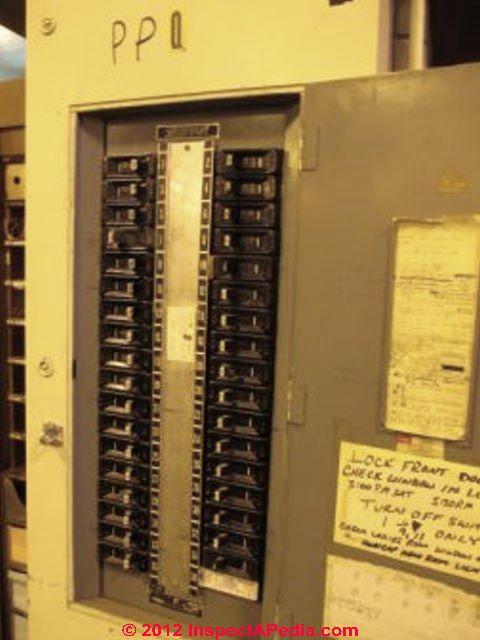
I was wondering if you could tell me if this is a Stab-Lok panel breaker. Is this a concern to replace this FPE panel.
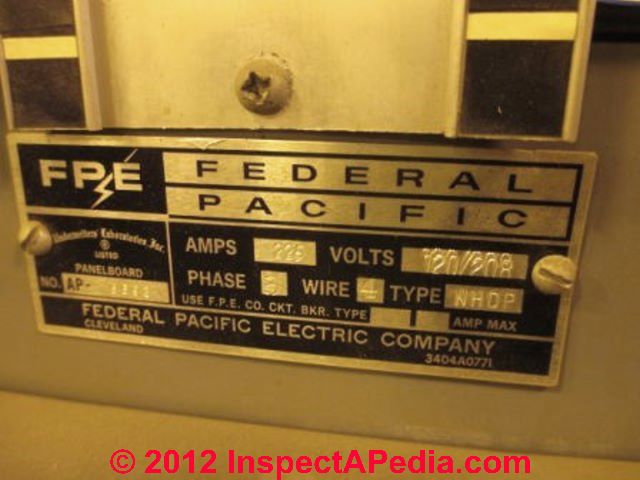
We have three electrical panels
- J.C. Troy NY Contractor, 12/5/2012
Reply:
Yes, J.C.
See FPE HAZARD SUMMARY to understand why you should replace this equipment.
Question: is it mandated to change FP panels or is this just your interpretation?
(June 15, 2011) patrick coyne pac1269@ameritech. said:
Are you telling me this is mandated to change these FP panels or is this your interpretation of the Code and Equipment? I am currently unaware that there is a legal mandate to remove these panels. It is rather common knowledge that the trip ratio is poor, but these have been in place for years. I agree that updating to a newer system is safer, but where is it mandated? Respectfully, Patrick Coyne
Reply:
No Patrick, there is no law that requires you to change out an unsafe electrical panel such as the FPE units described here. However some insurance companies will not write fire coverage on homes that have an FPE Stab-Lok panel installed, and most building owners, once reading the level of hazard found with these products, opt to change the equipment.
A circuit breaker that does not reliably trip in response to overcurrent is as dangerous as someone putting a penny in a fuse panel. If you wouldn't accept the penny-fix you wouldn't accept the FPE unit either.
Let me add that the advice to replace FP and FPE electrical panels is not "just my interpretation". I report the results of expert, independent test agencies, product history, court actions including finding the company guilty of fraud, CPSC history, and extensive field reports on fires and product failures.
InspectAPedia is an independent publisher of building, environmental, and forensic inspection, diagnosis, and repair information provided free to the public - we have no business nor financial connection with any manufacturer or service provider discussed at our website.
We are dedicated to making our information as accurate, complete, useful, and unbiased as possible: we very much welcome critique, questions, or content suggestions for our web articles. Working together and exchanging information makes us better informed than any individual can be working alone.
Question: Sometimes these breakers don't trip but I've also seen other product failures
(July 24, 2011) bob smitt said:
having installed a lot of fpe panel in my years as an electrician some times the breakers don't trip easy but have also seen the same on other brands some even worse so you just might as well say if you have a panel change it. I have a fpe in my house now and i am not planing on changing it
Reply:
Bob we agree that there are some other brands of concern, but do not agree with your conclusion; the failure rate on FPE equipment is astronomical compared with other field failure reports.
David Carrier was an independent electrical engineer who briefly carried on work by Jess Aronstein by conducting some ongoing tests of multiple brands of circuit breaker for no-trips - (not published as of 2014), but preliminary data, while pointing out other failing components, will by no means let the FPE product off the hook, rather his data, like other work before, confirmed the FPE no-trip breaker problem.
The historical test data on hand through 2014 makes clear that the FPE product suffers no-trip failures as high as over 60% - in an industry where in general circuit breaker no-trip failures are a fraction of one percent.
Question: what part of this FPE stuff is recalled?
(Sept 16, 2011) Eric said:
We have this FPE breaker panel. what part is a recall. how do we go about getting this replaced? what would the cost be to us being that this is a recalled item?
Reply:
Eric:
There was no FPE electrical panel recall.
There was (over the course of FPE history) an allocation to fund an FPE product recall at one point but the recall was never issued. There was also a "successful" class action lawsuit in New Jersey that gave minimal financial relief to original homeowners where an FPE panel was installed in New Jersey - no longer a source of financial aid.
You wont' find meaningful financial relief for replacing an FPE panel by means of product recall nor class action settlements, but financial aid may be available for homeowners of modest means who apply to local homeowner financial aid agencies.
Question: where's the data on FPE failures
(Dec 25, 2011) Harvey said:
Is there any data on how many actual fires have started that can be traced to the stab lock panels or circuit breakers. I understand the test for failure rates but I want to find data for actual fires in homes.
Reply:
Harvey you will find field reports of FPE failures here that include actual fires and losses, but not a national survey that recounts a total number of fires.
When there is a house fire, very often the root cause is not accurately diagnosed and components that may have been a root cause are completely burned up. Take a look at " FPE Technical Report - Independent Research 2011" - or
see FPE HAZARD ARTICLES, STUDIES
Question: FPE failure report: "... we found the first plug on a circuit actually melted ..."
(Feb 10, 2012) Ron said:
Dan, Although I am not an Electrician, I agree with your comments. We had a Federal Pacific Panel in our office that was built in the 70's. During the last remodel we found the first plug on a circuit actually melted due to too much power draw on that circuit. The breaker never tripped.
Too close for comfort. I'm sure the panels are fine if there are no electrical overloads or short circuits going on but the breakers are intended for when things aren't right. The accidents and the unintendeds.
Arguing these panels are safe because someone installed them for years and have one in their own house with no problems is like saying a GFIC plug is not needed near a sink because you have never dropped an appliance in the sink.
We had things rewired and the panel replaced.
Reply:
Thank you Ron for your comment and for adding another report on FPE real world performance in actual use
...
Continue reading at FPE Stab-Lok® PANEL COVERS or select a topic from the closely-related articles below, or see the complete ARTICLE INDEX.
Or see FPE & FP IDENTIFICATION FAQs - questions & answers about how to recognize a Stab-Lok electrical panel posted originally at this page.
Or see these
FPE Identification Articles
- FPE & FP IDENTIFICATION, HOW TO
- EMI & PRIVATE BRAND FPE PANELS
- FPE BREAKER ID PHOTOS
- FPE BREAKER LABELS
- FPE PANEL BUS DESIGNS
- FPE COMMERCIAL PANELS
- FPE ELECTRIC METER BASE & BREAKERS
- FPE PANEL AGE
- FPE PANEL COVERS Stab-Lok®
- FPE PANEL DOOR LABELS
- FPE TOGGLE SWITCH
- FEDERAL NOARK PANELS
- FEDERAL NOARK GE GENERAL ELECTRIC
- FPE ELECTRIC METER BASE & BREAKERS
- FEDERAL ELECTRIC PANELS
- FEDERAL ELECTRIC PANELS UK Stab-Lok
- FEDERAL PIONEER ELECTRIC PANELS
- HOW TO ID FPE IF NO LABELS
- PRIVATE BRAND/ EMI FPE PANELS
Suggested citation for this web page
FPE & FP IDENTIFICATION, HOW TO at InspectApedia.com - online encyclopedia of building & environmental inspection, testing, diagnosis, repair, & problem prevention advice.
Or see this
INDEX to RELATED ARTICLES: ARTICLE INDEX to FPE STAB-LOK BREAKERS & PANELS
Or use the SEARCH BOX found below to Ask a Question or Search InspectApedia
Ask a Question or Search InspectApedia
Try the search box just below, or if you prefer, post a question or comment in the Comments box below and we will respond promptly.
Search the InspectApedia website
Note: appearance of your Comment below may be delayed: if your comment contains an image, photograph, web link, or text that looks to the software as if it might be a web link, your posting will appear after it has been approved by a moderator. Apologies for the delay.
Only one image can be added per comment but you can post as many comments, and therefore images, as you like.
You will not receive a notification when a response to your question has been posted.
Please bookmark this page to make it easy for you to check back for our response.
Our Comment Box is provided by Countable Web Productions countable.ca
Citations & References
In addition to any citations in the article above, a full list is available on request.
- Chris Anderson, Home Spy Property Inspections, Denver CO, Tel: 303-978-1288, Website: www.homespyinspections.com Email: HomeSpyInspector@msn.com
- Timothy Hemm, Yucala, CA, contributed the photographs of FPE equipment installed in California buildings. Mr. Hemm can be contacted at TimHemm@yahoo.com
- Arlene Puentes, an ASHI home inspector in Kingston, NY, contributed the page top and example photograph of a bank of FPE adjacent electrical panels. Ms. Puentes can be contacted at ap@octoberhome.com
- Jon Bolton, a home inspector, the Inspectigator, FL, contributed the "camouflage" breaker. Mr. Bolton can be contacted at teamattitude@hotmail.com
- Mary DeMuth, a property owner, contributed the Texas Federal Pacific Electric Load Center photos, May 2006.
- Thomas M. Pino, a professional home inspector, contributed photos of the 100A Texas FPE panel used in a condo. www.sweetwaterhomeinspection.com. Mr. Pino can be contacted at sweetinspect@houston.rr.com or at sweetwaterhomeinspection@yahoo.com
- Patrick Hedderman is a licensed home inspector in Clifton Park, NY. Mr. Hedderman can be contacted by email to heddermanp@yahoo.com or from his listing information at the NY section of Directory of Professionals to Inspect or Test a Building
- The remaining photographs on these pages were made by the web author.
- In addition to citations & references found in this article, see the research citations given at the end of the related articles found at our suggested
CONTINUE READING or RECOMMENDED ARTICLES.
- Carson, Dunlop & Associates Ltd., 120 Carlton Street Suite 407, Toronto ON M5A 4K2. Tel: (416) 964-9415 1-800-268-7070 Email: info@carsondunlop.com. Alan Carson is a past president of ASHI, the American Society of Home Inspectors.
Thanks to Alan Carson and Bob Dunlop, for permission for InspectAPedia to use text excerpts from The HOME REFERENCE BOOK - the Encyclopedia of Homes and to use illustrations from The ILLUSTRATED HOME .
Carson Dunlop Associates provides extensive home inspection education and report writing material. In gratitude we provide links to tsome Carson Dunlop Associates products and services.
 | HOME | ABOUT | ASK a QUESTION | CONTACT | CONTENT USE POLICY | DESCRIPTION | POLICIES | PRIVACY | |
| © 2024 - 1985 Publisher InspectApedia.com - Daniel Friedman | |||||||||