
InspectAPedia® FREE Encyclopedia of Building & Environmental Construction, Diagnosis, Maintenance & Repair |
Question? Just ask us! InspectAPedia
|
 Can't Afford a Replacement Electrical Panel ?
Options for obsolete or unsafe older electrical panels: Challenger, Bulldog Pushmatic, Federal Pacific Electric, Federal Pioneer, FPE Stab-Lok, Zinsco
- POST a QUESTION or COMMENT about what to do if you think you cannot afford to pay for a replacement electrical panel in your home
Obsolete or Unsafe Electrical Panel replacement options if you're short on cash:
This document describes steps to take if you are unable to promptly replace an unreliable, obsolete, or otherwise unsafe electrical panel, including Challenger, Bulldog Pushmatic, Federal Pacific Electric, Federal Pioneer, FPE Stab-Lok, Zinsco. Here we address the question raised by some readers about what to do if you can't afford to replace an FPE Stab-Lok® electrical panel right away.
Watch out: Replacement Bulldog Pushmatic, Challenger, FPE Stab-Lok®, Zinsco, and some other brands of circuit breakers are unlikely to reduce the failure risk of this equipment. We recommend that unreliable electrical panels be replaced entirely or the entire panel bus assembly be replaced, regardless of the panel model number or year of manufacture. InspectApedia.com does not sell circuit breakers nor any other products nor services.
InspectAPedia tolerates no conflicts of interest. We have no relationship with advertisers, products, or services discussed at this website.
What to Do if You Cannot Replace an Unreliable, Unsafe, or Obsolete Electrical Panel
 This is information for home owners, home sellers, building inspectors, home buyers, home owners, and electricians regarding steps to reduce the hazards associated with Bulldog Pushmatic, Challenger, FPE Stab-Lok®, Zinsco, and some other brands of circuit breakers and service panels.
Watch Out: as with any electrical installation or repair, these steps must be performed by a licensed and qualified electrician and must comply with appropriate building codes and regulations.
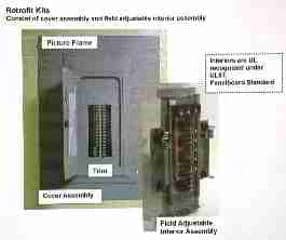
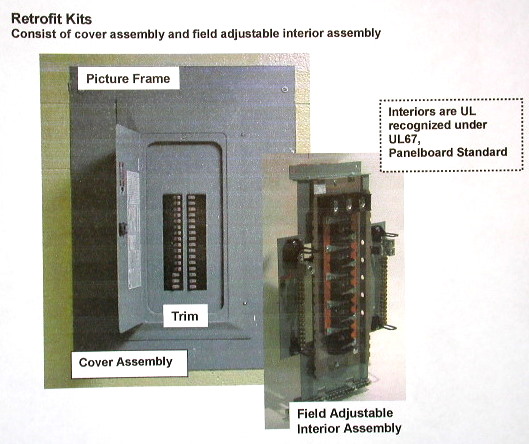
Good workmanship and an accurate assessment of the condition of the electrical panel enclosure which is to be re-used are important. You may find that the original panel enclosure is too small to accommodate a sufficient number of circuits for a modern building.
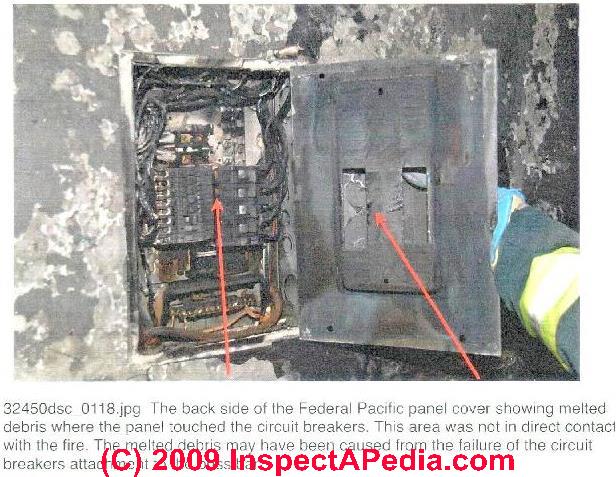
The home fire shown at the FPE electrical panel in the photo at above/left is described at FPE FAILURE FIRE PHOTOS.
[Click to enlarge any image]
What if Up to Now my Bulldog Pushmatic, Challenger, FPE or Zinsco Electrical Panel Has Seemed Just Fine?
Our breakers have already tripped
Some readers report that some of their FPE Stab-Lok® circuit breakers have tripped correctly in the past. That was good to hear; we don't assert that the failure rate on these circuit breakers is 100% of the time, but in fact the failure-to-trip rate occurs enormously more often than on other non-problem electrical panels and circuit breakers.
A problem is that we can't predict when an overcurrent or unsafe electrical condition is going to occur in a building, and we cannot predict exactly when an individual circuit breaker is going to fail to protect the circuit and thus the building from an overcurrent or electrical short.
But reporting that "up to now the panel has been fine" or "up to now we've never had a problem" or even "up to now the circuit breakers in our FPE panel have tripped off", is not any assurance that such a system is safe. We've seen that if you do trip an FPE Stab-Lok® breaker, that event can actually increase the chances that it will jam and not trip next time.
Our inspector said the panel looked ok to him
Visual inspections of the electrical panel or even in-place electrical "tests" of the panel are either unreliable or downright dangerous.
You cannot rely on such superficial or inexpert tests, and the very fact that they are offered by some is evidence of a lack of expertise on this topic.
Don't panic -
panic leads to getting over charged by the electrician. But get bids from at least two electricians experienced in electrical panel replacement. Plan to replace the panel; do not rely on visual inspections or "tests" that might claim that the electrical panel is safe.
Make certain you have working smoke detectors
in the home and that they are installed in the locations and in the manner recommended by their manufacturers or in local fire safety codes.
Take These steps to reduce the risk of an electrical fire or overcurrent in your home
While we cannot possibly provide a complete list, and while specific electrical hazards vary widely by building, age, usage, and other factors, here are some examples:
- Identify heavily loaded electrical circuits:
Hire an electrician or ask a qualified expert friend to help you identify just what circuits in the home are fed by which circuit breakers; normally we'd say "turn off the breaker and see what goes off - lights, receptacles, and appliances, etc. but watch out: since sometimes a "switched off" FPE breaker remains "on" internally, this test is not completely reliable. - Reduce the circuit load
especially on heavily loaded circuits: for example by unplugging some of the things on that circuit. A typical example would be circuits supplying kitchen electrical receptacles where people plug in toasters, microwaves, electric teapots, etc.
Especially in an older home, there may be only one circuit supplying the kitchen receptacles. Move some of those portable appliances to other circuits or be sure that they are not used at the same time. - Do your best to avoid overloading electrical circuits -
overloading a circuit means plugging in too many high-energy devices like heaters. That will reduce the chances of a circuit overload and breaker failure. It won't prevent a dangerous circuit breaker failure should there be an "event" like a short circuit in an electrical appliance however. - Turn off or replace unsafe electrical circuits or equipment:
If there are any circuits that are behaving funny - flickering lights, turn off that circuit. But beware: one of the FPE Stab-Lok® defects is that while you might turn off the breaker by flipping the toggle switch, the breaker may not really be "off" - its internal parts may be stuck in the on position.
Watch out: make sure the circuit is truly "off" - An electrician trained in how to use a multimeter or a simple neon tester can check to be sure that the questionable circuit is really "off" by testing for power at an outlet or light fixture on the circuit that is supposedly turned "off".
Also see ELECTRIC POWER LOSS / FLICKERING LIGHTS- causes of flickering or dimming lights - Check for and repair or replace any unsafe electrical devices
such as lights or appliances that themselves are in poor condition and are at extra risk of causing a short circuit. - Do not use electrical appliances that are old,
worn, in poor condition, behaving oddly. Doing so increases the risk of a short circuit or overload that could cause a fire - Unplug and store
electrical appliances or components not being used. - Stop using extension cords
- Stop using electrical receptacle "multi-way" plugs
that allow additional appliances to be plugged into the same receptacle. - Alert occupants to watch for trouble signs
Inform building occupants that the FPE-type electrical panels and circuit breakers are not necessarily reliable in the building and that they should be alert for signs of trouble such as: - Flickering lights or appliances that seem to flicker on and off
- Circuits that do not turn off
- Odors of burning plastic
- Visible smoke, sparks, around electrical switches and receptacles or lighting fixtures
- Do Not simply install "replacement" circuit breakers
for an FPE, Challenger, or Zinsco electrical panel.
See UBI FPE CIRCUIT BREAKER TEST RESULTS and also
see CIRCUIT BREAKER FAILURE RATES - independent test results for several widely-used brands of circuit breakers showing surprising failure rates. - Watch out: these are examples that can help reduce the risk of an electrical fire but they are incomplete, and by no means do these steps guarantee that you won't have an electrical problem, hazard, or fire.
You can reduce the risk of electrical fire or overload in your home, but until the FPE panel is replaced, significant risks remain.
Watch out: visual inspection of the interior of an electrical panel by a licensed electrician can in some (but not all) cases discover visual evidence of unsafe conditions such as overheating, but an FPE panel or circuit breaker may be damaged, jammed, burned, or otherwise unsafe without any external visual evidence: absence of evidence is not evidence of absence of trouble.
Watch out: do not ask an electrician or electrical engineer to try to test the circuits and circuit breakers in-place or in-situ. Doing so is improper, unsafe, and risks causing a building fire. Such tests can also increase the chance of a future no-trip failure of the circuit breakers being "tested".
Expert testing of FP FPE UBI and similar circuit breakers is indeed possible for breakers that have been removed from the electrical panel for that purpose.
The safety of independently-tested circuit breakers and their suitability for return to service needs further expert comment - Ed. - Assess the general level of safety & fire-risk in the building:
first there may be other more immediate fire or safety hazards in a home, such as unsafe heating equipment or chimneys, gas leaks, or even tripping and falling hazards that produce injuries at a high rate of occurrence.
The condition of the home and its electrical wiring, the existence of other risk factors such as elderly or otherwise immobile occupants who might have trouble escaping a fire, are examples of factors that increase the level of risk in a home.
Where the risk of an electrical problem is greater (old wiring in poor condition for example), or where the risk to occupants is greater (elderly or immobile occupants), the urgency of correcting these unsafe conditions should also be considered greater. - Be sure that smoke (and CO) detectors are properly installed,
located, and tested in the building - Install properly-sized and typed fire extinguishers
at building exits - Install fire alarms as appropriate in multi-occupant or other buildings
- Read up and become accurately informed
about FPE Stab-Lok® equipment: see FPE Stab-Lok® HAZARDS & REPAIRS WEBSITE. Don't be fooled by some of the nonsense articles posted online in which a few folks claim FPE Stab-Lok® circuit breakers & panels are not a problem - there is ample court record as well as soundly researched evidence about this equipment and its failure rates. - Obtain electrical panel replacement bids
from at least two electricians in your area. Once you have an accurate idea of what panel replacement is likely to cost you will know how much you'll need to save or borrow.
See FPE REPAIR ELECTRICIANS - Start saving up to replace your FPE Stab-Lok® electrical panel
as soon as you can. There is no meaningful financial relief available from FPE, nor from anyone else for FPE Stab-Lok® equipment. However there might be general home repair or home safety repair financial aid available in some communities who provide assistance to the elderly, disabled, or people of limited means. Check with your local community support agencies, office for the aging, or churches. - Save on electrical panel replacement cost
See FPE REPLACEMENT PANEL which for some installations can cut the electric panel installation cost in half.
Depending on your financial situation, the condition of the home and its electrical wiring, and the existence of other risk factors such as elderly or otherwise immobile occupants who might have trouble escaping a fire, it may be appropriate to borrow the cost to replace an unsafe electrical panel, or local community welfare agencies may be able to help offset that cost, or an electrician may agree to perform the work at a reduced rate. - Check to assure that your building is properly insured
and that your insurance company will not exclude a loss related to the presence of an FPE Stab-Lok® electrical panel in building. Some insurance companies or their individual branch offices may exclude coverage for buildings with this equipment installed. Don't play "dumb" and fail to tell your insurance company - doing so could void your insurance coverage.
If you find any other electrical safety suggestions useful for homes with an FPE Stab-Lok® panel, CONTACT us.
The $1000 or so to replace an electrical panel is probably much cheaper than the cost of a fire should one occur.
Reader Comments, Questions & Answers About The Article Above
Below you will find questions and answers previously posted on this page at its page bottom reader comment box.
Reader Q&A - also see RECOMMENDED ARTICLES & FAQs
On 2023-06-13 by InspectApedia-911 (mod) - how can one reduce the Zinsco hazard in a home before replacing the panel
@Douglas Jones,
You don't give your location so we don't have a clue about what free or reduced cost electrical services might be available in your area. But you might try calling some local electricians, explain your situation and ask the electrician if they're willing to expect and change out your panel at a reduced cost.
Be sure you read the article above on this page where we give some suggestions that can reduce the Zinsco hazard in your home before replacing the panel.
Start by turning off the specific circuit breaker or breakers that are on the circuits acting strangely.
Please keep us posted as the condition you describe sounds dangerous and risks a house fire.
On 2023-06-13 by Douglas Jones
I and members of our house hold are disabled and on a fixed income is there anyone that can come to see us about replacing our panel box its starting to short and spark. we have already lost some outlets and just 30 min ago 2 breakers and the main is really hot.
On 2023-05-26 by InspectApedia DF (mod) - contact your local community services agency to ask if there is either financial assistance or other support services
@Nicky Reed,
My best advice is to contact your local community services agency to ask if there is either financial assistance for you to hire a licensed electrician or if perhaps the agency knows of an electrician who can help you at a reduced rate or pro-bono.
For people of modest means, including veterans and widows, in some communities there may be financial aid that can help pay for fire and safety corrections in a home.
We don’t know what state and county you live in. There MIGHT be financial aid for elderly people as described here. Search by your state to see what’s available.
See this USDA website:
Single Family Housing Repair Loans & Grants - Program Status: OPEN
https://www.rd.usda.gov/programs-services/single-family-housing-programs/single-family-housing-repair-loans-grants
and this
USDA SINGLE FAMILY HOUSING LOAN OR GRANT PROGRAM FACT SHEET [PDF]
inspectapedia.com/fpe/USDA-Single-Family-Housing-Grant-Program.pdf
Let us know if you have additional questions.
On 2023-05-26 by Nicky Reed
Hello, I a 70yrs old senior medically disabled, in need of and electrical panel upgrade which I can't afford, for Home insurance renewal.by July 17th 2023, can I get aid to help me meet this deadline?
On 2023-02-24 by InspectApedia Editor - how can I replace lost identity documents
@Britt,
What an ordeal to go through, first your house fire and now re-establishing identity. You have our condolences.
Your local library is a great free resource to research what's available if you don't have a phone. You should be able to use a computer there. When able, visit this website:
https://texaslawhelp.org/article/replacing-lost-documents
Where they list government agencies that can help you get replacement copies of important documents, much of which is available online.
It looks like the 2022 Texas CAPER report does have goals regarding homelessness even if not fully met at this time.
More current and local information will be available from your county's social services department which will have information on available resources for housing, food, and child welfare. It would be beneficial to meet with a financial aid worker there.
It's commendable that you'd like to help others in difficult circumstances like yourself but in my opinion, I'd focus on finding your own solutions at the moment as it sounds like that's more than a full time job in itself.
On 2023-02-24 by Britt
Hi. My name is Brittany Rivas. I suffered a total loss in a fire in texas city November 16, 2022. I don't have any documents to prove who i am except a mug shot photo from tcpd and a pic of id off Instagram but im covering my address in the photo.
I have been researching for months now how to get help but its hard for me because someone stole my phone. Texas city has no plans to help prevent homelessness nor any shelters according to their CAPER statistical report so im reaching out because i have been forced to acquire my grannys house but i have no money for utilities to get legal so the house dont get condemed.
My breaker box needs replacing and the power company took the meter and wires to the pole. I think i can get help thru crime victims comp on that but it doesn't cover water. Which the city is making me pay past due balance from my dead uncle and its $273 plus $150 for deposit.
I really need help i have no resources and due to a recent accident my mother broke her hip so my family cant afford to help me. Im a single mother and grandmother who is trying to go to school so i can support myself and my family but i need help.
Im willing to work for it but i have no id. also have a couple of people i want to help too get their disability. Im currently in process of applying because i have a heart condition. -
Thank u for ur time and god bless. I
Brittany Rivas
On 2023-01-27 by InspectApedia Publisher - "No recall" does NOT mean "safe" - ONLY safe option is to replace the entire electrical panel with another, safe brand
@ping,
Watch out: reader warning: advice from Ping is perhaps well intended but incorrect and so, unsafe.
The statement
"Replacing the stab-lok breakers with more reliable circuit breakers may help reduce the risk ..."
is simply and completely wrong and dangerous.
There are NO replacement circuit breakers for FP, FPE Stab-Lok electrical panels that improve the safety of the system. Extensive independent expert testing has shown that those replacement circuit breakers fail at about the same (high) rate as the original product.
The ONLY safe option is to replace the entire electrical panel with another, safe brand.
In our OPINION, this advice is even more dangerous, seriously so, if followed because once building occupants think (*in error) that an unsafe condition has been "fixed" there is a greater risk that occupants will ignore dangerous warning signs (flickering lights, for example, or a breaker that won't turn off) and as a result could face fire, injury, or in the most-extreme case, fatality.
Regarding ping's followup, yes some other brands of circuit breakers have been recalled.
There was never a recall of FP FPE breakers, though they were found to fail at an astonishing rate. A recall was planned, even funded, at one point when the company changed hands, but the recall was never issued; the new owners decided (apparently) not to face the expense.
"No recall" does NOT mean "safe". Where a country has laws and police departments that does not mean that there are never any crimes.
Above on this suggestion you will find some safety suggestions for people who have trouble financing electrical panel replacement.
On 2023-01-27 by ping
Replacing the stab-lok breakers with more reliable circuit breakers may help reduce the risk although it is not a complete solution. The "fire hazard" is a "possibility" issue. If you could afford to replace the service panel, that is great. If not, replacing the breakers at least help reduce the possibility of fire hazard compared to not replacing at all.
Nothing is absolutely safe. Have Eaton, Square D breakers been recalled?
On 2023-01-26 by InspectApedia Publisher - possible financial aid for elderly people in Florida to get help replacing unsafe electrical panels
@Anonymous,
Thank you for a helpful question.
Yes there MIGHT be financial aid for elderly people in Florida to get help replacing unsafe electrical panels like the FPE units described here.
See this USDA website:
Single Family Housing Repair Loans & Grants in Florida - Program Status: OPEN
https://www.rd.usda.gov/programs-services/single-family-housing-programs/single-family-housing-repair-loans-grants/fl
and this USDA SINGLE FAMILY HOUSING LOAN OR GRANT PROGRAM FACT SHEET [PDF]
https://inspectapedia.com/fpe/USDA-Single-Family-Housing-Grant-Program.pdf
The USDA website I named above has contact points for several locations in Florida - here is one example
**N. Ft. Myers (Sub Office of Royal Palm Beach)
3434 Hancock Bridge Pkwy., Suite 209-A
N. Ft. Myers, Florida 33903-7005
Telephone: (239) 997-7331
FAX: (855) 475-8043
Counties Served from Royal Palm Beach and North Fort Myers: Broward, Dade, Glades, Hendry, Highlands, Martin, Monroe, Okeechobee, Palm Beach, St. Lucie, Charlotte, Collier, DeSoto, Hardee, Lee, Manatee, and Sarasota.
On 2023-01-26 y Anonymous
I'm widow 76,,,,,was told I need new electric panel( box) live in FLA can I get ANY kind of help ?
Is there any help for elderly to get a electrical panel in FLA ?
On 2021-06-13 by inspectapedia.com.moderator - there may be financial aid that can help pay for fire and safety corrections in a home
@Angie wheeler,
Regrettably although at one time funds were set aside to pay for an FPE panel recall, that money disappeared without ever being used for its intended purpose, and now there is no company remaining who might be held, toes to the fire, to pay all or part of the cost of replacing the FPE or FP panel in your home.
For people of modest means, including veterans and widows, in some communities there may be financial aid that can help pay for fire and safety corrections in a home.
It makes sense to contact aid agencies in the city or town nearest you in your country and state or province as well as checking with the VA directly.
The Veterans Administration offers some sorts of financial aid - not specifically for electrical safety repairs, but it's worth asking if the VA can extend their concept of help for you.
Contact:
VA Aid and Attendance benefits and Housebound allowance
VA Aid and Attendance or Housebound benefits provide monthly payments added to the amount of a monthly VA pension for qualified Veterans and survivors. If you need help with daily activities, or you’re housebound, find out if you qualify.
https://www.va.gov/pension/aid-attendance-housebound/
Another example in Minnesota you'd contact the Minnesota Department of Financial Assistance at https://mn.gov/mdva/resources/familyassistance/financialassistance.jsp
On 2021-06-13 by Angie wheeler
Can I get help to put replacing a circuit breaker box for my low income and due to my age which is 62
Plus I'm a widow of an husband who was a us army veteran
On 2021-05-12 by danjoefriedman (mod) - get another bid if price is or seems too high
@Clara Wilkerson,
$8000. To replace an electrical panel sounds quite costly. I would call some other electricians.
Also, depending on where you live, there may be financial aid for low income on seniors.
Meanwhile, take a look at the safety suggestions above on this page.
When you can't afford to replace the electrical panel right away, those steps can help avoid trouble.
On 2021-05-11 by Clara Wilkerson
My hine was built in 1963 with an FPE breaker box circuit which I was told is obsolete. A new AC unit was installed, and I cannot afford to pay an electrician a quoted price of $8,000 dollars. Please help
I am a senior citizen and widow of a veteran on a fixed income
On 2021-04-06 by (mod) - There is no government or state program nor recall that's going to finance the replacement of an FPE panel. But ...
@James Parnell,
There is no government or state program nor recall that's going to finance the replacement of an FPE panel.
However in many communities there are financial aid programs for people who need safety or other repairs to their home and who don't have the means to cover them. Check with your local financial aid agencies in the country and city where you live.
The article above also has other suggestions
On 2021-04-06 by James Parnell
Yes good morning my name is James Parnell Trying to get help with upgrading my electrical system in my house my fuse center is corroded rest it out my circuit breaker is overloaded
On 2021-02-17 by Nathan
Thank you. I will check my ins. co's policy on loss due to defective panels. Perhaps if they sold me a policy without expressly showing that they WON'T cover such an incident and I only found out by talking to an agent, then perhaps I have a foothold to stand on. I could at least threaten to drop them and get other insurance that DOES cover such an incident...
On 2021-02-17 - by (mod) -
Nathan
No I have not heard of cases of people's homeowners insurance paying the cost to replace an unsafe electrical panel. I have, however, had numerous reports of homeowners insurance companies refusing to cover a loss or even refusing to insure a property where an unsafe electrical panel has been installed.
Keep in mind that the cost of the loss from a fire or injury could be enormous compared with the cost of prevention by replacing the electrical panel.
On 2021-02-17 by Nathan
Has anyone had success getting homeowners insurance to pay for FPE Stab-Lok panel/breaker replacement proactively from a fire prevention aspect?
Or if someone started having issues that could be documented and observed upon inspection, would a home warranty claim be something to look at? My home is circa 1979.
On 2020-11-30 by (mod) - Unsafe FP breakers in Picton Ontario
Carolyn
Yes indeed, the nuisance tripping of FPE breakers is the lesser evil; much more serious is a breaker that won't trip in response to over-current, risking a building fire.
In Canada your panel is probably a FP or Federal Pioneer - the same design, with about the same failure rates;
There is no recall, no settlement, and IMO in Canada, as Hydro were the original agency who inspected for electrical safety I don't expect the same agency to now proclaim FP panels as unsafe - but the data is quite unambiguous;
As detailed at FEDERAL PIONEER PANEL SAFETY https://inspectapedia.com/fpe/Federal_Pioneer_Panel_Safety.php
Beware that depending on the policy of your insurance company at the time of a loss, an FP related loss may not be insured.
My suggestions about panel affordability are on the page above. Sorry there's not more help.
On 2020-11-30 by Carolyn G. Moore
We are senior pensioners and have just discovered that we have the Stab Lock (FPE?) electrical panel. We bought this house 2 years ago and all the inspector said about the electrics was that their was no cover over the panel. Through our realtor we got that taken care of but we have one breaker that keeps going; it's to our clothes dryer.
Recently my husband went to purchase a new fuse (breaker?) and was told they do not sell those anymore. He then checked online, finding out they are hazardous. So our problem is cost.
We are in Picton, Ontario and wonder if their would be a list of electricians who may be hooked up to a grant of some kind. Talked to Hydro One and they don't have anything like that.
Thanks a bunch,
Carolyn
On 2020-08-21 by (mod) - ranking of relative risk of FPE breakers or replacement breakers is not correct and not safe
Thank you for the interesting field report and your thoughts on comparative safety hazards of FPE, Britton.
It is important to remember that guesses at relative FPE circuit breaker risks based on photos or replacement product promises is not reliable in that "repair" claims based on replacing breakers is not consistent with actual independent test and research data.
Take a look at Aronstein's FPE and Connecticut Electric breaker failure testing and you'll see that they all have about the same failure rate.
There are, however, some FPE (and replacement FPE) breaker failures that appear to be of greater risk, based on the actual test data rather than supposition.
Here are some examples:
1. The double pole breakers fail to trip in response to over current at a higher rate than single pole breakers, with an up to 60% failure rate - as compared with an overall industry failure to trip rate that is a tiny fraction of less than 1%
2. Switching FPE breakers on and off, or "exercising the breakers" actually increases the risk of a subsequent failure-to-trip in event of an actual over-current
3. Replacement breakers sold on the current market to supposedly "replace unsafe FPE breakers with something safer" are in fact not any safer than the originals
4. Canadian FP circuit breakers are now found to fail at about the same rate as U.S. made FPE breakers
5. FPE and FP circuit breaker failures are traced to basic design properties, choice of materials, cheating on breaker testing by the manufacturer, illegal labeling and label-swapping among the product, and other unfortunate details that extend over the entire life of the product. There is no factual basis to claim that early FPE breakers are safer.
On 2020-08-21 by Britton - the original FPE panel in my grandparents home from 1956 is not safe
[Watch out: this reader's opinion is incomplete and and the readers's advice below is unsafe - Ed.]
I am a firm beleiver that the original FPE panel in my grandparents home from 1956 is not safe and I encourage anyone who can to replace the panel as recommended.
That being said everyone living in the home knows this is unsafe but I have a hard time quantifying how unsafe because growing up in this house these breakers would trip all the time (over and over again from to many loads on that branch circuit) and never once has a breaker failed to trip.
The breakers were also all original 1956 until 2018 when I started doing electrical updates and first started learning about the dangers of FPE panels and breakers.
From my intitial readings and financial position I decided to only add single pole breakers at the lowest amp rating possible and never buy new breakers from our big box stores as they are made by Connecticut Electric and are more likely to fail than an older genuine Federal Pacific breaker.
Once I found this information I could never stop looking at it and learning more. Something that has stuck out to me is every failure report I look at and all the data I read suggests that it's very possible the original 1956 breakers are in-fact very safe (when compared to breakers manufactured after say 1970) and that genuine Federal Pacific type NA single pole breakers might be reasonably safe especially when compared to double pole type NC breakers that can be installed in the same panel.
This is a deduction from all the data and pictures I've been able to look at seem to point to. There's just not enough data drill down to support my theory and since this section is about not affording replacement but maintaining as safe a home as possible I would like to suggest looking into this deeper. These deductions only cover breaker failure and not bad bus design or other FPE flaws.
I've studied this quite a bit now and am under the following impression that you can rank Stab-Loc type breakers for risk with 1st product being the lowest risk and the last product being the highest risk. This is only my opinion reasonably deducted from what I have studied about this product and has no verification.
[Watch out: this reader's opinion is incomplete and and the reader's advice below is unsafe - Ed.]
1.Genuine Federal Pacific single pole type NA circuit breaker
2 Genuine Federal Pacific single pole type NC circuit breaker
3 Federal Pioneer single pole type NA circuit breaker (sometimes UBI labeled assembled in CA and MX)
4 Genuine Federal Pacific double pole type NA circuit breaker (Real big hazards start here and get worse as you move down the list)
5 Federal Pioneer single pole NC type circuit breaker (sometimes UBI labeled assembled in CA and MX very likely recalled in Canada)
6 Genuine Federal Pacific double pole NC type circuit breaker (this product is a major fire hazard and the wiring and equipment running on it should be inspected)
7 Connecticut Electric NA and NC type single pole breakers (to much data suggest these are unsafely made and consumers are better off buying used)
|
8 Federal Pioneer NA and NC type double pole breakers (Data I've seen suggests this is worse that genuine FPE double pole NC)
9 Connecticut Electric NA type double pole breakers (call it new and make it most likely to destroy your home)
10 Connecticut Electric NC type double pole breakers
NA type breakers are thick and NC type breakers are thin. You can put two NC breakers in the place of one NA breaker. I believe (with no factual backing) the smaller form factor of the NC type breaker makes them more likely to fail. When two NC breakers are paired together as a unit only one has to fail for both breakers to stay energized or "JAM" the electricity path closed. I have seen no pictures or data representing that a single pole NA breaker failed. No one reporting the data dives this deep into the investigation that I can see.
On 2020-04-11 by (mod)
Troy
If I can help I'll be glad to do so, but what's the question here?
If you are referring to the cost to replace an FP or FPE electrical panel, there's no possible way that that cost could be even 1/10th of $68,000. CDN.
On 2020-04-11 by Troy - FP wiring complaint in Edmonton Alberta?
I live in Canada.Edmonton.Alberta . My father Waz born in 1925.And this is his son. So to get to the point.My father Waz taken for 68,000. To get the house done. Doing the court thing. but it's talking a long time . so that's what's going on.Thank you. Respect
On 2019-11-29 by (mod) - replacement for Challenger SL20 load center?
CCT-200-A-LOAD-CENTER.jpg) FPE REPLACEMENT PANEL
FPE REPLACEMENT PANEL
At
https://inspectapedia.com/fpe/FPE_Panel_Replacements.php
Offers some options
On 2019-11-29 by Ray
I HAVE CHALLENGER SL 20(20-40)CCT 200 AMPS LOAD CENTER. IS THERE A RETROFIT FOR THIS PANEL? OR WHAT WOULD BE AN EXACT REPLACEMENT?
On 2019-05-22 by (mod) - Siemens PHL1 ITE Pushmatic Handle Lock Kit
Fab
Siemens produces a PHL1 Siemens ITE Pushmatic Handle Lock Kit - shown below.
Part No. 0829079769 and UPC 30783643118554 selling for about $15. U.S.
I’ve seen the Pushmatic breaker lock sold at online vendors and you may also find it through your local electrical supplier. Basically it’s a screw-locked clip that prevents the user from pushing the Pushmatic breaker in or “down” without first using a tool (a tiny allen wrench) to remove the guard.
See your question repeated where we answer in more detail at
https://inspectapedia.com/electric/Circuit-Breaker-Locks.php CIRCUIT BREAKER LOCKS
Watch out, however: you should reconsider your position that you will not replace the Bulldog Pushmatic panel as there are known performance and safety concerns with those breakers. See details at: inspectapedia.com/electric/Pushmatic.php PUSHMATIC - BULLDOG PANELS
On 2019-05-22 by Fab87JCI
Been looking everywhere but to no avail. Maybe someone here could help please...
A picture attached shows an old school pushmatic breaker. Is there an option to add some kind of NFPA approved lock to the breaker for the dedicated fire alarm circuit??
All I'm finding is locks for the standard modern breakers but none for these really old ones. Replacing the breaker panel is not much of an option at this point.
Thanks in advance!
IMAGE LOST by older version of Clark Van Oyen’s useful Comments code - now fixed. Please re-post the image if you can. Sorry. Mod.
On 2018-10-10 by (mod) -
My best suggestions are in the article above. Unfortunately there was no recall and currently no National program offering financial assistance to replace the electric panel made by FPE.
In some communities there may be financial aid Societies or associations for the elderly or people of limited means. Check with your local Department of Social Services.
On 2018-10-09 by Cecillia Bredeson
Is there any place that will help me replacemy braker box on my home i dont have a lot of money and i cant get a lone is there some whete i can get help putting in a new braker box in my home town of olivehurst ca
On 2018-03-24 by (mod) -
READER WARNING:
Watch out: Kevin's opinion, shown below, is completely incorrect in every statement he offers, and his statements have no basis in fact.
Both the actual charges of fraud, including label swapping and forcing test results when breakers on the test bench did not trip as well as a very high failure rate, far above properly-performing circuit breakers, have been amply documented in the courts, by the CPSC's own staff, and by independent, expert testing.
Please see a summary at
HAZARDS of FPE BREAKERS
The ARTICLE INDEX at https://inspectapedia.com/fpe/Index_FPE_Stab_Lok_Federal_Pacific_Electric.php provides details.
Just one example is in
2007 FPE Stab-Lok® TECHNICAL REPORT - an updated test report of independent testing (a large 1.2MB PDF file) using a larger pool of FPE Stab-Lok® circuit breakers than the older CPSC and Wright Malta tests found significantly higher failure rates of FPE Stab-Lok® circuit breakers,
including a look at critical safety failures (breaker failed to trip at 200% of rated current or jammed) which found up to 80% failure rate for FPE Stab-Lok® GFCI circuit breakers (n=4), 12% failure rate for double pole FPE Stab-Lok® circuit breakers (n=120), and a 1% failure rate for FPE Stab-Lok® single pole circuit breakers (n=345).
found at
2008 - 2007 FPE Stab-Lok® TECHNICAL REPORT (revised) - https://InspectAPedia.com/fpe/FPE-Hazards-Revised-070525.pdf
It would be correct, however, to state that FPE Stab-Lok circuit breakers were and remain not the only poor-performing circuit breaker with hazards of failure to trip in response to an over-current.
See CIRCUIT BREAKER RELIABILITY TESTS at https://inspectapedia.com/electric/Residential-Circuit-Breaker-Reliability.php
InspectAPedia is an independent publisher of building, environmental, and forensic inspection, diagnosis, and repair information provided free to the public - we have no business nor financial connection with any manufacturer or service provider discussed at our website. We do not sell products nor services.
We are dedicated to making our information as accurate, complete, useful, and unbiased as possible: we very much welcome critique, questions, or content suggestions for our web articles. Working together and exchanging information makes us better informed than any individual can be working alone.
On 2018-03-24 by Kevin
@Matt / Houston,
If you have 220V, then you do not have an FPE breaker. They did not manufacture a 220V breaker. Their breakers were 240 and 120. You first need to determine the year of manufacture. You can still get new replacement breakers. FPE is now part of Square D and replacements are made by them as well as several other manufacturers.
On 2018-03-24 by Kevin
Dig a little further on this subject and you will find the real story, which is the biggest fraud to ever hit the real estate market. The actual study, which was conducted by cpsc.gov, concluded that the manufacturer was not following proper testing procedures through early 1980, but could find no higher failure rate with this product than any other product.
FPE continued to be manufactured through the 1980s and 1990's. These units are not part of this issue.
[Editor's note: Watch out: this reader's opinion and advice are incorrect and unsafe - Ed.]
Many home inspectors and electricians will automatically state all FPE service panels are bad. This is like saying all Ford products are bad because of the issue with the Pinto.
While new is always better than old, FPE panels built after the resolution of the testing procedures are probably just as safe as any other 30 yr old electrical panel. While some home inspectors have had issues with panels, they have no idea why. I recently had a GE breaker melt, but I dont jump to conclusions about the cause, as there can be other causes such as faulty wiring procedures.
On 2017-10-05 by Tracy Rubnich
I have an federal electric panel and I can not afford the cost to have a new electric panel put in the panel seems to be at least 37 years old I just moved in and I am trying.
To get home owns insurance on the home is there any thing that you can do to help me here’s my cell number 339-235-5017 my name is Tracy please let me lmow if there is anything that you can do or point me in the right direction to get the help I need
Thank you
Tracy Rubnich
On 2017-05-21 by (mod) -
Wanda,
I'm doubtful that the problem you describe can be safely addressed by someone who is not a trained, qualified electrician, as there are fire and shock hazards involved.
My best advice is to contact your local community services agency to ask if there is either financial assistance for you to hire a licensed electrician or if perhaps the agency knows of an electrician who can help you at a reduced rate or pro-bono.
Meanwhile, the safest step would be to turn off and leave off, at the electrical panel, the breakers or fuses for circuits that are acting strangely.
On 2017-05-21 by Wanda Duncan
I have many electrical problems. Half of my house will go out sometimes a couple times a day. Other times the lights will dim. My husband has been diagnosed with stage IV esophageal cancer which has spread to his spine. We cannot afford to even have an electrician check this out and it is pretty scary. We bought this home a few years ago and just recently started having a lot of electrical problems. Any suggestions would be greatly appreciated. email to jojo1722@gmail.com
On 2016-01-29 by Matt / Houston
This is true the FPE breakers are known to not trip, or on a dual circuit, only 1/2 trips, or they appear to trip but still stay in the "ON" position. I have 14 FPE boxes in rentals and a 220V 30A FPE failed to trip and caused a fire in the wall, which melted the circuit but the breaker stayed "ON."
Issue here is you don't know which ones are bad and which are good until it is too late.
Probably the best thing to do would be to test all the breakers in a spare box but getting the current right I'm not sure how to easily do that (maybe an adjustable heater or toaster oven) to ensure those trip at 135% of the rating, and toss out those that don't.
If I figure out an easy way I'll post it - trust me the damage from 1 failed breaker can easily set you back the cost of a new box, but I understand that some of us would have to pay (in my case) $14K or so to upgrade.
...
Continue reading at FPE REPLACEMENT PANEL COSTS, or select a topic from the closely-related articles below, or see the complete ARTICLE INDEX.
Or see these
Recommended Articles
- FPE REPLACEMENT BREAKERS
- FPE Stab-Lok® : FIRES WAITING TO HAPPEN
- UBI FPE CIRCUIT BREAKER TEST RESULTS - testing "new" replacement circuit breakers finds high failure rate
- CIRCUIT BREAKER FAILURE RATES - independent test results for several widely-used brands of circuit breakers
Suggested citation for this web page
CAN'T AFFORD A NEW ELECTRIC PANEL? at InspectApedia.com - online encyclopedia of building & environmental inspection, testing, diagnosis, repair, & problem prevention advice.
Or see this
INDEX to RELATED ARTICLES: ARTICLE INDEX to FPE STAB-LOK BREAKERS & PANELS
Or use the SEARCH BOX found below to Ask a Question or Search InspectApedia
Ask a Question or Search InspectApedia
Try the search box just below, or if you prefer, post a question or comment in the Comments box below and we will respond promptly.
Search the InspectApedia website
Note: appearance of your Comment below may be delayed: if your comment contains an image, photograph, web link, or text that looks to the software as if it might be a web link, your posting will appear after it has been approved by a moderator. Apologies for the delay.
Only one image can be added per comment but you can post as many comments, and therefore images, as you like.
You will not receive a notification when a response to your question has been posted.
Please bookmark this page to make it easy for you to check back for our response.
Our Comment Box is provided by Countable Web Productions countable.ca
Citations & References
In addition to any citations in the article above, a full list is available on request.
- Thanks to Dr. Jess Aronstein for FPE risk reduction hazard suggestions - October 2010
- Dr. Jess Aronstein, electrical engineer, Poughkeepsie, NY, forensic engineering services, independent laboratory testing for various agencies protune@aol.com - electrical topics, aluminum wiring, FPE Stab-Lok® , etc.
- Aluminum Wiring Information WebsiteAluminum Electrical Wiring Hazards and Repairs: in-depth authoritative info, photos, documents including selection of proper vs. ineffective repair methods. E.g.: Ideal 65 "Twister" purple connector fails in field and lab testing with aluminum wire.
- The Federal Pacific Stab-Lok® Electric Panel Hazard Website Safety Information for Consumers.
- 2007 FPE Stab-Lok® TECHNICAL REPORT - an updated test report of independent testing (a large 1.2MB PDF file) using a larger pool of FPE Stab-Lok® circuit breakers than the older CPSC and Wright Malta tests found significantly higher failure rates of FPE Stab-Lok® circuit breakers, including a look at critical safety failures (breaker failed to trip at 200% of rated current or jammed) which found up to 80% failure rate for FPE Stab-Lok® GFCI circuit breakers (n=4), 12% failure rate for double pole FPE Stab-Lok® circuit breakers (n=120), and a 1% failure rate for FPE Stab-Lok® single pole circuit breakers (n=345).
- In addition to citations & references found in this article, see the research citations given at the end of the related articles found at our suggested
CONTINUE READING or RECOMMENDED ARTICLES.
- Carson, Dunlop & Associates Ltd., 120 Carlton Street Suite 407, Toronto ON M5A 4K2. Tel: (416) 964-9415 1-800-268-7070 Email: info@carsondunlop.com. Alan Carson is a past president of ASHI, the American Society of Home Inspectors.
Thanks to Alan Carson and Bob Dunlop, for permission for InspectAPedia to use text excerpts from The HOME REFERENCE BOOK - the Encyclopedia of Homes and to use illustrations from The ILLUSTRATED HOME .
Carson Dunlop Associates provides extensive home inspection education and report writing material. In gratitude we provide links to tsome Carson Dunlop Associates products and services.
 | HOME | ABOUT | ASK a QUESTION | CONTACT | CONTENT USE POLICY | DESCRIPTION | POLICIES | PRIVACY | |
| © 2024 - 1985 Publisher InspectApedia.com - Daniel Friedman | |||||||||