
InspectAPedia® FREE Encyclopedia of Building & Environmental Construction, Diagnosis, Maintenance & Repair |
Question? Just ask us! InspectAPedia
|
Should Federal Pioneer Stab-Lok® Electrical Panels be Replaced?
Yes.
Recent Test results on Canadian FP Circuit Breakers detect 23% failure rate
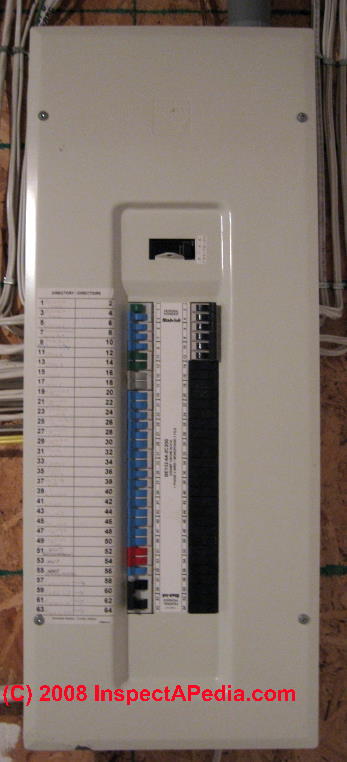
- POST a QUESTION or COMMENT about the safety and reliability of older vs more contemporary Federal Pioneer FP Electrical Panels and Circuit Breakers
Federal Pioneer Stab-Lok breaker & electrical panel safety: Canadian FP circuit breaker failure tests & failure rates to 2023 show a significantl higher failure rate than many other brands: about 23% of the time Canadian FP circuit breakers fail to trip properly. We including recent tests completed on newer circuit breakers from a 2004 home.
This article reports on testing confirming hazards of the Federal Pioneer Stab-Lok® electrical panels & circuit breakers, in both older and in more-recently manufactured FP product versions.
We also include data on electrical fire occurrences, frequency, reported causes, for Australia, Canada, the U.S. and other countries.
InspectAPedia tolerates no conflicts of interest. We have no relationship with advertisers, products, or services discussed at this website.
Are Newer Federal Pioneer Stab-Lok® Electrical Panels Safer than Older FP or Federal Pioneer Panels & Breakers? NO.
 The Federal Pioneer brand of electrical panels and circuit breakers is a Canadian version of the Federal Pacific Electric Stab-Lok® equipment.
The FPE website explains the hazards associated with the American product: Federal Pacific Electric Stab-Lok® circuit breakers and service panels, provides a history of the issue, recounts research on FPE failures, and recommends replacement of the panels.
Photo above: an ACBC FP Stab-Lok circuit breaker that can be currently (2017) found for sale online such as at Amazon.
[Click to enlarge any image]
Significant Failures among Federal Pioneer & American Pioneer Circuit Breakers
Bottom line:
[We can] conclude with a reasonable level of certainty that the Canadian product is not substantially different from the USA product in terms of defective calibration. - J. Aronstein, 9 November 2020, detailed below.
Test Results for Canadian Federal Pioneer - FP - Circuit Breakers: Failure Rates
Test Results for Canadian Federal Pioneer "FP" |
|||
| Canadian FP / FPE& Federal Pioneer Breakers | |||
| Total Canadian FP Circuit Breaker Tests to 2023 | No. | Failure Rate | |
| Number Tested | 157 | 23% | |
| Failures: UL 135% Test | 36 | ||
| Failures: NO-TRIP @ 200% (Jammed)5 | 2 | 1.5% | |
| Canadian FP Circuit Breaker Tests completed in October 2023 - below 4 | No. | No. of F ailures |
Sample Failure Rate |
| Summary for the Canadian FP breakers listed just below | 18 | 5 | 27.8% |
| 15A single pole: all OK (all tripped at or below 135% of rating) |
8 | 0 | 0 |
| 15A double pole: one failure to trip at 135% as required | 4 | 1 | 25% |
| 15A GFI/single pole: failed to trip at 135% as required | 1 | 1 | 100% |
| 30A double pole: OK | 1 | 0 | 0 |
| 20A double pole: two failed to trip at 135% as required (on one of the two poles) |
3 | 2 | 67% |
| 40A double pole: failed to trip at 135%, probably jammed (stopped test at 75A - it was very hot) 5 |
1 | 1 | 100% |
| Canadian FP Circuit Breaker Tests completed in February 2023 - below6 | No. | No. of Failures |
Sample Failure Rate |
| Summary for the Canadian FP breakers listed just below | 24 | 4 | 16% |
| #10 failed to trip at 135% as required (one pole of a a 30 amp double pole) |
1 | ||
| #13 (20 amp single pole): failed to trip at 135% as required | 1 | ||
| #22 (15 amp single pole): failed to trip at 135% as required | 1 | ||
| One breaker not numbered, FPE Canada brand (one pole of a 20 amp double pole) |
1 | ||
| Canadian FP Circuit Breakers Tested to 2020 - below.1-3 | No. | No. of Failures |
Failure Rate |
| Summary for the Canadian FP breakers listed just below | 115 | 28 | 24.3 % |
| Failures: UL 135% Test | 27 | ||
| Failures: NO-TRIP @ 200% (Jammed) | 1 | .8 % | |
Notes to the table above
- The sample size is now sufficient to conclude with a reasonable level of certainty that the Canadian product is not substantially different from the USA product in terms of defective calibration.
Where some suib-fields in the table are left blank it's that we do not have those details from the test reports. - Canadian FP or Federal Pioneer circuit breakers and panels are currently a brand owned and marketed in Canada by Schneider Electric.
- American-Pioneer or American FP Stab-Lok circuit breakers were produced by Canadian Federal Pioneer (Schneider Electric) and were sold under exclusive contract in the U.S. by ACBC, American Circuit Breaker Company, no longer in operation (2017) - Ed.
- Private email, J Aronstein to D Friedman et als, 10 April 2017, reporting "the results to date on all Stab-Lok types having the "American" brand (in its various forms) and Canadian brand (Pioneer Canada, etc.)."
- United States Court of Appeals,Ninth Circuit. AMERICAN CIRCUIT BREAKER CORPORATION, a New York corporation, Plaintiff-Appellant, v. OREGON BREAKERS INC.[PDF] an Oregon Corporation; Stephen Reames, an Oregon resident, Defendants-Appellees.
No. 03-35375.
Decided: April 25, 2005 - Source: http://caselaw.findlaw.com/us-9th-circuit/1122416.html
Excerpts from this case are at FPE STAB-LOK HISTORY
- Breakers provided from an Ottawa, Canada home was built in 2004, contributed by an InspectApedia.com reader.
Test results by private Email, Dr. Jess Aronstein to D. Friedman 2023/10/17, summarizing, 5 Canadian FP circuit breaker failures in 18 circuit breakers. Shipping paid by InspectApedia.com.
The reader provided 24 Canadian FP breakers in January 2023 and another 18 FP circuit breakers in June 2023. The test results below report on those breakers for which testing has been completed to date (October 2023).
Details include these that failed to trip at or below 135% of the rated current - the upper allowable limit:
#10 was the dryer circuit
#13 was a kitchen plug circuit
#22 was a basement circuit
the 20A unnumbered was for a 2 ton AC
Aronstein commented "A few others were marginal." - One of the 2023 set of breakers was probably jammed, testing stopped at 75A.
- Private Email, Aronstein to G.E., Feb. 6, 2023, excerpts below:
Four of the breakers in this set of xx failed to trip at 135% of rated current - the upper allowable unit. A few others were marginal.
In terms of overall percentage of failures, your set was pretty good relative to others that I have tested. That is likely due to the prevalence of 15 amp breakers in the sample set, all with the same date code (off the assembly line at the same time). The results will be added to the accumulated data and used in the next update of the report "Hazardous FPE Circuit Breakers and Panels" which will be posted at: http://fpe-info.org/ later this year.
Discussion: Previous Canadian FP Stab-Lok Circuit Breaker Test Results
Circuit-breaker no-trip rates for a limited sample of both "American" brand and "Canadian" brand Federal Pioneer Stab-Lok type circuit breakers sold as Canadian Pioneer and American Pioneer were summarized in independent tests performed by J. Aronstein as of April 2017 finding a 38% failure-to-trip for Canadian Pioneer FP circuit breakers and a 14% failure-to-trip rate for American Pioneer circuit breakers.
What's the difference between a "no trip" circuit breaker failure and a UL 135% of current trip failure?
Experts distinguish between a hard "no-trip" circuit breaker at which a device fails to turn off at any current load, and a "fail trip when should" failure such as the UL 135 test that requires that a circuit breaker trip within a prescribed time in minutes when exposed to a current draw at 135% of its rated capacity.
Both of these circuit breaker failure types are fire and safety hazards.
Research shows that Canadian Federal Pioneer or FP circuit breakers fail at about the same rate as US Federal Pacific Electric or FP breakers
In 2018 additional testing by Dr. Aronstein examining an additional set of FP breakers from a single Canadian home found that the performance of those Canadian Federal Pioneer circuit breakers was similar to that of U.S. FPE-brand circuit breakers.
In 2020 additional testing by Dr. Aronstein examining an additional set of older FP breakers from a single Canadian home found once again that the performance of those Canadian Federal Pioneer circuit breakers was similar to that of U.S. FPE-brand circuit breakers.
Readers should also see FPE & FP IDENTIFICATION, HOW TO for help in identifying Federal Pioneer old and more recently-manufactured Stab-Lok® products, and
see FP FEDERAL PIONEER in CANADA for a discussion of the safety of older Federal Pioneer equipment.
These discussions pertain only to the Federal Pioneer Stab-Lok® electrical equipment brand made in Canada, or made elsewhere and sold in Canada under the FP or Federal Pioneer brand. Here our comments do not pertain to the Federal Pacific Stab-Lok® brand made and installed in the United States.
In Canada, the Federal Pacific Electric FPE Stab-Lok® electrical panel and circuit breaker line has been and continues to be sold under the brand name Federal Pioneer or FP or FP Stab-Lok® and is produced by Federal Pioneer, a Canadian division of Schneider Electric.
In the United States FP or Federal Pioneer® Stab-Lok circuit breakers were distributed by ACBC (no longer in business) as replacements for FPE Stab-Lok breakers under contract with Federal Pioneer - Schneider Electric, Canada. As of April 2017 ACBC-branded "FPE" circuit breakers continue to be marketed to U.S. consumers from a variety of sources such as Amazon and Pacific Coast Breaker, a privately held company in Mcclellan, CA.
Also see CHALLENGER ELECTRIC PANELS.
Recent data about the performance and hazards of Canadian-made Federal Pioneer equipment newer than 1997 is lacking though there has been a Canadian product recall and a hazard warning for older equipment.
In U.S.-made Federal Pacific Electric components, we recommend against replacing individual FPE Stab-Lok® circuit breakers - there is no evidence that doing so will improve the safety of the electrical system.
Watch out: We recommend that any U.S. FPE Stab-Lok® [Federal Pacific Electric] and Canadian FP [Federal Pioneer] equipment be replaced entirely.
2020 Test Results Confirm 24% Failure Rate for Canadian-made Federal Pioneer - FP - Circuit Breakers
In August 2020 an InspectApedia.com reader offered an additional set of Canadian-made Federal Pioneer / FP circuit breakers for testing. These circuit breakers were obtained from a Canadian home in Edmonton, Canada.
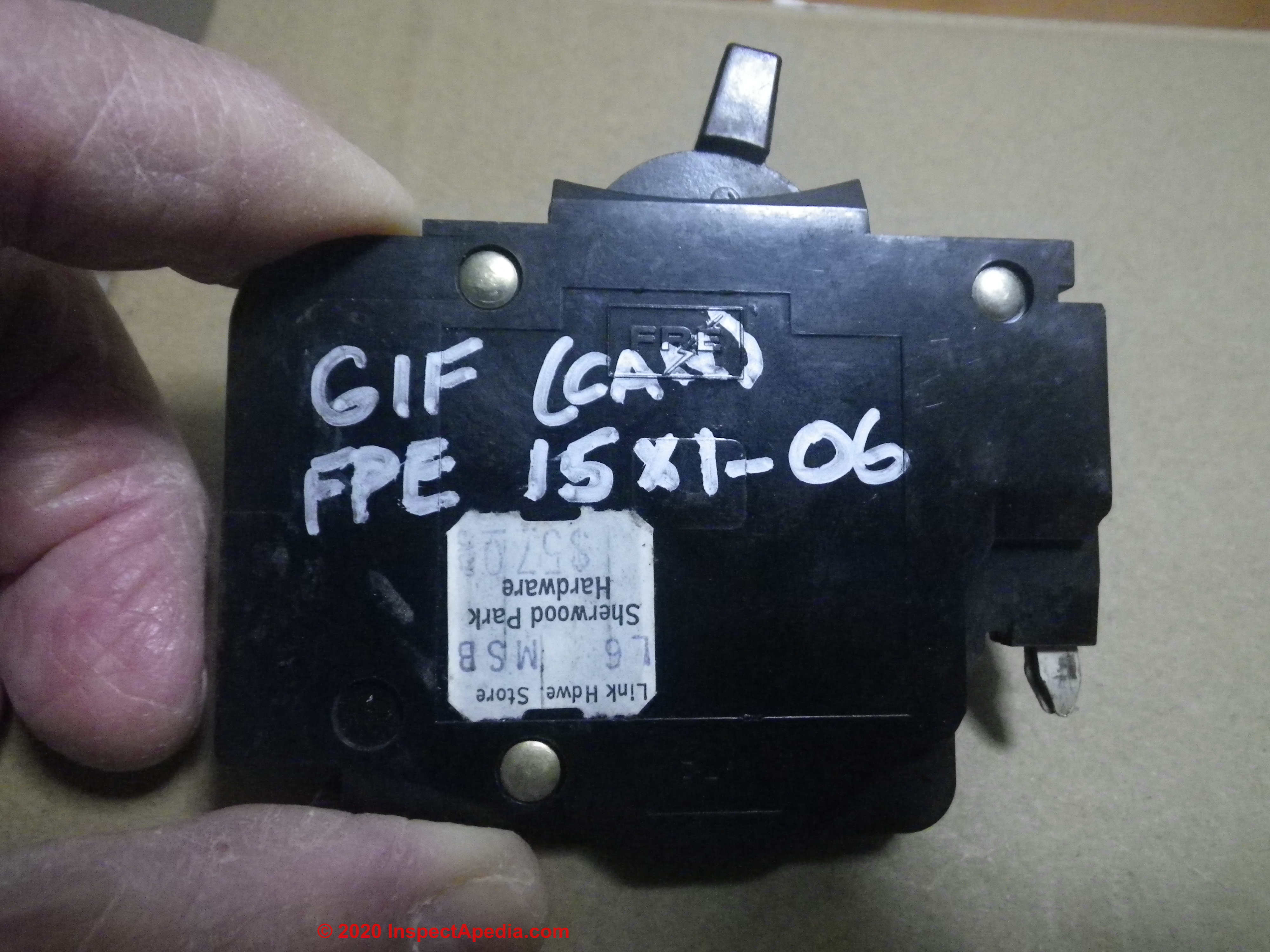
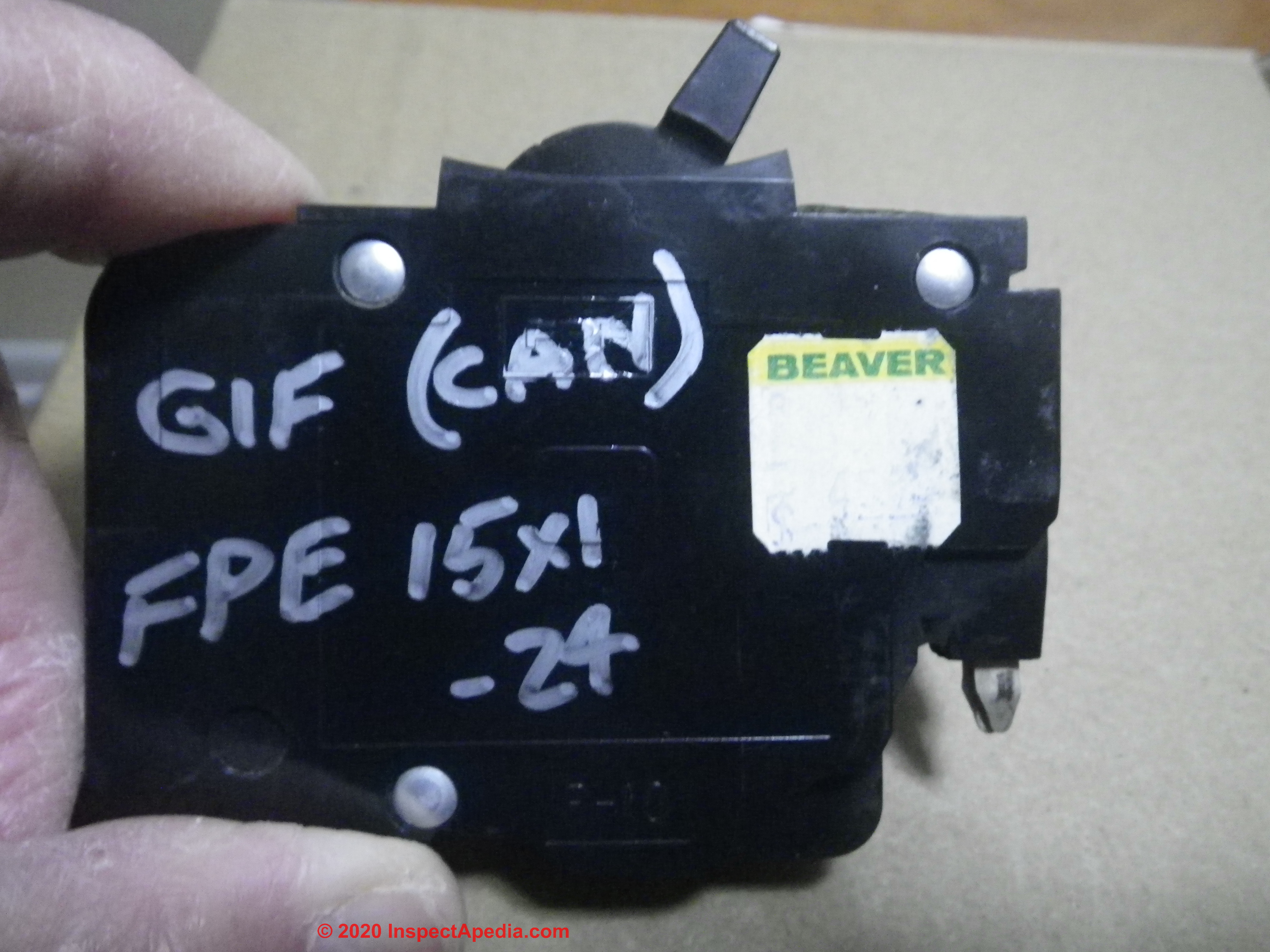
Examples from this collection of 28 Federal Pioneer circuit breakers include the 15A double-pole and 15A single pole circuit breaker shown here.
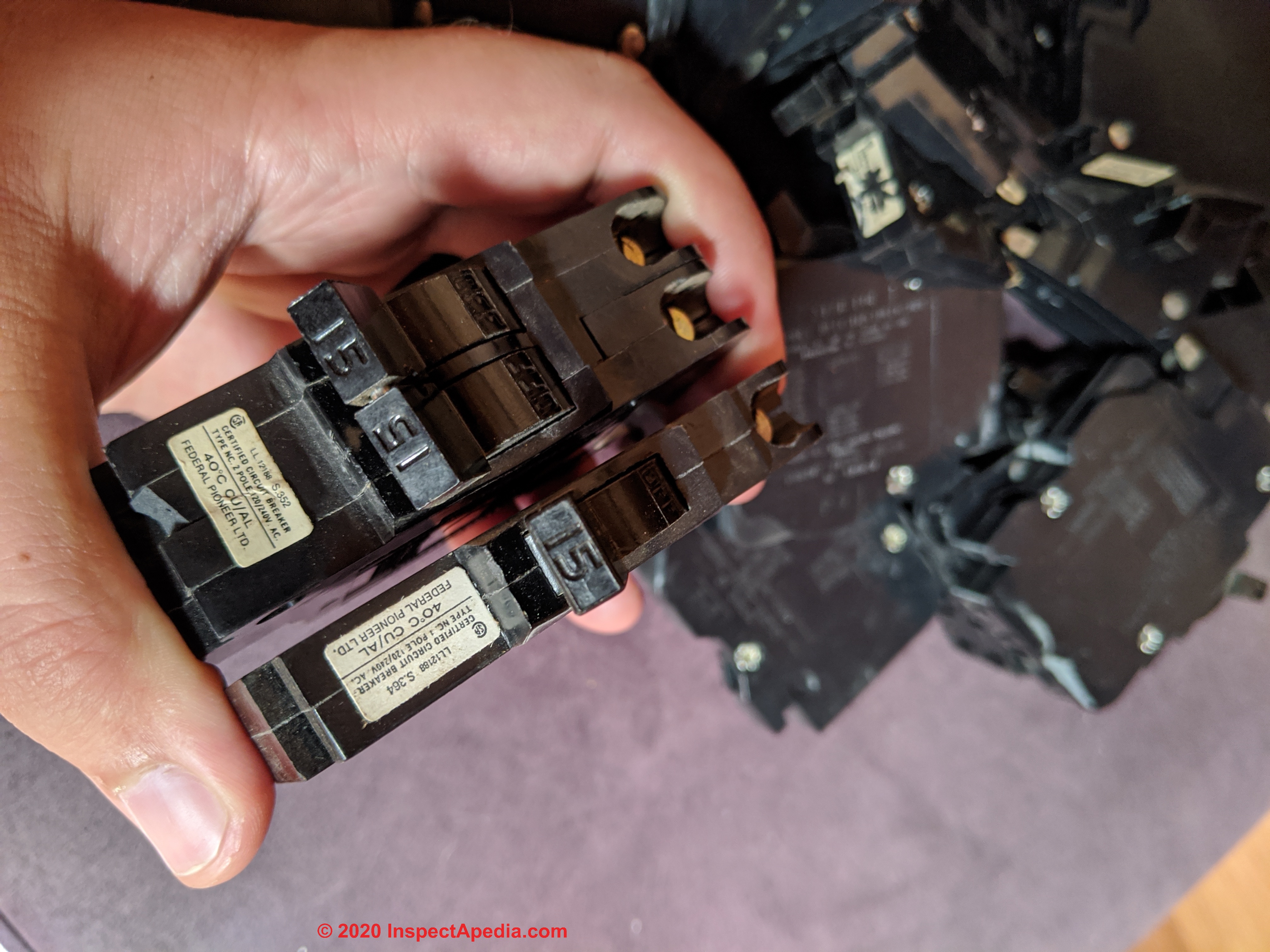
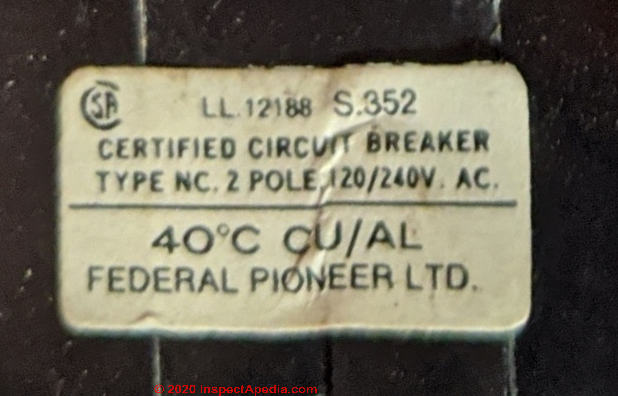
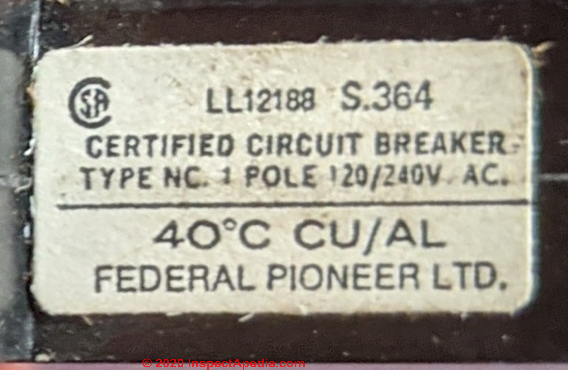
Below we see the CSA-listed label on each of these Canadian FP circuit breakers, confirming that these are the Canadian Federal Pioneer product.
 ...
... 
The circuit breakers were shipped by Canada Post, along with tracking data, to Dr. Jess Aronstein in Schenectady NY where, in September 2020, Aronstein performed additional circuit breaker load and failure testing as described in this article series.
Older Canadian FP Circuit Breaker Test Set Details
These FP circuit breakers included
- (24) 15A single pole,
- (2) 15A double pole
- (1) 30A
- (1) 40A double pole
for a total of 28 additional breakers obtained from the Canadian home.
- Building location: Edmonton, Canada
- Building Age: 1976
 ...
... 
- Circuit breaker age & replacement history:
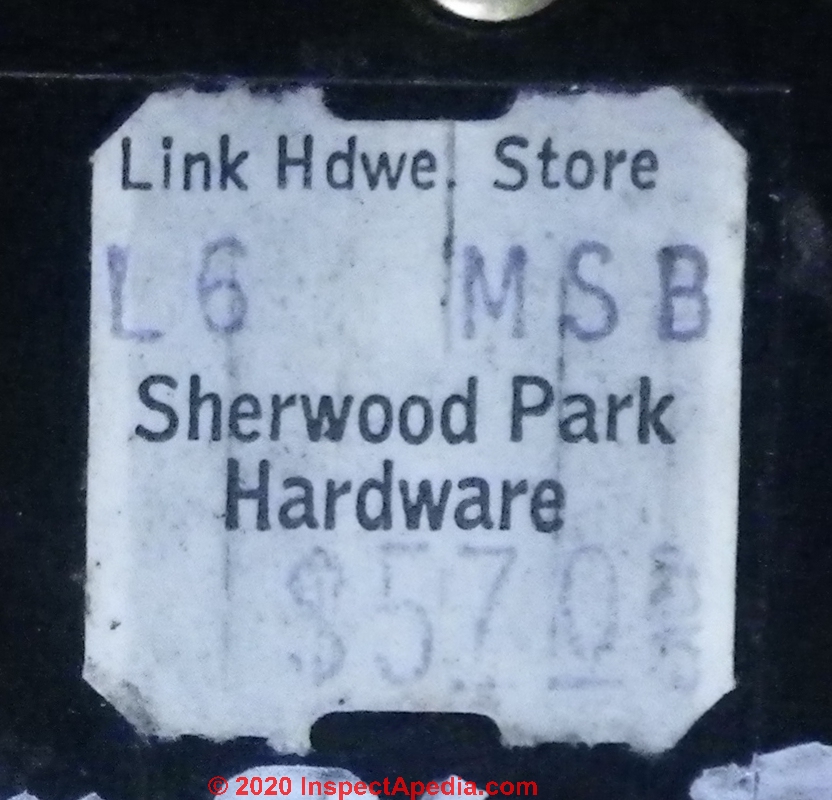
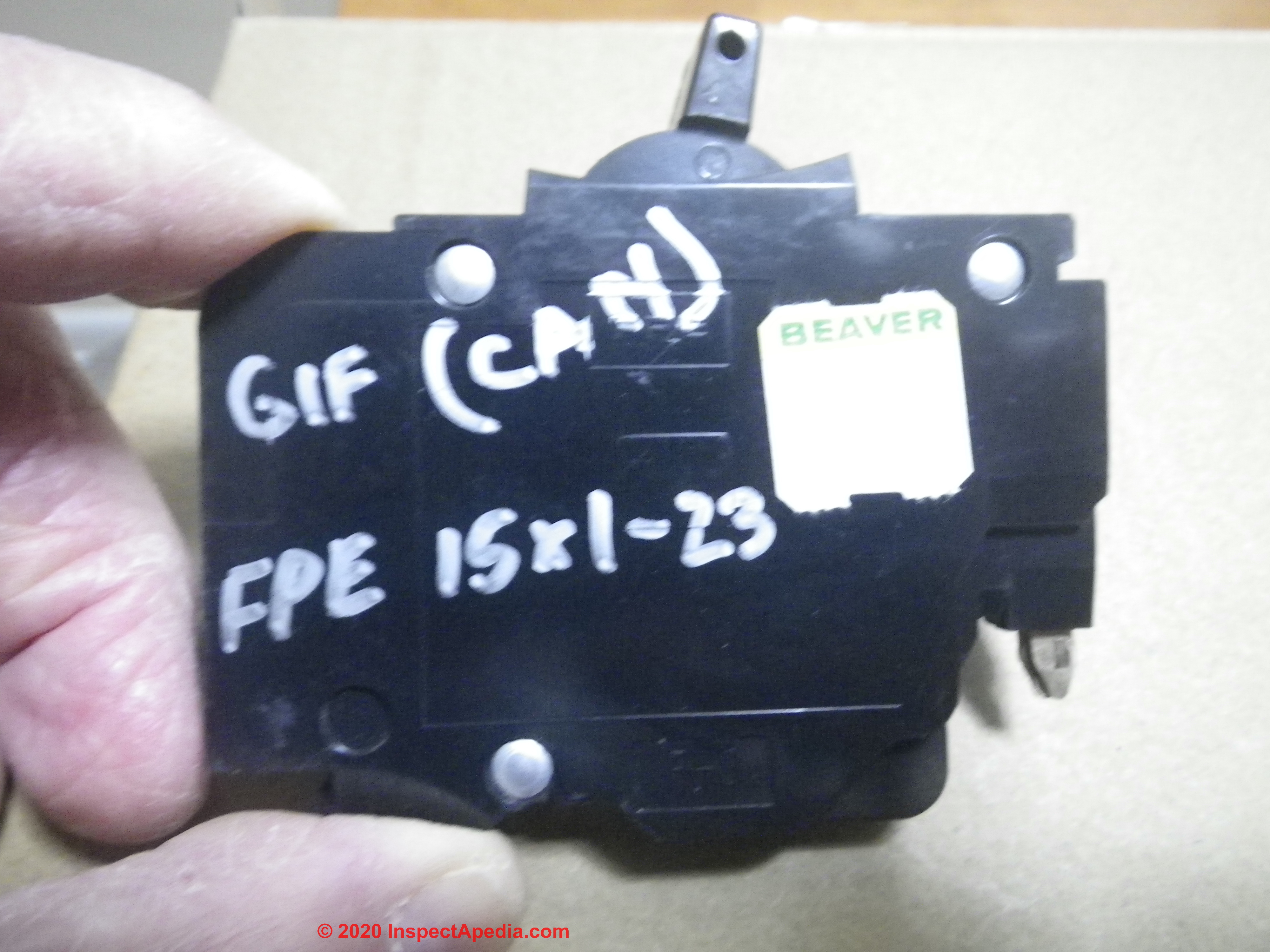
by visual inspection, labeling, these 25 appear to be original and three circuit breakers, shown above and below, bore store price stickers on their side, suggesting that they might have been added later for additional circuits or purchased as replacements.
One of these stickers was "Link Hdwr Store / Sherwood Park Hardware" and the two others were "Beaver". [Personal correspondence, Aronstein to Friedman 2020/11/13] - Current owner: purchased early in 2020
- Electrical issues observed: complaint of circuit breakers tripping at low loads - nuisance tripping?
- Visual evidence of moisture, corrosion, physical damage in the electrical panel: none
 ...
... 
Canadian FP Test Results, November 2020
On 9 November 2020 Dr. Aronstein reported the test results for these Federal Pioneer circuit breakers:
Three of the 15A breakers fail the calibration test (must trip within an hour at 135% of rated current). Two are 1-pole and the third is a 2-pole.
The overall tally for Canadian Stab-Lok type breakers is now 115 tested, 27 failed calibration test, and 1 jammed (no trip at 200%).
The sample size is now sufficient to conclude with a reasonable level of certainty that the Canadian product is not substantially different from the USA product in terms of defective calibration.
This most-recent FP breaker sample set dates back to the early days of Stab-Lok production in Canada.
It is interesting to note that the samples of more recent production (Federal Pioneer brand) that tested so far [by Dr. Aronstein] have a substantially higher defect level, about 25% (14 fails out of 57 breakers tested).
2019 FP Circuit Breaker Test Results - April 2018 - Updated March 2019
[Click to enlarge any image]
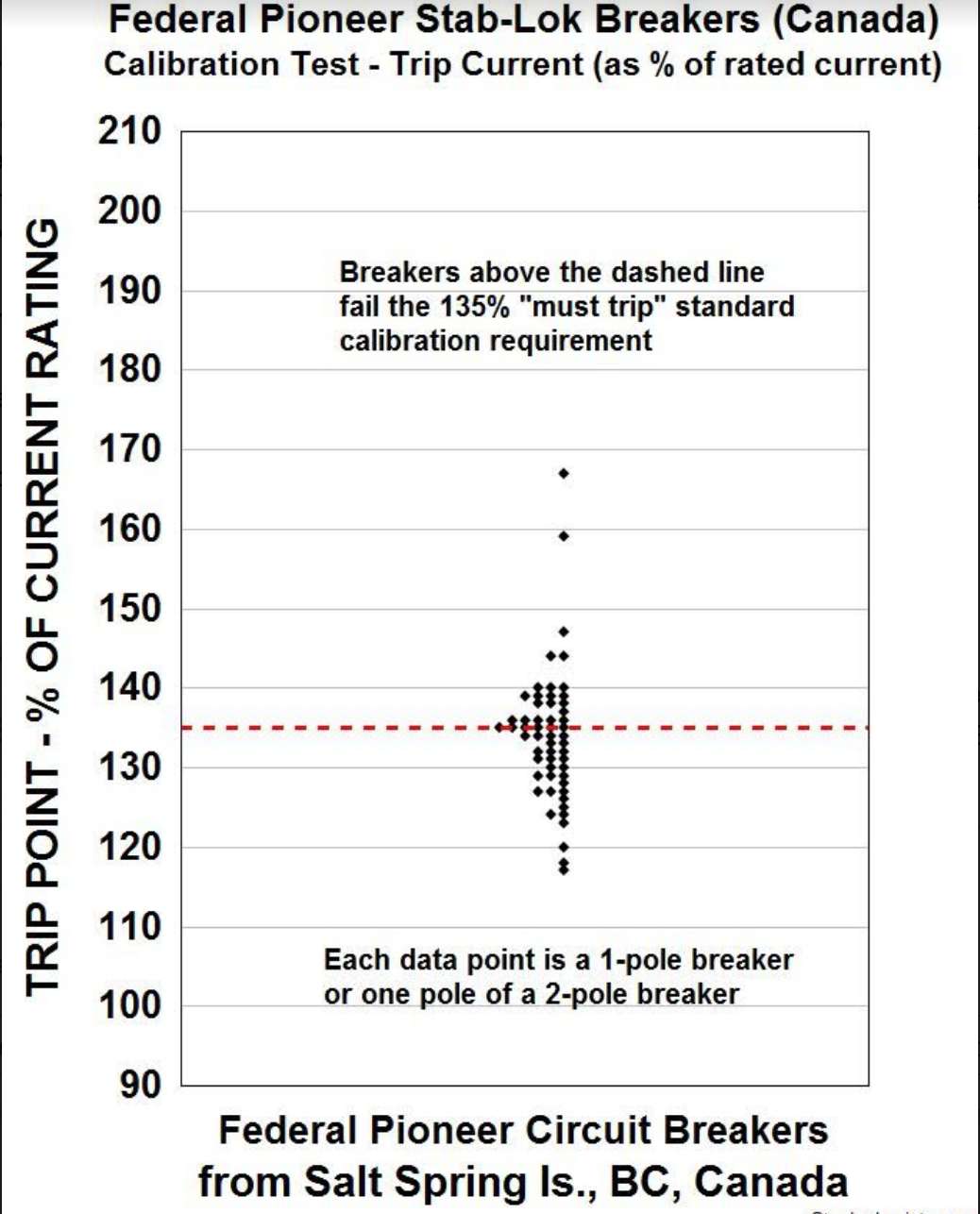
The December 2018 Failure rates for Federal Pioneer Circuit Breakers are shown above.
Below at "2019: Bottom Line on FP / Federal Pioneer Electrical Panel / Circuit Breaker Performance & Safety" you will see this failure pattern remained when the sample size of FP breakers was increased to include Federal Pioneer breakers from additional Canadian homes.
Dr. Aronstein comments:
The performance of this homeowner's samples of Canadian Federal Pioneer breakers is similar to that of the US brands.
In the photos, the red dots on the breakers indicate those that failed to meet the UL/CSA 135% "must trip" calibration requirement.
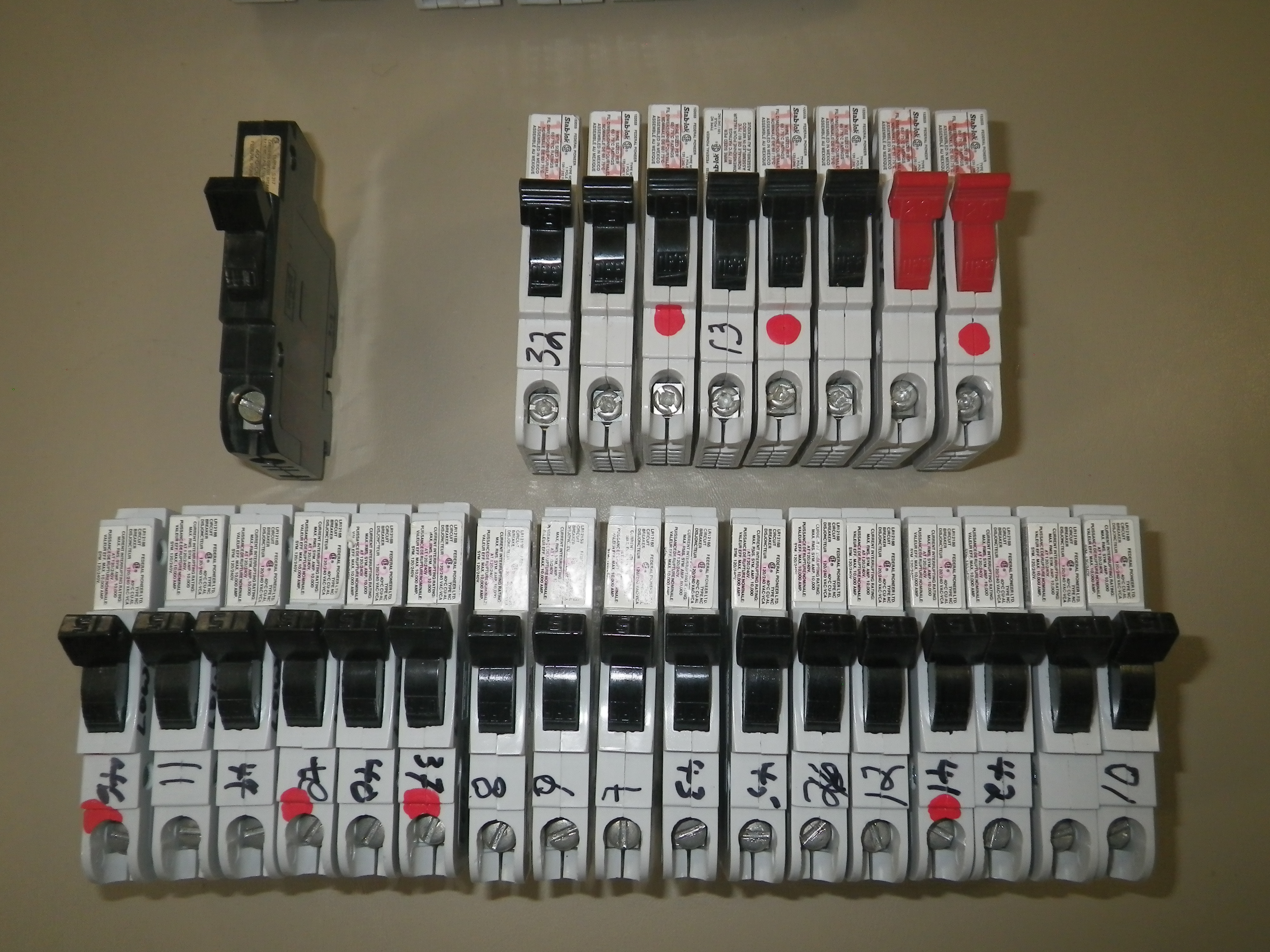
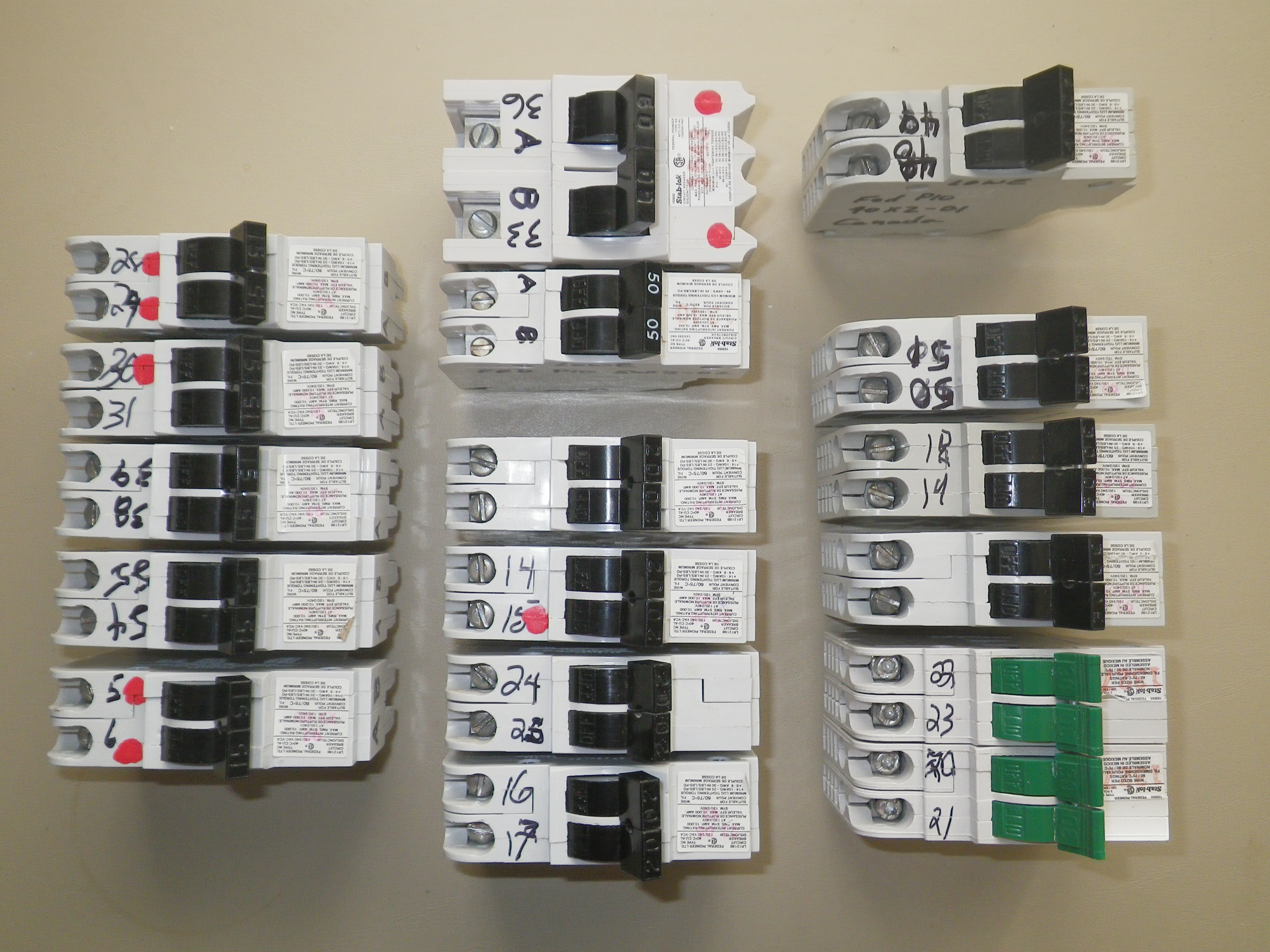
If we are interpreting the date codes correctly, about 2/3 of these Federal Pioneer circuit breakers were made in Canada in 1992 and the other 1/3 were assembled in Mexico.
Below, from Aronstein, as presented at the ASNT Meeting, 11 December 2018 - private email JA to DF & D. Hansen, 2020/01/26 compares Federal Pioneer circuit breaker failure results with larger samples of FEP, FPE, UBI, new UBI breakers, and Federal Pioneer.
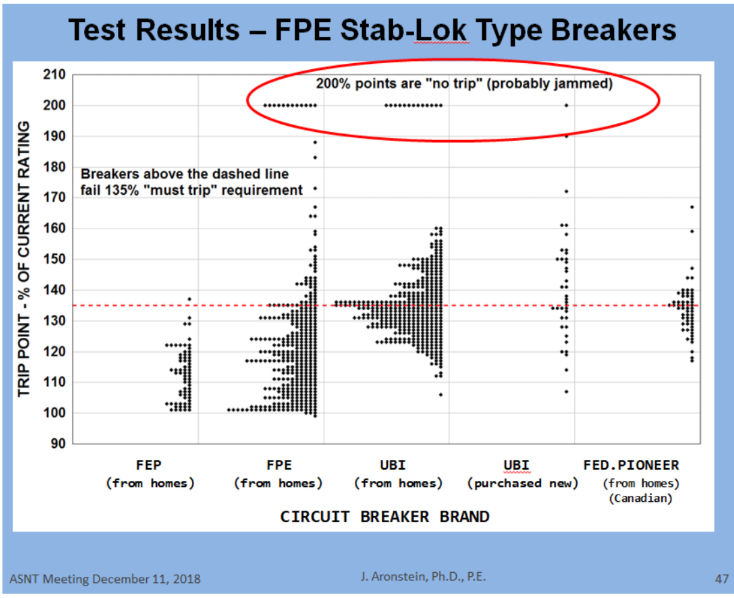
[Click to enlarge any image]
Preliminary Test Results for Canadian-made Federal Pioneer - FP - Circuit Breaker Failure Rates
Preliminary1 Test Results for a Small Sample of Canadian-Produced Stab-Lok type Circuit Breakers |
||||
| Canadian FP / FPE & Canadian Pioneer Brand |
American FP & American Pioneer Brand |
|||
| Number Tested | 24 | 51 | ||
| Failures: UL 135% Test | 9 | 38% | 7 | 14% |
| Failures: NO-TRIP @ 200% (Jammed) | 1 | 4% | 0 | 0% |
Notes to the table above
1. Opinion: while the Canadian FP circuit breaker test results shown above look compelling, readers must note that for statistical validity a substantially -larger sample size is required to obtain a sound estimate of the actual circuit breaker defect rate.
Additional FP breaker test results through April 2019 are given below.
Test results to date, including on a few new circuit breakers have indicated that there may be problems with some of the brands, and those results have been sufficient to justify expanding to a larger sample set. Further FP testing results were reported by Aronstein in April 2018 - cited herein.
2. American-Pioneer or American FP Stab-Lok circuit breakers were produced by Canadian Federal Pioneer (Schneider Electric) and were sold under exclusive contract in the U.S. by ACBC, American Circuit Breaker Company, no longer in operation (2017) - Ed.
- Private email, J Aronstein to D Friedman et als, 10 April 2017, reporting "the results to date on all Stab-Lok types having the "American" brand (in its various forms) and Canadian brand (Pioneer Canada, etc.)."
- United States Court of Appeals,Ninth Circuit. AMERICAN CIRCUIT BREAKER CORPORATION, a New York corporation, Plaintiff-Appellant, v. OREGON BREAKERS INC., an Oregon Corporation; Stephen Reames, an Oregon resident, Defendants-Appellees.
No. 03-35375.
Decided: April 25, 2005 - Source: http://caselaw.findlaw.com/us-9th-circuit/1122416.html
Excerpts from this case are at FPE STAB-LOK HISTORY
Federal Pioneer circuit breaker date code stamps
The Federal Pioneer circuit breaker labels shown below include date codes. The date code for the newer breakers (Mexico) is the 4-digit number stamped in red on the listing label. Our interpretation is that the first two digits are the year and the second two digits are the week of manufacture.
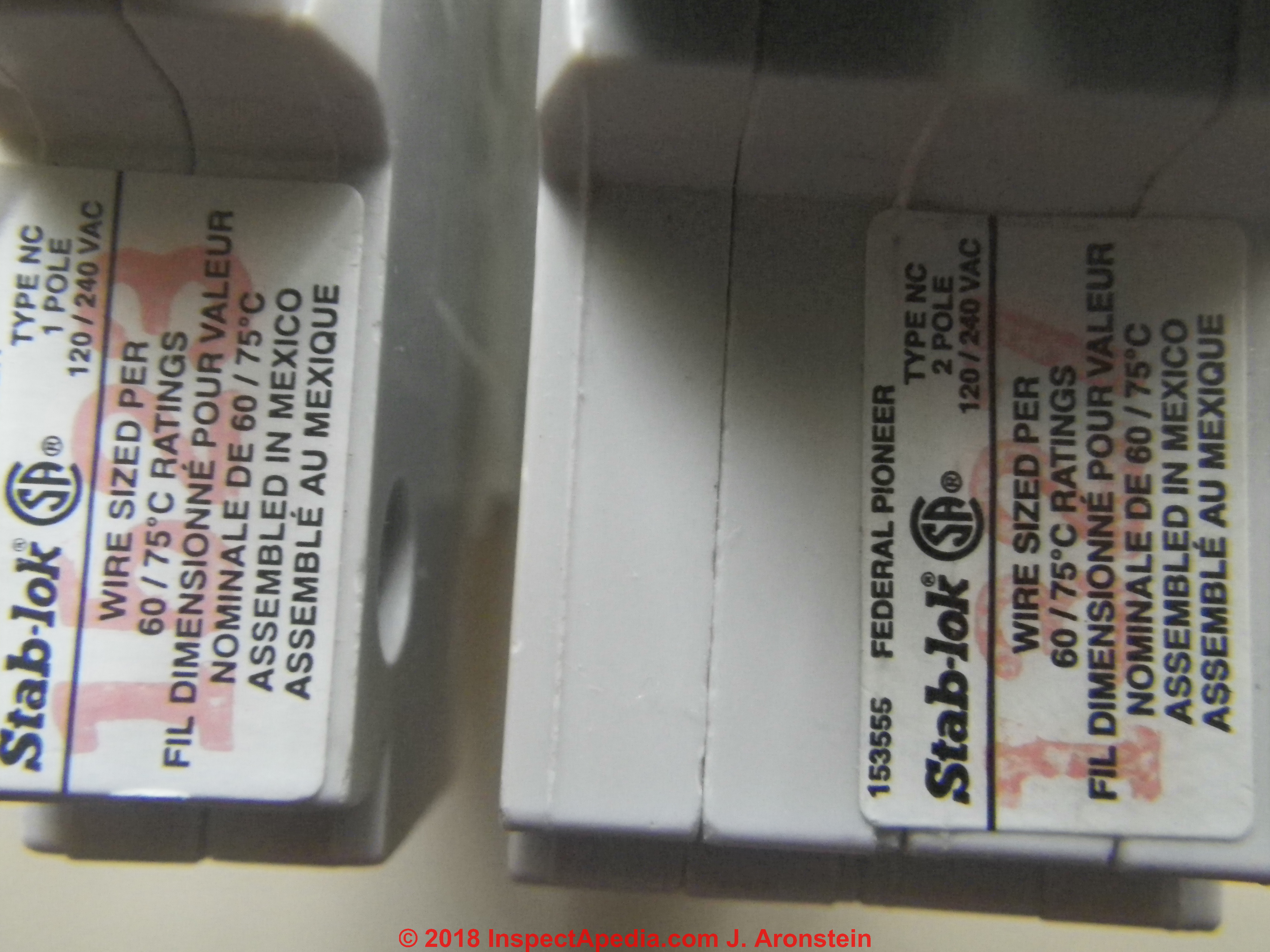
The left-hand Federal Pioneer circuit breaker' label date code stamped in red is 1523 that we decode as date of manufacture 2015, week 23.
The date code on the second FP circuit breaker at right in the same photo is 1327 that we decode as having been produced in 2013, week 27.
History of these FP Circuit Breakers
Details about the circuit breakers illustrated above were provided by the homeowner:
[The BC Canadian home from which these breakers were removed] was built in 1992. We purchased it in 2010, maintaining it as a vacation property ... in 2013. The house has been under slow renovation from 2013 to the present.
One of our first renovation projects was replacement of the electric baseboard heaters with an air-to-water heat pump. The three double-pole circuit breakers that supplied power to the three pieces of equipment are numbered 20-21, 22-23 & 24-25. They were installed in January, 2014.
There are three double-pole breakers without numbers shown in your photo. The 50 Amp unit was purchased for an upcoming kitchen renovation and is unused.
The other two are probably used, taken out of the panel when we decommissioned the electric baseboard heaters or some other equipment.
There are seven single-pole breakers without numbers shown in your photo. The unit with the slot-head screw in the bottom row was probably used and taken from the panel as we reworked some of the house electrical.
The six shown in the top row with a Robertson screw are in all likelihood unused spares that we purchased to have on hand for when we reworked/expanded the electrical distribution in the house. We had heard that Stab-Lok breakers might become hard to find in the future, so we thought having some spares on hand would be a good idea.
2019: Update on FP / Federal Pioneer Electrical Panel / Circuit Breaker Performance & Safety
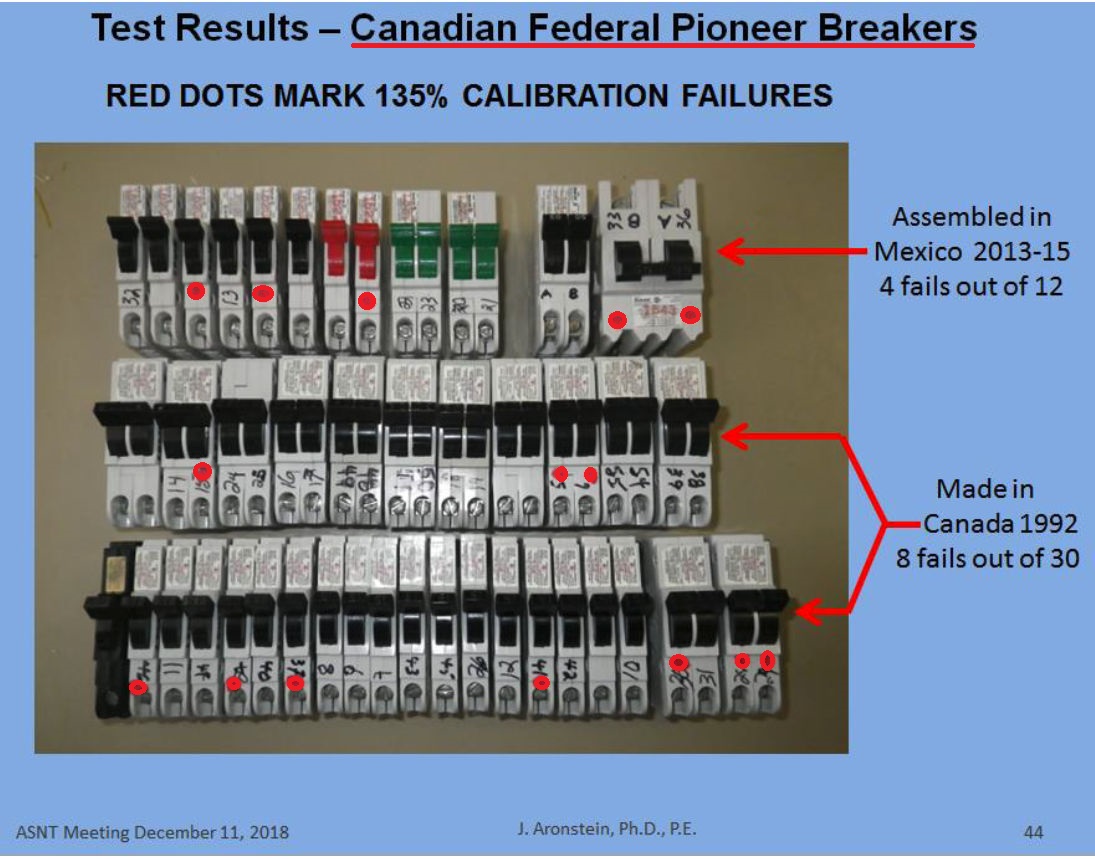
Above: the Federal Pioneer circuit breakers marked with a red dot are those that failed the 135% Must Trip requirement.
[Click to enlarge any image]
In April 2018 we had reported that the older or newer Federal Pioneer panels installed in Canada, from tests to date, appear to perform about the same as the older, discontinued US Federal Pacific Electric or FPE Stab-Lok® version of this product.
In March 2019 Dr. Aronstein provided the photo and FPE Stab-Lok Breaker Test Results, including Federal Pioneer breakers from Canadian Homes as shown here. You can see that a significant number of circuit breakers of all of the Stab-Lok variations tested showed significant failures to trip - see the clusters of dots above the 135% "must trip" requirement.
That means that the circuit breaker must trip when exposed to 135% of its nominal or rated current. This information was presented by Aronstein at an ASNT meeting on 11 December 2018. - private communication, J. Aronstein to D Friedman
Below: FPE and FP (Federal Pioneer) Circuit Breaker Test Results from Dr. J. Aronstein, cited above.
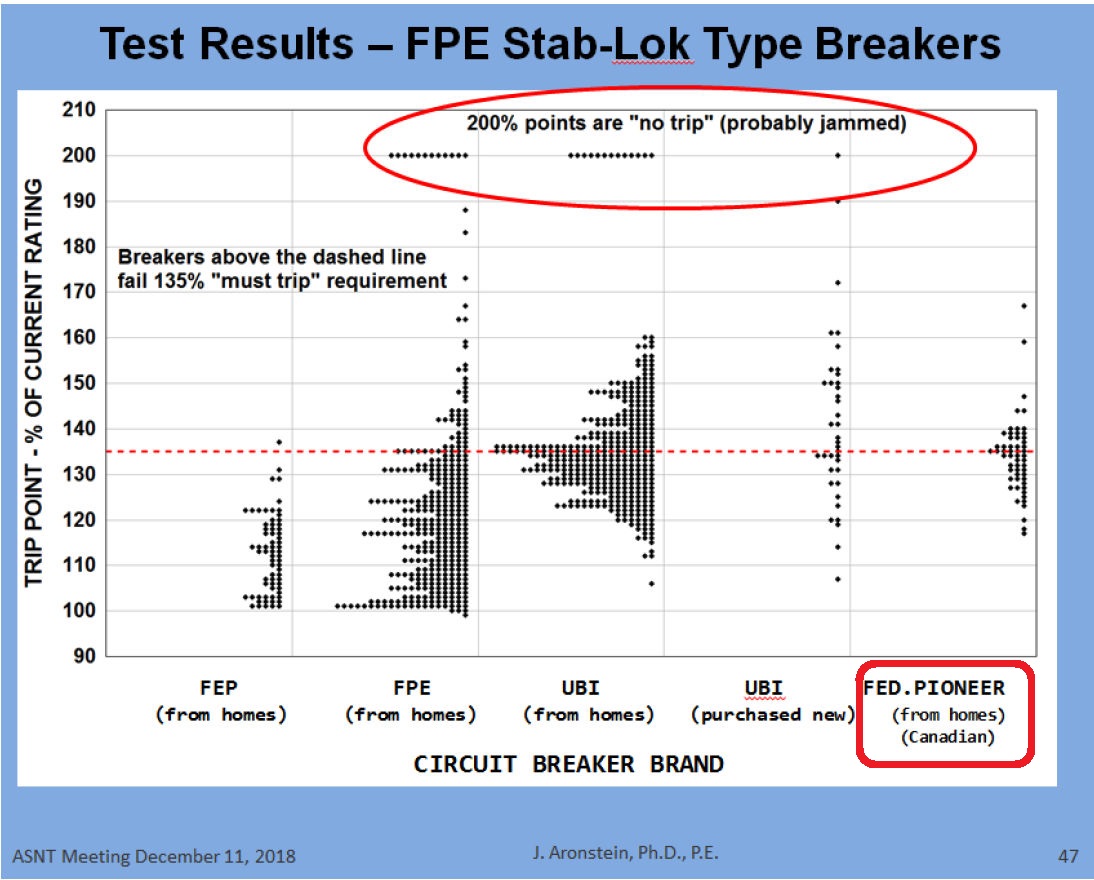
[Click to enlarge any image]
Building owners should not rely on any Federal Pacific Electric Stab-Lok® electrical panels, nor Federal Pioneer Stab-Lok® circuit breakers and panels, and building owners should be cautious about continuing to rely on any older Canadian Federal Pioneer® design.
We have much less field and test data on the Canadian FP products. There was a 1997 Canadian FP recall notice
discussed at FEDERAL PIONEER CIRCUIT BREAKER RECALL and
a 1997 warranty alert discussed at FEDERAL PIONEER WARRANTY ALERT.
We have received only some field reports about Canadian FP installations than U.S. FPE installations, but we lack data to know if that’s due to fewer website readers from Canada, fewer FP panels installed in Canada than FPE in the U.S., better Canadian electrical wiring workmanship overall, fewer electrical events that should trip the breaker, or a better product or redesigned product in the Federal Pioneer versions of this equipment sold in Canada.
In March 2019 we (Aronstein & Friedman) corresponded with a Canadian reader considering replacing a large number of FP distribution panels that were installed in a Canadian government building, principally between 1975 to 1979. The reader reports being asked
... if these [Federal Pioneer] breakers are defective, [why] are they apparently still manufactured and available in large stores [such as Home Depot stores, online circuit breaker outlets, and from Schneider Electric?
In our correspondence with the reader Dr. Aronstein explains:
See attached recent test results on Canadian Federal Pioneer Stab-Lok breakers. The red dots on the breakers identify those that failed to trip at 135% of rated current as per UL/CSA requirement. (The FPE data is a representative set - smaller than the total tested to date - with the same number of data points as for the UBI breakers.)
The listing and labeling system is weak. It depends on a pre-scheduled visit by a CSA inspector no more often than once every three months during which the inspector observes the manufacturer's test of about 6 breakers taken from the production line. The detailed test procedures and results are not available from either the manufacturer or CSA.
There is no independent entity such as Consumer Reports that tests breakers in the market supply chain.
CSA does not (nor do any of the NRTLs in the US) sample and test breakers that have left the factory. That means that our safety depends on the manufacturers' calibration and quality control procedures. Those procedures are not available.
It is known, however, that few manufacturers test any breakers to the 135% "must trip" requirement. Instead, in order to save time (and $) they test at 200% or 400% so as to speed up the testing. There may or may not be a good correlation between trip time at high current and trip (if at all) at 135%.
Further, with respect to the Stab-Lok design, there is no way of adjusting the calibration of the assembled breaker. Most likely every one that is assembled is shipped, and there are no standard AQL (Acceptable Quality Level) requirements.
We are depending on a "self-regulating" industry. In the US there is no person or agency specifically obligated to act on this sort of safety defect problem.
... I would also be interested in obtaining additional samples of Canadian Federal Pioneer Stab-Lok® breakers to increase the sample size and the statistical accuracy of the results. - J.A. to D.F. et als 2019/03/30
Canadian readers who can contribute FP circuit breakers for additional testing can contact Dr. Jess Aronstein at info@fpe-info.org
Or may CONTACT us.
The CSA Group (formerly the Canadian Standards Association; CSA), is a standards organization which develops standards in 57 areas. CSA Group publishes standards in print and electronic form and provides training and advisory services. CSA Group is accredited by the Standards Council of Canada, a crown corporation which promotes efficient and effective standardization in Canada. ... The CSA registered mark shows that a product has been independently tested and certified to meet recognized standards for safety or performance. - 2019/05/20 original source: Wikipedia https://en.wikipedia.org/wiki/CSA_Group
InspectApedia.com is an independent publisher of building, environmental, and forensic inspection, diagnosis, and repair information provided free to the public - we have no business nor financial connection with any manufacturer or service provider discussed at our website.
History of Federal Pioneer Electrical Panels & Breakers Produced or Sold in Canada
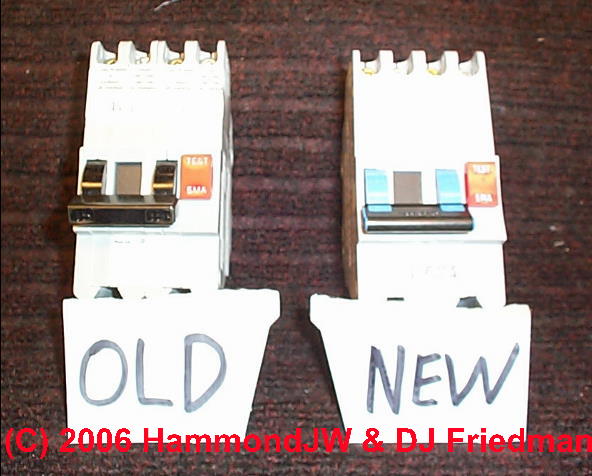 Schneider Electric in Canada purchased and has continued to market the Federal Pioneer line (which is the Canadian version of Federal Pacific Electric) of Stab-Lok® products.
How to Identify "Old" vs. "New" Federal Pioneer Circuit Breakers
Quite some time ago we (D Friedman) asked a Schneider engineer if Schneider made any product changes or improvements over the original FPE Stab-Lok® version when it was picked up in Canada.
While at first he was friendly, later, perhaps after talking with management, neither the engineer I spoke with nor anyone else at Schneider responded to any questions about this product whatsoever.
(The photo shows old and new circuit breakers such as seen in the Federal Pioneer NBLP38-TF32 electrical panel photographed in 1997)
At that time, I took that to mean that perhaps the company had no compelling good news to report, but I acknowledge that they could simply be afraid to share test or any other data, regardless of the product’s performance, as I explain below.
Some of the original product problems appear to have been inherent in the design of the breaker internal parts and the bus assembly, and I was told by some engineers that a redesign to correct these problems would have priced the product out of its niche in the market (the low end).
So we are faced with the situation of a company who has so far not provided public information about the product’s testing, performance, or engineering changes. We would very much welcome a Federal Pioneer product testing and performance update so to be able to inform to consumers whether or not later versions of the Federal Pioneer product line have been improved and perform acceptably.
I speculate that Schneider/Federal Pioneer may have indeed made corrections or improvements in the product since the 1970’s and 80’s, and I speculate further that they may be reluctant so say so since that would admit prior problems and thus risk liability and claims.
Watch out: Federal Pioneer circuit breaker test results to date show no improvement in "new" or "more-recent" models of these products.
Federal Pioneer Electrical Panel / Breaker Failure or Malfunction Field Reports Requested - use the page top or bottom CONTACT link or the page bottom Comments Box.
Reader Field Reports of Federal Pioneer Circuit Breaker Failure
On 2021-05-11 - by Anon: FP Breaker Failure in 2006 Home in Canada
Field failure report for Canadian FP circuit breakers in a 2006 home
I recently acquired a property containing a modular home equipped with a FP panel, built in 2006.
Upon attempting to start up the well pump, the motor starting capacitor/relay was clicking on and off around 10 second intervals.
Applying an amperage meter to the circuit we observed an alarming reading of 29 amps! The well pump was stuck, and cutting was out thermally at the motor some 200 feet below.
The 15 amp dual breaker that should have protected the circuit failed to trip multiple times as the motors own thermal protection took effect and reset.
Having already known the perils of these panels, I didn't need any additional convincing, and I plan to replace the entire assembly before home occupation.
The breaker assortment is your typical household mix of 15A, 30A, 40A and 100A main, including one GFCI and one brand new AFCI which has never seen a load.
Comment on Beaver Lumber hardware stores selling FP Circuit Breakers
Random side note: The Beaver price tag on your last batch of breakers refers to a chain of residential hardware stores previously known as Beaver Lumber .. they were bought out by Home Hardware (East Canada), which merged with Link Hardware (West Canada, on your other breaker tag) to create a national coverage chain.
They're very common in smaller communities, alongside other similar chains like True Value or Peavey Mart. They're a go-to for common plumbing fittings and electrical parts without having to travel into the more urban areas for a box store or wholesaler.
For as big as the world and the Internet is, I'm probably 5 minutes away from said defunct Link Hardware, assuming the Home Hardware that replaced it is in the same place.
- Anonymous by private email to editor 2021/05/10
Moderator reply:
We are discussing obtaining high resolution photos of this electrical panel, bus assembly, circuit breakers, wiring conditions, as further testing of FP breakers is no longer required. (Personal correspondence between the website reader, Jess Aronstein and the website editor 2021/05/11)
Canadian Federal Pioneer FP Stab Lok Panel Failure Report, 2015/09/17
I live in Ottawa ONT Canada
I recently had a Outdoor GFI outlet fill with water and caused the box to arc so bad that the hot wire melted right off.
I was shocked to see that the breaker did not trip, I consulted with an electrician and his conclusions were that the breaker had to be faulty. I bought a brand new Siemens stab loc 15 amp breaker for my Federal Pioneer panel, The electrician tested it (dangerously) by shorting it to the box, Sparks! and no trip of the brand new breaker. This should trip the breaker, no matter what right?
Please help, I am reading a lot about Federal Pacific being dangerous and panels should be replaced....but not much about Federal Pioneer. I was on the phone with tech help at Schneider,(who bought Federal Pioneer).
They claim that if my panel is in Canada and that it is Federal Pioneer, it should be fine and that one of their breakers would be safe. When I questioned him on the chances of 2 new breakers being faulty, he had no suggestion or comment.
I would really appreciate any input or advice you may have. - Anon, 17 sept 2015, Ottowa [by private email]
Reply:
Thank you ... for the important field failure report. If you do not object I'll add it to our field reports of this product, keeping you anonymous unless you want to be identified.
We have researched and published considerable information about Federal Pioneer used in Canada beginning
at FEDERAL PIONEER ELECTRIC PANELS and
you will find more field failure reports for FPE panels of what appears to be the identical design.
There is in my opinion a very good chance of multiple breaker failures in this product line as there appear to be inherent design issues, particularly corrosion at the breaker to bus connection and breaker overheating.
Take a look at the material we've provided and do let me know what questions remain.
It would be helpful to have photos of your panel cover, markings, labels, breakers, and also to know the age of the panel or when it was installed.
It is also my opinion that if it were my house I'd replace the panel.
CONTACT US - We invite building owners, electricians, fire marshals, manufacturers, or independent testing laboratories to report to us on the field performance or field failures or product testing results for this product and we will publish here any updates we are able obtain.
We’d also like to see photos of the bus design itself – an electrician can open the panel – remove the cover, and if necessary pull a breaker to expose the bus and breaker connectors – that might tell us if visible changes were made even if we don’t know if internal breaker design changes were made.
Reply from Anon:
I appreciate the reply. I did already read that article you linked me to and I am glad that you agree that the panel should be replaced. It is definitely troubling that these things are still sold, when it seems clear that they are/can be dangerous. I can't believe that Schneider could deny this over the phone with me! Terrifying.
Also incredible that they did not reply to your questions.
When I go shopping for my new panel in the next couple of weeks, I will be sure to research a panel and replacement breakers that have nothing to do with their company.
At this point I would prefer to remain anonymous in fear of having my house condemned before I have the money to afford this costly repair.
I will send you the pictures of my panel and any damage we may discover upon further inspection.
Again, I appreciate what you are doing here,
Reply:
Schneider is a big company. I have no data and thus nothing to criticize about their other products. I agree that the response on FP was disappointing.
I simply asked if they had any data to suggest a better performance of the Canadian product, if they had made any changes to the product design from the original FPE product made in the U.S. or if the equipment actually physically making the breakers was any different.
In sum, were there any product differences other than the label. The engineer was very cooperative in our original conversation, said he didn't know but would find out; then the company fell silent which to me says a manager gave the word to provide no information.
I could be wrong but it seems to me if I were making a product that had good test data and specs I'd be happy to publicize them.
I've been careful to point out that we have much less field data on FP performance in Canada than FPE performance in the U.S. We don't know if that's because the installed base is smaller, the electrical work is generally better (thus fewer events that should cause a breaker trip), lower propensity to report, or something else. Very few (less than a few %) of electrical failures are ever reported, making field reports important.
Hang on to your old FP panel, leaving it as intact and undisturbed as you can, as there may be an engineer left who's willing to carry on Aronstein's testing.
Watch out: from reading comments posted by some electricians at other websites I see that some Canadian electricians say they have found U.S.-made FPE Stab-Lok circuit breakers (and thus possibly "replacement" breakers that are unsafe) in Canadian FP electrical panels. See my Federal Pioneer breaker box discussion with another reader just below.
Compare Federal Pioneer / FP circuit breaker and FPE & Other Circuit Breaker Failure Rates
- Jesse Aronstein 1, (Life Senior Member, IEEE), & David W. Carrier 2 MOLDED CASE CIRCUIT BREAKERS - SOME HOLES IN THE ELECTRICAL SAFETY NET [PDF] Received December 4, 2017, accepted January 24, 2018, date of publication February 7, 2018, date of current version March 15, 2018.
Digital Object Identifier 10.1109/ACCESS.2018.2803298
1 Consulting Engineer, Schenectady, NY 12309, USA, 2 SUNY Dutchess Community College, Poughkeepsie, NY 12601, USA, Corresponding author: Jesse Aronstein (AronsteinJ@verizon.net)
This paper is also available at no charge at the IEEE Explore website. It can be accessed for online reading at: http://ieeexplore.ieee.org/document/8283732/
and can be downloaded directly from IEEE at http://ieeexplore.ieee.org/stamp/stamp.jsp?tp=&arnumber=8283732 - FPE HAZARD SUMMARY
- FPE HAZARD REPORT - 2017 [PDF] independent research article by Jess Aronstein, supersedes older FPE hazard reports by this author.
- Or see FPE-INFO.ORG - a non-commercial site dedicated to electrical & fire safety, posted by Jess Aronstein
- Or see FEDERAL PACIFIC FPE HAZARDS - home
- Or for a comparison of circuit breaker failure rates by brand see CIRCUIT BREAKER FAILURE RATES as well as the next cited article:
Electrical Fire Occurrence Data & Fire Reporting in Canada vs. U.S.
As we state in discussion of Federal Pioneer vs. FPE Circuit Breaker Failure data, differences in population as well as other factors are likely to explain differences in the absolute number of electrical fire or failure reports between Canada and the U.S.
The ratio of Canadian readers of the information on FP/FPE to U.S. readers is roughly 10-12. In the twelve months ending 20 November 2017 InspectApedia.com had twelve-times as many U.S. readers as Canadian readers. As recent population estimates put the Canadian population at 36.3 million and U.S. population at 323 million, one can see that the ratio of Canadian to U.S. readers of FPE data is likely to be similar to differences in the two total populations.
The following research citations offer research on the frequency and most-common causes of fires ascribed to residential electrical systems in Australia, Canada, the U.S. and other countries.
- Babrauskas, Vytenis, "RESEARCH ON ELECTRICAL FIRES, STATE OF THE ART" [PDF], VYTENIS BABRAUSKAS Fire Science and Technology Inc. 9000 – 300th Place SE Issaquah, WA 98027, USA retrieved 2017/11/20, original source: http://www.iafss.org/publications/fss/9/3/view/fss_9-3.pdf
- Bogart, W.A., , Jasminka Kalajdzic and Ian Matthews, "CLASS ACTIONS IN CANADA: A NATIONAL PROCEDURE IN A MULTI-JURISDICTIONAL SOCIETY? A report prepared for The Globalization of Class Actions Conference," [PDF] Oxford University, December 2007, retrieved 2017/11/20, original source: http://globalclassactions.stanford.edu/sites/default/files/documents/Canada_National_Report.pdf
- Campbell, Richard, "NFPA RESEARCH ON ELECTRICAL FIRES", [PDF], original source: NFPA, Research, Data & Analytics, NFPA, 1 Batterymarch Park, Quincy, MA 02169, USA Website: www.nfpa.org NFPA Contact information: 617-984-7451 or research@nfpa.org
- Distler, Daniel, Richard Emberley, Harold Reader, Zachary Taillefer, "Residential Electrical Fires:
Effects of Increased Demand on Aging Electrical Distribution
Systems in Victoria, Australia" [PDF] Worcester Polytechnic Institute (2010), retrieved 2017/11/20, original source:
Abstract: This project supports the efforts of the Metropolitan Fire and Emergency Services Board in Melbourne, Victoria to investigate potential risk associated with placing high electrical demand on deteriorating residential wiring systems.
Our project team analyzed electricity consumption and fire incident data, and conducted a survey and interviews which indicated the existence of an increase in electricity consumption per capita and related electrical fires from 1986 to 2009.
We made recommendations to implement routine residential electrical inspections, address failing electrical distribution systems attributable to overloads and establish stronger consumer awareness of associated risk. - FEMA, "RESIDENTIAL BUILDING ELECTRICAL FIRES (2009-2011)" [PDF] FEMA, Topical Fire Report Series, Vol 14 No. 3 March 2017
This report panel (including fuse) boards as the cause of 5 % of electrical fires in residential buildings, and blames more-generic "electrical failure, malfunction" for 90% of building fires.
Really? OPINION: arson experts have informed us [DF] that the reporting of the cause of building fires and electrical fires is usually inaccurate: much of the evidence has burned by the time a local fire marshall or investigator visits a fire scene, and often only a fire forensic expert can trace an electrical fire to its true, immediate cause.
Babrauskas (undated) cited above, notes that the largest portion of all of the factors contributing to ignition in reported structural fires traced to the electrical system is the category "unclassified electrical failure or malfunction".
The same author notes that "It is generally felt within the profession that poor connections (overheating or glowing connections) is the single most important mechanism for electrical fires."
It is quite possible, for example, that while the root cause of an electrical fire might have been failure of a circuit breaker to trip in response to an overcurrent, a local investigator might ascribe the fire to "faulty wiring". - (Aronstein, Lane, private communication)
Here is an example, from the above report, of an ambiguous fire-cause report:
The fire started while two electricians were working in the electrical room when, for unknown reasons, the electrical panel exploded. - Hall, John R., Jr., "HOME STRUCTURE FIRES INVOLVING
ELECTRICAL DISTRIBUTION OR
LIGHTING EQUIPMENT" [PDF], NFPA National Fire Protection Association, Fire Analysis & Research Division,
available from National Fire Protection Association One-Stop Data Shop 1 Batterymarch Park Quincy, MA 02169-7471 www.nfpa.org e-mail: osds@nfpa.org phone: 617-984-7443 NFPA No. USS37 (March 2008), retrieved 2017/11/20, original source: https://www.dos.ny.gov/DCEA/pdf/Home%20Structure%20Fires.pdf - Istre, Gregory R., Mary A. McCoy, Linda Osborn, Jeffrey J. Barnard, and Allen Bolton. "Deaths and injuries from house fires." New England Journal of Medicine 344, no. 25 (2001): 1911-1916.
Excerpt: House fires remain an important cause of death and injury, accounting for more than 3000 deaths and 17,000 injuries each year in the United States. - Lai, M. L., S. Y. Park, C. C. Lin, H. Naidu, A. Soom, A. M. Reinhorn, Y. H. Lee et al. "Mechanical failure detection of circuit breakers." IEEE Transactions on Power delivery 3, no. 4 (1988): 1724-1731.
- Lindquist, T. M., Lina Bertling, and Roland Eriksson. "Circuit breaker failure data and reliability modelling." IET generation, transmission & distribution 2, no. 6 (2008): 813-820.
- NFPA, "[U.S. Home] ELECTRICAL FIRES FACT SHEET" [PDF], NFPA, retrieved 2017/11/20, original source: NFPA, Research, Data & Analytics,
NFPA, 1 Batterymarch Park, Quincy, MA 02169, USA Website: www.nfpa.org NFPA
Contact information: 617-984-7451 or research@nfpa.org
This report notes that panel boards including circuit breakers are the source of 3% of fires and states:
Electrical distribution or lighting equipment was involved in 57% of the home fires involving electrical failure or malfunction. One-fifth (19%) of fires involved heating, ventilation and air conditioning equipment, 9% involved kitchen and cooking equipment, and 7% involved personal and household equipment.
Wiring and related equipment accounted for the great majority of home fires and losses involving electrical distribution and lighting equipment (69% of fires, 56% of civilian deaths, 53% of civilian injuries, and 66% of direct property damage).
Cords and plugs accounted for 10% of fires, but 28% of civilian deaths and 20% of civilian injuries, as well as 12% of direct property damage. - NFPA, "[U.S. Home] ELECTRICAL FIRES" [PDF] retrieved 2017/11/20, NFPA Op. Cit., original source: http://www.nfpa.org/News-and-Research/Fire-statistics-and-reports/Fire-statistics/Fire-causes/Electrical-and-consumer-electronics/Electrical
- Smith, Linda E., Dennis McCoskrie, "WHAT CAUSES WIRING FIRES in RESIDENCES?", [PDF] U.S. CPSC Consumer Product Safety Commission, Fire Journal, (1990) retrieved 2017/11/20, original source: https://www.cpsc.gov/s3fs-public/firejournal.pdf
This study found that in the U.S. 14% of residential electrical system fires were caused by the "service equipment" (that includes the service entry as well as failures at the distribution box). None of the comments in the article's table identified circuit breaker failures. - Warda, Lynne, Milton Tenenbein, and Michael EK Moffatt. "House fire injury prevention update. Part I. A review of risk factors for fatal and non-fatal house fire injury." Injury Prevention 5, no. 2 (1999): 145-150.
- Warda, Lynne, Milton Tenenbein, and Michael EK Moffatt. "House fire injury prevention update. Part II. A review of the effectiveness of preventive interventions." Injury Prevention 5, no. 3 (1999): 217-225.
- Wijayasinghe, Mahendra, "STUDY CONFIRMS COOKING, SMOKING ARE TOP CAUSES OF [CANADIAN] HOUSE FIRES", [PDF] Canadian Firefighter,
PO Box 530, 105 Donly Drive South, Simcoe, ON Canada N3Y 4N5 Canada, Tel: 1-888-599-2228, 26 September 2012, retrieved 2017/11/20, original source: https://www.cdnfirefighter.com/prevention/study-confirms-cooking-smoking-are-top-causes-of-house-fires-1327
Excerpt: "Canadian fire statistics are elusive: the last available analysis of nationwide fire losses in Canada is the 2002 Annual Report of Fire Losses in Canada, published by the Council of Canadian Fire Marshals and Fire Commissioners (CCFM/FC).
What’s more, statistics on home fires, which account for the majority of fire deaths and injuries in Canada, were not available in the 2002 report or in previous reports."
This article notes that electrical failures are the fourth most-common Canadian house fire cause following cooking, heating, and arson. Note: Mahendra Wijayasinghe, PhD, is the manager of the research and analysis in the office of the fire commissioner, public safety division, Alberta Municipal Affairs.
InspectAPedia is an independent publisher of building, environmental, and forensic inspection, diagnosis, and repair information provided free to the public - we have no business nor financial connection with any manufacturer or service provider discussed at our website.
We are dedicated to making our information as accurate, complete, useful, and unbiased as possible: we very much welcome critique, questions, or content suggestions for our web articles. Working together and exchanging information makes us better informed than any individual can be working alone.
Reader Comments, Questions & Answers About The Article Above
Below you will find questions and answers previously posted on this page at its page bottom reader comment box.
Reader Q&A - also see RECOMMENDED ARTICLES & FAQs
On 2021-06-10 by inspectapedia.com.moderator (mod) - FP Federal Pioneer circuit breaker No-Trip report
@Anonymous,
Thank you for the helpful FP Federal Pioneer circuit breaker No-Trip report. We include your comments also at
FPE FAILURE FIELD REPORTS where reader-reported field failures are tabulated for reference by U.S. authorities, the CPSC and other safety researchers. Yours is our 200th field failure. Considering that we think that only a fraction of 1% of such failures are ever reported anywhere, that makes your report helpful and significant.
On 2021-06-10 by Anonymous
Federal Pioneer No-Trip report
I recently acquired a property containing a modular home equipped with a FP panel, built in 2006. Upon attempting to start up the well pump, the motor starting capacitor/relay was clicking on and off around 10 second intervals. Applying an amperage meter to the circuit we observed an alarming reading of 29 amps!
The well pump was stuck, and cutting was out thermally at the motor some 200 feet below. The 15 amp dual breaker that should have protected the circuit failed to trip multiple times as the motors own thermal protection took effect and reset.
Having already known the perils of these panels, I didn't need any additional convincing, and I plan to replace the entire assembly before home occupation.
Side note: The Beaver price tag on your last batch of breakers refers to a chain of residential hardware stores previously known as Beaver Lumber .. they were bought out by Home Hardware (East Canada), which merged with Link Hardware (West Canada, on your other breaker tag) to create a national coverage chain.
They're very common in smaller communities, alongside other similar chains like True Value or Peavey Mart. They're a go-to for common plumbing fittings and electrical parts without having to travel into the more urban areas for a box store or wholesaler. . - Anonymous (on file)
On 2021-05-14 by John J Hazel - replacing FP Federal Pioneer electrical panels with something modern and safe is the way to go
I agree that replacing the panels with something modern and safe is the way to go. People should check out websites like Home Depot and see what the prices are for the breakers and panels and shop around for a reasonable installation price.
On 2021-05-12 - by (mod) -
@John J Hazel,I'm not suggesting that at all in fact I think for those readers who are interested in reading the detail, it is good to see the discussion.
But it is important that we keep in mind the safety of others who may read these comments, especially those who may read only part of them.
On 2021-05-12 by (mod) - FP and FPE panels are unsafe and should be replaced. DO NOT think that replacing circuit breakers is a useful alternative
@John J Hazel,
I'm not sure I've communicated clearly John. It's not about you. It's about other readers. When you and I post comments or have a discussion, as editor with the experience I cited before, of millions of readers and how they make use of online material, whenever we post anything I'm thinking not "John J. Hazel" I'm thinking instead, "John J. Hazel and the hundreds of other readers who will see these comments" and taking into account the very wide range of how people read, decide, and act on information they come across online.
Watch out: Note for other readers: bottom line: FP and FPE panels are unsafe and should be replaced. DO NOT think that replacing circuit breakers is a useful alternative to panel replacement. It is not; the replacement breakers are not more safe than the originals.
On 2021-05-12 by John J Hazel
I have read all of the InspectApedia websites on this topic. In fact, our discussions, also with the professor, go back years. I think maybe 2014 or 2015. I have just been AWOL for a few years. LOL.
On 2021-05-12 - by (mod) -
@John J Hazel,Of course John, I understand perfectly and not suggesting any malfeasance on your part whatsoever.
It's useful to understand however that we have the experience of almost 20 years of public exposure of this kind of information and across tens of millions of readers, so I'm very familiar with how people land on a page read a snippet of information and may act on it.
For that reason we try to take a great care.
We need to consider not just what a commenter intends but also how it may be read by people who have a great range of reading habits, attention to detail, extent and patience of reading all of the material, and who may act perhaps a bit hastily and unsafely.
On 2021-05-12 by John J Hazel
I do not expect anyone to take anything that I post as advice. I was just recounting some of my experiences relating to this topic.
On 2021-05-12 - by (mod) -
@John J Hazel,Of course not however I'm very cautious about misleading readers and they misunderstand the conversation and put themselves at unnecessary risk. That's why we have emphasized repeatedly that replacement Breakers are not a solution to this problem.
On 2021-05-12 by John J Hazel
I like to keep current with what is available. Is there something wrong with my wanting to know the status of the production of Federal Pioneer breakers ?
On 2021-05-12 - by (mod) -
@John J Hazel, thank you for the updates;I'm unclear what you are seeking in contacting Schneider or other suppliers of FP or FPE replacement breakers.
Note for other readers: bottom line: FP and FPE panels are unsafe and should be replaced. DO NOT think that replacing circuit breakers is a useful alternative to panel replacement. It is not; the replacement breakers are not more safe than the originals.
On 2021-05-12 by John J Hazel - Federal Pioneer breakers manufactured in Mexico - factory closed for Pandemic
Update - The factory in Mexico that manufactures the Federal Pioneer breakers is closed due to the pandemic. I am waiting to hear from Schneider Electric.
@moderator
Respectfully, I did not dispute the test results. It was one of the posts by an 'anonymous'. I find the test results interesting and useful. Concerning the 135% test, what is the time period in which the breaker should trip ? I found the information that most manufacturers don't perform the 135% test but perform a 200% or 400%. Would those tests be more like a short circuit ?
On 2021-05-11 - by (mod) - reminder that Eaton makes retrofit kits to replace the bus assembly in FP / FPE panels
 @John J Hazel,
Yes, thank you for the reminder.
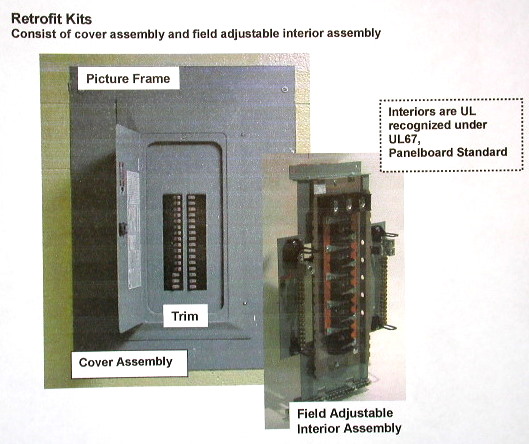
Eaton Cutler Hammer also makes "retrofit kits" - replacement bus assemblies that can fit into the original steel panel enclosure of many older electrical panels, thus reducing the cost of panel replacement; that works fine unless it's appropriate to increase the total panel ampacity and physical size to accommodate more circuits - as may be the case for some homes.
See details at FPE REPLACEMENT PANEL
Note that these retrofit kits are suitable for various panel brands, not just FP / FPE
On 2021-05-11 by John J Hazel - Replacement Eaton CH Panel for $300-$400. Estimates in the thousands are suspect.
@anonymous,
I forgot to mention that Eaton panels and breakers are available at Home Depot in Canada as well as the United States. They are inexpensive, reliable, and popular.
@anonymous,
Eaton panels and breakers are available in Canada. In fact, one can get a small Eaton panel with all necessary breakers for about $150. I posted in another thread(I cannot find it again there are too many different links within links) that I could get a panel replaced for $300-400. Yes, that meant panel, breakers, and installation.
I don't know where the person who responded to that came up with $3,000.
Here in the States, you can get the small Eaton panel and breakers(I am talking about 6 circuits) for $100 and 200-300 for installation. Maybe that price is because I have friends how are electricians. But $3000 ? Not me.
@David Nixon,
Yes, that can easily be done with the NC type breaker.
On 2021-05-11 - by (mod) - Comparison of the circuit breaker failure rates between reliable and unreliable products
@John J Hazel,
With respect, your thought-experiment on FPE failure data is wrong in its conclusions.
We have many decades of failure data now on FP and FPE showing that in an industry where the typical circuit breaker rate of failure to trip off when it should in response to an over-current is down in the 0.1% range, FP and FPE breakers fail in the 20 to 60% range!
That failure rate is due to breaker design and components, not age and corrosion.
In Aronstein's test reports you'll see a dramatic clustering among circuit breaker brands, in which the "bad performers" are dramatically worse than the "good performers".
No one should be replacing FP or FPE breakers, they should be replacing the panel itself. It is , as you will read above on this page, unsafe.
Above on this page, is an example of the FP and FPE failure data. The chart below is from Aronstein's 2017 FP Test Report provided to the US CPSC.
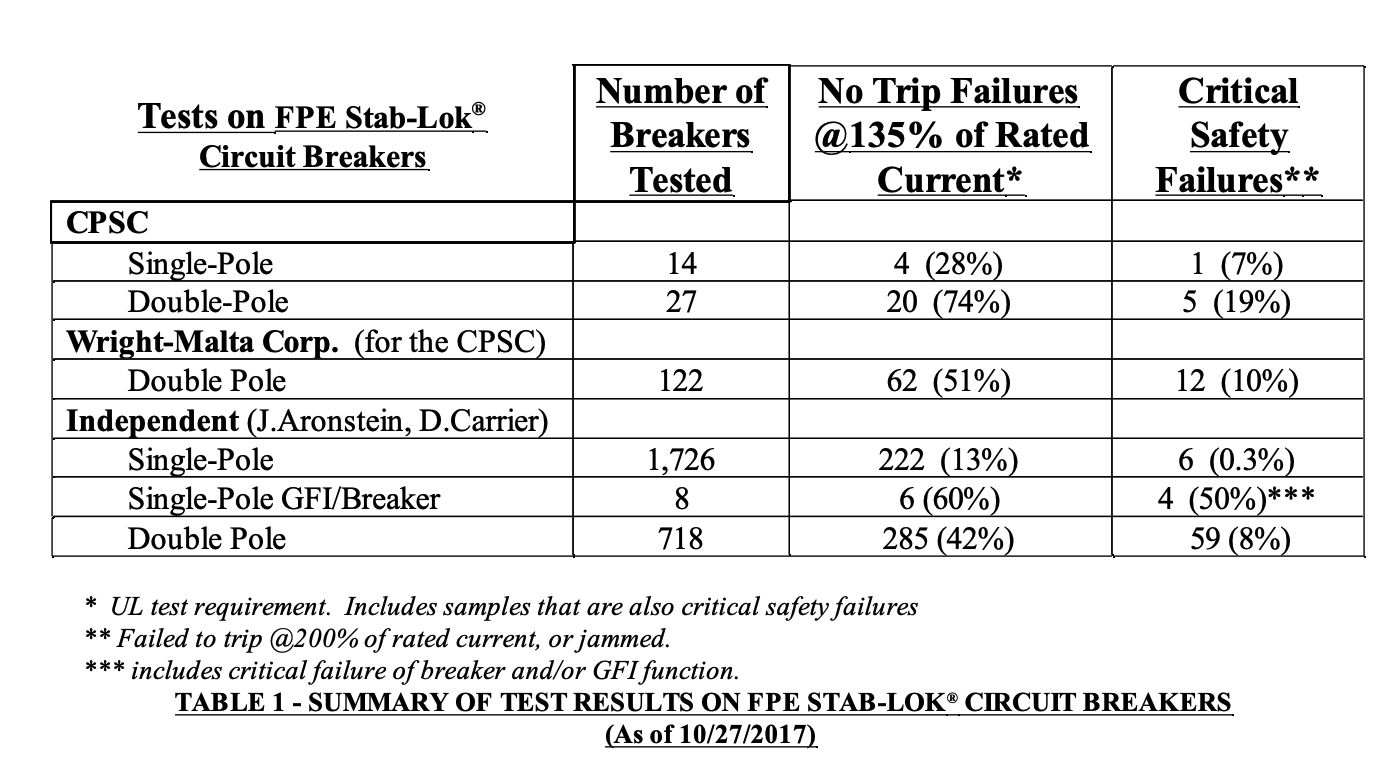
See details of the data above found
at
- Jesse Aronstein 1, (Life Senior Member, IEEE), & David W. Carrier 2 MOLDED CASE CIRCUIT BREAKERS - SOME HOLES IN THE ELECTRICAL SAFETY NET [PDF] Received December 4, 2017, accepted January 24, 2018, date of publication February 7, 2018, date of current version March 15, 2018.
Digital Object Identifier 10.1109/ACCESS.2018.2803298
1 Consulting Engineer, Schenectady, NY 12309, USA, 2 SUNY Dutchess Community College, Poughkeepsie, NY 12601, USA, Corresponding author: Jesse Aronstein (AronsteinJ@verizon.net)
This paper is also available at no charge at the IEEE Explore website. It can be accessed for online reading at: http://ieeexplore.ieee.org/document/8283732/
and can be downloaded directly from IEEE at http://ieeexplore.ieee.org/stamp/stamp.jsp?tp=&arnumber=8283732
Below, using a chart of breaker failures tested and documented by David Carrier, P.E., you can see, using other brands as examples, the dramatic difference in failure rate among what I'll call "reliable" electrical panel and breaker manufacturers and a few other brands.
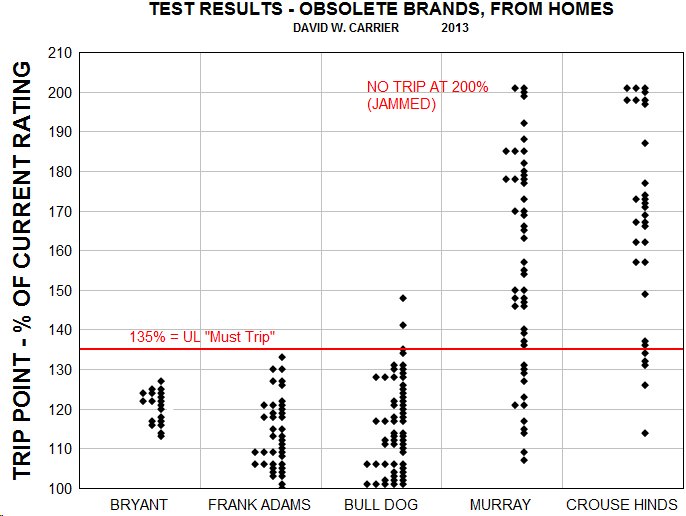
This data puts to bed your worry that it's age alone that explains the poor safety record of some circuit breakers; All of the electrical panel breakers in Carrier's / Aronstein's charts above are "old equipment".
Yet three of them, Bryant, Frank Adams, and BullDog had zero or close to zero failures to trip when they should, while Murry, Crouse Hinds, and in the earlier chart FP and FPE breakers fail to trip at very significant rates.
Details of the breaker failure testing above are
at CIRCUIT BREAKER RELIABILITY TESTS
Watch out: that's not to say that there might not be other safety concerns with some of those brands whose breakers performed as they should.
For example, Bulldog Pushmatic circuit breakers may remain "on" internally even when apparently switched "OFF". Some FP or FPE breakers do the same thing, making it extremely dangerous to rely on these circuit breaker products.
On 2021-05-10 by anonymous - thinks Square D might fail as often as FP or FPE given enough time
I wish to emphasize that I appreciate the huge effort you have obviously put into researching and documenting this safety sensitive issue - thank you for this information!
I have been thinking of upgrading our early 1980s FPE panel or possibly installing a sub-panel to support a heat pump installation. Based on the information you have documented here I will be looking into the possibility of a Square D optional alternative. Square D, similar to FPE/FP, has been around for a long time and it appears from the research you have presented here Square D is a much more reliable design.
But Square D may not have been as widely used as it appears to be relatively pricey.
Thus the Square D reliability database might be smaller which makes me wonder if the data is an absolute apples-to-apples comparison. Gosh FP* panels have been around since the early 60s thus there is probably a large number of Stablok breakers still in service that are 5 or more decades old.
Lots of time for corrosion to become a factor within a high humidity/condensation sensitive environment. It would be helpful to know what happened inside the breakers that failed to trip, manufacturing defect or some other factor(s).
I am not familiar with Eaton electrical panels which also appear to be more reliable. I do not know if they are available in Canada.
The cost of replacing the entire panel which would require the services of a qualified electrician to do the installation and power utility to remove and replace the meter is a major concern.
On 2021-05-10 by John J Hazel - I replaced older Federal Pacific with Newer Federal Pioneer Breakers!
@anonymous,
What you stated is exactly why I replaced the Federal Pacific breakers with brand new Federal Pioneers that I bought from a retailer in Canada.
As I stated in my first post yesterday, some of the old breakers were jammed in the on position.
They were also 60 years old. None of the panels showed any damage. I could have replaced them with Connecticut Electric UBI's which are sold everywhere here in the States but those breakers are much worse than the Federal Pioneers.
Now that Federal Pioneer breakers are no longer being manufactured, Canada retailers will be selling the CE UBI's.
I found a source for the Federal Pioneers here in the States. I don't know how long their stock will last. It is only going to get worse with the loss of Federal Pioneer breakers as more people will be buying CE UBI's and old stock of the worst breakers.
The last Federal Pioneers were made in Mexico. Prior to that they were made in Canada. The ACBC breakers with the white labels stuck on them were made by Federal Pioneer in Canada.
On 2021-05-10 - by (mod) - explaining why some breakers need longer over-current time before failure
@anonymous,
The difference between those breaker rating failures at different times and temperatures are simply how long the circuit has to heat up (and thus what is the actual level of over-current in Amps) before it is considered unsafe.
Put another way, if there's a continuous overload on a circuit at a lower current and means it can take longer to become unsafe but the end result is the same.
I agree with you that alarmism is not good for anyone, but neither is wishful thinking or ignoring the independent test data.
At the end of the day, now enough FP and FPE have now been tested enough that we know they perform about the same.
On 2021-05-10 by anonymous - don't panic over FP Stablok panels ?
Although I do not wish to defend the Federal Pioneer Stablok panels I get the feeling that the rather strong recommendation for Canadians to urgently replace FP panels might be slightly alarmist.
It is apparent from the test results graph given above that none of the Canadian Federal Pioneer breakers failed the 200% "no-trip" test yet many FPE breakers failed this test. I question why it is stated that the failures between FPE and FP are declared as similar. It would appear there is less risk with the FP breakers.
Certainly a no-trip "contacts jammed together" failure could clearly cause a house fire in short order as in the case of a 15A circuit it might in the extreme case subject #14 AWG wiring to hundreds of amperes.
Such an extremely high current could be caused by a shorted load and a no-trip breaker failure. That catastrophic situation could quickly turn the #14AWG conductors into an extremely hot element exceeding the kindling point of a wooden building structure.
In contrast a breaker that just fails the calibration test and doesn't trip until about 150% of load, although clearly an undesirable situation, is much less likely to result in a house fire as the temperature rise of the wiring conductors in the vast majority of cases would not reach kindling point.
Based on the test results graph no Federal Pioneer breakers failed the "no-trip" test which makes me wonder why the Canadian made breaker failure severity is declared similar to the FPE breaker failures.
Of interest regarding the no-trip failures of the FPE breakers would be forensics information that might explain why the breakers failed. Were the contacts welded together due to repetitive, possibly inductive overloads?
Was there a corrosion issue possibly caused by condensation (a photo of a panel showed significant rust)? Were the FPE no-trip failures caused by poor design, environmental exposure or a combination of both?
On 2021-05-09 - by (mod) -
@John J Hazel,
I appreciate the discussion is well, civil discourse is of course always welcome here. The facts however are really important to attend.
In this case there's no evidence that replacement circuit breakers are any safer than the ones that you took out unless of course the ones that you removed were already damaged in some way and even then replacement Breakers of this particular brand of shown in independent testing to fail at the same rate as their older siblings.
What removing circuit breakers does permit is an examination of the bus to which they connect. If you saw signs of overheating on the bus at that particular connection you would know that the panel itself is also damaged.
In the article index we have an article whose title is something like
Can't afford a new electric panel? Or
Can't afford to replace the FP electric panel?
There we discuss the warning signs that people should watch for when they have not replaced an FP or FPE circuit breaker panel.
The concern that I mentioned earlier needs emphasis: don't allow your residents to think that you've made the pedals safe at the expense of possibly than ignoring warning sign that in turn are likely to cause a fire or injury or other loss.
On 2021-05-09 by John J Hazel - Connecticut Electric UBI Breakers are not UL Listed
Thank you for the quick reply. We have discussed this before. It's interesting enough to continue.
I do honestly believe that replacing 60 year old Federal Pacific Stab-Loks with brand new Federal Pioneers has to be an improvement. We discovered more problems with the electricians' work than we have had with the breakers. Why would an electrician double tap a breaker ? Yet in every one bedroom apartment here, each one has a double tapped 15 am single pole breaker. We found 'stabs' that were bent out of the way to be able to jam the breaker into the busbar. We found subfeeds barely connected to the breakers.
This was with the 100 amp double pole breakers. Back to the breakers inside the apartments; people were given a choice. I was the first since I led the effort to replace the 60 year old breakers.
Not everyone wanted a new panel with the expense (depending on who installed it) and the drywall repair, and paint matching. I know and the stockholder occupants know that the Stab-Loks are not as safe as say Eton's(one of my favorites).
They know because I have told them repeatedly. I have done mailings to that effect. I am not trying to be rude but I would hope that you would understand that not everyone has the money to replace entire panels just as your organization does not have the money to buy brand new Federal Pioneers or NOS ACBC breakers. Supplies of genuine Stab-Loks are diminishing. Is there anyway to focus efforts to get people to stop thinking CE UBI's are safe ?
I just read a customer comment on Amazon where the customer stated that the CE UBI's are UL listed. They are not.
I gave each stockholder here a choice of replacing their entire sub panel or just the breakers. The only choice I allowed for breakers with the Fed Pac panel were the Federal Pioneers. CE UBI breakers are forbidden to be installed. It should be interesting to see what happens now that Federal Pioneer breakers are not longer in production.
All the best,
John
On 2021-05-09 - by (mod) - Replacing FP or FPE circuit breakers not a safety improvement.
@John J Hazel,
Replacing FP or FPE circuit breakers is, unfortunately, not a safety improvement.
New circuit breakers of those brand have same failure rate.
There are companies marketing replacement FP or FOE breakers, those have been tested, and they too have the same failure rate.
In my opinion it's important to guard against creating a false sense of security or to make occupants think that those electrical panels have been made more safe. The reason you should guard against that is that thinking that the panels have been repaired, people may ignore signs of danger.
On 2021-05-09 by John J Hazel - opted not to replace Federal Pioneer Stab Lok Panels in a multi-residence structure
It appears that Federal Pioneer Stab-Lok breakers are no longer in production. The breakers no longer appear on Schneider Electric's website.
Only 3 models of Federal Pioneer Stab-Lok breakers appear on TremTech Electrical Systems Inc. website. TremTech used to stock most models of the NA and NC type Stab-Loks which are popular for residential use.
Fortunately I have a couple of spare NA2P100 models which are used as main breakers (one for each of the 14 apartments) at our cooperative apartment community. The main breakers are outside and each one feeds one subpanel in each of the apartments.
The Federal Pioneer NA2P100 breakers replaced 60 year old Federal Pacific breakers. In spite of the documented failure rate for other Stab-Lok models, I feel that replacing 60 year old Federal Pacific breakers with brand new Federal Pioneer breakers was a significant safety improvement.
Some of the old Federal Pacific breakers were jammed in the 'ON' position. That would be 100% critical failure. To replace 14 panels was not an option as the estimates to do so were $30K-$40K. That simply was not in the budget for our small community.
Each panel was examined for evidence of overheating, arcing, and burn marks. We found no evidence of damage. We did find some very sloppy work by whomever installed the original Federal Pacific breakers. Some subfeed wires were barely connected and we found some breakers that had many of the 'stabs' bent out of place. There was a mix of 80, 90, and 100 amp double pole breakers. All should have been 100 amps. We still have 9 Federal Pacific panels in addition to the 14 main breaker panels.
Two are common service panels which are a wiring nightmare. Those two panels are mounted on an exterior wall thankfully. There is no main breaker for those two panels but they do follow the 'rule of 6'. There are 7 out of 14 apartments with indoor Federal Pacific Stab-Lok subpanels. 3 have all brand new Federal Pioneer breakers made in Mexico.
The other 4 panels will have to be replaced with the Eaton small panels as there are only 6 circuits in each apartment and new Federal Pioneer breakers are no longer available as mentioned above. My Federal Pioneer NA20((type 'NA'(thick), 20 amp single pole)) tripped quickly in an overcurrent situation.
The pros and cons of replacing the subpanel vs getting brand new Federal Pioneer breakers installed were discussed with each stockholder. Four apartments received Eaton panels. 3 apartments already had subpanel replacements with 2 GE and 1 Square D subpanels.
...
Continue reading at FEDERAL PIONEER ELECTRIC PANEL IDENTIFY or select a topic from the closely-related articles below, or see the complete ARTICLE INDEX.
Or see FEDERAL PIONEER PANEL SAFETY FAQs - questions & answers posted originally at this page
Or see these
Recommended Articles
- CHALLENGER ELECTRIC PANELS where an apparently-identical FPE Stab-Lok breaker is discussed.
- CIRCUIT BREAKER FAILURE RATES - comparing various brands
- COUNTERFEIT FPE CIRCUIT BREAKERS
- FEDERAL PACIFIC FPE HAZARDS - home
- FP FEDERAL PIONEER in CANADA
- FPE HAZARD SUMMARY
- FPE REPLACEMENT BREAKERS
- FPE REPLACEMENT PANEL
- UBI FPE CIRCUIT BREAKER TEST RESULTS
Suggested citation for this web page
FEDERAL PIONEER PANEL SAFETY at InspectApedia.com - online encyclopedia of building & environmental inspection, testing, diagnosis, repair, & problem prevention advice.
Or see this
INDEX to RELATED ARTICLES: ARTICLE INDEX to FPE STAB-LOK BREAKERS & PANELS
Or use the SEARCH BOX found below to Ask a Question or Search InspectApedia
Ask a Question or Search InspectApedia
Questions & answers or comments about the safety and reliability of older vs more contemporary Federal Pioneer FP Electrical Panels and Circuit Breakers.
Try the search box just below, or if you prefer, post a question or comment in the Comments box below and we will respond promptly.
Search the InspectApedia website
Note: appearance of your Comment below may be delayed: if your comment contains an image, photograph, web link, or text that looks to the software as if it might be a web link, your posting will appear after it has been approved by a moderator. Apologies for the delay.
Only one image can be added per comment but you can post as many comments, and therefore images, as you like.
You will not receive a notification when a response to your question has been posted.
Please bookmark this page to make it easy for you to check back for our response.
Our Comment Box is provided by Countable Web Productions countable.ca
Citations & References
In addition to any citations in the article above, a full list is available on request.
- 1997 Schneider Canada Federal Pioneer circuit breaker recall
- Note: as we didn't add this reviewers list until 2007, this list of technical reviewers is incomplete; we have received comments and suggestions regarding this topic, edits and remarks included, from engineers and management from the US CPSC, electricians (many listed at our page on field reports of FPE failures), home inspectors, licensed electricians, and electrical engineers, and even a few attorneys and real estate agents, since 1986. Technical review, critique, content suggestions, questions, or clarifications are invited and where a contributor wishes, credit and links will be provided to that source. Contact us to provide feedback.
- Dr. Jess Aronstein, electrical engineer, Poughkeepsie, NY, forensic engineering services, independent laboratory testing for various agencies protune@aol.com (independent electrical panel testing, including FPE Stab-Lok® panels, to April 2010)
- David Carrier, electrical engineer, 53 Henmond Blvd., Poughkeepsie, NY 12603 845-430-7527 davidwcarrier@earthlink.net (independent electrical panel testing, including FPE Stab-Lok® panels, beginning 2010)
- Alan Carson, Carson Dunlop Associates, Toronto, Ontario. Mr. Carson is a home inspection professional, educator, researcher, writer, and a principal of Carson Dunlop Associates, a Toronto home inspection and education firm. Mr. Carson is a past president of ASHI, the American Society of Home Inspectors
- Mark Cramer Inspection Services Mark Cramer, Tampa Florida, Mr. Cramer is a past president of ASHI, the American Society of Home Inspectors and is a Florida home inspector and home inspection educator.
- Carl Grasso, Esq., Herzfeld & Rubin, New York, NY. Mr. Grasso is an attorney who managed a plaintiff's class action litigation against Federal Pacific Electric in New Jersey.
- William King, US CPSC Director of Electrical Engineering (Ret).
- In addition to citations & references found in this article, see the research citations given at the end of the related articles found at our suggested
CONTINUE READING or RECOMMENDED ARTICLES.
- Carson, Dunlop & Associates Ltd., 120 Carlton Street Suite 407, Toronto ON M5A 4K2. Tel: (416) 964-9415 1-800-268-7070 Email: info@carsondunlop.com. Alan Carson is a past president of ASHI, the American Society of Home Inspectors.
Thanks to Alan Carson and Bob Dunlop, for permission for InspectAPedia to use text excerpts from The HOME REFERENCE BOOK - the Encyclopedia of Homes and to use illustrations from The ILLUSTRATED HOME .
Carson Dunlop Associates provides extensive home inspection education and report writing material. In gratitude we provide links to tsome Carson Dunlop Associates products and services.
 | HOME | ABOUT | ASK a QUESTION | CONTACT | CONTENT USE POLICY | DESCRIPTION | POLICIES | PRIVACY | |
| © 2024 - 1985 Publisher InspectApedia.com - Daniel Friedman | |||||||||