
InspectAPedia® FREE Encyclopedia of Building & Environmental Construction, Diagnosis, Maintenance & Repair |
Question? Just ask us! InspectAPedia
|
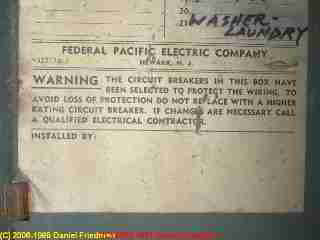 Federal Pioneer / Federal Pacific Circuit Breaker and Electric Panel Inspection Report Language
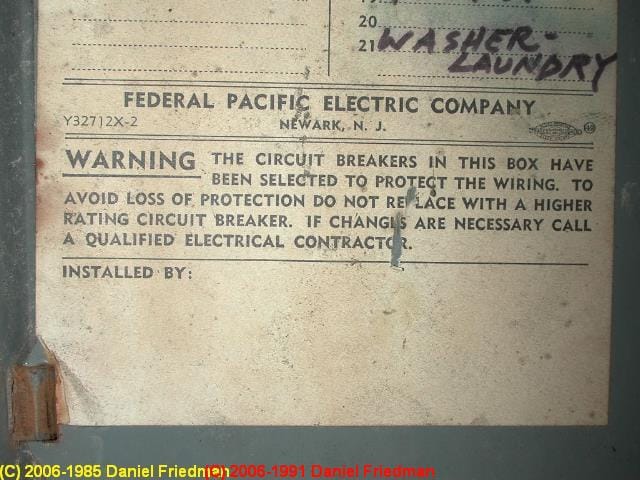
- POST a QUESTION or COMMENT about how to report on the condition of Federal Pacific Electric Stab Lok - FPE Stab Lok electric panels and breakers
This document provides recommended home inspection report language to be used when the inspector observes the presence of a Federal Pacific Electric Stab-Lok® electric panel in a building. Building inspectors are permitted to use the suggested reporting language described above in printed reports.
Replacement FPE Stab-Lok® circuit breakers are unlikely to reduce the failure risk of this equipment. We recommend that residential FPE Stab-Lok® electrical panels be replaced entirely or the entire panel bus assembly be replaced, regardless of FPE model number or FPE year of manufacture. We do not sell circuit breakers nor any other products.
InspectAPedia tolerates no conflicts of interest. We have no relationship with advertisers, products, or services discussed at this website.
FPE Stab-Lok® Breaker or Panel Inspection Reports - Recommended Language
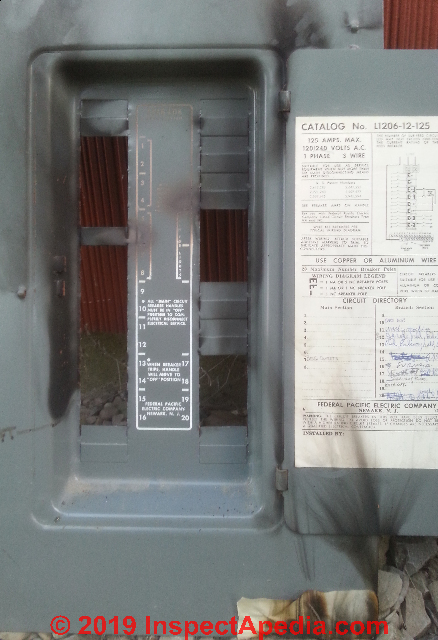 In building inspection reports of the condition of the electrical service panel I inform my clients as follows:
*** Safety Warning*** I have observed a Federal Pacific Electric "Stab-Lok® " service panel in the house. This panel is a latent fire hazard: it's circuit breakers may fail to trip in response to an overcurrent or a short circuit. Failure of a circuit breaker to trip can result in a fire, property damage, or personal injury.
A circuit breaker that may not trip does not afford the protection that is intended and required. Simply replacing the circuit breakers is not a reliable repair. The panel should be replaced, and significant expense may be involved.
Additional information about the fire and shock hazards associated with this equipment can be read on the internet at https://InspectAPedia.com/fpe/FPE_Stab_Lok_Hazards.php.
Explanation of Why FPE Panels are Unsafe and Should be Replaced
- Latent fire/shock hazard:
Properly described, the presence of an FPE Stab-Lok® electrical panel in a building is a latent fire or shock hazard.
The panel does not "initiate" an unsafe condition. Rather, when an unsafe condition such as a short circuit or current overload on a circuit occurs, the equipment may not provide the protection expected. The result can be an overheated wire and an electrical fire and/or personal injury. If you are not sure how to identify an FPE Stab-Lok® electrical panel,
see FPE & FP IDENTIFICATION, HOW TO. While we have had fewer reports of failures in the Canadian version of this equipment (Labeled Federal Pioneer Stab-Lok® ) we have had field failure reports from Canada, and there has been one Canadian product recall.
See CANADIAN VERSIONS of FPE Stab-Lok®. - Past "performance" does not mean "safe":
The fact that a problem has not occurred in a building is absolutely no assurance that questionable equipment is "safe." A circuit breaker has normally little to do except pass current onwards until there is an unsafe condition. If an unsafe condition has not occurred in a building the fact that a breaker may not trip is not discovered.
If an overcurrent or short circuit subsequently occurs it's a bit late to discover that the circuit breaker did not do its job. For an in-depth technical report explaining the hazards of this equipment
see FPE Technical Report - Independent Research 2011 [or later versions of this report found at this website] - Panel replacement is required:
There is no safe alternative to complete replacement of the FPE Stab-Lok® electrical panel. Replacement circuit breakers do not reduce the hazard, both because the breakers themselves have not been shown to be a safety improvement and because there are multiple hazards involving the breakers, the panel bus design, and the panel itself. - Financial impact:
The presence of an unsafe electrical panel and the need to replace it is not, by itself, a reason not to buy a property any more than needing to replace an unsafe tire on an automobile would be, itself, a reason not to buy the car. The cost of a new electrical panel is not a significant percentage of the value of a property.
- Real hazard:
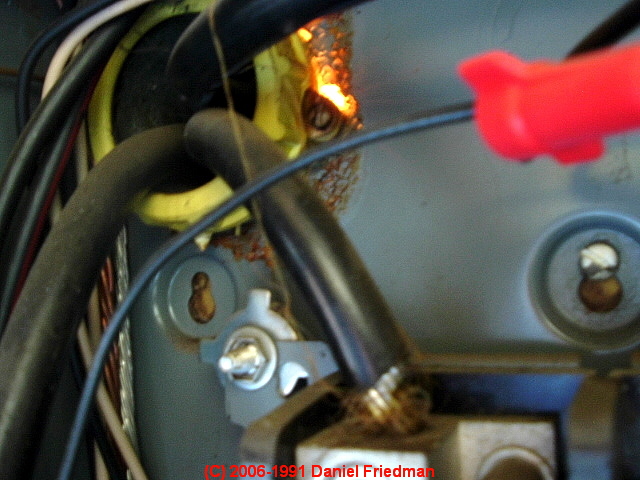
The safety problems with this equipment are real, not theoretical. In addition to the information on-line, I have received a number of reports of panel overheating instances and related fires. It really happens. Some electricians have written to me that they call these "federal no-trip" panels.
See FPE FAILURE FIRE PHOTOS.
Regrettably, parties with conflicts of interest in this matter, including FPE, and some building sellers, and even IAEI have offered inaccurate "opinions" which have confused other consumers, inspectors, and realtors. For our response to an egregious example which the FPE attorney placed in a national magazine,
see FPE HAZARD IAEI LETTER INACCURATE
Also
see FPE Stab-Lok® TECHNICAL REPORT UPDATES
- Class action status:
At least one attorney has brought a successful class action suit (in New Jersey). Information in the court documents (available at the FPE information website) also confirmed the hazards and history of this safety problem. If/when there is some suitable public action and announcement I'll post it at the website and submit it to the appropriate publications such as the ASHI Reporter as well. - Ongoing research:
For research purposes we are quite interested in obtaining actual field samples of these panels, both when overheating or fires have occurred and when they are replaced before such an unfortunate event. When you come across one of these that's to be replaced I'd be grateful to hear about it; we can arrange shipment of the old panel to the appropriate expert at no cost to the homeowner.
The panels are tested by an independent forensic engineer in order to develop additional competent data for CPSC and industry. To submit an FPE Stab-Lok® panel for research use the "Contact Us" link on any of our web pages. - Accurate reporting:
In all cases it is appropriate to report the risk to the consumer in clear, calm, unambiguous language. Inspectors who are vague about hazardous conditions are liable to charge of failure to exercise due diligence, malpractice, or worse, criminal negligence.
Inappropriately vague language which does not make clear the hazards is negligent. Inspectors must be clear in reporting the hazards of and need for action concerning this defect.
Just as vague "soft soaping" language is misleading and negligent, inappropriately frightening language is not appropriate in a professional condition of property report.
Which is worse: a nervous buyer who understands that it's a legitimate concern that needs to be addressed, or a comfortable buyer who doesn't understand that and who later has an electrical fire that could have been prevented.
Just ask: nervous vs fire, nervous vs fire, and figure out what's the professional responsible choice. - Urgency of action:
For some hazards it may be that a reasonable course of action is simply to be informed that risks are involved, leaving to the consumer the choice to replace equipment or to correct an unsafe condition. Some unsafe conditions do not need to be handled as an emergency. Choices regarding of urgency and extent of action depend on the risks involved, the use of the facility, and the alternative costs to remedy the condition. However in the case of electrical equipment which does not perform as intended my opinion is that the risks are serious enough to require prompt action. - Bias and Financial Gain:
we conduct this research and provide this information as a non-profit project out of personal concern and interest in the material. Home inspectors and building professionals have a professional obligation to protect their clients and other consumers by presenting information in an accurate, informed, and unbiased manner using clear, unambiguous language which speaks to the point. Simply reporting an FPE Stab-Lok® electrical panel as "obsolete" or "hard to find replacement parts for" is potentially criminally negligent.
We are dedicated to making our information as accurate, complete, useful, and unbiased as possible: we very much welcome critique, questions, or content suggestions for our web articles. Working together and exchanging information makes us better informed than any individual can be working alone.
InspectAPedia.com is an independent publisher of building, environmental, and forensic inspection, diagnosis, and repair information provided free to the public - we have no business nor financial connection with any manufacturer or service provider discussed at our website.
- Ethical building inspection
means not profiting from repair work and not engaging in conflicting interests. It means not having any financial connection with properties inspected. (See the ASHI Code of Ethics.) It means not having hidden relationships with referring agencies such as real estate firms - known in the home inspection industry as "the buy-in" or "paid referral" or "referral agreements" (which are not disclosed to the client ahead of time and perhaps never). It does NOT mean soft-pedaling the information to keep realtors and sellers happy at the risk of a loss or injury to the ultimate consumer or building occupants.
...
Continue reading at FPE PANEL ADVICE for HOME BUYERS or select a topic from the closely-related articles below, or see the complete ARTICLE INDEX.
Or see these
Recommended Articles
- FEDERAL PACIFIC FPE HAZARDS - home
Suggested citation for this web page
FPE PANEL INSPECTION REPORTS at InspectApedia.com - online encyclopedia of building & environmental inspection, testing, diagnosis, repair, & problem prevention advice.
Or see this
INDEX to RELATED ARTICLES: ARTICLE INDEX to FPE STAB-LOK BREAKERS & PANELS
Or use the SEARCH BOX found below to Ask a Question or Search InspectApedia
Ask a Question or Search InspectApedia
Questions & answers or comments about how to report on the condition of Federal Pacific Electric Stab Lok - FPE Stab Lok electric panels and breakers.
Try the search box just below, or if you prefer, post a question or comment in the Comments box below and we will respond promptly.
Search the InspectApedia website
Note: appearance of your Comment below may be delayed: if your comment contains an image, photograph, web link, or text that looks to the software as if it might be a web link, your posting will appear after it has been approved by a moderator. Apologies for the delay.
Only one image can be added per comment but you can post as many comments, and therefore images, as you like.
You will not receive a notification when a response to your question has been posted.
Please bookmark this page to make it easy for you to check back for our response.
Our Comment Box is provided by Countable Web Productions countable.ca
Citations & References
In addition to any citations in the article above, a full list is available on request.
- Note: as we didn't add this reviewers list until 2007, this list of technical reviewers is incomplete; we have received comments and suggestions regarding this topic, edits and remarks included, from engineers and management from the US CPSC, electricians (many listed at our page on field reports of FPE failures), home inspectors, licensed electricians, and electrical engineers, and even a few attorneys and real estate agents, since 1986. Technical review, critique, content suggestions, questions, or clarifications are invited and where a contributor wishes, credit and links will be provided to that source. Contact us to provide feedback.
- Dr. Jess Aronstein, electrical engineer, Poughkeepsie, NY, forensic engineering services, independent laboratory testing for various agencies protune@aol.com (independent electrical panel testing, including FPE Stab-Lok® panels, to April 2010)
- David Carrier, electrical engineer, 53 Henmond Blvd., Poughkeepsie, NY 12603 845-430-7527 davidwcarrier@earthlink.net (independent electrical panel testing, including FPE Stab-Lok® panels, beginning 2010)
- Alan Carson, Carson Dunlop, Associates, Toronto, Ontario. Mr. Carson is a home inspection professional, educator, researcher, writer, and a principal of Carson Dunlop Associates, a Toronto home inspection and education firm. Mr. Carson is a past president of ASHI, the American Society of Home Inspectors
- Mark Cramer Inspection Services Mark Cramer, Tampa Florida, Mr. Cramer is a past president of ASHI, the American Society of Home Inspectors and is a Florida home inspector and home inspection educator. (727) 595-4211 mark@BestTampaInspector.com 11/06
- Carl Grasso, Esq., Herzfeld & Rubin, New York, NY. Mr. Grasso is an attorney who managed a plaintiff's class action litigation against Federal Pacific Electric in New Jersey.
- William King, US CPSC Director of Electrical Engineering (Ret).
- In addition to citations & references found in this article, see the research citations given at the end of the related articles found at our suggested
CONTINUE READING or RECOMMENDED ARTICLES.
- Carson, Dunlop & Associates Ltd., 120 Carlton Street Suite 407, Toronto ON M5A 4K2. Tel: (416) 964-9415 1-800-268-7070 Email: info@carsondunlop.com. Alan Carson is a past president of ASHI, the American Society of Home Inspectors.
Thanks to Alan Carson and Bob Dunlop, for permission for InspectAPedia to use text excerpts from The HOME REFERENCE BOOK - the Encyclopedia of Homes and to use illustrations from The ILLUSTRATED HOME .
Carson Dunlop Associates provides extensive home inspection education and report writing material. In gratitude we provide links to tsome Carson Dunlop Associates products and services.
 | HOME | ABOUT | ASK a QUESTION | CONTACT | CONTENT USE POLICY | DESCRIPTION | POLICIES | PRIVACY | |
| © 2024 - 1985 Publisher InspectApedia.com - Daniel Friedman | |||||||||