
InspectAPedia® FREE Encyclopedia of Building & Environmental Construction, Diagnosis, Maintenance & Repair |
Question? Just ask us! InspectAPedia
|
 Carbon Monoxide Gas Alarm Causes
Why does the CO alarm keep going off? Response Levels for Current & Obsolete Carbon Monoxide Detectors.
- POST a QUESTION or COMMENT about the behavior of CO detectors: what sets off carbon monoxide detectors, and is it always CO?
Carbon monoxide CO alarm sound-off troubleshooting:
This document discusses the causes of CO alarms going off - when a carbon monoxide alarm sounds you should assume there is dangerous carbon monoxide gas (CO) present.
But other things might set off some alarm and not all of them are CO hazards.
Beware that the production of dangerous carbon monoxide gas in a building is usually not constant - it can start and stop. So even if someone tests and does not find CO gas present, especially if your CO alarm has been sounding, you can NOT assume that conditions are safe in the building, and further expert visual inspection of heating equipment, chimneys, etc. are in order.
For example, simply closing the door to a boiler room where gas fired equipment is operating can cause sudden production of CO gas if there is insufficient combustion air when the door is closed. Yet when someone opens the door to inspect the area, more combustion air is provided. CO production may stop.
InspectAPedia tolerates no conflicts of interest. We have no relationship with advertisers, products, or services discussed at this website.
What Makes a CO Detector Alarm Go Off
 IF YOU SUSPECT CARBON MONOXIDE POISONING GO INTO FRESH AIR IMMEDIATELY and get others out of the building, then call your fire department or emergency services for help.
Seek prompt advice from your doctor or health/safety experts if you have any reason to be concerned about exposure to toxic gases. Carbon monoxide poisoning can be fatal but exposure at lower limits can produce flu-like symptoms and headaches that are often mistaken for ordinary illness.
Carbon monoxide detector alarms may sound for a variety of reasons, but until you have diagnosed for sure why a particular alarm has sounded, you should assume that it has detected dangerous carbon monoxide indoors and you should follow our safety advice above.
Here are some causes of Carbon Monoxide Detector alarms sounding:
- The CO alarm has detected carbon monoxide in the building at a dangerous level. The alarm may sound if there is a sudden surge of high concentrations of CO or it may sound if lower levels of CO have been present for a longer period.
- Heating system malfunctions or malfunction in other gas or oil burning equipment (such as a space heater or a water heater) can produce dangerous levels of carbon monoxide indoors
- A blocked chimney flue can cause dangerous backup of carbon monoxide gas indoors
- Inadequate combustion air can cause production of dangerous levels of CO indoors
- Presence of other chemicals and gases in the building other than CO Carbon Monoxide might cause a CO alarm to sound, as reported by some readers
at CO ALARM CAUSES FAQs
All of these conditions are dangerous. Follow our safety advice above
- Other indoor contaminants, including smoke, other particles, chemicals, and gases might cause some models of smoke alarms or carbon monoxide detector alarms to sound.
- Beeping or chirping from a CO carbon monoxide detector alarm, a sound that is not continuous but sounds every few minutes, may indicate a dead or dying battery - replace the battery; if the alarm is in doubtful condition replace it.
Watch out: never ignore the sounding of a CO or carbon monoxide detector alarm. As our fire expert has pointed out:
2015/09/19 NHFirebear said:
...Older CO detectors were designed to an earlier "occupational" exposure limit and would alarm at a level where daily exposure becomes a health hazard. The UL and similar standards were amended to PROHIBIT alarms at less than a "dangerous level", i.e., that which can quickly make a person sick (under 100 ppm).
Therefore, it is NEVER acceptable to ignore a CO alarm or disconnect it to make it stop.
Indeed there was such a frequent issue with CO detector alarms sounding at very low levels that there developed a "boy who cried wolf" problem: people became habituated to ignore a carbon monoxide detector's alarm sound, just shutting it off. For example some gas fired equipment will emit a harmless "burp" of flue gases at initial start-up: a burp that could trigger the older, sensitive CO detectors.
Modern CO detectors integrate both the level of carbon monoxide and the duration of its sensing to cross an alarm sounding threshold that should never be ignored.
Carbon Monoxide Detector Methods
CO detectors use a range of detection methods depending on the detection requirements such as the response time required and the level of sensitivity required.
The carbon monoxide detection technology in a highly-sensitive CO detection instrument used by a building investigator or an industrial hygienist will typically be far more sensitive than the detection methods use in a home CO detector or in a badge-type detector used to protect workers. Some CO sensor types include:
MOS: metal-oxide semiconductor chip CO detectors: circuitry on an electronic chip detects CO by lowered electrical resistance across a sensor, causing an alarm to sound.
Electrochemistry: electrodes in a chemical solution respond to CO by detecting a change in the conductivity of the solution that has in turn been affected by CO.
CO-sensitive gel: used in badge type sensors, this "biometric CO detector" gel changes color after absorbing carbon monoxide. A human observes the color and interprets the meaning based on the badge design.
Safety Suggestions: Install Carbon Monoxide Detectors in addition to Smoke Detectors
Carbon monoxide detectors are inexpensive and readily available, both as a battery-operated unit and as a unit that plugs into an electrical outlet in the home.
No home should be without this safety protection, and homes with gas-fired equipment (natural gas or LP propane), space heaters, or other sources of risk should be extra cautious. Smoke detectors do not protect against carbon monoxide poisoning, and the opposite is also true. Carbon monoxide detectors do not warn of smoke or fire.
What Level of CO Causes a Carbon Monoxide Alarm to Go Off ?
Underwriters Laboratories Inc. Standard UL2034 requires residential CO Alarms to sound when exposed to levels of CO and exposure times as described below. The Carbon Monoxide level is measured in parts per million (ppm) of CO over time (in minutes).
Table 1: Current UL2034 Standard Requirements for Carbon Monoxide Detector Alarm Response |
||
| Carbon Monoxide Level in PPM [2] | Number of Minutes Until Alarm Must Sound | Comments |
| 400 ppm of CO | Averaged or responding to CO at this level detected between 4 and 15 minutes | Average CO level for less than 15 minutes |
| 200 ppm of CO | Averaged up to 35 minutes | Average CO level for less than 35 minutes |
| 150 ppm of CO | between 10 and 50 minutes | |
| 100 PPM of CO | Averaged for 90 minutes | Average CO level for less than 90 minutes |
| 70 ppm of CO | between 60 and 240 minutes | |
| 30 ppm of CO | NO response for 30 days of exposure at 30 ppm | Avoids nuisance sounding of the detector. See Table 2: Obsolete CO Detector Limits |
Notes to the table above
[1] We have combined CO sensitivity levels from several sources for this table. Most sources cite the 100, 200, and 400 ppm limits for CO given in the table above. Others such as BRK (cited below) give a more detailed explanation of how the CO detector is designed.
[2] Approximately 10% COHb exposure at levels of 10% to 95% Relative Humidity (RH).
[3] Some companies produce CO detectors that will respond, for example by a blinking light, at lower CO levels down to 10-25 ppm as "peak limits", that is, the detector will respond to a brief surge of CO. Responses at this level may cause nuisance calls as areas of high vehicle traffic and use of some gas fired heating equipment can certainly cause brief surges of CO at these levels.
Sources:
- CO EXPOSURE LIMITS at InspectApedia.com. Includes tables of permissible carbon monoxide exposure levels, air quality index AQI levels, PELs, TLVs, and effects.
- Wikipedia 2015
- BRK Electronics, "What Levels of CO Cause an Alarm", BRK Brands, Inc. 3901 Liberty Street Road Aurora, Illinois 60504 Tel: (630) 851-7330, The company has offices in Australia, Canada, Columbia, Europe, Malaysia, Mexico, New Zealand, Nigeria, Peru, and the United States - retrieved 20 Sept 2015, original source: http://www.brkelectronics.com/faqs/oem/what_levels_of_co_cause_an_alarm
- Rossol, Monona, "Data Sheet: Carbon Monoxide & CO Detectors",
Monona Rossol, Health and Safety Director
United Scenic Artists, Local USA 829, IATSE
181 Thompson St., # 23 - New York, NY 10012-2586
212-777-0062 E-mail: ACTSNYC@cs.com
February 4, 1998 revised 1/6/05, 12/18/07, 4/6/08
- retrieved 20 Sept 2015 original source: https://www.usa829.org/Portals/0/Documents/Health-and-Safety/Safety-Library/Carbon-Monoxide-and-CO-Detectors.pdf
Obsolete CO Detector Limits
Table 2: Obsolete CO Detector Limits & Response Times |
||
| Carbon Monoxide Level in PPM | Number of Minutes Until Alarm Must Sound | Comments |
| 100 ppm | 16 Minutes | CO Level is averaged over the response period |
| 60 ppm | 28 Minutes | |
| 16 ppm | 30 Days | |
Notes to the table above
Examples of these now-obsolete CO detectors that responded in this range were the FirstAlert7® and the Nighthawk7® Carbon Monoxide Detectors.
Source:
- DATA SHEET
CARBON MONOXIDE & CO DETECTORS
Monona Rossol, Health and Safety Director
United Scenic Artists, Local USA 829, IATSE
181 Thompson St., # 23 - New York, NY 10012-2586
212-777-0062 E-mail: ACTSNYC@cs.com
February 4, 1998 revised 1/6/05, 12/18/07, 4/6/08
- retrieved 20 Sept 2015 original source: https://www.usa829.org/Portals/0/Documents/Health-and-Safety/Safety-Library/Carbon-Monoxide-and-CO-Detectors.pdf
Response Levels of CO Detectors vs. Human Breathing
Reader Question: my doctor says my breath is triggering the CO monitor
21 July 2015 Kari M said:
After several months of seeing a new doctor, my regular visits showed my blood oxygen to be so low that it often wouldn't register or would be in the low 80% range. I also pointed out blue nail beds and toenail beds and pitting edema of my calves, ankles and feet. I have never smoked and am 53 years old.
She asked it I had a carbon monoxide detector in my home. I said I did, but why would that matter.
She claimed that if I am breathing in my own carbon dioxide (that I exhale) it would cause the CO monitor to go off. This does not make sense to me as the two are the result of different ways of eliminating oxygen, resulting in different chemical change. Can you clarify? Thanks. Kari
Reply: baloney: human breath will not set off a CO detector
Kari
I'm not sure who "she" is, but human breath should not make a home carbon monoxide detector alarm sound. However there are numerous studies reporting elevated levels of CO in the breath of people suffering from a variety of illnesses including asthma.
And we may be confusing CO2 (carbon dioxide) with CO (carbon monoxide).
Exhaled human breath is mostly nitrogen - 78.04% and oxygen (13.06-16%) and contains about 4-5% (by volume) more CO2 than we breathed-in and less Oxygen than we breathed in.
Exhaled breath contains about 4.8-5% CO2. Note that this is carbon dioxide (CO2) - not carbon monoxide (CO). Those are different gases.
The remaining about 1% of gases in human breath are insignificant, such as Argon and other gases.
What is the level of carbon monoxide in human breath?
However smokers may indeed have carbon monoxide (CO) in their breath at levels of about 16.4 ppm. (0.00164 percent) and Zayasu et als reported elevated levels of CO in asthmatic patients (Zayasu 1997). In our references just below you'll see elevated CO levels reported for patients with other illnesses as well. For perspective, the level of carbon monoxide in cigarette smoke itself can be in the range of 500 - 1000 ppm (Rossol, 2005).
As we explained earlier in this article, the response point of a carbon monoxide detector is not a fixed number since most units will respond faster to higher levels (immediately to high levels) and may take many minutes to respond to a low level of CO in the area being sensed or monitored in a building.
The response time and response-level of a carbon monoxide detector used as a building safety alarm varies by model. But in general, at 400 ppm of CO a Carbon monoxide detector will respond in minutes and at 30 ppm or below the CO detector is designed not to respond for 30 days.
Since the level of CO in human breath would be expected to be well below 30 PPM, and since CO Alarms are generally designed not to respond to constant CO levels at (or below) 30 ppm over a duration of 30 days, human breath should not cause a CO detector alarm to sound.
You can see that there is a large difference between the maximum CO that a human might exhale and the response level of CO to which a CO detector will respond. In fact Home CO detectors made to current UL Standards (in the US) or Canadian Standards in Canada (CSA) are prohibited from showing CO levels below 30 ppm on digital displays - perhaps in part because of the cost, misleading effects, and impact of nuisance calls.
Therefore to whoever "she" is, I can only say about the claim that the CO2 (carbon dioxide) level in your breath is triggering a CO (carbon monoxide) detector alarm is nonsense. I must hope that this was a misunderstanding between you and your doctor and that you will discuss your concerns with her again.
It is possible to detect lower levels of carbon monoxide in buildings, but not using a home CO detector alarm. Separately, a hand-held portable gas detector or CO detection lab or field investigation instrument used by building environmental test experts, some home inspectors, some industrial hygienists, (Bachrach Instruments, Draeger Instruments, Fluke, Industrial Scientific, KWJ Engineering, Honeywell, RKI Instruments, Sensorcom, Quantum Group, and Zellweger) can respond to CO levels in air down to just a few parts per million (PPM).
IF YOU SUSPECT CARBON MONOXIDE POISONING GO INTO FRESH AIR IMMEDIATELY and get others out of the building, then call your fire department or emergency services for help.
References on CO detection levels & components of human breath
- Affek, Hagit P., and John M. Eiler. "Abundance of mass 47 CO 2 in urban air, car exhaust, and human breath." Geochimica et Cosmochimica Acta 70, no. 1 (2006): 1-12.
- Dickerson, Russell R., and Anthony C. Delany. "Modification of a commercial gas filter correlation CO detector for enhanced sensitivity." Journal of Atmospheric and Oceanic Technology 5, no. 3 (1988): 424-431.
- Funazaki, Naomi, Akihide Hemmi, Satoshi Ito, Yasukazu Asano, Sunao Yamashita, Tetsuhiko Kobayashi, and Masatake Haruta. "Development of carbon monoxide detector using Au fine particles-doped α-Fe 2 O 3." Sensors and Actuators B: Chemical 14, no. 1 (1993): 536-538.
- Hammond, M. D., G. E. Gale, K. S. Kapitan, A. Ries, and P. D. Wagner. "Pulmonary gas exchange in humans during exercise at sea level." Journal of Applied Physiology 60, no. 5 (1986): 1590-1598.
- Owens, Elizabeth Oesterling. "Endogenous carbon monoxide production in disease." Clinical biochemistry 43, no. 15 (2010): 1183-1188.
- Paredi, Paolo, Sergei A. Kharitonov, David Leak, Pallav L. Shah, Derek Cramer, Margaret E. Hodson, and Peter J. Barnes. "Exhaled ethane is elevated in cystic fibrosis and correlates with carbon monoxide levels and airway obstruction." American journal of respiratory and critical care medicine 161, no. 4 (2000): 1247-1251.
- Roller, C., K. Namjou, J. Jeffers, W. Potter, P. J. McCann, and J. Grego. "Simultaneous NO and CO 2 measurement in human breath with a single IV-VI mid-infrared laser." Optics letters 27, no. 2 (2002): 107-109.
- Sylvester, Karl P., Richard A. Patey, Gerrard F. Rafferty, David Rees, Swee Lay Thein, and Anne Greenough. "Exhaled carbon monoxide levels in children with sickle cell disease." European journal of pediatrics 164, no. 3 (2005): 162-165.
- Thorpe, Michael J., David Balslev-Clausen, Matthew S. Kirchner, and Jun Ye. "Cavity-enhanced optical frequency comb spectroscopy: application to human breath analysis." Optics Express 16, no. 4 (2008): 2387-2397.
- Whittle, Chris L., Steven Fakharzadeh, Jason Eades, and George Preti. "Human breath odors and their use in diagnosis." Annals of the New York Academy of Sciences 1098, no. 1 (2007): 252-266.
- Wikipedia, "Carbon Monoxide Detector", retrieved 25 Jul 2015 original source https://en.wikipedia.org/wiki/Carbon_monoxide_detector
- Yamara, M., K. Sekizawa, S. Ishizuka, M. Monma, and H. Sasaki. "Exhaled carbon monoxide levels during treatment of acute asthma." European Respiratory Journal 13, no. 4 (1999): 757-760.
- Yamaya, Mutsuo, Kiyohisa Sekizawa, SATOSHI ISHIZUKA, Mizue Monma, Katsumi Mizuta, and Hidetada Sasaki. "Increased carbon monoxide in exhaled air of subjects with upper respiratory tract infections." American journal of respiratory and critical care medicine 158, no. 1 (1998): 311-314.
- Zayasu, Kiyoshi, Kiyohisa Sekizawa, Shoji Okinaga, Mutsuo Yamaya, Takashi Ohrui, and Hidetada Sasaki. "Increased carbon monoxide in exhaled air of asthmatic patients." American Journal of Respiratory and Critical Care Medicine 156, no. 4 (1997): 1140-1143.
Reader Comments, Questions & Answers About The Article Above
Below you will find questions and answers previously posted on this page at its page bottom reader comment box.
Reader Q&A - also see RECOMMENDED ARTICLES & FAQs
On 2020-07-06 (mod) - Will a leaking refrigerator refrigerant set off a CO detector?
Tony:
What's leaking? If you mean the fridge has a refrigerant leak, that won't last long, as the refrigerant charge is small and will soon be exhausted.
Refrigerants are pretty inert an are not hydrocarbons - they won't set off a carbon monoxide detector.
Other gases can set off a CO detector, such as hydrogen (released by charging a some car batteries), and in some cases sewer gases.
On 2020-07-06 by Tony
Will a leaking refrigerator refrigerant set off a CO detector?
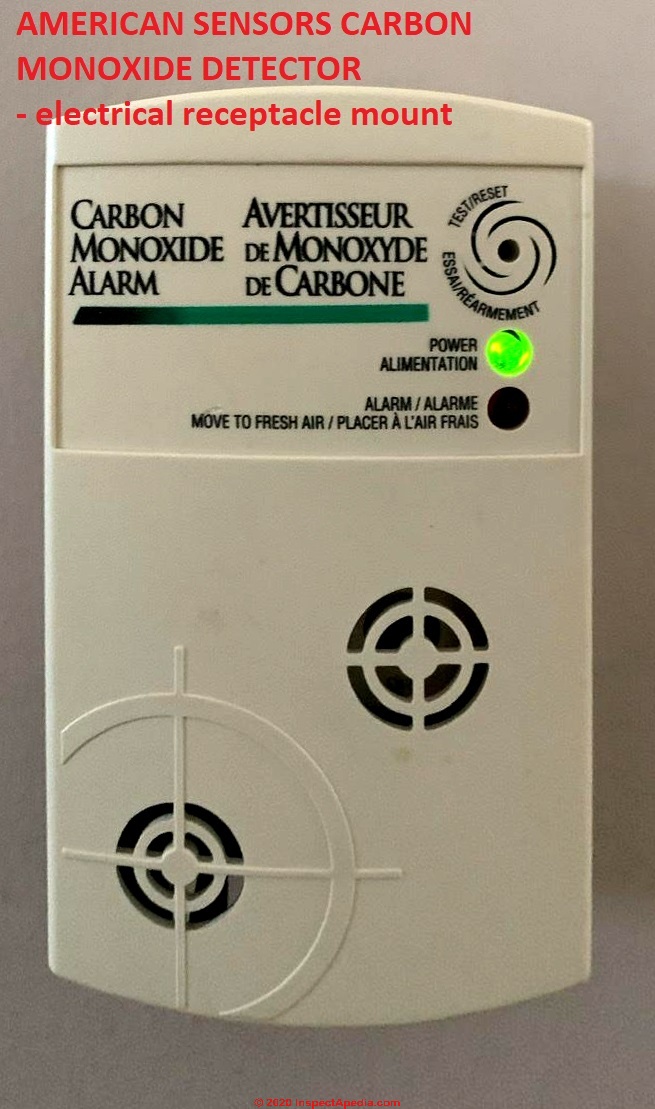
On 2019-11-07 (mod) - Can anyone identify the brand of this old CO detector?
Daisy
That's a Carbon Monoxide Detector manufactured by American Sensors. This model plugs into any electrical receptacle. An example of its online marketing data is posted below.
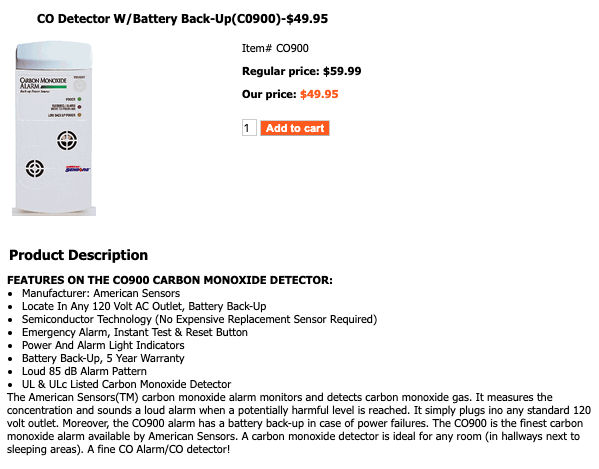
I'm looking for a match to see if I can identify the CO detector in your photo. Meanwhile you should realize that just based on age alone it could be unsafe and you should replace it.
On 2019-10-19 by Daisy
Can anyone identify the brand of this old CO detector?
On 2018-11-09 (mod) - First Alert CO7 carbon monoxide detector gas sensitivity
Gary (and other readers)
The First Alert CO7 carbon monoxide detector manual includes this information about gas sensitivity:
CO Alarm is not formulated to detect CO levels below 30 ppm typically.
UL tested for false alarm resistance to Methane (500 ppm), Butane (300 ppm), Heptane (500 ppm), Ethyl Acetate (200 ppm), Isopropyl Alcohol (200 ppm) and Carbon Dioxide (5000 ppm). Values measure gas and vapor concentrations in parts per million.
That information tells you that your CO detector may sound an alarm when any of those gases is / are present at levels above the "false alarm resistance" data the company offers.
Watch out: it would be a possibly fatal mistake to ignore a CO detector alarm based on the assumption that it is "false".
While it's reasonable to wonder if the alarm is sounding in response to new materials (carpets, carpet padding, vinyl windows, paint, other off-gassing substances) and while it thus makes sense to also ventilate the home with fresh to speed that off-gassing process,
DO NOT ignore the alarm sounding. There may also be an unsafe heating system combustion gas or CO gas leak (also such gases can come from a running vehicle like a car in a garage).
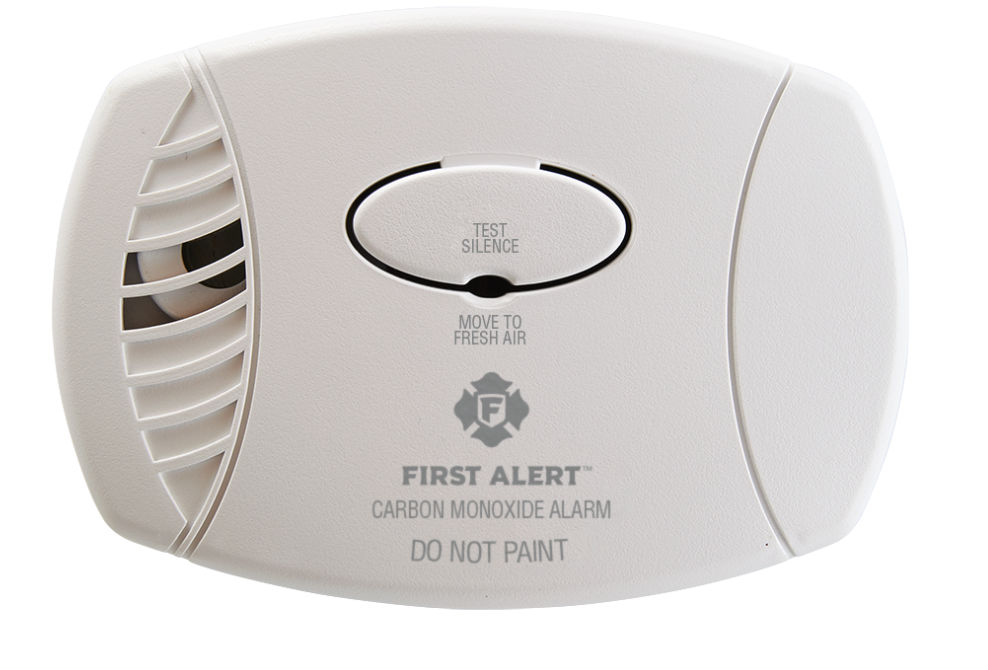
Below is an image of the First Alert CO detector you mentioned.
If you do not already have the instruction manual for your CO detector you can download it from this link:
First Alert CO 605 / 606 USERS MANUAL [PDF] at inspectapedia.com
Or directly from First Alert at 1hwaqv35k3or3y079muiil4q-wpengine.netdna-ssl.com/wp-content/uploads/2017/12/m08-0206-008_co605.pdf as retrieved 2018/11/09
There you will find additional details about how the alarm responds to various levels of CO in the air over time.
Excerpts:
CO Alarms are designed to alarm before there is an immediate life threat. Since you cannot see or smell CO, never assume it’s not present.
• An exposure to 100 ppm of CO for 20 minutes may not affect average, healthy adults, but after 4 hours the same level may cause headaches.
• An exposure to 400 ppm of CO may cause headaches in average, healthy adults after 35 minutes, but can cause death after 2 hours.
IMPORTANT
This CO Alarm measures exposure to CO over time. It alarms if CO levels are extremely high in a short period of time, or if CO levels reach
a certain minimum over a long period of time.
The CO Alarm generally sounds an alarm before the onset of symptoms in average, healthy adults.
Why is this important? Because you need to be warned of a potential CO problem while you can still react in time.
In many reported cases of CO exposure, victims may be aware that they are not feeling well, but become disoriented and can no longer react well enough to exit the building or get help.
Also, young children and pets may be the first affected. The average healthy adult might not feel any symptoms when the CO Alarm sounds. However, people with cardiac or respiratory problems, infants, unborn babies, pregnant mothers, or elderly people can be more quickly and severely affected by CO.
If you experience even mild symptoms of CO poisoning, consult your doctor immediately!
Standards: Underwriters Laboratories Inc. Single and Multiple Station carbon monoxide alarms UL2034.
According to Underwriters Laboratories Inc. UL2034, Section 1-1.2:
“Carbon monoxide alarms covered by these requirements are intended to respond to the presence of carbon monoxide from sources such as,
but not limited to, exhaust from internal-combustion engines, abnormal operation of fuel-fired appliances, and fireplaces.
CO Alarms are intended to alarm at carbon monoxide levels below those that could cause a loss of ability to react to the dangers of Carbon Monoxide
exposure.”
This CO Alarm monitors the air at the Alarm, and is designed to alarm before CO levels become life threatening. This allows you precious time to leave the house and correct the problem. This is only possible if Alarms are located, installed, and maintained as described in this manual.
On 2018-11-06 by Gary G
Installed a new carpet in a closed room yesterday containing our CO detector. Am wondering if the off-gasing of the carpet may have set off the CO detector last night. Has never happened before.
Thank you! This is a First Alert Model CO7 10. Electromechanical sensor.
...
Continue reading at CO EXPOSURE LIMITS or select a topic from the closely-related articles below, or see the complete ARTICLE INDEX.
Or see CO ALARM CAUSES FAQs - Q&A posted originally at this page
Or see these
Recommended Articles
- CARBON DIOXIDE - CO2 - a different gas
- CARBON MONOXIDE - CO
- CARBON MONOXIDE WARNINGS: HOME HEATERS
- GAS DETECTION INSTRUMENTS
- GAS EXPOSURE EFFECTS, TOXIC
Suggested citation for this web page
CO ALARM CAUSES at InspectApedia.com - online encyclopedia of building & environmental inspection, testing, diagnosis, repair, & problem prevention advice.
Or see this
INDEX to RELATED ARTICLES: ARTICLE INDEX to GAS HAZARDS in BUILDINGS
Or use the SEARCH BOX found below to Ask a Question or Search InspectApedia
Ask a Question or Search InspectApedia
Try the search box just below, or if you prefer, post a question or comment in the Comments box below and we will respond promptly.
Search the InspectApedia website
Note: appearance of your Comment below may be delayed: if your comment contains an image, photograph, web link, or text that looks to the software as if it might be a web link, your posting will appear after it has been approved by a moderator. Apologies for the delay.
Only one image can be added per comment but you can post as many comments, and therefore images, as you like.
You will not receive a notification when a response to your question has been posted.
Please bookmark this page to make it easy for you to check back for our response.
Our Comment Box is provided by Countable Web Productions countable.ca
Citations & References
In addition to any citations in the article above, a full list is available on request.
- Air Pollution Toxicology: APTI Course SI:300, Introduction to Air Pollution Toxicology, US EPA Air Pollution Training Institute, Environmental Research Center, Research Triangle Park, NC 27711, Sept. 1993, web search 08/28/2010, original source: http://yosemite.epa.gov/
- CCSP, 2008: Analyses of the effects of global change on human health and welfare and human systems. A Report by the U.S. Climate Change Science Program and the Subcommittee on Global Change Research. [Gamble, J.L. (ed.), K.L. Ebi, F.G. Sussman, T.J. Wilbanks, (Authors)]. U.S. Environmental Protection Agency, Washington, DC, USA. Web search 08/28/2010, original source: http://nepis.epa.gov/
- Health Effects of Carbon Dioxide - see "National Advisory Committee for Acute Exposure Guideline Levels (AEGLs) for Hazardous Substances; Proposed AEGL Values, Federal Register Document", http://www.epa.gov/EPA-TOX/2002/February/Day-15/t3774.htm note that these are proposed guidelines
- Carbon Dioxide CO2: Geologic Sequestration Health Effects: "Vulnerability Evaluation Framework
for Geologic Sequestration of Carbon Dioxide", US EPA, EPA430-R-08-009, July 2008, web search August 2010,original source: http://www.epa.gov/climatechange/emissions/downloads/VEF-Technical_Document_072408.pdf - Carbon Dioxide CO2: Geologic Sequestration, U.S EPA, web search 08/28/2010, original source:
http://www.epa.gov/climatechange/emissions/co2_gs_tech.html - GTSP, 2006: Carbon Dioxide Capture and Geologic Storage: A Core Element of a A Global
Energy Technology Strategy to Address Climate Change (PDF, 37 pp., 6.05 MB, About PDF).
April 2006, JJ Dooley et al. Global Energy Technology Strategy Program (GSTP) - IPCC, 2005: Special Report on Carbon Dioxide Capture and Storage, Special Report of the
Intergovernmental Panel on Climate Change [Metz, Bert, Davidson, Ogunlade,
de Coninck, Heleen, Loos, Manuela, and Meyer, Leo (Eds.)]. Cambridge University Press, The
Edinburgh Building Shaftesbury Road, Cambridge CB2 2RU England - Fluorine, Its Compounds, and Air Pollution,: a Bibliography with Abstracts, US Environmental Protection Agency, Office of Air Quality Planning and Standards, Research Triangle Park, North Carolina 27711, December 1976. Web search 08/28/2010, original source: http://nepis.epa.gov.
NOTE: because the EPA's original source of this document in PDF format is damaged we have created a text image file, converted to a new PDF for readability. - Greenhouse Gas Overview: Carbon Dioxide: U.S. EPA, web search 08/28/2010, original source:
http://www.epa.gov/climatechange/emissions/co2.html - Nitrogen Oxides: Air Quality Criteria for Oxides of Nitrogen, Vol III of III, US EPA, EPA600/8-91/049cF, August 1993, web search 08/28/2010, original source: http://nepis.epa.gov [Large PDF 25MB]
Key chapters in this document evaluate the latest scientific data on (a) health effects of NOx measured ill laboratory animals and exposed human populatIOns and (b) effects of NOx on agricultural crops, forests, and ecosystems, as well as (c) NOx effects on visibility and nonbiological materials. Other chapters describe the nature, sources, distribution, measurement, and concentratiOns of NOx m the environment These chapters were prepared and peer revived by experts from various state and Federal government offices, academia, and private industry for use by EPA to support decision makIng regarding potentIal risks to public health and the enVIronment Although the document IS not intended to be an exhaustIve literature reVIew, It IS intended to cover all the pertinent literature through early 1993 - "Choosing and Using a Carbon Monoxide CO Monitor," Dan Friedman, The ASHI Technical Journal, Vol. 2 No. 1, July1991
- Dräger MSDS for Dräger CH25301 Air Current Tubes, Page 1 of 2.
Dräger MSDS for Dräger CH25301 Air Current Tubes , Page 2 of 2.
Watch out: the Dräger air current tube or "smoke tube" # CH16631 produces a sulfuric acid gas sulfuric acid H2SO4 /SO3 that is dangerous to life and is highly corrosive. Take a look at our copy of the Dräger MSDS for their CH25301 Air Current Tubes. We stored this MSDS in the box with the rubber bulb and tube cutter provided by Dräger. These air current monitoring tubes are provided with rubber caps so that the tube can be "stopped" or shut down when not in use. But the sulfuric acid was so corrosive that it not only caused the rubbger caps to disintegrate, it actually "burned" or oxidized our copy of the MSDS paper form! - TABLE Z-1 LIMITS FOR AIR CONTAMINANTS, 1910.1000 TABLE Z-1 [PDF] OSHA standard for air contaminant limits (http://www.osha.gov/pls/oshaweb/owadisp.show_document?p_table=STANDARDS&p_id=9992) - includes for CO2, Carbon dioxide.........| CAS No. 124-38-9 | 5000 ppm | 9000 mg/m3 limits for carbon dioxide as an air contaminant.
- In addition to citations & references found in this article, see the research citations given at the end of the related articles found at our suggested
CONTINUE READING or RECOMMENDED ARTICLES.
- Carson, Dunlop & Associates Ltd., 120 Carlton Street Suite 407, Toronto ON M5A 4K2. Tel: (416) 964-9415 1-800-268-7070 Email: info@carsondunlop.com. Alan Carson is a past president of ASHI, the American Society of Home Inspectors.
Thanks to Alan Carson and Bob Dunlop, for permission for InspectAPedia to use text excerpts from The HOME REFERENCE BOOK - the Encyclopedia of Homes and to use illustrations from The ILLUSTRATED HOME .
Carson Dunlop Associates provides extensive home inspection education and report writing material. In gratitude we provide links to tsome Carson Dunlop Associates products and services.
 | HOME | ABOUT | ASK a QUESTION | CONTACT | CONTENT USE POLICY | DESCRIPTION | POLICIES | PRIVACY | |
| © 2024 - 1985 Publisher InspectApedia.com - Daniel Friedman | |||||||||