
InspectAPedia® FREE Encyclopedia of Building & Environmental Construction, Diagnosis, Maintenance & Repair |
Question? Just ask us! InspectAPedia
|
 Carbon Monoxide Exposure Medical & Health Effects
- POST a QUESTION or COMMENT about procedures useful to test for CO or carbon monoxide gas in buildings
What are the medical & health effects of short term or chronic exposure to carbon monoxide gas?
This article describes the short term & long term medical & health effects of exposure to carbon monoxide gas (CO). We give references and explanation regarding Toxicity of Carbon Monoxide, based on literature search and an original search on Compuserve's Safety Forum. This is background information, obtained from expert sources.
Seek prompt advice from your doctor or health/safety experts if you have any reason to be concerned about exposure to toxic gases. Carbon monoxide poisoning can be fatal but exposure at lower limits can produce flu-like symptoms and headaches that are often mistaken for ordinary illness.
InspectAPedia tolerates no conflicts of interest. We have no relationship with advertisers, products, or services discussed at this website.
MEDICAL EFFECTS of CO - Medical effects of Carbon Monoxide (CO) Poisoning
Discussed here: Medical effects of carbon monoxide exposure - CO exposure - Toxicity of carbon monoxide gas. Carbon monoxide gas exposure effects, short term CO exposure & long term CO gas exposure effects.
IF YOU SUSPECT CARBON MONOXIDE POISONING GO INTO FRESH AIR IMMEDIATELY and get others out of the building, then call your fire department or emergency services for help. Links on this page also direct the reader to carbon dioxide gas information in a separate document. Seek prompt advice from your doctor or health/safety experts if you have any reason to be concerned about exposure to toxic gases. Carbon monoxide poisoning can be fatal but exposure at lower limits can produce flu-like symptoms and headaches that are often mistaken for ordinary illness.
Many sources I (DF) reviewed indicated that if carbon monoxide exposure was subacute, that is if the person did not lose consciousness and was removed from the CO exposure before losing consciousness, then any medical effects were temporary.
Indeed detection of CO exposure at a hospital is problematic since CO leaves the bloodstream quickly once a person is exposed to normal air. However there is evidence that lasting physical damage may occur from carbon monoxide exposure, though the popular press has not (2006) discussed the exposure level and duration necessary for these effects.
Heart muscle damage occurs from Carbon Monoxide (CO) exposure, screening recommended
31 January 2006 - The New York Times Science Section reports on a new study, released in JAMA's January 25 2006 Magazine Issue, and which indicated that people exposed to carbon monoxide suffer damage to their heart muscles and are at much greater risk for heart attacks in later years.
The Times article asserted that CO Poisoning results in 40,000 emergency visits a year in the United States - the most common accidental poisoning event in the U.S. with an annual average accidental death rate of about 1000 people and average suicidal death rate of about 2400 people. [U.S. CDC] Five percent of such patients die in the hospital. Research was not cited regarding subacute exposures and exposures which do not result in a visit to a hospital. -- New York Times Science Section, January 31, 2006 p. F6, "After Crisis, Carbon Monoxide Still Takes a Toll."
The carbon monoxide exposure and heart muscle damage study was led by Christopher R. Henry, Minneapolis Heart Institute Foundation, in the current [Jan 2006] Journal of the American Medical Association The study examined the medical history of 230 people exposed to carbon monoxide and treated at hospital between 1994 and 2002, following their health to 2005.
After 7 1/2 years, in this otherwise low risk (of heart failure) population, 25% of the originally-surviving patients had died - a rate about three times the average heart failure death rate statistic.
For people who had suffered heart muscle damage the mortality rate was 38% with half of the mortalities being (apparently) traced to cardiovascular problems. The study concludes that people who are exposed to carbon monoxide should be screened for heart muscle damage.
Heart muscle damage from CO poisoning (in the study) was characterized by elevated levels of cardiac troponin I (a type of protein) or creatine kinase-MB (a type of enzyme), and/or changes in diagnostic electrocardiogram (ECG). -- DJ Friedman paraphrasing the NY Times article and JAMA's news release regarding this study.
Original document source
This carbon monoxide discussion file originated from a technical expert message board discussion on Carbon Monoxide and later Carbon Dioxide alarms, featuring comments by one of the leading authorities on CO, Jack Peterson, P.E., CIH, Ph.D., in May, 1987.
NOTE: Daniel Friedman extracted CO and CO2 sections from that document, edited and added practical and field inspection-based information. Since its original publication this document has been expanded by reference materials from a variety of other sources.
Safety Suggestions: Install Carbon Monoxide Detectors in addition to Smoke Detectors
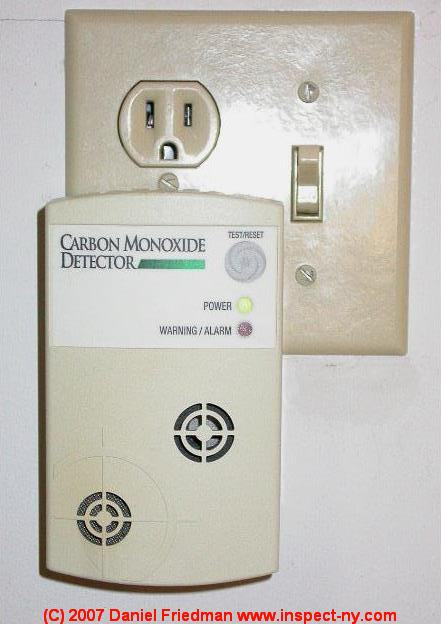
Carbon monoxide detectors are inexpensive and readily available, both as a battery-operated unit and as a unit that plugs into an electrical outlet in the home. No home should be without this safety protection, and homes with gas-fired equipment (natural gas or LP propane), space heaters, or other sources of risk should be extra cautious.
Smoke detectors do not protect against carbon monoxide poisoning, and the opposite is also true. Carbon monoxide detectors do not warn of smoke or fire.
Watch out: This text may assist readers in understanding these topics. However it should by no means be considered complete nor completely authoritative. See the additional carbon monoxide poisoning and exposure effects references and citatations below.
...
Continue reading at POISONING SYMPTOMS - CO or select a topic from the closely-related articles below, or see the complete ARTICLE INDEX.
Or see these
Carbon Monoxide Gas Articles
- CARBON DIOXIDE - CO2 - a different gas
- CARBON MONOXIDE - CO
- CARBON MONOXIDE WARNINGS: HOME HEATERS
- GAS DETECTION INSTRUMENTS
- GAS EXPOSURE EFFECTS, TOXIC
Suggested citation for this web page
MEDICAL EFFECTS of CO at InspectApedia.com - online encyclopedia of building & environmental inspection, testing, diagnosis, repair, & problem prevention advice.
Or see this
INDEX to RELATED ARTICLES: ARTICLE INDEX to GAS HAZARDS in BUILDINGS
Or use the SEARCH BOX found below to Ask a Question or Search InspectApedia
Ask a Question or Search InspectApedia
Try the search box just below, or if you prefer, post a question or comment in the Comments box below and we will respond promptly.
Search the InspectApedia website
Note: appearance of your Comment below may be delayed: if your comment contains an image, photograph, web link, or text that looks to the software as if it might be a web link, your posting will appear after it has been approved by a moderator. Apologies for the delay.
Only one image can be added per comment but you can post as many comments, and therefore images, as you like.
You will not receive a notification when a response to your question has been posted.
Please bookmark this page to make it easy for you to check back for our response.
Our Comment Box is provided by Countable Web Productions countable.ca
Citations & References
In addition to any citations in the article above, a full list is available on request.
- In addition to citations & references found in this article, see the research citations given at the end of the related articles found at our suggested
CONTINUE READING or RECOMMENDED ARTICLES.
- Carson, Dunlop & Associates Ltd., 120 Carlton Street Suite 407, Toronto ON M5A 4K2. Tel: (416) 964-9415 1-800-268-7070 Email: info@carsondunlop.com. Alan Carson is a past president of ASHI, the American Society of Home Inspectors.
Thanks to Alan Carson and Bob Dunlop, for permission for InspectAPedia to use text excerpts from The HOME REFERENCE BOOK - the Encyclopedia of Homes and to use illustrations from The ILLUSTRATED HOME .
Carson Dunlop Associates provides extensive home inspection education and report writing material. In gratitude we provide links to tsome Carson Dunlop Associates products and services.
 | HOME | ABOUT | ASK a QUESTION | CONTACT | CONTENT USE POLICY | DESCRIPTION | POLICIES | PRIVACY | |
| © 2024 - 1985 Publisher InspectApedia.com - Daniel Friedman | |||||||||