
InspectAPedia® FREE Encyclopedia of Building & Environmental Construction, Diagnosis, Maintenance & Repair |
Question? Just ask us! InspectAPedia
|
 Carbon Monoxide CO Poisoning Symptoms
- POST a QUESTION or COMMENT about the symptoms of carbon monoxide poisoning
CO Poisoning Carbon Monoide Poisoning Symptoms:
This document discusses the the symptoms of carbon monoxide poisoning. We give references and explanation regarding Toxicity of Carbon Monoxide, based on literature search and search on Compuserve's Safety Forum.
This is background information, obtained from expert sources. Seek prompt advice from your doctor or health/safety experts if you have any reason to be concerned about exposure to toxic gases. Carbon monoxide poisoning can be fatal but exposure at lower limits can produce flu-like symptoms and headaches that are often mistaken for ordinary illness.
InspectAPedia tolerates no conflicts of interest. We have no relationship with advertisers, products, or services discussed at this website.
CO POISONING SYMPTOMS - What are the Symptoms of Carbon Monoxide Poisoning
IF YOU SUSPECT CARBON MONOXIDE POISONING GO INTO FRESH AIR IMMEDIATELY and get others out of the building, then call your fire department or emergency services for help.
Links on this page also direct the reader to carbon dioxide gas information in a separate document. Seek prompt advice from your doctor or health/safety experts if you have any reason to be concerned about exposure to toxic gases. Carbon monoxide poisoning can be fatal but exposure at lower limits can produce flu-like symptoms and headaches that are often mistaken for ordinary illness.
Carbon monoxide characteristics
Carbon monoxide (CO) is a colorless, odorless, tasteless gas that, physiologically, is a chemical asphyxiant. When inhaled, it combines with hemoglobin more readily than does oxygen, displacing oxygen from hemoglobin and thereby interfering with oxygen transport by the blood. In other words, breathing carbon monoxide can lead to asphyxiation - unconsciousness and even death.
A person suffering from carbon monoxide (CO) intoxication may have these symptoms:
- first experience euphoria (similar to the effect of a martini or two)
- then headache
- and possibly vomiting
as the concentration of carboxyhemoglobin in the blood increases.
Other symptoms of Carbon Monoxide poisoning include:
- Weakness
- dizziness
- Lethargy
- Confusion
In addition to neurological effects, heart damage has also often been reported in CO or carbon monoxide poisoning cases - see comments below.
IF YOU SUSPECT CARBON MONOXIDE POISONING GO INTO FRESH AIR IMMEDIATELY and get others out of the building, then call your fire department or emergency services for help Carbon monoxide poisoning can be fatal.
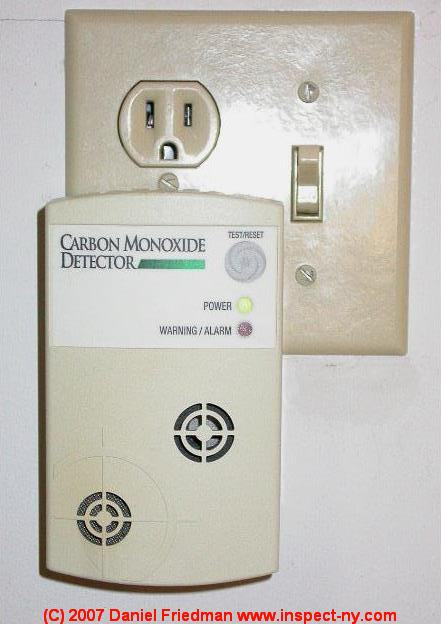
Safety Suggestions: Install Carbon Monoxide Detectors in addition to Smoke Detectors
Carbon monoxide detectors are inexpensive and readily available, both as a battery-operated unit and as a unit that plugs into an electrical outlet in the home. No home should be without this safety protection, and homes with gas-fired equipment (natural gas or LP propane), space heaters, or other sources of risk should be extra cautious. Smoke detectors do not protect against carbon monoxide poisoning, and the opposite is also true. Carbon monoxide detectors do not warn of smoke or fire.
Chronic exposure to CO Carbon Monoxide - complaints of declining health
Reader Question:
I am writing to ask if you can help me. I live in Louisville, am a psychotherapist, and teach family psychiatry at the University of Kentucky.
For over a year, my health has been declining and I have become increasingly withdrawn from friends and family. On Tuesday, June 22nd, I learned that I have been chronically exposed to unknown levels of CO in my home. I work out of my home much of the time and spend most of that time in my home office, which is immediately above the gas hot water heater in my basement. A description of the hot water heater is attached (RUUD Pacemaker PR75).
I don't know how much of the story you might find helpful, so I will give some details, followed by my questions.
About ten days ago, I turned off the hot water heater (pilot light out) and shut off the water to the washing machine to try to determine the reason no hot water was coming through to my washing machine. I am not an expert at fixing things, and it took several days to figure out that a rock-type occlusion was completely blocking the water pipe about six inches above the water spigot. I chipped it away with a screwdriver and hammer, and put everything back together. I ran one load of laundry to see if water came through the hot water pipe. It did.
I then lit the pilot light and ran several more loads of laundry that day. The hot water heater had been on most of that day, and I was in my office working around 8pm. I began to feel like I have felt numerous times over the past year, only worse. It was about 95 degrees outside and very humid. I felt like I needed air. I went to the windows and opened them. Breathed deeply. I noticed I was wringing my hands, feeling like I wanted to go to sleep or vomit.
It was difficult, but I walked to the basement and opened the door to the furnace room, which is about 20 X 25 feet. Our home is nearly a hundred years old, with several basement rooms, and three other (hardwood) floors. The furnace room was covered in about 3" of water, and very hot water was coming out the steam release pipe on the side of the hot water heater. I began crying because I was so tired after months of trying to regain my strength from some unknown ailment. I did not know how to stop the water flow, nor whether I should step in the water. It didn't seem like a good idea to stop the water because it seemed like the hot water heater was a pressure cooker at that point.
I did go into the room and located the water shut-off valve to the house. I turned off the water and opened the windows. I opened other doors and windows in the house. I took dirty laundry and threw it on the floor of the furnace room to soak up some of the water. I felt really sick, and vomited once right after calling the gas company for what I thought might be a gas leak. I felt like I was in another world, not really seeing reality. I got out of the house and waited in my air-conditioned car for the gas company to come. Meanwhile, water was still gushing out of the hot water heater.
The gas company guy arrived within 20 minutes and I followed him around while he checked for gas leaks. There were none, but he said he thought I had a carbon monoxide problem because of the smells in the house. He explained that even though CO is colorless and odorless, that its effects can create other smells.
My sense of smell and taste were affected months ago, and I did not trust them at this point.
He turned on a little CO monitor and when it reached 30, he turned it off and said I definitely had a problem. By this time, the hot water heater was empty and the water was off. He had turned off the pilot light after holding a match near the top of the heater, which was blown out immediately.
The flue was not drawing. I'm not sure if my terminology is correct on all of these things, but hopefully you understand what I mean. That night, after he assured me that there was no danger in the house now, he left. I went to the third floor of my house and slept with my head near the open window.
I have not yet had anyone come to clean out the flue. The hot water heater remains off. I have had the windows and doors open as much as possible. I do feel better, more alert, than in a long time. However, I know that I am not well. I become fatigued and have several health issues I must attend. I have let things go over the past year because I was not able to deal with them.
I have a 14 year old son with Asperger Syndrome and I have not been able to mother him as I have the first 13 years of his life. Because of my hypersensitivities, my husband and son have been staying in a small apartment near our home, which is why they were not affected by the CO. Although I have no history of psychiatric problems, I had begun to think I was becoming psychotic.
I'm sure you know that the effects of chronic exposure to low or moderate levels of CO are not widely recognized. I did not go to the hospital that night, because I was too tired. Because of my son's Asperger Syndrome, I am aware of how one's biochemistry can be affected and metabolism changed. I am aware of the risk of long-term neurological, cognitive, and cardiac issues related to CO.
Because I have so many things to 'catch up on' in my life, I will have to inform people of what has happened and ask for their understanding as I take time to recover and 'produce' what I owe them.
The reason I am contacting you is to ask if there is a way to quantify the levels of CO to which I may have been exposed--if the flue has been blocked for over a year, which is when my symptoms began. Also, I wonder if there is a particular type of service who could best check the flue and clean it out. Maybe the process of cleaning it out would provide more information.
I think that's about it for now. If you suggest that I submit an email consulting form, I will be happy to do so. Thank you for listening. - A.S.
Reply:
Thank you for the interesting CO question - it helps us realize where we need to work on making our text more clear or more complete. I was sorry to read of the history of complaints and concerns you described about your water heater.
First - be sure you have working CO detectors in your home.
Second - be sure that the problem you trace to the heater is not the only issue - other gas fired appliances could be at fault
Third, an expert inspection of the equipment, chimneys, vents, flue vent connectors, combustion air supply, etc. could be in order.
A water heater does not produce nearly as much exhaust as, for example, a boiler or furnace.
Regarding your question about quantifying your CO exposure, no, an honest, defensible, accurate characterization of exposure over months of varying building and equipment conditions would be quite difficult. But one could measure under various building conditions to put bounds on the question - identifying the maximum CO production rate and concentrations in a building vs the minium.
Given that data and weather, testimony on status of windows and doors open or shut, degree days, equipment operation, fuel consumption, an engineer with the right expertise could make some ballpark calculations on gas levels that could have been present in a building.
You need to review the question with your physician, the complaints, the hypotheses, and obtain an expert medical opinion on the possible relations between complaint and various kinds of exposure before you can know how much cost and trouble detailed assessment is worthy.
...
Continue reading at MEDICAL EFFECTS of CO or select a topic from the closely-related articles below, or see the complete ARTICLE INDEX.
Or see these
Carbon Monoxide Gas Articles
- CARBON MONOXIDE - CO
- CARBON MONOXIDE WARNINGS: HOME HEATERS
- GAS DETECTION INSTRUMENTS
- GAS EXPOSURE EFFECTS, TOXIC
Suggested citation for this web page
POISONING SYMPTOMS - CO at InspectApedia.com - online encyclopedia of building & environmental inspection, testing, diagnosis, repair, & problem prevention advice.
Or see this
INDEX to RELATED ARTICLES: ARTICLE INDEX to GAS HAZARDS in BUILDINGS
Or use the SEARCH BOX found below to Ask a Question or Search InspectApedia
Ask a Question or Search InspectApedia
Try the search box just below, or if you prefer, post a question or comment in the Comments box below and we will respond promptly.
Search the InspectApedia website
Note: appearance of your Comment below may be delayed: if your comment contains an image, photograph, web link, or text that looks to the software as if it might be a web link, your posting will appear after it has been approved by a moderator. Apologies for the delay.
Only one image can be added per comment but you can post as many comments, and therefore images, as you like.
You will not receive a notification when a response to your question has been posted.
Please bookmark this page to make it easy for you to check back for our response.
Our Comment Box is provided by Countable Web Productions countable.ca
Citations & References
In addition to any citations in the article above, a full list is available on request.
- In addition to citations & references found in this article, see the research citations given at the end of the related articles found at our suggested
CONTINUE READING or RECOMMENDED ARTICLES.
- Carson, Dunlop & Associates Ltd., 120 Carlton Street Suite 407, Toronto ON M5A 4K2. Tel: (416) 964-9415 1-800-268-7070 Email: info@carsondunlop.com. Alan Carson is a past president of ASHI, the American Society of Home Inspectors.
Thanks to Alan Carson and Bob Dunlop, for permission for InspectAPedia to use text excerpts from The HOME REFERENCE BOOK - the Encyclopedia of Homes and to use illustrations from The ILLUSTRATED HOME .
Carson Dunlop Associates provides extensive home inspection education and report writing material. In gratitude we provide links to tsome Carson Dunlop Associates products and services.
 | HOME | ABOUT | ASK a QUESTION | CONTACT | CONTENT USE POLICY | DESCRIPTION | POLICIES | PRIVACY | |
| © 2024 - 1985 Publisher InspectApedia.com - Daniel Friedman | |||||||||