InspectAPedia.com InspectAPedia®
Google
InspectAPedia
 

Free Encyclopedia of Building & Environmental Inspection, Testing, Diagnosis, Repair

Ask a Question or Search InspectAPedia

  • HOME
  • AIR CONDITIONING
  • DAMAGE ASSESSMENT
  • ELECTRICAL
  • EXTERIORS
  • HEATING
  • HOME INSPECTION
  • INTERIORS
  • PLUMBING
  • ROOFING
  • SEPTIC SYSTEMS
  • STRUCTURE
  • WATER SUPPLY
  • ENERGY SAVINGS
  • ENVIRONMENT
  • INDOOR AIR IAQ
  • INSULATION
  • MOLD INSPECT TEST REMOVE
  • NOISE
  • ODORS
  • SOLAR ENERGY
  • VENTILATION
  • EXPERTS DIRECTORY
  • CONTACT US


InspectAPedia ® Home

ENVIRONMENTAL HAZARDS - INSPECT, TEST, REMEDY

ACCURACY vs PRECISION of MEASUREMENTS
AIR CLEANER PURIFIER TYPES
AIR LEAK DETECTION TOOLS
AIR POLLUTANTS, COMMON INDOOR
AIR QUALITY IMPROVEMENT STRATEGIES
ANIMAL ODORS IN BUILDINGS

BACKDRAFTING HEATING EQUIPMENT
BIBLIOGAPHY for ENVIRONMENTAL HEALTH, MOLD, IAQ
BIOGAS PRODUCTION & USE
BIOLOGICAL POLLUTANTS
BLOWER DOORS & AIR INFILTRATION
BOOKSTORE - ENVIRONMENTAL
BUILDING SAFETY HAZARDS GUIDE

CARPETING & INDOOR AIR QUALITY
CHINESE DRYWALL HAZARDS
CHLORINE IN DRINKING WATER
COMBUSTION PRODUCTS & IAQ
COMBUSTION GASES & PARTICLE HAZARDS
CONDENSATION or SWEATING PIPES, TANKS
CPSC Indoor Air Pollution Book Online Copy

DRAFT MEASUREMENT, CHIMNEYS & FLUES
DUST SAMPLING PROCEDURE

EMERGENCY RESPONSE, IAQ, GAS, MOLD
ENVIRO-SCARE - PUBLIC FEAR CYCLES

Fireplaces & Woodstove Contaminants
FLAME COLOR, BLUE vs YELLOW COMBUSTION
FORMALDEHYDE HAZARDS
Formaldehyde Gas Hazard Reduction

GAS DETECTION INSTRUMENTS
GAS LP & Natural Gas Safety Hazards
GAS LP & Natural Gas Pressures

HEATING OIL EXPOSURE HAZARDS, LIMITS
HOUSE DUST ANALYSIS
HUMIDITY CONTROL & TARGETS INDOORS
HYDROGEN SULFIDE GAS

Indoor Air Pollution Book Online CPSC
INDOOR AIR QUALITY & HOUSE TIGHTNESS
INDOOR AIR QUALITY IMPROVEMENT GUIDE

LP & Natural Gas Pressures
LP & Natural Gas Safety Hazards

MOLD ODORS, MUSTY SMELLS
MSDS Material Safety Data Sheets
MVOCs & MOLDY MUSTY ODORS
Museum Artifact Preservation

ODORS GASES SMELLS, DIAGNOSIS & CURE
ODORS IN WATER
OXYGEN - O2
OZONE HAZARDS

PARTICLE SIZES & IAQ
Pesticide Exposure Hazards
PLASTIC ODORS-SCREENS, SIDING
PLUMBING SYSTEM ODORS
PVC - VINYL BUILDING PRODUCTS

RADON HAZARD TESTS & MITIGATION

SEPTIC METHANE GAS
SEPTIC SYSTEM ODORS
SMELL PATCH TEST to Track Down Odors
SULPHUR & SEWER GAS SMELL SOURCES

UFFI UREA FORMALDEHYDE FOAM INSULATION
URETHANE FOAM Deterioration, Outgassing

VAPOR CONDENSATION & BUILDING SHEATHING
VENTILATION in BUILDINGS
VINYL Siding or PLASTIC Window ODORS
Volatile Organic Compounds VOCs

WATER ODORS, CAUSE CURE

More Information

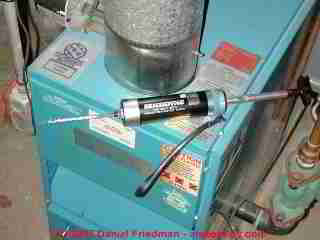
Photograph of a Drager hand pump used to measure carbon dioxide levels in the environment. Warnings for Users of Toxic Gas Measurement Instruments
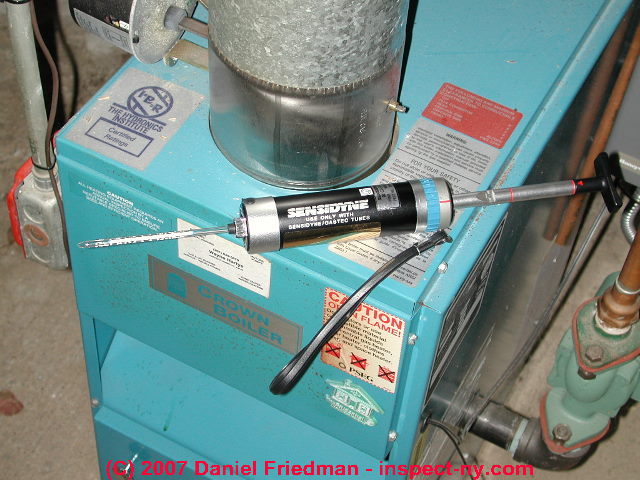
     

  • GAS DETECTOR WARNINGS - Warnings about using instruments for detection of toxic gases - ecommendations for gas measurement instruments, gas detector tubes, Draeger & Gastec, Komyo Rikagaku Kitagawa, RAE, & Sensidyne gas detection tubes & pumps for detection of gases
    • Dangers of choosing the wrong detector tube
    • Gas Detector Tube Chemical Hazards
    • Warning: choose the right tube for gas detection
  • Questions & Answers about how to test for toxic gas leaks, safety procedures & warnings
  • References

Click to Show or Hide Related Topics

  • GAS DETECTION INSTRUMENTS - home
    • COLORIMETRIC GAS DETECTION TUBES
    • Drager GAS DETECTORS
    • GAUGE, REFRIGERATION PRESSURE TEST
    • GAS DETECTOR WARNINGS
    • GAS DETECTOR TUBE WARNINGS
    • TIF 5000 GAS DETECTOR
    • TIF 8800 GAS DETECTOR
  • BACKDRAFTING HEATING EQUIPMENT
  • BLUE vs YELLOW COMBUSTION FLAMES
  • CARBON DIOXIDE - CO2
  • CARBON MONOXIDE - CO
  • CARBON MONOXIDE WARNING
  • COALSTOVE SAFETY
  • COMBUSTION PRODUCTS & IAQ
  • COMBUSTION GASES & PARTICLE HAZARDS
  • DEFECTS LIST - HEAT SPACE & FIREPLACE, GAS
  • DRAFT HOODS - gas fired
  • DRAFT MEASUREMENT, CHIMNEYS & FLUES
  • DRAFT REGULATORS, DAMPERS, BOOSTERS
  • EMERGENCY RESPONSE, IAQ, GAS, MOLD
  • FLAME COLOR, BLUE vs YELLOW COMBUSTION
  • FORMALDEHYDE HAZARDS
  • FORMALDEHYDE GAS HAZARD REDUCTION
  • GAS EXPOSURE EFFECTS, TOXIC
  • GAS EXPOSURE LIMITS & STANDARDS
  • GAS EXPOSURE SCREENING TEST
  • GAS LP & Natural Gas Safety Hazards
  • GAS LP & Natural Gas Pressures
  • GAS PIPING, VALVES, CONTROLS
  • HEAT EXCHANGER LEAK TEST
  • INDOOR AIR QUALITY & HOUSE TIGHTNESS
  • METHANE GAS SOURCES
  • MVOCs & MOLDY MUSTY ODORS
  • ODORS GASES SMELLS, DIAGNOSIS & CURE
  • ODORS IN WATER
  • OXYGEN - O2
  • OZONE as a "CURE" for MOLD or ODORS
  • OZONE AIR PURIFIER WARNINGS
  • OZONE EXPOSURE STANDARDS
  • OZONE HAZARDS
  • OZONE MSDS
  • OZONE ODORS, MOLD, REFS
  • OZONE TESTS
  • OZONE TOXICITY
  • SAFETY RECALLS, Chimneys, Vents, Heaters
  • SEPTIC METHANE GAS
  • SEWER GAS ODORS
  • SULPHUR & SEWER GAS SMELL SOURCES
InspectAPedia tolerates no conflicts of interest. We have no relationship with advertisers, products, or services discussed at this website.

Safe use of gas leak detector tools: this document outlines warnings for people using gas detection tools and sensors used to test for the level of toxic and other gases in buildings and in outdoors. In related documents we give references and explanation regarding toxicity of several of the most common indoor gases, based on literature search and obtained from the U.S. government and expert sources. This text may assist readers in understanding these topics. However it should by no means be considered exhaustive.

Green links show where you are. © Copyright 2013 InspectAPedia.com, All Rights Reserved. Author Daniel Friedman.

Warnings about Relying on Instruments for Detection of Hazardous Gases in buildings
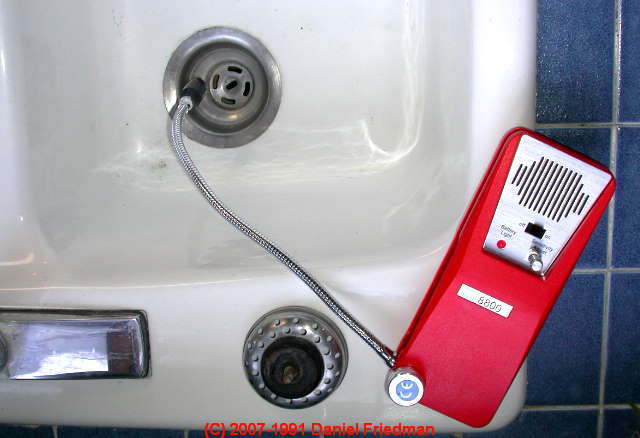
Photo of a TIF 8800 combustible gas analyzer being used to check a kitchen sink drain for sewer gas leaksOPINION-DF: In 1991, for ASHI, the American Society of Home Inspectors I authored or edited several articles on the use of instruments to test for evidence of dangerous flue gas leaks such as carbon monoxide in residential buildings.

Shown at left, the TIF 8800 combustible gas analyzer, a very sensitive instrument.

We were excited by the possibility of improving the level of safety afforded by a professional home inspection by permitting home inspectors to use instruments to perform simple screening tests for toxic or dangerous carbon monoxide gas leaks. Inspectors were already using the TIF 8800 described above, but that wide spectrum instrument could not focus specifically on, nor give numeric levels of carbon monoxide gas alone.

Quite a few home inspectors rushed to buy and some continue to use any of a variety of excellent and sensitive specialized pocket-sized gas detectors designed to screen specifically for carbon monoxide. Particularly in parts of the U.S. where home inspectors had found that the level of expertise offered by their local gas distribution companies was a bit weak, they were anxious to have a more reliable safety check tool for buildings heated by natural or LP gas.

In my view these articles encouraging the use of carbon monoxide detection instruments in the hands of some of these home inspectors was a disaster.

High Speed Home Inspecting?

Home inspectors who were not technically inclined, home inspectors who were more focused on the bottom line (profit), and inspectors who were looking for a way to simply speed up their inspection while doing less work, simply purchased one of these instruments, turned it on, and left it to check the heating system for CO leakage while they, being efficient and fast fellows, went off to inspect something else.

In other words, some home inspectors stopped inspecting the heating system as thoroughly as they had before relying instead on the instrument to do their work for them. Those inspectors, thinking that their job was done, simply reported that the instrument did or did not detect any carbon monoxide, and they disclaimed further responsibility for the condition of the heating equipment or even for the accuracy of the test they had performed.

What was wrong with this approach of relying on gas detection tools:
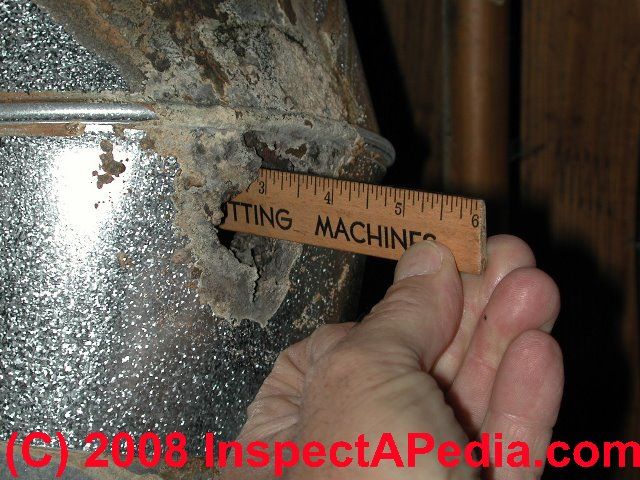
Flue gas leak problem photo

  • A complete visual inspection of the heating system, flue vent connector, chimney externals, controls, and safety devices is essential to form a reasonable opinion about the condition, usability, and safety of a heating system. Use of an instrument to check for the presence of a single gas is an inadequate substitute.

  • The production of dangerous carbon monoxide varies enormously at a given heating system over a short time and for a variety of reasons.

    For example, testing with a door to the boiler room or furnace room open or shut can completely change the supply of combustion air (in some cases) and thus can "turn on" or "turn off" the production of dangerous carbon monoxide.

  • Many other safety operating defects may be present and may be very important besides the test for carbon monoxide release.
  • Because the TIF 8800 responds to a very wide range of combustible gases, it is useful in tracking down sewer gas or septic gas odors as well. See
    • Sewer Gas Odors diagnosing, finding, and curing septic tank and sewer line smells and odors
    • Building Drains & Sewer Lines - diagnosing odors in buildings coming from leaky sewer lines or drain lines
    • Sewer Gas - Methane and other septic system gas explosion or asphyxiation hazards such as hydrogen sulfide
    • Odors, Smells, Gases - diagnosis and cure of all kinds of odors in buildings

In sum, there is a place for and good use for test instruments during building investigation, but they are not and should not ever be a substitute for a careful and thorough visual inspection and history-taking by an expert. Those "high speed" inspectors would have performed a better service for their clients by encouraging them to purchase and install smoke detectors and home-use carbon monoxide detectors than to hasten their inspection by using an unattended CO instrument in the home.

Our article CARBON MONOXIDE - CO includes a photograph of a simple and effective carbon monoxide detector intended for homeowner installation and use.

Warning: About Selecting the Proper Gas Detection Tube

Gas Tube and Gas Pump Must be Compatible

Colorimetric gas detection tubes produced by different manufacturers are not necessarily interchangeable among gas detection pumps. Be sure that the gas detection tube you are using is one recommended for use with your gas detection pump - check both the gas detection pump manufacturer's instructions and the gas detection tube manufacturer's specifications.

For example, as we were informed in May 2008 by Nextteq GastecTM detection tube distributor in the U.S., Gastec tubes that are currently available are not intended for use on the SensidyneTM gas detection pump.

At one point in time, Sensidyne had the contract for Gastec tubes and lost it due to rebranding.  The tubes they sell now are Kitagawa tubes, not Gastec.  We don't want to confuse anyone out there that they can use a Gastec tube with the Sensidyne pump.  The Gastec tubes are not calibrated to work with a Sensidyne pump and therefore, the reading could be incorrect and prove fatal in some cases.\

Gas Tube Must Be Properly Sensitive to the Gases Being Investigated

Be sure to select gas detection tubes designed to detect the proper gases being screened in a building, and also to select the gas detector tube which is calibrated to detect gases at the proper level of concern. The detection of many gases is supported at varying levels of sensitivity.

Selecting a gas detector tube which is not sensitive enough may result in failing to detect the presence of the target gas. Selection of a gas detection tube which is too sensitive may result in inability to accurately detect the actual level of gas which is present since the tube will become saturated before the actual gas level has been recorded.

How Birdwatching Can Inform Building Environmental Investigations
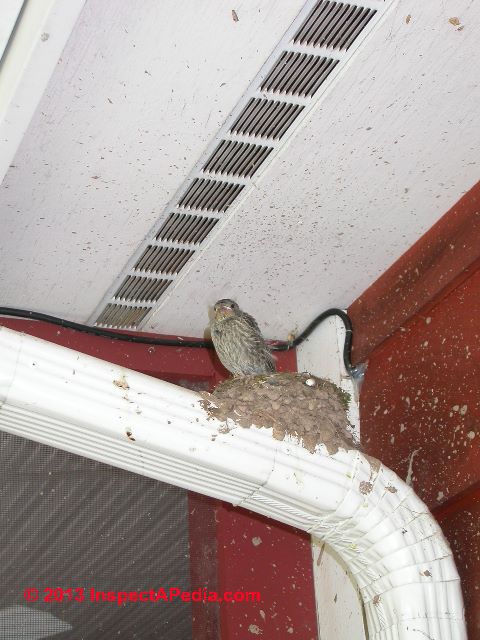
Bird nesting on house downspout (C) Daniel Friedman

Gas Detection Measurement Must be Made in the Proper Test Locations

At TIF 8800 Test procedure we explain and illustrate in detail that when testing for gases produced by combustion in a heating or hot water appliance, because combustion gases produced by the burner are quite hot, test points must extend beyond the appliance itself to look for accumulated gases near the room ceiling.

And at TIF 8800 FIELD TEST as well as at TIF 8800 GAS DETECTOR we explain that when screening for heavier-than-air gases (including LP gas) tests need to be made close to floor level as well.

When birdwatching, if you look where the bird's aren't you won't find them. If you look where they are, you will. The same thinking applies to screening buildings for hazards.

Gas Detection Measurements Must be Made at the Proper Times
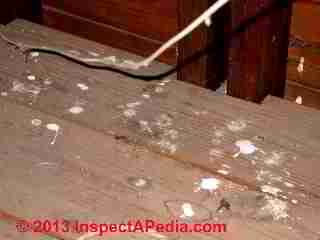
Evidence of birds in the attic of a building even when the birds are not home (C) Daniel FriedmanAt CO DETECTOR OPTIONS we explain that when using any gas detector tool to test inside of the air plenum for flue gas leakage, one critical test time is before the blower fan has come on.

Once the fan begins not only is building air in the plenum diluted, the pressurization of air around the heat exchanger is likely to change the direction of a combustion gas leak.

Our photo illustrates a second point, that there may be evidence of a problem (in this case bird guano or droppings in the building attic) even if the problem source is not visible or not present at the time of inspection. The birds are not home right now, but they've been having a nice time living in the attic of this home.

When birdwatching, if you look in the North for birds when they've migrated South for the winter you won't find them. Similar thinking applies when screening buildings for environmental or other hazards whose presence varies by time of day, weather, usage, or other varying site conditions.

Gas Detector Tube Chemical Hazards: Air Current Tubes & Smoke Generating Tubes: Safety Warnings

Watch out: the Dräger air current tube or "smoke tube" # CH16631 produces a sulfuric acid gas sulfuric acid H2SO4 /SO3 that is dangerous to life and is highly corrosive. Take a look at our copy of the Dräger MSDS for their CH25301 Air Current Tubes.

We stored this MSDS in the box with the rubber bulb and tube cutter provided by Dräger. These air current monitoring tubes are provided with rubber caps so that the tube can be "stopped" or shut down when not in use.

But the sulfuric acid was so corrosive that it not only caused the rubber caps to disintegrate, it actually "burned" or oxidized our copy of the MSDS paper form!

  • Dräger MSDS for Dräger CH25301 Air Current Tubes, Page 1 of 2.
  • Dräger MSDS for Dräger CH25301 Air Current Tubes, Page 2 of 2.

Frequently Asked Questions (FAQs) about using gas leak tools and instruments

...

Ask a Question or Search InspectApedia

Questions & answers or comments about how to test for toxic gas leaks, safety procedures & warnings.

Ask a Question or Enter Search Terms in the InspectApedia search box just below.

Technical Reviewers & References

Related Topics, found near the top of this page suggest articles closely related to this one.

  • Jennifer Moore, Sales Administrator, Nextteq, LLC, Tampa FL, www.nextteq.com 813-249-5888. Nextteq is the master Distributor for Gastec in the United States. According to the company's website, Gastec Gas Sampling Pumps are the industry’s first and only pumps to provide on-the-spot measurement of ambient temperature. [Private email, JM to DF 5/23/08]
  • "Choosing and Using a Carbon Monoxide CO Monitor," Dan Friedman, The ASHI Technical Journal, Vol. 2 No. 1, July1991
  • "Heat Exchanger Testing, Who's Right?" Dan Friedman, The ASHI Technical Journal, Vol. 2 No. 1, July1991
  • "Case History: LP Gas Leak - Using the TIF 8800", Dan Friedman, The ASHI Technical Journal, Vol. 2 No. 1, July1991
  • Chimneys, Flues, Woodstoves & Fireplaces: Safety Concerns, safe and proper venting of combustion gases, carbon monoxide hazards
  • "Table Z-1 Limits for Air Contaminants, 1910.1000 Table Z-1" OSHA standard for air contaminant limits (http://www.osha.gov/pls/oshaweb/owadisp.show_document?p_table=STANDARDS&p_id=9992) - includes for CO2, Carbon dioxide.........| CAS No. 124-38-9 | 5000 ppm | 9000 mg/m3 limits for carbon dioxide as an air contaminant.
  • Sampling for gases in air such as VOC's, MVOC's, toxic chemicals, and combustion products.
    Unfortunately no single test or tool can detect all possible building contaminants. We use methods and equipment which can test for common contaminants. If the identity of a specific contaminant is known in advance we can also test for a very large number of specific contaminant gases in buildings.
    We use gas sampling equipment provided by the two most reliable companies in the world, Draeger-Safety's detector-tubes and Drager accuro� bellows pump, the Gastec� cylinder pump and detector-tube system produced by Gastec or Sensidyne, and we also use Sensidyne's Gilian air pump. For broad screening for combustibles and a number of other toxic gases and for leak tracing we also use Amprobe's Tif8850. All of these instruments, their applications, and sensitivities (minimum detectable limits) for specific gases are described in our Gas Sampling Plan online document.
  • Air Pollution Toxicology: APTI Course SI:300, Introduction to Air Pollution Toxicology, US EPA Air Pollution Training Institute, Environmental Research Center, Research Triangle Park, NC 27711, Sept. 1993, web search 08/28/2010, original source: http://yosemite.epa.gov/
  • CCSP, 2008: Analyses of the effects of global change on human health and welfare and human systems. A Report by the U.S. Climate Change Science Program and the Subcommittee on Global Change Research. [Gamble, J.L. (ed.), K.L. Ebi, F.G. Sussman, T.J. Wilbanks, (Authors)]. U.S. Environmental Protection Agency, Washington, DC, USA. Web search 08/28/2010, original source: http://nepis.epa.gov/
  • Gas Exposure Hazard Levels: for Toxic Gas Exposure to Ammonia, Arsine, Arsenic, Bromine, Carbon Dioxide, Carbon Monoxide, Hydride, Ozone - allowable exposure levels and hazard levels
  • Carbon Dioxide Gas Toxicity hazard level, poisoning symptoms, & testing
  • Health Effects of Carbon Dioxide - see "National Advisory Committee for Acute Exposure Guideline Levels (AEGLs) for Hazardous Substances; Proposed AEGL Values, Federal Register Document", http://www.epa.gov/EPA-TOX/2002/February/Day-15/t3774.htm note that these are proposed guidelines
  • Carbon Dioxide CO2: Geologic Sequestration Health Effects: "Vulnerability Evaluation Framework
    for Geologic Sequestration of Carbon Dioxide
    ", US EPA, EPA430-R-08-009, July 2008, web search August 2010,original source: http://www.epa.gov/climatechange/emissions/downloads/VEF-Technical_Document_072408.pdf
  • Carbon Dioxide CO2: Geologic Sequestration, U.S EPA, web search 08/28/2010, original source:
    http://www.epa.gov/climatechange/emissions/co2_gs_tech.html
  • GTSP, 2006: Carbon Dioxide Capture and Geologic Storage: A Core Element of a A Global
    Energy Technology Strategy to Address Climate Change (PDF, 37 pp., 6.05 MB, About PDF).
    April 2006, JJ Dooley et al. Global Energy Technology Strategy Program (GSTP)
  • IPCC, 2005: Special Report on Carbon Dioxide Capture and Storage, Special Report of the
    Intergovernmental Panel on Climate Change [Metz, Bert, Davidson, Ogunlade,
    de Coninck, Heleen, Loos, Manuela, and Meyer, Leo (Eds.)]. Cambridge University Press, The
    Edinburgh Building Shaftesbury Road, Cambridge CB2 2RU England
  • Carbon Monoxide Gas Toxicity hazard levels, poisoning symptoms, & testing
  • Fluorine, Its Compounds, and Air Pollution,: a Bibliography with Abstracts, US Environmental Protection Agency, Office of Air Quality Planning and Standards, Research Triangle Park, North Carolina 27711, December 1976. Web search 08/28/2010, original source: http://nepis.epa.gov.
    NOTE: because the EPA's original source of this document in PDF format is damaged we have created a text image file, converted to a new PDF for readability.
  • Formaldehyde: US EPA. UFFI (Urea Formaldehyde Foam Insulation) was previously considered a hazard (formaldehyde outgassing). Subsequent research virtually closed concern regarding this material; however formaldehyde appears to remain a health concern for sensitive individuals.
  • Greenhouse Gas Overview: Carbon Dioxide: U.S. EPA, web search 08/28/2010, original source:
    http://www.epa.gov/climatechange/emissions/co2.html
  • Nitrogen Oxides: Air Quality Criteria for Oxides of Nitrogen, Vol III of III, US EPA, EPA600/8-91/049cF, August 1993, web search 08/28/2010, original source: http://nepis.epa.gov [Large PDF 25MB]
    Key chapters in this document evaluate the latest scientific data on (a) health effects of NOx measured ill laboratory animals and exposed human populatIOns and (b) effects of NOx on agricultural crops, forests, and ecosystems, as well as (c) NOx effects on visibility and nonbiological materials. Other chapters describe the nature, sources, distribution, measurement, and concentratiOns of NOx m the environment These chapters were prepared and peer revived by experts from various state and Federal government offices, academia, and private industry for use by EPA to support decision makIng regarding potentIal risks to public health and the enVIronment Although the document IS not intended to be an exhaustIve literature reVIew, It IS intended to cover all the pertinent literature through early 1993
  • Ozone Warnings - New Use of Ozone as a "mold" remedy is ineffective and may be dangerous.
  • Sulfur dioxide & other Oxides: Air Quality Criteria for Particulate Matter and Sulfur Oxides, Vol. III, US EPA, Environmental Criteria and Assessment Office, Research Triangle Park NC 27711, Dec. 1982, EPA-600/8/2-029c. Web search 08/26/2010, original source: http://nepis.epa.gov [large PDF]

Books & Articles on Building & Environmental Inspection, Testing, Diagnosis, & Repair

  • Our recommended books about building & mechanical systems design, inspection, problem diagnosis, and repair, and about indoor environment and IAQ testing, diagnosis, and cleanup are at the InspectAPedia Bookstore. Also see our Book Reviews - InspectAPedia.
  • Home Reference Book - Carson DunlopThe Home Reference Book - the Encyclopedia of Homes, Carson Dunlop & Associates, Toronto, Ontario, 25th Ed., 2012, is a bound volume of more than 450 illustrated pages that assist home inspectors and home owners in the inspection and detection of problems on buildings. The text is intended as a reference guide to help building owners operate and maintain their home effectively. Field inspection worksheets are included at the back of the volume. Special Offer: For a 10% discount on any number of copies of the Home Reference Book purchased as a single order. Enter INSPECTAHRB in the order payment page "Promo/Redemption" space. InspectAPedia.com editor Daniel Friedman is a contributing author.

    Or choose the The Home Reference eBook for PCs, Macs, Kindle, iPad, iPhone, or Android Smart Phones. Special Offer: For a 5% discount on any number of copies of the Home Reference eBook purchased as a single order. Enter INSPECTAEHRB in the order payment page "Promo/Redemption" space.

  • GO TO Carson Dunlop's Home Study Course Information - How to Become a Home Inspector: Carson Dunlop's nationally recognized Home Study Course, selected by ASHI the American Society of Home Inspectors and other professionals and associations. This website author is a contributor to this course.
  • GO TO Carson Dunlop's Home Study Course Information - How to Become a Home Inspector: Carson Dunlop's nationally recognized Home Study Course, selected by ASHI the American Society of Home Inspectors and other professionals and associations. This website author is a contributor to this course.
  • GO TO Carson Dunlop's Home Study Course Information - How to Become a Home Inspector: Carson Dunlop's nationally recognized Home Study Course, selected by ASHI the American Society of Home Inspectors and other professionals and associations. This website author is a contributor to this course.
    Building inspection education & report writing systems from Carson, Dunlop & Associates Ltd
  • Carson Dunlop, Associates, Toronto, have provided us with (and we recommend) Carson Dunlop Weldon & Associates' Technical Reference Guide to manufacturer's model and serial number information for heating and cooling equipment
    Special Offer
    : Carson Dunlop Associates offers InspectAPedia readers in the U.S.A. a 5% discount on any number of copies of the Technical Reference Guide purchased as a single order. Just enter INSPECTATRG in the order payment page "Promo/Redemption" space.

  • Environmental Health & Investigation Bibliography - our own technical library on indoor air quality inspection, testing, laboratory procedures, forensic microscopy, etc.
  • Air Pollution Toxicology: APTI Course SI:300, Introduction to Air Pollution Toxicology, US EPA Air Pollution Training Institute, Environmental Research Center, Research Triangle Park, NC 27711, Sept. 1993, web search 08/28/2010, original source: http://yosemite.epa.gov/

Gases: Toxic gases, indoor exposure levels, testing, identification

  • A Toxic Gas Testing Plan: A Gas Sampling Plan for Residential and Commercial buildings lists some of the toxic indoor gases for which we test, depending on the building complaint and building conditions
  • CCSP, 2008: Analyses of the effects of global change on human health and welfare and human systems. A Report by the U.S. Climate Change Science Program and the Subcommittee on Global Change Research. [Gamble, J.L. (ed.), K.L. Ebi, F.G. Sussman, T.J. Wilbanks, (Authors)]. U.S. Environmental Protection Agency, Washington, DC, USA. Web search 08/28/2010, original source: http://nepis.epa.gov/
  • Gas Exposure Hazard Levels: for Toxic Gas Exposure to Ammonia, Arsine, Arsenic, Bromine, Carbon Dioxide, Carbon Monoxide, Hydride, Ozone - allowable exposure levels and hazard levels
  • Carbon Dioxide Gas Toxicity hazard level, poisoning symptoms, & testing
  • Health Effects of Carbon Dioxide - see "National Advisory Committee for Acute Exposure Guideline Levels (AEGLs) for Hazardous Substances; Proposed AEGL Values, Federal Register Document", http://www.epa.gov/EPA-TOX/2002/February/Day-15/t3774.htm note that these are proposed guidelines
  • Carbon Dioxide CO2: Geologic Sequestration Health Effects: "Vulnerability Evaluation Framework
    for Geologic Sequestration of Carbon Dioxide
    ", US EPA, EPA430-R-08-009, July 2008, web search August 2010,original source: http://www.epa.gov/climatechange/emissions/downloads/VEF-Technical_Document_072408.pdf
  • Carbon Dioxide CO2: Geologic Sequestration, U.S EPA, web search 08/28/2010, original source:
    http://www.epa.gov/climatechange/emissions/co2_gs_tech.html
    • GTSP, 2006: Carbon Dioxide Capture and Geologic Storage: A Core Element of a A Global
      Energy Technology Strategy to Address Climate Change (PDF, 37 pp., 6.05 MB, About PDF).
      April 2006, JJ Dooley et al. Global Energy Technology Strategy Program (GSTP)
    • IPCC, 2005: Special Report on Carbon Dioxide Capture and Storage, Special Report of the
      Intergovernmental Panel on Climate Change [Metz, Bert, Davidson, Ogunlade,
      de Coninck, Heleen, Loos, Manuela, and Meyer, Leo (Eds.)]. Cambridge University Press, The
      Edinburgh Building Shaftesbury Road, Cambridge CB2 2RU England
  • Carbon Monoxide Gas Toxicity hazard levels, poisoning symptoms, & testing
  • Fluorine, Its Compounds, and Air Pollution,: a Bibliography with Abstracts, US Environmental Protection Agency, Office of Air Quality Planning and Standards, Research Triangle Park, North Carolina 27711, December 1976. Web search 08/28/2010, original source: http://nepis.epa.gov.
    NOTE: because the EPA's original source of this document in PDF format is damaged we have created a text image file, converted to a new PDF for readability.
  • Formaldehyde: US EPA. UFFI (Urea Formaldehyde Foam Insulation) was previously considered a hazard (formaldehyde outgassing). Subsequent research virtually closed concern regarding this material; however formaldehyde appears to remain a health concern for sensitive individuals.
  • Greenhouse Gas Overview: Carbon Dioxide: U.S. EPA, web search 08/28/2010, original source:
    http://www.epa.gov/climatechange/emissions/co2.html
  • Nitrogen Oxides: Air Quality Criteria for Oxides of Nitrogen, Vol III of III, US EPA, EPA600/8-91/049cF, August 1993, web search 08/28/2010, original source: http://nepis.epa.gov [Large PDF 25MB]
    Key chapters in this document evaluate the latest scientific data on (a) health effects of NOx measured ill laboratory animals and exposed human populatIOns and (b) effects of NOx on agricultural crops, forests, and ecosystems, as well as (c) NOx effects on visibility and nonbiological materials. Other chapters describe the nature, sources, distribution, measurement, and concentratiOns of NOx m the environment These chapters were prepared and peer reviewed by experts from various state and Federal government offices, academia, and private industry for use by EPA to support decision makIng regarding potentIal risks to public health and the enVIronment Although the document IS not intended to be an exhaustIve literature reVIew, It IS intended to cover all the pertinent literature through early 1993
  • Ozone Warnings - New Use of Ozone as a "mold" remedy is ineffective and may be dangerous.
  • Sampling for gases in air such as VOC's, MVOC's, toxic chemicals, and combustion products.
    Unfortunately no single test or tool can detect all possible building contaminants. We use methods and equipment which can test for common contaminants. If the identity of a specific contaminant is known in advance we can also test for a very large number of specific contaminant gases in buildings.
    We use gas sampling equipment provided by the two most reliable companies in the world, Draeger-Safety's detector-tubes and Drager accuro� bellows pump, the Gastec� cylinder pump and detector-tube system produced by Gastec or Sensidyne, and we also use Sensidyne's Gilian air pump. For broad screening for combustibles and a number of other toxic gases and for leak tracing we also use Amprobe's Tif8850. All of these instruments, their applications, and sensitivities (minimum detectable limits) for specific gases are described in our Gas Sampling Plan online document.
  • Sulfur dioxide & other Oxides: Air Quality Criteria for Particulate Matter and Sulfur Oxides, Vol. III, US EPA, Environmental Criteria and Assessment Office, Research Triangle Park NC 27711, Dec. 1982, EPA-600/8/2-029c. Web search 08/26/2010, original source: http://nepis.epa.gov [large PDF]
  • Radon Gas U.S. EPA Radon level maps, web search 2005, original source: http://www.epa.gov/iaq/radon/zonemap/zmapp33.htm
  • "Table Z-1 Limits for Air Contaminants, 1910.1000 Table Z-1" OSHA standard for air contaminant limits (http://www.osha.gov/pls/oshaweb/owadisp.show_document?p_table=STANDARDS&p_id=9992) - includes for CO2, Carbon dioxide.........| CAS No. 124-38-9 | 5000 ppm | 9000 mg/m3 limits for carbon dioxide as an air contaminant.
  • GAS EXPOSURE EFFECTS, TOXIC Toxic Gas Exposure effects, including links to toxic gas exposure screening and gas testing protocols.
  • ...

HOME ABOUT CONTACT COPYING DESCRIPTION POLICIES PRINTING PRIVACY © 2013 Copyright InspectAPedia.com