
InspectAPedia® FREE Encyclopedia of Building & Environmental Construction, Diagnosis, Maintenance & Repair |
Question? Just ask us! InspectAPedia
|
 Health Risks from Eating Oil-Spill Contaminated Seafood

- POST a QUESTION or COMMENT about the types & levels of contamination & health hazards in fish & other seafoods when contaminated by oil spills such as crude oil or heating oil
Contaminated seafood hazards due to oil spills:
This document explains the common reasons for oil tank leaks in or from home heating oil storage tanks.
Both underground tank leaks and above ground storage tank leak causes are discussed. Oil tank leaks are caused by corrosion, mechanical damage, soil conditions, other factors which are explained here.
InspectAPedia tolerates no conflicts of interest. We have no relationship with advertisers, products, or services discussed at this website.
Health Risks from Eating Oil-Spill Contaminated Fish or other Seafood
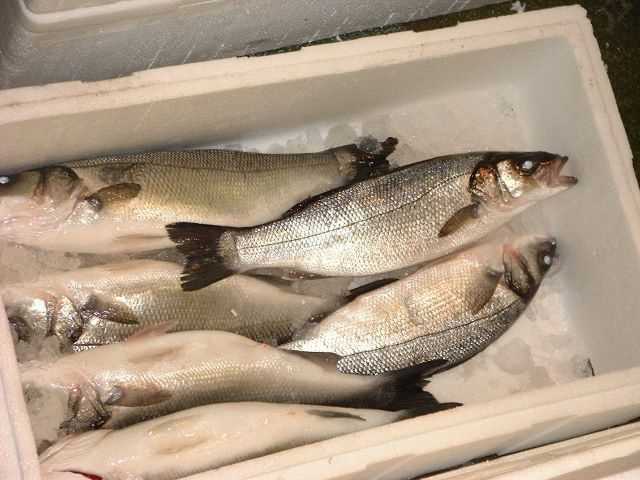
The actual level of oil or oil product contamination in various foods including types of fish is likely to vary widely as a function of the individual fish or food product, its location, its own exposure to spilled or leaked oil.
Below we list excerpts from various news reports and documents that provide some insight into this concern.
Fish photo (left, not contaminated) courtesy of Simply Seafoods - www.simplyseafoods.co.uk
Article Series Contents
Because fishermen are "not allowed" to fish in oil-spill contaminated waters, oil-contaminated seafood is not normally expected to reach consumers. A scan of the thundered of articles discussing the effect of a long history of oil spills in the Nigerian Delta supports this view for a second reason - severely oil-contaminated seafood is virtually inedible. A result is that popular media articles have not reported in depth on the actual contaminants in seafood from or near areas of oil spills.
As of mid June 2010, we had not found U.S. media reports confirming contamination in seafood near the Gulf of Mexico oil spill - but our OPINION is that conditions in that area remain evolving and that to date testing and studies in the U.S. Gulf of Mexico oil spill area incomplete. By late June 2010, at least one third of the Gulf of Mexico fishing areas had been closed to commercial fishing, and the impact on U.S. fish markets, restaurants, and consumers had begun in the form of decreased fish supply and economic losses to workers and businesses throughout the seafood industry. - Reuters
In the United States, the U.S. Department of Health & Human Services reported (29 May 2010, HHS.gov) that "Part of the federal government response to the oil spill in the Gulf of Mexico is the monitoring of environmental conditions that might affect public health and the safety of seafood."
The Food and Drug Administration is closely monitoring the developing situation in the Gulf Coast region to help ensure that seafood potentially impacted by the oil spill is not making its way into commerce. FDA scientists are working with experts at NOAA’s National Seafood Inspection Laboratory in Pascagoula, Miss., on methods to test fish, crabs, shrimp, and oysters, for harmful oil residues. One of FDA’s mobile labs is deployed to the Gulf Coast and will be used to conduct prescreening analysis of seafood samples being evaluated to determine if waters closed to fishing and shellfish harvesting can be re-opened. - original source: http://www.hhs.gov/news/press/2010pres/05/deepwater_factsheet.html
The U.S. Food and Drug Administration and other U.S. agencies provided this 30 April 2010 update on the health risks associated with seafood from the Gulf of Mexico following the crude oil spill there:
Although crude oil has the potential to taint seafood with flavors and odors caused by exposure to hydrocarbon chemicals, the public should not be concerned about the safety of seafood in the stores at this time.
Earlier this week, the state of Louisiana opened some commercial zones to shrimping ahead of the regular season, to allow fishermen to harvest before the oil reached those zones; however, the State has since closed some of those zones to shrimping based on the location and movement of the oil spill.
At sunset on April 30, 2010, the state of Louisiana closed the molluscan shellfish beds in growing areas 2, 3, 4, 5, 6 and 7 to harvest. The closure is a precautionary measure taken because of the possible adverse environmental effects of the oil spill in the area. FDA and the NOAA Fisheries Service will continue to monitor the situation and notify the public if any problem is detected with seafood from this area of the country. - websearch 6/17/2010, original source: http://www.fda.gov/Food/ucm210436.htm
Summary of Oil Contaminants in Seafood - what contaminants occur, where are they found?
- Wild finfish are unlikely to become contaminated or tainted because they typically are either not exposed or are exposed only briefly to the spilled oil and because they rapidly eliminate petroleum compounds taken up. If nearshore sediments are contaminated, species that spawn in nearshore and shallow waters are more likely to be exposed to spilled oil than pelagic and benthic species.
- Shellfish are more likely than finfish to become contaminated from spilled oil because they are more vulnerable to exposure and less efficient at metabolizing petroleum compounds once exposed. Shellfish are generally less mobile and have more contact with sediments, which can become contaminated and serve as a long-term source of exposure.
- Among crustaceans, species that burrow are at the highest risk of exposure at spills where bottom sediments are contaminated, followed by species that utilize nearshore and estuarine benthic habitats.
- Bivalves are at high risk of contamination because they are sessile, filter-and deposit feed, and occur in substrates in shallow tidal and intertidal areas that are more likely to become contaminated.
- It is generally accepted that uptake and elimination rates both increase with temperature, though study results are somewhat contradictory.
- PAHs (polyaromatic hydrocarbons) tend to accumulate to higher concentrations in lipid-rich tissues and organisms. Seasonal differences in tissue lipid content associated with spawning may influence uptake and elimination rates of PAHs in some marine species.
- Chronic exposure to hydrocarbons in water and sediments may reduce elimination capacity.
- Websearch 6/17/2010, original source: "Is Delaware Bay Seafood Safe to Eat?", University of Delaware, College of Earth, Ocean, and Environment, http://www.ceoe.udel.edu/oilspill/seafood.html
Key Recommendations for Protecting from Unsafe Seafood in Areas of Oil Spill Incidents
Managing Seafood Safety after an Oil Spill [PDF], Ruth Yender, Jacqueline Michel & Christine Lord, published by NOAA - quoting from that document's introduction:
Seafood safety is a concern raised at nearly every oil spill incident of any significance. Both actual and potential contamination of seafood can substantially affect commercial and recreational fishing and subsistence seafood use. Loss of confidence in seafood safety and quality can impact seafood markets long after any actual risk to seafood from a spill has subsided, resulting in serious economic consequences. Protecting consumers from unpalatable and unsafe seafood is a primary objective of federal and state public health agencies after a spill occurs. Seafood managers may be faced with making many urgent decisions after an oil spill, often based on limited data:
- Should seafood harvest in the spill area be closed or restricted?
- If closed, what criteria should be applied to re-open a fishery?
- How should seafood safety and palatability be evaluated?
- How can health risks best be communicated to the public?
Public health officials and other seafood managers do not routinely deal with oil spills as part of their day-to-day responsibilities. Consequently, they typically have little experience with risks to seafood from oil spills when they suddenly are faced with determining appropriate seafood management actions in response to a spill.
The objective of this guide is to provide seafood managers and other spill responders with information to help them evaluate the likelihood that an oil spill will contaminate seafood, determine whether seafood actually has been contaminated, and assess and communicate human health risk from eating contaminated seafood.
Guidance on Sensory Testing and Monitoring of Seafood for Presence of Petroleum Taint Following an Oil Spill [PDF], NOAA Technical Memorandum NOS OR&R 9 - quoting from that document's introduction:
When an oil spill occurs, local seafood resources may be exposed to petrochemicals that affect their sensory qualities (taste, smell, and appearance). Even when seafood samples from the spill area pass the standard chemical-analytical tests (the levels of polycyclic aromatic hydrocarbons are below the limits permitted as determined by human health risk assessment), flavor or odor still may be affected. Taint in seafood renders it adulterated and unfit for human consumption according to U.S. law (Federal Food, Drug, and Cosmetics Act, US Code 21, Chapter IV, Sec. 402 [342], a.3).
The specific compounds in oil responsible for causing off-flavors and off-odors in seafood have not been determined with certainty. Experience at recent oil spills indicates that, when well-trained sensory panelists conduct sensory testing, there is generally a high degree of correlation between the results of chemical analysis and sensory testing. Because this correlation is not absolute, there is a role for both sensory and chemical analysis in assessing adulteration and safety of seafood. Analytical instrumentation, particularly hand-held electronic noses, continue to advance and may eventually play a significant role at oil spills as tools for rapid assessment. However, at their present state of sophistication, these instruments are chemical detectors only, incapable of making any sensory judgment on odor or flavor. The final judgment about the presence and absence
Readers concerned about possible health effects of eating oil-spill-contaminated seafood, fish, or other food products should also review the crude oil and heating oil material safety data sheets (MSDS) listed at the top of HEATING OIL EXPOSURE HAZARDS, LIMITS for basic health information.
Nigeria: Oil Spills in the Nigerian Delta - Consumers Shun Fresh Fish
Because of a long history of more than fifty years of oil spills in the area, Nigeria appears most prominently in response to a search for oil spill-related environmental and food damage.
Restaurateurs and sea-food dealers in coastal communities in [Ibeno, Southern] Akwa Ibom State say the recent oil spillage in the area has affected the consumption of fresh fish by the people. They attributed the development to fear among the people over the possibility of buying fish poisoned by spilled crude. ... We no longer make sales because people are avoiding fish. In fact, fishermen no longer go to sea to fish. The fish we sell now are from trawlers which operate outside Nigerian waters. "Oil operations in this area are really affecting our business negatively and that was why women joined the youths to protest the frequent oil spills."
The article refers to... "the May 1 oil spillage from the Qua Iboe Oil Fields, which polluted water in the communities. Mobil Producing Nigeria (MPN), a subsidiary of U.S. Oil firm, ExxonMobil, had, in a statement signed by its Executive Director, Mrs Gloria Essien-Danner, confirmed that oil was leaking from the company's pipeline." - Original source - http://allafrica.com/stories/201006150295.html 14 June 2010
In an earlier article from the same source quotes the oil producer:
Although, the oil major admitted there was a reported spill in the high sea which later flew to the shoreline, it said that "there is no hydrocarbon release from MPN operations" as subsequent tests of the sample collected showed that it was not consistent with MPN crude.
- Original source - http://allafrica.com/stories/201004050784.html
We witnessed the slow poisoning of the waters of this country and the destruction of vegetation and agricultural land by oil spills which occur during petroleum operations. But since the inception of the oil industry in Nigeria, more than twenty-five years ago, there has been no concerned and effective effort on the part of the government, let alone the oil operators, to control environmental problems associated with the industry.
- Websearch 6/15/2010, Original source, quoted in Greenpeace International's Shell Shocked, 11
The environmental and economic effects of oil production activities in Nigeria have been summarized by Chrisotpher O. Orubo et als as follows:
The ultimate economic effect of environmental impacts of oil production activities is to catalyse a reduction in the standard of living of people in the area of primary activities. The economic effects are extensive, and include dislocation of traditional economic activities and associated livelihood pursuits as well as danger to human health. Expectedly, all of the economic effects translate to pecuniary effects, which can be measured in terms of reduced real incomes and the loss of alternative uses of resources consumed by oil companies (Ekuerhare and Orubu, 1996).
We can refer to the effects described above as first round effects. There are also the second round effects, with longer-term welfare implications. Each round of environment–degrading activity tends not only to increase the incidence of poverty among vulnerable groups such as farmers and fishermen and their dependants, but also involves intensified exploitation of existing natural resources, such as timber and non-timber forest resources. For example, pollution of major fishing waters leads to massive exploitation of marginal fishing waters. The pressure on land as a result of pollutive oil industry activities also leads to the exploitation of marginal farmlands, over-farming and deforestation, all of which result in a new wave of environmental degradation. In this way, a kind of vicious circle relationship between environmental degradation and poverty incidence is created, particularly in the face of inappropriate compensation programmes of oil companies, which do not provide for alternative sources of livelihood for deprived land owners.
Material Safety Data Sheets for Crude Oil and Refined Heating Oil Products
Contamination of seafood may also involve not just crude oil (MSDS Sheet for CRUDE OIL) spilled in an area, but chemicals used as dispersants (MSDS Sheets for OIL DISPERSANTS) as well.
- Heating Oil Exposure Health Effects - introduction and general health effects
- MSDS Sheet for HOME HEATING OIL - Material Safety Data Sheets for No. 2 Heating Oil
- Exposure Limits for Home Heating Oil - Exposure LImits for Oil Exposure
- MSDS Sheet for CRUDE OIL- exposure hazards, personal protection advice, accidental release guidance
Research on Contamination of Seafood by Oil Spills & Other Sources
- Please see the citations atReferences or Citations for this article
- Al‐Awadhi, N., R. Al‐Daher, A. EINawawy, and M. T. Salba. "Bioremediation of oil‐contaminated soil in Kuwait. I. landfarming to remediate oil‐contaminated soil." Soil and Sediment Contamination 5, no. 3 (1996): 243-260.
- Bernard, Alfred, Fabrice Broeckaert, Geert De Poorter, Ann De Cock, Cédric Hermans, Claude Saegerman, and Gilbert Houins. "The Belgian PCB/dioxin incident: analysis of the food chain contamination and health risk evaluation." Environmental research 88, no. 1 (2002): 1-18.
- Bernard, Alfred, Cédric Hermans, F. Broeckaert, G. De Poorter, A. De Cock, and G. Houins. "Food contamination by PCBs and dioxins." Nature 401, no. 6750 (1999): 231-232.
- Bernard, Alfred, Cédric Hermans, F. Broeckaert, G. De Poorter, A. De Cock, and G. Houins. "Food contamination by PCBs and dioxins." Nature 401, no. 6750 (1999): 231-232.
- Bolger, Michael, and C. Carrington. "Hazard and risk assessment of crude oil in subsistence seafood samples from Prince William Sound: lessons learned from the Exxon Valdez." Evaluating and Communicating Subsistence Seafood Safety in a Cross-Cultural Context: Lessons Learned from the Exxon Valdez Oil Spill. Pensacola: Society of Environmental Toxicology and Chemistry (1999): 195-204.
- Bu-Olayan, A. H., and Sami Al-Yakoob. "Lead, nickel and vanadium in seafood: An exposure assessment for Kuwaiti consumers." Science of the total environment 223, no. 2 (1998): 81-86.
- Fayad, N. M., A. H. El-Mubarak, and R. L. Edora. "Fate of oil hydrocarbons in fish and shrimp after major oil spills in the Arabian Gulf." Bulletin of environmental contamination and toxicology 56, no. 3 (1996): 475-482.
- Friberg, Lars. "The GESAMP evaluation of potentially harmful substances in fish and other seafood with special reference to carcinogenic substances." Aquatic Toxicology 11, no. 3 (1988): 379-393.
- Gilroy, Duncan J. "Derivation of shellfish harvest reopening criteria following the New Carissa oil spill in Coos Bay, Oregon." Journal of Toxicology and Environmental Health Part A 60, no. 5 (2000): 317-329.
- Hites, Ronald A., Jeffery A. Foran, David O. Carpenter, M. Coreen Hamilton, Barbara A. Knuth, and Steven J. Schwager. "Global assessment of organic contaminants in farmed salmon." Science 303, no. 5655 (2004): 226-229.
- Hom, Tom, Tracy K. Collier, Margaret M. Krahn, Mark S. Strom, Gina M. Ylitalo, William B. Nilsson, Rohinee N. Paranjpye, and USHA VARANASI. "Assessing seafood safety in the aftermath of Hurricane Katrina." In American Fisheries Society Symposium, vol. 64, pp. 000-000. 2008.
- Järup, Lars. "Hazards of heavy metal contamination." British medical bulletin 68, no. 1 (2003): 167-182.
- Jin, Hyun Mi, Jeong Myeong Kim, Hyo Jung Lee, Eugene L. Madsen, and Che Ok Jeon. "Alteromonas as a key agent of polycyclic aromatic hydrocarbon biodegradation in crude oil-contaminated coastal sediment." Environmental science & technology 46, no. 14 (2012): 7731-7740.
- Jørgensen, Lasse Vigel, and Hans Henrik Huss. "Prevalence and growth of Listeria monocytogenes in naturally contaminated seafood." International journal of food microbiology 42, no. 1 (1998): 127-131.
- Law, Robin J., and Jocelyne Hellou. "Contamination of fish and shellfish following oil spill incidents." Environmental Geosciences 6, no. 2 (1999): 90-98.
- Law, Robin J., Carole Kelly, Kerry Baker, Jacqueline Jones, Alistair D. McIntosh, and Colin F. Moffat. "Toxic equivalency factors for PAH and their applicability in shellfish pollution monitoring studies." Journal of environmental monitoring 4, no. 3 (2002): 383-388.
- Lemiere, Sebastien, Carole Cossu‐Leguille, Antonio Bispo, Marie‐José Jourdain, Marie‐Claire Lanhers, Daniel Burnel, and Paule Vasseur. "Genotoxicity related to transfer of oil spill pollutants from mussels to mammals via food." Environmental toxicology 19, no. 4 (2004): 387-395.
- Longnecker, Matthew P., Walter J. Rogan, and George Lucier. "The human health effects of DDT (dichlorodiphenyltrichloroethane) and PCBs (polychlorinated biphenyls) and an overview of organochlorines in public health 1." Annual review of public health 18, no. 1 (1997): 211-244.
- Moller, T. H., Brian Dicks, K. J. Whittle, and Michel Girin. "Fishing and harvesting bans in oil spill response." In International Oil Spill Conference, vol. 1999, no. 1, pp. 693-699. American Petroleum Institute, 1999.
- Rotkin-Ellman, Miriam, Karen K. Wong, and Gina M. Solomon. "Seafood contamination after the BP Gulf oil spill and risks to vulnerable populations: a critique of the FDA risk assessment." Environ Health Perspect 120, no. 2 (2012): 157-161.
- Saxton, Wilbur L., Richard T. Newton, Julie Rorberg, Jim Sutton, and Lloyd E. Johnson. "Polycyclic aromatic hydrocarbons in seafood from the Gulf of Alaska following a major crude oil spill." Bulletin of environmental contamination and toxicology 51, no. 4 (1993): 515-522.
- Sadiq, Rehan. "Drilling waste discharges in the marine environment: a risk based decision methodology." PhD diss., Memorial University of Newfoundland, 2001.
- Shaw, Brenda Jo. "Evaluation of risks to human health in Hong Kong from consumption of chemically contaminated seafood: a riskassessment approach." PhD diss., The University of Hong Kong (Pokfulam, Hong Kong), 1995.
- Smith, A. G., and S. D. Gangolli. "Organochlorine chemicals in seafood: occurrence and health concerns." Food and Chemical Toxicology 40, no. 6 (2002): 767-779.
- Upton, H.F., "The Deepwater Horizon oil spill and the Gulf of Mexico fishing industry." Congressional Research Service, Library of Congress, 2011.
- Yender, Ruth, Jacqueline Marie Michel, and Christine Lord. Managing seafood safety after an oil spill. US Department of Commerce, National Oceanic and Atmospheric Administration, National Ocean Service, Office of Response and Restoration, 2002.
- Ylitalo, Gina M., Margaret M. Krahn, Walton W. Dickhoff, John E. Stein, Calvin C. Walker, Cheryl L. Lassitter, E. Spencer Garrett et al. "Federal seafood safety response to the Deepwater Horizon oil spill." Proceedings of the National Academy of Sciences 109, no. 50 (2012): 20274-20279.
- Young, C. C., H. Hupfer, C. Siering, M-J. Ho, A. B. Arun, W-A. Lai, P. D. Rekha et al. "Azospirillum rugosum sp. nov., isolated from oil-contaminated soil." International journal of systematic and evolutionary microbiology 58, no. 4 (2008): 959-963.
...
Continue reading at HEATING OIL EXPOSURE HAZARDS, LIMITS or select a topic from the closely-related articles below, or see the complete ARTICLE INDEX.
Suggested citation for this web page
EXPOSURE to CRUDE OIL or HEATING OIL-CONTAMINATED FISH at InspectApedia.com - online encyclopedia of building & environmental inspection, testing, diagnosis, repair, & problem prevention advice.
Or see this
INDEX to RELATED ARTICLES: ARTICLE INDEX to BUILDING ENVIRONMENT
Or use the SEARCH BOX found below to Ask a Question or Search InspectApedia
Ask a Question or Search InspectApedia
Try the search box just below, or if you prefer, post a question or comment in the Comments box below and we will respond promptly.
Search the InspectApedia website
Note: appearance of your Comment below may be delayed: if your comment contains an image, photograph, web link, or text that looks to the software as if it might be a web link, your posting will appear after it has been approved by a moderator. Apologies for the delay.
Only one image can be added per comment but you can post as many comments, and therefore images, as you like.
You will not receive a notification when a response to your question has been posted.
Please bookmark this page to make it easy for you to check back for our response.
Our Comment Box is provided by Countable Web Productions countable.ca
Citations & References
In addition to any citations in the article above, a full list is available on request.
- "Impact of Crude Oil on Seafood" - PDF - web search 6/17/2010 - cites this link that was not functional:
http://response.restoration.noaa.gov/book_shelf/1888_Seafood_safety_FACT_SHEET.pdf - Managing Seafood Safety after an Oil Spill, Ruth Yender,
Office of Response and Restoration, National Oceanic and Atmospheric Administration, Seattle, Washington,
Jacqueline Michel and Christine Lord, Research Planning, Inc., Columbia, South Carolina,
NOAA, - websearch 6/17/2010, original source:
http://response.restoration.noaa.gov/book_shelf/963_seafood2.pdf - Guidance on Sensory Testing and Monitoring of Seafood for Presence of Petroleum Taint Following an Oil Spill, NOAA Technical Memorandum NOS OR&R 9, Terriann I. Reilly, National Oceanic and Atmospheric Administration/National Marine Fisheries Service, Seafood Inspection Program Roberta K. York, Canadian Food Inspection Agency, Laboratories DirectorateSeattle WA, 2001, published by: Office of Response and Restoration National Ocean Service, National Oceanic and Atmospheric Administration, U.S. Department of Commerce, Silver Spring, Maryland- original source: http://response.restoration.noaa.gov/book_shelf/964_seafood.pdf
- Christopher O. Orubu, Ayodele Odusola, William Ehwarieme, "The Nigerian Oil Industry: Environmental Diseconomies, Management Strategies, and the Need for Community Involvement", J. Hum. Ecol., 16(3): 203-214 (2004) [PDF] - original source: http://www.krepublishers.com/02-Journals/JHE/JHE-16-0-000-000-2004-Web
/JHE-16-3-151-226-2004-Abst-PDF/JHE-16-3-203-214-2004-1168-Orubu-C-O/JHE-16-3-203-214-2004-
Orubu-C-O.pdf - "Toxicological profile for fuel oils", U.S. Department of Health and Human Services, Public Health Service, Agency for Toxic Substances and Disease Registry (ATSDR) Atlanta, GA 1995. - http://www.atsdr.cdc.gov/toxprofiles/tp75.html
- Public Health Statement for Fuel Oils, ATSDR, (the full document original source can be found at http://www.atsdr.cdc.gov/toxprofiles/phs75.html). An excerpt from this document is just below. ATSDR,
Division of Toxicology, 1600 Clifton Road NE, Mailstop F-32, Atlanta, GA 30333 888-422-8737. - Heating Oil Exposure Health Effects - The ATSDR section on health effects of exposure to heating oil see-ATSDR
- No. 2 Home Heating Oil Chemical Properties - ATSDR data on the chemistry and composition of No. 2 home heating oil and of kerosene
- Potential for Human Exposure to Heating Oil - ATSDR
- Regulations and Advisories Pertaining to Fuel Oil - ATSDR data on how exposure limits for heating oil were derived, a table of international and national (U.S.) regulations governing fuel oil,
- Simply Seafood's Simplyseafoods - http://www.simplyseafoods.co.uk generously gave permission for us to use their fish photo June 2010 Retail, Wholesale Fishmongers, Tel: 0208 893 7402/07944068469 Fax: 0208 759 7395, simplyseafoods@yahoo.co.uk,
Fresh or Frozen fish delivered to your door, Our friendly team can deliver to you in temperature controlled vans, LIVE CRABS, LOBSTERS, ATLANTIC COD, MACKEREL ETC., We promise to get you almost any seafood of top quality that you desire. - Home Heating Oil Spills, Fact Sheet, Connecticut Department of Public Health
- "Home Heating Oil Spills", Wisconsin Department of Health, at http://dhs.wisconsin.gov/eh/Air/fs/Oilspill.htm
- Occupational Exposures in Petroleum Refining; Crude Oil and Major Petroleum Fuels, IARC - World Health Organization, 1/21/1998. This monograph is available at https://publications.iarc.fr/ENG/Monographs/vol45/volume45.pdf and it includes a chapter
FUEL OILS (HEATING OILS) Residual (heavy) fuel oils (Group 2B) and Distillate (light) fuel oils (Group 3) that describes heating oil exposure data, concluding "Residual (heavy) fuel oils are possibly carcinogenic to humans (Group 2B)." To search the IARC monographs on various environmental concerns and carcinogens, use https://publications.iarc.fr/ENG/Monographs/PDFs/index.php - "MSDS for No. 2 Fuel Oil - home heating oil", Hess Corporation, 1 Hess Plaza, Woodbridge, NJ 07095-0961 Original Source: www.hess.com/ehs/msds/0088No2FuelOil.pdf 07/01/2007
- "MSDS for No. 4 Fuel Oil - home heating oil", Hess Corporation, 1 Hess Plaza, Woodbridge, NJ 07095-0961 Original Source: www.hess.com/ehs/msds/0088No2FuelOil.pdf 07/01/2007
- Crude Oil MSDS from Martin Marietta Materials Corp., November 2007, Martin Marietta Materials, 2710 Wycliff Road, Raleigh, North Carolina 27607-3033 Effective Date: 8-07 (919) 781-4550, original source: http://www.martinmarietta.com/products/MSDS-CrudeOil.pdf
- MSDS for Crude Oil, El Paso Corporation,
and its subsidiaries Information: (713) 420-2600
1001 Louisiana Street CHEMTREC: (800) 424-9300 Houston, Texas 77002, original source 4/230/10 http://www.elpaso.com/msds/A0017-Crude%20Oil.pdf - MRL - Minimum risk level: this is an estimate of the level of daily human exposure to a substance such that the exposure is probably not an appreciable risk for adverse effects (noncancer) over a specified exposure time period.
- "Agency Orders Use of a Less Toxic Chemical in Gulf", Campbell Robertson, Elisabeth Rosenthal, The New York Times, May 20, 2010, http://www.nytimes.com/2010/05/21/science/earth/21disperse.html?scp=1&sq=corexit&st=cse
- Nalco Energy Services, L.P. P.O. Box 87, Sugar Land, Texas 77487-0087, 281)263-7000, www.nalco.com
- "Is Delaware Bay Seafood Safe to Eat?", University of Delaware, College of Earth, Ocean, and Environment, http://www.ceoe.udel.edu/oilspill/seafood.html
- "Clean-up workers risk health problems from oil spill", Emma Ashburn, Reuters News Service, 23 June 2010 - web search 6/23/2010
- "Gulf spill hits NY fish market", Jenna Haines, Reuters NY, Reuters News Service, 23 June 2010 - web search 6/23/2010 [video report]
- U.S. Centers for Disease Control and Prevention - US CDC, "What to Expect from the Oil Spill and How to Protect Your Health", web search 17 June 2010 - original source http://emergency.cdc.gov/gulfoilspill2010/what_to_expect.asp
- U.S. EPA - environmental Protection Agency, List of Approved Oil Dispersants - Web Search 06/13/2010 - original source http://www.epa.gov/oem/content/ncp/tox_tables.htm
- U.S. Polychemical of Spring Valley, N.Y., makes dispersant Dispersit SPC 1000 - Web Search 06/13/2010: Dispersant SPC 1000 specifications sheet - see http://www.uspoly.com/disspec.html
- HEATING OIL EXPOSURE HAZARDS, LIMITS - Heating Oil Exposure Effects, Exposure Limits, Health Hazards
- Exposure to Crude Oil or Heating Oil Combustion Gas, Soot, Flue Gases
- Exposure to Crude Oil or Heating Oil Fumes
- Exposure to Crude Oil or Heating Oil Liquid
- Exposure to Crude Oil or Heating Oil - contaminated fish - eating oil-contaminated seafood
- Material Safety Data Sheets for Crude Oil and Refined Heating Oil Products
- Heating Oil Exposure Health Effects - introduction and general health effects
- MSDS Sheet for HOME HEATING OIL - Material Safety Data Sheets for No. 2 Heating Oil
- Exposure Limits for Home Heating Oil - Exposure LImits for Oil Exposure
- MSDS Sheet for CRUDE OIL- exposure hazards, personal protection advice, accidental release guidance
- MSDS Sheets for Gulf Oil Spill Dispersant Corexit - toxicity and MSDS sheets for Corexit®, Dispersit®, and other oil spill dispersants
- ENVIRONMENTAL HEALTH & INVESTIGATION BIBLIOGRAPHY - our own technical library on indoor air quality inspection, testing, laboratory procedures, forensic microscopy, etc.
- Air Pollution Toxicology: APTI Course SI:300, Introduction to Air Pollution Toxicology, US EPA Air Pollution Training Institute, Environmental Research Center
- In addition to citations & references found in this article, see the research citations given at the end of the related articles found at our suggested
CONTINUE READING or RECOMMENDED ARTICLES.
- Carson, Dunlop & Associates Ltd., 120 Carlton Street Suite 407, Toronto ON M5A 4K2. Tel: (416) 964-9415 1-800-268-7070 Email: info@carsondunlop.com. Alan Carson is a past president of ASHI, the American Society of Home Inspectors.
Thanks to Alan Carson and Bob Dunlop, for permission for InspectAPedia to use text excerpts from The HOME REFERENCE BOOK - the Encyclopedia of Homes and to use illustrations from The ILLUSTRATED HOME .
Carson Dunlop Associates provides extensive home inspection education and report writing material. In gratitude we provide links to tsome Carson Dunlop Associates products and services.
 | HOME | ABOUT | ASK a QUESTION | CONTACT | CONTENT USE POLICY | DESCRIPTION | POLICIES | PRIVACY | |
| © 2024 - 1985 Publisher InspectApedia.com - Daniel Friedman | |||||||||