
InspectAPedia® FREE Encyclopedia of Building & Environmental Construction, Diagnosis, Maintenance & Repair |
Question? Just ask us! InspectAPedia
|
 Age or Health-Related Noise Complaints in Buildings
How hearing disorders, deafness, mental & neurological disorders relate to building noise & sound complaints
- POST a QUESTION or COMMENT about age or health-related noise and sound complaints
Age & Health-Related Causes of Noise & Sound Complaints:
This article discusses how to identify noise or sound complaints that may be health or age-related. This article series discusses noise and sound source diagnosis and control: how to inspect, diagnose & cure noise or sound problems in buildings. Information is provided about auditory (hearing), visual, historic, or other clues of building condition that explain various sounds heard in buildings.
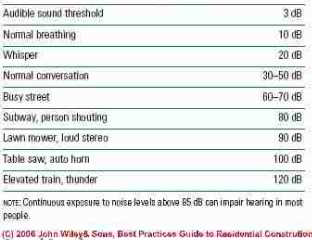
Our page top table of relative sound levels (left) is from Best Practices Guide to Residential Construction (Steve Bliss, J Wiley & Sons) , by Steven Bliss, courtesy of Wiley & Sons.
InspectAPedia tolerates no conflicts of interest. We have no relationship with advertisers, products, or services discussed at this website.
How to Identify & Report Age or Health-Related Noises & Sounds in Building Interiors
 Daniel Friedman - OPINION
First: the opinions and advice in this article series are based on our extensive experience in inspecting and diagnosing building related complaints and building defects, combined with experience in responding to complaints by building occupants about noises or sounds. Our experience includes working with people suffering from physical and mental health difficulties as well as the challenges imposed by normal aging.
The author is not a medical professional. Below we recommend that people complaining of noises or sounds that cannot be confirmed by others (presumably with normal hearing ability) should be sure to check with their primary care physician who in turn may recommend consulting with a neurologist, audiologist, or other trained professional who can help rule in or out potentially serious health concerns.
[Click to enlarge any image] Shown here: OSHA's Standard 1910.95 Noise Exposure Limits, Table G-16, Permissible Noise Exposures (in the workplace), source cited below.
Second: noise complaints in buildings can be directly related to the health and well being of building occupants. Because responding to sound or noise issues may involve issues of physical or mental health, disputes between neighbors, and even immediate life safety concerns, it is important that the investigator proceed with both sensitivity to the needs of the individuals involved and caution lest an unsafe condition be underestimated or worse, ignored. Identifying and responding to noise complaints that may involve personal safety is a first priority.
Even for an individual who suffers from auditory hallucinations, not every noise complaint is hallucinatory. Investigating a noise complaint involving an elderly building occupant we learned that she suffered from auditory hallucinations and was certain that a neighbor was playing loud music. (The neighbor was not.)
But we were shocked to discover that a local contractor, taking advantage of the occupant's condition, obtained large, regular cash payments ostensibly for providing "security services". We learned that the contractor was calling the elderly occupant, pretending to be the neighbor, adding to her anxiety, provoking her to purchase additional "security services."
At NOISE / SOUND DIAGNOSIS & CURE we discuss how to locate the source of, identify and correct various building sounds and noises indoors or on occasion, noises from outside that penetrate indoors at annoying levels. While we touch on environmental noise coming from outside of buildings (aircraft noise, highway noise, noisy neighbors) the focus of this article series is on identifying and curing unwanted indoor noise sources in buildings - noise control.
Separately at SOUND CONTROL in BUILDINGS we provide a series of detailed articles on reducing unwanted building noise levels through building design, insulation, sound isolation, and noise barriers.
Actual versus Perceived Noises in buildings
Using our own terms to aid this discussion, we distinguish between actual noises or sounds in buildings and perceived sounds in buildings.
Actual noises (for our purposes here) are sounds that are caused by physical sources such as heating equipment, plumbing, or a neighbor playing music. Actual noises are transmitted from the source to the individual through air or in some cases through the conductivity of physical building components (floors, pipes).
Perceived noises (for our purposes) are sounds that are reported to have been experienced or observed by an individual, regardless of whether or not a physical source and actual instrument-detectable sounds are present. So perceived noises may include both actual noise and/or the perception of noise (or sound) that has in part or in total a neurological, or mental, or health-related basis.
Actual or "Physically-based" Building Noises or Sounds
Regardless of their source, actual noises are transmitted in buildings by two methods.
Airborne Sound: Sound waves traveling through air move between building areas - such as through open windows, doors, or stairwells.
Mechanically transmitted sound: When sounds move through solid building components such as floors, ceilings, walls, framing, carrying sound from one area to another the sound transmission is referred to more technically as impact insulation class transmission or IIC sound transmission.
In many cases the source of an annoying building sound may be obvious and we can move immediately to strategies for reducing that source to an acceptable noise level. But we also receive queries from people who have difficulty tracing a sound to its source, or who are unsure if a sound that they hear at a known source (say a humming sound at an electrical component) is normal or means trouble.
For unidentified sound sources, general advice on tracking down the source and cause of annoying building sounds and noises includes a procedure similar to our ODOR DIAGNOSIS CHECKLIST, PROCEDURE. Keep a noise log, noting
- The date and time of the noise at each occurrence, especially when it was first observed
- What equipment is operating or turned off in the building
- What weather conditions might be pertinent such as wind, rain, or freezing
- What has changed in the building that might be relevant such as installation or removal of equipment
- Differences in noise perception between what is observed indoors, at different indoor locations, and outside.
- Who heard the sound, and who, present at the same time, did not?
- Were independent observers or consultants present when the sound or noise was reported?
Health Related Noise Complaints in buildings
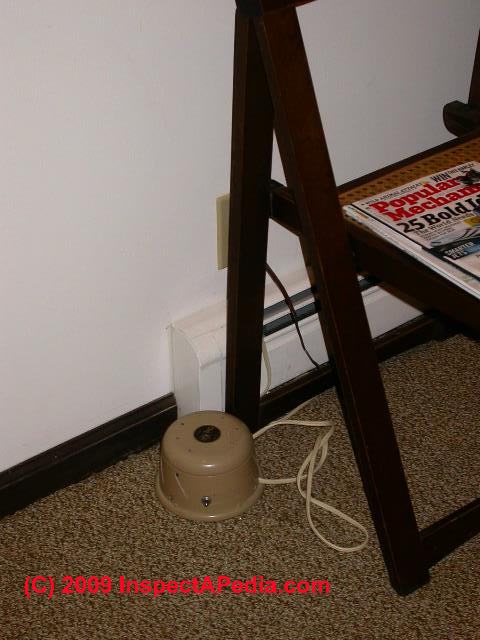
Health related noise and apparent noise sources can involve common aging or hearing disorders, dementia, or other serious medical conditions. Shown at left is the Sleep Mate™ sound generator produced by Marpac.
- Normal aging of people is often accompanied by changes in hearing and hearing perception. Neurological disorders, psychological disorders, or possibly other serious medical conditions can cause a perception of noise in buildings that can be very disturbing to the person suffering from these conditions.
- Deafness and other hearing disorders of varying degrees can be caused or excacerbated by a wide range of disorders or causes, some of which can include perception or mis-perception of building noises & sounds.
Even ototoxic drugs such as streptomycin and neomycin have been associated with or can cause hearing disorders or even deafness. According to the Merck Manual, drugs may cause hearing loss, dysequilibrium, and/or tinnitus. [1] A building noise complaint investigator may need to include consideration of these disorders. - Dementia can cause a perception of noise in buildings that can be very disturbing to the person suffering from these conditions
Watch out: medical advice from experts including neurologists, geriatricians, and psychiatrists can be very important when responding to noise & sound complaints.
Shown above is the Sleep Mate™ sound generator produced by Marpac.
There are multiple causes of dementia including
- Aids
- Alzheimer's Disease
- Brain Tumors
- Depression
- Drug reactions or drug interactions
- Head Injuries
- Huntington's disease
- Hydrocephalus
- Infections
- Multi-infarct dementia
- Nutritional deficiencies
- Parkinson's disease
- Pick's disease
- Thyroid problems
We recently investigated a case in which an elderly person in a Florida home had complained of loud voices and loud music for more than a year. Because it is normal for any individual's mind to find an apparently rational explanation for sensations that appear "real", the complainant was certain that the noise problem rested with her next door neighbor.
But reports from family members confirmed that their mother had the same complaints in two other cities, one in a hotel, another in a private home. In those cases family members were certain that the sounds were not actually occurring. We recommended a medical consult. -DF
We consulted in a different building noise complaint that was voiced by just one occupant of several in a home. Our client had consulted with his physician who did not find a medical cause for a hearing disorder. Before assuming that we could not help this individual we considered that because people's hearing sensitivity varies widely, together we needed to confirm that others did nor did not hear noises in the building. --DF
"Although no one would say that noise by itself brings on mental illness, there is evidence that noise-related stress can aggravate already existing emotional disorders. Research in the United States and England points to higher rates of admission to psychiatric hospitals among people living close to airports.
And studies of several industries show that prolonged noise exposure may lead to a larger number of psychological problems among workers." - "Noise, A Health Problem", US EPA,
Hearing disorders and even hearing aid malfunctions can cause a perception of noise in buildings that can be very disturbing to
We recently investigated another mysterious music complaint involving the author's brother in law who wears hearing aids that incorporate a blue-tooth wireless function to permit easy use of a cell phone. But our brother-in-law began hearing music, intermittently. The problem was traced to his iPod that had been left on and transmitting music to his hearing aids. --DF
See details at HEARING DISABILITIES & BUILDING NOISES
Humming Noises or "The Hum" Perceived Noise Complaints:
Some individuals who are otherwise healthy, may nevertheless perceive irritating sounds that have no external physical basis, often only in a single building, or at a single location in a building.
See details at HUMMING NOISE COMPLAINTS
Sleep disturbance and noise
"Human response to noise before and during sleep varies widely among age groups. The elderly and the sick are particularly sensitive to disruptive noise. Compared to young people, the elderly are more easily awakened by noise and, once awake, have more difficulty returning to sleep. As a group, the elderly require special protection from the noises that interfere with their sleep". - "Noise, A Health Problem", US EPA,
Here is an example sleep disturbance report:
I am a senior citizen (68) living alone, here in the Poconos in Pike County. Please note, I do not have tinnitis For the last 4 years, I have been suffering with a hissing sound in my house. I tried to locate sound engineers, listening devices and the like but, have not been successful.
This noise always takes place in the hours between 9:00PM and 6:00AM and sometimes during the daylight hours. I have a fairly simple house with a sump pump which I just replaced, and a septic (grinder pump) that is approximately 24 yrs old. I am at my wits end and haven't had a decent night's sleep in all this time. Short of having someone spend the night at my house, I don't know what to do anymore. It is very difficult to get competent people to diagnose this problem. -- E.R.
Steps to Track Down a Night-Time Hissing Sound or Noise
We suggested some simple first steps in on-site detective work to track down this night time hissing noise:
- Have a good flashlight in hand
- Turn off all electrical power at the main panel
- Does the sound change ?
- Wait a few minutes to observe
- If there is no change in the sound,
- Turn off all water at the water main valve
- If there is change in sound, try turning off individual pieces of equipment in the home, or even ALL electrical power
- Record the date and time of the noise at each occurrence, especially when it was first observed
- Record What equipment is operating or turned off in the building
- Record what weather conditions might be pertinent such as wind, rain, or freezing
- Record what has changed in the building that might be relevant such as installation or removal of equipment
- Record differences in noise perception between what is observed indoors, at different indoor locations, and outside.
- Use SOUND EVENT LOG for recording events or activities or equipment operation that may help track down the source of a noise or sound complaint
The steps above were not sufficient, as E.R. continued.
- I followed your instructions:
- I turned off the water at the main (left off fall Night)
- I turned off the grinder pump (septic system) and left it off all night)
- I turned of the electric fuse box and the noise continues
At my wits end.... - I had a home inspector to view the property and he thought it was crickets.
- Of course, we both know is isn't crickets...
- I called the cable company, the telephone company.
- People are going to think I am hard of hearing. NO WAY...I do not have tinnitis
- This is a real challenge and I don't know what else to do.
When to bring in an expert for on-site noise or sound diagnosis & cure
In difficult cases such as this one, having an experienced person on-site when the noises are occurring, possibly using simple noise amplification equipment to help determine the direction from which sound is emanating, may be the only way to both make progress and avoid contusing medical health concerns for on-site sound problems.
Other medical conditions: If you or someone you are assisting is disturbed by noises whose presence is not verified by independent third parties, we recommend that you or the noise-disturbed person check with their physician. In addition to careful medical examination, use of hearing aids or a white noise machine (see SOUND CONTROL in buildings) may assist in these cases.
Neurological Anomalies or Hearing Disabilities & Building Noise Complaints

Hearing Disabilities often include difficulty in
- Recognizing the presence of actual noises
- Distinguishing between actual noises and perceived noises
- Determining the direction from which a noise emanates or the location in which a sound is loudest
Even when a noise is present at a discernable level, a person with hearing impairment may have difficulty accurately pointing to the direction from which a noise is emanating.
If you are hearing impaired or working with someone who is, recruit additional help from others and don't forget to consider that the apparent direction or source of a noise could be quite mistaken.
These limitations may interfere with the ability to identify of a hearing impaired person to identify and/or track the source of noises in buildings.
Also don't forget to check hearing aids themselves for noise sources; a poorly-fitting or low battery hearing aid may squawk, shriek, or emit periodic chimes, beeps, or with the newest units even voices announcing "low battery".
The author, who is hearing impaired, has on occasion received complaints from others nearby when his own hearing aid was making noises that he did not perceive.
Auditory Synesthesia & Sounds - Possible Relation to Building Noise Complaints?
Synesthesia (from Greek) refers to a joining of the senses. A stimulus in one sense modality (sight, touch, smell, hearing) consistently and involuntarily elicits a sensation in another modality. Saenz and Koch point out that "Synesthesia is a benign neurological condition in humans characterized by involuntary cross-activation of the senses, and estimated to affect at least 1% of the population."
Examples of synesthesia include
- Seeing particular colors when seeing particular shapes
- Experiencing particular flavors when hearing particular sounds
- Hearing particular sounds when seeing particular movement.
Saenz and Koch also report that auditory synesthesia occurs, presenting evidence from "four healthy adults [with no known hearing or neurological deficits] for whom seeing visual flashes or visual motion automatically causes the perception of sound". [1]
OPINION-DF: Although we have not found research specifically linking auditory synesthesia to building-related noise complaints, our opinion is that this cause should not be ruled out of the initial states of investigating building-related noise complaints when the investigator has not found an apparent explanation in a detected physical source of actual sounds.
We suspect that most synesthetes are aware of their condition and thus may be less likely to mistake auditory synesthesia for other building noises.
What we don't know is whether auditory synesthesia might also be induced in some individuals suffering from dementia, from an injury or from illness.
1. Saenz, Melissa and Koch, Christof, "The sound of change: visually-induced auditory synesthesia", Current Biology Vol. 18 No. 5 R650
Hum Noise Complaints - "The Hum"
Here is a final diagnosis of a noise complaint reported to us by reader C.C.
I write to inform you, I have at long last now got to the bottom of the noise thing. It wasn't X's fan/fan-heater the culprit, nor was it my gas boiler or hot water heater, but of all things I have apparently adopted a condition called 'The Hum', and I have been informed it occurs in both men and women over the age of 50.
I am almost 51 now, and having read up some about 'The Hum' on the Internet, I am now beginning to understand it. Its frustrating but I will just have to cope with it. 'The Hum' can be heard in one place only, like in-doors and that's where its happening with me, at home in my flat - it doesn't happen anywhere else.
It only happened to me slightly once the other day on my way home I heard the idle engine noise, as that's what is described as 'The Hum', and that's the exact sound I here. Its not noisy neighbour after all. I had my gas boiler/water heater checked yesterday and its all working fine. - C.C.
Sources of "The Hum" hearing low frequency vibration or buzzing sounds
Editor's note: research on the scientific basis of "the hum" low frequency hearing disturbances is incomplete, somewhat ambiguous, and ongoing. Here we pose several possible sources of this complaint. CONTACT us for critique or comments.
Normal human hearing perceives airborne vibrations or sound waves in the frequency range of 20 to 20,000 cycles or Hz.
In tracking down noise and sound complaints in or around buildings, investigators should also consider that in some individuals, hearing sensations such as a humming or buzzing noises may be triggered in or perceived by
- Exposure to electrical fields
- Exposure to low frequency vibrations or sounds
- Exposure to microwave transmissions
- Unusual individual brain neurology resulting in experiencing certain visual or other sensations as sound - see Auditory Synesthesia & Sounds - Possible Relation to Building Noise Complaints?
- Possibly other sensory inputs to which the individual may or may not be consciously aware
Drone Vibrations Can Produce Perception of Humming Sounds - Unidentified Acoustic Phenomena
Some people may be particularly sensitive to low frequency vibrations in the environment, experiencing them as a humming sound without an apparent source.
Without exposure to detectable normal sound waves or without physical connection electrodes (Electrophonic hearing), exposure to vibrations (e.g. 56 Hz) or other stimulation, possibly even outside the auditory range of sounds commonly perceived by humans may stimulate perception of a humming sound. Sources of drone vibrations [our term] may include materials moving in underground piping, moving furniture, gasoline or other motors, and other distant activities.
- Moir, Tom, and Alam, Fakhrul, Massey University, Auckland New Zealand.
Electrophonic hearing
In hearing a similar condition is described as electrophonic hearing. Electrophonic hearing is the sensation of hearing a sound following stimulation of the brain by an audio-frequency current that is conducted to the individual by electrodes that are attached to areas of the head and/or body.
Synonyms for "the Hum" in the U.K. and other countries include the Bristol Hum, Taos Hum, Hueytown Hum,Largs Hum, Kokomo Hum and others.
Microwave-Induced Sound Sensations in People
Microwave hearing is the auditory perception (as sound) of microwave signals or "pulses" that impinge on the head. In literature reviewed by Seaman, an effect of microwaves on some individuals is the perception of sound following the generation of acoustic energy in the head.
Seaman explains that sound is produced through transmission by bone conduction to the inner ear and thence to stimulation of the auditory receptors in the cochlea, ultimately producing a neural signal that is processed or in our view, "perceived" by the auditory processing center of the brain - the individual "hears" sounds that were caused by microwaves.
Quoting Seaman:
The most frequently cited sequence of events used to explain auditory sensations resulting from microwave pulses, or “microwave hearing”, starts with transduction of microwave energy to sound in the head. In this explanation, the sound is then transmitted through cranial bones, i.e., by bone conduction, to stimulate hair cells in the inner ear.
Recently reported experiments with animals and humans indicate that sound conduction through bone itself is not necessary in bone-conduction hearing. Instead, sound generated inside the cranium is most efficiently transmitted through holes in the cranium that form channels to the inner ear: vestibular aqueduct, cochlear aqueduct, and/or perivascular and perineural spaces.
The short latency of cochlear microphonics reported for microwave hearing and the oscillation of the microphonics at the calculated brain resonant frequency are consistent with transmission through the channels. Thus, the channels are the most likely pathway for transmission of sound to the inner ear in microwave hearing. Consideration of this transmission pathway may be useful in reconciling results from various microwave hearing experiments. - Seaman, Ronald L.
Microwave induced sound is also referred to in the literature as the microwave auditory effect, microwave hearing, electrophonic effect, and emf microwave hearing.
Case Report: Questions & Comments Leading to Hum Noise Complaint Diagnosis
We include the original Q&A series on heating noises, fan noises, other noise complaints from this flat located in the U.K. to illustrate both our thinking and the practical difficulty, perhaps unreliability, of tracking down a sound source without onsite investigation work.
CC#1 - I live above a basement flat and the neighbour below informs me he doesn't run fans and his boiler is of normal sound.
Thing is, ever since the neighbour came here 14 months ago, I hear a continuous rumbling sound excessively loud and can hear it all the way through my flat. If its not a fan and his boiler is working normal, what could the on-going rumbling sound be caused by? Would it be air in the heating lines?
I never had the problem of the above noise before this person moved in. I've been here 5 years now, just over. - C.C.
DF#1 - I can't say from just your email if this is a mechanical noise being transmitted through ductwork or a more serious and possibly dangerous condition - if the boiler is not working properly it could be unsafe, so I'd suggest that a service call is needed as you are saying this is a change from normal behavior of the system.
Some examples of heating noises that could mean trouble are OIL BURNER NOISE SMOKE ODORS.
CC#2 - I know the property was a house built between 1800-1837 and was converted into flats in the mid eighties. I was told the boilers/heating system has been in this place for fifteen years...the flats are of the Guinness Trust and I have been told all the boilers here have been serviced, not just mine. And the neighbour below me, tells me its not a fan and he said his boiler is of normal sound. Another question, can fan heaters make excessive noise?
DF#2 - If you mean electric fan heaters, yes noises can come from a bent blade hitting an obstruction (risking motor burnup) or from a bad bearing or motor - but if you mean a blower for a hot air heating system there are different sounds. I don't know enough about your heating system to offer accurate opinion.
A fan blade ticking because it is hitting an obstruction is also potentially unsafe - a jammed fan can lead to fan motor overheating and possibly a fire hazard.
CC#3 - I have had the problem over a year now and been thinking its the neighbour down below with a fan heater.
He should me the fan heater he got the other week working, and that one was quiet. I've got the boiler on now and can hear a slight buzzing noise but sometimes the buzzing sound has sounded like it coming through the bedroom wall. Would that be my boiler as well and can boilers get excessively loud ?
DF#3 - Buzzing can be transmitted from an oil burner pump unit through oil piping that is secured to the building framing - or from other components.
If there has been a change in the sound it's more indicative of something deteriorating. It's time for a service call by your heating service co.
CC-#4 - I've just switched off the boiler, and can now hear a buzzing sound sounding like bedroom wall. Is this the pipes cooling down? I've also had a look and not sure whether I can still see a blue flame in the boiler. The tank itself is a Valliant. I am most certainly going to contact the gas people and ask them to come and check my boiler as it was last checked on 10th June, 2010.
And on the sheet it says next check within 12 months. Is it more likely to be the boiler than a fan-heater causing the buzzing sound ?
CC#5 - I know its definitely not the boiler now, as when I started hoovering this morning, on came the neighbour's fan heater and its as you described at the start of your email explanation. Yesterday afternoon, he had it blasting out loud and he denies its him but I know full well it is him.
I have ordered some sound proofing material for the floor, so hopefully that will reduce the noise from his fan heater. I will let you know if it does. Again, thank you for your very kind explanation. I appreciate. The housing officer won't do anything cos she says its a house-hold item, and have to prove it. I think that's very poor of her and cos of the noise from the fan heater, that's a reason I'm looking at moving from this flat.
I think as long as I live in this place, I'm going to have the problem and it'll be a difficult one to resolve - I've tried everything and think long-term am going to try and move from here rather than suffer and become ill because of it.
Yesterday for two hours, the fan-heater was blasting so loud - I have very high ceilings here but it was so extreme I wouldn't have been surprised if the neighbour above me would have probably heard it. How loud can fan-heaters go ?
CC#6: I write to inform you, I have at long last now got to the bottom of the noise thing. It wasn't X's fan/fan-heater the culprit, nor was it my gas boiler or hot water heater, but of all things I have apparently adopted a condition called 'The Hum', and I have been informed it occurs in both men and women over the age of 50.
I am almost 51 now, and having read up some about 'The Hum' on the Internet, I am now beginning to understand it. Its frustrating but I will just have to cope with it. 'The Hum' can be heard in one place only, like in-doors and that's where its happening with me, at home in my flat - it doesn't happen anywhere else.
It only happened to me slightly once the other day on my way home I heard the idle engine noise, as that's what is described as 'The Hum', and that's the exact sound I here. Its not noisy neighbour after all. I had my gas boiler/water heater checked yesterday and its all working fine. - C.C.
Reader Comments, Questions & Answers About The Article Above
Below you will find questions and answers previously posted on this page at its page bottom reader comment box.
Reader Q&A - also see RECOMMENDED ARTICLES & FAQs
Question: Noise Standards in Churches, Synagogues, Mosques
Radwan Almasri said:
Is there a standard noise standard for mosques ? Radwan Almasri masri.radwan@gmail.com
Reply:
Radwan, Please see NOISE STANDARDS CHURCHES MOSQUES where we have moved our detailed answer to your question.
Question:
I'm so glad to have found this article. I live in a rural area on a small farm in the USA and have no health insurance nor enough money to be seen to find a diagnosis for the vibration I have recently begun hearing at home.
Recently it has become so pervasive that I have seriously considered that I might be losing my mind. It even keeps me awake. For a long time, I though that the vibration I was hearing was the sound of the wind in the guy wires of our television antenna, but since our TV has gone digital, the antenna came down in a wind storm and we never replaced it.
Yet, the sound has returned. It is a very deep, barely perceptible sound and I have ruled out many origins of it. Being in the country, it is very quiet here at night. I switched off the main to our entire property, yet, even with no electrical usage at all on our land, the sound perseveres.
I even stuck my head down our well to see if perhaps there was a vibration from some machine use at a distance that was being amplified by that large, cavernous space. It was louder there, but it is also louder upstairs than downstairs. It is audible in our cellar, in our barn, even outdoors, although it has to be perfectly still for me to hear it, since the slightest breeze will drown it out.
I find it a distressing experience, primarily for its inexplicable nature. I think if our antenna were still up so I could presume that it was indeed the wind in the guy wires, I would easily be able to ignore it.
Recently, cellular service to our area has been growing stronger. I am three miles from the nearest microwave tower. Is it possible that, now that we have better cell reception here, I am becoming sensitive to the microwave sounds? I think that it would behoove you who are researching this phenomenon to go to an area where there IS no cell service to see whether "the hum" persists there.
Thank you for offering a possible solution to this maddening conundrum. - Deborah
Reply: people cannot directly hear microwaves nor cell tower radiation - things to check
Deborah, we're sorry to read about the frustrations of trying to track down a noise complaint. Certainly in addition to checking with your doctor, and if s/he agrees, perhaps with a neurologist or audiologist to rule out health and hearing concerns as the origin of these troubling sounds, you might want to check a bit for wind or weather noise sources or even equipment or motors operating somewhere in the distance.
Sounds carry a greater distance and are often more noticeable in the still night air than in daylight hours. A motor generator located even a considerable distance away might be heard by neighbors, for example.
I'm doubtful that you'd be hearing the electrical operation of the emissions cell tower itself is involved. Cell phone tower electromagnetic radiation produces signals that are very high frequency, less than 1 meter in wavelength, (300 MHz up to 3 GHz) thus enormously above the range of human hearing (about 12 cycles per second up to 20,000 cycles per second, with some sources placing the audible threshold in humans as low as 3 cycles), so not something you would be likely to hear directly through the normal human ear and hearing mechanism. We have read other consumer complaints citing "... microwave pulsation accompanied by of pure tones... " that, at least as of 12/11, lacked adequate technical or scientific explanation.
As we detail above at Hum Noise Complaints - "The Hum", There might be microwave-induced effects, including medical effects, or neurological effects from close-range exposure to high frequency radiation that might, in some people introduce auditory effects [citation needed] but not directly through sound pressure waves in the air striking the normal human hearing mechanism of the eardrum, middle ear bones, auditory nerve, and hearing center in the brain. In my OPINION at a distance from you of three miles, microwaves as a source of your complaint seem less likely than some other cause.
Of course cell or just about any other equipment itself could be producing mechanical, audible (to humans) noises, and wind noise through any tower or wires, indeed some wind power generators themselves, as well as equipment operation noises are indeed the source of some sound and noise complaints.
Take a look at Cell phone Radiation Hazards and if you want more details about wavelengths and sources of different types of electromagnetic radiation see Table of EMR Frequencies.
Question: loud humming noise complaint, cell towers, microwave towers, high voltage power lines, ill occupant
I'm in an apartment in Vancouver WA and I left apartment one day and when I returned four hours later, there was a loud humming sound buzzing screeching sound that at first started off low pitched then everyday getting louder. sound commenced initially after phone tech changed cabling and did wiring inside but they insist no correlation.
The sound is worse when I am alone and when people come over, it’s as though someone remotely is turning noise off so witness wont hear it but soon as they leave, volume put highest level and is unmistakable. this noise is not outside or anywhere else in the complex. people want this apartment I am told. outside bedroom window, there are 3 eiffel tower sized cell and microwave towers that are maybe 400-500 ft away. What makes it worse is they have a smartmeter on this building.
im on 3rd level top floor and there is busy road on side of window. the humming started only recently and tech says these high voltage power lines are putting out higher currents sending them to faraway place like seattle wa and that's probably cause of humming. is so loud u cant think here or sleep; havenet slept in 6 days maybe 1 hr per day.
Neighbors here are in the military and have lucrative side dru_ business I am told and this apt perfect for clandestine operation. techs tell me due to this location, smartmeter and towers of microwave cell means anyone can intercept wifi and do.....?
whatever plus this combination causing 30,000 micrometres per square foot of microwave radiation into apartment which explains why ive had 12 disabling conditions for 2 years stopping me from working. tech says get an inspector in there to see if someone left something behind when they moved and now the remote was found and being used on me. huh? help! - A.L. 12/29/2013
Reply:
A competent onsite inspection by an expert usually finds additional clues that would permit a more accurate, complete, and authoritative answer than we can give by email alone. You will find additional depth and detail in articles at our website.
That said I offer these comments:
There have been reports of people perceiving noises or sounds where electronic equipment was present and in use - in a variety of situations and equipment. Something as simple as a humming step-down transformer on an electrical power pole can be a noise source in some locations.
To track down the cause of an annoying noise in the situation that you describe, and for people to believe you and respond to you properly, these steps are probably necessary:
1. Confirm that the noise that is troubling you has been observed by others. That may mean asking a person with normal hearing and in good health to spend time with you or to be present when you are observing the noise.
2. If the impartial observer confirms that a noise is present but together you cannot promptly track the sound to its source, there are several approaches described
at NOISE / SOUND DIAGNOSIS & CURE that can be helpful.
Also many readers find it helpful to keep careful records of when an annoying sound is observed, relating the presence of the sound to time of day, weather, building occupancy, operation of equipment, etc.
Take a look at thisSOUND EVENT LOG used to help keep those records.
3. If an impartial independent observer with normal hearing cannot confirm the noise problem, you will want to check with your doctor for advice. There are medical problems that can result in perceived troublesome noises. Some background that may help you is
at HEALTH RELATED NOISE COMPLAINTS.
Reader follow-up comments:
soon as phone tech left whoevers operating thje remote control immediatl;y incread humming 100%; especially done at night when theres no witnesses they make the humming loud, hurts ears nothing blocks it.
someones doing this intentinoally; they increase the sound immediately after anyone comes in to hear. I hav digital meter, 4 giant high voltage towers cell microwave right outside bedrm window and bed is metal springs. sound heard allover apartm. they stop the humming anytime I seek witness to it. it commenced 7 days ago , I was gone 4hrs, when returned humming was here
is not health related drugdealers want this apt. people I don't know said don't mess us with us, we're in the military; they have sound weapons to make people flee from wherever they seek takeover territory.
Reply:
A.L. - I have offered our best suggestions in three steps above. That's where you should start.
Also see
- ACGIH "A Guide For the Control of Audible Sound Hazards" 1st Ed., ACGIH, (2020) Website: acgih.org
Abstract:
A Guide for the Control of Audible Sound Hazards is newly published by ACGIH® and the Threshold Limit Values for Physical Agents (TLV®-PA) Committee.
This guide is designed to provide additional guidance for users of the Threshold Limit Value (TLV®) for occupational exposure to audible sound, which recommends levels of exposure and conditions under which it is believed that nearly all healthy workers may be repeatedly exposed, day after day, without adverse health effects.
It is important that this TLV® be applied only by individuals adequately trained and experienced in the necessary measurement and evaluation techniques.
...
Continue reading HEALTH RELATED NOISE COMPLAINTS or select a topic from the closely-related articles below, or see the complete ARTICLE INDEX.
Or see these
Related Articles
- BUZZING NOISE DIAGNOSIS - topic home
- HUMMING NOISES in BUILDINGS - topic home
- NOISE EXPOSURE STANDARDS, CODES, GUIDES
- NOISE / SOUND DIAGNOSIS & CURE - topic home, how to locate the source of, identify and correct various building sounds and noises indoors or on occasion, noises from outside that penetrate indoors at annoying levels.
- SOUND CONTROL in BUILDINGS - topic home, detailed articles on reducing unwanted building noise levels through building design, insulation, sound isolation, and noise barriers.
While we touch on environmental noise coming from outside of buildings (aircraft noise, highway noise, noisy neighbors) the focus of this article series is on identifying and curing unwanted indoor noise sources in buildings - noise control.
Suggested citation for this web page
HEALTH RELATED NOISE EFFECTS at InspectApedia.com - online encyclopedia of building & environmental inspection, testing, diagnosis, repair, & problem prevention advice.
Or see this
INDEX to RELATED ARTICLES: ARTICLE INDEX to BUILDING NOISE DIAGNOSIS
Or use the SEARCH BOX found below to Ask a Question or Search InspectApedia
Ask a Question or Search InspectApedia
Try the search box just below, or if you prefer, post a question or comment in the Comments box below and we will respond promptly.
Search the InspectApedia website
Note: appearance of your Comment below may be delayed: if your comment contains an image, photograph, web link, or text that looks to the software as if it might be a web link, your posting will appear after it has been approved by a moderator. Apologies for the delay.
Only one image can be added per comment but you can post as many comments, and therefore images, as you like.
You will not receive a notification when a response to your question has been posted.
Please bookmark this page to make it easy for you to check back for our response.
Our Comment Box is provided by Countable Web Productions countable.ca
Citations & References
In addition to any citations in the article above, a full list is available on request.
- OSHA NOISE EXPOSURE LIMITS STANDARD 1910.95 [PDF] OSHA, Occupational Safety and Health Administration, 200 Constitution Ave., NW, Washington, DC 20210 USA, Tel: 800-321-6742 , Website www.OSHA.gov, retrieved 2018/06/12, original source: www.osha.gov/pls/oshaweb/owadisp.show_document?p_table=STANDARDS&p_id=9735&p_text_version=FALSE
- [1] "Drug-Induced Ototoxicity", The Merck Manual, website: http://www.merckmanuals.com, retrieved 11/13/2013. Quoting: "Factors affecting ototoxicity include dose, duration of therapy, concurrent renal failure, infusion rate, lifetime dose, coadministration with other drugs having ototoxic potential, and genetic susceptibility. Ototoxic drugs should not be used for otic topical application when the tympanic membrane is perforated because the drugs might diffuse into the inner ear."
- ACGIH "A Guide For the Control of Audible Sound Hazards" 1st Ed., ACGIH, American Conference of Government Industrial Hygienists, Threshold Limit Value for Physical Agents Committee, (2020) Website: acgih.org
- Acoustical Society of AmericaElaine Moran, ASA Office Manager, Suite 1NO1, 2 Huntington Quadrangle, Melville, NY 11747-4502
516) 576-2360, FAX: (516) 576-2377 email: asa@aip.org.
ASA is an excellent source of noise and sound standards. Quoting from the associations history page:
"From the Society's inception, its members have been involved in the development of acoustical standards concerned with terminology, measurement procedures, and criteria for determining the effects of noise and vibration. In 1932, The American National Standards Institute (ANSI), then called the American Standards Association, appointed the Acoustical Society as sponsor of a committee, designated as Z-24, to standardize acoustical terminology and measurements.
The work of this committee expanded to such an extent that it was replaced in 1957 by three committees, S1 on Acoustics, S2 on Mechanical Shock and Vibration, and S3 on Bioacoustics, with a fourth, S12 on Noise, added in 1981. These four committees are each responsible for producing, developing a consensus for, and adopting standards in accordance with procedures approved by ANSI. Although these committees are independent of the Acoustical Society, the Society provide s the financial support and an administrative Secretariat to facilitate their work. After a standard is adopted by one of these committees and approved by ANSI, the Secretariat arranges for its publication by ASA through the American Institute of Physics.
The ASA also distributes ISO and IEC standards. Abstracts of standards and ordering information can be found online on the ASA Standards Page. More than 100 acoustical standards have been published in this way; a catalog is also available from the Standards Secretariat (631-390-0215; Fax: 631-390-0217).
The Society also provides administrative support for several international standards committees and acts as the administrative Secretariat (on behalf of ANSI) for the International Technical Committee on Vibration and Shock (TC-108)." - http://asa.aip.org/history.html - Barrier Ultra-R super high-R building panels, produced by Glacier Bay, use Aerogel and are rated up to R-30 per inch, or in Barrier Ultra-r™ panels, R-50 per inch. The company also produces acoustic panels that are Ultra-db resistant and lightweight. Unlike the appliance insulation panels discussed in the original Q&A above on miracle insulation, these Areogel based panels will continue to retain some, though reduced insulating value if punctured, performing at perhaps R-9 per inch. The product is used in marine refrigerators, but in the future may be available as a residential construction product. The company is researching specialized products in medical, transportation, and aerospace applications. Contact: Glacier Bay, Inc., 2930 Faber Street, Union City, CA 94587 U.S.A., (510) 437-9100, Sales and Technical Information - sales@glacierbay.com
- Best Practices Guide to Residential Construction, by Steven Bliss. John Wiley & Sons, 2006. ISBN-10: 0471648361, ISBN-13: 978-0471648369, Hardcover: 320 pages, available from Amazon.com and also Wiley.com. See our book review of this publication.
- Developments in Noise Control, NRCC, National Research Council, Canada, suggestions for noise control, sound transmission through block walls, plumbing noise control, noise leaks, and sound control advice. Web search 01/17/2011, original source: https://www.nrc-cnrc.gc.ca/eng/ibp/irc/bsi/90-noise-control.html
- Marpac, produces white sound generators, a product that they identify as the Marpac sound conditioner. Marpac can be contacted at http://www.marpac.com/ or contact the Marpac Corporation, P.O. Box 560 Rocky Point, NC 28457 Phone: 800-999-6962 (USA and Canada) Fax: 910-602-1435 1-910-602-1421 (worldwide), 800-999- or email: info@marpac.com
- Moir, Tom, and Alam, Fakhrul, Massey University, Auckland New Zealand
- Mystery Humming Sound Captured, Stephen Hutcheon, The Sydney Morning Herald, 17 November 2005, Quoting:
Dr Tom Moir, a computer engineer at
Massey University's Institute of Information and Mathematical Sciences, made the recording at a house in Auckland's North Shore suburb of Glenfield earlier this week.
Dr Moir and his colleague Dr Fakhrul Alam have dubbed the sound an unidentified acoustic phenomena.
Four people who previously reported hearing the low-level hum have confirmed that this is the sound they can hear in their homes.
"If this is indeed the hum, then it's acoustical and not electromagnetic," Dr Moir said.
Dr Moir previously pinpointed the low-level drone at a frequency of 56Hz, which is very close to the 50Hz frequency produced by the 240 volt AC main electricity supply delivered to homes in New Zealand (and Australia).
Although 56Hz is within the standard range of human hearing - which can range from 20 to 20,000Hz - it is too low for many people to pick up.
web search 02/26/2011, original source: http://www.smh.com.au/articles/2006/11/17/1163266756133.html - Saenz, Melissa and Koch, Christof, "The sound of change: visually-induced auditory synesthesia", Current Biology Vol. 18 No. 5 R650. Melissa Saenz is at (Division of Biology, Caltech, Pasadena,
California 91125, USA). Web search 02/27/2011, and http://www.cell.com/current-biology/retrieve/pii/S0960982208007343 http://hfac.gmu.edu/people/jthompsz/saenz.pdf
- Quoting from the article summary:
Synesthesia is a benign neurological condition in humans characterized by involuntary cross-activation of the senses, and estimated to affect at least 1% of the population [1]. Multiple forms of synesthesia exist, including distinct visual, tactile or gustatory perceptions which are automatically triggered by a stimulus with different sensory properties [1,2,3,4,5,6] such as seeing colors when hearing music. Surprisingly, there has been no previous report of synesthetic sound perception. Here we report that auditory synesthesia does indeed exist with evidence from four healthy adults for whom seeing visual flashes or visual motion automatically causes the perception of sound. As an objective test, we show that ‘hearing-motion synesthetes’ outperformed normal control subjects on an otherwise difficult visual task involving rhythmic temporal patterns similar to Morse code. Synesthetes had an advantage because they not could not only see, but also hear the rhythmic visual patterns. Hearing-motion synesthesia could be a useful tool for studying how the auditory and visual processing systems interact in the brain. - Seaman, Ronald L., Transmission of Microwave-Induced Intracranial Sound to the Inner Ear is Most Likely Through Cranial Aqueducts, McKesson Bioservices Corporation at Wrair US Army Medical Research Detachment, 8308 Hawks Road, Building 1168, Brooks Air Force Base, TX 78235, USA - Microwave Hearing Pathway,
- Sound Oasis sound conditioners are produced by Sound Oasis: http://www.sound-oasis.com/ email: info@sound-oasis.com or 1-866-625-3218
- Tremco, Tremco Global Sealants Division, 10701 Shaker Blvd., Cleveland OH 44104 - see www.tremcosealants.com/
- Ideal Tape, Inc., 1400 Middlesex St., Lowell MA 01853 - see www.abitape.com/tape/iframe_ideal.htm Tel: 1-800-284-3325
- 3-M Corporation, tape products, see solutions.3m.com/
- "Measurement of Highway-Related Noise", US Department of Transportation, Federal Highway Administration, http://www.fhwa.dot.gov/environment/noise/measure/chap8.htm
- Thanks to audiologist Cheryl P. Harllee, licensed hearing specialist, for discussing noises and noise problems in preparation for this article. Ms. Harllee can be located at the Village Hearing Center, 249 U.S. Highway One, Tequesta FL 33469 561-744-0231
- Thanks to reader Sue Hazeldine, from the U.K. for discussing how she tracked down a whistling chimney noise to an antique hanging sign on the building exterior - 01/19/2010.
- Thanks to reader Michael Anderson, 8 May 2009, for discussing clicking sounds coming from air conditioning equipment.
- Thanks to reader Erna Ross who described loss of sleep due to a hissing noise at her home 06/15/2008.
- Thanks to reader C.C. who described tracing buzzing sounds to an auditory sensation she describes as "the Hum", February 2011.
- Our recommended books about building & mechanical systems design, inspection, problem diagnosis, and repair, and about indoor environment and IAQ testing, diagnosis, and cleanup are at the InspectAPedia Bookstore. Also see our Book Reviews - InspectAPedia.
- Best Practices Guide to Residential Construction, by Steven Bliss. John Wiley & Sons, 2006. ISBN-10: 0471648361, ISBN-13: 978-0471648369, Hardcover: 320 pages, available from Amazon.com and also Wiley.com. See our book review of this publication.
- In addition to citations & references found in this article, see the research citations given at the end of the related articles found at our suggested
CONTINUE READING or RECOMMENDED ARTICLES.
- Carson, Dunlop & Associates Ltd., 120 Carlton Street Suite 407, Toronto ON M5A 4K2. Tel: (416) 964-9415 1-800-268-7070 Email: info@carsondunlop.com. Alan Carson is a past president of ASHI, the American Society of Home Inspectors.
Thanks to Alan Carson and Bob Dunlop, for permission for InspectAPedia to use text excerpts from The HOME REFERENCE BOOK - the Encyclopedia of Homes and to use illustrations from The ILLUSTRATED HOME .
Carson Dunlop Associates provides extensive home inspection education and report writing material. In gratitude we provide links to tsome Carson Dunlop Associates products and services.
 | HOME | ABOUT | ASK a QUESTION | CONTACT | CONTENT USE POLICY | DESCRIPTION | POLICIES | PRIVACY | |
| © 2024 - 1985 Publisher InspectApedia.com - Daniel Friedman | |||||||||