
InspectAPedia® FREE Encyclopedia of Building & Environmental Construction, Diagnosis, Maintenance & Repair |
Question? Just ask us! InspectAPedia
|
 How to Find & Fix Sources of Sulphur Odors or Sewer-Gases, Rotten Egg Smells & Hazards in buildings
- POST a QUESTION or COMMENT about diagnosing and curing sulphur or rotten egg smells in buildings
How to find and fix the source of sulphur odors and smells in buildings:
What might be causing sulphur odors or rotten egg smells in buildings? List of places to look when diagnosing the cause of sulphur smells or sewer gas smells in buildings.
This article and its companions discusse the common sources of rotten egg odors, sulphur odors or sewer gas smells in buildings and traces them to their possible cause.
Examples of sources of sulfur smells in or around buildings include Chinese drywall outgassing, dangerous sewer gas leaks, plumbing vent defects, sulfur in drinking water, water heater bacteria, and more. We describe safety, explosion, and bacterial hazards associated with sulphur gases and sewer gases in buildings.
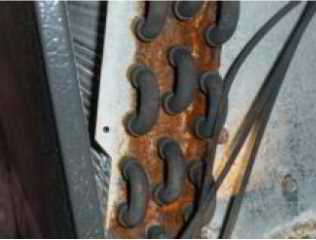
Our page top photo shows a subtle clue that can explain a sulphur odor in buildings: discolored copper piping on the air conditioner cooling coil caused by outgassing from Chinese drywall.
InspectAPedia tolerates no conflicts of interest. We have no relationship with advertisers, products, or services discussed at this website.
Find & Fix Sources of Sulphur Odors or "Rotten Egg Smells" in buildings Include Smells Associated with Chinese Drywall & Other Causes in buildings
 This article series about building odors discusses the diagnosis and cure of odors from a variety of sources including
animals including pets, dogs, cats, or unwanted animals or dead animals, formaldehyde odors in buildings from building products or furnishings, plumbing drains, plastic or vinyl odors from building products, flue gases, oil tanks or oil spills, pesticides,
septic odors, sewer gases, and even abandoned chemicals at properties.
This article series about building odors discusses the diagnosis and cure of odors from a variety of sources including
animals including pets, dogs, cats, or unwanted animals or dead animals, formaldehyde odors in buildings from building products or furnishings, plumbing drains, plastic or vinyl odors from building products, flue gases, oil tanks or oil spills, pesticides,
septic odors, sewer gases, and even abandoned chemicals at properties.
The page top photo of blackened corrosion on an air conditioner cooling coil is from the U.S. CPSC warning to fire safety professionals.
Common Sources of Sulphur Gases & Odors in buildings: Causes of "Rotten Egg" Smells
Sulphur odors in buildings are described also as rotten egg smells or even flatulence smells that generally are associated with the presence of hydrogen sulfide (H2S) gas.
To track down and cure the source of such odors review the list below. Information about the gas itself and links to hydrogen sulfide exposure limits and health effects are given separately
at HYDROGEN SULFIDE GAS.
- Electrical conduit leaks conducting septic tank gas: a reader has reported septic gases following electrical conduit from septic pumping station into the principal building.
See SEAL SEPTIC GAS LEAK THROUGH ELECTRICAL CONDUIT? - Chinese drywall contamination can produce dangerous sulphur gases and rotten egg smells in buildings that have driven people from homes, caused costly damage, and in some cases cause health concerns as well.
- See CHINESE DRYWALL HAZARDS for details about Chinese Drywall problems in U.S. homes.
Chinese Drywall outgassing, particularly in homes where drywall was installed in new construction or in remodeling after 2004, creates rotten egg smells & odors, indoor air quality hazards, corrosive outgassing, health hazards, and damage to copper building components such as copper electrical wiring and plumbing - caused by outgassing from Chinese Drywall used in construction in the U.S. - Some buildings using Chinese drywall do not present a characteristic sulphur odor but may still have corrosion and outgassing problems
- There are multiple possible sources of sulphur gases and sulphur odors in buildings
- Individual sensitivity to odors varies substantially, making odor reports inconsistent, but complaints include headaches, runny noses, and difficulty breathing.
- See CHINESE DRYWALL HAZARDS for details about Chinese Drywall problems in U.S. homes.
- Sulphur odors from well water - see
- DIAGNOSE & REMOVE SULPHUR ODORS
- SULPHUR ODOR REMOVAL in WATER
- WELL WATER CONTAMINANT SOURCES
- More information about causes of and cures for hydrogen sulfide odors in water is
at WATER ODORS.
- Sulphur gases and odors from a failing hot water tank sacrificial anode - see
- Sulphur gases and odors from a bacterial contamination of a hot water tank, often curable by cleaning and shocking the tank interior with chlorine or bleach.
- Sulphur odors from defects in the building drain waste or vent piping
- PLUMBING FIXTURE TRAPS - dry plumbing traps or leaky traps may be an odor source. Drain noises can be a clue to this problem.
We discuss how to diagnose and cure drain sounds
at PLUMBING DRAIN NOISES. - Loose toilets or a faulty toilet base wax ring are discussed
at SEWER GAS ODORS - SEWER GAS ODORS - common sources & causes of sewer gas smells
- SEWER GAS ODORS in COLD / WET WEATHER - tracking down sewer odors that appear mostly in cold or wet weather conditions
- Blocked or improperly installed plumbing vents:
see PLUMBING VENT DEFECTS & NOISES for an explanation of sewer gas leaks from building drain vent piping.
Transite pipe plumbing vents - an cement-asbestos material, can become delaminated and clogged with age, blocking the plumbing vent system.
See TRANSITE ASBESTOS CHIMNEYS, DUCTS, PIPES - See BUILDING DRAIN & SEWER LINE ODORS for the full discussion of odors from building drains & drain piping.
Also see SEPTIC or SEWER PIPING LEAKS for odors from septic systems and sewer lines. - Illustrations of a leaky cast iron sewer line that sent sewer gases into the building's transite (asbestos cement) heating duct system can be seen
at TRANSITE PIPE AIR DUCTS and
at CAST IRON DRAIN PIPING.
Watch out: if the sulphur odors in a building are due to sewer gas backups, dangerous levels of possibly explosive methane gas could be present.
Also, at SEPTIC & CESSPOOL SAFETY we explain that gases produced in a septic tank are dangerous, as a potential source of explosion and as a cause of death by asphyxiation if someone falls into or deliberately enters a septic tank. - PLUMBING FIXTURE TRAPS - dry plumbing traps or leaky traps may be an odor source. Drain noises can be a clue to this problem.
- Sulphur odors from plumbing traps: Sulphur odors or "septic odors" at a kitchen sink may actually be food odors from a garbage disposer that needs cleaning.
- Sulphur odors from a failing or backing-up septic system - see
- See SEPTIC SYSTEM ODOR CURES for the full detailed article on this topic.
- Also see HYDROGEN SULFIDE GAS (H2S)
- SEPTIC SYSTEM ODORS
- Sulphur odors originating outdoors -
see SITE WEATHER or NEIGHBOR'S SEWER ODORS - Dead animals: Other odors mistaken for sulphur odors, such as a dead animal in building walls or crawl spaces. We also mention human flatulence which also can have a sulphur odor but will normally be episodic and brief in duration.
- LP Gas or Natural Gas Leak odors:
Watch Out: some people mistake dangerous, possibly explosive LP gas or natural gas leak odors for sulphur gas or sewer odors.
See GAS PIPING & TANK DEFECTS
In sum, before blaming drywall for building odors, be sure that the smells are not from another detectable source such as sewer gases or a failing hot water tank anode -
...
Continue reading at WATER ODOR DIAGNOSIS - SULPHUR or select a topic from the closely-related articles below, or see the complete ARTICLE INDEX.
Or see SULPHUR ROTTEN EGG SMELL SOURCE FAQs - questions & answers about sulphur or rotten egg smells posted originally at this article.
Or see these
Recommended Articles
- ANIMAL ENTRY POINTS in BUILDINGS
- CHINESE DRYWALL HAZARDS & ODORS
- CONCRETE CORROSION DUE TO HYDROGEN SULFIDE
- GAS DETECTION INSTRUMENTS
- HYDROGEN SULFIDE GAS
- METHANE GAS SOURCES
- PLUMBING SYSTEM ODORS - home: explore this link to track sulphur odors traced to the plumbing system, drains, toilets, vents
- SEPTIC SYSTEM ODORS - home: explore this link to track sulphur odors traced to septic system failures, septic tank trouble, backups
- SEWER GAS ODORS - home: explore articles at this lik to diagnose sources of sewer gases in buildings from all sources
- SULPHUR ODOR REMOVAL in WATER - how to get rid of the smell
- SULPHUR & SEWER GAS SMELL SOURCES - home
- WATER ODORS, CAUSE CURE - home: sulphur odors in the water supply coming from a well or from contamianted hot water heater tanks or similar sources
- WATER POLLUTANT SOURCES
Suggested citation for this web page
SULPHUR & SEWER GAS SMELL SOURCES at InspectApedia.com - online encyclopedia of building & environmental inspection, testing, diagnosis, repair, & problem prevention advice.
Or see this
INDEX to RELATED ARTICLES: ARTICLE INDEX to BUILDING ODOR DIAGNOSIS & CURE
Or use the SEARCH BOX found below to Ask a Question or Search InspectApedia
Ask a Question or Search InspectApedia
Try the search box just below, or if you prefer, post a question or comment in the Comments box below and we will respond promptly.
Search the InspectApedia website
Note: appearance of your Comment below may be delayed: if your comment contains an image, photograph, web link, or text that looks to the software as if it might be a web link, your posting will appear after it has been approved by a moderator. Apologies for the delay.
Only one image can be added per comment but you can post as many comments, and therefore images, as you like.
You will not receive a notification when a response to your question has been posted.
Please bookmark this page to make it easy for you to check back for our response.
Our Comment Box is provided by Countable Web Productions countable.ca
Citations & References
In addition to any citations in the article above, a full list is available on request.
- ASTM E2600 - 08 Standard Practice for Assessment of Vapor Intrusion into Structures on Property Involved in Real Estate Transactions is available from the ASTM at astm.org/Standards/E2600.htm
"This practice is intended for use on a voluntary basis by parties who wish to conduct a VIAOn a parcel of real estate, or more specifically conduct a screening evaluation to determine whether or not there is potential for a VIC, and if so, identify alternatives for further investigation."
The standard goes on to emphasize the uncertainty in testing any site for gases and vapor intrusion. - American Industrial Hygiene Association, 1962. Hydrogen Sulfide. Hygienic Guide Series. Detroit, Michigan.
- Amoore, J.E. and Hautala, E., 1983. Odor as an aid to chemical safety: odor thresholds compared with threshold limit values and volatilities for 214 industrial chemicals in air and water dilution. Journal of Applied Toxicology 3, 272-290.
- Bates, M.N., Garrett, N. and Shoemack, P., 2002. Investigation of health effects of hydrogen sulfide from a geothermal source. Archives of Environmental Health, 57(5): 405-411.
- Gangolli, S. (Ed.), 1999. The Dictionary of Substances and their Effects, 2nd edn. The Royal Society of Chemistry. Cambridge.
- Sax, N.I. and Lewis, R.J., Sr., 1989. Dangerous Properties of Industrial Materials, 7th edn. Van Nostrand Reinhold. New York.
- Snyder, J.W., Safir, E.F., Summerville, G.P. and Middleberg, R.A., 1995. Occupational fatality and persistent neurological sequelae after mass exposure to hydrogen sulfide. American Journal of Emergency Medicine, 13(2): 199-203.
- “Defective Imported Drywall: Don’t Get Nailed by Bogus Tests and Treatments,” (local copy) original source - www.ftc.gov/bcp/edu/pubs/consumer/alerts/alt164.pdf, December 2009.
- EMS Testing Laboratories (a nationwide chain in the U.S.) - see http://www.emsl.com
- "Draft Report on Preliminary Microbiological Assessment of Chinese Drywall", U.S. CPSC, draft report 26 March 2010, - Web Search 08/03/2010, original Source: http://www.cpsc.gov/info/drywall/microbio.pdf
Lori Saltzman, M.S., Director, Division of Health Sciences, U.S. Consumer Product Safety Commission, 4330 East West Highway, Bethesda, MD 20814, Prepared By: Environmental Health & Engineering, Inc., 117 Fourth Avenue, Needham, MA 02494, EH&E Report #16512, March 26, 2010 - "Drywall Flaws: Owners Gain Limited Relief, Chinese Product Forces Many From Homes", Andrew Martin, The New York Times, p. 1, 18 September 2010
- Germano, et al. v. Taishan Gypsum Co. Ltd., et al., case no. 09-6687: Germano Chinese Drywall Lawsuit Case Court Ruling (PDF) - Web Search 06/13/2010 original source: http://www.chinesedrywallprotocol.org/uploads/Germano.pdf
- U.S. CPSC & HUD Executive Summary, Chinese Drywall Hazards, published by the US Consumer Product Safety Commission, and supported by the US CDC (Centers for Disease Control), the U.S. EPA (Environmental Protection Agency), and HUD, the U.S. Department of Housing and Urban Development - original source: http://www.cpsc.gov/info/drywall/execsum0410.pdf
- Chinese Drywall information hosted by the US Consumer Product Safety Commission, and supported by the US CDC (Centers for Disease Control), the U.S. EPA (Environmental Protection Agency), and HUD, the U.S. Department of Housing and Urban Development - http://www.cpsc.gov/info/drywall/index.html
- HUD and CPSC Issue Guidance on Repairing Homes With Problem Drywall, U.S. Department of Housing and Urban Development, Shaun Donovan, Secretary, Office of Public Affairs, Washington, DC 20410 and U.S. Consumer Product Safety Commission, 4330 East West Highway, Bethesda, MD 20814, Friday April 2, 2010, HUD No. 10-068 HUD Contact: Shantae Goodloe, (202) 708-0685 http://www.hud.gov/news and CPSC Media Contact: Patty Davis, (301) 504-7908 http://www.cpsc.gov- see http://www.cpsc.gov/info/drywall/hud10068.html for details
- HUD and CPSC Issue Guidance on Identifying Problem Drywall in Homes, same source as op.cit., - original source: http://www.cpsc.gov/info/drywall/hud10020.html
- FHA-insured families experiencing problems associated with problem drywall may be eligible for assistance to help them rehabilitate their properties. HUD’s Community Development Block Grant (CDBG) Program may also be a resource to help local communities combat the problem.
- "Pay up, US tells drywall makers
Government names chinese firms that sold tainted products", William E Gibson, Paul Owers, Sun Sentinel, 26 May, 2010, Palm Beach County FL edition, p. S8. William E. Gibson wgibson@SunSentinel.com - 202-824-8256. Original source: print edition. Online source (less detail) see http://www.sun-sentinel.com/business/
fl-drywall-report-0526-20100525,0,7022672.story - "U.S. names Chinese drywall brands with worst emissions", Los Angeles Times, 27 May 2010 - Web Search 08/03/2010 Original Source: http://www.latimes.com/business/la-fi-drywall-20100527,0,3260498.story
- "Chinese Drywall Seller Reportedly Aware Of Problem", CBS4 News, May 20, 2010, Web-Seach 08/03/2010 http://cbs4.com/local/Chinese.Drywall.CPSC.2.1565689.html
- [Procedures for] Identification of Homes with Corrosion from Problem [Chinese] Drywall, by the Consumer Product Safety Commission and the Department of Housing and Urban Development, January 28, 2010 - original source: http://www.cpsc.gov/info/drywall/InterimIDGuidance012810.pdf
- US CPSC Form for registering information about a drywall incident You can also report a drywall complaint by calling toll-free at 1-800-638-2772 or by sending an e-mail to info@cpsc.gov
- U.S. CPSC Interim Remediation Guidance for Homes with Corrosion from Problem Drywall - original source: http://www.cpsc.gov/info/drywall/guidance0410.pdf
- CPSC Alert to Fire Safety Professionals - ALERT! Report to CPSC any fires that you suspect are associated with problem drywall - see http://www.cpsc.gov/info/drywall/firesafetyprof.pdf Report problem drywall-related fires to: CPSC’s Rik Khanna at rkhanna@cpsc.gov or 301-504-7546 or Andrew Trotta at atrotta@cpsc.gov or 301-504-7578.
- CPSC Staff Preliminary Evaluation of Drywall Chamber Test Results, Reactive Sulfur Gases1, Michael Babich, Ph.D., Mary Ann Danello, Ph.D., Kristina Hatlelid, Ph.D., M.P.H., Joanna Matheson, Ph.D., Lori Saltzman, M.S., and Treye Thomas, Ph.D. March 2010 - see http://www.cpsc.gov/info/drywall/chamber0310.pdf
- US CPSC Status Update on Chinese Drywall - March 2010 - see http://www.cpsc.gov/info/drywall/mar2010status.pdf
- U.S. Federal Drywall Information Center website - www.drywallresponse.gov
- U.S. Gypsum Corporation, - Web Search 08/03/2010 Quoting from the company's website
We are aware of complaints and lawsuits related to certain wallboard manufactured in China that was imported into Florida in the 2005-2006 timeframe. All of United States Gypsum Company’s wallboard is produced in North America and does not have the problems associated with Chinese made drywall.
U.S. Gypsum also provides information about its use of synethetic gypsum as follows:
Synthetic gypsum has been used to make wallboard in the U.S. for more than 20 years: Since 2000 alone, the U.S. gypsum wallboard manufacturing industry has produced the equivalent of 72,000,000,000 square feet of wallboard made with synthetic gypsum – enough to finish the interior of more than 7,000,000 American homes. Today, all USG SHEETROCK™ brand gypsum wallboard is manufactured using either synthetic gypsum, gypsum mined in North America, or a combination of both.
Synthetic gypsum is identical to mined gypsum: Synthetic gypsum is an environmentally‐friendly product made through a controlled process by which limestone and water are used to “scrub” the emissions from coal‐fired power plants to create the end product calcium sulfate. Calcium sulfate is a high purity mineral identical in chemical composition to mined gypsum. 1 This “scrubbing” process is also called “flue gas desulfurization” (FGD).
The U.S. Environmental Protection Agency encourages the use of synthetic gypsum in making wallboard: In 1993 and again in 2000, the EPA classified synthetic, or FGD, gypsum as a non‐hazardous waste. The EPA encouraged U.S industry to use FGD gypsum to make wallboard, stating that the use is beneficial to “conserve natural resources, reduce disposal costs, and reduce the total amount of waste destined for disposal.”2 The EPA stated, “[w]e support increases in these beneficial uses, such as . . . use in construction products such as wallboard.”3 As recently as 2008, the EPA highlighted on its website a new wallboard plant that was built near a coal‐fired power plant and would use synthetic gypsum made from scrubbing the power plant’s emissions. ...
- web search 08/03/2010, original source http://www.usg.com/documents/corpcom/synthetic-gyp.pdf
- Chinese Drywall information from the Florida state department of Environmental Protection -
http://www.doh.state.fl.us/environment/community/indoor-air/casedefinition.html#presence - help with visual identification of Chinese drywall products. - Chinese Drywall References (from the FL DOH article, these documents can be obtained at www.drywallsymposium.com)
- 1. Alessandroni, M. What's the (Elemental S)tory?). Poster Presentation at Technical Symposium on Corrosive Imported Drywall Nov 5-6, 2009.
- 2. Demott, R., Alessandroni, M., Hayes, H., Freeman, G., Gauthier, T. - Elemental Sulfur and Trace Metal Content in Chinese and Domestic Brands). Poster Presentation at Technical Symposium on Corrosive Imported Drywall Nov 5-6, 2009.
- 3. Salazar, R., Krause, D., Eldredge, C. - Comparison of Methods Utilized by Commercial Laboratories for Analyses of Bulk Drywall Samples. Poster Presentation at Technical Symposium on Corrosive Imported Drywall Nov 5-6, 2009.
- 4. Singhvi, R, Lin, Y., Admassu, G., Syslo, J. Field Analysis of Elemental Sulfur in Drywall by GC/ECD. Poster Presentation at Technical Symposium on Corrosive Imported Drywall Nov 5-6, 2009.
- 5. Spates, W., Rinicker, T., Toburen, T. - Evolution of Chinese Drywall Inspections and Findings Based on Laboratory Data and FDOH Guidelines and the Need to Incorporate New and Productive Inspection Techniques Poster Presentation at Technical Symposium on Corrosive Imported Drywall Nov 5-6, 2009.
- 6. Tuday, M., Chen, K, Cherazaie, H., Fortune, A., Henton, W., Parnell, C, Dangazyan, M., Cornett, C. Measurement of Corrosive, Odorous and Potentially Harmful Gases from Imported and Domestic Wallboard . Oral Presentation at Technical Symposium on Corrosive Imported Drywall Nov 5-6, 2009.
- 7. Tedder, R. Disposal Options for Imported Drywall. Oral Presentation at Technical Symposium on Corrosive Imported Drywall Nov 5-6, 2009.
- 8. Layne, A. EPA’s Activities on Chinese Drywall. Oral Presentation at Technical Symposium on Corrosive Imported Drywall Nov 5-6, 2009.
- Reference (Available at http://www.epa.gov/oswer/docs/chinesedrywall.pdf) (Back to top)
- References (Available at http://www.cpsc.gov/info/drywall) (Back to top)
- 10. Garland, S.E., and Greene, M.A. Statistical Analysis of the Chemical Screening of a Small Sample of Unused Chinese and non-Chinese Drywall – Tab A. Oct 28, 2009.
- 11. Interagency Task Force on Chinese Drywall October 29, 2009 Release of Initial Chinese Drywall Studies – Indoor Air Studies. Tab C. Oct 28, 2009
- 12. EH&E Report 16512 for the CPSC. Draft Final Report on an Indoor Environmental Quality Assessment of Residences Containing Chinese Drywall – 51 home study. Nov 18, 2009.
- Our recommended books about building & mechanical systems design, inspection, problem diagnosis, and repair, and about indoor environment and IAQ testing, diagnosis, and cleanup are at the InspectAPedia Bookstore. Also see our Book Reviews - InspectAPedia.
- ENVIRONMENTAL HEALTH & INVESTIGATION BIBLIOGRAPHY - our own technical library on indoor air quality inspection, testing, laboratory procedures, forensic microscopy, etc.
- In addition to citations & references found in this article, see the research citations given at the end of the related articles found at our suggested
CONTINUE READING or RECOMMENDED ARTICLES.
- Carson, Dunlop & Associates Ltd., 120 Carlton Street Suite 407, Toronto ON M5A 4K2. Tel: (416) 964-9415 1-800-268-7070 Email: info@carsondunlop.com. Alan Carson is a past president of ASHI, the American Society of Home Inspectors.
Thanks to Alan Carson and Bob Dunlop, for permission for InspectAPedia to use text excerpts from The HOME REFERENCE BOOK - the Encyclopedia of Homes and to use illustrations from The ILLUSTRATED HOME .
Carson Dunlop Associates provides extensive home inspection education and report writing material. In gratitude we provide links to tsome Carson Dunlop Associates products and services.
 | HOME | ABOUT | ASK a QUESTION | CONTACT | CONTENT USE POLICY | DESCRIPTION | POLICIES | PRIVACY | |
| © 2024 - 1985 Publisher InspectApedia.com - Daniel Friedman | |||||||||