
InspectAPedia® FREE Encyclopedia of Building & Environmental Construction, Diagnosis, Maintenance & Repair |
Question? Just ask us! InspectAPedia
|
 Guide to Using the TIF 8800 8800X & TIF 8900
Combustible Gas or Heating Flue Gas Detection
- POST a QUESTION or COMMENT and safety advice for using combustible gas detection equipment
How to test for combustible gas or flue gas leaks: This document explains how to use the TIF 8800 combustible gas analyzer and similar equipment, outlining methods used to test for the level of toxic and other gases in buildings and in outdoors.
In related documents we give references and explanation regarding toxicity of several of the most common indoor gases, based on literature search and obtained from the U.S. government and expert sources. We include reference links to many articles that can help diagnose the source of dangerous carbon monoxide in buildings.
InspectAPedia tolerates no conflicts of interest. We have no relationship with advertisers, products, or services discussed at this website.
Guide to Using the TIF 8800 Combustible Gas Detector
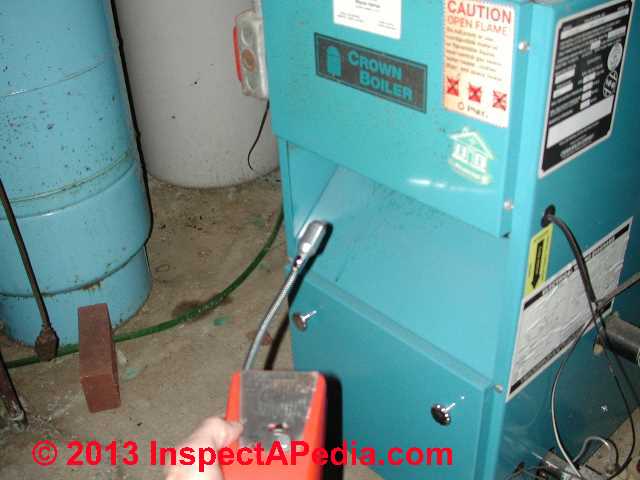 Flue gas detectors and combustible gas analyzers such as the TIF8800 discussed here can add an additional level of testing for dangerous gas leaks, flue gas leaks, and assist in detecting leaky chimneys or unsafe gas or oil fired heat exchangers.
This text may assist readers in understanding these topics. However it should by no means be considered exhaustive.
Article Contents
We include safety warnings about relying on any instrument to detect flue gas leaks, natural gas leaks, LP or propane gas leaks, etc.
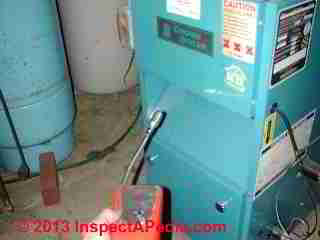
In our photo at left the TIF 8800 combustible gas analyzer is being used to check for flue gas spillage at the built-in draft hood intake at a gas furnace.
Watch out: Seek prompt advice from your doctor or health/safety experts if you have any reason to be concerned about exposure to toxic gases.
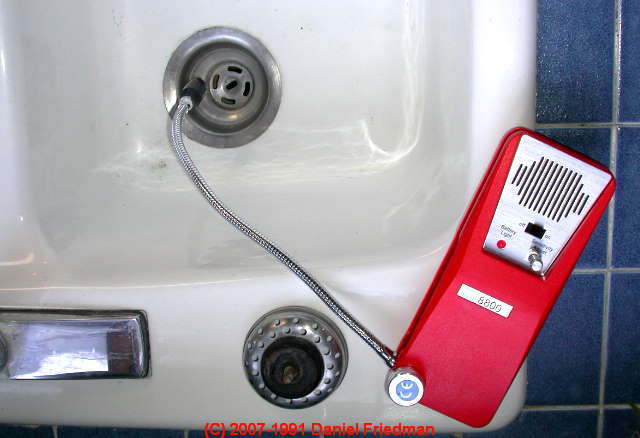 Because it responds to a wide spectrum of hydrocarbons and other gases or chemicals, broad spectrum sensitive instruments such as the TIF8800 must be used with some intelligence.
The photograph at left shows our TIF 8800 combustible gas analyzer being used to sniff for possible sewer gases at an industrial sink.
Just about any building drain at a sink includes a local plumbing trap that will produce low levels of detectable gases.
[Click to enlarge any image]
The TIF 8800 gas detection instrument is very sensitive to a wide range of combustibles and hydrocarbons, and is a quick and reliable way to check for gas leaks at LP or natural gas lines as well as for flue gas spillage.
An audible signal which makes a "geiger-counter"-like ticking noise will speed up as the sensor is moved closer to a leak source.
This permits the user to not only detect that a combustible gas leak is present, but to follow the gas leak concentration to its source.
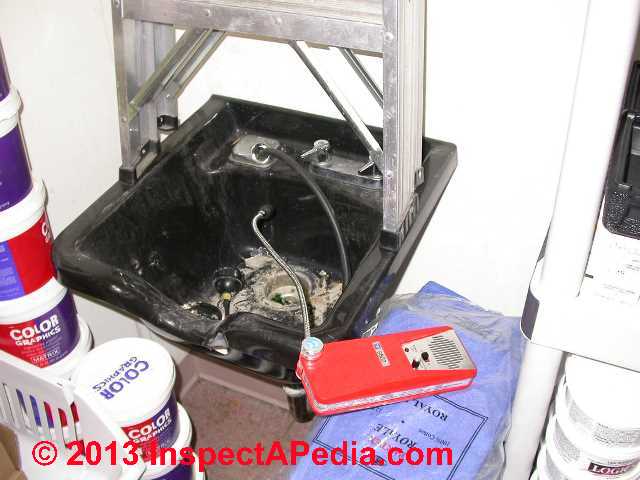
The difficulty of making sense of sensitive gas test instrument readings is illustrated by our photographs just above. Called to track down "chemical odors" in a New York law office we found that all of the offices in a one story building shared a common ceiling plenum through which HVAC return air circulated.

At the opposite end of the building from the law office was a beauty parlor whose chemicals proved to be the odor source. Checking the sink (above left) where chemicals were used gave a strong reaction from our TIF8800, but the main chemical source proved to be a closet in which loosely-capped, leaky, and even spilled chemical bottles were stored (above right).
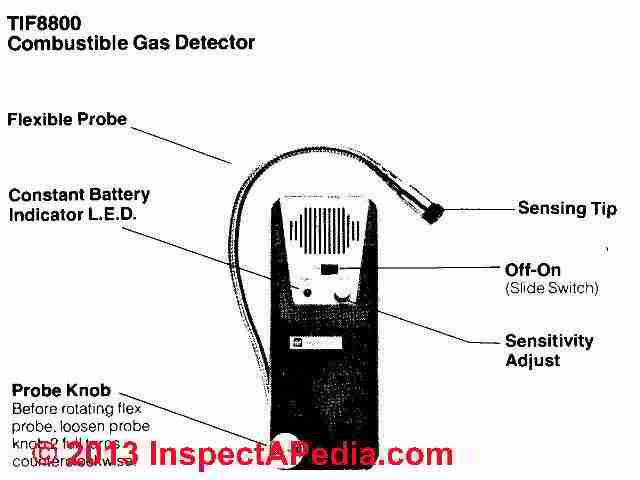 The user can adjust the actual field sensitivity of the instrument using a knob visible at the lower right of the silver control panel in the photograph.
The TIF instrument company rates the instrument as responding to very small traces of combustible gases, from 50 PPM to 1000 PPM.
When checking gas piping for leaks, if the plumber has recently sealed a connection using certain pipe sealants containing aromatic hydrocarbon solvents, this instrument will respond just as if there were a gas leak.
It's a fabulous tool when used with thought, and it has often found gas leaks that were otherwise missed by the soap or match (dangerous) method used by many plumbers.
To maximize the sensitivity of the TIF8800 and thus its ability to detect combustible gas leaks, we recommend turning on the instrument while outside in fresh air (and away from any running automobiles or similar equipment).
Let the instrument stabilize, adjust it for a steady but fairly sensitive beeping tone, then enter the area to be inspected.
TIF 8800 Test procedure To Screen for Flue Gas Spillage or for Combustible LP or Natural Gas
Following a warm up period (electrode in the sensing tip
has to heat up) an adjustable dial sets a tic noise to a steady but
modest rate. The manufacturer says to use a rapid rate - which is
a more sensitive setting.
As the sensing tip is moved into test locations the operator listens for an increase in the tic rate. The faster the tic the higher the concentration of whatever is being detected.
Your breath will make the instrument respond, even if you're sober - because of its humidity. Gas leaks in any serious quantity will promptly change the tic rate to a continuous siren.
If the siren sounds before the leak source can be identified, the air in the area is contaminated with heavy concentrations of gas. The user can desensitize the tip by turning the control knob to a slower tic rate. When looking for small leaks, a high tic rate must be used.
When to make heating furnace plenum measurements for gas leakage
At CO DETECTION OPTIONS we expliain in detail that when using any gas detector tool to test inside of the air plenum of a fossil-fuel fired appliance as a screen for CO or flue gas leakage, a critical test time is before the blower fan has come on. That's because once the fan begins not only is building air in the plenum diluted, the pressurization of air around the heat exchanger may change the direction of a combustion gas leak.
When using the TIF 8800 or similar gas detectors, remember to test the air for combustible gases at various levels or heights
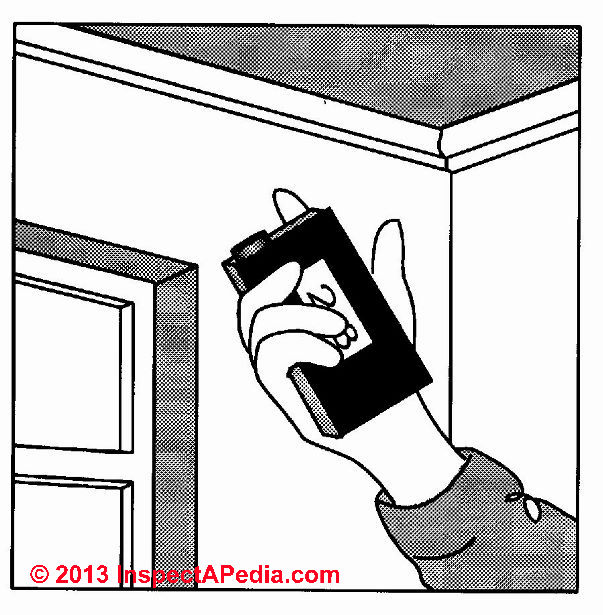
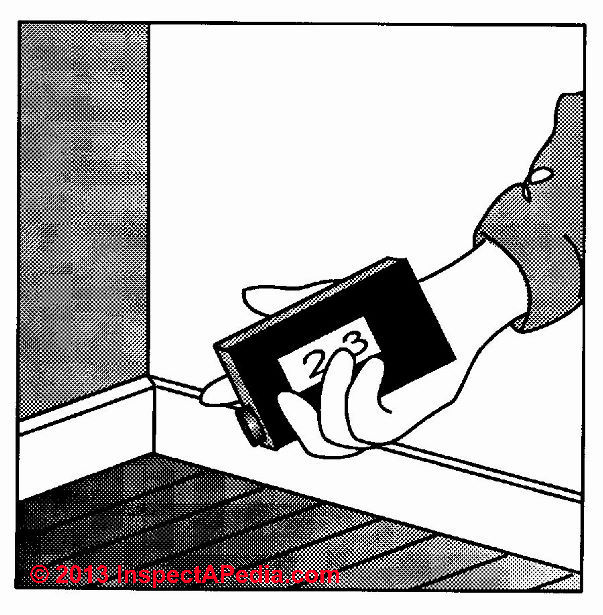
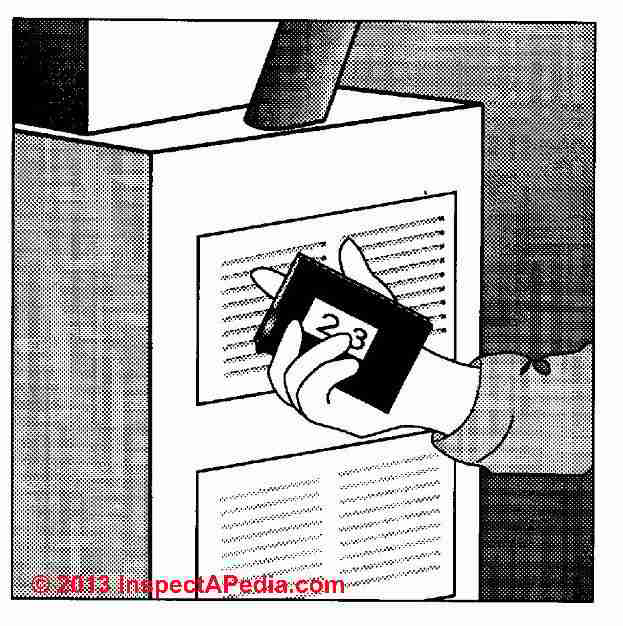 As we illustrate below, test building air at floor, mid-room height, and near the ceiling, since despite the varying weights of gases (such as LP gas and natural gas), a combustible gas or flue gas might be found at an unexpected location.
For example, flue gases that should be heavier than air and should be found accumulating at floor level may in fact be accumulating at ceiling level in a building where they are carried while mixed with other hot or warm combustion air products (which rise by natural convection).
Our sketches illustrate at least three test locations that should be checked when using a CO detector or a Combustible gas detector (like the TIF-8800)at a heating appliance.
We test at the appliance, we test at the floor (heavier-than-air gas mixes including LP gas), and we test near the ceiling (warm air such as leaky flue gas rises). You may find surprising results.
We inspected a property that had suffered an LP gas explosion and damage. An screened porch was enclosed by solid walls in its lower half.
An LP tank stored there was attached to a portable barbecue unit and was leaking.
The property owner opened the kitchen door to access the screened porch whose lower half was filled with LP gas.
When the kitchen door opened and a kitchen light switch was operated, LP gas that had entered the kitchen from the porch exploded.
Also see HEAT EXCHANGER LEAK ALLOWED - separate article
Because the TIF 8800 responds to a very wide range of combustible gases, it is useful in tracking down sewer gas or septic gas odors as well. See these articles where the TIF8800 or TIF8800X are particularly useful:
- SEWER GAS ODORS diagnosing, finding, and curing septic tank and sewer line smells and odors
- BUILDING DRAINS & SEWER LINES - diagnosing odors in buildings coming from leaky sewer lines or drain lines
- SEWER GAS-METHANE and other septic system gas explosion or asphyxiation hazards such as hydrogen sulfide
- ODORS SMELLS GASES - diagnosis and cure of all kinds of odors in buildings
Reader Question: how can I use the TIF 8800 to confirm a suspected gas leak when I smell gas?
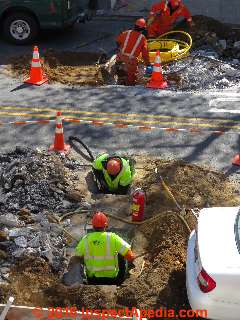 Our photo shows Con Edison workers performing gas line replacement & repair work on Washington Avenue in Brooklyn, NY in April 2015.
I have this detector and it is giving a positive reading near a taped off sprinkler in the ceiling of a closet and also in my HVAC vents near the ceiling... my landlord says this is normal and that the meter is just overly sensitive, but I purchased this because I sometimes smell gas in this closet and sure enough the meter gives a positive as well.
Any suggestions for how I should proceed when I'm being told that everything is fine even when I have a meter reading gas? - Anon. 1/24/2014
Reply:
Anon: Thank you for an excellent question.
Our photo shows Con Edison workers performing gas line replacement & repair work on Washington Avenue in Brooklyn, NY in April 2015.
In June 2015 the National Transportation Board concluded that in 2014 a large explosion in East Harlem in Brooklyn NY that destroyed two five-story buildings and killed eight people was probably caused by a poorly welded joint in a Con Edison gas line and a break in an old city sewer line.
The Tif 8800 is a very very sensitive device. It will "respond" if you simply breathe on the tip when the instrument is on and warmed-up. It will also respond to VOCs emitted by pipe dope, paint, and a very wide range of VOC-emitting substances besides "gas" that you name in your question. In the product literature you can see a list of the types of substances to which the device is sensitive.
You will want to take a look at two companion articles
GAS DETECTOR WARNINGS and
also TIF 8800 FIELD TEST
Now: to demonstrate that the instrument is probably responding to a combustible gas or VOC mixed in air in a building you will want to:
- Turn the instrument on and adjust its sensitivity while still outside the building, in outdoor air, away from other gas sources such as running automobiles or other internal combustion engines, oils, or volatile liquids, gases, paints - that is, in fresh air.
- Enter the building and note if the instrument responds
- Walk towards the test area and note any change in response
- Enter the "closet" of your concern, holding the instrument first at waist level, then at head level and finally about a foot from the ceiling
- Note the instruments's response changes as you bring its sensor near various test points
During these tests do not place the sensor tip closer than a foot from plumbing fittings, HVAC controls, or other components that may have used pipe dope, sealants, or other VOC emitting materials. The object is to be sure we are examining air in the test area, not a local emission from a basically harmless sealant or component.
It is also useful to keep in mind that
if combustion gases are emitted inside a building, say from a leaky chimney, they tend to be more concentrated near the ceiling (warm air rises) even though individual gases may be described as "heavier than air" they may rise to the ceiling because they are not existing in pure state but rather are mixed
Also keep in mind that gases other than combustion fuel (LP or natural gas) can cause the instrument to respond. Examples include
- VOCs from paint
- Sewer gas
- Gases emitted from a solvent spill
- Emissions from pipe sealant or pipe dope
- Flatulence of nearby observers (yes this caused trouble during one of my investigations)
Is it Reasonable to Use the TIF-8800 to Check for Carbon Monoxide Hazards?
Yes and No.
Watch out: the TIF 8800 TIF8800X TIF8900 and some other combustible gas detectors will respond to high levels of Carbon Dioxide CO2, typically over 2000 ppm, but it should not be used as a general CO2 level detection instrument - it's not designed for that use.
In fact I have found that simply exhaling onto or near the sensor tip of my TIF8800 would cause the alarm to sound.
If the instrument responds we don't know just which gas it is responding-to as it is very sensitive to a wide range of hazardous and combustible gases. However, as carbon monoxide released from a heating appliance such as a furnace, boiler, or water heater is being produced by gas (or possibly fuel oil, kerosene, coal or other bio fuel) it is not going to be produced in pure nor isolated form.
Rather the CO (carbon monoxide) will be mixed with leaking or spilling flue gases.
For this reason alone, in our OPINION the detection of abnormal flue gas spillage would be a sufficient indicator of unsafe conditions in a building regardless of the absolute level of carbon monoxide in the mix at that moment.
What the heck is "abnormal flue gas spillage?" Well it's normal for there to be a brief burp or spill of flue gases from many heating appliances at the time of burner start-up and before the chimney has become heated enough to establish full draft. Certainly after a few minutes (five minutes is a reasonable rule of thumb for most residential buildings) there should be no ongoing flue gas spillage at the appliance.
Safety Warnings About Using a Gas Detection Device to Check for Dangerous Flue Gases or Natural Gas / LP / Propane Gas Leaks
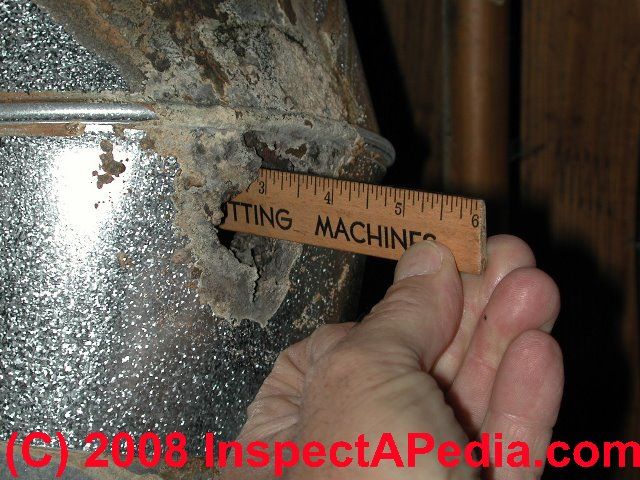 Watch out: Testing for any gas in a building by relying solely on test instruments can be dangerously misleading.
Our photo at left shows a dangerously leaky heating flue - in this case it was visually obvious and no flue gas detection equipment was necessary.
Watch out: when inspecting and testing furnace heat exchangers for leaks, don't forget to look for other flue gas or carbon monoxide leak sources such as shown in our photo at left. Failure to observe a gross safety hazard such as this one risks focusing on the wrong hazard.
False positive gas detection test results
The TIF8800, for example, is a wonderfully sensitive instrument and it can detect very low levels of flue gas or combustible gases.
But it will also respond to other substances that are miscible in air. Just try breathing on the sensing tip when the instrument is set to a sensitive position and you'll get a response, as I explain below in our discussion of CO2 detection.
Watch out: Once while checking a heating system for flue gas spillage my TIF8800 alarm sounded before I approached the heater.
My client, standing nearby, had released personal gas -methane in flatulence will cause the TIF to respond. It was necessary to discreetly ask the client to stand further away while we tested the heating system for gas leaks.
So test instruments work best in the hands of a very experienced building investigator and instrument user.
False negative gas detection results
Any gas detection instrument is vulnerable to variations in building conditions or in the operation of mechanical systems in the building that can temporarily hide the presence of a dangerous gas leak. For example, a leaky heat exchanger in a heating furnace may leak detectable gases into the warm air plenum only until the blower fan comes on.
Changes in building pressures, open or shut windows or doors, fans on or off, and other such variables can completely change the detectable presence of a dangerous gas indoors.
For this reason, if you call a fire department or emergency worker to test a building for the presence of a dangerous gas such as flue gases, leaks in natural or LP or propane gas lines or equipment, or carbon monoxide levels, even if the worker detects no gas leak present at the time of the inspection that is not a guarantee that the building is safe.
What should you do about this gas test reliability problem? Where there are reasons to be concerned about unsafe gas levels in a building, a more thorough building investigation is in order. Such an investigation includes at least
- Taking a history of building related indoor air or safety or gas leak complaints
- A visual inspection of the entire building for possible conditions that could produce or hide a dangerous gas leak, such as the condition of chimneys, vents, heating equipment and appliances as well as building fans and ventilation systems.
- Tests for the presence of leaking chimneys, flues, appliances, gas piping etc. These may include introducing of a tracer gas into heating equipment to test for leaks in a heat exchanger or flue.
Readers should see GAS DETECTOR WARNINGS for additional recommendations.
Where to Buy the Tif 8800, 8800A, or 8850 Combustible Gas Analyzer or Where to Get Your Instrument Repaired
 (Oct 9, 2011) Anonymous said: where to get it repaired?
Reply: Anon when my TIF instrument needed repairs I contacted TIF Instruments and then arranged to send it to them for repair work - the results were fine.
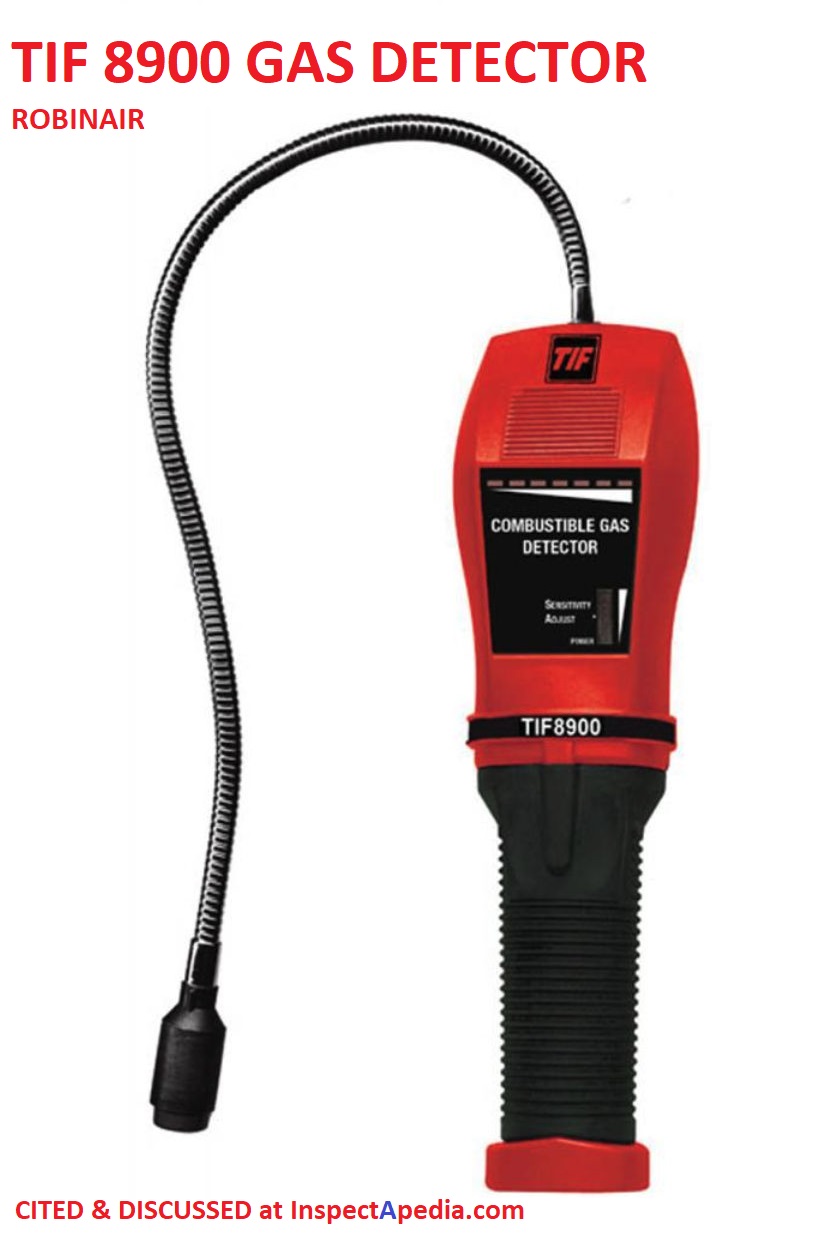
Photos: a TIF 8800X Gas Leak Detector as sold by online vendors in January 2020, for abour $200. USD. and the TIF8900 Combustible Gas Detector, about $260, both from Robinair®.
- TIF 8800X COMBUSTIBLE GAS DETECTOR MANUAL [PDF] (2010) SPX Service Solutions, 655 Eisenhower Drive,
Owatonna, MN 55060-0995 USA Tel: 800 327 5060 Website: www.tif.com - this link forwards to www.robinair.com who specializes in portable gas recovery units and accesories for HVACR systems.
This manual is available in Spanish and French at the company's website given below. - Robinair, TIF8800X COMBUSTIBLE GAS DETECTDOR PRODUCT DATA SHET [PDF] Robinair, 655 Eisenhower Drive, Owatonna, MN 55060 USA Tel: 800-327-5060 Web: www.robinair.com Email: RobinairHVACsales@spx.com, retrieved 2010/01/02, original source: https://www.robinair.com/products/combustible-gas-detector-0, "Certifications | UL913 7th Edition (user class I, II, or III Division I hazardous locations.)"
- TIF 8900 COMBUSTIBLE GAS DETECTOR MANUAL [PDF] SPX ATP Miramar, FL Phone: 954-499-5400 • Fax: 954-499-5454 1-800-327-5060 www.TIF.com
- TIF Instruments, Inc., 9101 NW 7th Avenue, Miami, Florida 33150 - note that a different address, more-current is shown just above.
TIF instruments and other gas detection equipment are also sold by home inspection tool and equipment suppliers, plumbing and heating suppliers, and test equipment suppliers in most countries of the world. Examples include
- Advance Auto Parts - Website: http://shop.advanceautoparts.com
- Amazon.com
- Ebay
- Test Equipment Depot - Fotronic Corporation 99 Washington Street Melrose, MA 02176-6024 Phone: 781.665.1400 / 800.517.8431 Fax: 781.665.0780 Email: Sales Department, Website: http://www.testequipmentdepot.com
- Testers & Tools, Tel: 602-795-4033, Website: http://www.testersandtools.com Email: sales@testersandtools.com
- Truetech Tools: website: www.truetechtools.com
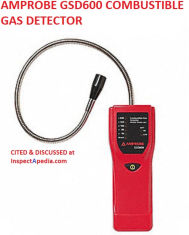 Similar Gas Detection Instruments
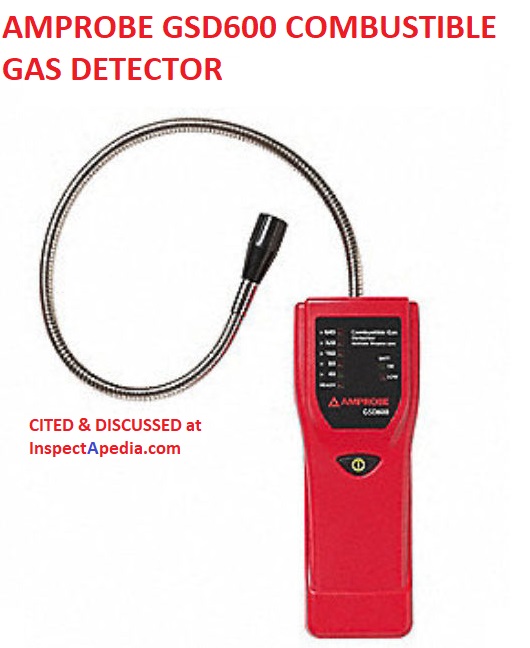
By January 2020 the TIF8800 was no longer the chief option for a simple, broad-spectrum combustible gas detection screening instrument. Grainger.com alone listed more than forty different combustible gas leak detection instruments. Examples include:
- Amprobe Combustible Gas Detector, Model GSD600 available from various vendors including grainger.com $2130. USD.
- General Methane & Natural Gas Detector, Model NGD8800 available from various vendors including grainger.com $240. USD.
- Test Products International, Gas Detector, model 721, 0 - 9999 ppm or 0 to 19.9% LEL (Lethal Exposure Level), available from various vendors including grainger.com $340. USD.
Reader Comments, Questions & Answers About The Article Above
Below you will find questions and answers previously posted on this page at its page bottom reader comment box.
Reader Q&A - also see RECOMMENDED ARTICLES & FAQs
On 2020-01-03 by stack
stack gas analyzer said:
Thanks for having this article, it helps a lot. It’s a well-written blog and it is very informative. Keep on blogging, looking forward to see more of your posts
On 2020-01-03 by (mod) - Calibrating the TIF8800 TIF8800X TIF8900: test that the device is working properly
Mr. Barrientos
No you do not need to calibrate the TIF8800 "quantitatively" in order to make use of the instrument, but as we note below you do need to go through a "calibration" procedure to be sure that the instrument is working properly.
First about quantitative calibration: consider that the TIF 8800 responds to a very wide range of gases, detecting the presence of gases down to very low levels, as low as 1 ppm for gasoline, or down to 5 ppm for the TIF8900, but these gas detectors are NOT a quantitative instrument in their reporting.
The TIF 8800's adjustment dial varies the sensitivity of the instrument, but again, not against a numeric or quantitative scale, so frankly in my opinion calibration doesn't make sense.
Watch out: however it is absolutely essential to test the TIF8800, TIF8800X and TIF8900 using a known gas source to be sure that it is working before using the instrument to check for gas leaks, since a malfunction or failure to use the instrument properly could contribute to explosion, injury, or death. Our standard practice is to confirm that the instrument is working properly by exposing it to a known gas source such as
To "calibrate" the TIF you should do the following:
- Turn on the TIF or other Gas Detection unit, fully charged, in a non-contaminated area of fresh air. Adjust the instrument to mid sensitivity. It should not be ticking or making an alarm sound.
Watch out: Beware of simply stepping outdoors if you are going to be standing by a busy highway or a truck exhaust or an area where there may be widespread gas leakage already present. That's because the TIF responds to a change in gas level contrasting with what it senses when first turned on. - Test the unit's response by exposing it to a know gas source. Turn up the instrument's sensitivty knob and you should hear an increasingly-rapid ticking. At very high exposure the instrument may make a whining or siren noise.
If the gas detector does not respond then the sensor tip is probably defective.
We use
- flue gases in a gas fired heating system
- LP or natural gas at a stove burner - Leaving the response-test gas source the instrument should stop signaling that a gas was detected.
- Now approach the test area or test connection to check for a response. The closer you get to a gas source the more-rapid will be the ticking noise.
Watch out: if on entering an area the ticking is very rapid or makes a whining or siren noise then it is very possible that you are in a highly-contaminated area; you may be able to turn down the sensitivity knob to permit identification of the leak source. - In life-critical situations we may also re-test the instrument's response again against a known gas source to be sure it's still working.
Carry a spare sensor tip. If the sensor on the end of the TIF becomes contaminated it's sensitivity is impaired.
If the instrument does not respond then replace the sensor tip, make sure the instrument is fully charged (battery power) and try again.
Also note that the TIF 8800X unit is designed to operate within this temperature range: 32˚F to 125˚F (0˚C to 52˚C)
Finally - well it's never really final - instructions for the modern TIF 8800X (given above on this page) do not include the word "calibration" in that document.
Other TIF instruments such as the (refrigerant) halogen gas leak detector were sold with a small vial of odorant that indeed could be used to check the function or sensitivity of the instrument.
On 2019-07-10 by F. Barrientos - Does the Tif 8800 require calibration?
Does the Tif 8800 require calibration?
On 2017-07-07 by (mod) -
The TIF instrument company rates the instrument as responding to very small traces of combustible gases, from 50 PPM to 1000 PPM.
More-recent literature, varying by gas detector model, reports sensitivity to SOME gases down to 1 ppm.
You have to consider that the response of the instrument to the presence of a combustible gas is going to vary considerably depending on how you use it and where the gas is located. Some examples of those variables are in the article above
On 2017-07-06 by Beth
Please can you help me to determine the sensitivity to methane and natural gas for Tif 8800
On 2017-05-13 by (mod) -
Kathryn
TIF Instruments, Inc., 9101 NW 7th Avenue, Miami, Florida 33150
TIF instruments and other gas detection equipment are also sold by home inspection tool and equipment suppliers, plumbing and heating suppliers, and test equipment suppliers in most countries of the world. Examples include
Advance Auto Parts - Website: http://shop.advanceautoparts.com
Amazon.com
Ebay
Test Equipment Depot - Fotronic Corporation 99 Washington Street Melrose, MA 02176-6024 Phone: 781.665.1400 / 800.517.8431 Fax: 781.665.0780 Email: Sales Department, Website: http://www.testequipmentdepot.com
Testers & Tools, Tel: 602-795-4033, Website: http://www.testersandtools.com Email: sales@testersandtools.com
On 2017-05-13 02:28:39.254952 by Kathryn
How does one get a hold of the tester for the gas odors?
On 2016-11-22 by Teresa
I have had this horrible sewage smell in my bathroom and the smell goes into adjoining closets such as the linin closet and my bedroom closet.
My son and I are also getting hradaches as well as nauseous and vomiting!
Any ideas as I have told the office the said they are putting in a work order and no one comes to look at it.
I also have two therapy dogs in the home that seem to be getting lethargic.
Please advise me as to what I should do?
Thank you for your help.
On 2016-11-17 by (mod) -
There are numerous online vendors selling the TIF 8800 and similar models. I'd do a web search for "Buy TIF 8800" or TIF8800A and find one who will accept your payment and ship to you in Lebanon. You may find the product listed now a Robinair brand. Robinair-Email: orders@service-solutions.com or send them an email and ask who distributes their products in the Middle East. The company can provide a list of vendors in several countries.
Or try contacting Robinair's distributor right in Lebanon
CASTOR TRADING S.A.L. DORA TRADE CENTER, DORA HIGHWAY 009611254444 009611244441 n.saad@castortrading.com Najib S. Saad
and let me know if they could help you.
On 2016-11-17 by (mod) -
RE-Posting
This is [anon by private email] from Lebanon. I am writing to you regarding the TIF 8800. I am interested to buy one of this product., Please advise the best way to procure it and how can we move forward.
Question:
(Jan 24, 2014) Anonymous said:
I have this detector and it is giving a positive reading near a taped off sprinkler in the ceiling of a closet and also in my HVAC vents near the ceiling... my landlord says this is normal and that the meter is just overly sensitive, but I purchased this because I sometimes smell gas in this closet and sure enough the meter gives a positive as well. Any suggestions for how I should proceed when I'm being told that everything is fine even when I have a meter reading gas?
Reply:
Anon, thank you for the question; I've posted a detailed answer in the FAQs section at the bottom of the article just above. Let us know if you have further questions and let us know what you find.
Question: using a combustable gas leak detector (UEi CD100A)
(Aug 23, 2014) Ken said:
I'm using a combustable gas leak detector (UEi CD100A) to help track down the source of odors/a possible gas. I understand that other procedures also need to be used. After calibrating the detector outside to several clicks per second, I walk down the stairs to the basement.
The rate of the clicks double at the bottom of the stairs, are 3 to 4 times the calibrated rate along the baseboard of an outside basement wall, very fast (but not a siren) in a closet ceiling (near electrical conduit - I think) and highest through the opening of a sump pump cover (the water in the sump pump has some vegetation/debris but is otherwise clear).
Is the detector most probably just detecting water vapor (e.g. water seeping up from the foundation by the base board) or a gas that could be of concern.
Reply
Ken, the UEi CD100A combustible gas detector is, similarly to the TIF 8800 discussed here, responsive to a wide range of gases including
- Acetone
- Industrial Solvents
- Alcohol
- Jet Fuel
- Ammonia
- Lacquer Thinners
- Benzene
- Methane
- Butane
- Naphtha
- Ethylene Oxide
- Natural Gas
- Gasoline-Petrol
- Propane - LP gas
- Halon Refrigerants
- Hydrogen Sulfide and finally,
- Toluene.
Some of these instruments will thus respond even to human breath, to airborne dust, to pipe dope, or in the case you describe, decaying vegetation, algae, methane, sewage gas, even maybe water vapor.
The company includes this instrument usage advice that might help in the case you describe:
The audible tic increases in volume when exposed to gases with 50 parts per million or more.
When gas is detected, the tic r ate will increase, rotate the thumbwheel back to the steady tic, resetting the instrument to this new background level. Move the instrument into higher concentrations of gas (indic ated by increase tic rate) until the leak is found.
I'd consider where the instrument was responding, its response level, its response to similar mechanical system components in the same building, the presence of obvious emitters that might trigger it, its response at different room elevations, in fresh air, and I'd inspect visually closely any area where I see a response.
If there were a leak in a gas pipe you would usually find the instrument response soars significantly when you get close to the leak point (or to a pipe joint with VOC-emitting compounds); most but not all such leaks can be confirmed with a soap solution.
Keep us posted
Daniel
Question:
(Dec 12, 2014) Richard Bowen said:
tif 8800 lost manual, how do the batteries get installed?
Reply:
Richard
This unit has a large recessed screw in a panel on the back side of the device. Opening that screw permits removing of the panel cover to expose the factory's rechargable battery pack.
...
Continue reading at TIF 8800 FIELD TEST or select a topic from the closely-related articles below, or see the complete ARTICLE INDEX.
Or see these
Recommended Articles
- HEAT EXCHANGER LEAK TEST
- GAS DETECTION INSTRUMENTS - guide to toxic gas measurement instruments
- GAS DETECTOR WARNINGS
- GAS EXPOSURE EFFECTS, TOXIC
- GAS EXPOSURE LIMITS & STANDARDS
- GAS EXPOSURE SCREENING TEST
- GAS LEAK DETECTION, LP / NG
- HEAT EXCHANGER LEAK TEST
- TIF 8800 FIELD TEST
- TIF 8800 GAS DETECTOR
Suggested citation for this web page
TIF 8800 GAS DETECTOR at InspectApedia.com - online encyclopedia of building & environmental inspection, testing, diagnosis, repair, & problem prevention advice.
Or see this
INDEX to RELATED ARTICLES: ARTICLE INDEX to GAS HAZARDS in BUILDINGS
Or use the SEARCH BOX found below to Ask a Question or Search InspectApedia
Ask a Question or Search InspectApedia
Try the search box just below, or if you prefer, post a question or comment in the Comments box below and we will respond promptly.
Search the InspectApedia website
Note: appearance of your Comment below may be delayed: if your comment contains an image, photograph, web link, or text that looks to the software as if it might be a web link, your posting will appear after it has been approved by a moderator. Apologies for the delay.
Only one image can be added per comment but you can post as many comments, and therefore images, as you like.
You will not receive a notification when a response to your question has been posted.
Please bookmark this page to make it easy for you to check back for our response.
Our Comment Box is provided by Countable Web Productions countable.ca
Citations & References
In addition to any citations in the article above, a full list is available on request.
- Roger Hankey is principal of Hankey and Brown Inspections, Winter Park, CO. Mr. Hankey is a past chairman of the ASHI Standards Committee and served in other ASHI chapter and national leadership roles. Mr. Hankey is a National Radon Proficiency Program certified measurement professional and a Level II infrared thermographer. Contact Roger Hankey at: 970-393-6604 - rogerhankey47@gmail.com . Website: www.HankeyandBrown.com Mr. Hankey is a frequent contributor to InspectAPedia.com.
- In addition to citations & references found in this article, see the research citations given at the end of the related articles found at our suggested
CONTINUE READING or RECOMMENDED ARTICLES.
- Carson, Dunlop & Associates Ltd., 120 Carlton Street Suite 407, Toronto ON M5A 4K2. Tel: (416) 964-9415 1-800-268-7070 Email: info@carsondunlop.com. Alan Carson is a past president of ASHI, the American Society of Home Inspectors.
Thanks to Alan Carson and Bob Dunlop, for permission for InspectAPedia to use text excerpts from The HOME REFERENCE BOOK - the Encyclopedia of Homes and to use illustrations from The ILLUSTRATED HOME .
Carson Dunlop Associates provides extensive home inspection education and report writing material. In gratitude we provide links to tsome Carson Dunlop Associates products and services.
 | HOME | ABOUT | ASK a QUESTION | CONTACT | CONTENT USE POLICY | DESCRIPTION | POLICIES | PRIVACY | |
| © 2024 - 1985 Publisher InspectApedia.com - Daniel Friedman | |||||||||